Loading...
news
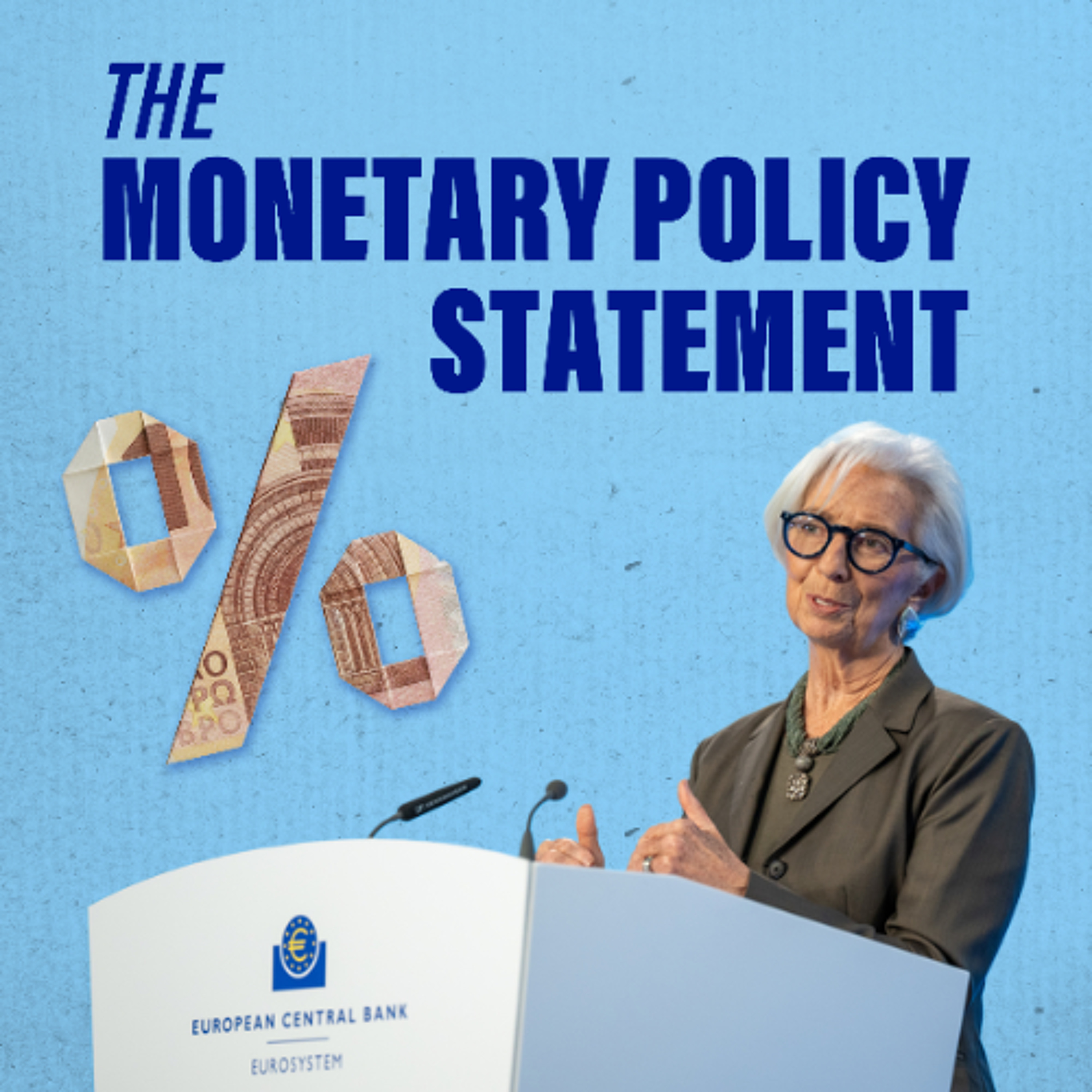
President Lagarde presents the latest monetary policy decisions – 19 March 2026
About this Episode
Today our Governing Council decided on monetary policy.
Listen to President Christine Lagarde present today’s decisions. The statement also covers:
• how the economy is performing
• how we expect prices to develop
• the risks to the economic outlook
• the dynamics behind financial and monetary conditions
Published and recorded during our press conference on 19 March 2026.
Our monetary policy statement at a glance, 19 March 2026 https://www.ecb.europa.eu/press/press_conference/visual-mps/2026/html/mopo_statement_explained_march.en.html
Christine Lagarde, Luis de Guindos: Monetary policy statement, 19 March 2026 https://www.ecb.europa.eu/press/press_conference/monetary-policy-statement/2026/html/ecb.is260319~93b1cbad97.en.html
Monetary policy decisions, 19 March 2026 https://www.ecb.europa.eu/press/pr/date/2026/html/ecb.mp260319~3057739775.en.html
Combined monetary policy decisions and statement, 19 March 2026 https://www.ecb.europa.eu/press/press_conference/monetary-policy-statement/shared/pdf/ecb.ds260319~30247d385d.en.pdf
Macroeconomic projections, 19 March 2026 https://www.ecb.europa.eu/press/projections/html/ecb.projections202603_eurosystemstaff~da4f97a747.en.html
European Central Bank
https://www.ecb.europa.eu/home/html/index.en.html


Transcript
Today, the European Central Bank's governing council took its latest monetary policy decisions.
In this episode, you'll hear President Christine Lagarde deliver the monetary policy statement
from the press conference, where she explains the decisions.
You're listening to Euro matters.
The European Central Bank podcast today is Thursday the 19th of March 2026.
Here is the monetary policy statement.
The governing council today decided to keep the three key ECB interest rates unchanged.
We are determined to ensure that inflation stabilizes at our 2% target in the medium term.
The war in the Middle East has made the outlook significantly more uncertain, creating
upside risks for inflation and downside risk for economic growth.
It will have a material impact on near-term inflation through higher energy prices.
Its medium-term implications will depend both on the intensity and duration of the conflict
and how the energy prices affect consumer prices in the economy.
We are well positioned to navigate this uncertainty.
Britain has been at around 2% target.
Longer term inflation expectations are well anchored and the economy has shown resilience
over recent quarters.
The incoming information in the period ahead will help us assess how the war will affect
the inflation outlook and the risks surrounding it.
We are closely monitoring the situation and our data-dependent approach will help us set
monetary policy as appropriate.
The new ECB staff projections, exceptionally, incorporate information up to the 11th of March,
a later cutoff date than usual.
In the baseline, headline inflation is seen to average 2.6% in 2026, 2% in 2027 and 2.1%
in 2028.
Inflation has been revised up compared with the December projections, especially for 26.
And this is because energy prices will be higher owing to the war in the Middle East.
For inflation excluding energy and food, staff projects an average of 2.3% in 26, 2.2% in
27 and 2.1% in 28.
This is also higher than the December projections, mainly owing to higher energy prices feeding
into inflation excluding energy and food.
Staff expect economic growth to average 0.9% in 26, 1.3% in 27 and 1.4% in 28.
This implies a downward revision, especially for 26, reflecting the global effects of
the war on commodity markets, real incomes and confidence.
At the same time, low unemployment, solid private sector balance sheets and public spending
on defence and infrastructure should continue to underpin growth.
In line with our monetary policy strategy commitment to incorporate risks and uncertainty
into our decision making, staff also assessed how the war in the Middle East could affect
economic growth and inflation under some alternative illustrative scenarios.
These scenarios will be published with the staff projections on our website.
The scenario analysis suggests that a prolonged disruption in the supply of oil and gas would
result in inflation being above and growth being below the baseline projection.
The implications for medium-term inflation depend crucially on the magnitude of indirect
and second-round effects of a stronger and more persistent energy shock.
We will follow a data dependent and meeting-by-meeting approach to determining the appropriate
monetary policy stance.
In particular, our interest rate decisions will be based on our assessment of the inflation
outlook and the risks surrounding it in light of the incoming economic and financial
data, as well as the dynamics of underlying inflation and the strength of monetary policy
transmission.
We are not pre-committing to a particular rate path.
The decisions taken today are set out in a press release available on our website.
So I will now outline in more detail how we see the economy and inflation developing and
will then explain our assessment of financial and monetary conditions.
Starting at the economic activity, the economy grew by 0.2 percent in the fourth quarter
of 2025, driven by stronger domestic demand.
Households increased their spending as real income rose and unemployment remained close
to its historical low.
Construction and housing renovation strengthened and firms invested more, particularly in areas
such as research and development, software and databases.
Growth was no longer weighed down by net exports as it had been in the previous two quarters.
It was underpinned mainly by services.
Staff still see private consumption as the main driver of growth over the medium term.
And should also continue to grow with governments spending more on defense and on infrastructure
and firms increasingly investing in new digital technologies.
The external environment remains challenging, including in light of volatile global trade
policies.
The war, in the Middle East, is disrupting commodity markets and weighing on real incomes
and confidence.
This has led to a downward revision of consumption and investment in the baseline staff projections,
especially for 2026.
The impact would be even more pronounced in alternative scenarios with the most severe
and prolonged energy shock.
The governing council highlights the urgent need to strengthen the euro-area economy while
maintaining sound public finances.
Any fiscal responses to the energy price shock should be temporary, targeted and tailored.
The current energy crisis underscores the imperative to further reduce dependence on fossil
fuels.
Completing the savings and investments union is vital to fund innovation and support
the green and digital transitions.
The digital euro and tokenized wholesale central bank money will enhance Europe's strategy
autonomy, competitiveness and financial integration and will boost innovation in payments.
It is thus essential to swiftly adopt the regulation on the establishment of the digital
euro.
Simplifying and harmonizing rules across the EU's single market will help European firms
grow faster.
Looking now at inflation, inflation rose to 1.9% in February from 1.7% in January.
Energy prices were 3.1% lower than a year ago after having been 4% lower in January.
Food price inflation had down to 2.5%.
Inflation excluding energy and food increased to 2.4% in February from 2.2% in January.
The increase reflected goods inflation rising to 0.7% from 0.4% and services inflation
moving up to 3.4% from 3.2%.
Indicators of underlying inflation have changed little over recent months and remain consistent
with our 2% medium-term target.
Product profits recovered further in the fourth quarter of 25 while unit labour costs
rose at a similar rate as in the previous quarter.
Growth in compensation per employee slowed to 3.7% from 4% in the third quarter.
Negotiated wage growth and forward-looking indicators such as the ECB wage tracker
and surveys on wage expectations suggest that labour costs will ease further in the
course of 2026 which should support the return of inflation to target.
The increase in energy prices caused by the war will drive inflation above 2% in the
near term.
If persistent higher energy prices may lead to a broader increase in inflation through
indirect and second-run effects, the situation which requires close monitoring, inflation
expectations in the financial markets have moved up significantly over shorter horizons.
Most measures of longer-term inflation expectations stand at around 2% supporting the stabilization
of inflation around our target.
Let us now turn to our risk assessment.
The risks to the growth outlook are tilted to the downside, especially in the near term.
The war in the Middle East is a downside risk to the Euro-area economy adding to the volatile
global policy environment.
A prolonged war could increase energy prices further and for longer than currently expected
and also weigh on confidence.
These factors would erode incomes and make firms and households more reluctant to invest
and spend.
A worsening of global financial markets sentiment could further dampen demand.
Additional frictions in international trade could disrupt supply chains, reduce exports,
and weaken consumption and investment.
Other geopolitical tensions, in particular, Russia's unjustified war against Ukraine,
remain a major source of uncertainty.
By contrast, growth could turn out to be higher if the economic repercussions of the
war in the Middle East proved to be more short-lived than currently expected.
In addition, planned defence and infrastructure spending reforms to enhance productivity
and Euro-area firms adopting new technologies may drive up growth by more than expected.
New trade agreements and a deeper integration of the single market could also boost growth
beyond current expectations.
The risks to the inflation outlook are tilted to the upside, especially in the near term.
A prolonged war in the Middle East could lead to a larger and longer-lasting upward
shift in energy prices than currently expected, raising Euro-area inflation further.
This could be reinforced and become more persistent if inflation expectations and wage growth
were to rise in response if the energy price increase were to spill over to non-energy
inflation to a larger extent than assumed in the baseline or if the war disrupted global
supply chains more broadly.
Ongoing trade tensions could also give rise to more fragmented global supply chains,
curtail the supply of critical raw materials and tighten capacity constraints in the
Euro-area economy.
By contrast, inflation could turn out to be lower if the economic repercussions of the
war in the Middle East proved to be more short-lived or if indirect and second-round effects
proved less pronounced than currently expected.
inflation could also be lower if tariffs reduced demand for Euro-area exports by more
than expected and if countries with overcapacity increased further the exports to the Euro-area.
More volatile and risk-averse financial markets could weigh on demand and thereby lower inflation
as well.
Looking at the financial and monetary conditions, the war in the Middle East has had a pronounced
impact on global financial markets.
Overall financial conditions have tightened since our last meeting, stock markets have fallen
and market interest rates in the Euro-area, especially short-term rates, have reason notably.
In January, bank lending rates for firms and the cost of issuing market-based debt both
remained at 3.6 percent, while the average interest rate on new mortgages edged up to
3.4 percent.
Bank lending to firms grew by 2.8 percent on a yearly basis in January, done from 3 percent
in December.
However, this was offset by stronger issuance of corporate bonds with the annual growth rate
rising to 4 percent from 3.5 percent in December.
Mortgage lending grew by 3 percent and changed from December.
So in conclusion, the governing council today decided to keep the three key ECB interest rates
unchanged. We are determined to ensure that inflation stabilizes at our 2 percent target in
the medium term. We will follow a data dependent and meeting-by-meeting approach to determining
the appropriate monetary policy stones. Our interest rate decisions will be based on our
assessment of the inflation outlook and the risks surrounding it in light of the incoming
economic and financial data, as well as the dynamics of underlying inflation and the strength
of monetary policy transmission. We are not precommitting to a particular rate path.
In any case, we stand ready to adjust all of our instruments within our mandate
to ensure that inflation stabilizes sustainably at our medium term target and to preserve
the smooth functioning of monetary policy transmission.
That was President Christine Lagarde presenting the ECB's monetary policy decisions.
To hear more from Euro matters, make sure to subscribe. Every first and third Tuesday of the
months, we unpack the stories, ideas and decisions shaping Europe's economy and bring you fresh
perspectives from the people at the heart of it all. The next podcast on the monetary policy
statement will be published on the 30th of April 2026. In the spirit of Europe, I'd like to end in
Hungarian and say, Vislat, until next time. Thanks for listening.