President Trump is trying to change how elections are run. Where do things stand?
About this episode
Consider This from NPR is made possible by:
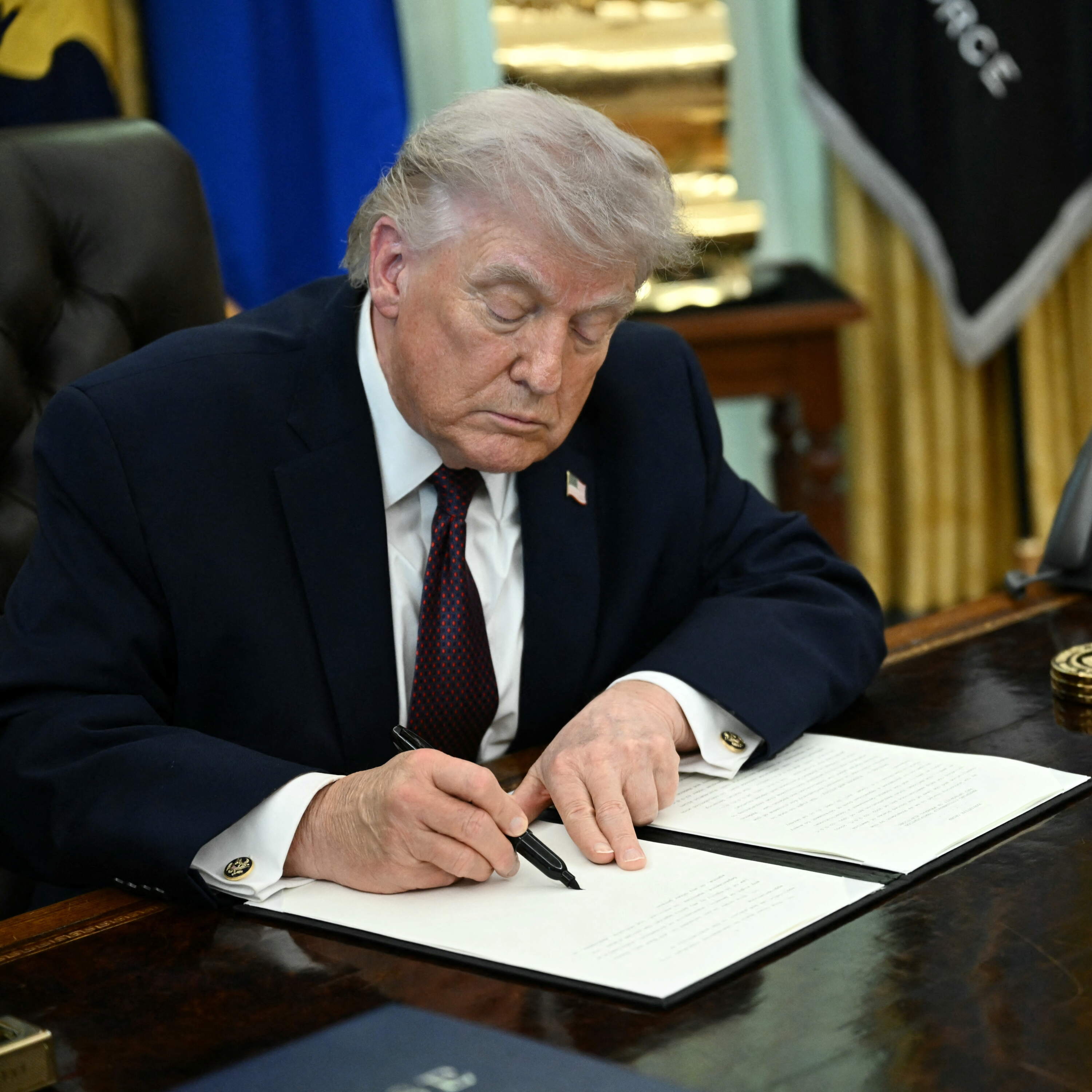
This includes signing two executive orders: One is aimed at new registration requirements, the other at voting by mail. Both are being challenged in court.
With midterm elections fast approaching, where do things stand?
This episode was produced by Alejandra Marquez Janse, with audio engineering by Ted Mebane and Kwesi Lee.
Our director is Jonas Adams.
It was edited by Kelsey Snell, Tinbete Ermyas, and Christopher Intagliata.
Our interim executive producer is Courtney Dorning.
Support public media with NPR+ and enjoy perks for over 25 podcasts like this one. This show’s perks include bonus episodes and sponsor-free listening. Learn more at plus.npr.org.
See pcm.adswizz.com for information about our collection and use of personal data for sponsorship and to manage your podcast sponsorship preferences.
NPR Privacy Policy
Get every episode summarized
Each time Consider This from NPR publishes, we email you a written briefing from the transcript — the topics, who appeared, and any specific claims, with the ad reads skipped.
Email me new episodesFree for 3 shows. No card needed.
Hosts & guests

Transcript ready
184 searchable segments. Every word is indexed and playable.
Full transcript
Consider This from NPR — President Trump is trying to change how elections are run. Where do things stand?. Machine-transcribed; use the interactive transcript above to jump the player to any line.
It's considered this, where every day we go deep on one big new story. Today, President Trump is trying to change how elections are run. One way is by attacking voting by mail. And hopefully there will be no corrupt mail-in ballots, which if you watched California and so many other places, mail-in ballots are inherently corrupt. That's Trump speaking during a prime time address in July. The president has long repeated baseless claims about election fraud. The spring he signed an executive order seeking to restrict mail-in voting. The order has been blocked as it makes its way through the courts. Meanwhile, state election officials who are in charge of running elections are preparing for November's midterms. I do not see any competent way that the federal government and the United States Postal Service are going to be able to do what they want to do in a very short period of time. Nevada Secretary of State Cisco Aguilar speaking to NPR this week. What we're asking voters to do is make a plan. If you're going to use mail-bellets, mail them a week before election day.
If you're going to use a mail-bellet and wait closer to election day, take it to a polling location and drop it off in a drop box so that we know it's in the possession of the county so that it can get processed in time and it can get counted. Consider this. The Trump administration is trying to overhaul key aspects of how elections are run with midterms fast approaching. Where do things stand? From NPR, I'm Wanna Summers. This message comes from Angie. When it comes to home projects, it matters who you hire. Angie has been helping homeowners find skilled pros to get their home projects done well for over 30 years. Angie's nationwide network has experts in everything from landscaping to roofing and more. Find verified reviews, see photos of past work, and request and compare quotes to find your best price all in one place. Download the free Angie app today or visit Angie.com.
That's ANGI.com. This message comes from Schwab. At Schwab, you can get everything from self-directed investing to full service wealth management all in one place. No matter your investing goal, life stage, amount to invest or know how, you can invest your way with Schwab. This message comes from IXL. IXL's level-up diagnostic gives immediate benchmark results along with personalized action plans that link directly to IXL's skill practice. More at IXL.com slash NPR. It's consider this from NPR. Throughout a second term, President Trump has repeatedly sought to upend the U.S. voting system. He's launched investigations into the 2020 election, issued executive orders that have attempted to add new restrictions, and demanded voter data from states. What could this mean for the midterms? NPR voting correspondent Miles Parks and congressional reporter Eric McDaniel, or here to talk
it through with us. Hi there. Miles, I want to start with you. Could you just help us understand how the Trump administration has tried to change the lay-american's vote? Sure. I will also note at this point that for most voters, this election is on pace to look basically identical to 2024 or 2022. Basically previous election cycles, even though Trump's actions have inserted a lot of uncertainty. The president notably assigned two executive orders, one aimed at new registration requirements, the other at voting by mail, and both at this point have been blocked by the courts. The Justice Department and Department of Homeland Security are both also investigating the 2020 election, as well as voter fraud more broadly in novel new ways, and that has many experts and officials worried about what that effort could potentially look like as this election gets underway specifically on this issue of potential law enforcement interference in either voting or vote counting. It's not just the election administrators, it's Democrats as a whole. I've been reporting on a task force in the Senate where at least 11 Democratic offices, their staff, outside litigators, and cross ideological, good governance groups are all
working to respond to what they describe as active threats to the election process, as well as prepare for future threats. It's everything from issues at a single voting location to Trump dispatching federal troops or ICE agents to the polls. Troops at polling sites? Trump was asked by PBS News back in May, Liz Landers asked about whether he would dispatch the National Guard or ICE agents to voting sites, and he refused to rule it out. He said he'd do anything necessary to protect elections. We should say troops at polls is illegal, and when I asked the Department of Homeland Security about this specifically, an official told me that ICE agents would not be sent to the polls, and the administration refused to engage with me on what they describe as hypothetical polls. I want to note here that elections themselves, and here we're talking about the actual process of casting a vote to choose your representation, that is supposed to be a non-partisan function of our government. I wonder, is that changing as this becoming a partisan issue? Not at the administrative level, really. There are very few election officials, including Republicans who have bought into Trump's level of election denial. It's just a lot easier for Democrats to talk about the worst case scenarios that they're
watching for, considering that elected Republicans have to obviously worry about the political ramifications of opposing Trump, especially at this early stage, where we haven't seen a lot of these interference efforts actually take place yet. Right, Eric, is there a partisan divide in who is actually pushing back publicly? As far as elected officials on this task force, it's explicitly a democratic effort. When Republicans talk about election integrity, which they do, they're not addressing Trump's interventions or proposed interventions in the voting process. We're talking about this more or less imaginary problem of ineligible folks casting ballots in American elections, which investigations and research showed and has shown over and over again, is not widespread enough in the United States to shape election outcomes. White House spokeswoman Lauren Bis told me, quote, President Trump has been clear and he is absolutely right. We fix this now or we lose our country. That's a call to pass his election overhaul legislation the Save America Act. Separately, it's worth remembering before he was speaker of the House, then Congressman Mike Johnson played a central role in Trump's legal efforts to remain in power in 2020 and
2021, despite losing the presidential reelection effort. I'll be watching to see if Republican lawmakers do take action if some of the big fears of federal involvement in elections, like troops at polls come to pass. Right. OK, but elections, they're run by states. How is all of this playing out for the people who are actually in charge of administering elections? It's complicated. It's threatening this needle of not wanting to scare people, but also wanting to talk about some of these issues so that we think and reassure voters that the election system is secure and that it is safe to vote. You know, I was talking about this dynamic this summer with a few election officials at an event hosted by the Center for Election Innovation and Research and Connecticut Secretary of State, Democrat Stephanie Thomas told me the people approach her all the time who are worried and can't even really describe why. Grandmothers approach me concerned and I say, what are you concerned about? And they say, I don't know. I just feel afraid. So regardless of whether or not any of these things materialize, it is taking a toll on voters. You know, it's worth noting, Lana, that midterm elections are already much lower turnout
elections than presidential. 2022, for instance, lagged way behind 2020, 2024 in terms of turnout. So there's a risk that these sort of ambiguous worries kind of amplify that effect. Eric, Republicans are in control of both chambers of Congress and they control what comes up for a vote. So what does that leave Democrats actually able to do? Whether it been sounding the alarm speaking out. I mean, they're planning, right? They've held tabletop games so they're not caught off guard by the same failure of imagination, but they described to me as a failure of imagination that caught them off guard five or six years ago around January 6th. Allied groups are also directly involved in litigation to stop the Department of Justice from obtaining state voter rolls, which they describe both as federal overreach and a pretext to income, to income or eligible voters. Democrats also have this massive bully pulpit. lawmakers are some of the most visible folks in their communities and they're trying to be the connective tissue between local officials and these national resources. Vitaly, Task Force members want to emphasize that they feel prepared and that voters should feel confident casting their ballot.
Here's Vanita Gupta, a Task Force advisor who was the number three in Biden's Department of Justice. She's now at New York University Law School. Maybe the process of getting from here to a new Congress may be misier than any of us would like, but we are going to have free and fair elections so long as people don't take for granted, they're right to vote. Miles, there are still voting issues before the court, so what else could still affect this fall's elections? I mean, the thing is we don't really know, right? Trump is incredibly unpredictable and voting officials say preparing for all the different scenarios is almost like preparing for a hurricane where you don't know exactly what's going to happen. That said, election officials are feeling pretty confident right now. The law is very clear on who runs elections and protecting voters rights, so now it's just a question of reaching these voters and reassuring them. And here's Miles Parks and Eric McDaniel, thanks to both of you. Thank you. This episode was produced by Alejandra Marquez-Hancey with audio engineering by Ted Meabane and Quacy Lee. Our director is Jonas Adams.
It was edited by Kelsey Snow, Tenbeat Airmias and Christopher and Taliyada. Our interim executive producer is Courtney Dorning. And a thank you to our consider this plus listeners who support the work of NPR journalists and help keep public radio strong. Supporters also hear every episode without messages from sponsors and unlock bonus episodes of consider this. Learn more at plus.npr.org. This message comes from Mint Mobile. If you're tired of spending hundreds on big wireless bills, bogus fees and free perks, Mint Mobile is for you. Shop plans at MintMobile.com slash switch. Taxes and fees extra. See Mint Mobile for details. This message comes from NetSuite, the AI-powered business management suite that securely connects all of your data. It's a unified suite that brings your financials, inventory, commerce, HR and CRM into a single
source. For the first time ever, you can try NetSuite next for free. If your revenues are at least in the seven figures, go to netsuite.ai slash shortwave. Built for every industry. Ready for every boardroom. NetSuite.ai slash shortwave.
More episodes
More from Consider This from NPR

25 years after the 9/11 attacks, where does the trial stand?
Consider This from NPR

Are big AI companies gambling with our lives?
Consider This from NPR

After a difficult trial, how do jurors move on?
Consider This from NPR

The Smithsonian's leader is stepping down. Where does the Institution go from he...
Consider This from NPR