About this episode
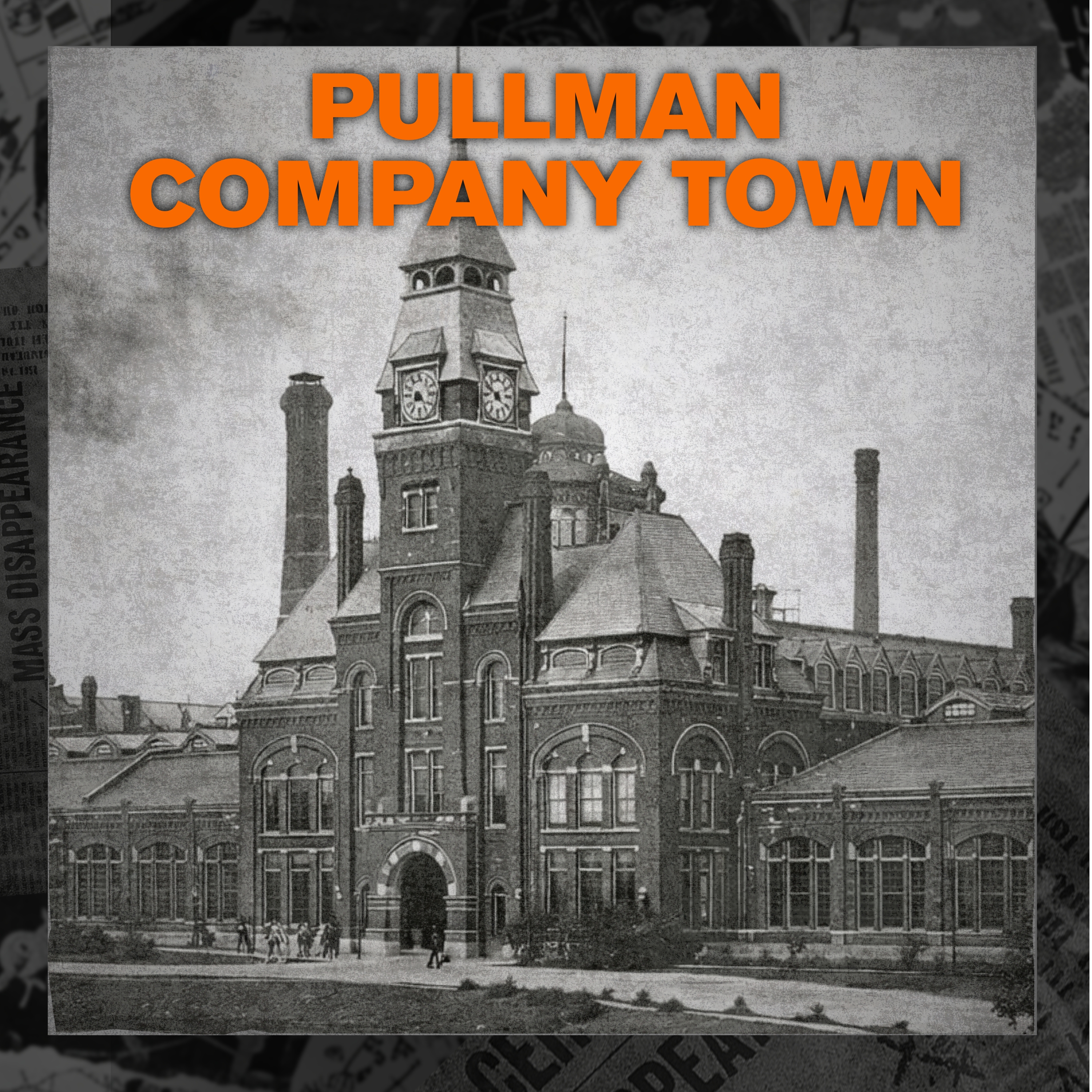
In this episode of Conspiracy Theories, Cults, & Crimes, Vanessa Richardson examines the rise and fall of the Pullman Company Town, a planned industrial community built outside Chicago in the 1880s. Created by railroad magnate George Pullman, the town was designed to provide workers with housing, stores, churches, and strict moral oversight under corporate control. While promoted as a model society, Pullman tightly regulated daily life, wages, and behavior, fostering criticism that the town functioned less like a community and more like a paternalistic social experiment. When economic downturn led to wage cuts without reduced rents, tensions erupted into the violent Pullman Strike of 1894. This episode explores the structure of the company town, the power dynamics at play, and how corporate control over workers’ lives fueled one of the most significant labor conflicts in American history.
If you’re new here, don’t forget to follow Conspiracy Theories, Cults, & Crimes to never miss a case! For Ad-free listening subscribe to Crime House+ on Apple Podcasts. Conspiracy Theories, Cults and Crimes is a Crime House Original Podcast, powered by PAVE Studios
🎧 Need More to Binge?
Listen to other Crime House Originals Clues, Crimes Of…, Serial Killers & Murderous Minds, Crime House 24/7, Murder True Crime Stories and more wherever you get your podcasts!
Follow me on Social
-
Instagram: @Crimehouse
-
TikTok: @Crimehouse
-
Facebook: @crimehousestudios
-
YouTube: @crimehousestudios
Get every episode summarized
Each time Conspiracy Theories, Cults, & Crimes publishes, we email you a written briefing from the transcript — the topics, who appeared, and any specific claims, with the ad reads skipped.
Email me new episodesFree for 3 shows. No card needed.
Hosts & guests

Transcript ready
597 searchable segments. Every word is indexed and playable.
Full transcript
Conspiracy Theories, Cults, & Crimes — Pullman: The Company Town Experiment. Machine-transcribed; use the interactive transcript above to jump the player to any line.
Hi, it's Vanessa. If you're drawn to true crime stories about disappearances, there's a new crime house original you should check out. It's called The Final Hours, hosted by Sarah Turnie and Courtney Nicole. Sarah is an advocate for missing and murdered victims whose own sister disappeared in 2001, and Courtney is a true crime storyteller who's seen firsthand how crime can change a family forever. Together, they bring lived experience to every case, examining the moments just before a person disappears. The routines, the timelines, the small details that often get overlooked, because every disappearance has a moment where everything still feels normal until it doesn't. Listen to and follow The Final Hours on Apple Podcasts, Spotify, Amazon Music, or wherever you get your podcasts. New episodes drop every Monday. This is Crime House.
For nearly 15 years, tens of thousands of people worked on the south side of Chicago at the Pullman Rayal Yards. Seamstresses stitched the drapes that went into the carriages, blacksmiths shaped the steel beneath them, and engineers designed the systems that kept everything running smoothly. When everyone was done for the day, they returned to Pullman-owned homes. They shopped at Pullman-owned stores and worshipped in a Pullman-owned church. Every part of life flowed through the company. And yet, these people could barely afford to make ends meet. They tried to fight for higher wages and better working conditions, but their pleas fell on deaf ears. And eventually, the Pullman workers had enough. In July 6, 1894, 4,000 people gathered at the rail yard and began targeting rail cars. Some were vandalized, others were pushed from the tracks, a few were set on fire. Federal authorities moved into restore order, and what started as a labor dispute turned
into something far darker. What followed was one of the most controversial uses of military power against organized labor in American history. It ended with dozens lying dead in the street. From UFO cults and mass suicides to secret CIA experiments, presidential assassinations, and murderous doctors, these aren't just theories, they're real stories that blur the line between fact and fiction. I'm Vanessa Richardson, and this is conspiracy theories, cults, and crimes, a crime house original powered by paved studios. Every Wednesday and Friday, I'll explore the real people at the center of the world's most shocking events and nefarious organizations. These cases are wild, and I want to hear what you think. At the end of each episode, leave a comment wherever you listen.
Be sure to rate, review, and follow so we can continue building this community together. And for ad free access to both episodes, subscribe to Crime House Plus on Apple Podcasts. Today, I'm talking about a forgotten piece of American history, the rise of company towns in the late 1800s, more specifically the Pullman Company Town in Chicago, Illinois. The people living and working in Pullman spent years dedicating their lives to the company, but when they asked for higher wages and better working conditions, the man in charge, George Pullman, refused to negotiate. Eventually, one of the most powerful unions got involved and declared a national boycott. At its peak, the strike shut down rail traffic across much of the country, disrupting commerce, halting male delivery, and paralyzing transportation west of Detroit. Over a century later, we can look back on the story of Pullman as a cautionary tale. Big business can silence its critics, but it's just a matter of time until the tides change
and when they do, no one is safe. All that and more coming up. These days, I'm really focused on quality over quantity. I'm raising my standards, especially when it comes to my closet. If it's not well made and versatile, I just don't bother. That's why I love quints. Their fabrics feel elevated. The cuts are thoughtful and the pricing is surprisingly reasonable. They make wardrobe staples in 100% European linen, silk, and organic cotton poplin. Their cotton cashmere sweaters are light, soft, and perfect for layering this season. And their spring colors, gorgeous. Everything is designed to make getting dressed effortless. These are pieces built to last. Just gauze that isn't flimsy, linen that holds its shape, and stitching that really stands up over time. That cotton cashmere sweater I grabbed has become my daily go-to, light, locks, and exactly what I want.
Stop waiting to build the wardrobe you actually want. Right now, go to quints.com slash crime house pod for free shipping and 365 day returns. That's a full year to wear it and love it, and you will. Now available in Canada, too, don't keep settling for clothes that don't last. Go to quimce.com slash crime house pod for free shipping and 365 day returns. Quints.com slash crime house pod. The all new 2026 Toyota RAV4 is here. And it builds on everything drivers know and love about Toyota. With a redesigned look and modern tech that makes life behind the wheel easier than ever. The 26 RAV4 comes standard as a hybrid, providing smooth, efficient performance for both city streets and longer journeys. While the available all-wheel drive keeps you in command when conditions are unpredictable. The new RAV4 is designed around the way people actually use their SUV, from daily errands to weekend adventures.
While the GR Sport model, coming soon, both CNET combined 320 horsepower in a plug-in hybrid drivetrain with a GR tuned suspension for an even more responsive, exciting drive. No matter which RAV4 you choose, you'll enjoy the reliability Toyota is known for, coupled with the inspiring performance that's unique to Toyota. Shop more and find details at toyota.com. The all new RAV4 from Toyota. Let's go places. In the mid-19th century, Chicago, Illinois was a city of opportunity. Its location along Lake Michigan meant it was one of the most popular trade routes by 1860 11 rail lines crossed through the area. That made it a hotspot for emerging industries like transportation, commerce, and manufacturing. And that year, a 29-year-old man named George Pullman tried to strike it big in the windy city. George had grown up along the Erie Canal in Albion, New York.
His father, Louis, was a carpenter and inventor. He had patented a machine that could move entire buildings from one foundation to another. When George was a teenager, Louis was hired by the state of New York to widen the Erie Canal. So, George left school to work alongside his father, learning how to operate the machinery. Then, in 1853, Louis Pullman died, leaving George in charge. The 22-year-old rose to the occasion. And when opportunity came his way, he took it. Shortly after Louis's death, George took on the contract with the state of New York. He used his father's invention to move about 20 buildings from the bank of the canal, further inland, fully intact. The decision saved New York a lot of money. And earned George Pullman a lot of admiration. Before long, his skills and his equipment were in demand across the country, especially in Chicago. Although the city's economy was booming, it had a serious problem.
Chicago was built on Swampland. To clear the water and ensure people, horses, carriages, and everything else could travel easily, the city made a radical decision. They were going to re-engineer the sewage infrastructure. Not only did this require raising the city's streets, it meant raising the buildings too. After his work in New York, the city knew George Pullman was the man for the job. He joined a group of engineers and used his machines to lift entire buildings, while people continued living and working inside them. The project was a success, and it took George Pullman's career to the next level. He was no longer just a skilled engineer capable of executing complex projects. He'd proven that he could operate at scale, manage massive logistical challenges, and reshape an entire city's infrastructure. With that success came ambition. And soon, George set his sights on a new venture, the emerging field of rail travel.
In the mid-1800s, overnight train travel was miserable. Cars were cramped. Smoke from oil lamps filled the air. Passengers slept sitting upright if they slept at all. But George Pullman didn't think it had to stay that way. He believed travel could be enjoyable, not just something you had to endure. While still helping to elevate Chicago, George started putting his vision into motion. His rail cars would have high-line features like plush carpets, polished wood, and gas lamps instead of oil. He also planned to hire porters and maids. The idea was to create a luxury experience and give clients the feeling that they weren't traveling on a train. They were staying in a hotel. But to get his venture off the ground, George needed to generate buzz. Soon, a national tragedy provided the perfect opportunity. On April 14, 1865, President Abraham Lincoln was enjoying a play at Ford's Theatre in Washington, D.C.
when he was assassinated by John Wilkes Booth. A week after Lincoln's death, his body was transported by train from Washington, D.C. to its final resting place in Springfield, Illinois. The train would be making dozens of scheduled stops, allowing Americans across the country to pay their respects. While others saw tragedy, George saw free marketing. The funeral train was going to consist of nine cars, carrying 300 guests. He'd just finished his first two luxury sleeping cars, the Pioneer and the Springfield, which he offered to the government, free of charge. In the wake of this stunt, orders flooded in. This was pretty impressive considering George hadn't even launched Pullman's palace car company yet. That came two years later in 1867. Unsurprisingly, the company was a success. And by 1879, 12 years after getting off the ground, George had 464 cars leased out to various railroad companies.
Things were going better than George had ever imagined, and his pocketbook was proof. That year, he made $2.2 million, about $100 million today. Some people might have been satisfied with that, but George had grand plans and a need for total control. In 1880, George bought 4,000 acres of land on the western edge of Lake Calumet, about a dozen miles south of the Chicago Loop. He wanted to create something truly unique there. With so much demand for his rail cars, George's company needed more employees, draftsmen, carpenters, painters, blacksmiths, and others. But George didn't want to simply hire them. He wanted to organize, gather, and collect them in one central location. He envisioned a town where workers lived close to their jobs, where housing, shopping, education, and recreation were all provided, a place designed, managed, and owned entirely by the company.
The same year, George bought the land. He and his men broke ground on the property near Lake Calumet. It was an exciting moment in US history. If the Pullman Company town was a success, who knew how many others might follow? But like they say, not everything that glitters is gold, and the town of Pullman was about to learn that, the hard way. Why have I asked my HVAC guy? I found on Angie.com to change my grandpa's trachea tube. I was so amazed at how he replaced our air ducts. I knew I could trust him to change PopPop's tube. I think we should call it doctor. Angie, but when you trust to find the ones you trust, find pros for all your home projects at Angie.com. This episode is brought to you by Progressive. Most of you aren't just listening right now. You're driving, cleaning, and even exercising. But what if you could be saving money by switching to Progressive? Drivers who saved by switching saved nearly $750 on average, and auto customers qualify for an average of seven discounts.
Multitask right now. Quote today at Progressive.com. Progressive casualty insurance company and affiliates, National average 12-month savings of $744 by new customers surveyed, who saved with Progressive between June 2022 and May 2023. Potential savings will vary. Discounts not available in all states and situations. In 1880, 49-year-old George Pullman took on the biggest project of his career, creating and maintaining an entire town dedicated to his life's work. Located on the far south side of Chicago, the Pullman Company town was supposed to be a worker's paradise. George's business, Pullman's palace car company, was worth $50 million in the late 1800s. That's over $1.7 billion today. And George didn't pinch pennies when it came to the town. When it was established, Pullman was marketed as a model industrial community. It was carefully planned, newly built, and designed to project order, comfort, and progress.
People started moving in as early as 1881, and three years later, around 1,400 multi-family houses were ready for tenants. While the bulk of those residents were Pullman employees and their families, anyone could choose to live there, but only in certain areas. They strolled down tree-lined streets, past brick apartment buildings in neat rows, beautiful gardens, and parks. But people spent most of their time at the arcade. This building held the post office, various stores, a YMCA, a kindergarten, an opera house, and a library. From the outside looking in, it seemed like Pullman was a great place to live, combed to a cultured thriving community. But behind closed doors, things weren't all sunshine and rainbows. George wasn't providing these amenities out of the goodness of his heart. He'd promised his investors that, in addition to the profits from his business, the town itself would deliver 6% returns each year.
To make good on this promise, he needed to charge residents' exorbitant rates for simply using and occupying the buildings he created. For example, renting the opera house was $500 a year, over $17,000 today. The YMCA charged $180 annually, which would be over $6,000 today. Even places that should have been free, like the library, cost $3 a year to access, about $107 today. Even the church wasn't off limits. Any congregation or denomination that wanted to use it needed to rent it for a $300 annual fee. That's over $10,000 today. When a group of Methodists asked George to lower the rent, he allegedly refused and said, quote, When that church was built, it was not intended so much for the moral and spiritual welfare of the people, as it was for the completion of the artistic effect of the scene. Meaning the church was nothing more than an accessory.
A way to make Pullman look like a real town, even if it didn't function like one, because the only thing George Pullman cared about was keeping up appearances. And it didn't matter who suffered along the way. One of the most detailed accounts of Pullman comes from Reverend William H. Carwadine, a pastor who lived there. Over time, he became an important lifeline for residence. They share their experiences with him, describing the pressures they faced behind the town's polished exterior. Years later, Reverend Carwadine compiled those accounts in a book called The Pullman Strike. Although he kept his sources anonymous, their accounts offer a clear picture of what life was like for the estimated 12 to 14,000 residents. According to the pastor, most people lived in tenements and small flats. Families were often packed into tiny apartments with limited privacy and few amenities. Larger units existed, but most residents couldn't afford them.
Rent was between $6 and $9 per month, or between $191 and $286 today. That might sound great now, but compared to how little these people were making, and all the additional fees they were charged, it was pretty steep. Tenants were built separately for water, usually 60 to 70 cents per month. In some buildings, residents had to share a single faucet, but each person still paid the same amount. In large tenement blocks, one outdoor faucet might serve four houses. In other cases, hundreds of residents shared limited water. If someone had a problem with the policies, well, that was too bad. Living in Pullman wasn't optional for most employees. Jobs at the factory were closely tied to residency in the town, and workers who lived elsewhere were often the first to be let go during layoffs. Leaving Pullman meant risking unemployment. George Pullman knew that and used it to his advantage. Reverend Carwadine estimated that George's company made over $325,000 a year,
the equivalent of over $10 million today, just on housing. And that was only a tiny fraction of the money he was making on the factory floor. The town was designed around a massive manufacturing plant, where all the rail cars were made. The complex included specialized studios, like a foundry, which made metal casing, and a cabinet shop, where rail cars were designed and created. There was also a brickyard, which provided raw materials. Factory supervisors weren't there to look out for their workers. They were there to squeeze as much labor out of their employees as possible. It didn't matter how abusive these managers were, as long as they kept productivity high and wages low. One employee had risen the ranks from factory worker to four woman. Instead of empathizing with her colleagues, she took a page out of George Pullman's playbook. She singled out certain workers, randomly cut rates, and refused to let sick employees go home.
Women who complained were told to accept things as they were, or quit. Some did leave, even though they desperately needed the work. Most stayed because they had no alternative, but others were forced out. One of the company's best blacksmiths left work one afternoon for a legitimate reason. When he came back, he discovered his name had been placed on a black list. When he went to management, they agreed that it shouldn't have happened, but said their hands were tied. Apparently, they couldn't reinstate him, or find him another position. Eventually, he was fired and ordered to leave his home. In another situation, a fireman was responsible for heating massive industrial boilers. It was hard, physically exhausting work. The man worked 86 hours a week for the first two weeks. The next two, he worked 126 hours a week. By the end of the month, he'd worked 428 hours. He made $40 total, or $1,400 today.
That's just a few cents an hour. Even then, he was expected to pay full rent, full water charges, and other expenses in Pullman. Unfortunately, his story wasn't unique. Skill tradesmen saw intense pay cuts, and women working in departments like laundry and linen services were hit particularly hard. Their wages were reduced so severely that many struggled to meet even their most basic needs. These cuts weren't isolated incidents, and over time, lowering wages became an accepted practice. Supervisors who resisted were pressured to leave, or replaced with others willing to enforce harsher policies. But that wasn't the only way the town of Pullman controlled its residents. In one case, a foreman ran for local office. Problem was, town officials wanted a different person to win. When they tried to pressure the foreman to withdraw, he refused. Though he didn't win the election, Pullman officials were still angry with him.
After the election, the foreman was asked to resign. Others who supported him were also dismissed. Still, that wasn't the worst of it. One account describes a young woman named Jenny Curtis, whose father worked for the Pullman Company for 10 years. Eventually, he became sick and was unable to work. After three months, he passed away. At the time of his death, the family owed $60 in background. Despite the circumstances, the town of Pullman insisted it be paid in full. These stories show how the men and women of Pullman were squeezed from every direction, by wages that fell, rents that didn't, and a system that left no room to escape. And while they struggled to make ends meet, George Pullman's company was doing better than ever. From August 1892 to August 1893, Pullman added about 400 new rail cars to service.
That works out to more than one new Pullman car completed every day. To meet demand, Pullman hired more workers. At its height, the company employed between five and six thousand men. The shops were busy, and for many workers, steady employment made the high cost of living in Pullman feel manageable. But what comes up must come down, even in Pullman. Later in 1893, the US economy slowed to a standstill as gold reserves fell. Banks shut down, and the railroad industry went into massive debt. Known as the panic of 1893, this was the worst economic disaster until the Great Depression. For the Pullman company, this meant less demand and fewer orders placed. In response, the company started firing lots of workers. But George was working hard in the background to save the business. Later that year, some new corporate contracts were secured, and more people made their way to the Pullman company town.
Employment rose again, climbing back to three or four thousand workers during the winter. But this recovery came with a critical change. According to Reverend Carwadine, wages were cut repeatedly, and unlike employment levels which fluctuated with demand, rents did not change. Families who were barely skating by before now faced genuine hardship. By the winter of 1893, nearly everyone in Pullman was destitute. Men worked when work was available, earned less, and still owed the same amount every month to the town, owned by the company that employed them. Years earlier, the people of Pullman probably would have put their heads down and kept grinding, but at some point everyone reaches their breaking point. As life got harder, residents started talking openly about their situation for the first time. It was clear that the image Pullman projected was nothing more than a smoke screen. In reality, people were living in a dictatorship,
where every aspect of their lives was carefully monitored. And the only way to knock George Pullman down a peg was to do something drastic. Parle tu français? Parle tu français? If you've used Babel, you would. Babel's conversation-based technique teaches you useful words and phrases to get you speaking quickly about the things you actually talk about in the real world. With lessons handcrafted by over 200 language experts and voiced by real native speakers, Babel is like having a private tutor in your pocket. Start speaking with Babel today. Get up to 55% off your Babel subscription right now at babel.com slash listen and it's bell-b-a-b-e-l.com slash listen. Rules and restrictions may apply. Primally pure just launched their blue-tancy body butter, and it's more than a moisturizer. It's a full-body exhale. This is their best-selling body butter formula. Reimagined with calming blue-tancy. It's a rich whipped body moisturizer. Pack with barrier-building grass-fed tallow to deeply nourish dry, compromised skin.
The texture is cloud-soft but ultra-replenishing. It melts in, protects against moisture loss, and leaves skin visibly smoother and more supple. And the scent? Soft blue-tancy, lavender and sandalwood, fresh, subtle, and elevated. If you already love the blue-tancy deodorant or body oil, this is the perfect next step. My name is Sarah Turnie. I spent years fighting for justice for my missing sister Alyssa Turnie. Before and arrest was finally made in our case after nearly 20 years. I know what it's like to fight for media attention, for answers, and for justice. On my podcast Voices for Justice, I provide unique insight into these tragic cases, because I know what it's like to not just listen to these stories, but to live them. Listen to Voices for Justice in your favorite podcast player today. By 1894, the people living and working at the Pullman Company town were trapped. Their wages kept falling, rents stayed high,
and nearly every part of their lives was controlled by the company. Pullman residents had spent years maintaining the status quo, but at the end of the day, they found themselves with no real leverage and no legal protections. Eventually, they reached a breaking point. Back then, there were no labor laws requiring employers to negotiate or arbitrate disputes. The National Labor Union existed, but at that point, its main focus was keeping the work day to an eight-hour maximum. Things like working conditions and fair pay weren't part of the equation. So the Pullman workers tried to cut out the middleman. First, they met with company executives hoping to negotiate. When those discussions went nowhere, they took the issue to George Pullman himself. But he said there was nothing he could do to lower rent or address their complaints. After months of getting nowhere, the Pullman workers knew they had to do something radical. On May 11th, 1894, nearly 4,000 employees walked off their job sites.
They were on strike indefinitely. The next day, the company acted like nothing was wrong. They hired a band to play around town and publicly claimed they weren't affected by the strike. In reality, production had stopped entirely. Still, it wasn't enough to move the needle. George Pullman refused to negotiate. Many observers in Chicago criticized his decision, arguing that he should meet with his workers and address their concerns. When he didn't budge, the striking employees got in touch with the American Railway Union or the ARU. The largest labor organization in the country at the time. Hundreds of Pullman workers joined the ARU. And a month into the strike, the Union held its national convention in Chicago. Several Pullman employees attended. One of them was Jenny Curtis, the woman whose father had died while the family was living in Pullman. Even though he was a loyal worker for 10 years, George Pullman refused to forgive his debt, $60 in background.
At one point, Jenny addressed Union delegates directly. She described being insulted by clerks at the company bank, and said she simply didn't make enough to pay rent and survive. She described Pullman, both the man and the town, as a fundamental threat to workers, and argued the conditions would not improve without collective action. After Jenny and several other residents spoke, the ARU voted on whether to support the strike. The motion passed with flying colors. 600 delegates voted in favor. Now that they had the support of the Union, the strike took on a life of its own. The problems at Pullman were no longer a local issue. They were a national issue, and the results were devastating. Railroad workers across the country refused to handle trains carrying Pullman rail cars. Switchmen, engineers, and yard workers agreed not to move trains that included Pullman equipment. Within two months, the boycott expanded to include roughly 250,000 workers nationwide,
making it the largest sympathy strike in US history at the time. Rail service was disrupted on 29 railroads, including major freight and passenger routes. Even commuter rail lines within cities were affected. With major trade routes impacted, agricultural products spoiled in rail cars and fields, freight shipments stopped, rail transportation across large portions of the country ceased functioning. It seemed like maybe things were finally going to change for the Pullman workers. The only question was, would George Pullman come to the negotiating table? Instead of trying to make nice, George only got nastier, and unfortunately for his employees, he had some very powerful people on his side. George was part of the General Managers Association, a coalition of 24 influential railroad operators, headquartered in Chicago. George was close friends with several of the group's leaders, and they all agreed the shutdown
needed to end. The GMA's first move was to hire strikebreakers to replace union labor. At the same time, they launched a public campaign against the American Railway Union, trying to make them look like dangerous criminals. Up to this point, the strike had remained largely peaceful, but after the GMA fan the flames, things got destructive. Large crowds of workers and supporters had gathered at the South Chicago rail yards. With all the talk about them being out of control, the group decided to live up to their reputation. Soon, they started to overturn rail cars and set them on fire. The GMA used this incident to their advantage and continued to turn public opinion against the railway workers. When that still wasn't enough to convince the union to end its strike, the GMA decided the whole country needed to suffer. In late June, the GMA arranged for US mail cars to be attached to trains that also carried Pullman rail cars. This meant that any refusal to move Pullman equipment
would now interfere with the delivery of federal mail. As expected, mail service was disrupted. Railroad managers accused the ARU of obstructing interstate commerce and interfering with the US mail. And they weren't the only ones who were upset. Thanks to Pullman's connections in Washington DC, he received a federal injunction against the strike. Legislators in DC declared the boycott illegal and ordered the strike to come to an end. But the Pullman workers had come this far and they weren't going to stop now. So, the US government decided to make them. On July 4, 1894, the people of Chicago and the town of Pullman were greeted by thousands of federal troops, not exactly an ideal independence day. The attorney general said he was dispatching the soldiers because tampering with mail was a federal offense. Two days later, on July 6th, striking workers
and residents gathered at the Pullman rail yards. After months of shouting into the void, they reached their limits. Violence broke out as protesters and soldiers clashed. At one point, an unarmed bystander named William Analan was shot by a federal deputy. He later died from his wounds. The shooting marked a major shift. The strike was no longer confined to negotiations, boycotts or damaged property. It had crossed into lethal force and the conflict escalated rapidly from there. Strikers and their supporters overturned rail cars, damaged tracks and created barricades to stop the troops from reaching the rail yards. In response, national guardsmen fired into the crowd. By the end of the day, dozens of unarmed, innocent workers laid dead, and many others were badly injured. There was $80 million in property damages across the country, which would be $2 billion today. Afterwards, the government officially ended the strike
and arrested the leaders of the American Railway Union. Their bail was set at $10,000. That's over $365,000 today. The Pullman Strike was one of the worst losses for the US labor movement. Not only did many innocent people lose their lives, but the Pullman Company never agreed to any of the workers' demands. Many employees didn't get their jobs back, and those who did were forced to sign agreements, promising not to join any other unions. With the leaders of the ARU in jail, the union was disbanded. What had been the largest labor organization in the country collapsed almost overnight. But George Pullman didn't get to enjoy his victory for long. In 1897, three years after the strike ended, the 66-year-old had a fatal heart attack, and he wasn't the only one who suffered. President Grover Cleveland was largely criticized for his decision to deploy federal troops against civilians. As a Democrat, a large portion of his
base supported organized labor. In the wake of the strike and the economic depression, President Cleveland decided not to run for another term. A year after George Pullman's death in 1898, the Illinois Supreme Court ruled that the Pullman Company could not function as a landlord or a municipal authority. By controlling housing, utilities, and civic life, the company had exceeded its legal limits. The court ordered the Pullman Company to divest from all residential and non-industrial property forcing the sale of the town. At that point, President Cleveland tried to do damage control. He appointed a national commission to investigate the conflict. The commission criticized George Pullman's refusal to negotiate and condemned the company town as un-American. But that's pretty much all they did. Instead, civil and criminal charges were brought against union leaders. Not only that, but the Supreme Court unanimously upheld the use of federal injunctions and troops to break the strike.
Although the Pullman Strike ended in disaster, it was an incredibly important moment in American history, one that only made the labor movement stronger. The road to meaningful change hasn't been smooth. It was marked by resistance, sacrifice, and loss. Not everyone was heard. Not everyone survived long enough to see change. Still, the people of Pullman mattered. Because of them, we have higher wages, better working conditions, and the freedom to have personal lives outside of the office. Thanks so much for listening. I'm Vanessa Richardson, and this is conspiracy theories, cults, and crimes. Come back next time. We'll decode the episode together, and hear another story about the real people at the center of the world's most notorious cults, conspiracies, and criminal acts. Conspiracy theories, cults, and crimes is a
crime house original powered by paved studios. Here at Crime House, we want to thank each and every one of you for your support. If you like what you heard today, reach out on social media, add crime house on TikTok and Instagram. Don't forget to rate, review, and follow conspiracy theories, cults, and crimes wherever you get your podcasts. Your feedback truly makes a difference. And to enhance your conspiracy theories, cults, and crimes listening experience, subscribe to Crime House Plus on Apple Podcasts. You'll get every episode at free. We'll be back on Friday. Conspiracy theories, cults, and crimes is hosted by me, Vanessa Richardson, and is a crime house original powered by paved studios. This episode was brought to life by the conspiracy theories cults and crimes team Max Cutler, Ron Shapiro, Alex Benadon, Natalie Pritzowski, Laurie Maranelli, Sarah Camp, Rob Heckert, Leo Roche, and Michael Langsner. Thank you for listening.
Oh, could this vintage store be any cuter? Right. And the best part? They accept discover. Accept discover? In a little place like this? I don't think so, Jennifer. Oh yeah, huh. Discover's accepted where I'd like to shop. Come on, baby. Get with the times. Right. So we shouldn't get the parachute pants? These are making a comeback. I think. Discover is accepted at 99% of places that take credit cards nationwide. Based on the February 2025 Nilsen report. Hi, it's Vanessa. If you're drawn to true crime stories about disappearances, check out the new Crime House original, The Final Hours, hosted by Sarah Turnie and Courtney Nicole. Listen to and follow the final hours on Apple podcasts, Spotify, Amazon Music, or wherever you get your podcasts. New episodes drop every Monday. Life lock. How can I help? The IRS said I filed my return, but I haven't. One in four tax paying Americans has paid the price of identity fraud.
What do I do? My refund though. I'm freaking out. Don't worry. I can fix this. Life lock fixes identity theft guaranteed, and gets your money back with up to $3 million in coverage. I'm so relieved. No problem. I'll be with you every step of the way. One in four was a fraud paying American. Not anymore. Save up to 40% your first year. Visit lifelock.com slash podcast. Terms apply.
More episodes
More from Conspiracy Theories, Cults, & Crimes

CRIME: Who Killed JonBenét?
Conspiracy Theories, Cults, & Crimes
CULT: Power in the Woods: Bohemian Grove
Conspiracy Theories, Cults, & Crimes
CONSPIRACY THEORY: Did the CIA Invent Modern Art?
Conspiracy Theories, Cults, & Crimes
CRIME: LSD & Mind Control: Operation Midnight Climax
Conspiracy Theories, Cults, & Crimes