Loading...
societyculturedocumentary
Pyramids, Voids & Vanished Queens: The Tech Cracking Egypt's Darkest Secrets
About this Episode
🏺 Hidden Voids & Royal Secrets: Is Ancient Egypt Gaslighting Us? 🏺
Think you know the truth about the Pharaohs? Think again. 🕵️♂️ What if the most advanced technology on Earth just proved we’re still fundamentally clueless about the past? In this episode, we’re tearing up the history books and diving into the unsolved mysteries of ancient Egypt that keep archaeologists awake at night.
We’re talking about the Great Pyramid and the mind-bending architectural anomalies recently exposed by muon scanning technology. These aren’t just small cracks; we’re looking at massive hidden voids that challenge everything we know about ancient engineering. Why were they built? What’s inside? And why does it feel like the more we discover, the less we actually understand?
Here is what’s on the slab today:
✨ Think this is wild? Share this episode with your favorite history nerd and start a debate! ✨
👉 Hit that subscribe button to join our expedition into the unknown. Let’s uncover the secrets the Pharaohs didn’t want us to find! 🚀
Become a supporter of this podcast: https://www.spreaker.com/podcast/thrilling-threads-conspiracy-theories-strange-phenomena-true-crime-unsolved-mysteries-etc--5995429/support.
ThrillingThreadsPod.com - Unravel the Unknown.Dive deep into the world's greatest conspiracy theories, strange phenomena, true crimes, and unsolved mysteries. Follow the threads.
You May also Like these:
SkyNearMe.com – Your all-in-one "Sky Super-App." Track real-time weather, sunset and air quality, stargazing conditions, 5G signal mapping, drone flight zones, solar potential, track satellites, rocket launches, UFO sightings in your local airspace and even get your Sky Horoscope and more!
🤖Nudgrr.com (🗣'nudger") - Your AI Sidekick for Getting Sh*t Done
Nudgrr breaks down your biggest goals into tiny, doable steps — then nudges you to actually do them.
Think you know the truth about the Pharaohs? Think again. 🕵️♂️ What if the most advanced technology on Earth just proved we’re still fundamentally clueless about the past? In this episode, we’re tearing up the history books and diving into the unsolved mysteries of ancient Egypt that keep archaeologists awake at night.
We’re talking about the Great Pyramid and the mind-bending architectural anomalies recently exposed by muon scanning technology. These aren’t just small cracks; we’re looking at massive hidden voids that challenge everything we know about ancient engineering. Why were they built? What’s inside? And why does it feel like the more we discover, the less we actually understand?
Here is what’s on the slab today:
- 🌌 The Muon Revolution: Using cosmic particles to 'X-ray' the pyramid and why the results are controversial.
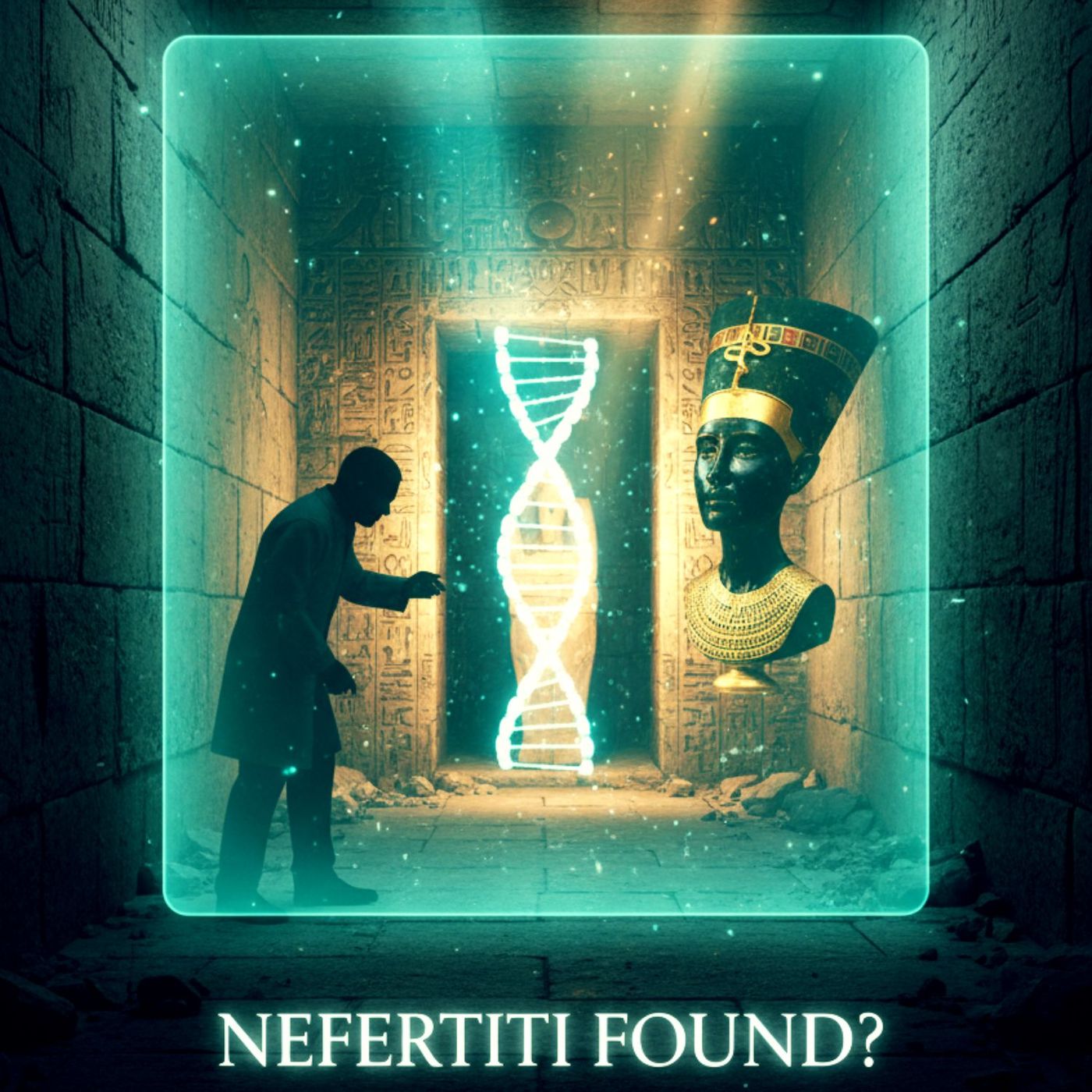
- 👑 Nefertiti’s Ghost: The hunt for the missing tomb of Nefertiti and why her identity remains a royal riddle.
- 💀 The Tutankhamun Conspiracy: Was it a tragic accident or an ancient cover-up? We look at the forensic debates and DNA testing results.
- 🏗️ Impossible Monuments: From the Khufu Solar Boat to the lost Labyrinth, how did they achieve such technological precision without modern tools?
✨ Think this is wild? Share this episode with your favorite history nerd and start a debate! ✨
👉 Hit that subscribe button to join our expedition into the unknown. Let’s uncover the secrets the Pharaohs didn’t want us to find! 🚀
Become a supporter of this podcast: https://www.spreaker.com/podcast/thrilling-threads-conspiracy-theories-strange-phenomena-true-crime-unsolved-mysteries-etc--5995429/support.
ThrillingThreadsPod.com - Unravel the Unknown.Dive deep into the world's greatest conspiracy theories, strange phenomena, true crimes, and unsolved mysteries. Follow the threads.
You May also Like these:
SkyNearMe.com – Your all-in-one "Sky Super-App." Track real-time weather, sunset and air quality, stargazing conditions, 5G signal mapping, drone flight zones, solar potential, track satellites, rocket launches, UFO sightings in your local airspace and even get your Sky Horoscope and more!
🤖Nudgrr.com (🗣'nudger") - Your AI Sidekick for Getting Sh*t Done
Nudgrr breaks down your biggest goals into tiny, doable steps — then nudges you to actually do them.
Hosts & Guests
Transcript
The Maps app that came with your phone, it's fine if you enjoy waiting, and guessing, and inefficient routes.
Or you could use MapQuest.
MapQuest is back with live directions, real-time traffic, and faster routes.
It moves when you move.
Best of all, no prints are needed.
No paper, no more misterns.
Just you and the app.
Get there fast with MapQuest.
Download the MapQuest app on the app store or visit MapQuest.com.
MapQuest, still getting you there.
Greenlight helps kids learn about money the way most of us never did,
by actually using it.
It's a debit card and money app that teaches kids to earn, save, and spend in real life.
Not just swipe and hope for the best.
Learning happens naturally in the moment.
Parents can set limits, see spending in real time, and guide better habits along the way.
All in one place, without constant check-ins or cash runs.
Don't wait. Try Greenlight Risk-Free today at greenlight.com slash Try Greenlight.
Imagine, for just a moment, that you are standing right at the absolute center of the Geese
Plateau. The midday sun is just beating down, turning all that sand into this blinding mirror.
Oh yeah, the heat there is, uh, it's intense.
Right, and the air is just thick with dust.
You've got the chaotic sounds of Cairo humming in the background.
And you tilt your head all the way back, looking up at 2.3 million blocks of solid stone,
stretching nearly 500 feet into the sky.
It's staggering. I mean, it really puts human scale into perspective.
It really does. And for centuries, humanity has looked the great pyramid and just,
you know, thought of it as a solved puzzle.
A marvel, obviously, but a known quantity.
Yeah, we figured, well, we measured the outside with lasers.
We mapped the interior chambers, put it in the textbooks, and basically just check the box.
Exactly. We thought we had the blueprint of antiquity all figured out.
But what if the very stones you're looking at are hiding massive secrets right now?
Like literally right now.
Yes. What if behind the walls of these monuments, we thought we knew inside and out?
There are, uh, colossal voids, secret doors with tiny copper handles,
and deliberately erased identities that we are only just now discovering.
And we're finding them using technology that borders on science fiction, honestly.
Welcome to Thrilling Threads. I'm so glad you're joining us.
We are taking all those centuries of assumptions, throwing them completely out the window,
and doing a deep dive into the source material.
We're looking at the ancient world through like the lens of modern particle physics,
forensic biology, and cutting edge archaeology.
You're probably here because you, like us, absolutely love that aha moment when a piece of history
just flips completely upside down.
Today's thread is pulling together a wild mix of historical accounts and modern science.
To explore really the most tantalizing ancient Egyptian mysteries that are still completely
insult today. Okay, let's unpack this because we aren't just talking about a few missing artifacts
or misplaced pottery shards here. No, not at all. The stakes are incredibly high when we look at
these sources. We aren't just looking at old rocks. Right. We are looking at a civilization that
possessed astonishing engineering capabilities, incredibly complex spiritual mythologies,
and really tense political traumas. And so much of that reality has either been lost to time
or deliberately erased by their own people. Exactly. When we study ancient Egypt, we are essentially
acting as detectives at a crime scene where the evidence is four and a half millennia old.
And all the witnesses have been dead for thousands of years. It really feels like having what you
think is a fully completed jigsaw puzzle sitting on your dining room table. Oh, I like that analogy.
Yeah, you're admiring it. You think you see the whole picture, but then you accidentally bump
the table, a few pieces slide away, and you realize that half the pieces actually belong to an
entirely different puzzle hidden underneath. And suddenly you have no idea what the real picture
is supposed to look like. So let's start with the macro. The biggest puzzle piece on the board.
The Great Pyramid of Giza itself. Right. Completed roughly around 2560 BCE during the reign
of the Faro Kufu. And for nearly 4,000 years, it was the tallest artificial structure on the planet.
Which is just wild to think about it. It is. But it's sheer size, you know, the millions of tons
of stone. That isn't actually the most perplexing mystery to structural engineers. The real mystery
is its alignment. Yeah. The Great Pyramid is aligned to true North,
southeast and west with an accuracy that is frankly terrifying. We're talking about a
managing of error of less than 360 of a single degree. It's almost impossible to comprehend.
If you ask me to park my car perfectly straight in my own driveway, I'm going to have a wider
margin of error than they did building a 480 foot tall artificial mountain 4500 years ago.
Right. Without a modern compass or laser leveling or satellite GPS. How is that even possible?
Well, it's a testament to an observational brilliance that we often fail to credit to ancient
peoples. There are several theories, mostly revolving around the observation of the stars that
circle the North Pole. But the sources highlight a particularly compelling theory proposed
back in the year 2000 by a British Egyptologist named Kate Spence. She looked at the problem not
as an architectural one, but as an astronomical one. Oh, interesting. So looking up instead of down.
Exactly. She suggested that the ancient builders didn't just look for a single north star
because the sky didn't look the same then as it does now. Instead, they used two specific stars
that aligned vertically in the night sky around the year 2500 BCE. Right. Those stars are
co-chabbed, Mizar. Yeah. So if you are standing in the Egyptian desert in 2500 BCE and you traced
an imaginary plum line, like a straight vertical line between co-chab and Mizar down to the horizon,
that line would point almost exactly to true north. Wow. So the Pharaoh's architects could
eventually just plant a sighting stick in the sand, wait for that exact cosmic alignment to
happen in the night sky, and draw a perfectly straight line on the desert floor. Exactly.
To establish the foundational grid for the entire pyramid, it's elegant in its simplicity.
I absolutely love that idea, but it requires you to understand something fundamental
about how the earth moves. Like, it's tied to a very specific moment in time, right? That is.
Because if you go out to the Giza Plateau tonight and look up at Cochab and Mizar,
they are going to help you build a perfectly aligned pyramid. The cosmic clock has shifted.
That brings us to the mechanics of axial procession. To understand why Spence's theory is so
powerful, we really have to understand how our planet moves. Right. Imagine a spinning top.
When a top is spinning rapidly, it stands perfectly straight. But as it begins to lose momentum,
the top of the stem starts to trace a slow, wide circle in the air. It wobbles.
It wobbles. And the earth does the exact same thing. As it spins on its axis, the gravitational pull
of the sun and the moon causes it to wobble very, very slowly. And it takes what? About 26,000 years
to complete one wobble? Roughly. Yeah. Which means the direction our north pole points into space
is constantly, slowly sweeping across the stars in a giant circle. So because of this axial
procession, the stars appear to drift very slowly across the sky over millennia. The north star we
used today, Polaris. Wasn't the north star when Kufu was building his pyramid? No. Back then,
the closest pole star was Thubin. So the alignment of Cochab and Mizar doesn't point to true north
anymore. But here is where Kate Spence's theory becomes brilliant. Okay. It not only explains the
mechanism of how they might have aligned the pyramid, but it accounts for the error. The slight
fractional error in the pyramid's alignment actually correlates perfectly with the very slight
drift of those two stars around the exact decade Kufu was building it. That is just mind blowing.
The tiny error itself is a chronological fingerprint. It really is. They literally built a monument
perfectly sank to a sky that doesn't even exist anymore. They anchored this massive physical
weight to a fleeting moment in the cosmos. It's poetry and stone. It is. But I have to lay
devil's advocate here. It's brilliant to use the stars as a compass. It solves the geometry
and the surveying. But knowing the precise angle to lay a 15 ton block of solid granite,
doesn't explain how you actually get it there. You can have the most perfect blueprints in the world
drawn by the greatest astronomers. But if you don't have cranes. Right. If you don't have hydraulics
or combustion engines or even the wheel, how are you moving 2.3 million of these blocks? That logistics
puzzle has been the eternal question. How do you move mountains of stone without industrial machinery?
Yeah. But the source is bring up an incredible discovery from 2013 that shed immense light on
the logistics, if not the actual lifting mechanism itself. Oh, the diary of mayor. Yes. Near the
coast of the Red Sea at a site called Wadi al-Jarfe, archaeologists uncovered a cache of ancient
papyrus documents buried in these artificial caves. This is honestly one of my favorite historical
discoveries of the entire century. We always hope to find like a golden mask or a magical text.
But finding the diary of mayor is like digging in the sand and finding a 4,500-year-old corporate
spreadsheet. It sounds mundane, but it is utterly revolutionary. It really is. Mayor was an
official essentially a middle manager or a maritime foreman who was heavily involved in the supply chain
for the construction of Kufu's pyramid. And his logbook just meticulously details his daily
activities. He doesn't write about the gods or the cosmic alignment. No, he writes about moving
rocks. He details how his crew of workers transported the gleaming white turra limestone,
which was used for the pyramid's smooth outer casing from quarries across the Nile.
If you read the translations, it reads exactly like a modern shipping manifest. Inspector
Maraer spent the day with his file loading stones, sailed up the river, unloaded at Giza.
Yeah, he tracks his shipments, notes how many days the voyage took, and even records the
rations given to his men. It describes a highly sophisticated state-sponsored supply chain.
It's unbelievable. They loaded these massive stones onto specially designed wooden boats.
They navigated them down the Nile and threw a complex series of artificial purpose-built
canals that acted as an aquatic highway. Bringing the stone right up to the base of the Giza
Plateau. Exactly. They even used the annual flooding of the Nile to their advantage,
floating the stones closer to the site than would be possible during the dry season.
It just humanizes the whole endeavor so much. It wasn't magic, and it certainly wasn't aliens.
It was an incredibly sophisticated bureaucracy with thousands of workers,
supply lines, and maritime engineering. Just massive coordination.
But I keep coming back to the physical reality of the stone. I mean, Maraer writes about
getting the stones to Giza by boat. He tracks the maritime shipping. Right.
But he conveniently leaves out the part where they take a stone,
the weight of three modern elephants out of the boat, and listed hundreds of feet into the air.
Yeah, the diary stops where the greatest mechanical mystery begins.
We know they possess copper chisels, hemp rope, wooden sleds, and water to slick the sand to
reduce friction. Just really basic tools. Very basic. The prevailing archaeological consensus
leans heavily toward the use of massive ramps made of mud brick, limestone ships, and rubble.
But even the ramp theory has massive structural and logical issues.
Huge issues. I mean, if you try to build a straight ramp,
reaching the top of a 480 foot pyramid, with a gentle enough incline to actually drag a 15 ton
block up it, that ramp would have to be over a mile long. Exactly. The ramp itself would require
almost as much material and labor as the pyramid was built to service. It doesn't make sense.
Which is why architectural historians have proposed dozens of alternatives.
Some suggest a spiral ramp that wrapped around the exterior of the pyramid as it grew.
I've heard that one. And others, like the French architect Jean-Pierre Houdin,
have proposed a fascinating theory of an internal ramp system.
Like a spiraling tunnel hidden just inside the outer edge of the stone,
allowing workers to drag the blocks up from the inside.
I want you to just take a second and really imagine the logistical nightmare of this.
Picture yourself trying to organize a workforce of thousands of people.
Without a single computer. Right, you have to feed them, house them, coordinate them to stack,
2.3 million multi-ton blocks perfectly. No mechanized pulleys, no iron tools,
just human muscles, sweat, and organization.
And doing it all before the invention of the wheel.
The ultimate lifting method remains an absolute, frustrating, glorious mystery.
It forces us to recognize what human beings can accomplish with unified focus.
And generational dedication. The sheer volume of stone used for Kufo's pyramid is staggering.
It dominates the entire landscape and our modern imagination of ancient Egypt.
Well, what if there was a structure that made the great pyramid look small?
A structure so vastly complex that it made Giza look like a simple geometric exercise.
And what if we just, you know, lost it?
If we connect this to the bigger picture, this brings us to the phenomena of missing
megastructures, specifically the legend of the labyrinth.
Oh, the story is wild.
To understand this, we have to look at the accounts of early historians.
Around 450 BCE, the Greek historian Herodotus traveled to Egypt.
Context is everything here.
Right, because by the time Herodotus visited Egypt, the great pyramid of Giza was already 2,000
years old. He was a tourist looking at ancient history himself.
Exactly. But while he was deeply impressed by the pyramids,
he described another structure near the pyramid of the Pharaoh,
Amanemhat III, in the Fayyum oasis that left him completely awestruck.
He called it a labyrinth.
And Herodotus was a chronicler known for occasionally exaggerating,
but his description of this labyrinth is so specific and so wild that it demands attention.
It does. He claimed it had 3,000 rooms.
3,000?
Yeah. He wrote that half of them, 1500 rooms, were above ground,
and the other 1500 were entirely subterranean.
He described massive courtyards built of white marble,
ceilings made of enormous single slabs of stone,
and a layout so massive and complex that it was impossible to navigate without a local guide.
And it wasn't just Herodotus spinning a tall tale, either.
The Greek Geographer Strabo also visited the site centuries later and confirmed it existed.
Describing massive intersecting halls that dizzyingly confuse anyone who walked through them.
So we have multiple independent eyewitness accounts from classical antiquity,
describing a megastructure that rivaled the pyramids.
It was considered one of the great wonders of the world by those who saw it,
but today, if you go to the site at Hawara where it's supposedly stood,
you see a ruined mud brick pyramid and a massive flat expanse of sand and scattered rubble.
The obvious question is how does a civilization just lose a building with 3,000 rooms?
Did it just vanish into the desert?
Did a massive earthquake swallow at whole?
The answer is likely much more pragmatic,
and it has to do with the ancient Egyptian practice of stone recycling.
We look at these monuments as sacred heritage,
but to the people living there thousands of years later,
building materials were incredibly precious.
Right, and labor intensive to quarry.
Exactly.
Subsequent generations of rulers, then the Romans,
and eventually the builders of Medieval Cairo,
looked at these ancient abandoned monuments not as history to be preserved,
but as incredibly convenient pre-cut stone quarries.
So over millennia, people simply dismantled the labyrinth blocked by block.
Yes, they carted the stone away to build new temples,
Roman outposts, homes, and city walls.
When archaeologists finally excavated the area in the late 1800s,
like Flinders Petri, they found the massive foundational bed of sand.
And scattered stone chips, confirming something colossal stood there.
But the superstructure was entirely gone,
it's heartbreaking to think about.
It is.
Imagine taking a grand majestic medieval cathedral like Notre Dame,
carefully pulling down every single stone,
and using them to build a dozen completely mundane modern houses.
Or paving stones for a road.
The grandeur is just dispersed into the mundane.
You might be walking past a retaining wall in Cairo today that was once part of
the greatest labyrinth in the ancient world.
It is the ultimate architectural ghost.
But there's a tantalizing caveat to this story that keeps archaeologists awake at night.
Yes, there is.
Remember, Herodidus specifically noted that half of the labyrinth 1500 rooms were underground.
He claimed they contained the tombs of the kings who built the labyrinth,
and the labyrinth-themed tombs of the sacred crocodiles.
Representing the god Sobeck, who was worshiped in that region.
Now, while the above ground structure was easily visible and therefore easily quarried away,
excavating a subterranean complex of that immense size just to steal the stone would have been
incredibly difficult.
Dangerous and time-consuming.
So if the quarrying stopped at the ground level,
then the colossal underground portion of the labyrinth could theoretically still be impact.
Wow.
It would be deeply buried beneath the sands and the very high corrosive water table of the
phyum region.
Some researchers fiercely speculate that this hidden world is just waiting to be unearthed.
We may still have the greatest, most complex, Egyptian monument sitting entirely unseen beneath
our feet, protected by the groundwater and the sand.
That gives me absolute chills.
It's an amazing thought.
We are looking for lost rooms beneath the sand, hoping to find a buried city.
But what is so incredible about modern archaeology is that perhaps the most shocking lost rooms
aren't under the sand at all.
No, they're hiding right above our heads.
Suspended in the stone, inside the very monuments we thought we knew inside and out,
which brings us out of the macro mysteries of missing buildings and right into the
micro mysteries of particle physics.
We are returning to the great pyramid of Giza for centuries.
Explorers, grave robbers, and eventually legitimate archaeologists have mapped the interior.
We know about the king's chamber with its anti-sarcophagus,
the queen's chamber below it, the chaotic subterranean chamber.
And the magnificent sloping, corbal, vaulted hallway known as the Grand Gallery.
By the 20th century, the academic consensus was that we had found all the major spaces.
The pyramid was considered structurally mapped and complete.
But then, the year 2017 happens. Enter the scan pyramid's project, and they didn't bring
pickaxes or ground penetrating radar or dynamite like the early explorers who literally blasted
their way in. They brought cutting-edge particle physics, they utilized a revolutionary technique
called muon tomography. And to truly understand how profound this is, we have to look at the science
of what a muon actually is. Okay, lay it on us.
Muons are elemental particles, similar to electrons, but much heavier.
They are created naturally and constantly. When high-energy cosmic rays from deep space,
often from supernovas or distant galaxies crash into the Earth's upper atmosphere,
they collide with atoms of gas. And this collision creates a shower of secondary particles,
right? Exactly, including muons, which rain down on the surface of the Earth constantly at
near the speed of light. They pass through our bodies, through buildings, through almost
everything, every single second of every day. But they interact differently with solid matter
versus empty space. I always think of it like standing in a greenhouse with a glass roof
during a massive hail storm. Oh, that's a good way to picture it. Yeah, if the hail is just
falling on the glass, you see an even spread of impacts. But if there's a thick tree branch,
spend it above the glass roof, the hail hits the branch, and you see a blank spot on the glass
below or no hail hits. That is a brilliant analogy. Muon tomography works on a similar principle,
but in reverse. It works basically like a cosmic x-ray. Muons can penetrate solid rock,
but as they travel through incredibly dense material like limestone, they gradually lose energy
and get absorbed or deflected. However, if they pass through empty space, like a hidden room,
they don't lose that energy, and they continue straight through. Right. So the scan pyramids team
placed highly sensitive muon detectors, which look a bit like specialized photographic plates
inside the known chambers of the Great Pyramid. And then they waited. They simply tracked the
particles raining down from the sky over several months. And as the data accumulated, a picture
began to emerge from the cosmic noise. Where there was solid rock above the detectors, fewer muons
hit the plates. But in one specific localized area, there's a massive spike in muon strikes.
And that spike meant the cosmic rays were flying unimpeded through an empty void,
a void that nobody in modern history knew existed. The data revealed a massive empty space
sitting directly above the Grand Gallery. And we aren't talking about a little crack in the rock
or a collapsed stone. No. The mathematical modeling shows this void is at least 30 meters long,
that's roughly 100 feet. It is almost the exact same size and shape as the magnificent Grand
Gallery below it. It is the first major hidden structure found inside the Great Pyramid since
the 1800s. And they found it without moving a single grain of sand. It is a stunning triumph
of non-invasive archaeology. We use the debris of dying stars to look inside a 4,500-year-old
monument. But it also presents a massive agonizing scientific frustration. Because we know exactly
where this void is, we know it's rough dimensions, but we have absolutely no idea what is inside it.
It doesn't appear to connect to any known hallway or passageway. The data shows it is completely
sealed off by massive blocks of stone on all sides. Exactly. And nobody wants to be the person who
takes a giant industrial drill to the last remaining wonder of the ancient world just peak inside.
Definitely not. So we are in this agonizing waiting period. What is it? Is it a hidden, untouched
burial chamber containing the true horde of Kufu? Is it a storage room for sacred artifacts?
Or, as some structural engineers argue, is it simply a large structural gap left intentionally
by the builders to reduce the immense weight of the stone on the grand gallery below it?
We can see the ghost of the room through the mathematics of particle physics,
but we cannot open the door. But as if that wasn't enough to digest, the same scientific team dropped
another absolute bomb shell in 2023. Here's where it gets really interesting. They have played a
similar highly localized muon detection technique near the main original entrance of the great pyramid
on the north face. Above the descending passage there are these massive chevron shaped limestone
blocks stacked in an inverted V. And for a long time, architects assumed they were just their
for structural support to divert the immense weight of the pyramid away from the entrance below
like an archway. But the muon detectors found another anomaly hiding right behind those chevrons.
The detectors indicated a smaller void just behind those massive blocks. And this time,
because it was so close to the exterior, they were able to interact with it. They pushed tiny,
flexible, endoscopic cameras through the millimeter thin gaps between those chevron blocks.
And they didn't just find a rough cavity in the rubble, they found a beautifully finished,
vaulted corridor. It's about 9 meters long, roughly 30 feet, with a perfectly angled ceiling,
just sitting there in the absolute dark. It hasn't seen the light of day since the bronze age.
And again, nobody is entirely sure why it was built. Sure, it could be a pressure relief chamber
for the entrance. But an equally tantalizing idea is that this hidden corridor might be a
blocked-off path. It could be a false lead, or it could be a tunnel leading deeper into the pyramid
to places we haven't even conceived of yet. What's fascinating here is the complete paradigm shift
at forces upon us. We have moved from a historical mindset of, well, we have mapped the layout
of the great pyramid to the thrilling realization that the great pyramid is actively hiding
things from us. The architecture is deliberately opaque. And this is the first time the internal
architecture the great pyramid is deliberately stone-walled us. No, it's not. If we are talking about
the pyramid actively stone-walling us, we absolutely have to talk about the robots. Right.
Because the saga of the ventilation shafts is like something out of a science fiction movie.
In the so-called Queen's Chamber, which sits below the King's Chamber, there are two narrow shafts
carved directly into the walls, angling upward into the solid body of the pyramid.
They are incredibly small, only about eight inches square, way too small for any human being to
ever crawl into. Right. And for decades, the assumption in the archaeological community was purely
pragmatic, they were just air vents for the workers who were carving the chamber to provide oxygen.
But then, in the early 1990s, specifically 1993, an engineer named Rudolph Contenbrink
decided to see exactly where these shafts went. He sent a tiny custom-built German robot,
equipped with tank treads and a camera named Upiatu, crawling up to southern shaft.
I remember the world watching the grainy footage as this little treaded robot slowly climbed
the steep eight-inch tunnel. Grinding its way up a 40-degree incline through thousands of years of
dust. Yeah. And after traveling about 200 feet up into the dark heart of the pyramid,
it didn't find the outside air. It suddenly stopped. It didn't reach the exterior of the pyramid
as a functional ventilation shaft naturally should. Instead, the shaft was abruptly and deliberately
blocked by a smooth limestone slab. And here's the detail that absolutely sticks in my mind.
The thing that I think about constantly when we talk about ancient engineering,
on the front of this tiny stone block, sitting 200 feet up a tunnel no human could ever possibly
fit in, there were two little copper pins or handles. Yes, the infamous door. Why? Why would anyone
put two copper handles on a tiny door that no human being could ever reach? If you are a builder
and it's just a structural block meant to cap a shaft, you just use a block of stone. Exactly.
Adding copper handles implies it was meant to be interacted with, or at the very least,
it symbolically represents a door meant to be open. It is one of the most baffling poetic details
in the entire structure of the pyramid. And it drove the archaeological world crazy. It prompted
further, highly anticipated exploration. Because everyone wanted to know what was behind it.
Right. Years later in 2002, another robotic mission was organized broadcast live on television.
They equipped a new robot with a tiny specialized drill. The robot crawled back up the shaft,
meticulously drilled a small hole right through that limestone door and pushed a fiber optic
camera right through the hole to see what treasure, or scroll, or chamber lay beyond.
And what did they find? The camera looked through the hole, the light illuminated the darkness,
and right behind the first door with the copper handles was just another roughly
huge stone block sealing the way. It's like a cosmic Russian nesting doll made of limestone.
And later another robot named Jedi went up the opposite shaft, the northern shaft,
and found essentially the same thing. Another door with copper pins. You don't double seal
an agent shaft and meticulously install copper handles on it just for weight distribution or ventilation.
No, this isn't structural engineering. This is deeply psychological or rather spiritual
architecture. That is the crux of the entire mystery. Right. We often fall into the trap of
projecting modern pragmatic engineering sensibilities onto ancient builders. We look for a physical
function for every stone. But in the ancient Egyptian worldview, the spiritual and the physical
were entirely intertwined. They were inseparable. Consider the shafts in the king's chamber above.
Astronomical alignments suggest they point directly to the circumpolar stars and the constellation
of Orion, which was associated with Osiris, the god of the afterlife. So these weren't air vents
at all. Many Egyptologists believe these eight-inch tunnels weren't air vents for the living.
They were literal physical pathways for the soul of the Pharaoh. They were designed to guide
the king's spirit out of the tomb and toward his eternal destiny among the imperishable stars.
So the door with the handles, it's a spiritual door. It's an obstacle or a gateway meant to be
opened by the ethereal soul, not by a physical hand. Precisely. And the fact that we, thousands of
years later, are sending little mechanized robots up there to drill holes in it represents a fascinating
clash of civilizations. It really does. It's our modern scientific desire to physically conquer and
categorize every space, colliding with an ancient architecture that was built entirely for the
These shafts and doors weren't meant for the living to explore. They were vessels for the afterlife,
which actually provides a perfect thematic transition to the immense physical vessels they built for
the exact same purpose. If we are talking about vessels for the afterlife, we have to talk about the
journey of Ra and Kufu's solar boat. Because while the pyramid itself is a mountain of stone,
what they buried right next to it is a masterpiece of a completely different material.
In 1954, an Egyptian archaeologist named Kamal El Malok was directing the clearing of sand and
debris near the southern base of the Great Pyramid. They were essentially just cleaning up the site.
But underneath massive enclosure wall, he discovered a sealed pit carved directly into the bedrock.
The pit was covered by 41 enormous limestone blocks. Each weighing around 18 tons
sealed so perfectly with gypsum plaster that it was entirely airtight.
And when they finally managed to lift one of the massive blocks and shine a light inside,
the air that rushed out still smelled of ancient cedar. They didn't find a tomb or a mummy,
they found wood. But not just random planks of wood, they found an entire ship.
But here is the incredible catch. It was completely disassembled.
The builders had carefully and deliberately dismantled this massive vessel into 1224
individual pieces of beautiful imported Lebanese cedar and they had stacked them in this pit
in 13 neat layers with absolute precision. It had been sitting in the dark in pieces for
4,500 years. The preservation was astonishing due entirely to that airtight limestone seal.
Even the ancient ropes made of half a grass were still intact.
But discovering the boat was only the beginning of a massive logistical challenge.
An Egyptian restoreer and conservator named Ahmed Yusuf was tasked with putting it back together.
Which is an incredible story in itself. I always compare this to the ultimate
nightmare scenario of building the world's oldest, most complex piece of IKEA furniture.
Except you have 1224 wooden pieces. Absolutely no instruction manual, no picture on the box.
And if you accidentally snap a wooden peg or apply the wrong pressure, you just ruin to
priceless bronze age artifact. It was an agonizingly slowed, deeply respectful process.
Ahmed Yusuf spent years just studying modern Egyptian boat builders along the Nile,
looking for traditional techniques that might have miraculously survived the millennia,
just to understand how the ancient joints and lashings might have worked.
He had to map every single piece of wood. Yeah.
He spent over 14 years painstakingly rebuilding it without using a single modern metal nail.
And when it was finally complete, the scale of this thing was breathtaking.
The reassembled ship measured 43 meters long.
That is over 140 feet. It has a high sweeping prow in stern, shaped like papyrus stalks.
It is a masterpiece of aerodynamic and hydrodynamic design.
What's incredible is the engineering of the wood itself.
The ancient shipwrites used a system of mortise and tenon joints held together by wooden pegs
and then lash the entire hole together with rope.
And the genius of this design is that when the ship is put in the water,
the dry cedar wood absorbs the moisture and swells.
The ropes shrink when wet.
Together, the swelling wood and shrinking rope pull the ship incredibly tight,
creating a naturally watertight seal without pitch or nails.
It's brilliant engineering.
But once again, we run into the mystery of its actual purpose.
Why go to the immense trouble and expense of building a 140 foot luxury yacht
out of rare imported wood using master craftsmen,
only to immediately take it completely apart and bury it in a hole next to a pyramid?
Was it ever even used?
That is the subject of intense ongoing debate among Egyptologists.
Right.
One can't believe it was a highly functional funeral barge.
The theory is that after Faro Kufu died,
his embalmed body was placed on a canopy on this very ship
and it was sailed down the Nile in a grand solemn procession to the Giza Plateau.
And after the funerary ceremony was complete,
the boat, having touched the divine body of the Pharaoh,
was considered too sacred for common use.
So it was ritually dismantled and buried near his tomb as a sacred relic.
But the other camp says it's purely symbolic,
tied deeply to the mythology of the Sun God,
yes, the solar barge theory.
Right.
In ancient Egyptian religion,
the Sun God Ra traveled across the sky during the day
in a magnificent boat,
bringing light to the world,
and then traveled through the perilous demon-filled
underworld at night in a different boat.
And the Pharaoh, who was considered the living embodiment of Horus on Earth,
was expected upon death to join Ra on this eternal cosmic journey.
Some researchers fiercely argue that Kufu's boat was never meant to touch earthly water.
It was a magical object, a physical spell buried in the bedrock
so that the Pharaoh's soul could use it in the afterlife
to navigate the heavens.
So it's essentially a spaceship made of cedar?
Essentially, yes.
And the physical evidence is completely contradictory.
Some experts point to subtle watermarks and shrinkage on the wood,
suggesting it did indeed sail the Nile at least once.
Others point out that there's no evidence of rigging for sails,
and the ores seem more decorative and functional
for a ship of that massive size,
making it a purely symbolic construct.
But regardless of whether it touched the Nile or was built for the stars,
it perfectly reflects a society where the symbolic held exactly as much weight
and demanded exactly as much engineering perfection as the physical.
Kufu's boat was carefully preserved in an airtight vault
for his eternal glory.
The Egyptians went to unimaginable lengths
to ensure his name, his journey, and his soul lasted forever.
But that reverence wasn't guaranteed for everyone.
No, it certainly wasn't.
What happens when a royal's legacy isn't preserved in the sealed pit
but is actively, violently, and systematically destroyed?
This raises an important question about the nature of memory and immortality in ancient Egypt.
And to explore it, we have to move forward in time,
roughly 1200 years after Kufu,
leaving the massive pyramids of Giza for the hidden subterranean tombs of the new kingdom
in the Valley of the Kings.
Specifically, we have to look at a tomb discovered in 1907 by Edward Erton,
known simply by its archaeological designation KV-5.
Right, KV-55 is the ultimate true crime story of Egyptology.
When archaeologists opened this tomb,
they immediately realized they were walking into an ancient crime scene.
It wasn't just the tomb had been robbed for gold,
which is unfortunately common for almost every tomb in Egypt.
It was that the tomb had been completely desecrated with specific, targeted intent.
The beautiful wooden coffin inlaid with gold and glass had been viciously smashed.
The spectacular gold face mask, which usually depicts the idealized,
serene face of the dead to guide the soul back to the body,
had been deliberately torn off and destroyed.
And most chillingly of all, the identifying inscriptions,
the royal cartouches containing the name of the deceased,
had been violently scratched out, chiseled away,
and erased from every single surface in the tomb.
If you're a standard grave robber, you grab the gold, you grab the jewels,
and you run before the guards catch you.
You don't sit there in the dark,
meticulously chipping away a name from a wooden box.
Right, there's no profit in that.
Why it's been so much physical energy just to erase someone's name?
Because to understand this crime, you have to understand ancient Egyptian theology.
To the ancient Egyptians, a human being was made of several parts.
There was the physical body, the Ka or life force,
the Ba or personality, and crucially, the Ren, the name.
They believed that to survive in the afterlife,
your name had to be spoken and remembered by the living.
It anchored your existence.
So if your name was destroyed, if it was chiseled off your statues
and erased from your tomb, your soul was completely disconnected from the universe.
It was effectively annihilated.
It was the ultimate punishment, eternal oblivion.
So the destruction in KV-55 wasn't a robbery.
It was an act of profound theological hatred.
Someone wanted this specific person wiped from existence entirely.
Which immediately makes you ask, who was in the coffin?
And what on earth did they do to make their own people so deeply violently angry?
Inside that wrecked, nameless coffin was a badly deteriorated mummy.
At first, the bones had suffered such massive water damage and decay over the centuries
that researchers couldn't even agree if it was a man or a woman.
Eventually, the consensus settled on a male royal from the late 18th dynasty.
But pinning down the exact identity set off a fiery debate
that has raged in academic circles for over a century.
And the leading candidate for this wrath,
the man whose actions would justify such an extreme erasure,
is a Pharaoh who fundamentally broke every rule of Egyptian society.
Akanaten is such a fascinating, almost alien figure in history.
He comes into power and he completely upends the table.
For centuries, Egypt had a massive, wealthy pantheon of gods,
Amun Rao, Osiris, Isis, and Nubis.
And the priesthood of Amun, based in Thebes, was incredibly powerful,
practically rivaling the Pharaoh in wealth and political influence.
Akanaten takes the throne and effectively says no.
We're scrapping all of that.
He institutes what many historians argue
is the first recorded instance of monotheism in human history.
He commands the worship of a single, abstract,
formless Sundayity called the Aitan.
It was a religious, political, and cultural revolution
of unprecedented scale.
He didn't just change the god.
He moved the entire capital city away from the powerful priests and Thebes
out into the barren desert, building a new city called Akanaten,
known today as Amarna.
He even completely changed the style of Egyptian art,
moving away from the rigid, idealized,
muscular forms of previous pharaohs,
to a strange, almost grotesque realism.
Statues of Akanaten show him with a long face,
a protruding belly, wide hips, and elongated limbs.
But when Akanaten died, the massive system he overturned
fiercely snapped back.
The old establishment, the priest of Amun,
returned to power with vengeance.
They abandoned his new desert city to the sand,
restored the old gods, and began a systematic,
state-sponsored campaign to wipe his heresy from history.
They smashed his statues, chiseled his name off every temple wall,
and attempted to erase him from the official king lists.
So, finding a desecrated tune like KV55,
with a smashed face and meticulously erased names,
perfectly fits the profile of Akanaten.
The traditionalist found his body,
or a press intercepted it during a reburial,
and tried to dam his soul for eternity.
It makes perfect narrative sense.
It's the closing act of a religious war.
And in 2010, modern science seemed to finally back the story up.
Right, the famed 2010 DNA testing of the royal mummies.
Researchers took tiny, precious samples
from the badly deteriorated bones of the KV55 mummy,
and they ran the genetics against the other known royal mummies.
The genetic markers suggested two crucial things.
First, that this mummy was the direct son
of the great Pharaoh Amunhotep III,
and second, that this mummy was the biological father
of the famous Boyking to Tan Kamun.
Which points a massive glowing neon arrow
directly at Akanaten.
We know from historical records that Akanaten
was the son of Amunhotep III,
and while it was debated, many historians believe
he was to Tan Kamun's father.
So, the DNA seemed to definitively solve
the central old mystery.
KV55 is Akanaten, case closed.
But history is never that simple.
Because the physical evidence,
the actual bones themselves,
threw a massive wrench into the DNA results.
When forensic anthropologists examine the actual skeleton
of the KV55 mummy,
they looked at the epiphasial fusion,
the way the ends of the bones
fused to the shafts as a person eges,
particularly the collarbone and the pelvis.
They also looked at the wear on the teeth.
They concluded quite firmly that this person died
in their early 20s, maybe 25 of the latest.
And herein lies the immense contradiction.
Historical records indicate that Akanaten
ruled Egypt for 17 years.
He enacted a massive religious revolution,
built a city,
and had multiple daughters with his primary wife,
Nefertiti,
and likely other children with secondary wives.
He couldn't possibly have achieved all of that
and died in his early 20s.
To fit the timeline of his reign,
he had to be at least in his 30s,
or more likely his 40s when he died.
So, the forensic bone age says one thing,
the historical timeline says another,
and the DNA, well,
the DNA is profoundly complicated.
Why is the DNA complicated?
If it says he's the father of Todd, isn't that proof?
We have to acknowledge the severe limits of forensic science
when dealing with 3,000-year-old degraded DNA,
especially within the context of royal Egyptian dynasties.
Because of the inbreeding, right?
Exactly.
The Egyptian royal family viewed themselves as divine,
and gods only marry other gods.
Therefore, they engaged in generations of close-can-marriage,
brother-marrying sister, father-marrying daughter.
Over generations, this intense inbreeding
creates a massive genetic bottleneck.
The DNA profiles of brothers, or even cousins,
begin to look so remarkably similar
that distinguishing them after 3,000 years of environmental degradation,
water damage and contamination is incredibly fraught.
So, the KV-55 mummy could theoretically be Akanatan
if the anthropologists are drastically wrong about bone aging?
Or it could be a lesser-known younger brother of Akanatan,
a shadowy figure named Smekkar,
who may have ruled briefly
and whose genetics would look nearly identical to Akanans.
The science meant to solve the mystery only deepened it,
more than 100 years after that tomb was opened,
and after millions of dollars in modern genetic testing,
the body in KV-55 remains a literal cold case.
But speaking of the power vacuum left
after Akanatan's chaotic reign,
we absolutely cannot talk about the Amarna period
without talking about the woman who stood right beside him.
Her resting place isn't just a mystery.
Finding it would be the holy grail of modern Egyptology.
You are, of course, referring to Nefertiti.
Nefertiti is a true ghost of history.
She lived in the 14th century BCE.
She is undeniably one of the most recognizable figures
from the ancient world,
largely because of that stunning, perfectly preserved,
painted limestone bust discovered
in a sculptor's workshop in Amarna in 1912.
The elegance, the cheekbones, the vibrant colors,
it's iconic.
But she wasn't just a beautiful face,
she wielded immense power.
She was right there alongside Akanatan
during his radical religious revolution.
Some surviving stone reliefs
even show her striking down the enemies of Egypt
with a mace,
a violent, dominant pose
normally reserved strictly for the pharaoh himself.
She was a co-architect of the new religion.
And yet, after Akanatan's death,
her historical footprint becomes incredibly murky.
The record's fragment.
Did she die shortly after her husband?
Or has some historians strongly suspect?
Did she actually assume the throne herself
and rule Egypt as a pharaoh in her own right,
adopting a new royal name,
spent today,
or nephrine fraught?
She may have been desperately trying to guide the country
through the chaotic, violent aftermath
of her husband's religious experiment,
trying to placate the angry priests of Amun
while holding onto power.
We don't know the end of her story,
because we have never found her tomb.
Most of the major players from that era have been found,
but nefertiti is missing.
Which leads to one of the most controversial
edge of your seat theories of the last decade.
In 2015, a British Egyptologist
named Nicholas Reeves proposed an idea
that set the archaeological world on fire.
He suggested that nefertiti's tomb wasn't lost
out in the desert sands.
He was hiding in plain sight,
behind the walls in the most famous tomb ever discovered.
He was looking at the burial chamber of her stepson,
King Tutankhamun.
Reeves was examining ultra-high resolution
3D laser scans of the painted walls
inside Tutankhamun's burial chamber.
Beneath the vibrant paint,
he noticed strange, perfectly straight lines
and fishers in the plaster.
He suggested these were the faint structural outlines
of plastered over sealed doorways.
His theory was radical but logical.
Tutankhamun's tomb is famously small and cramped for a Pharaoh.
Reeves theorized that the tomb was originally
built for nefertiti.
But when young King Tut died unexpectedly at 19,
his own tomb wasn't ready.
So the priest quickly walled off nefertiti's
deeper burial chamber,
plactored over the doors,
painted over them and hastily buried
the boy King in the front anti-chamber.
It was an incredible theory.
It meant the greatest treasure in history
was sitting just inches behind the walls of a tomb
we had been walking through since 1922.
And initially, the science seemed to support it.
In 2015, a team of Japanese radar experts
brought ground penetrating radar to the valley of the kings.
GPR works by sending high-frequency radio pulses
into the wall and measuring how those waves bounce back.
If they hit solid bedrock, they bounce back quickly.
If they hit an empty void,
the signal changes.
They scanned the north and west walls of Tut's tomb
and announced that they saw distinct anomalies,
evidence of open spaces,
and even signatures that suggested metallic
and organic materials sitting right behind the plaster.
The global media lost its collective mind.
We were days away from finding nefertiti.
But this is where their rigorous,
often frustrating process of the scientific method comes in.
Science requires replication.
The stakes were too high to drill a hole
through priceless 3,000-year-old wall paintings
based on one radar scan.
So subsequent, more comprehensive radar scans
were conducted by different teams,
including a team from National Geographic
using different frequencies and more advanced equipment.
And those results yielded mixed
and ultimately negative conclusions.
The radar waves and the valley of the kings
are notoriously tricky.
The natural fishers in the limestone bedrock
can scatter the signals and create false ghost voids in the data.
It was a crushing blow to everyone
who wanted that mystery solved.
The current official consensus
of the Egyptian antiquities ministry
is that there are no hidden rooms
behind Tutankhamun's walls.
The anomalies in the initial scans
were likely just natural cracks in the rock.
Nefertiti remains a ghost waiting out there in the desert.
But all of this ties directly back
to the boy in the tomb himself.
Tutankhamun is the most famous Pharaoh in the world,
discovered untouched in 1922 by Howard Carter,
a king who took the throne at nine years old
and was dead by 19.
And his physical body has been the subject
of the most intense evolving cold case
in medical history.
Tutankhamun's remains perfectly illustrate
how our historical narrative shifts
depending entirely on the lens of the technology
we have available to analyze the evidence.
The story of his death has changed drastically
over the last century.
Let's track the evolution of this cold case
because it shows how our biases shape history.
For decades after the tomb was opened,
everyone assumed there was foul play.
Look at the context.
He was young.
His father, Akanatan's reign had been a chaotic heresy.
The country was unstable
and powerful generals and priests were vying for control.
A 19-year-old king dying suddenly
his prime real estate for an assassination theory.
And in 1968, new technologies seem to objectively
confirm that narrative.
A team from the University of Liverpool
took the very first portable X-ray machine
into the Valley of the Kings
and x-rayed the mummy in its tomb.
The two dimensional images revealed a dark shadow,
a loose fragment of bone sitting inside the cranial cavity,
and a thickened area at the base of the skull.
Boom, murder theory-born.
The narrative immediately shifted.
Documentaries were made, books were written.
The story became that Tutankhamun was struck on the back of the head
with a blunt instrument while he was sleeping
or maybe during a chariot ride,
assassinated by his ambitious advisor,
I, or his general horror hub, who wanted to seize power.
It was Shakespearean.
It was sexy history, it made perfect sense.
But science advances and our ability
to see the truth become sharper.
In 2005, researchers brought a much more
sophisticated diagnostic tool to the mummy,
a CT scanner.
Instead of a flat X-ray,
this allowed them to capture thousands of cross-sectional slices
and create an incredibly detailed 3D model of the skeleton.
And the CT scan completely dismantled
the 1968 murder theory,
the bone fragment floating in the skull.
The 3D imaging showed it perfectly matched a piece missing
from the cervical vertebrae.
It was likely dislodged during the ancient
embalming process or, more embarrassingly,
it was roughly knocked loose by Howard Carter's
own archaeological team when they were using hot knives
to melt the hardened resin
to pry the solid gold mask off the mummy in the 1920s.
There was no evidence of a healing blow to the back of the head,
but while the CT scan closed one door,
it opened another.
The 3D imaging found something the X-ray missed.
It showed a severe compound fracture in tux-left leg,
specifically just above the knee.
And unlike the skull fragment,
this fracture showed a thin layer of embalming resin
inside the brake,
which means the bone broke while he was still alive
or immediately upon death and hadn't started to heal.
So the narrative shifted again.
He wasn't murdered.
The new theory was that he fell off a chariot while hunting,
shattered his leg,
and in a world three millennia before antibiotics,
the massive wound got infected with gangrene and killed him.
A very plausible, very mundane, very human tragedy.
But the story doesn't end there.
In 2010, the paradigm shifted a third time.
We moved from structural imaging of the bones
to molecular biology.
The DNA testing we mentioned earlier regarding KV-55
didn't just map his Missy Family tree.
It looked for the genetic signatures of ancient pathogens.
And they found something massive.
They found the DNA of the plasmodium
false apparent parasite in his bone tissue.
King Tut had malaria.
And not just a mild case,
but evidence of multiple infections
of the most severe deadly form of the disease.
Furthermore, the DNA confirmed the tragic reality of his lineage.
His parents, the mummy and KV-55
and the mummy known as the younger lady,
were full brother and sister.
This extreme genetic bottle necking resulted in
severe congenital health issues.
The combined data from the CT scans in the DNA
showed that Tutankhamans suffered from a cleft palate,
a mild curvature of the spine,
and most significantly a severe club foot.
The imaging also showed he had colar disease,
a painful degenerative condition
where the bones in the foot slowly die
and crumble from a lack of blood supply.
This changes the entire picture of who this person was.
He wasn't the robust, golden boy king we see in the Hollywood movies,
riding into battle on a chariot with a bone arrow
who was assassinated by his enemies.
Exactly. If we synthesize all this data from the last 50 years,
Tutankhamon was a frail, severely immunocompromised teenager
living in constant physical pain.
He couldn't stand unated.
He likely needed a cane to walk,
which perfectly explains why over 130 walking sticks,
many showing signs of heavy use,
were found perfectly preserved in his tomb.
He was suffering the profound, debilitating genetic consequences
of royal dynasty building.
He didn't die of a dramatic blow to the head
in a political coup.
He likely succumbed to a cascade of failing health,
where a sudden broken leg,
combined with severe bone necrosis
and a massive bout of malaria,
finally overwhelmed his severely weakened immune system.
So what does this all mean for us,
the people trying to look back at the past?
It means that officially,
the exact pinpoint cause of his death
remains officially unresolved on the coroner's report.
We can't say definitively which ailment stopped his heart.
But more importantly, it shows how our understanding of history
is never truly settled.
It is a living, breathing thing
that changes entirely based on the lens we use to look at it.
The 1968 X-ray gave us a thrilling murder mystery.
The 2005 CT scan gave us a tragic mundane accident.
And the 2010 DNA gave us a sobering,
painful medical reality of a frail teenager.
It forces us to approach ancient history
with a profound sense of humility.
The more advanced our tools become,
the more we realize how much we do not know.
And what an incredible journey that has been today.
We started with the massive macro mysteries,
the impossible precision of the great pyramid,
aligning with dead stars using a celestial plumb line.
We explored the logistical nightmare
of moving two million stones
tracked on a papyrus spreadsheet by a foreman named Mirror.
We talked about the ghost of a 3,000-room labyrinth
that was dismantled and recycled
into the mundane streets of Cairo.
And then we zoomed all the way into the micro mysteries.
Subatomic cosmic rays revealing 100-foot voids
hidden above the Grand Gallery,
tiny robots drilling through spiritually sealed doors
with copper handles.
And the degraded DNA of a tragic teenage king
rewriting a century of dramatic murder theories.
History is not static,
it is not locked in a textbook,
it is actively being rewritten today.
Which leaves us with a truly provocative thought to mull over,
one that expands far beyond the borders of Egypt.
If muon scanning,
which allowed us to see massive hidden voids
through solid stone from the outside
and ground penetrating radar
are just in their absolute infancy right now.
Imagine what archaeological technologies
50 or 100 years from now will be able to reveal.
What if every major ancient monument on Earth,
not just in Egypt,
but the massive temples in Mesoamerica,
the forgotten stupas in Asia,
the megaliths in Europe,
has an invisible twin structure?
What if there is a hidden labyrinth of rooms,
forgotten corridors and intact tombs
just waiting for the right scientific lens to finally be seen?
We might be living on a planet filled with undiscovered history
right in front of our eyes,
hovering just beyond our current spectrum of sight.
That is exactly the kind of thought
that keeps me entirely glued to this subject.
The puzzle is never finished.
We just keep finding new tools
to see the pieces that were buried under the table.
And we keep digging.
And now we want to bring you into the conversation.
Think that everything we've unpacked today,
from the cosmic to the genetic.
If you had the power to safely magically look behind one
of those sealed double doors in the Queen's shaft
to see where the soul was meant to go.
Or if you could dig beneath the waterlogged sands of Hawara
to find the true underground scale of the lost labyrinth,
which mystery would you choose to uncover and why?
Drop a comment and let us know where you stand.
Thank you so much for joining us on this deep dive
into the unknown on thrilling threads
where the past is always full of surprises.
Until next time, keep questioning everything.
More from Thrilling Threads - Conspiracy Theories, Strange Phenomena, Unsolved Mysteries, etc!
View all episodes →
Even Einstein Was Wrong: The Secret Mistakes of History’s Geniuses
Thrilling Threads - Conspiracy Theories, Strange Phenomena, Unsolved Mysteries, etc!
May 5, 2026·57:35·pending

Why the Government Just Registered Aliens.gov (And What They Are Hiding)
Thrilling Threads - Conspiracy Theories, Strange Phenomena, Unsolved Mysteries, etc!
May 5, 2026·29:15·pending