Loading...
news
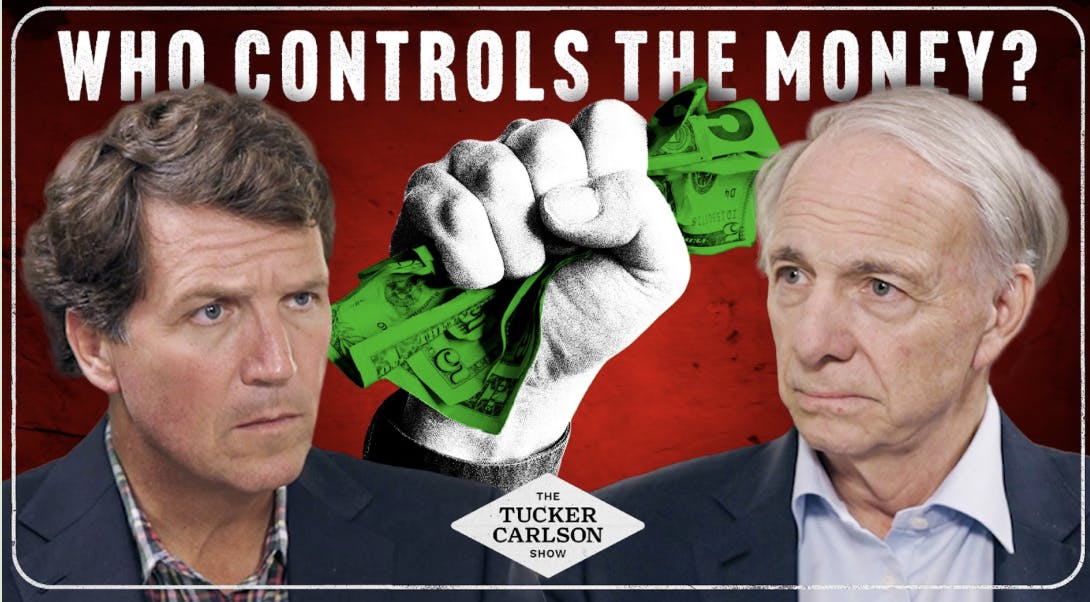
Ray Dalio: How to Survive the Coming Civil War and Plot to Use Debt and CBDCs to Enslave You
About this Episode
Ray Dalio on how to prevent another American civil war.
(00:00) The Cycle of Civilizations
(26:53) Why Gold Always Survives System Failure
(46:09) The Difference Between Wealth and Money
(53:17) Should We Worry About Civil War?
(55:26) Who Actually Controls the Money?
Paid partnerships with:
Defend: Enter code "Tucker" for 20% off your purchase at https://defendcellcam.com
Dutch: Get $50 a year for vet care with Tucker50 at https://dutch.com/tucker
Charity Mobile: A pro-life company serving pro-life customers and supporting pro-life causes for 30 years. Use promo code TUCKER to get a free phone with free activation, free shipping, and a free gift with every new line of service at https://charitymobile.com/Tucker
Learn more about your ad choices. Visit megaphone.fm/adchoices
Transcript
America leads the world in medicine development. It matters. We get new medicines first nearly
three years faster. Five million Americans go to work because we make medicines here at home
and not relying on other countries keeps us safe. But China is racing to overtake us.
Will we let them or will we choose to stay ahead? When America leads, America cures.
Let's tell Washington to keep us in the lead.
Learn how at americacures.com, paid for by pharma.
Redalia, thank you very much. We spoke last year in exactly this place and
and you outlined in part the cycle that you see in civilizations,
vying for supremacy of the world. And not everyone I think bought kind of bought into your
views on this and you were delighted as what Jeremiah is scaring people on everything.
Your later you have a new summary of ideas that you've been
formulating for a long time out this week and about 18 people have sent it to me. And so I think
we've reached a moment where people are ready to hear what you're saying. So if you wouldn't mind
outlining in whatever detail you like, the cycle that you see the countries go through and where
our country the U.S. is in that cycle. Gladly. Yep, so there's a cycle. There are orders.
There are systems, right? So there's a monetary order. How does the economy work? You put
in money, creates credit. People with credit take do things with that they borrow if they can earn
enough money to pay back. The system works well. They create productivity. They create opportunities.
The capital markets and so on. That's the monetary system. And the way that works and the cycle
is that when there's no debt, such as in 1945, we start a new monetary order. There's no debt.
There's a system and it builds up over a period of time. And it's a mechanics that when
income, when debt service payments rise relative to incomes, it squeezes out other spending.
The way it would do for you as an individual, the way it would do for companies,
except governments can print money. But that squeezes out spending and that becomes a problem.
And then you also have a supply demand problem. So when you have a new monetary system,
which the United States had the new monetary system and the dollar was the world's reserve currency,
then you can sell a lot more of the debt. So there's a supply and a demand, right? And so when
that builds up and everybody's one man's debts or another man's assets and they build up holding
a lot of dollars in nominated debt, and then they sell a lot more debt, then there's a mechanics
of that supply demand. And then when you have politics and world politics, geopolitics,
enter into it, that monetary system is more at risk for those reasons. We'll get into that.
But the first force of these five forces is the mechanics of this process, which is the monetary
system. The second is there's a domestic political order. There's all countries have an order,
a system, and all these orders change and they evolve. And of course, that is connected to
the economic system. And so when you get large wealth and values differences, and there's a sense
that the system isn't working for them, and there's greater polarity. There's the emergence
of populism, like in the 30s, you know, the left and the right. And there's that populism
gets the point that there are irreconcilable differences. In other words, the lack of willingness to
compromise, the lack of willingness to accept loss, losing one's vote, and so on. But if fight and
win for me at all costs, like in the 30s, four democracies chose to be autocracies because the
polarity was so great and the willingness to go along with that democracy system ceased to exist.
So that dynamic has happened throughout history. And then the third is the geopolitical order.
How countries were relative to each other? What's the system? And after World War II,
we created a system, a multilateral system in which it was in some ways naive, but it was very
different than existed before in that by being multilateral, having united nations, a world trade
organization, a world health organization, a world court, and all of those, the idea of being
representative and they would make decisions in a certain rule-based system was the path. And of
course, the problem of that is that any system has to have its enforcement. And if the system,
as a whole, a multilateral system is not consistent with the interests of those who are the most
powerful, the power rules, and so you have the dynamic of the breaking down of that order.
So we're breaking down the monetary order in a very classic way. We're breaking down the
political order in a very classical way. We're breaking down the geopolitical order. So those
orders, we have to recognize throughout time, all of those orders have changed. There's never
been a time that they haven't changed and haven't broken down in their issues. And they're getting
back to how they were in some ways in the past. Number four is acts of nature, drought floods
and pandemics have killed more people than wars. So you can't ignore it as a big influence. And
number five is the inventions of new technologies, particularly fabulous new technologies come about.
And they're important not only for prosperity, but they're important in wars. Whoever wins the
tech war wins also the economic and the geopolitical war. And so there's that dynamic. And that dynamic
is when there's rising powers, challenging and existing powers. There's no court to go to. There's
no way of resolving that. There are tests of these powers and we're in a power type of dynamic.
Now, when you understand that that dynamic works through time and you get down to its individual
symptoms, in other words, there's in my book, principles for dealing with the changing world
order, which I wrote about five years ago. I took and I broke that cycle into five parts of the
six parts of the cycle. And like a disease, you can see the symptoms in those parts and you
can see it progress and you can see the choices that exist at those stages. So when you're in a
different stage, the leadership has a different stage. And all I wanted to do, whether it's in that
book or in our conversation here today, is to try to let people see that. And I'm just a practical
investor, right? I've been to 60 years. I've been named macro investor. So I have to bet on what
the future is going to be like. I place financial bets on that. And now I'm at a stage in life that
I want to pass that along. So I hope that we could talk about or look at that in a dispassionate way
to say, how does the machine work to produce that dynamic? That's exactly right. And you're not
casting judgments here. You're just acknowledging what has happened and what, therefore, it's like
that happened. Because go back, I don't want to let this pass. In the second factor that you described
in this, the political factor, you pointed back to the very fraught decade of the 1930s and you
said you had four democracies become a revert to autocracies because of the partisanship that
became unworkable. They couldn't reconcile. And so they became autocratic. Is that a consistent
principle to you? Yeah. That's you can look at it through Chinese dynasties. You can look at it
through Rome. Like who was in control, right? That they, you know, Caesar in the Senate and being
in the Senate. Plato wrote about this. I think it was like 350 BC. He wrote about the cycle in
the Republic. In other words, democracies and the challenge of democracies where you vote
and so on. But then there's the that were wealth gaps and the rich gaps and then who has the
money and then the not willing to vote. And then there's the power that changes. Yes. So partisanship
becomes gridlock becomes irreconcilable, just mass. And then that evolves by necessity into
autocracy. Right. When the one I'm no longer willing to accept that the system, the rule of the
system because everybody thinks it's rigged. Okay. Is this the Supreme Court? Is it rigged? Because
that partisan has more pointies and it won't be fair. And so I remember when the Supreme Court
was kind of the Supreme Court and we lived in at a time where we said the system is fair.
The legal system when you go in and you're convicted. Okay. Is the legal system fair? And so on.
And then you believe in that system with its imperfections and so on. When that ceases to be the case,
when the when the causes that people are behind are more important to them than the system,
the system is in jeopardy. Right. Yes. Of course, by definition, and all this is relevant to where
we are now. So tribalism, whether it's political or ethnic, but when people square off into
tribes and they have no common ground and they have no hope of reconciling or compromising,
then you're getting a new system. And you see it. It's so interesting. It's like watching a movie
over and over and over again. Because then you see how it is. They make stereotypes of the other.
Right. The stereotype of this that personality, the stereotype of that type, whether it's an ethnic
or economic or whatever it is. Oh, they're one of those. And I'm one of these. And now it becomes
the stereotypes that are fighting, right? Which are nonhuman, right? So it's easier to.
There's no empathy. There's of course, because there's the. It's not human being. It's a stereotype.
It's the fight. Right. And so then you have to pick a saw. I mean, one of three things. You have
to pick a side and fight for it. Or you keep your head down and hope you don't get shot or flee.
That's right. This is throughout history. Yeah. And that's what's happening.
Hey, it's your brag. But we're pretty confident. This show is the most vehemently pro-dog podcast
you're ever going to see. We can take or leave some people, but dogs are non-negotiable. They are
the best. They really are our best friends. And so for that reason, we're thrilled to have a new
partner called Dutch Pet. It's the fastest growing pet telehealth service. Dutch.com is on a mission
to create what you need, what you actually need. Affordable quality veterinary care anytime
no matter where you are. They will get your dog or cat, what you need immediately. It's offering
an exclusive discount. Dutch is for listeners. You get 50 bucks off your vet care per year.
Visit Dutch.com slash talker to learn more. Use the code Tucker for 50 dollars off. That is an
unlimited vet visit. 82 dollars a year. 82 bucks a year. We actually use this. Dutch has vets who
can handle any pet under any circumstance in a 10 minute call. It's pretty amazing. Actually,
you never have to leave your house. You don't have to throw the dog in the truck. No wasted
time waiting for appointments. Don't waste money on clinics or visit fees. Unlimited visits and
follow ups for no extra cost plus free shipping on all products for up to five pets.
It sounds amazing. It couldn't be real, but it actually is real. Visit Dutch.com slash talker to
learn more. Use the code Tucker for 50 bucks off your veterinary care per year, your dogs, your cats,
and your wallet. Fox News is now streaming live on Fox one. When it matters most, turn to the
voices you trust. We go beyond the headlines, bringing you the stories you won't hear anywhere else.
Live coverage, sharp analysis, real perspective at home or on the go. Stay connected when it counts.
Stream Fox News on Fox one. Download today.
During Lowe's pro savings days, save more on what goes into the job. Add power to your lineup
with a free to walk 20 volt max five amp hour battery when you buy a select to walk 20 volt max
tool. Plus get up to 35% off. Select major appliances for rural pool,
Maytag, and more. Get the job done right. Keep more in your pocket. That's pro savings days.
Our best lineup is here at Lowe's valid through 327 selection. Various allocations.
Cross applies last. Well, thank you. So you join effectively the Civil War. You try and find a
safe place domestically or you just split. Yeah. In other words, you're quiet because you don't
want to get into the fight. You're going to get injured, right? A lot of people are scared now,
right? People you'd imagine never would be scared. Right? They don't want to speak up
as something. So you keep your head down. You either get in the fight and fight, pick a side and
fight for it. Throughout history, this is true. Pick a side and fight for it or keep your head down
or in some cases flee. You know, people leave. They go from, you know, immigration. Think about how
all the immigration largely is taking place. Right. There's some hell taking place in there.
And then they move to some place else where there's not. Here we are in the UAE. Okay,
a lot of people are coming to the UAE because they're fleeing in a sense. So there's that dynamic.
And so you can see many, many, many symptoms. Like there were things, you know, when it gets violent
and then when you get killing too many people, then you start to cross the lines, you know, like
maybe in Iran. Okay, do we cross the lines? Yes. And then where you, you know, there are these
symptoms that, and there's financial, you know, how do you pay? So, and Ram, Ram was like,
you're not Ram. But just back to the political one last question, is it ever resolved? Does the
system ever stay intact when you get to a point where people just don't want to compromise at all
or even live in the same place? Have you seen any example of where people sort of decide, wait a
second, let's, let's enter into power sharing and pull back before this gets violent or we get a
cane? In some places, sometimes in dynasties and so on, they're not often, what happens is there's
a reversal or a fixing by somebody who can not, who's strong enough to deal with the issues.
For example, we have a dead issue, we have all of these other issues and can bring people together.
But there needs to be almost, Plato would say, the benevolent despot. Yes. That's in his cycle.
In other words, there's somebody who can stop the fighting and be smart and impose the disciplines
that are necessary, for example, there's a financial discipline. How do we deal with the debt and
all the supply demand and so on? Can we raise taxes? Can we cut spending? What are we going to do to
bring about a budget balance or not a budget balance, let's say a deficit of 3% of GDP, which would
sustain set of circumstances? What is that financial discipline? What is that way of working together so
we do not do each other harm? Because we are at a point, let's say, as we come to the next midterm
elections. There's a significant probability that the Republicans would lose the House and
talk of even could be the Senate. Now, when you go after that and you imagine what the conflict
can be like, how will that conflict work? Will it be rule of law or will it be a win at all cost?
And as that win at all cost and what that means, is there rules? Is there playing by the rules?
That dynamic. So this thing is repeated. It's not easy to get to that point because you have to deal
with how do we stop fighting with each other and how do we do the right things to get strong?
That's a great challenge. So where are we now given the five factors that you outlined?
Where is the United States or even really the West will include Europe in this very familiar cycle
of rise and fall? In my book, I show 18 measures of health having to do with education, military,
reserve currency, a number of measures that show strength. Okay, what is the level of strength?
And the United States is the strongest power which has been in relative decline and experiencing
these conflicts. And that's measured if you go in the book, how principles for dealing with
the changing world order, you'll see a number of charts. So I don't want to just pronounce it that
way. I just want to say that like if you were to take education and to take scores, pieces of
scores and so on and statistics, you will see that there was a rise, their rising powers,
their declining powers, their large wealth and values, differences. And we are in what I call
stage five, which means we are sort of at the brink, but not over the brink. In other words,
we're not, there's a capacity to, it's before a period of great disorder when there can be a
monetary breaking down of the system, you know, what is money? We should talk at some point.
What is money? And can I, can money be an effect of storehold of wealth? And what happens if it's
not? And so we are at what I would call stage five in a six-stage cycle, the six-stage is when
there's a breaking down of these orders. We're not there yet, but we are close to there and headed
in that type of direction. What does a breakdown look like? What does stage six look like?
Well, from the monetary point of view, it is that the demand for the reserve currency
is not sufficient to meet the supply. So what that means is you see a supply-demand problem.
You produce a lot of supply and the demand's inadequate and all things being equal there will
be a rising long rate while the central bank is trying to hold that from down by easing the short
rate and and look shortening the maturity of the debt that it sells. Okay, that dynamic. And that
then the currency, these debts and the currency falls relative to the non-fiat currencies. In other
words, like gold. In other words, you are seeing a movement by central banks and countries
to hold gold as an alternative reserve currency, partially because of that supply-demand situation
and partially because they worry that there may be a payments problem. And the payments problem,
like it happened in Japan, prior to World War II, yet an economic problem. And the United States
sanctioned, essentially, didn't pay the Japanese their debt, the money in terms of that,
like a debt or credit or problem. And they didn't make those payments. Much like Russia,
they basically took control because they have the ability to take control of the treasuries
and other things. And so there is becomes more of a reluctance to hold that money as that
and a movement more into the non-fiat currency, which is gold. So, in other words, other countries
perceive a risk in holding dollars because, well, for lots of reasons, but one of them is,
like, if the United States government at the time doesn't like you, they can grab your dollars.
That's right. No, worth it. Right. And it's a risk that both the debtor and the creditor have
to each other. So, think about a China. And if you were thinking China, how do you feel about
holding treasury bonds? Okay. So, you may not feel secure about holding treasury bonds,
both for two reasons, because you could be sanctioned or you also, because there's a supply-demand
so you start to see the movement in that direction. And then, of course, it's also in that situation
governments want to control their supply-demand, so they might establish foreign exchange controls,
they might do certain things like that. But they also feel vulnerable. The United States can
feel vulnerable if they can't sell enough of those bonds to others if the demand isn't,
because then interest rates would have to rise, because the supply-demand too much supply
relative to them. To make it more appealing to buyers. Yes. And also to cut the demand for credit.
In other words, if the price rise, then people will borrow less and so on. And that then has the
effect of mechanically slowing down the economy that produces that result, which then what happens
is then the central bank comes in and it prints money and it buys the debt, which depreciates
the currency. That's the mechanics that's of the debt part of it that is related to the political
and the geopolitical part of it that I'm answering. May I ask you something or so? If foreign
countries don't want to buy your debt and your central bank decides we're going to print more
money and buy our own debt with it, which is what we're doing, wouldn't the people doing that stop
and say, wait a second, this sounds like an electric windmill. What are we doing here? This sounds
crazy. They're stuck. They're stuck. They're stuck because they have a deficit and they'll
deficit will be there unless they raise taxes and cut spending or something. And that's bad for
the economy and it's politically bad. Or you print the money and you make up the difference. And
so since the breakdown of the monetary system in 1971, that was when there were too many claims
on gold and we had a system attached to gold and because they were in August 15, 1971, I remember
well I was clerking on the floor of the New York Stock Exchange after college before I went to
graduate school. Richard Nixon gets on August 15 Sunday night. He gets on the television and he
says we're not going to allow the conversion of that paper money into gold and we're not going to
you won't get your gold. And then I walked on the floor of the Stock Exchange the next morning.
I thought this is a big crisis and what they did is they essentially printed it and then we had
the stagflation of the 70s. But I was very surprised and I found out I didn't
we never threw anything like that before. I studied history. I found out they did the exact same
thing in Roosevelt did the exact same thing at March of 1933. Right after you got inaugurated.
Right. Okay. For the same reasons. Okay. Because your choice is to have a lot of defaults and a
debt problem or to do that. Right. That's how it works. That's how the machine works. So
and at the end of the day since 1971 when we went off the gold standard and we went to a fiat
monetary system we have always done that and you know and you know the Fed put and you know that's
that's the way it is. So and it's kind of worked for 55 years but it's showing signs of
what it does is it's like using what was the hair of the dog that bit you. Oh it's the hangovered
cure. Yeah. I'm familiar with that. Okay. Yeah. For sure. It's what you do is you give more money
in credit and what happens is to get out of it and because then you make it easier to pay the debt.
You make like in 2008 or 2020 you give the money. Okay. And you give the credit and you and you
fund it and you make that but that makes the debts go up again. Okay. Until then you reach the point
where the debt is squeezing on the expenditures and you have the supply demand. So that's why
you have these big debt cycles you know. When we started this company we promised that we would
only partner with other companies that share our values. We didn't want to advertise products made
by people who hate us or for that matter you. So with that in mind it is a pleasure to announce
we're working with charity mobile. It is a pro-life phone company. Charity mobile holds a view on
abortion than almost every single major US company disagrees with. I think it's completely wrong. It
is sad and celebrating it is one of the darkest things this country's ever done and we agree
completely. So when you switch your cell phone service to this American company they'll donate a
percentage of your monthly price plan to a pro-life pro-family charity that you choose.
There's no better way to prove what their real values are than doing that. No one would do that
unless they meant it. All their plans are under 50 bucks and you can keep your existing number
and your existing phone if it's compatible. Charity mobile is a pro-life company serving pro-life
customers and supporting pro-life causes and it's done it for more than 30 years. Visit charity
mobile.com slash Tucker use promo code Tucker to get a free phone with free activation free shipping
and a free gift with every new one. Jackson Hewitt has a great tax prep deal $149 or less.
Missing out is like ignoring the check engine light in your car. You regret it. Seriously the price
is only $149 or less no matter how complicated. So don't wait. Like when you get a password
expires today alert or you're shopping online and there's only one item left it's like your taxes
are in the cart just complete the purchase. Hurry this deal for $149 or less is like your phone at
1%. It's about to power down. Limited time offer for new clients on federal returns participating
locations only terms of Jackson Hewitt.com slash $149. Finding a hoodie that lasts through the season
can be tough. The American Giant Classic Fulzeh Putty is made to last a lifetime so you can count on
it to bring you comfort and warmth year after year. The iconic classic Fulzeh Putty is the jacket
that started it all for American Giant. Custom heavyweight fleece and side panels for mobility
make it the best hoodie ever and a double-lined hood and reinforced elbow patches means this hoodie
will last. Born from a commitment to support the communities that create its products every American
giant piece is made in America and designed to last. No exceptions. The result is durable clothing
like the premium Slub Crew T no BS high-rise pant and slim rough neck pant that become part of
your life. Snag the hoodie that will bring you comfort for life. The American Giant Classic Fulzeh
and save 20% off your first order at American-giant.com when you use code staple 20 at checkout.
That's American-giant.com code staple 20. I have service. So I think every even people who are not
really interested in monetary policy or macroeconomics feel like there is a point at which this
doesn't work anymore. It just breaks. It is. It's happened all and all. So what does that look like
specifically? The dead craze as people keep talking? Well I because of that my last book, my most
recent book put out about a little less than a year ago is called How Countries Go Brogue.
Yes. The big cycle. And what I wanted to do and is to just show 35 cases of it that is just
the mechanics to show how it works. But it is that dynamic of the squeezing on the spending
and the supply demand. And then you start to see it where as I was saying the long rate goes up
while the short rate comes down because the central bank is pushing the short rate down. And then
they shorten the maturities of the debt. And then the central bank buys that. And then the central
bank now it's owns all these treasuries. And then the central bank starts losing money because
they own the treasuries. And then they're going up. So they have to produce the money and credit
to keep that rate down. And they lose more and more money. And that dynamic then doesn't stop that
they change in the capital flows. That's why you and then traditionally in all of these cases,
you see a move to the hard money to move to gold. Okay. As we're seeing, you see that dynamic in
terms of that move to gold. And then it starts to run its course. So it's very much like think
about what happened from 71 through the 70s produces more stagflation. And then at some point
the inflation problem or the devaluation of money problem becomes such that the central bank
then titans money and so on and the bulk of years, 1979, 80, 81, 82. So the pendulum swings.
Think about it this way. In order to have a balance of successful economy or successful capital
market, since one man's debts or another man's assets, you have to keep interest rates
not so high that they crush the debtor without having them so low that they are bad for the
creditor. So you see these cycles when we had zero interest rates and negative real interest rates,
what you saw was massive creation of credit and money and borrowing and so on. And then you had
that cycle. So that's what the cycle looks like if you have losses. And then you also have
under those circumstances, classically, the weakening of the central bank control or I should say
the strengthening of the central government's control over the central bank.
In other words, when these things happen, then there is, they can't be at odds. Okay. And so there
is greater control by the central government of this. And are you writing the news? No, I've just
seen this movie before. This is exactly what's happening. I know, but that's what I'm saying because
must happen in that, in the nature of that dynamic, when you have, imagine a fight between the
central bank and the central government in the middle of a crisis and so on. So there is this
control because there's a monetary, there's your has to be right. What happens if you're the
president of the United States or you are the leader in that country and you're in this kind of
monetary crisis? It's like anything, any fight. You don't want the internal fight. You want to
get control and there's a fight for control. So we're living in a world today in which there are
fights for control, right? Who has the power and the fights for control? So again, at what point do
we know the system is just broken and this, this experience began post-war in 1945. It's like
reached its end and we need something. Pretty much almost only in retrospect. What happens
if you really close up and you say, when did they know that there was a breakdown or when did
they know that there was, let's say the French Revolution? There's a day that they say,
storm the best deal. Right. And there's that day and they said it. They didn't know that. No,
they didn't. Just like some prison got raided or something. They didn't, yeah, no, that's right.
Okay. So when it's not like they announced it or it becomes clear cut, right? You slip into
those things. There's never that clear moment. But what happens next? We heard Chairman
Sheep three days ago say, hey, by the way, China should hold the world's reserve currency and
that seems very far away. Now, I guess, but maybe. So you're asking me what I think about China's
having. Well, I just, I will, the other reason I'm putting the, I have no idea if that's possible.
I can, you can tell me. Yeah. Okay. I don't think China is going to have a, there are two
purposes of a currency. Yes. Medium of exchange and storehold of wealth. Right. Okay. Medium of
exchange. It's logical that China is going to have much more of a medium of exchange type of
reserve currency because it is right now the world's largest trading country. Right. And so people
central banks want to hold some reserves in the things that they're trading in. Of course.
And so on. And so they, the Chinese have intentionally, in order to minimize that conflict,
have not pushed that thing. And now they're going to operate and moving in that way.
As far as storehold of wealth, though, who's going to trust the Chinese with your wealth and
capital controls and so on? I think that all fiat currencies have a problem. Okay. So they're,
they have the history of foreign exchange controls. They have it. Would you trust it's anti-wealth
protection? You know, this is not, that's not their great track record. I think I'm going to protect
your wealth. You even private property and how it works in China is a new concept relatively. And
it's something that they're, you know, wrestling about. They don't, you can't own land. You know,
you can't own property. So the storehold of wealth element is going to be very tough for
them to sell. So the world does not have what you want as a currency, as a reserve currency,
other than gold. I mean, it's just a default, right? Because it's a debt and gold is, you know,
what, like they say, it's the one asset you can have that's not somebody else's liability,
meaning you have to get money from somebody else to do. So I asked you last year off camera. I'll
never forget it. I've always been a gold buyer, but then I don't know anything. I just instinctively
seemed like it made sense, but I've always been a little bit embarrassed about it. And so I asked
you, is it crazy to, you know, take some money in by some gold? And you said it's not crazy at all.
And I remember feeling vindicated, but also wondering like, why don't more people say that? It
almost feels like there was a conspiracy in the financial crisis. Things all around, not only in,
not only in related to gold, but all of the things I think people get used to, what's credible
to them is what they experience and norm that they have at that time. And so much see that's
happening. You, I hear people say, I'm shocked by, but the only reason they're shocked is because
they'd become used to that, right? If you, if you were traveling through time and you went and
before 1971 and so on and you saw history and you saw the university, university of money and gold.
And now the whole system worked repeatedly over time. You would understand there's that dynamic
that's taking place. But yes, people think they misunderstand. They think it's a metal to speculate
on. Right. They don't realize that actually it's a money. Okay. Central banks, second largest
money. Okay. So when you're, it's almost like when you look at the world through that money,
you can see what things cost through that lens. Exactly. People are looking at it instead,
like through a dollar lens and they see gold go up. Okay. But you could look at the world through
a gold lens and see money go down. Okay. So all I'm saying is because of their experience and what
it is, it's implausible. It's like the tooth fairy or Santa Claus, you believe in these things
and so on and then you realize through the cycle. And that's why surprises take place. That's why
it seems implausible. But if you read history, it's almost, it's logical. Most security systems operate
like old-fashioned cable internet. They're installed in one place. They're tied to one address. And if
you move or your job moves, you got to start over. But that's not how other people do a construction
sites, ranches, large properties, they have a better way. They need cameras that are portable,
not tied down to one location. Defend security cameras are the perfect solution for ordinary people
to do this. With defend, you own the camera. You're not renting it like a modem from a cable company
and you're not locked to a building or a Wi-Fi network. The job moves well then the camera moves
with it. That's a better way to do things. No power lines or infrastructure of any kind is required.
These run uncellular like your phone. They're perfect for watching. Job site equipment,
overnight, livestock, it's your ranch, long driveways, outbuildings on your property. You mount it
where you need it. You open the defend app and you are set. You got clear footage, night vision,
alerts straight to your phone. Defend never sells any data to anyone. Not tech companies, not
the government, not China. Plan started about five bucks a month. There's no contract you can cancel
it anytime. Visit defendcelcam.com today. Defendcelcam.com. Ryan Reynolds here from int mobile. I don't
know if you knew this, but anyone can get the same premium wireless for $15 a month plan that I've
been enjoying. It's not just for celebrities. So do like I did and have one of your assistance
switch you to mint mobile today. I'm told it's super easy to do at mintmobile.com slash switch upfront
payment of $45 for three month plan equivalent to $15 per month required intro rate for three months
only then full price plan options available taxes and fees extra default terms at mintmobile.com.
This episode is brought to you by spreeker the platform responsible for a rapidly spreading
condition known as podcast brain symptoms include buying microphones you don't need explaining
RSS feeds to confused relatives and saying things like sorry I can't talk right now I'm editing
audio. If this sounds familiar you're probably already a podcaster. The good news is spreeker makes
the whole process simple you record your show uploaded once and spreeker distributes it everywhere
people listen Apple podcasts Spotify and about it doesn't apps your cousins swears are the next
big thing. Even better spreeker helps you monetize your show with ads meaning your podcast might
someday pay for well more microphones start your show today at spreeker.com spreeker because if
you're going to talk to yourself for an hour you might as well publish it. So you don't seem
surprised at all by anything that's happened or is happening right now what are a few other
things you would not be surprised to see in the near future for example let's start with gold
what would you not be surprised to see the spot price of gold per ounce in like five years
I don't want to you know that's one of those headline presuming let me say it this way yes
I think people pay too much attention to the spot price whether it's a spot going to go up
or down or whatever and what they don't do is think if I didn't have any view on gold what
amount should I have in my portfolio and in other words if you did a portfolio construction
exercise right and you said what is an effective diversified portfolio and what assets should I
have and what amounts in that because gold is a very effective diversifier and also a protector
of this during very bad times gold does very well when the rest of your portfolio does
poorly because let's say the 70s being a good example or the 30s being a good example during
those times it's a diversifier okay so the optimal amount to have for an individual or a central
bank might be different but an individual would be depending on what's in their portfolio
between five and 15% of a portfolio and so what I would say is if you approach that question
that way and you think what should I have you should have what I what we talked about before
when my a year ago yes and so what you should have that particular amount somewhere in that
neighborhood depending on what your portfolio is like and because it's an effect of diverse
fire and it is a money okay when the traditional money does badly this money does well when the
traditional money which gives you an interest rate then it's the reverse so so that's the thing
that I would try to convey to people you know okay do you have some of that what's the amount
that's your comfort level you know but have some so what if you were running the United States
or a country like the United States in its current position what would you need to do to protect
your country in the midst of these changes some of which are inevitable some of which maybe aren't
like what are the steps specifically that you would take to help your country I would
be dealing with achieve something like a 3% budget deficit not more than a 3% budget deficit
I would try to get financial I try to minimize or eliminate but minimize the risks of that
dynamic I was talking about so you get the budget deficit yes but and I would say to every I'm
said to legislators I go down to Washington then you know leaders of both parties and I said
it's like being on a ship and everybody on the ship is headed to a rock and that and everybody
knows that if you have a deficit of six or seven percent of GDP you're going to have a supply
demand problem and I have the conversations and by and large this is the agreement and I don't
care whether you turn left or you turn right in terms of that but do not hit the rock and what
if I would do is I would take a 3% pledge in other words say I will get it down there and if I
can't agree on how I would do it proportionately with three things I would proportionately with
taxes spending in other words if you raised taxes by 4% if you cut spending by 4% and you lowered
which would lower interest rates because it improved the supply demand and it would also convey
the message that it's being dealt with you would also lower the interest rate on the debt
and those two things would begin to get it to approach about a 3% budget deficit and so on
and but doing that would require would be politically impossible so I I have these conversations
and the answer is you know like Ray you don't understand the world of politics if I'm
I have to give at least one of two pledges the pledges and probably both the pledges is I won't
raise your taxes and I won't cut your benefits okay you know taxes you know good so there's a big
move here primarily to try to grow your way out of it in other words again you know
stimulate fiscal and monetary stimulation and hope that that produces perhaps with the new
technologies and so on that's the idea enough income growth and so on so that this moves toward
that 3% which is in my opinion a not likely occurrence why is it not it's not likely that
technology will turn out to be so beneficial and lucrative that it I think that the
the artificial and technology miracle is a is a is a great miracle okay I mean very very
beneficial and I've gone through study great miracles the invention of electricity I mean wow
what measure where we'd be without that but if you anyway you know I could describe
what the 20s would like and 2000s and like and so on the ability to convert that to enough of a
productivity miracle is is not I think probable in the also the time frame that we're dealing with so
this is an issue the debt is and that dynamic remains an issue and then of course what there is
is the dynamic of of how that prosperity and productivity is shared in other words there's the
it's it creates a great wealth gap right or you're seeing this we'll talk about wealth I'm going
to come back and talk about wealth but you're seeing great increases in wealth on some populations
you know wow trillionaire okay and that kind of thing and then there's 60% of Americans have
below a sixth grade reading level so that you take that sixth grade okay now how are you going
you still have to deal with the nature of that dynamic of how it comes so the question is what
is the amount of productivity converted into income how does the government get that income to deal
with its debts so the holders of the debt get a effective real return and don't have the problems
how does that happen you know in a politically acceptable way there are lots of things that make that
you know very very difficult I want to say something about wealth and wealth taxes which is I think
worth understanding there's a big difference between wealth and money and I want to just highlight it
okay wealth is it is very easy to create because it's almost accounting limit what I mean by that
is I could put out a raised 50 million dollars or individuals can raise 50 million dollars
at a billion dollar valuation and they will call that that that's that person's a billionaire and
that there's a billion dollars more wealth okay it's not literally that you have to have those
transactions and wealth is not worth very much unless you convert it to money in other words
you have all of that wealth but you can't spend well you can't pay for dinner with it right
you have to sell it sell some of it in order to get money in order to pay it and so when wealth
rises a lot relative to money you have a risky situation okay now the other thing about why
is that a risky situation because when there's a movement the the bubbles pop right when there's
a movement that I need to get money now that quite often is I need to get money because it's a
debt service payment right no it's let's say quite often people borrow to buy wealth okay so
there's a lot of borrowing now not only in buying stock but companies themselves buying to create wealth
and when you need to get the money like in the in all the stock market bubbles there was a lot of
borrowing to buy the wealth when the the need for money came along they had to sell some of that
wealth to get the money and then that produces a dynamic well you don't tax wealth okay so because
you don't tax wealth and then there is this political issue of wealth are you going to tax wealth
what is going to happen in California what is going to help the elsewhere in terms of
taxing wealth if you tax wealth then imagine what happens you have to sell wealth to pay taxes
okay so there's a dynamic understanding and that lowers the value of it right and that's what
pops bubbles right so this the wealth issue is is a political issue the wealth gap issue is a
political issue and it's a market issue and it's an important issue to understand is it inevitable
that you would see given the way our wealth is allocated across 350 million people that you would
get the rise of wealth taxes because the goodness have been predicted it it it seems like
it's such an obvious headline seemingly logical thing to do right right in other words everybody
would say wait a second all these people having all the wealth then you're not paying any taxes
on their wealth while this is going on okay we need to go where the money is right right
so we so it seems like that without then you know the full understanding of those things and how to
do it in a you know managed way but so it's anyway it's upon us certainly and what will happen
I mean that's I think a referendum in California so well I think what's what's happening is
and we're seeing it around the world in many different ways people are people in California
moving and it's not the it happening it's the fear of it happening right right so you're you know
you're seeing that dynamic I'm just a you know like I'm a mechanic of course I get it you're not
judging other way you're just describing what's happening but because that is happening and people
are moving and not just within the country but outside the country do you have any guesses as or
observations about where people are moving so clearly in the country it's Texas Florida but
Wyoming but in the world where people moving um they're generally speaking they're moving
to where there's civility and opportunity and there's not much fighting there you know they
want to be in places that um have a um they go to places that have lower taxation but also
vibrancy you know they go Texas and Florida as you say and um here in the Middle East or in um
you know places that um are also vibrant and things are happening and see you could see the
patterns of those kinds of movements and then the problems that that creates is a hollowing out
in those places the other places because when they leave the tax base um is um you know um
roughly speaking you know the top 10% pays about 80% of 76% or something of the taxes and so when
you lose let's say half of them you lose a big amount of tax revenue and um then that
becomes a you know a dynamic so could you see given all the factors you've described um
like democracy representative democracy continuing in a in a country like ours
I um I um I you know I just the I hope so oh me too and I just and um and I just don't know I think
um I think we I think deep in us we want most Americans really really want that
so on um and then at the same time there are irreconcilable differences and um I think it was
um a recent poll something like 25% of the um population said that they would fight violently
for their side I mean some significant percentage yes and um so and it only takes
a relatively small amount so I don't think we can take it for granted another
there's a lot we can't take for granted and I think we want to cherish those things
I want to put those things above everything else but you can't take it for granted
when you hear people speaking lightly of civil war what's which they are
what's your reaction um I have a principle if you worry you don't have to worry
and if you don't worry you need to worry because if you worry if you worry then you're more inclined
to prevent the thing that you're worried about so I think that the greater worry about some of
these things is a good thing you know yes in other words okay now we won't take it for granted
we worry about these things so what are we going to do about it I see people not worrying and sort
of widely widely throwing it out like almost like the way they talk about some foreign policy
operations is go in and you know kill these guys put these guys in it'll be fine that same
attitude I hear a lot about the United States like well we're going to have to fight it out at
some point you've taken a close look at civil wars throughout history what are they like
well civil wars and international wars are so horrendous that every the most bold people
who were you know trumpets blaring and and going into that and so on everyone came out of it
with deeper regret I mean we can see while we see it on the news and you can see that but
just imagine how horrendous the wars are so I think it's a cycle you know your confidence and
your boldness is increased by the distance that you have to your last wars you know right
okay what is the difference you you were saying earlier there's a difference between
money and wealth and wealth you said is not necessarily easily convertible to money
in a society like ours where is the money who has the money is it the same people who have the
wealth no no no no many people have a lot of wealth and don't have much money they have ill
liquid assets yes okay now money is the is that what you can transact currency short term deposits
that you can assuredly and quickly turn into money you know that's what money is yes and
and and the central bank really controls the money and then you could look at who has that
increasingly like you could look at M zero M one and you could see money market accounts and you
could see those very liquid you know money safe money treasury bills those kinds of things and
so that then you know it's but ultimately it's the central bank because they control the supply
demand so I mean if in a period of volatility it would seem like the central bank would clamp
down on the money supply circulating among people well it faces the trade-off right the trade-off
is like a let's say COVID right or 1971 when there's too many claims and so on
there the trade-off is that people need money and they may need money to pay debt and they
may need money for whatever reasons and so they are tempted therefore to create money and so
you see the coordination between fiscal policy and monetary policy so you saw two big waves
of large budget deficits and large supports of central banks first um under Trump when the
uh covid began and then under Biden when they got in and because he also wanted more universal basic
income and both of those cases the government sent out lots of checks and that's also a popular
thing to do discipline financial discipline is not what the population typically likes send out
those checks but where does the money come from and then the central bank cooperates
buying the government bonds and um produce you know print money and then buying those bonds
so it's um when they're in the middle you know austerity is not an easy thing to have right
what happens if the government issues digital currency like what does that mean?
well digital currency is right you're talking about um central bank digital currencies yeah
okay and that um um there's a great deal of a PLB cause of the fact that it's easy and so on
but it's um and i think it'll it'll it'll be um and it'll be none a lot happens you think it will be
done um yeah i think it's and but what happens in the digital currency um but of course it's easy
to transact and so on um almost the uh and it'll be like money market funds i think um the question
will be first uh will they be able to offer interest so there's a debate now as to whether
they will be interest if they're not able to offer interest and they that there will be a debate
probably they won't be but then they're not on effective vehicle to hold it in because you
have the depreciation of course you'd rather hold it in a money market fund or a bond but that's
the debate there will be no privacy and it's a very effective controlling mechanism by the government
what i mean is all the transactions will be known all transactions done with digital currencies
will be known um which is good for illegal activities getting control legal activities
but it also means that the government has a great deal of control for example they can
they can tax that way they can take your money they can establish foreign exchange controls
in the like and that'll um so that's something that uh will be an increasing issue particularly for
international holders of that currency because they might feel let's say if you're a Frenchman and
they wanted to have sanctions they could take your money of course you know and and so on so
there's the privacy issue uh of that um so um and if you're politically disfavored you could
be shut off pretty little bit dislavered you could be shut off yes um so those kinds of issues
and during to it for those reasons i don't and and they're very tiny um i don't think that you're
going to see the development of central bank digital currencies to be of a magnitude that it's
going to be um um you know that that big of a deal um i i i think that doesn't mean it won't
grow but i don't think it's going to be um a big deal um so so my last question is given um
your description of the United States as in stage five in a process that only it doesn't mean
it's inevitable of course but there are only six stages in the process you describe so it's
toward the terminus it's it's the time that it's time to worry
so you go to Washington you try to convince policymakers members of congress people
administration here's what you need to do you've described the reception you get is like
hey you don't understand politics we can't do that so that's you know not a lot of headway made
obviously for obvious reasons do you have advice for people watching who are not policymakers
who are just americans as to what they can do to prepare for whatever comes next
uh well you know there's the there's the basics you know um well earn more than you spend
try to save diversify your portfolio including about money
and those um that's those things are paramount importance um think about the country the
opportunities where where are the opportunities people have migrated from one place to another
follow the opportunities and most importantly is raise your children well um you know so that
they're well-educated and able to be productive and also civil so that they can be um
be effective and as I say there are only three things a country needs to do and that's the same
for the individuals you know raise your kids well so that they're well-educated and can earn
an income and and operate go to places that work well so that they there's civility and productivity
and there's opportunity and stay out of uh civil wars and international wars
those seem pretty obvious that i you do those things well i mean really almost everything else
takes care of itself really yeah right dahlia thank you very much for that it's always a pleasure thank you


