ReadMultiplex.com: You Have 5000 Days: Navigating the End of Work as We Know It. Part 16: Build Your Ark
Get every episode summarized
Each time ReadMultiplex.com Podcast. publishes, we email you a written briefing from the transcript — the topics, who appeared, and any specific claims, with the ad reads skipped.
Email me new episodesFree for 3 shows. No card needed.
About this episode
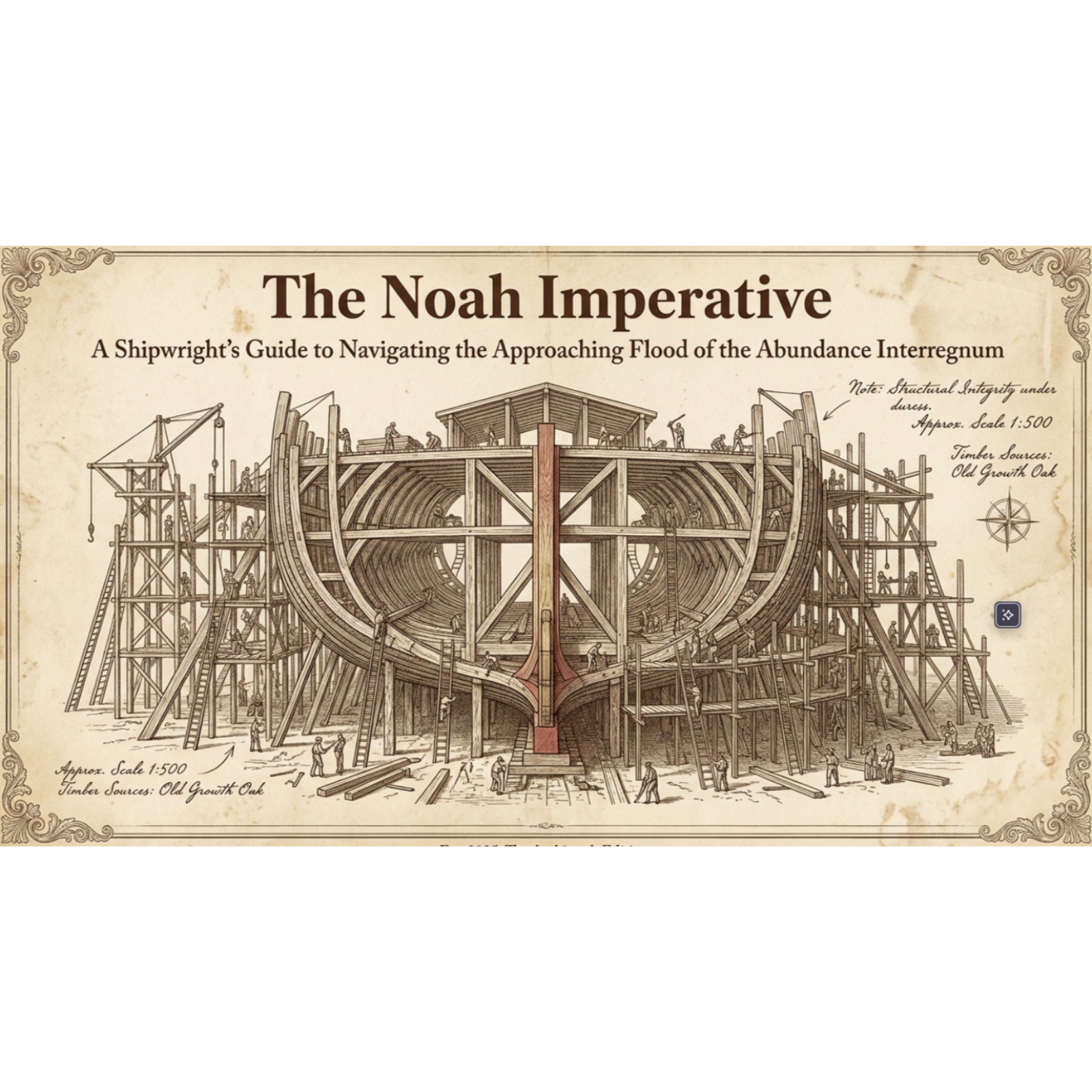
Gather around the shared fire of our destiny. I present this not as a chronicler, but as a guide through uncertainty. The flood is coming. This is not a deluge of water, but a wave of transformation from AI, automation, and remade economies. This is the flood of the Abundance Interregnum, the passage we have charted across these 15 chapters, where old wage structures crumble under AI’s surge. In the next 5000 days, from late 2025 to 2039, you must become the architect of your future, the hero of your own journey.
We draw from Noah’s tale (a vitally important story no matter your faith), the archetype of preparation, and weave it through Joseph Campbell’s Hero’s Journey, the monomyth guiding our series. In Genesis, Noah lived in a corrupted Ordinary World, like our era of deskilled labor from Part 5: Your Deskilling. The divine Call to Adventure came: Make an ark. Noah crossed the Threshold into trials, gathering materials and enduring mockery. He entered the Inmost Cave of isolation, faced the Ordeal, and emerged through Resurrection to the Elixir of renewal.
Read the article at: ReadMultiplex.com
Get every episode summarized
Each time ReadMultiplex.com Podcast. publishes, we email you a written briefing from the transcript — the topics, who appeared, and any specific claims, with the ad reads skipped.
Email me new episodesFree for 3 shows. No card needed.
Hosts & guests
Transcript ready
814 searchable segments. Every word is indexed and playable.
Full transcript
ReadMultiplex.com Podcast. — ReadMultiplex.com: You Have 5000 Days: Navigating the End of Work as We Know It. Part 16: Build Your Ark. Machine-transcribed; use the interactive transcript above to jump the player to any line.
I want you to close your eyes for a second. Seriously, just for a moment. Yeah, just picture the heat. It's not just a warm day. It is a relentless baking heat that just cracks the earth beneath your feet. You're standing in the middle of a desert. Right. There is not a single cloud in the sky. The air is so dry, it just sucks the moisture right out of your skin. And all around you, life is just happening. Exactly. People are arguing over prices at the market. They're planning weddings. They're complaining about the local politics. It is business as usual. Completely normal. Which is, I mean, it's the definition of normalcy bias. Everything looks fine, so everything must be fine. Right. But you, well, you are not doing business as usual. You are sweating through your tunic, dragging these massive beams of gopher wood across the sand. Because you are building a boat. And not just a little dinghy, you are building a Leviathan. 300 qubits long. That is roughly 450 feet for those keeping track.
It's a skyscraper on its side. And you are sealing it with pitch inside and out. And your neighbors. Oh, they aren't just ignoring you. They are laughing. They are pointing at you. Yeah, they think you have lost your absolute mind. They're like, why are you building a ship in a drought? There is no water for miles. But you keep hammering. Plank by plank. Because you know something they don't. You know the rain is coming. Welcome to the deep dive. I'm your host. And I'm sitting down with our resident expert to unpack something truly massive today. Thanks for having me. And that intro, that is the visceral reality of the no one narrative from Genesis. It really is. It's so easy to think of it as a nursery rhyme. You know, the animals, the rainbow, the two by two. To keep little boat with the giraffe, sticking their heads out. Exactly. But when you really strip it down as our source material does today, it is a psychological horror story that transforms into a story of ultimate redemption. It's about the burden of carrying a truth
that no one else can see. And the crushing isolation of preparation. And the reason we are starting with this ancient dusty image is because according to the breakdown we are covering today, that desert is right now. We're in it. You and I listening to this, we are standing in the sand. The sky looks blue. The stock market is doing its thing. Restaurants are full. But the barometer is dropping. Precisely. But this time, the flood isn't water. No. It is not a geological event. We are talking about a wave of transformations so massive that it defies historical comparison. We're talking about the convergence of artificial intelligence, large-scale automation, and a complete restructuring of the global economy. The source material for today's deep dive calls this upcoming period, the abundance interregnum. Yeah, I have to be honest. When I first read that term, I tripped over it, interregnum. I mean, it sounds like something out of game of thrones. It does sound a bit medieval, doesn't it? It really does. But it's a very specific technical term. An interregnum is a pause, a gap.
Like a waiting period. Usually it refers to the chaotic period between the death of one king and the coronation of the next. I see. The old laws don't quite apply anymore, but the new laws haven't been written yet. So we are in the gap between the age of labor where you trade your time for money and whatever comes next. Exactly. And the timeline laid out by Brian Romell, the author of our focus text today, is the next 5,000 days. Roughly from late 2025 to the year 2039. The premise is that the world we know, the world of go to college, get a degree, work for 40 years, retire. That world is about to be washed away. And the question isn't whether we can stop the rain. The rain is coming. The question is simply, do you have an arc? Right. We are diving deep into part 16 of the Read Multiplex series today. And this specific installment is titled The Noah Imperative. I think we need to pause here and talk about Brian Romell for a second. We definitely do. Because in the world of AI commentary, the voices are usually pretty polarized.
That is putting it mildly. You essentially have two camps right now. On one side, you have the economist and the tech bros who are just obsessed with the models. Yeah, they're looking at GDP shifts, productivity gains, stock prices. It's all very dry. Very clinical. They'll say things like, oh, labor participation will drop by 14%. They treat human lives like cells on a spreadsheet. And then on the other side, you have the dooms. The people screaming that we are all cooked. The robots will take everything. Humanity's obsolete just give up and wait for the end. It's terrifying, but it's also incredibly paralyzing. Which is why Brian's work in Read Multiplex is so distinct and so important. He acknowledges the danger. He doesn't sugarcoat the disruption at all. But he frames it as a hero's journey. He isn't telling you to curl up and die. He is telling you that you are the architect of the future. He takes this terrifying concept, the end of the traditional workforce, and turns it into a true call to adventure. It's empowering. It feels like he's handing you a blueprint
rather than reading you a eulogy. And that is literally what we are doing today. We aren't just talking philosophy here. We are going to break down the Noah imperative. We are going to walk through the specific timbers and planks you need to build your personal arc. And we should clarify, this arc isn't a physical boat. No, it's a structure of life. Brian divides it into five realms, mental, emotional, relational, financial, and physical. The core idea is that politics and economics are going to be chaotic. He uses the phrase crayons with no draftsmen. That is a brilliant image of chaos, crayons with no draftsmen. It really is. You cannot rely on the government to build your boat. You have to swing the hammer yourself. So our mission today is to give you that hammer. We want to walk through this blueprint so that by the end of this deep dive, you know exactly where your arc is strong, and where it might be leaking. Let's start with the map, the mythic map. Right, to understand where we are going, we have to understand the story we are in.
Brian overlays the Noah narrative with Joseph Campbell's hero's journey. I always love good heroes' journey breakdown. It's the skeleton of every great story, from Star Wars to the Matrix. But usually we apply it to fiction. Right. So how does it apply to a guy sitting in a cubicle right now worried about chat GPT taking his job? Well, Campbell starts with the ordinary world. OK. In the Noah story, that is the world before the flood. Corrupt, distracted, completely unaware. And in our context. The ordinary world is what Brian calls the era of de-skilled labor. De-skilled labor. That is a heavy term. Can we unpack that? Let's do it. Because I feel like most people listening think they are highly skilled. I mean, I know how to use Excel. I know how to edit video. I know how to code. But think about how we do those things. Let's take a very concrete example. OK. 20 years ago, if you were a taxi driver in London, you had to have the knowledge. Oh, right. The famous test. You had to memorize 25,000 streets. You had a mental map of the entire city in your brain.
You were a master of navigation. And today, today you follow the blue line on ways or Google Maps. Exactly. If the GPS goes down, the driver is lost. The skill has been outsourced to the tool. That is de-skilling. We have become operators of buttons, not masters of the craft. And Brian's point is that in the ordinary world, we are comfortable, but we are incredibly fragile. That hits close to home. I mean, I can't even remember fine numbers anymore because my phone does it for me. We all do it. So if that is the ordinary world, what is the call to adventure? For Noah, it was the voice of God saying, make an arc. And for us. It's a realization, maybe while reading part one of this Read Multiplex series or maybe just using a new AI tool, that the decoupling has started. The decoupling of human labor from economic value. Yes. The realization that intelligence is no longer a human monopoly. It's that moment your stomach just drops because you realize, wait a minute, the thing I do for a living, this software just did it in four seconds.
That is the wake-up call. And then, naturally, you have to cross the threshold. You enter the trials. And this is where the Noah metaphor is so absolutely perfect. How so? Because the trials aren't just about learning new things. They're about social friction. Ah, the neighbor's laughing. Noah had to build the arc while his neighbors mocked him. We have to prepare for a post-labor world while our friends and family might still be in complete denial. You can hear it now. Why are you learning how to weld? You're an accountant. Or why are you obsessing over 3D printing? Just buy it on Amazon. It's that feeling of being the crazy person in the room. Exactly. And that isolation leads to the innmost cave. In Campbell's structure, this is the low point, the dark night of the soul. In the Read Multiplik series, this connects directly to part six. It's the grief. It's the realization that the systems we trusted, the 401K, the career ladder, the social contract, they are all dissolving. It's a really scary place.
I think a lot of people are actually in that cave right now. They are seeing the layoffs. They're seeing the tech advance. And they just feel helpless. But the hero's journey doesn't end in the cave. You emerge. The return. Noah sends out the raven, then the dove. The dove returns with the olive branch. That is the elixir, the renewal. The goal of this entire deep dive, and really the goal of Brian's work, is to get you through that cave into that olive branch. To the age of abundance on the other side. So we know the path. We've accepted the call. We are in the desert. Now we actually have to build the thing. Let's talk about the structure of this arc. Brian breaks it down into timbers. And the first section is the mental timbers. These are the keel of the ship. The keel is the backbone at the very bottom of the hull, right? Right. To provide stability, if your keel is rotten, the boat capsizes the moment the water gets rough. In this metaphor, the storms are going to be economic chaos and political confusion. If your mind isn't fortified, you will panic. Okay, so let's get into the 30 pillars.
The first pillar in this mental section is cultivate unyielding vision. Yes. Now I have to play devil's advocate here for a second. Go for it. This sounds a little bit like manifesting or the secret. Just visualize a good future and it will happen. Is that really a survival strategy? It is a totally fair skepticism. But let's look at the mechanism behind it. It's not about magic. It's about neurology. Your brain is a filtering machine. If you are terrified, your particular activating system, the part of your brain that filters information, it will only show you threats. You will only see the layoffs, the corruption, the danger. You will freeze. So visualization is a way to retrain that filter. Exactly. Brian suggests a specific practice, daily visualization of the age of abundance. You need to journal a future where work is optional. Imagine yourself in 2035. You aren't working because you have to pay rent. You're working on a project because you genuinely love it. By locking onto that image, you turn uncertainty
into a navigation beacon. When the news is terrifying, you look at your vision. It keeps you moving forward instead of spinning in circles. OK, that makes a lot of sense. It's proactive focus, not magic. Right. The next pillar is embrace continuous learning. This connects back to the artisans awakening in part nine of the series. This is the exact counter move to that deskilling we talked about earlier. And the advice here is very granular. Dedicate 30 minutes a day to a new tool. But, and this is the key part, it is not just about learning more of what you already know. It's about cross-pollination. Yes. The example from Brian's work is fascinating. A coder learning 3D printing. Think about that. A coder deals in pure logic, virtual structures. By learning 3D printing, they're bringing that logic into the physical world. They are actively reversing the deskilling. They aren't just consumers of technology anymore. They become masters of it. They can fix things, they can build things, they are reclaiming their agency.
That leads right into the third pillar, master reframing. Again, this sounds like a corporate buzz word. Let's reframe this problem. But in the context of the NOAA imperative, it feels much heavier. It is heavier. It is the difference between being a victim and being a protagonist. Let's say you lose your job to automation. The victim frame is, I have been replaced. I am worthless. The system is broken. And that leads straight to depression in action. What is the reframed view? The reframed view is, I have been liberated from a repetitive task. I now have the time to pursue the creative work I've been putting off. It's not just lying to yourself, though. No, it's choosing which narrative you are going to inhabit. One narrative leads to paralysis. The other leads to building the arc. One of the most beautiful concepts in this mental section is pillar four, preserve wisdom. This links directly to the savewisdom.org initiative Brian has discussed. It moves the focus from saving my own skin to saving humanity. This is critical. The arc wasn't just for NOAA. It was for the biology of the world.
It was a genetic archive. So our arc must be a wisdom archive. But practically speaking, what does that look like? Am I supposed to start writing an encyclopedia in my basement? Think smaller, but deeper. The example given is a mechanic. As cars become fully electric and computerized, the art of listening to a combustion engine and diagnosing a misfire just by ear, that is dying. It's a form of tacit knowledge that is just evaporating. So the imperative is to document it. Film it. Write it down. Teach it to someone. Even if robots fix the cars of the future, understanding the logic of the engine preserves human ingenuity. When you do that, you aren't just a redundant worker anymore. You become a librarian of the human experience. That gives you immense purpose. Pillar 5 is foster wondering curiosity. This seems tough when you're stressed about paying bills. How do you stay curious when you're scared? Fear kills curiosity. That is a biological fact. But the inverse is also true. Curiosity kills fear. If you can shift from, what if this hurts me?
To, I wonder how this works. You shift right out of fight or flight mode. Brian suggests using these very AI tools to simulate history to blend old wisdom with new tech. Rediscover awe. Look at the stars. Remind yourself the universe is bigger than the economy. And finally, for the mind, Pillar Sims develops strategic foresight. This is the watchman on the deck. It's about not being blindsided. Use tools like SWAT analysis, strengths, weaknesses, opportunities, threats. Don't wait for the pink slip. If you are in customer service, and you see the chap routes getting better every week, don't ignore it. Map out the shift. Where does the human touch still matter? Move there before the wave hits. OK, so we've built the keel. The mind is fortified. But I feel like the biggest point of failure for most people isn't intellectual. It's emotional. You can know exactly what to do. But if you're paralyzed by anxiety, you just won't do it. That is absolutely correct. Intelligence without emotional stability is just a high-resolution panic attack. That's a great way to put it.
That's why the second section of the art is the emotional anchors. These are designed to steady the heart. Pillar 7, the first anchor here, is heel foundational wounds. The source material explicitly mentions therapy here. That's interesting because usually when we talk about future prep, we talk about learning to code, not talking about our childhoods. But it's essential. Brian is acknowledging that we are all carrying baggage. Maybe it's personal trauma. Maybe it's just the accumulation of stress from the ordinary world. But the transition to the abundance into a regnum is going to be high pressure. If you have cracks in your psyche, the pressure will split them open. It's like trying to run a marathon with a broken ankle. You might have the lung capacity, but the structure will fail. The source mentions the loss of identity. If you are a truck driver, and that is who you are, and then self-driving trucks arrive, that is a form of death. You have to grieve that. You have to process that loss before you can build a new identity. If you skip the grief, you get stuck in bitterness. That connects to Pillar 8.
Build resilience through adversity. Viewing failures as or deals in the hero's journey. It changes the stakes. If you try to launch a side business and it fails, it's not a tragedy. It's just chapter four. It's the road of trials. You gather the data, you lick your wounds, and you try again. Resilience isn't about not falling down. It's about how fast you bounce back up. Pillar 9 is nurture gratitude and meaning, which references Victor Frankl. That is a heavy hitter. Frankl survived the concentration camps by finding meaning and suffering. If Frankl could find meaning in a holocaust, we can find meaning in an economic transition. The key is to find purpose beyond the paycheck. Maybe automation frees up 10 hours of your week. Don't fill it with doom scrolling. Fill it with family, with art, with connection. Which leads to Pillar 10, practice emotional intelligence. I feel like this is the specific antidote to AI. Yeah. AI is high IQ, zero EQ. Precisely. As machines take over the logical tasks, the coding, the calculating, the scheduling, the value of human empathy goes through the roof.
The ability to mediate a conflict, to soothe a worried client, to negotiate a delicate truth between neighbors in your community. AI cannot do that. Your EQ becomes your most valuable currency. There's one pillar here that really stood out to me. Pillar 11. Embrace solitude and reflection. Because let's be real. Noah was on that boat for a long time. Rain falling for 40 days. Just him, the family, and a lot of animals. And silence, modern life has basically destroyed our ability to be silent. We are addicted to the dopamine hit of the notification. Brian is saying we need to reverse the descaling of our attention spans. You need to be able to sit in a room, alone, without your phone, and actually hear your own thoughts. Why is that so critical for survival? Because that is where intuition lives. If you are constantly plugged into the hive mind of social media, you are absorbing other people's panic. To navigate the flood, you need to hear your own internal compass. You can't hear it if there is constant noise. And the final emotional anchor, pillar 12, cultivate optimism.
But this isn't toxic positivity, is it? It's not everything is awesome. No, toxic positivity denies reality. It says there is no flood. And that gets you drowned. Strategic optimism admits the flood is coming, but believes in the ability to float. It's viewing the flood as purification rather than destruction. It is the fuel that gets you out of bed to hammer the wood. Moving on to segment three, the relational bonds. This is the rigging of the ship. And honestly, this is the biggest shift for Western society. We are so individualistic. We love the idea of the lone ranger. But Noah didn't build the arch alone. He had a crew. And this is vital. You cannot survive the interregnum as a lone wolf. The complexities is too high. The stress is too great. You need a tribe. Pillar 13 is forged deep family ties. The household becomes the primary unit of survival. In the corporate era, the family was often secondary to the job. Sorry, Emma's dinner had a deadline. In the interregnum, the family is the enterprise. Brian suggests having real conversations
with your kids and partners about AI. That can be an awkward conversation. Kids, the robots are taking over. How do you handle that without terrifying them? You make them part of the crew. You say, hey, the world is changing. And we are going to learn how to surf this wave together. The example is learning AI tools as a family. Instead of banning chat GPT, sit down and use it together. Let's see if we can make a comic book with this. It builds collective resilience. Then there's the concept of guilds, pillar 14, build guilds and communities. This has been a huge theme in the Read Multiplex series. It's the return to a medieval model, but with high tech tools. We are moving away from being employee 4526 at Omega Corporation. We are moving toward being independent artisans who collaborate. So instead of a boss, I have a network. Exactly. You might have a local maker's guild. You share expensive tools. Maybe one person has a high-end CNC machine. Another has a deep knowledge of contract law. You trade services. It's mutual aid. It's, I help you patch your roof. You help me set up my local server.
That requires a totally different skill set than climbing a corporate ladder. You can't just compete. You have to cooperate. Which is why pillar 16, practice radical empathy and pillar 18 resolve conflicts with grace are right here in this section. In a corporation, if you hate your coworker, you can ask HR to move you or you can just ignore them. In a guild or on a small arc, you are stuck together. You have to work it out. You need mediation skills. You need to understand that if your neighbor is snapping at you, it's probably because they are terrified of the flood, not because they hate you. Pillars 17, nurture networks to support, also emphasizes diversity. Connect diversely. This is the don't put all your eggs in one basket rule applied to people. If you are a writer and all your friends are writers and AI disrupts writing, your entire network collapses at once. You're all drowning together. Right, you need to know a plumber. You need to know a farmer. You need to know a robot assist. You need a diverse ecosystem on your arc so that if one sector gets hit, the others can support it.
Okay, let's talk about the resources, the financial planks. This is the deck of the ship. We can have great attitudes and great friends, but we still need to eat. The economy is transforming, not disappearing. Correct. The deck is where we stand. It's the practical mandates for economic survival. Pillar 19 is diversifying income streams. The death of the single paycheck. This is the end of safety in one job. The goal is the barbell strategy. On one side, maybe you lean into high tech, using AI to generate content or code. On the other side, you lean into high touch physical services that cannot be automated. I love that hybrid model. So Monday through Wednesday, I run a newsletter using advanced LLMs. Thursday and Friday, I restore vintage furniture. Exactly. If the internet breaks, you sell chairs. If the furniture market crashes, you sell information. You are anti-fragile. Pillar 20, invest in future proof assets. This is tricky because no one has a crystal ball. But Brian suggests betting on the trends we've discussed. It's about looking at the inevitable.
We know energy demand is going to skyrocket because AI eats electricity. So renewables are energy infrastructure. We know automation is happening. So robotics companies. It's putting your money where the current is flowing, rather than trying to swim upstream and invest in dying industries. Here is a tough one for our consumerist culture. Pillar 21, practice frugality and stewardship. This is the most un-American pillar of them all. We are taught to spend to show success. Brian is saying, live below your means aggressively. It's not about being a miser. It's about drag. That is a great way to put it. Debt is drag on your boat. High overhead is drag. If you need $10,000 a month just to keep the lights on, you are extremely vulnerable. If you can live on 3000, you can weather a storm that would sink your neighbor. Frugality buys you freedom. Pillar 22, leverage AI for prosperity. This is a critical distinction. Don't just play with the tools. Right. Don't just use chat, GPT to write funny lemma ricks
about your cat. Use tools like GROC to analyze your local market. Ask it. What are the unmet service needs in my zip code? Use it to automate your invoicing so you can spend more time networking. Make the AI your intern, not your entertainment. Pillar 23, build emergency reserves. The six month rule. Again, the physical beams are the framework, the body itself. Because you cannot endure high stress if your physical vessel is crumbling. Pillar 25 is prioritize health. It seems obvious, but when people are stressed, health is the first thing to go. We eat junk, we stop sleeping. And that is a strategic error. You need energy to learn new traits. You can't spend 30 minutes a day learning Python or welding if you have brain fog from a sugar crash. Your body is the engine of the arc. Maintain it. Pillar 26, master practical skills. The return of the handy individual. This is the Magyver pillar. Can you fix a toaster? Can you patch a roof? Can you 3D print a replacement gear for your dishwasher?
As supply chains potentially wobble, but Brian calls the crumbling. You can't always just click by now and have it arrived tomorrow. The ability to repair and maintain your physical world becomes a massive form of wealth. Pillar 27, connect with nature. Grounding, it's not just hippie talk. Being outdoors, seeing the seasons, reminds you that change is natural. Nature is the ultimate adapter. Watching how a forest recovers from a fire teaches you how to recover from an economic crash. Pillar 28, emergency kits. Practical prep, water, food, batteries. If the grid flickers, you don't want to be fighting for the last bottle of water at the store. You want to be at home, calm, brewing a coffee on your camping stove. Preparedness brings peace. Now we arrive at the end. Pillar 30. It's not just a timber, it's the destination. To garden. This is the most poetic and profound part of the source material. Brian talks about an internal garden. He describes a place inside us that we might have abandoned.
Maybe it's full of weeds. The weeds have hurt of disappointment of, I'm not good enough. Maybe a teacher told you in third grade that you couldn't draw. Maybe a boss told you to stay in your lane. So you locks the gate to that garden and walked away. The Noah imperative is a call to go back. Break the lock. Pull the weeds. Know the soil. Brian writes, when the sun is just right and the water is just right, plant these seeds. What are the seeds? Your potential. Your latent creativity. The human magic that no AI can replicate. The promise is that if you tend this garden, it can feed the world. There is one line in that section that really shook me. It was about the boss. You no longer have a boss. The only boss is the force of nature. That is the ultimate realization of this journey. When you build the ark and you sail through the interregnum, you arrive at a place of sovereignty. You are responsible to the seasons, to the soil, to the truth, but not to a manager. You are free. That is the abundance waiting at the end of the interregnum. Exactly.
The flood destroys the old structures, the cubicles, the org charts, the artificial hierarchies. But it irrigates the soil for the new garden. This has been massive. We've covered the ancient desert, the futuristic flood, the mental peel, the emotional anchors, the relational rigging, the financial deck, the physical beams, and the secret garden. It's a complete blueprint. So let's go back to Noah one last time. The rain stops. The waters recede. What happens? The covenant, the rainbow. It's the promise of renewal. The story tells us that the destruction wasn't the point. The destruction was just the clearing of the board. The rebirth was the point. Brian Arremel's message to us is, do not wait for the rain to start building. If you wait until the layoff notice comes or until the industry collapses, it is too late to plant the go-for-wood trees you have to start today. And we really need to give credit where it's due. Part 16 of Read Multiplex. Brian is doing something very brave here. He really is. It is so easy to be cynical right now. It is profitable to sell fear.
It is very hard to sell hope that requires work. And that's what this is. It's not hope as in sit back and it will be fine. It is hope as in, here is a hammer, get to work. He's inviting us to be heroes. Exactly. So here is the question we want to leave you with. I want you to look at your life. Look at the blueprint we just discussed. If the flood started tomorrow, if the salary tap turned off completely, would your arc float? Is your financial deck rotting? Is your emotional anchor rusted through? Do you have a crew or are you sailing alone? Identify the missing piece. Don't shame yourself for it. Just identify it. And then pick up the hammer. And if you were looking for your crew, Brian has created a space for that. The shared fire at ReadMultiplex.com. It's a place where people are sharing their blueprints and sailing toward abundance together. Because the only thing better than surviving the flood is building the new world on the other side. I'm going to go home and have a serious talk with my family about our crew.
And maybe I'll finally learn how to fix that leak in the roof myself. And I'm going to go tend to my garden. See you in the inneregdom, everyone. Keep building. Keep building. Keep building. Keep building. Keep building. Keep building.
More episodes
More from ReadMultiplex.com Podcast.

ReadMultiplex.com: How Your Old Computer Can Become An Employee At The Zero-Huma...
ReadMultiplex.com Podcast.

ReadMultiplex.com: You Have 5000 Days: Navigating the End of Work as We Know It....
ReadMultiplex.com Podcast.

ReadMultiplex.com: You Have 5000 Days: Navigating the End of Work as We Know It....
ReadMultiplex.com Podcast.

ReadMultiplex.com:You Have 5000 Days: Navigating the End of Work as We Know It....
ReadMultiplex.com Podcast.