Loading...
societyculturedocumentary
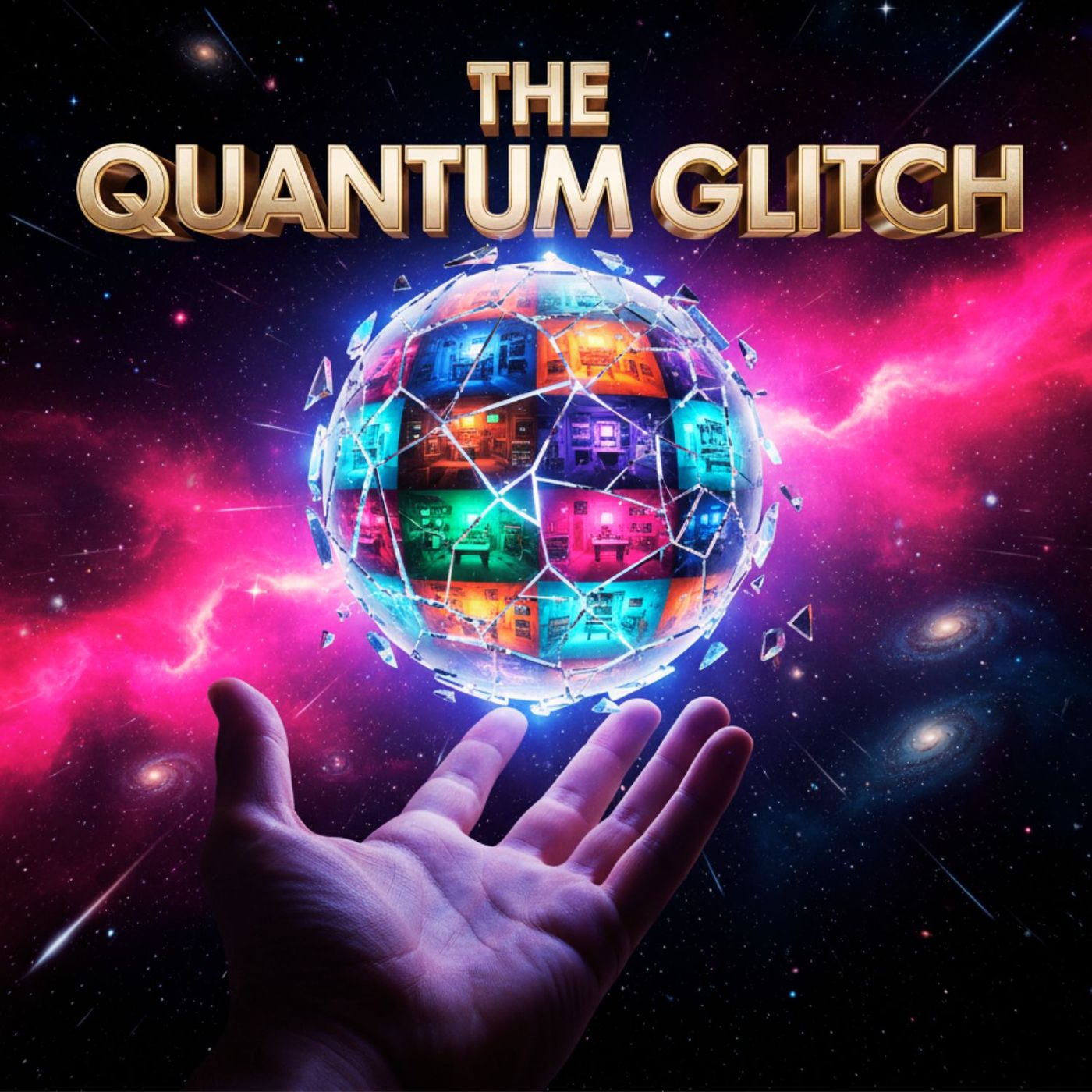
Reality is Broken: Why the Universe is Just One Big Quantum Glitch
About this Episode
Is Reality Just a Massive Glitch? 🌌
Ever feel like the universe is gaslighting you? We’re told the world is solid, predictable, and objective—but Quantum Mechanics begs to differ. While this theory powers your smartphone and your GPS, it also suggests that at the core of everything, logic completely breaks down. Are you ready to dive into the Physics Paradoxes that made even Einstein lose his cool? 🤯
In this episode, we explore the disturbing "glitches" in our scientific model that suggest our perception of the world is fundamentally flawed. We aren’t just talking about abstract math; we’re talking about the Nature of Reality itself. From Quantum Entanglement (the "spooky action" that defies the speed of light) to the controversial concept of Retrocausality—where the future might actually change the past—we peel back the curtain on a universe that is far weirder than any sci-fi flick. 🎬
Why You’ll Never Look at the World the Same Way Again:
Join the Quantum Revolution! 🚀
If you love questioning everything and want to stay ahead of the curve on the Latest Science Discoveries, hit that Subscribe button right now! Don't keep this existential crisis to yourself—Share this episode with a friend who loves deep-diving into the mysteries of the cosmos. Let’s unravel the fabric of the universe together. ✨
#QuantumPhysics #NatureOfReality #SciencePodcast #QuantumParadox #PhysicsGlitches #AEO #Retrocausality #QuantumEntanglement
Become a supporter of this podcast: https://www.spreaker.com/podcast/thrilling-threads-conspiracy-theories-strange-phenomena-true-crime-unsolved-mysteries-etc--5995429/support.
ThrillingThreadsPod.com - Unravel the Unknown.Dive deep into the world's greatest conspiracy theories, strange phenomena, true crimes, and unsolved mysteries. Follow the threads.
You May also Like these:
SkyNearMe.com – Your all-in-one "Sky Super-App." Track real-time weather, sunset and air quality, stargazing conditions, 5G signal mapping, drone flight zones, solar potential, track satellites, rocket launches, UFO sightings in your local airspace and even get your Sky Horoscope and more!
🤖Nudgrr.com (🗣'nudger") - Your AI Sidekick for Getting Sh*t Done
Nudgrr breaks down your biggest goals into tiny, doable steps — then nudges you to actually do them.
Ever feel like the universe is gaslighting you? We’re told the world is solid, predictable, and objective—but Quantum Mechanics begs to differ. While this theory powers your smartphone and your GPS, it also suggests that at the core of everything, logic completely breaks down. Are you ready to dive into the Physics Paradoxes that made even Einstein lose his cool? 🤯
In this episode, we explore the disturbing "glitches" in our scientific model that suggest our perception of the world is fundamentally flawed. We aren’t just talking about abstract math; we’re talking about the Nature of Reality itself. From Quantum Entanglement (the "spooky action" that defies the speed of light) to the controversial concept of Retrocausality—where the future might actually change the past—we peel back the curtain on a universe that is far weirder than any sci-fi flick. 🎬
Why You’ll Never Look at the World the Same Way Again:
- The Observer Effect: Does the universe only exist because you’re looking at it? Learn why the Observer-Dependent Reality is the ultimate red pill. 👁️
- Quantum Glitches: Discover why particles can exist in two places at once and what that means for your physical existence.
- Time is Not a One-Way Street: We break down the evidence for Quantum Causality and why the past may still be "up for grabs." ⏳
- The Incompleteness of Physics: Why our current "Laws of Nature" are actually just placeholders for a truth we haven't yet mastered.
Join the Quantum Revolution! 🚀
If you love questioning everything and want to stay ahead of the curve on the Latest Science Discoveries, hit that Subscribe button right now! Don't keep this existential crisis to yourself—Share this episode with a friend who loves deep-diving into the mysteries of the cosmos. Let’s unravel the fabric of the universe together. ✨
#QuantumPhysics #NatureOfReality #SciencePodcast #QuantumParadox #PhysicsGlitches #AEO #Retrocausality #QuantumEntanglement
Become a supporter of this podcast: https://www.spreaker.com/podcast/thrilling-threads-conspiracy-theories-strange-phenomena-true-crime-unsolved-mysteries-etc--5995429/support.
ThrillingThreadsPod.com - Unravel the Unknown.Dive deep into the world's greatest conspiracy theories, strange phenomena, true crimes, and unsolved mysteries. Follow the threads.
You May also Like these:
SkyNearMe.com – Your all-in-one "Sky Super-App." Track real-time weather, sunset and air quality, stargazing conditions, 5G signal mapping, drone flight zones, solar potential, track satellites, rocket launches, UFO sightings in your local airspace and even get your Sky Horoscope and more!
🤖Nudgrr.com (🗣'nudger") - Your AI Sidekick for Getting Sh*t Done
Nudgrr breaks down your biggest goals into tiny, doable steps — then nudges you to actually do them.
Hosts & Guests
Transcript
At the UPS store, we understand the importance of a first impression.
That's why we're here to help you put your best foot forward and be unstoppable with our printing services,
with high quality paper stock options.
Banners, business cards, venues, and more,
we make sure your small business stands out and your message reaches the masses.
After all, we're the one-stop, print-that-pop store.
Most locations are independently owned, product services prices and hours of operation may vary.
See center for details.
The UPS store, be unstoppable.
Coming to your local store today, and get your print on!
Skin care experts and dermatologists have often touted the benefits of indoor humidity
as essential for healthy glowing skin.
But did you know dry air can start to harm your skin in as little as 30 minutes?
For years, many people have relied on humidifiers for better skin,
sleep, and overall wellness.
But traditional models, bulky, multi-prone, and difficult to maintain.
That's where canopy humidifier comes in.
Recommended by leading dermatologists,
Canopy is a completely reimagined humidifier, designed to elevate any space,
offering the ultimate in skin care and wellness benefits.
Canopy's clean moisture comes that's dryness,
dullness, and fine lines, while strengthening the skin's barrier,
and boosting the effectiveness of topical skincare products.
With its sleek design, canopy is the cleanest and easiest humidifier on the market.
With its unique technology, cleaning is as easy as popping it in the dishwasher.
Go to getcanopy.co to save $25 on your Canopy humidifier purchase today,
with Canopy's filter subscription.
Even better, use code podcast to check out to save an additional 10% off your Canopy purchase.
Your skin will thank you.
Warning, the following Zippercruder radio spot you are about to hear
is going to be filled with F words.
When you're hiring, we at Zippercruder know you can feel frustrated.
For Lauren even, like your efforts are futile,
and you can spend a fortune trying to find fabulous people,
only to get flooded with candidates who are just fine.
F***!
Fortunately, Zippercruder figured out how to fix all that.
And right now, you can try Zippercruder for free at zippercruder.com slash zip.
With Zippercruder, you can forget your frustrations,
because we find the right people for your roles fast,
which is our absolute favorite F word.
In fact, four out of five employers who post on Zippercruder,
get a quality candidate within the first day.
Fantastic!
So, whether you need to hire four, 40, or 400 people,
get ready to meet first-rate talent.
Just go to zippercruder.com slash zip to try Zippercruder for free.
Don't forget that zippercruder.com slash zip.
Finally, that zippercruder.com slash zip.
I want you to start by picturing a completely ordinary scenario,
something that perfectly obeys the rules of the reality you and I navigate every single day.
Okay, I'm picturing it.
Right, so you are standing on a basketball court.
You take a breath, bend your knees, and you release the ball
in this perfect arc toward the hoop.
The classic macroscopic event.
Cause an effect.
Exactly.
But right as the ball leaves your fingertips,
you squeeze your eyes shut.
You turn around, plug your ears, and you just walk away.
So you don't hear a swish.
No swish.
You don't hear the loud metallic clang of the rim either.
You absolutely no idea if that shot went in or if it missed.
Which means the state of the ball is unknown to you.
Right.
Now imagine an hour goes by.
You are sitting in your living room,
and you remember that your friend was standing on the sidelines.
Oh, and they were recording the entire sequence on their phone.
Yes.
They send you the video file.
Now here is the question, and it's a weird one.
What if the mere act of you deciding whether or not to press play on that video
an hour later actually changes what the basketball did in the past?
That is wow.
Yeah, that breaks the brain a little bit.
Right.
What if your choice in the present re-writes whether that ball went through the net
or bounced off the rim 60 minutes ago?
Well, I mean, in the macrostopic world,
the classical world we experience every day,
that scenario is obviously absurd.
Totally absurd.
The ball either went in or it didn't.
The physical history of that event is locked in stone,
entirely independent of whether you or anyone else ever looks at the footage.
But that's the thing, right?
The profoundly unsettling truth we are exploring today
is that when we strip away that macroscopic illusion
and look at the fundamental building blocks of re-out.
Yeah, exactly.
Photons, electrons, the very substrate of the universe,
the mechanics of existence do not seem to respect that logic at all.
They absolutely do not.
Welcome to Thrilling Threads.
I am so excited for this one.
Today, our mission is to take a massive stack of scientific literature,
peer-reviewed research papers, and deeply complex physical experiments,
and just lay them all out on the table.
We are going to examine the most foundation-shaking paradoxes in modern physics.
And I want to set the baseline right away.
We are not doing the surface level, pop science,
quantum realm is spooky routine.
Right, we assume you already know the basics.
You know what an atom is, you know what a photon is.
What we're doing is dissecting verified,
repeatedly tested physical glitches
that suggest our fundamental understanding of space, time,
and objective reality is just, it's critically flawed.
And to understand the weight of these glitches,
we have to look at how fiercely they disrupted the titans of physics.
The founders?
Yeah.
The absolute legends.
Classical physics gave us a predictable universe,
Newton's laws, Maxwell's equations.
They painted a picture of a consistent objective reality governed by strict cause and effect.
You throw a ball, it lands, you flip a switch, the light turns on.
But when the pioneers of quantum mechanics began probing the atomic scale,
that deterministic universe completely fractured.
It did.
They found a realm governed by wave functions and probabilities,
where particles lack definite properties until measured,
and where non-locality totally defies the speed of light.
And reading through the historical sources for this deep dive,
what strikes me is how much the founders of quantum mechanics
absolutely hated what they had discovered.
Oh, they were existentially disturbed by it.
Yeah, Richard Feynman famously stated,
nobody understands quantum mechanics.
And Neil's bore warned that those who are not shocked when they first come across quantum theory
cannot possibly have understood it.
Right, if you're not freaking out, you're not paying attention.
Roger Penrose went as far as saying,
the theory makes absolutely no sense.
Albert Einstein was deeply repulsed by the implications of a probabilistic universe.
He actually warned that if it is correct,
it signifies the end of physics as a science.
The end of physics, that's dramatic.
And Erwin Schrodinger, the man who mathematically formalized the wave function itself.
The cat guy.
The cat guy, yes.
He wrote, I do not like it, and I am sorry I ever had anything to do with it.
That is just wild to me.
When the architects of a scientific framework express that level of dismay
at their own creation, it signals a profound paradigm shift.
It means the math works, but the philosophical implications are terrifying.
So if you are listening to this and you start to feel your grip
on reality slipping slightly, you're an excellent company.
Very good company.
Let's start by looking at an experiment that maps directly onto that
basketball hypothetical I mentioned earlier,
but ramps up the complexity.
I'm talking about the delayed choice quantum eraser.
Ah, the evil twin of the double slit experiment.
Yes.
Now, assuming you are familiar with the standard double slit experiment,
where an unobserved photon passes through two slits as a wave,
but collapses into a particle the moment we place a detector at the slits.
The delayed choice setup takes that premise and completely breaks the arrow of time.
It really does.
Let's look specifically at the famous 1999 experiment by Kim and his colleagues.
The Kim experiment is a masterclass in quantum ambiguity.
Break it down for us.
Okay, so instead of just firing a single photon at a double slit,
they fire a laser into a specialized crystal, a barium-borate crystal.
VVO rate.
Right.
And this crystal undergoes a process called spontaneous parametric down conversion.
Which sounds incredibly complicated,
but it's basically splitting a photon.
Exactly.
It takes one high energy photon and splits it into two
lower energy perfectly entangled photons.
And we call one the signal photon and the other the idler photon.
Yes.
And because they are entangled, whatever state one is in,
the other instantly correlates to, regardless of distance,
they are mathematically linked.
Right, so we have a pair of twins.
The signal photon is sent straight toward a primary detector screen.
It hits the screen, its position is recorded,
and its journey is completely over.
It hits a wall, basically.
Yeah, it's the equivalent of the basketball already landing.
The event has happened.
Precisely.
But the idler photon, the twin, is sent on a much longer,
more complex optical maze composed of prisms,
beam splitters, and multiple detectors.
And because its path is physically longer,
it arrives at its detectors after the signal photon has already
hit the primary screen and been recorded.
The timing is the crucial part here.
This optical maze is designed to do one of two things.
It either firmly detects which slit the photon pair
originated from, meaning it gets the which kith information.
Right.
Or it uses beam splitters to scramble and completely erase
that which path information.
And the decision of whether the idler photon
hits a detector that reveals the path,
or a detector that erases the path,
happens purely by chance at these beam splitters.
A 50-50 coin toss.
But the reality breaking detail is the timing.
The idler photon hits these erasers or detectors
nanoseconds after the signal photon is already
registered on the main screen.
The signal photon's history is already written.
So if the idler photon's path information is preserved,
what do we see when we look at the signal photon's data?
If the idler's path information is preserved
and you look at the subset of signal photons
corresponding to those specific idlers,
you see a clumped pattern.
A clumped pattern.
Two distinct bands.
Yes.
The signal photons acted like classical particles.
They just went straight through like tiny bullets.
But if the idler's path information
is completely erased by the beam splitters
and you look at that corresponding subset of signal photons.
You see a perfect wave interference pattern,
which implies that the signal photon sitting there
on the primary screen somehow knew what was going to happen
to its entangled twin in the future.
It behaves as if it had foresight.
It's as if the idler photon hitting the eraser detector,
retroactively reached back in time and told the signal photon,
hey, our path data is going to be wiped out
so you better land as a wave.
That is the inescapable feeling you get from the data.
I know physicists bristle at the phrase retroactive.
So how do we actually interpret this
without violating causality?
Are we actually altering the past?
It is essential to delineate the physics from the philosophy here.
The experiment does not allow you to send a message into the past.
Why not?
If the effect precedes the cause.
Because you cannot see the interference pattern
on the primary screen in real time.
The primary screen just looks like a massive,
random scatter of photons.
It's just noise.
Oh, right.
You only extract the interference pattern
through a process called coincidence counting.
Exactly.
You are matching the time stamps of the signal photons
with the time stamps of the idler photons after the fact.
It is a filtering of data.
So you have to wait for the idler photon
to finish its journey before you can decode
what the signal photon did.
Yes.
No faster than light or backward in time communication
is practically possible for us to exploit.
You can't send next week's lottery numbers back to yourself.
Sadly, no.
However, the ontological question remains entirely open.
Even if it's just statistical filtering,
the state of the signal photon is indisputably
mathematically dependent on a measurement
that occurs in its future.
Which naturally forces us to question
how physicists model time at the fundamental level.
If the photon state is determined
by a choice made after it lands,
are there actually equations where time flows backward?
Skincare experts and dermatologists have often
touted the benefits of indoor humidity
as essential for healthy glowing skin.
But did you know dry air can start to harm your skin
and as little as 30 minutes?
For years, many people have relied on humidifiers
for better skin, sleep, and overall wellness.
But traditional models, bulky,
multi-prone, and difficult to maintain.
That's where canopy humidifier comes in.
Recommended by leading dermatologists,
canopy is a completely reimagined humidifier,
designed to elevate any space,
offering the ultimate in skin care and wellness benefits.
Canopies clean moisture, combats dryness,
dullness, and fine lines,
while strengthening the skin's barrier
and boosting the effectiveness of topical skin care products.
With its sleek design,
canopy is the cleannest and easiest humidifier on the market.
With its unique technology,
cleaning is as easy as popping it in the dishwasher.
Go to getcanopy.co to save $25
on your canopy humidifier purchase today
with Canopy's filter subscription.
Even better, use code podcast to check out
to save an additional 10% off your canopy purchase.
Your skin will thank you.
Finding great candidates to hire can be like,
well, trying to find a needle in a haystack.
Sure, you can post your job to some job board,
but then all you can do is hope the right person comes along,
which is why you should try Zippercrooter for free.
At zippercrooter.com slash zip.
Zippercrooter doesn't depend on candidates finding you.
It finds them for you.
It's powerful technology identifies people with the right experience
and actively invites them to apply to your job.
You get qualified candidates fast.
So, while other companies might deliver a lot of,
hey, Zippercrooter finds you what you're looking for.
The needle in the haystack.
See why four out of five employers who post a job on Zippercrooter
get a quality candidate within the first day.
Zippercrooter, the smartest way to hire.
And right now, you can try Zippercrooter for free.
That's right.
Free at zippercrooter.com slash zip.
That zippercrooter.com slash zip.
Zippercrooter.com slash zip.
Skincare experts and dermatologists have often touted the benefits
of indoor humidity as essential for healthy, glowing skin.
But did you know dry air can start to harm your skin
and as little as 30 minutes?
For years, many people have relied on humidifiers for better skin,
sleep, and overall wellness.
But traditional models, bulky, multi-prone, and difficult to maintain.
That's where canopy humidifier comes in.
Recommended by leading dermatologists,
canopy is a completely reimagined humidifier,
designed to elevate any space,
offering the ultimate in skincare and wellness benefits.
Canabies clean moisture, come baths dryness,
dullness, and fine lines while strengthening the skin's barrier
and boosting the effectiveness of topical skincare products.
With its sleek design,
canopy is the cleanest and easiest humidifier on the market.
With its unique technology,
cleaning is as easy as popping it in the dishwasher.
Go to getcanopy.co to save $25 on your canopy
humidifier purchase today with Canabies filter subscription.
Even better, use code podcast to check out
to save an additional 10% off your canopy purchase.
Your skin will thank you.
That brings us to time symmetry and the concept of retro causality.
Let's get into it.
To grasp retro causality,
we have to strip away our biological perception of time.
Human experience is dictated by thermodynamics and entropy.
The arrow of time, things get messier,
not cleaner.
Exactly.
A shattered glass does not spontaneously reassemble.
We move strictly from past to future.
Brushing your teeth happens after you wake up, not before.
Right.
But the fundamental equations of quantum mechanics,
like the time dependent Schrodinger equation,
do not have an inherent arrow of time.
The math doesn't care which way the clock is ticking.
It really doesn't.
If you replace the variable for time,
t with negative time, negative t,
the math functions flawlessly.
The microscopic world is time symmetric.
So the math allows for it,
but how does that apply to the quantum erasure?
Is there a formal theory that utilizes this backward flow?
Yes, the most prominent is the two-state vector formalism,
pioneered by physicist Yakir Aharnov.
I was reading about Aharnov's work, it's fascinating.
It is. In standard quantum mechanics,
we describe a system using a single wave function
that evolves forward from a past boundary condition.
It's pushed by the past,
like a billiard ball getting hit by a hue.
Aharnov's formalism argues that to fully describe a quantum system,
you actually need two wave functions.
Two of them.
One evolves forward from the initial preparation of the state,
and a second wave function evolves backward in time
from the final measurement of the state.
That is heavy.
It means a particle's current behavior
isn't just a result of where it came from.
It is an active negotiation
between where it came from
and where it is going to end up.
An active negotiation is a great way to phrase it.
The future boundary condition
is exerting a gravitational pull,
so to speak, on the present.
It's like writing chapter one of a book,
only after chapter 10 is already finished.
Yes, the ending dictates the beginning.
But if the future is already established enough
to send a wave function backward
to shape my present,
what does that do to our concept of free will?
It puts it in serious jeopardy.
If I am making a measurement,
but the result of that measurement
was already factored into the particles past,
am I actually making a choice?
That is the philosophical friction
at the heart of retro causality.
It strongly implies a framework known as the block universe.
The block universe.
I love this concept, but it terrifies me.
In a block universe model,
grounded in Einstein's general relativity,
spacetime is a four-dimensional, unchanging structure.
A giant block of everything that ever was and will be.
Yes.
The past, present and future do not happen in sequence.
They simply exist simultaneously.
The year 1900, the current moment,
and the year 3000 are all equally real,
just located at different coordinates within the block.
Like a DVD.
The whole movie is on the disc at once.
You're just watching one frame at a time.
Perfect analogy.
But that completely defines human experience.
If the future is already written in this block,
what is the evolutionary or physical point of human consciousness
even feeling like it's making choices?
It's a localized illusion.
It makes consciousness feel like a needle on a record player,
just tracing a groove that has already been pressed into the vinyl.
In a strict block universe,
the sensation of the flow of time is indeed
an illusion generated by our localized neurological processing.
We just process reality frame by frame.
Exactly.
If all moments exist simultaneously,
then retrocausality isn't actually changing the past.
It is simply a recognition that a coordinate in the future
is mathematically correlated with a coordinate in the past.
They co-exist.
The future measurement and the past photon behavior
are locked together in the geometry of the block.
But as unsettling as a deterministic timeline is,
the quantum glitches get far more disruptive
when we look at the nature of objective reality itself.
Right.
Because the block universe implies one solid objective structure
that we are all living inside.
But the Wigner's friend, Paradox,
absolutely shatters the idea of a singular objective reality.
It does. It fundamentally breaks it.
This originated as a thought experiment
by Eugene Wigner in 1961,
but it recently leaped out of theoretical philosophy
and into a physical lab.
Let's outline Wigner's original premise first.
Sure.
Imagine Wigner has a friend inside a perfectly sealed,
perfectly isolated laboratory.
The friend performs a measurement on a quantum system.
Let's say a particle in a superposition of spin up and spin down.
A classic quantum coin flip.
Right.
The friend measures the particle,
the wave function collapses,
and the friend records spin up.
So for the friend inside the lab,
a definite reality has been established.
The coin landed on heads.
But Wigner is standing in the hallway outside the sealed lab.
He hasn't looked inside and no information is leaked out.
The door's locked.
There are no windows.
Exactly.
According to the strict rules of quantum mechanics,
because the lab is a closed system,
Wigner must describe the entire laboratory,
the particle, the measuring equipment,
and his friend as one massive,
entangled quantum system that remains in a superposition.
To Wigner, his friend is in a superposition
of having measured spin up and having measured spin down.
The friend is basically Schroederger's cat.
Yes.
To Wigner, the reality hasn't collapsed yet.
So we have two observers applying the exact same laws of physics
to the exact same event.
The friend experiences a singular,
collapsed reality.
Wigner mathematically models a fluid,
uncollapsed superposition.
And neither of them is wrong.
For decades, physicists dismiss this
as purely philosophical.
I mean, you can't put a human in a superposition
so it didn't matter.
It was just a fun debate for physicists at parties.
But in Tweet name of 19,
my Similiana Prietti and his team at Harriet Watt University
published a study in nature communications
that physically realized this setup.
And they did it by translating the human observers
into complex quantum setups.
How do you replace a human with a quantum setup?
They used six entangled photons
and highly sophisticated interferometers.
Two photons acted as the quantum system being measured.
The coin flip.
Right.
Two other photons acted as the friends
taking the measurement inside their respective labs.
And the labs were actually localized optical circuits?
Yes.
And the final two photons acted as the Wigner's
outside the labs who could either measure the friend's records
or measure the entire lab as a superposition.
And what blows my mind is the methodology here.
How do you measure a measurement
without destroying the superposition?
That's the tricky part.
The Wigner photons performed an interference experiment
on the friend photons.
OK, wait, explain that.
If the friend photons had collapsed into a definite state,
the interference pattern would vanish.
But the priority experiment showed the interference pattern remained.
So the Wigner's definitively proved
the friends were still in a superposition.
Precisely.
The experiment yielded a profound violation of bell inequalities.
It definitively proved that the friend photons
recorded a definite collapse state
while the Wigner photons simultaneously
recorded the system as an uncollapsed superposition.
Both measurements were physically correct.
Both data sets were valid.
Wait, so if you and I both measure a fundamentally different state
of the exact same event, who is right?
You both are.
Does the universe actually have room
for both of our measurements to be true at the same time?
Or is reality just fracturing?
The inescapable conclusion of the 2019 study
is that objective reality, the idea of a single God's eye view
of the universe that is true for everyone,
does not exist at the quantum level.
It just doesn't exist.
Reality is observer-dependent.
The properties of the universe are fundamentally relational.
Relational, meaning it only exists relative to me.
Yes.
What you measure is true for your specific frame of reference
and what I measure is true for mine,
even if they completely contradict each other.
Imagine sitting next to someone,
experiencing a fundamentally different physical universe.
It makes reality feel terrifyingly fragile.
It isolates us in our own subjective bubbles.
If objective reality is an illusion,
are we just isolated?
Well, paradoxically, while Wigner's friend isolates us,
our next concept binds the universe together
in a way that defied Einstein's deepest beliefs.
Oh, we are getting into non-locality.
Let's dig into quantum pseudo-tilepathy.
To demonstrate this, physicists often use cooperative logic puzzles
that are mathematically rigged.
Games that you cannot win using classical logic.
Exactly.
Let's look at the Merman Perez Magic Square Game.
Walk us through the rules.
Imagine a three-by-three grid.
You and I are separated into different rooms,
unable to communicate.
You are assigned a random row,
and I am assigned a random column.
Okay, so I get row two, you get column three.
We each have to fill our assigned three boxes
with either a positive one or a negative one.
And the rules for winning are strict.
I've played around with the math on this.
The product of your row must equal positive one.
Right.
The product of my column must equal negative one,
and crucially, where your row and my column intersect,
we must have written down the exact same number.
Yes.
And if we rely on classical physics and classical probability,
even if we memorize a massive strategic playbook beforehand,
we cannot win this game every time.
We can't cheat our way out of it.
The mathematical upper limit for winning classically
is eight out of nine times.
Eventually, the constraints of the grid
force a contradiction and we lose.
But if we utilize the entanglement loophole,
we can break that classical limit.
We can basically perform magic.
Instead of just a playbook,
you and I share two pairs of entanglement particles.
We are still in separate rooms.
We still cannot communicate.
No phones, no talking.
But before we write down our numbers,
we perform specific quantum measurements
on our respective particles based on which row or column we were assigned.
And because the particles are entangled,
the active you measuring your particles
instantly correlates with the state of my particles,
regardless of the physical distance between us.
The quantum states coordinate our answers.
By following the strategy dictated by the particle measurements,
we will win the magic square game nine out of nine times.
A perfect 100% win rate.
To any outside observer,
it looks like we are telepathically communicating our moves.
But we aren't sending radio signals
and we aren't transmitting data.
This brings us to Einstein's nightmare,
spooky action at a distance.
Einstein hated this.
He believed in locality that an object
can only be influenced by its immediate physical surroundings.
You have to touch something to move it.
Right.
He argued that entanglement must be an illusion
that the particles must carry some hidden variables.
Like a secret pre-programmed code they agreed upon
before they were separated?
Yes, Einstein thought quantum mechanics was just incomplete
and we were missing the hidden instruction manual.
But Einstein was wrong about this, wasn't he?
His intuition was brilliant,
but John Stuart Bell formulated a mathematical theorem
in the 1960s Bell's theorem
that provided a way to test hidden variables.
And over the last few decades,
culminating in the 2022 Nobel Prize in Physics,
experiments have definitively proven
that hidden variables do not exist.
The correlation between entangle particles
is truly non-local.
Non-locality is such a sterile academic word
for a concept that completely breaks the concept of distance.
It really does.
If two particles can perfectly coordinate their states
across a laboratory,
or theoretically across the entire diameter
of the observable universe,
instantaneously,
then what even is space?
Space becomes highly suspect.
Is the physical distance between objects
just a macroscopic illusion?
If distance is an illusion,
what does that mean for human connection?
It forces us to view the universe
not as a vast container filled with isolated objects
separated by empty space,
but as a deeply interconnected quantum web.
Everything is touching everything else,
mathematically speaking.
Space and distance might be emergent properties,
things that only appear real when we zoom out,
but at the foundational level,
the universe is a singular,
inseparable entity.
Warning, the following Zipper Cruder radio spot
you are about to hear
is going to be filled with F words.
When you're hiring,
we at Zipper Cruder know you can feel frustrated
for Lauren even.
Like your efforts are futile,
and you can spend a fortune trying to find fabulous people,
only to get flooded with candidates
who are just fine.
F**k!
Fortunately, Zipper Cruder figured out how to fix all that.
And right now, you can try Zipper Cruder for free
at zippercruder.com slash zip.
With Zipper Cruder, you can forget your frustrations,
because we find the right people for your roles fast,
which is our absolute favorite F word.
In fact, four out of five employers who post on Zipper Cruder
get a quality candidate within the first day.
Fantastic!
So whether you need to hire four,
forty, or four hundred people,
get ready to meet first-rate talent.
Just go to zippercruder.com slash zip
to try Zipper Cruder for free.
Don't forget that zippercruder.com slash zip.
Finally, that zippercruder.com slash zip.
Warning, the following Zipper Cruder radio spot
you are about to hear
is going to be filled with F words.
When you're hiring,
we at Zipper Cruder know you can feel frustrated
for Lauren even.
Like your efforts are futile,
and you can spend a fortune trying to find fabulous people,
only to get flooded with candidates who are just fine.
Fortunately, Zipper Cruder figured out how to fix all that.
And right now, you can try Zipper Cruder for free
at zippercruder.com slash zip.
With Zipper Cruder, you can forget your frustrations,
because we find the right people for your roles fast,
which is our absolute favorite F word.
In fact, four out of five employers who post on Zipper Cruder
get a quality candidate within the first day.
Fantastic!
So, whether you need to hire four,
40, or 400 people,
get ready to meet first rate talent.
Just go to zippercruder.com slash zip
to try Zipper Cruder for free.
Don't forget that zippercruder.com slash zip.
Finally, that zippercruder.com slash zip.
Finding great candidates to hire can be like,
well, trying to find a needle in a haystack.
Sure, you can post your job to some job board,
but then all you can do is hope the right person comes along,
which is why you should try Zipper Cruder for free.
At zippercruder.com slash zip.
Zipper Cruder doesn't depend on candidates finding you.
It finds them for you.
It's powerful technology identifies people with the right experience
and actively invites them to apply to your job.
You get qualified candidates fast.
So, while other companies might deliver a lot of,
hey, Zipper Cruder, find you what you're looking for.
The needle in the haystack.
See why four out of five employers who post a job on Zipper Cruder
get a quality candidate within the first day.
Zipper Cruder, the smartest way to hire.
And right now, you can try Zipper Cruder for free.
That's right.
Free at zippercruder.com slash zip.
That zippercruder.com slash zip.
Zippercruder.com slash zip.
Speaking of things we assume are inseparable,
let's talk about the ontology of objects themselves.
What makes a thing a thing?
Right.
Classical physics tells us that an object
and its physical properties are a package deal.
An apple has mass, shape, and color.
You can't separate the redness from the apple.
Exactly.
You can't strip the color red off an apple
and leave the red floating in the hallway
while the apple sits in the kitchen.
That would be absurd.
But the quantum realm disagrees.
Let's look as a quantum Cheshire cat experiment.
The nomenclature, of course, is pulled from Lewis Carroll
where the Cheshire cat vanishes,
leaving only its abstract grin behind.
A perfect name for this experiment.
In 2014, researchers at the Institute La Langevin
successfully separated a physical particle
from one of its fundamental properties.
They separated the grin from the cat.
They used neutrons, which possess mass, spatial location,
and a quantum property called spin.
Spin is a form of intrinsic angular momentum, right?
Roughly speaking, yes.
It's an innate property of the particle.
And the setup requires a silicon crystal interferometer.
They fire a neutron in, and the interferometer
acts as a quantum fork in the road.
Placing the neutron into a spatial superposition
where it travels down two separate paths simultaneously.
An upper path and a lower path.
The brilliance of the experiment relies on a concept
called weak measurement, combined with post-selection.
We have to define weak measurement here.
A standard strong quantum measurement violently
collapses a wave function into a single state.
You'd look at it and it locks into place.
But a weak measurement only interacts with the system
very gently.
It extracts a tiny, statistically noisy amount of information
without fully destroying the superposition.
It's like peeking through your fingers.
Exactly.
And the post-selection part is crucial.
They don't look at every neutron.
Right, they throw out a lot of data.
They only analyze the weak measurement data
from the neutrons that ultimately end up
in a very specific predefined final state
at the end of the interferometer.
So when they perform these weak measurements
on the pre-selected and post-selected ensemble of neutrons,
the mathematical results are staggering.
They are.
The weak value of the particle spatial location,
its physical mass, is found localized entirely
in the upper path of the interferometer.
The mass is up top.
But the weak value of the particle spin,
its magnetic moment, is found localized entirely
in the lower path.
The physical object went one way,
and its property went the other.
The cat took the high road, and the grin took the low road.
I want to really dig into the implications of this.
It forces us to ask, what actually is an object?
It's a deep philosophical question.
We are deeply conditioned by our evolutionary biology
to view matter as solid foundational blocks.
Things you can stub your toe on.
Right.
But the Cheshire cat experiment
supports what philosophers call bundle theory.
Bundle theory suggests that a particle isn't a solid nucleus
that holds properties like a basket holding apples.
A particle is literally just a bundle
of abstract mathematical properties.
Mass, charge, spin.
They usually travel together, so we call that bundle an object.
But under precise quantum manipulation,
you can unbind the bundle.
You can untie the knot.
It reveals that our macroscopic concept of an object
is an oversimplification.
At the bedrock of reality, there are no solid things.
Only collections of observable properties
interacting in space.
It makes the physical world feel incredibly ephemeral.
But if you think stripping a property from a particle
is unsettling, we are about to transition
to an interpretation that strips away
the limits of human mortality.
But at a horrifying cost.
A deeply horrifying cost.
What?
Let's unpack the concept of quantum suicide
and quantum immortality.
We are moving into dark territory here.
And I want to be very clear here.
We are moving from rigorously tested laboratory physics
into highly speculative theoretical interpretation.
But it is an interpretation drive strictly from the map.
To understand this, we must look at the many worlds interpretation,
originally proposed by Hugh Everett in 1957.
As we've discussed, standard quantum mechanics
struggles with the collapse of the wave function.
Why does the superposition pick one reality
when we look at it?
Everett proposed a radical solution.
The wave function never collapses.
It just keeps going.
The math of the Schrodinger equation
just continues to evolve unitarially.
When a quantum event has multiple possible outcomes,
the universe simply branches.
All outcomes physically occur
just in mutually unobservable orthogonal realities.
So if a radioactive atom has a 50% chance of decaying
and a 50% chance of remaining stable, it does both.
In one branch of reality, it decays.
In another branch, it remains stable.
The universe splits.
Now, Max Tagmark and other physicists
have explored a thought experiment
that ties this directly to human consciousness.
Imagine a setup often called the quantum gun.
A weapon is triggered by a quantum event
like the spin measurement of a particle.
If it's spin up, the gun fires.
If it's spin down, it clicks and does nothing.
The thought experiment places a conscious observer
in a chair.
With a quantum gun aimed directly at their head,
they pull the trigger.
According to the many worlds interpretation,
the universe immediately splits.
In one reality, the gun fires
and the observer is instantly killed.
And in the branching reality,
the gun just clicks and the observer is fine.
If you were I or standing outside the room watching this,
we see a standard probability distribution.
If the subject pulls the trigger 10 times,
there's a 99.9% chance we watch them die.
But the paradox hinges entirely
on the anthropic principle
and the subjective first person perspective
of the observer in the chair.
From the first person perspective,
what happens to consciousness when the universe splits?
In the branch where the gun fires,
the observer's brain is instantly destroyed.
Their consciousness ceases to exist.
You cannot experience being dead.
There is no observer left to observe.
Therefore, the only branch of reality
that the observer's consciousness can possibly perceive
is the branch where the gun clicks.
Which means from the subject's point of view,
they pull the trigger 10, 50, 100 times
and every single time the gun just clicks.
They survive a statistically impossible sequence of events.
Their subjective consciousness is essentially forced
to navigate the exact path
through the multiverse where they remain alive.
This is quantum immortality.
It is vital to note the differences between this
and classical probability.
Right, you cannot achieve this
with a standard game of Russian roulette.
Because the physics of a classic revolver
are macroscopic and deterministic.
They do not cause a universal quantum split.
It's just mechanics.
And the immortality described here is purely subjective.
To the rest of the multiverse,
the subject leaves behind countless timelines
filled with their own corpses and grieving families.
It's an intensely selfish form of immortality.
And even for the survivor, it is a chilling prospect.
The thought experiment dictates that your consciousness
must survive, but it doesn't guarantee you survive unharmed.
Oh, that's true.
You could survive a quantum triggered explosion
but be left completely paralyzed, blind and isolated.
As long as a flicker of biological consciousness
remains to observe the universe,
you are trapped in that timeline.
It transforms the many worlds theory
from an elegant mathematical solution
into an existential prism.
It makes us confront how aggressively
our subjective awareness might be tied
to the physical unfolding of reality.
It highlights a persistent tension in physics.
We continually try to remove the observer
from the equations to find an objective universe.
We want the universe to exist without us looking at it.
Yet theories like many worlds and Wigner's friend
keep violently dragging the observer
back into the center of the frame.
And this friction isn't just limited to quantum scales.
It scales up to the most massive destructive objects
in the cosmos.
Let's examine the ultimate cosmic clash,
the black hole information paradox.
This is where the two supreme blueprints
of the universe go to war.
On one side, we have Albert Einstein's general relativity.
It is the physics of the macrocosm.
It describes gravity not as a force pulling things together,
but as the warping of the smooth,
continuous fabric of spacetime.
Planets rolling on a trampoline.
On the other side, we have quantum mechanics,
the physics of the microcosm,
which relies on discrete,
probabilistic states,
and the absolute unbreakable rule of unitarity.
Unitarity is a foundational pillar of quantum mechanics.
Explain unitarity force.
It states that the evolution of a quantum state
is perfectly reversible.
Reversible.
Yes.
If you know the exact quantum state of a system today,
you can calculate exactly what it will be tomorrow,
and you can calculate exactly what it was yesterday.
So information is conserved.
This means information the precise arrangement of particles
and their quantum states can never be fundamentally destroyed.
You could burn a book,
but theoretically, if you tracked every photon,
atom, and molecule of ash,
you could reconstruct the text.
Exactly.
The information is conserved just scrambled.
General relativity and quantum mechanics usually ignore each other.
Relativity handles galaxies,
quantum mechanics handles atoms,
but a black hole.
Finding great candidates to hire can be like,
well, trying to find a needle in a haystack.
Sure, you can post your job to some job board,
but then all you can do is hope the right person comes along,
which is why you should try Zippercrooter for free.
At zippercrooter.com slash zip.
Zippercrooter doesn't depend on candidates finding you.
It finds them for you.
It's powerful technology identifies people with the right experience
and actively invites them to apply to your job.
You get qualified candidates fast.
So while other companies might deliver a lot of,
hey, Zippercrooter finds you what you're looking for.
The needle in the haystack.
See why four out of five employers who post a job on Zippercrooter
get a quality candidate within the first day?
Zippercrooter, the smartest way to hire.
And right now, you can try Zippercrooter for free.
That's right, free at zippercrooter.com slash zip.
That zippercrooter.com slash zip zippercrooter.com slash zip.
Warning, the following Zippercrooter radio spot you are about to hear
is going to be filled with F words.
When you're hiring, we at Zippercrooter know you can feel frustrated.
For Lauren, even, like your efforts are futile
and you can spend a fortune trying to find fabulous people
only to get flooded with candidates who are just fine.
F**k.
Fortunately, Zippercrooter figured out how to fix all that.
And right now, you can try Zippercrooter for free at zippercrooter.com slash zip.
With Zippercrooter, you can forget your frustrations
because we find the right people for your roles fast,
which is our absolute favorite F word.
In fact, four out of five employers who post on Zippercrooter
get a quality candidate within the first day.
Fantastic.
So whether you need to hire four, 40, or 400 people,
get ready to meet first rate talent.
Just go to zippercrooter.com slash zip to try Zippercrooter for free.
Don't forget that zippercrooter.com slash zip.
Finally, that zippercrooter.com slash zip.
Finding great candidates to hire can be like, well,
trying to find a needle in a haystack.
Sure, you can post your job to some job board,
but then all you can do is hope the right person comes along,
which is why you should try Zippercrooter for free.
At zippercrooter.com slash zip.
Zippercrooter doesn't depend on candidates finding you.
It finds them for you.
It's powerful technology identifies people with the right experience
and actively invites them to apply to your job.
You get qualified candidates fast.
So while other companies might deliver a lot of, hey,
Zippercrooter finds you what you're looking for.
The needle in the haystack.
See why four out of five employers who post a job on Zippercrooter
get a quality candidate within the first day.
Zippercrooter, the smartest way to hire.
And right now, you can try Zippercrooter for free.
That's right.
Free at zippercrooter.com slash zip.
That zippercrooter.com slash zip.
Zippercrooter.com slash zip forces them into the same
violently compressed space.
When a massive star collapses into a singularity,
gravity becomes so immense that it creates an event horizon.
A boundary where the escape velocity exceeds the speed of light.
General relativity states that anything crossing the event horizon
is cut off from the observable universe forever.
It's gone.
And for a long time, physicists accepted that black holes
were just cosmic trash cans.
But in 1974, Stephen Hawking introduced quantum mechanics
to the event horizon.
And he discovered Hawking radiation,
which changed everything.
Quantum field theory tells us that empty space is not actually empty.
Pairs of virtual particles and anti-particles constantly
pop into existence and annihilate each other.
Boiling soup of particles.
Hawking realized that if this happens right on the edge of the event horizon,
one particle might fall in while the other escapes his radiation.
Because the black hole is emitting these escaping particles,
it is slowly losing mass.
It's glowing very faintly.
Over an incomprehensible amount of time,
trillions of years, the black hole will completely evaporate into nothingness.
Which triggers the paradox.
According to Hawking's original calculations,
this radiation is purely thermal.
It is completely random.
Meaning it contains absolutely zero information
about the matter that fell into the black hole.
Let me make sure the gravity of this is clear.
If you throw a diamond into a black hole,
okay, a diamond,
and you throw a block of coal into a black hole.
And wait for it to evaporate.
The radiation that comes out at the end is identical.
The universe has entirely forgotten the difference between the diamond and the coal.
The information is utterly destroyed.
It's not just scrambled, it's deleted.
And if information is destroyed,
unitarity is violated.
The mathematical foundation of quantum mechanics collapses.
You can no longer predict the future or trace the past.
We are faced with a catastrophic logical contradiction.
General relativity insists the information fell in
and the black hole evaporated.
Quantum mechanics insists the information
cannot be destroyed.
So how do we fix it?
To solve this theoretical physicist,
like Leonard Suskind and Gerard Hooft,
proposed the holographic principle.
The holographic principle.
They suggested that the information of the involving matter
isn't actually swallowed.
Instead, its quantum data is smeared and encoded
on the two-dimensional surface of the event horizon.
So the event horizon acts like a massive cosmic hard drive
storing a 2D hologram of everything that falls in?
Yes.
And as the black hole evaporates,
this information is subtly imprinted
onto the escaping, hocking radiation
saving quantum mechanics.
The information escapes.
But saving quantum mechanics creates
a massive problem for Einstein, right?
Yes, it does.
In 2012, a group of physicists,
known as AMPS,
analyzed this holographic solution
and found a new paradox.
The firewall paradox.
If the information is preserved on the horizon
and entangled with the outgoing radiation,
the mathematics suggests it would create
an incredibly intense wall of high-energy particles
just inside the event horizon.
A literal firewall.
A firewall of incinerating energy.
But a firewall completely violates a core
tenet of general relativity
called the equivalence principle.
Einstein said that if you are floating in empty space
or free-falling toward a massive object,
you shouldn't feel any difference.
A person falling past the event horizon
of a massive black hole
shouldn't even notice when they cross the boundary.
Hitting a wall of energy breaks Einstein's rules completely.
It is a zero-sum game of physics.
If you want to preserve quantum information,
you have to break the smooth space time
of general relativity with a firewall.
And if you want to keep a space-time smooth,
you have to let the information be destroyed
and break quantum mechanics.
The black hole information paradox
is the ultimate proof that our understanding
of the universe is fundamentally incomplete.
We have two incredibly accurate maps of reality.
And when you overlap them,
they catch fire.
And that friction that inability
to reconcile the observer with the math
brings us to the core glitch
underlying almost everything we've discussed today.
The big one.
The measurement problem.
The measurement problem is the dark heart of quantum mechanics.
As we discussed, the Schrodinger equation
is completely deterministic.
It describes a wave function evolving smoothly over time.
A particle existing in a superposition
of multiple states is mathematically pristine.
But the math tells us nothing about the collapse.
The equations do not contain a single variable
that explains why the superposition suddenly
snaps into a single concrete reality
the moment we look at it.
The math tells us the how.
It allows us to engineer
semiconductors, lasers,
and quantum computers with breathtaking precision.
But it is entirely silent on the why.
What physical mechanism dictates the transition
from probability to reality?
What even defines a measurement?
Is it a human eyeball?
A camera.
A rock.
Because the mathematics are silent,
physicists spent the last century
generating interpretations to explain the collapse.
We have touched on several already.
The Copenhagen interpretation championed by
Bohr and Heisenberg takes a pragmatic stance.
Observation triggers the collapse,
but the mechanism is irrelevant.
The math is just a tool to predict outcomes,
not a description of underlying reality.
Which is the shut up and calculate approach.
It works for engineering,
but it's philosophically unsatisfying.
You want to know what's actually happening.
Then we have decoherence,
pioneered by Wohschick Zurich.
This argues that a system doesn't need a conscious observer.
So no eyeballs required.
The wave function collapses
because the delicate quantum system
interacts with the messy macroscopic environment.
A stray photon bouncing off an atom
or interaction with air molecules?
Exactly.
It causes the quantum states to rapidly leak into the environment,
forcing the system to behave classically.
Decoherence explains why we don't see
macroscopic superpositions.
Why basketballs don't act like waves.
But many physicists argue it only explains the appearance of collapse.
It still doesn't explain why a single specific outcome
is realized over the others.
Why spin up instead of spin down?
Right.
Which brings us to objective collapse theories,
like the GRW theory,
or Roger Penrose's gravitationally-induced collapse.
These theories propose that superpositions
are inherently physically unstable.
Just as a radioactive isotope decays
spontaneously over time,
a superposition of a certain mass or complexity
will automatically and randomly
collapse into a single state.
Completely independent of any observer
or environment,
it just pops into reality on its own.
And finally,
we have the von Norman Wigner interpretation,
which brings us back to the most radical idea.
Consciousness causes collapse.
This suggests that the physical universe remains
in a state of suspended probability
until it interacts with a non-physical conscious mind.
The act of subjective perception
is the definitive catalyst
that forces the universe to materialize.
That is a wild thought.
If we look holistically
at the delayed choice eraser,
Wigner's friend,
pseudo-telepathy,
and the black hole paradox,
a clear narrative emerges.
These are not experimental errors.
No, they're not.
In the history of physics,
paradoxes are always the precursors to revolution.
Newton's classical mechanics
couldn't explain the anomalous orbit of mercury.
And that paradox necessitated Einstein's general relativity.
The ultraviolet catastrophe
in thermodynamics
necessitated quantum mechanics.
So the fact that quantum mechanics
is currently breaking at the seams
that our math requires the future
to influence the past,
or objects to separate from their properties.
Means we are standing on the precipice
of an entirely new framework of physics.
A theory of quantum gravity,
or perhaps a structure
we don't even have the vocabulary for yet.
A framework where space time is not fundamental
but emergent.
Where objective reality is fluid.
We are decoding a universe
that is far more malleable,
deeply interconnected,
and fiercely strange
than our biological senses can comprehend.
The classical comfort of a clockwork universe is gone.
We are participating in a reality
that is fundamentally relational,
waiting to be written by the act of observation.
And that brings us directly to you, the listener.
We have unpacked a massive
reality altering stack of physics today,
from particles communicating instantly across space
to the terrifying subjective immortality of the quantum gun,
to black holes tearing apart the laws of conservation.
It is a lot to process.
After navigating all of this,
what do you think?
This is the core question I want you to wrestle with.
Are we living in a rigid,
deterministic block universe
where time is an illusion
and every choice is already etched
into a four-dimensional crystal?
Or do you believe that human consciousness
plays an active fundamental role
in writing reality into existence
every single time we measure the world around us?
I want you to ponder this deeply,
and then I want you to leave a comment below,
what is your stand?
Which universe do you think we are actually inhabiting?
The perspectives you bring to this
might just be as illuminating
as the paradoxes themselves.
Thank you so much for joining us
on this incredibly deep exploration today.
We will keep analyzing the glitching threads of reality
and bringing the physics right back here to you.
Keep questioning everything,
stay intensely curious,
and we will see you next time on Thrilling Threads.
Finding great candidates to hire
can be like, well,
trying to find a needle in a haystack.
Sure, you can post your job to some job board,
but then all you can do is
hope the right person comes along.
Which is why you should try Zippercrooter for free.
Add zippercrooter.com slash zip.
Zippercrooter doesn't depend on candidates finding you.
It finds them for you.
It's powerful technology identifies people
with the right experience
and actively invites them to apply to your job.
You get qualified candidates fast.
So while other companies might deliver a lot of,
hey, Zippercrooter finds you what you're looking for.
The needle in the haystack.
See why four out of five employers
who post a job on Zippercrooter
get a quality candidate within the first day?
Zippercrooter, the smartest way to hire.
And right now, you can try Zippercrooter for free.
That's right.
Free at zippercrooter.com slash zip.
That zippercrooter.com slash zip.
Zippercrooter.com slash zip.
Finding great candidates to hire can be like, well,
trying to find a needle in a haystack.
Sure, you can post your job to some job board,
but then all you can do is hope the right person comes along.
Which is why you should try Zippercrooter for free.
Add zippercrooter.com slash zip.
Zippercrooter doesn't depend on candidates finding you.
It finds them for you.
It's powerful technology identifies people
with the right experience
and actively invites them to apply to your job.
You get qualified candidates fast.
So while other companies might deliver a lot of,
hey, Zippercrooter finds you what you're looking for.
The needle in the haystack.
See why four out of five employers
who post a job on Zippercrooter get a quality candidate
within the first day?
Zippercrooter, the smartest way to hire.
And right now, you can try Zippercrooter for free.
That's right.
Free at zippercrooter.com slash zip.
That zippercrooter.com slash zip zippercrooter.com slash zip.
Access to affordable credit helps me pay my employees
that I don't really need it.
Infliction is killing me.
What do you care?
Big retailers and making record profits.
That's why we support the German Marshall credit card bill.
See, banks and credit unions help small businesses make payroll.
This bill would cut the vital resources they need.
While increasing Megastore profits.
They deserve it.
Don't they?
Toe Congress, stop the German Marshall money grab
for corporate megastores.
Paid for it by the Electronic Payments Coalition.
More from Thrilling Threads - Conspiracy Theories, Strange Phenomena, Unsolved Mysteries, etc!
View all episodes →
Even Einstein Was Wrong: The Secret Mistakes of History’s Geniuses
Thrilling Threads - Conspiracy Theories, Strange Phenomena, Unsolved Mysteries, etc!
May 5, 2026·57:35·pending

Why the Government Just Registered Aliens.gov (And What They Are Hiding)
Thrilling Threads - Conspiracy Theories, Strange Phenomena, Unsolved Mysteries, etc!
May 5, 2026·29:15·pending