Loading...
businessentrepreneurshipeducation
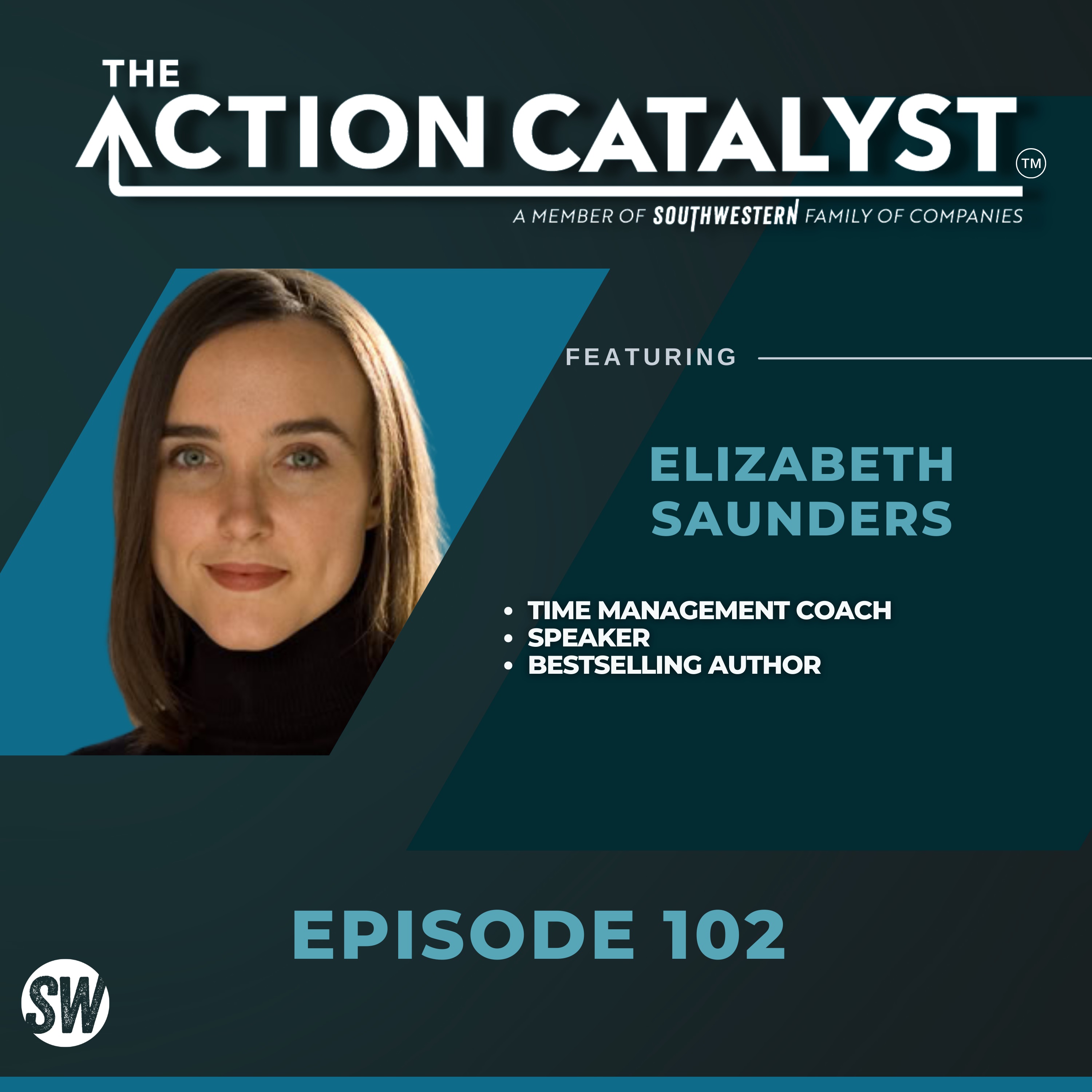
REMASTERED: Breaking Through the Barrier of Busy, with Elizabeth Saunders | (Time Management, Productivity, Business, Decision Making)
About this Episode
Best-selling author and time management coach Elizabeth Saunders explains why more input doesn’t equal more busy, and shares ways to expertly manage email, use text expanders, define "time investment", and get clarity from your calendar, plus breaks down techniques like the I.N.O. method, and priority-based decision making.
Hosts & Guests
Transcript
It is factual that there's more input than ever before.
Do you need to be more busy now?
You can be in a place where you make choices
about what you do or don't do with your time.
You have to bet the parameters and boundaries
to the viewer's try to handle all the input coming at you.
You will be crazy.
Top leaders.
Meaningful conversation.
Actionable advice.
Bulldo's complacency.
Inspiration.
Create impact.
Produced by the Southwestern family of companies.
This is the Action Catalyst.
Are you interested in advertising with the Action Catalyst?
Our listeners could be hearing about your brand.
Right here, right now.
For details, shoot us an email at info at theactioncatalyst.com.
Elizabeth Saunders is an entrepreneur and she talks about productivity and time management.
So Elizabeth, thanks for being here.
My pleasure.
My pleasure.
I want to talk first about this concept of busyness.
It's like, are people really more busy today than ever before?
Or does it just kind of feel like that?
Absolutely.
So number one, it is factual that there's more input than ever before.
So in the patch, you would have mail that came once a day.
And when the mail came, you could go get it.
And that was all you were going to get for 24 hours.
Made even longer.
If it was Saturday and you had to wait until Monday.
Whereas now we've got email.
We have text.
We have all these social media.
Before, there was fun phone line in your house.
And that was for everyone in that house.
So there was just a lot less communication.
So is there more input?
Yes.
Do you need to be more busy now?
And the difference is you can be in a place where you make choices about what you do or don't do with your time.
And the fact that we have technology, whether you're in sales or nunchkin or lots of other things,
can help you get more done faster.
But you have to set the parameters and boundaries on what's in or what's out.
You don't get overwhelmed because if you try to handle all the input coming at you,
yeah, you will be crazy busy and running around like chicken with the pet cat.
And a lot of that comes down to the expectation in regards to whether or not you feel overwhelmed.
I have executive client to on purpose won't answer most email.
And they just know that if something really important, there is for stint or someone else will follow up with them on it.
And they don't feel overwhelmed by it.
And then there's other people who, if they're in back to the net that you're all the time, are freaking out.
And so of course it varies depending on your job.
I'm not saying no one called me.
I was just like never answer email.
So what I am saying is your expectations of what does or doesn't need to be done for you to feel good about your life and what you're doing.
Have a huge impact on whether or not you have that easier, overwhelmed feeling or whether you're just in a place of peace where you're totally as into the moment and loving what you're doing.
On the topic of email, do you have any strategies or tips or things that you see for helping people kind of manage email?
Because that's a, that's a big stressor. It seems like definitely definitely so a few things.
Number one, if you have the ability to have an assistant help you just clear things out and do standard responses, do that.
The huge benefit to you, particularly if you're in sales or in other sort of positions where you have a lot of graduating coordination that need to happen.
That can literally cut hours and hours from your week of having someone else just take care of that in advance.
Follow up on whatever you need to know about phone numbers or location or that sort of thing so you don't need to deal with that.
And you can also set up filters so that those email get into the right person if they don't go through your inbox or even with all the meeting confirmation so they get filtered into particular folders so that they're not cluttering up your inbox.
Another thing that I really really love and use every day are something called tech defenders and what that means is I have software downloaded on my computer.
Very inexpensive and you have short abbreviation that then pop up to use standard responses so standard email replies I send standard even sentences or paragraphs of text I tend to need.
I have in little short abbreviations that are maybe read a five letters long to that standard reply and then they just send the email.
So it's way easier than copying and piecing something I think it's even easier than having draft email because I simply put it into wherever I am on my computer whether it in my you know program or in a word documents or on a webpage and those snippets of text expand or whatever I need.
One I use is called type it for me and that works on Mac there's a few other tools that work on Mac and then also some on PC if you just Google.
You'll get some good options there and you get that up little little clippings or little abbreviations and I do everything from like a dead whole email to have an abbreviation for my name or for my mobile phone number or for my address or.
I might have to type again I have down for basically a two letter or three letter abbreviation that I have to type it that is really helpful then also in regards to the time investment type of it.
I find that people studying inside dedicated time to answer email is much more effective than just randomly trying to.
Because what happens when you quote unquote please it in is that you end up reading but not responding to a lot of emails and the email that.
Are truly most important a lot of the time they may be required nuance approach you never end up doing because it takes more than five minutes so.
You just let them linger in your inbox and feel guilty.
You're about it every day whereas if you set aside maybe thirty minutes you are three times a day or if you prefer to do it all once an hour hour and half then you can.
Cross us through when you read something immediately respond and get those emails that are truly important done instead of never responding to them.
That term what does that mean like when you talk about time investment.
Definitely so I think time management traditional time management is that what I see is the next evolution is what I call time investment and that is about deciding what's important and what not.
They know as much as possible and then really focusing in on what matters what are those high value activity.
So that is first of all just cutting out a whole bunch of things in your scene.
I'm not doing this and I'm not going to feel guilty that I'm not doing it because that's the fastest way to get something done.
Then from there I have what I call an I know technique and what that stands for is investment neutral and optimite so there are certain perks of your life or time that I see is investment activity so basically they pay returns on that time.
It's not about like ABC priority like what needs to get done today versus tomorrow that first thing it's about looking at what's the ROI on that time invested.
So professionally an investment activity may be setting up a system that will mean you never need to do something in.
Or it could be moving ahead a huge contract that is going to help you meet this quarters quota or maybe half a year's quota.
Those things where if you put in a few extra hours or even a few extra days this exponential return on that investment mutual is where there's one to one ratio.
So maybe this could be like having a meeting with your staff or talking to your assistant or something like that.
You need to put time into it. We don't want to cut it but funny a lot more time that staff meeting is not going to probably read to 500% return on that time.
So you want to get them done but you don't want to spend any more time than is necessary doing them and then optimize activities are things that you want to accomplish as quickly as possible.
So like I was saying with the text expanders answering a repetitive email is not something where there's any value in that taking any more of my time that it needs to take.
So if I have a little snippet of checks that pops up that's what I should use.
Cordating eduling things that can be something that can be delegated to an assistant or if you're doing it yourself.
You can use tools like calendar that we get easy for people to book a time with you or time trade or other tools like that and it thinks with my Google calendar.
So then I can send people to a link and then they can select a time that works for them have the appointment set up and it will automatically go to my Google calendar and as I make changes my Google calendar.
calendar will update so that it will show me infinity on the time that I'm no longer available.
So it's basically a very simple name for people to make appointments with me and need to have total control over my busy times my free times and I'll set up a lot of parameters.
So with calendar I can designate whether or not it's a 30 minute meeting a 15 minute meeting.
I can stay how many meetings I wanted to pay if I want buffer after meeting here before all the search of things it left me.
What is appropriate and then it gives people the freedom to set up the appointments they want within those parameters.
You know on the topic of calendars what's your current stance on using to do list schedules and calendars you think like they're still useful tools or are those things that have been left behind.
I think that calendars in particular are still extremely useful and why that is if they give you clarity.
I think one of the biggest reasons people don't invest their time well or even don't eliminate things like we were talking about it because they don't have clarity on what's really significant or important and so then they just fall into a reactive mode as they get at their computer.
People with the emails that come in look at who come by their does go to their meetings and they haven't even thought think about what might be important.
So what I find is that when you have your calendar laid out and you reserve time and advance for those top priority and most significant activities.
These and force everything else to fit around them and that's particularly important was individual to have a lot of meetings and time to get book can get booked back to back.
They have to reserve time in their calendar and advance just they this will be time I move forward on priority projects or else they will never get done.
I really think that's where weekly and daily planning come into play, which is something I absolutely advocate and weekly planning in particular is an opportunity to make strategic decision about what you will or won't do.
On a weekly basis they review the prior week, you need to be wrapped up or moved forward or taken off and then they look over the coming week and that's a great time if they haven't done so already she's a client meetings to both own thing to take things off their schedule and really clarified based on the current reality.
What are my top priorities and how do I make those happen so the calendar should not be like a mindless thing that you just you just follow, but I think it can be a good place to give people a realistic sense of their capacity is often what happens is like I said people don't have any time reserved for those key investment activity.
So they don't get to simply completely over commit they say oh sure I'll work on that project or he on that presentation or jeez or that without ever stopping and looking to see on their calendar if they have the time to pay for whatever commitments that they're making.
What about to do this.
You know it's so interesting to ask that question because I'm actually I've been evolving in that regard and I think part of that was based on the sort of work I did so before being in this whole area of time management time investment.
I was in the world of managing journalism and so a lot of my work was project based and I had a lot of different designs that needed to get done and it was actually quite helpful to have things like my project list.
And to do less than all of that and I still do have like to do the places where I write down potential item.
But what I'm finding more and more is that if something is truly important to me it should just go right on my calendar.
Either as an event where I'm going to get the item chat then or as is like a task or all events at the top of the day when it I'm sensitive and you see it done.
Otherwise it probably not that important and either like shouldn't be on it to do this at all or should be on some sort of like someday maybe list so I've been evolving in that area more and more toward.
It's important just to schedule it now and if it's that important maybe shouldn't even write it down or help accountable to what I sound worked best to do something I call priorities based decision making and what that is.
A filter that helps you determine it can help you to turn from an overall life view or from a narrow view like just within your professional life.
What needs to be attended to and what doesn't.
For example, my priorities be filter would look like you know God in my face at the top of my family, then my friend, then my business, then Walnut and leisure activity.
So as I'm making decisions about what's going to be on my schedule I want to make sure that I have.
The top thing they're first though like I have time to go to church or I have times you connect with my family or my friends and then from there I can decide on being.
That I'm going to do for my business or leisure or that sort of thing and so it's about making sure that the higher level items are tended to first before I do the lower level item.
Then if I'm drilling into a specific area like for instance with my business I have a sense of okay what are the top business development activities that I need to be working on and then what are some lower level priorities so it's like yeah business development at the top.
And you at least for me and then serving my frank client and then you know I might have some business upgrade your business and that I want to work on and then there's everything else after that and so I make sure that my top order items are put in first.
And then if I don't have time for the things at the bottom it's okay awesome well Elizabeth where can people go to learn more about you where do you want to direct people.
While the best place to go is to real life e.com and I'll fill out for you so our E.A.L.L.I.F.E. and then another E.I.L.A.L.E.
Very cool well it's been awesome to have you here and thank you for coming on the show and we wish you all the very best.
Awesome my pleasure thank you very much for having me.
If you enjoy this podcast please make sure to subscribe and to stay updated on everything that the action catalyst is up to.
Make sure to follow us on Facebook and Instagram at action catalyst podcast and on Twitter at catalyst underscore action and as always thanks for listening.