Loading...
newseducationhistory
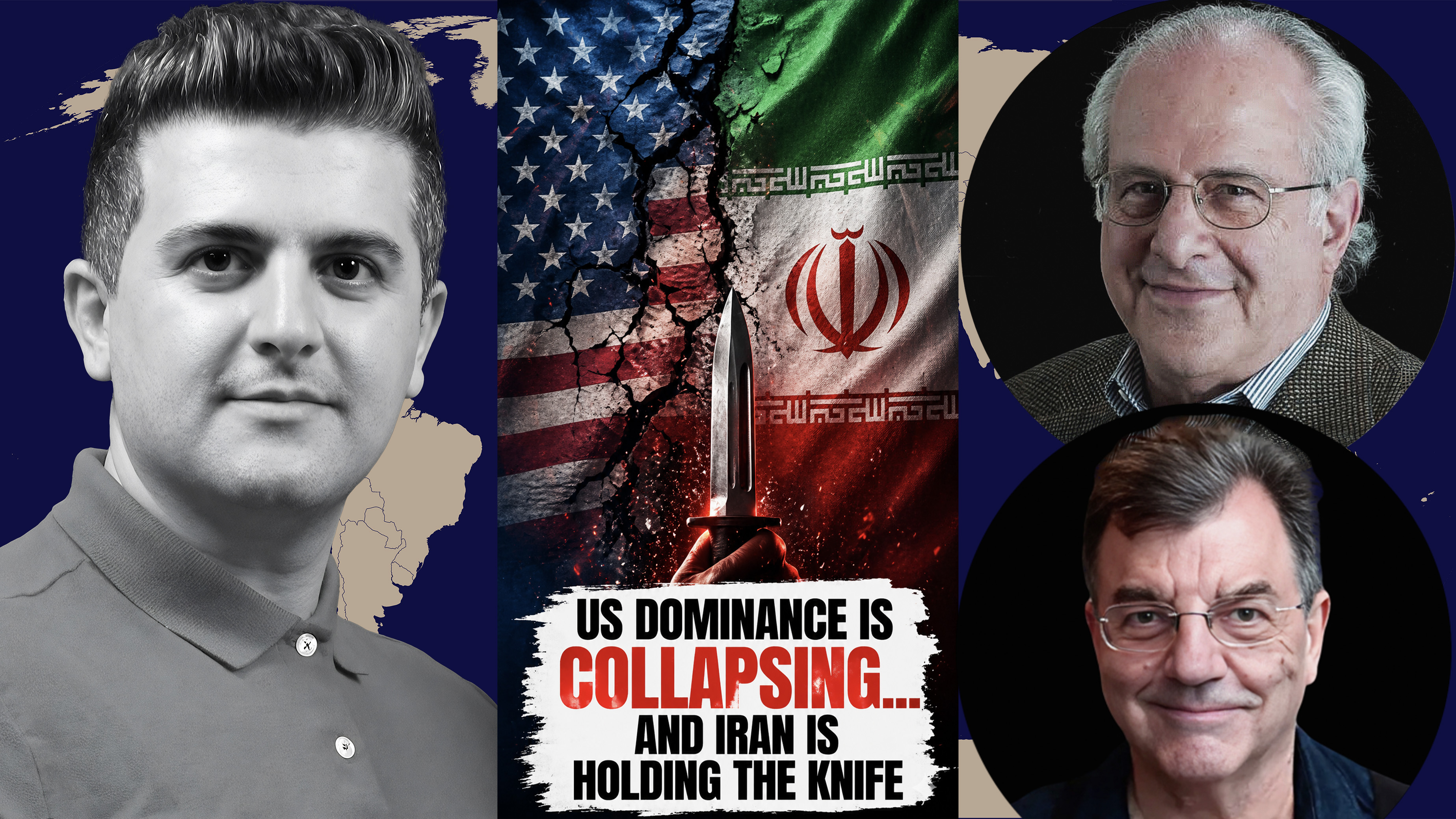
Richard Wolff & Michael Hudson: US Dominance Is Collapsing… And Iran Is Holding the Knife
About this Episode
Deep dive into US-Iran conflict: Economic sanctions and naval blockades face pushback as Iran leverages regional trade routes. UAE's OPEC exit reflects Gulf debt pressures and oil market uncertainty. Discussion covers dollar weaponization accelerating de-dollarization, with China-led payment systems challenging SWIFT. Military costs mount while US economic growth trails China's. Nuclear concerns examined as potential pretext for oil control and containing emerging multipolar alliances. Analysis suggests aggressive unilateralism may inadvertently strengthen the very partnerships it targets, reshaping global trade and power structures amid empire decline.
Hosted on Acast. See acast.com/privacy for more information.
Hosts & Guests
Transcript
Hi, everybody. Today is Thursday, April 30th, 20th, 26th, and our dear friends, we should
go on Michael Hudson or here with us. Welcome, I appreciate my goodly back.
Let me start with current situation with the war between Iran and the United States.
What we've heard so far, it seems that Donald Trump, the people in the Trump administration
somehow divided some of the most of them or those people who supported Donald Trump,
the Adelson family and these people are forcing Donald Trump to again attack Iran. These are
the leaks from Washington. We've heard just hours ago and on the other hand is the situation with
the economy and how the the US Treasury Secretary is trying to put pressure on the Iranian economy
and here is what Scott Besson said in terms of the strategy on their part.
And into the country, we are partnering with our Gulf allies who
having been fired upon for almost 40 days are much more willing to share the bank accounts of
members of the Iranian regime and their countries. We are reaching out to banks including
Chinese banks to remind them of that any Iranian goods and the purchases that are of our
forbidden and that the dollars would be sanctioned and that we will press for secondary sanctions
if there's a problem. So the Gulf? Yeah, a part of that, what is going on, for example, with the
case of UAE, UAE, it seems that has decided they have announced that they have decided to get
out of OPEC and which would somehow try to help Donald Trump and his administration. On the
other hand, Donald Trump was arguing that if Iran is not able to export its oil,
their oil wells going to explode and everything going to be devastated in Iran and here is what
Iran in the head of Iran in parliament posted yesterday. He says three days in, no well exploded,
we would extend to 30 and live streamed the well here. And that was the kind of the
junk advice the U.S. administration gets from people like Scott Besant who also pushed the
blockade theory and crank oil up to 120. Next stop, going to be 140, the issue is in the theory,
it's the mindset. Richard, let me start with you and you're understanding, they're trying to
put pressure on Iranian economy. Scott Besant said that and even before this war started with those
protests in Iran, then riots in Iran, it's all about putting a lot of pressure on Iranian
economy, then breaking down the economy from within, then bringing down the Iranian regime,
so-called regime. What is your understanding of the current situation? Because they're
somehow talking about the Iranian economy as though this blockade is bringing some sort of new
opportunity for the Trump administration, which is not the case, looking at what's going on,
for example, between Iran and Pakistan. Pakistan has opened six lines of communications
through Pakistan. The tankers go to Pakistan and go through online to Iran. This is
the reality of what's going on with the blockade. You're understanding, Richard.
Okay, let me begin by making an even stronger comment about Scott Besant than I have in the past.
Beyond being embarrassed by the fellow, his slavishness to every bit whim of Mr. Trump
is clearly what got him into his job. Nothing else could explain it. And taking seriously
one comment after another of him is, I think, a fool's errand. There's nothing there, but bluster.
It's the bluster that he copies from Mr. Trump. Lots of threats, lots of dire warnings, very
little performance. Everyone should remember Mr. Trump thought he could solve the problem of Iran
in a day or a week. He was going to do it right after he got elected as part of the no more
wars that he ran his campaign on. All of that was bluster. All of that proved to be as
phony as a four dollar US currency bill, which for those of you who don't get the joke is funny
because there is no such thing. It's the same thing with Mr. Besant. He's gone a boycott,
and we've told the Chinese banks. I'm sure the poor bankers in China are trembling because Mr.
Scott Besant and Mr. Trump have threatened. You know how many threats against China they've made
in the last year and a half 50, and they've almost all either been retracted or never made any
difference had no reality beyond verbiage. All right, now let's deal with the current situation.
The United States guaranteed everybody above all itself that it could solve the problem of Iran
with a nice short war. You know, like the 12-day war last year in June, they would go in there,
they would assassinate a political religious leader, Ayatollah Kaminay, etc., and every government
would fold, and Iran would split into five countries, all of which would be additions to the
Gulf States, run by local people picked by the United States, and maybe Britain would be allowed
to have one in honor of King Charles's visit. That's a level of mentality that you're dealing with here,
and that proved like so many of their dreams, unrealizable, couldn't do it, misunderstood it,
didn't understand the drones that the Iranians have, didn't understand the missiles that the
Iranians have, didn't understand the Caspian Sea, and the corridor that that gives Russia and the
Iran to move between each other without crossing any other national border, but nobody can interfere,
we don't even know what they've been building there for the last 15 years of their relationship.
And remember, China has an even bigger unguarded border with Russia, so China, which is the world's
manufacturing colossus, more important, according to Paul Krugman, than the manufacturing base of
the United States, Britain, France, Germany, Italy, combined. Okay, so you have the greatest
manufacturing capacity in China, who can move everything easily into the border with Russia,
which can move everything easily down the Caspian Sea, right to Tehran, which is close to the Caspian
Sea. Okay, so this is the notion, they don't have the equipment, they don't have stop.
This is all make-believe, and it's make-believe for people who've never looked at the map,
who don't understand the geography or anything else. That's a first. Now the second thing,
a big item in the news, and you refer to it, is the decision of the United Arab Emirates to quit
OPEC. That is very important. OPEC was in a solid organization, basically run by Saudi Arabia,
with the others going along in the interests of controlling the market, at least to a certain extent.
And what this means is that Saudi Arabia, who is the one most affected by this decision,
is much weaker in terms of its ability to control the oil business in the world.
And that's important, not just because it makes life difficult for Saudi Arabia,
but because Saudi Arabia can't control, everybody else is now going to be
troublingly dependent on what the Saudis in their desperation may now do.
Why did the United Emirates go? Well, I'm not privy, but here's my best guess.
Saudi Arabia, of course, the United Arab Emirates, like most of the Gulf countries,
took their dollar holdings, and not only purchased US treasuries and US stocks in bonds,
but getting greedy, used those stocks in bonds to leverage. In other words, as collateral for
big loans, which is normal in this level of business, Michael knows all about it, financing
an ever bigger role for themselves in whatever their projects were. And remember,
they want Abu Dhabi to be the global center of finance and wealth.
They have enormous debts. They have to service those debts. And in order to service the debts,
they have to have oil revenue. And they've got to have it now, not next week, not next month,
now, or else what? They either go to the United States and sell their dollar assets,
which for all I know, they have already done. They're desperate, even if they haven't done it,
they're desperate. And I think what they're doing is looking at the oil business,
deciding that we will never again see oil prices this high, that the transition to non-oil
is going to be greatly stimulated by all of what's going on now. So here's the best idea.
Sell as much oil as you can at the current high prices. That was what they could not do as part of
OPEC. And that is what they can do if they're not part of OPEC. If I understand correctly,
their capacity is millions of barrels per day larger than what they are now selling. So they can
sell much more, take advantage of these high prices, lock in an enormous gain, take care of
all of their debts, and accumulate for the coming period when oil will no longer be what it was
throughout their history to this point. So they're taking care of themselves in a bad situation.
And I don't think it's all that different in the other Gulf states. Could be,
but not all that different in terms of their behavior and their dependency. So sure,
they want a big swap arrangement with America. They want to get their hands on a lot of dollars
in a hurry, which is all that the swap really does because they really need it to same problem.
The freedom from the OPEC and the swap allow them to handle a desperate situation.
All that this means is that Iran has even more leverage over the situation than we may have given
them credit for. Last point. And I know these are disparate things, but they do link together.
The United States announced with great pride that their current economic growth is at 2% a year.
Now, for the United States, that's quite nice. China is roughly 5%. And that relationship
that the Chinese are growing two to three times faster than the United States has been maintaining
as the relationship for the last 30 plus years. China is catching up and surpassing.
And the very measures that Scott percent says, we will do this to you,
do that to you. Someone should shake him by the lapels and say to him, you've got it wrong, Jack,
you're not the dog wagging the tail. You are becoming the tail of a different dog.
And you're teaching that dog how to treat you in a few years. And you ought to think about that
before you continue this disastrous cementing of the alliance between China, Russia, and the Iran.
Michael.
Nima, I have a choice. You begin by asking about the effect of the American sanctions.
And then Richard brought up the issue of the swap agreements. What do you, I have quite a bit
to say about both. What do you want to discuss? I think it's better to start with the sanctions
and the way that Scott, the Santa is trying to put pressure on the Iranian economy.
Okay. It's obvious that Trump has been told by his military that an invasion,
an armed physical invasion of the army is out. And also that even an air attack, certainly by
airplanes, is also out. So the US cannot do the military response that Trump has thought has
been the major threat all of this time because the military has told him this is we're going to lose.
Every game plan that they've done shows how heavily they're going to lose. So what can Trump do?
All that he can do is applying sanctions. And so he's turned the strategy
over away from the military to bessent basically for financial sanctions. And that means choke points.
Well, how is it? All of these choke points are really, as Bessent's quote was, it's all about
China. The whole idea is to prevent China from benefiting from the resumption of OPEC trade.
And especially from trade with Iran that is denominated in Chinese currency and will basically be
based in China. So what can other countries do to cope with all of this? They're all faced with
the following problem. If they do nothing, if they let Trump impose these sanctions, preventing
their banks from processing any deposits or transactions or payment transfers that come from Iran,
then these whole banks are going to be presumably put out of business. Well, the only way
that they can solve this and it may take a little bit of time is to break free of all of these
threats. Well, how do you do that? In other words, I think RoboDope is the only way of breaking free.
For instance, the only way to prevent with US tried to threaten other countries by saying,
we're going to block all of your foreign banks from the Swift bank clearing procedure,
if you don't follow our diplomatic direction. Well, what happened was that China created an
alternative, the cross-border interbank payment system that charges much less for processing
transactions than Swift. So now countries have an alternative to using the Swift system.
Well, this is a model for what they can do to cope with the financial sanctions that Trump
is imposing. If Trump is going to weaponize the dollar system and the international financial
system in the way that he's tried to weaponize the Swift system that was ostensibly run out
of Belgium, well, then the alternative is to create an independent but parallel system for all of
this. And I guess you could say that well, the United States could block all transactions with
these banks. This is mutually assured financial destruction. The US is saying we will destroy
your economy, your financial system that is needed to operate your economy if you don't isolate
Iran and isolate China in the way that we've said. Well, all they can do is call his bluff and
say, well, we're going, you know, you can try to freeze everything. We will work together as quickly
as we can to create an alternative system so that in the future, our banks will become completely
independent of so independent of the United States that you won't have any power over us to create
a choke point like this again because we won't be using you. We're de-dollarizing everything.
It probably will take them a few years to develop this. But what Trump is doing in one point
after another, one weaponizing finance, weaponizing trade, the same thing is happening with his
weaponizing the oil trade. What can other countries do? Well, number one, they can say,
all right, you're going to cut off our oil supply. What we're going to do is reorient our
trade energy trade with Russia, Iran, and other friendly countries away from the US. But most of all,
and this is a point that's been made by environmentalists in the last week. We can move away from
oil and gas and carbon fuels itself. We can move towards wind power, wind and solar power,
and nuclear power. Well, the irony is that all of these three alternatives to oil and gas are
the used technologies that are developed by China. And so what Trump is doing just as in
weaponizing swift, weaponizing the banks and weaponizing the oil trade is to drive other countries
into China's orbit for all of it. So ultimately, it's going to be destructive because it's
driving other countries away from an international system that is based on America's ability to turn
the world economy into choke points. Well, scale is important on this. The more countries
that opt out of this US choke point system, the easier it will be to join an alternative
to the whole purpose of trade and investment to try to make it the way it was supposed to be before
the United States weaponized everything and to make trade and investment a system of mutual gain,
which is the basic principle of Chinese policy. So that's the big context.
All of this is going to create, for the short term, the threat, a breakdown in the world economy
and what's going to happen. This is the lead in, this is the transition to what Richard just did.
What does this have to do with the Arab Republic, the UAE withdrawing from OPEC? Well,
here's the problem that Saudi Arabia and the Arab Emirates have just as Richard described.
They need, they're very highly debt leveraged themselves despite all of the investment that they
have in the US. So what are they going to do? Saudi Arabia has already said what it's going to do.
Well, we're not going to be able to export oil and have earnings that we then transfer into our
US accounts and invest in trying to make more money by buying US bonds and stocks. In fact,
we have to meet the shortfall in our earnings that we need in order to keep many of our businesses
afloat. We have to begin selling US investments. Well, the problem is that these investments are not
only US government bonds, which have gone down in price as interest rates have gone up, but a lot
of these investments are in private capital investments, which are illiquid. And the US economy right now
is the most highly itself, the most highly debt leveraged economy in the world, just as it was in
1929 before the world, the stock market crisis and brought on the world depression. So the UAE
has the same problem that Saudi Arabia has. Well, suppose they want to sell their blackstone
investments because they've put a lot of money into investments like private capital.
The problem is that blackstones put a block on withdrawals from the system and there are many
other private capital investments that everybody's trying to get out of them and recover what at least
they had put in originally. But the investments they have in many of these technology companies
and investment vehicles are selling at a great discount, 20%, 30% of the discount if you withdraw
your money now because there's a realization as Jamie Diamond has just said in the last few days
that the whole US financial system is over leveraged. And so what can the UAE do to the US? It says,
well, look, you're attacked on Iran. You didn't talk about, you didn't consult us before you attacked
Iran. This is causing us a financial problem. You're threatening to impose a huge loss on us as we
sell these American investments that we've recycled to your economy at a huge discount. So
Vessent has said, well, we have an alternative. These are the swap agreements. Instead of you having
to sell, let's say, $100 million worth of your investments in US securities and crash their price
in the process, we will create a swap agreement. You'll give us $100 million of your currency,
we'll give you $100 million of US dollars is a swap. So you don't have to sell any of your investments
and therefore you don't have to crash the US market. That is all that Vessent really cares about.
He doesn't care about saving Iran or Saudi Arabia from taking a loss. He wants to prevent the US
banking system and the US financial market from saving a loss. And what Vessent has said is, well,
what we've done for the Arab Emirates we can do for all the other countries. Right now you're
having throughout the whole global south. A crisis is a result of the rise in energy prices. Well,
what can Vessent do? These countries are then telling the United States, well, because of your war
with Iran and the blockage of oil transport through the Strait of Hermos and the rising price,
we can't afford both to import the oil that we need to keep our factories going in our houses
lit and pay the debts that we have to you. We're going to have to cut back something and we're going
to have to put our own interest first because we're not going to suffer a destruction of our economy
just to pay all of the loans that you've made to finance a system that you've locked us into
where we run rising, rising deficits. So I think Vessent is saying, we're just going to print the
money. We're going to turn the whole world economy into what we've done with the US economy.
A Ponzi scheme. We will lend you the money to keep a float for all of this system that is running
a continued deficit. We'll just keep printing the money to keep at least the financial system
afloat. That's what it all is. And so by threatening on the one hand trying to keep the financial
system afloat by these swaps and on the other hand, threatening to block all the banks that use
Iranians in countries that use that have Iranian bank accounts, which are I think a lot of countries
that he's threatening to crash the financial system. So that's the what we call an internal
contradiction in the whole American imperial strategy. Something's got to give. One way or another,
either of these ways, the world economy has to be broken down and crashed as a result of the US
attack on Iran and the consequences of drastically raising international oil prices and
preventing oil trade altogether. Richard, here is what we've heard yesterday from the estimation of
DOD of the cost of the operation against Iran. Here is what they said yesterday.
This day, we're spending about $25 billion on operation epic fury. Most of that is in munitions.
There's part of that. It's obviously O&M and equipment replacement. We will formulate a
supplemental through the White House that will come to Congress. So once we have a full assessment
of the cost of the conflict. So you're saying the full cost at this point is $25 billion.
That's a restment for the cost. What's happening in the other reports, Richard, which was on CNN on
New York Times, both reported that the stockpile of the United States, when it comes to the
jasms, when it comes to the interceptors, tax system, and patriot system is less than 50%.
They have 50% of what they had before this was started. But our friend of this podcast,
Larry Johnson, his estimation is when it comes to the tax system, air defense system, and jasms,
which are important when it comes to the offensive capabilities of the United States to hit the
targets outside of the Iranian airspace because they have some sort of range that can get the
target in Iran, deep into Iran. They're less than 10% in American stockpile. On the other hand,
their estimation of Iranian drones and missiles, they're basically talking about Iran has 70%
of its stockpile that it had before this was started. So the Iranian depleted 30% something
like that. And the United States, as I've mentioned, what is the calculation? How do you see the way
that these numbers are working for the Trump administration? Look, again, I really have to say this,
I guess, over and over again, to take this seriously, what they say in these hearings is ridiculous.
They don't tell you what their situation is. If they've depleted, I can assure you they do not want
anyone, especially Iranians or Russians or Chinese, to know how much they really have depleted,
just like they try to keep secret how much they actually have. And they certainly don't want to
be embarrassed by questions about the details because they don't want to talk about any of that,
which I, by the way, I understand. It's just this peculiar American craziness in which you know
you're supposed to be transparent. So you put out a theater of transparency, but you're not
transparent. No governments that I know of are particularly transparent on that issue on the
other side either. So these estimates, they're costing us this amount. I want to remind you that the
estimates of the cost of the Iraq war, the Afghanistan war, the Vietnam war were all over the place.
All kinds of academic institutions came up with numbers radically different from the political
numbers, and it was never resolved. And you can pick and choose. And an awful lot of people make
an argument by picking which a large number, if that's what's good for your argument, or a small
one, if that's what's better for your argument, we can't, we can't get lost in that process.
What these numbers mean for those who care, orders of magnitude is the only thing you want to take
seriously. Okay, $25 billion. That's an enormous amount of money. That already allows us to tell the
classic story of guns or butter. Huge numbers, 25 billion is more than what was saved by everything
Elon Musk did with the Department of Governmental Efficiency. So for months, we were told he fired
these, he closed the education to 25 billion would have made all of that unnecessary. Okay, so we're
choosing guns over butter. And that's an old story. We knew it before. These numbers simply make
it clear to say. Then there have been at least a dozen exposés, military exposés, in at least
European literature that I look at that show that the Iranians very cleverly understood long ago.
How much you can tell by electronic surveillance and how much you can't.
So it turns out it's not that difficult to have some trucks and a crane and the building of what
looks like a missile silo. But that's all it is. It looks like it. There is no missile in there.
10 miles away is another one and 10 miles away is another forever. Some of them have a missile in
them. Some of them don't. And since it is extremely cheap to do this, you have phony missile silos
everywhere. And so then the joke is the United States uses a 10 million dollar missile to get rid
of a $500 fake silo. Does it over and over again? And so you can get the crazy result. They
haven't depleted much of what they actually have. And the United States has to, but you know,
this funny story is like the story told about the American Revolution. The British sent over
an army to repress the revolution here. And the American farmers with their primitive rifles
running around behind a tree have a better grasp of a terrain and what is in his mouth.
And so all the advanced technology that the British can deploy their military globally across
their empire ends up being unable twice in 1776, again in 1812, to defeat the United States.
That's what we're watching. It's now the United States turn to be embarrassed. It's the United
States turn to go through the experience that the British went through when they're great navy
didn't help them because they had the unload troops and those troops in the condition of New England
couldn't do very well. Okay, the technology is different, but the story is pretty much the same.
And the spectacle, let me drive off, there's a spectacle here that shouldn't be missed.
He can't use the air force because the bombing didn't work. I mean, he did bombing for a few weeks
and nothing didn't get anything, right? So the bombing doesn't work. Putting troops on the ground,
that doesn't look like it's going to work. So as Michael reminds us, he chose, or maybe you said
it, Nima, he chose the navy. But here's the, in choosing the navy to undertake one of its biggest
tasks in many years, the global blockade of shipping in and out of Iran, the same week that he does
this, he fires the head of the navy. That's crazy. That's not a time you change. What? Now,
either that means there was tremendous opposition from this naval head to what they were doing.
And then that tells you a lot, if that was the case, or they wasn't, in which case it tells you
a lot that they fired the guy in charge of the biggest effort they're making that makes no sense
this sort of thing in any rational way of going about it. Moreover, I have no idea. I'm no
a naval expert, but how you do a blockade when basically it's the whole world. I mean,
Iranianships can get out of the straight of hormones. They've been doing that, if I understand
correctly, throughout this whole story, they know how to go along the coast and they can be hidden
and all that. And so they get out into the larger oceans and then they go in all different,
is it really going to be a global blockade? And if it is, it would have to be done by air power,
because in fact, you'd have to track these boats and then do what? Do to them what you do to
those fishermen in the Caribbean and in the Pacific, which by the way they've started doing again,
killing those people in boats, which we ought to be talking about also, since that is extra
judicial summary judgment execution. It violates every international law of the ocean. It's
extraordinary, but it is an unbelievable notion that they're going to be able to control this
by a ship. And I don't think it's going to go anywhere. And it's just his refusal to resolve
the contradiction with which we begin. If we are right, and that he has the pressure from the
APAC and all of that to stay with it, and the pressure of the economy to end this thing,
and he can't resolve it, well, I don't see him being in a position to resolve it at any time,
unless one or the other of these things goes. So that leaves me with a question, which maybe you
can answer, Nema or Michael, how much damage to Israel has been done and is being done
by the Iranians from Iran and by Hezbollah in Lebanon, because at a certain point, is it possible
even with a regime like Netanyahu that the Israelis will want this to stop because of what it's
costing them? I think there is some sort of conflict in Israel, Richard, because Netanyahu's
survival is on the front line right now. He doesn't care about the economy in Israel. He's fighting
to the end, because if he's the rival, Michael, go ahead, you're taking that.
Well, Richard, you could just as well have asked how much damage is the war and Trump's policy
causing for the United States. I want to pick up on the point that you brought up at the beginning
of your last comments on this guns and butter argument. This was what helped bring the Vietnam
war to an end. In the mid-60s, I was a member of the Columbia 3, Seymour Millman, who was writing
about Pentagon capitalism with an active within the Democratic Party, Terence McCarthy,
and myself. We're writing in ramparts and all other magazines and going around the countries,
I even had many articles in the Catholic press on this. We pointed out that look at what
the Vietnam war is doing to the U.S. economy. Well, let's ask the same question today, and this
is exactly the point, Richard, that you're right. This is what we have to have the U.S. talking
about. What is the effect on the U.S. economy? Well, the fact is 25 billion is not a big number,
compared to the 1.5 trillion of the overall U.S. military budget. Let's take a look at what the
real costs are. Remember, there's been a study of the Iraq war that figured that it was going to end
up costing the United States $3 trillion when you factor in all of the interest payments on the foreign
debt on the U.S. Treasury debt that has been taken on to finance this military spending. The
whole deficit finance, all of the veterans administrations costs for the injured and killed soldiers,
all these long-term costs. The 25 billion is only the current out of pocket costs,
but how much is that going to cost to restock all of the U.S. missiles and airplanes and
ornaments that have been used up that you pointed out? They're not counting this in that 25 billion
because that money hasn't spent, but what is that going to cost? 200 billion, 300 billion,
added to the deficit for interest payment over the next generation. It's really over a trillion
already, my guess is. Why is there's no opposition today to the Iran war like there was in the
Vietnam War when we were all making the calculations of what the costs of this, just financial costs
and the physical costs are going to be, not to mention the costs in terms of the restructuring of
the world economy as a result. So how much is the U.S. economy going to have to pay to rebuild
its military armaments to do this all over again when it fights China and what's the cost of China
going to be? 100 trillion. This is the order of magnitude is what the United States is trying to
minimize. So it's not that they're lying about the 25 billion that they've spent out of pocket.
They're just distracting attention from the fact that you have to take into account the effect
of what you've done, what are the long-term costs and what are they going to be and what will
the effect on the U.S. economy be? Richard, here is yesterday Pete Hexet was asked if the
United States is winning the war with the case of Iran and here is what Pete Hexet the way that he
responded. Going, do you think we're winning? Militarily on the battlefield, it's been an astounding
military success. But are we winning the war? Absolutely. Okay, so do you call Iran closing the
Strait of Hormuz winning? Well, I would say the blockade that we hold that doesn't allow anything
to come in or out of Iranian ports. So we've blockaded their blockade. They blockaded us
and then we blockaded their blockade. That's like saying tag your it or if President Madison
said, well the British just burned down Washington but don't worry, we're going to burn it down as well.
Richard, the reality is what's going on the latest proposal that is happening between Iran and the
United States. Iran has proposed a plan of three steps. The first step would be the end of the war
on all fronts between Iran and the United States between Israel and Lebanon, which this is the
first step. The second step would be the Strait of Hormuz, how they can negotiate and they
bring some sort of sanity to what's going on, you know, to negotiate with the United States,
considering the case of the Strait of Hormuz, the new mechanism in Iran and Oman is defining for
the Strait. And the third step would be the nuclear program of Iran, you know. It was so amazing
that these two first steps were not part of the game before this war started. It was all about the
Iranian nuclear program right now. Iran says, no, we're going to talk about those first two
steps, then the third step. And you're understanding because it's somehow when you look at the situation,
if the main problem, because the Trump administration, I don't know if you heard, you know, the
if you heard the Secretary of Energy, if let me, the Energy Secretary Chris
write what he said about the main objective of this operation. Here is what he said, Richard.
In this country, if the world's largest sponsor of terrorism had nuclear weapons that they could
deliver to your city, the United States and President Trump decided that's entirely unacceptable.
That is an existential threat to the region of the Middle East, to the world economy, to the
United States and to all of our allies. He took the hard decision to put an end to this risk.
We could ignore it. Everything's fine today. Look, when you have cancer, everything's fine.
Until you start chemotherapy, and then you're not fine, but you're killing the cancer that will
kill you. That's what we're doing right now. Before this metastasizes into a nuclear armed Iran,
President Trump had the courage to say, we will put an end to that. We will not let the world
be subject to that. And yes, he has been frustrated that he has taken from our European allies.
Not all of them, of course, but he's taken a lot of criticism and heat for doing that. I think
he's well justified in that. And yes, we would appreciate more support and more backing
in what we're doing. We're not doing it just for America. We're doing it for the world.
But we'll get through this. This that you Iran will not get nuclear weapons,
things will return to normal in the Middle East and will be in a much better place. But these
are frictions and bumps around along the road. You know, the funny thing, Richard, is that the case
of the nuclear program of Iran was on the table before this war started. They were negotiating
on that. You understand, you know, what's going on? Well, you know, these people that you are
giving us clips of are what we used to say. They are not the sharpest knives in the drawer.
Listen to Mr. Wright. At the beginning, Mr. Trump is portrayed as protecting us from the
nuclear weapons that the Iranians have. At the end of the talk, he's talking about the nuclear
weapons that the Iranians will have. But before you fight a war, the difference between
they have these weapons and they will have these weapons is crucial. Because then you negotiate,
so what they don't have now, they do not acquire. And from everything, the atomic energy
and the international agency told us from the inspections and everything else, they were still
quite a while. I want to remind people that Benjamin Netanyahu, the leader of Israel, has talked
about the danger of nuclear weapons in the Iran for 25 years. And there's no evidence at any time
that they had it. When pressed, even when Israel bombed locations in Iran, it was about locations
where they could, in the future, make nuclear weapons, not that they did. And especially
would have been strange to bomb a place that already had a nuclear weapon, because that can
do unspeakable. The contradictions here are so blatant, so over the top that I think many
Americans filter them out. It's like filtering out the nonsense that an upset person says,
to try to get at what's really upsetting them. Don't pay attention to the very terrible you
are afraid of the dragon. There is no dragon, but you take seriously that they're very afraid,
and you ask, what is it they are afraid of? This moronic energy secretary is telling you a story
that the Europeans are at fault for not helping in a war that was undertaken without their knowledge
and their participation. No one in their right mind would say such nonsense.
Or if you felt that they should have helped you despite being excluded from the decision,
you have to say something about yet to give a reason why it's reasonable to expect support
from someone you've excluded from a war right on their border.
Again, you have to be an American, lost in the craziness of mass media in this country,
not to see through the kind of silliness of all of this. I also want to drive home
something that Brian Briletic says. I believe he overdoses it, but he has his finger on something.
The United States feels it's confronting an alliance between Russia and China. I'm going to
center side the fact that that alliance, which I believe is real, is itself a product of American
policy because that's never understood in the United States and they can't handle it. When I say
it, I can see in their faces, we're done, but it's clear to me. And so the United States does
understand that has to deal with this alliance. So you could look at the current situation this way.
You fight the Russians to the last Ukrainian. That doesn't work. Now you are mobilizing Europe
in the same way you mobilized Ukraine to demonize Russia and to launch itself against Russia,
to have a war between Europe and Russia parallel to, and basically a continuation of
the war of Ukraine against Russia. And you hope that you can somehow neutralize or overwhelm Iran.
Neutralize or overwhelm Russia by having Europeans, your slavish people doing what they're told,
so that you can concentrate on China because you've come to the conclusion that only something like
that is going to be able to even have a chance of doing that. And why? Because your rate of growth is
2% a year and China is five. That inequality is the bottom line and they can't deal with it.
They have no solution for it. In fact, gunning international trade and going to these or
target turning inward is going to slow the rate of growth because it means you have to pay more
money for everything than you used to have to pay. All right, it's not an efficient arrangement.
It's a lack of efficiency. And so my conclusion, we are watching not a grand strategy. Again,
Brian puts it that way. That's not the way I would put it. I would put it. This is a ad hoc
terrorized governmental, economic, empire-declined group trying desperately wherever they can to hold back
the movement of history. And that never works real well. Sometimes, that's what they hope for,
but they're going for broke. And one of the reasons they, you know, you might wonder,
why would they let the supply of weaponry be depleted like? I mean, either you fight a war
and you make sure you replace or you don't and spend time replacing. Why would you fight multiple
wars, you know, depleting your missiles and drones, and then have to say, gee, we only have 10%
again. I don't believe any of it. As far as I know, the story about depleted
resource is purely a mechanism to get a very pliable Congress to vote the money so that we can
justify the increase of the defense budget from the current 900 billion to the proposed next year,
1.5 trillion. Why? We have to replace all of the used, you know, that's a normal way these games
are playing. But they're going to have difficulties, Richard, because we know most of these
missiles, interceptors, and jasms, and these sort of missiles, they need rare earth minerals
that come in from China. If the United States is not going to be able to, you know, to replace
them easily, that's the problem that they're facing in my opinion.
Yes, but we don't know how far the Chinese will go to continue to provide them if it is a way
at least to postpone if not to prevent a war against them, which they know will be very, very
bad. I think it's an open question. I think the Chinese have been extraordinarily careful.
As the Iranians, you know, tit for tit, don't take the initiative, don't, you know,
if they do something, do something proportional in return, but show, you know, the whole world,
and I don't think the message has been lost on the world, who's the aggressor here?
In fact, in the Iran, they literally had to do. They were maneuvered by the circumstances
into having to be the one who invades. And that was a difficult, it must have been a difficult
decision. They just come off four years of maximally denouncing the Soviet Union because it was a
big country invading a little one. And then we do Iran. It's like a joke. I mean, how do you
pull that off? You're a big one. You're working in alliance with Israel, which is the local regional
big one, and you're invading a little one. I mean, ridiculous population in the United States and
Israel, 335 million people, and Iran is 92. Okay. Five to one in population, and much greater
than that in the GDP. So this is as gross an imposition, you know, and that hurts in you in the
UN. It hurts you in the court of public opinion, and they've done nothing to get make that better.
The desperation in the United States, again, I do not think it's a minor matter.
Killing those fishermen in the little boats, in the Caribbean, and the Pacific, is the behavior
of an out of control psychopath. What are you doing? Again, I want to remind people,
when we arrest people engaged in the drug traffic, narco traffickers, according to Mr. Headset,
and we give them a lawyer, we give them a trial, we give them a chance to confront
accuses, and we give them a chance to submit evidence. If after all of that, they are found guilty,
they get a prison sentence. We do not apply capital punishment to drug traffickers.
So what is the government doing, summarily killing them on the whole? This is extraordinary.
What in the world is going on here? That this is not a moment of public hearings,
a question strikes me as absolutely, there is no defense of this, there is no.
No one is in America is threatened by these people, what are you doing?
And why wouldn't you, if you have to, arrest them. You have this big navy,
that's what they used to do, arrest them, stop the boat, inspect the boat, if there are drugs,
well then there's a procedure. What happened? Why is that procedure? We know we wanted to intimidate
Venezuela and Cuba, so that explains some of it, but now what?
Michael, we know that Donald Trump, he's going to go to China on May 15, and he wants to have
some sort of, you know, victory, but it doesn't seem that he's going to get anything before
going to China. And China is feeling, if the United States decides, as we have these leaks from
Washington, that they're going to do a new operation, a new sort of attack on the ground in Iran,
and China would be more than happy to see how the United States is destroying itself
in the West Asia, your take, Michael, before I can.
Michael, we don't, we cannot hear you. Yeah, go ahead.
Okay, go ahead. All that China can really do is sit quietly and say, all right, you asked to
visit us, Mr. Trump, what is it that you want to say, and just respond to him. I'm going to pick
two things that are connected to this, to what words that Richard said, he referred to the
silliness of all of this discussion of Iran and the nuclear bomb. This is, it's not silliness,
it's a distraction. This fight with Iran has nothing at all to do with a nuclear bomb,
because Iran, when it joined the anti-NPP authority of the UN, the head of the UN,
talked to all of the Iranian physicists, gave their names to the Israel, and said, here's how
you have to kill, to assassinate, to make sure that anybody who knows physics on a high level cannot
even dream of building a bomb. And these dreams is, the American, Tulsi Gabbard reported,
every single US intelligence agency said there was no bomb there. So what, when Trump says it's all
about the atom bomb, it means we're not going to say what it's all about. It's all about oil,
and it's all about not only Iran becoming an independent oil producer that we can't control,
but it's our inability to choke China's economy from getting the oil. That's what, certainly what
China can talk about. And this focus on oil is basically the key. When Trump and the negotiator
is in the mass media, say, we're doing exactly what the Nazis did in World War II, Gabbals,
said you can always justify a war by saying we're under a threat. So Netanyahu
obsessed with Goal, saying they did it to us. How are we going to do to them? He says, well,
we're threatened by this fictitious atom bomb. So that's just the cover for it to say, we're starting
something that because it's fictitious, there's no way that you were in can say, we'll never again
have the physical capacity and the intellectual capacity to build an atom bomb. That's saying,
there's not going to be a discussion. We're not going to discuss the end of the war. We're not
going to discuss what it's all about oil. We're going to just prevent any discussion so that we
can have an excuse to keep bombing you with this pretense. And the final point when Richard picked
up on what we'd spoken about before the show, the US 2% GDP compared China's 5% GDP, the entire
growth of US GDP last year, that 2% was financial in character. It was the increased price of housing
as homeowners calculate. It's the increase in interest rates and late fees and it's the increase
in military spending. That's the whole GDP, the whole rest of the real economy, the industrial
economy by which most American people live in has been shrinking. So it's really going down,
the whole GDP concept is very largely fictitious, whereas China doesn't have the elements of GDP
that America considers as growth. Inflation of real estate prices, debt inflation, interest rates,
and military spending, overspending on an enormously overpriced document. So the fact is
that China is not just growing twice America's rate, it's probably more like 50 times. America's
minuscule rate, but it's incalculable because America's GDP, real production, real income and product
are falling, not going up, and that fall is being exacerbated by the war in Iran.
Just a final word, we really are watching, and I know this is a summary of much of what our
conversation has been for the last year or so. These are symptomatic, desperate actions of a
declining empire, all of this. If you want the thread that holds it together, the desperate idea
of mobilizing Europe so it should be a big Ukraine against Russia, desperately threatening secondary
boycotts of Chinese banks by the United States if they dare to the grandiosity.
And it culminates in having King Charles standing next to wannabe King Trump,
blathering the nonsense that came out of their mouths as England prepares, even in the words of
their King to be the slavish Ukrainians in an endless war against Russia that they can't win.
You're watching a really desperate realignment of the world and we're living through it.
Thank you so much Richard and Michael for being with us today.
Great pleasure as always. Thank you.