Loading...
About this Episode
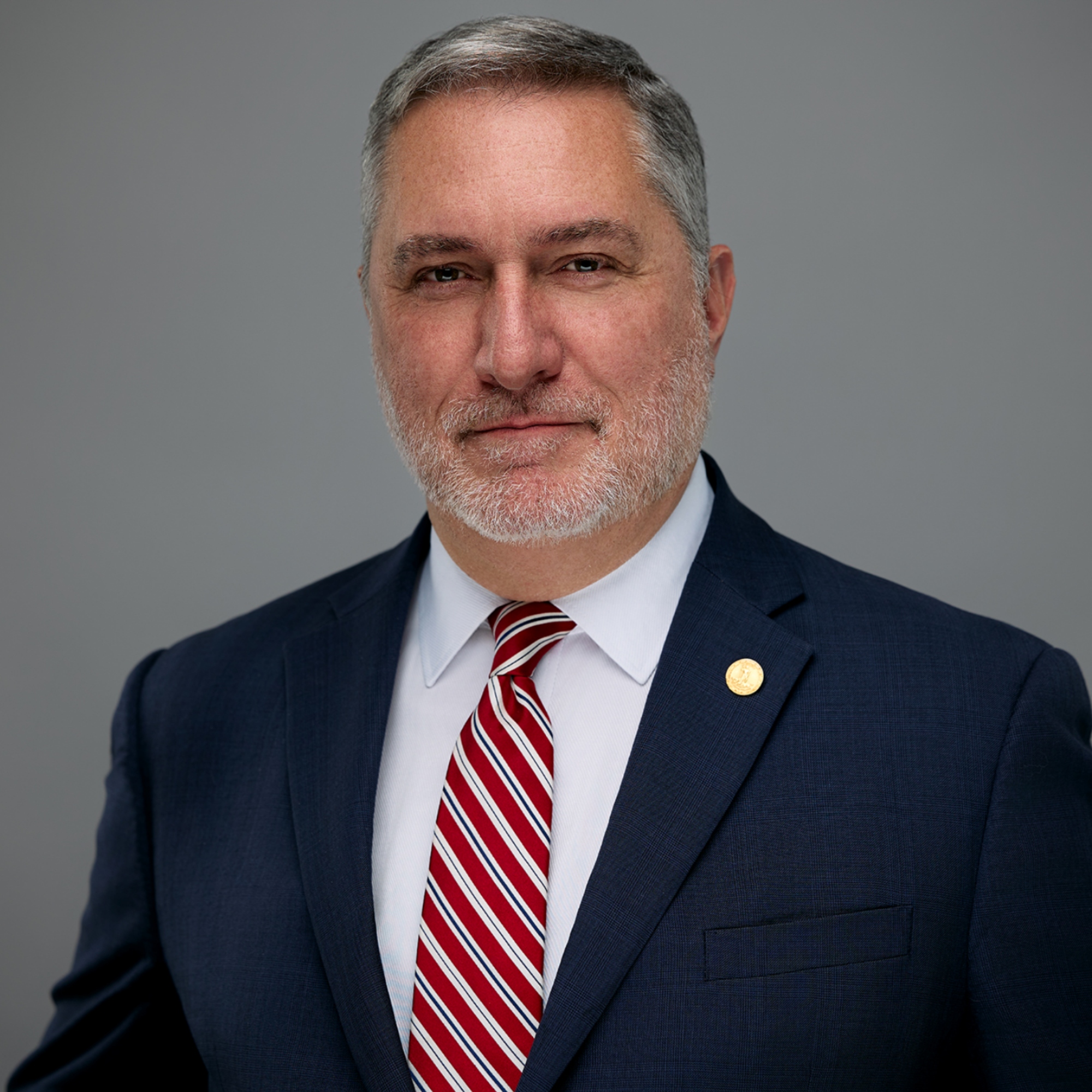
In the show's second segment today, Congressman Rob Wittman (from Virginia's 1st District) makes his inaugural appearance -- so as to discuss Operation Epic Fury and Virginia Gerrymandering.
Hosts & Guests
Transcript
Back this morning on the Read Revolution, I'm John Reed, and we are very glad to welcome
my congressman, Rob Whitman, to the program today to talk about some of the issues that
are bubbling in Washington and around the world.
Congressman, I appreciate you coming on your vice chair, the Armed Services Committee.
A lot of people don't recognize that we've got a very powerful congressperson who deals
with the military, and there are a lot of military men and women and posts and bases
in Virginia that you're looking out for on a regular basis.
Can I get you to tell me what your take is where we are with the engagement with Iran
at the moment?
Good morning to you.
Sure.
Well, John, good morning.
Great to be with you.
Yes, Operation Epic Fury is incredibly impactful in that region.
I'm so proud of our men and women in uniform who are doing an exceptional job there in achieving
their missions and really they're ahead of what the objectives are with these missions
there and taking away Iran's capability to harm others, not just in the region, but around
the world, and we're certainly very mindful today of the six military members that gave
their lives to this nation.
We're blessed beyond compare of people that are willing to sacrifice everything in order
to stand up for what we all believe in and as the foundational principles of this nation.
So I want to make sure that everybody takes time to remember and honor those that gave
their lives into keeping your thoughts and prayers, their families who obviously are suffering
through the loss of loved ones.
Now, let's make sure that we understand what the cost of this is, but also understand
too that for 47 years, the Islamic regime there has perpetrated acts of terror, has killed
Americans all throughout the world as well as others there in the Middle East.
So they are indeed through the years an existential threat to the United States.
That existential threat, as we know in recent decades, has continued to build with their
ability to field nuclear weapons with Operation Midnight Thunder.
We were able to take out a significant part of their ability to refine uranium to turn
it into a nuclear weapon.
But what we saw them doing very recently was rebuilding that capability quickly and then
building a large enough stockpilot conventional weapons, John, to keep anybody from coming
back in and doing what we did with Operation Midnight Thunder.
So if you put enough drones, enough missiles around there to keep any airplanes from flying
in and using the weapons that we had to take out these deep in the ground bunkers where
they were refining this uranium, they were fully intending to reconstitute their nuclear
capability and make it almost impossible for any effort to take it out again.
So that was one of the precipitators for the United States to act in conjunction with
Israel to take out that capability.
So as you've heard, the military mission for the United States is to take out the missiles,
just take out the facilities that build those missiles, take out the nuclear facilities,
take out Iran's ability to perpetrate harm and destruction on anybody outside of Iran.
In other words, you can have your ability to defend yourself, but extending that rain
of terror that they've done through the years through building military capability is
something that was only going to lend itself to threats and further harm around the world.
Iran was fully intending to build an intercontinental ballistic missile that could reach the United
States.
So those things are threat to the United States.
The President said we're going to act because he knew that the longer you waited, the
deeper this threat got and then the more difficult it would be to be able to take out this
threat.
Why do you think Democrats on the Hill have responded negatively to this?
It's very clear that Iran is not benign in their attitude towards the West and to the
United States and their recent things that we can point to that they've been behind that
are harmful to the American government and to innocent American citizens.
And yet there hasn't been the unity from the Democrat Party to support President Trump
even if they don't like him personally, I would think this would be one of the few things
that everybody could agree on and that hadn't happened.
It hasn't and it should go back in history.
Look at it.
They didn't object when President Clinton went into Bosnia.
They didn't object to President Obama when he did some things there in the Middle East.
So you'll look at this and you do have to ask the question, is this just about politics
or is this about advocating for what's best for the United States?
And then also acknowledging the great effort that's being put into this by the men and women
of the military.
Listen, they're not there for political purposes.
They're there to defend the United States and if nothing else, everybody ought to be
commending the job that they're doing and then acknowledging the deep sacrifices that
those six made for this nation giving of their lives and then the families there.
So, you know, there ought to be the ability to do that.
I think that it's regretful that there tends to be sometimes a myopathy and listen, it
occurs in many different ways.
But I want to make sure that we understand what this is all about.
And we've had some great briefings from the administration laying things out.
And listen, you can disagree with the tactics.
You can disagree with what we should or shouldn't be doing there.
But I think overall, there's no way that you can look at and go, oh, yeah.
As you said, Iran is benign.
They're not a threat.
We shouldn't be doing anything to be able to minimize what the Islamic Republic there
is doing to other areas of the world.
That Iranian Islamic Republic there, run by extremist clerics, is indeed a perpetrator
of violence, of terrorism around the world and they've done that consistently.
They killed Americans.
They kidnapped Americans.
There's no way that you can look at Iran and go, oh, yeah, it's okay for them to continue
to grow an ability to threaten not just their neighbors in the Middle East job, but to threaten
the United States.
Yeah, well, I hope a sober objective minds will take over the party.
Their party, as they look at this, if you don't mind, let me bring you back domestically
and talk a little bit about the gerrymandering referendum, which appears likely to begin on
Friday of this week and run all the way through April 21st.
Your survival as a, as a congressperson, as a Republican congressperson in Virginia is
probably on the ballot here, as Democrats push through what I think, again, an objective observer
of the law and the rules that the Democrats put in place that they're now not following
would, would vote no.
What is your assessment of where we are as we head towards what looks like the start of this
illegal action?
Well, listen, I believe that it will start.
Obviously, there are a number of court cases out there.
Some very favorable rulings for us in the lower courts, but ultimately, the Supreme Court
will have to act to this point.
They've said, no, they're going to wait until after the referendum, which does that surprise you?
Yeah, it does.
It just doesn't make sense to me.
The constitutionality of this, I think, is now, you know, if you wait until after
there are a whole variety of reasons you can assert to the court as to why they would choose
to do that, I think that the efforts by the Democrats in doing this clearly have circumvented
the Constitution have clearly circumvented the statutes for the Commonwealth of Virginia.
They've gone through a number of political machinations there and they are political
machinations within the General Assembly to try to cobble together some justification to be
able to do this and to provide some support to their, what I think, a false assumption about
this being constitutional or it being a statutorily compliant, I think that the court hopefully
would rule on that.
Now, we'll see, they still have a little bit of a window to be able to do that.
The bottom line, though, is as we have to be ready in this referendum to be able to win this,
and that you've seen the polling, the polling clearly states that
Virginians don't want this going all the way back to 2020 when a super majority of Virginians said,
no, we want the bipartisan redistricting commission.
And by the way, Senator Louise Lucas, Governor Spamberger, all have said vehemently that they are in
favor of bipartisan redistricting and against gerrymandering.
In fact, it was Governor Spamberger, it said gerrymandering is a threat to democracy.
I would agree with her fully and now all of a sudden she's all in favor of it.
And the same with Senator Lucas and others, it's interesting how they've completely changed their
focus on this. And then, too, they justify by saying, oh, we have to do it because
Texas has done it and North Carolina has done it.
And they've been very vocal to say how much they object to gerrymandering, how bad gerrymandering is.
And then their response is, well, we hate gerrymandering and gerrymandering is wrong.
So our response to it is actually gerrymandering ourselves here in Virginia.
I don't think Virginians will have any part of it.
But they're very deceptive, John, too, and how they've worded this referendum.
The wording of the referendum, I believe, is also not in compliance with the state law.
The state law says you have to, in a nonpartisan way, state what the referendum is about.
And they say, oh, this is just temporary.
I don't know anybody that believes that a change through the constitution is temporary.
Second of all, as they say, oh, it's about restoring fairness.
Well, fairness was already there with what the bipartisan redistricting commission had done.
This actually eliminates fairness by going in and saying, now we're going to let politicians
pick their voters. We're going to gerrymandered these districts.
Anybody that looks at the map can just as beside themselves.
And now you have five districts that have a northern Virginia majority there in those districts.
So that'll be five members from northern Virginia.
And those areas extend all the way down to Richmond and the rural areas of Virginia.
So those areas are going to be very underrepresented.
Because if you believe that a member that gets elected in a district where the majority of their
voters are in northern Virginia, we're going to give any credence to anybody outside of that area.
You have to have another thing coming.
And then looking at those maps, they are as gerrymandered as you can be.
They're not maintaining communities of interest.
They're not compact.
I mean, all the things that they're supposed to be.
So I've actually filed a suit in the Richmond court to say, listen,
they're misrepresenting this and the wording in the referendum.
We think that that's problematic.
And I want to make sure that people understand that.
We have the case filed.
We're still waiting for some other things to happen in order to serve the case.
Is there language that requires objectivity in the way a question is presented to the general
public?
Because clearly the Democrats have rigged this to the language at least to say,
this is all about restoring fairness.
And that I don't see how they can think that that's true objectively.
But it's certainly not a balanced presentation of why you would vote one way or the other.
John, there is a requirement that directs how the language for these
referendums are to be written.
And that is for it to be nonpartisan and not to be leading.
In the court of law, you always will get objected to by a defense attorney or prosecuting
attorney if you're trying to lead a witness because you're trying to get them to an answer
and make it misleading and how you're asking the question.
That's exactly what's happening here.
This is misleading.
This is not about restoring fairness.
Anybody that looks at these maps can no way shape or form say,
oh, yeah, this is fair.
And it's not fair to go from a six five congressional delegation, six Democrats five Republicans
to attend one delegation.
You know, I would argue six five pretty representative of the state where it is right now.
You know, the last two statewide elections,
the seven percent and 54 percent of votes gained by the Democrats.
If you look at 10, one, that's 92 percent, 92 percent now Democrat.
Virginia's not a 92 percent Democrat state.
So to do this and then justify, you know, by these spacious reasons is just beyond me.
And Virginians have said, and no, no, we don't want this.
If you look at the polling, Virginians have said, no, we think that this is wrong.
And there's still almost a super majority out there that said, we still like the bipartisan
redistricting commission.
Our challenge is to make sure we get the word out because the advertising that's going on
by the Democrats is very misleading.
Obviously, they're throwing a lot of resources at that because they believe if they can pick up
four seats, which is what they intend to do with this, that, you know, spending 10 million,
20 million dollars to do that, it's a pretty good return on investment.
So we've had some very good discussions with the National Republican Congressional Committee,
with the Republican National Committee, with the White House, to get them to put some money in.
We've also been, you know, talking, there's an independent entity out there that's raising money.
It's called Virginians for Fair Maps.
And anybody that's interested in going there, you can go to their website.
It's vaffairmaps.com, vaffairmaps.com.
And for anybody that wants to help, we have all of our committees out there that are on the ground.
They are spun up about this.
The good news, too, John, in the poll, if you look.
And the enthusiasm is on our side.
I think people are really beside themselves and what's happening with the General Assembly.
Enrichment, the overreach that's happening there.
I think they look at this and go, wow, this is just going to exacerbate it.
And put Virginia in the wilderness and put it at the hands of extremists,
you know, for a long time to come if we don't prevail in this referendum.
So this is, as I said, an all-hands-on-deck call for the Commonwealth.
And for folks out there to say, with everything you've got,
get your friends and family out to vote because, you know, this will be about the long-term
viability of having a different point of view than the Democrats.
I mean, if you're an independent or you're a Republican, and even for that matter,
a number of Democrats, John, say, no, we disagree with this.
This is not the way to go about this.
So I think people want that bipartisan effort and government,
they're tired of the divisions there they want, they want those efforts to not be blatantly
partisan or to have a partisan power grab like they're seeing going on now with this referendum.
You were a part of the Virginia General Assembly for a period of time.
Were you in there when Republicans were in the majority?
Yes, yes, I was there with your father.
And we were there with Speaker Bill Howell, and yes, we were there.
So was there a push at one point with a really kind of
aggressive group of Republicans to do this?
And Republican leadership said, no, am I remembering that correctly?
There were times when the maps were to be redrawn that there were some partisan efforts
on Republicans' part on the redistricting side.
But again, the effort was to say, well, let's get away from that.
And I agreed with that.
It shouldn't be a partisan process, you know, regardless of who did it.
And it was both sides.
It was, you know, you go back to Speaker Tom Moss.
Look at what happened to the two, I think it was the fifth congressional district
who happened to be represented by at the time,
Congressman George Allen.
And guess what happened with the Democrats?
They redistricted George Allen out of his district.
And George said, okay, that's fine.
I'm going to run for governor.
Run for governor.
And as you know, the rest is history.
So it's been done by both sides.
They've been read at that every sense, probably.
That's right.
That's right.
So it's been done historically, but Virginians in 2020
by supermajority 66% said, no, we don't want this.
Prior to recently Democrats across the spectrum agreed with that.
Governor Spamberg ran her campaign and said, no,
I don't think we ought to do this.
I think it's wrong to do this gerrymandering.
Before that, when the gerrymandering referendum
you know, was was suggested, she said no.
And then even prior to that,
position was that gerrymandering is just not good for Virginia.
But I would agree with her.
I don't know how you can say that.
Yeah, I don't know how you can say that, you know,
a year plus ago, and then all of a sudden today it's good.
If you believe it's good today, then tell us what conditions
have changed to justify that other than somebody else has done it.
You know, John, when we grow up, our parents always used to tell us
just because somebody else does something wrong,
doesn't mean that justifies you doing something wrong.
And this is not good for Virginia.
It is wrong from the standpoint of making sure that you're fair to the voters.
Remember, these are politicians picking their voters,
which is what voters absolutely hate.
And yet we have the governor, the majority leader in the Senate,
the Speaker of the House all saying, oh, no, no, no, we've got to do this.
And this is good for Virginia.
This is restoring fairness.
And it's completely the opposite.
Wrong for Virginia doesn't restore fairness.
And this is exactly what the people of Virginia said they didn't want.
66% of the people said, no, we don't want this.
What is, what is, you know, what is, uh, so, you know,
quizzical about that for, for Democrats,
it ought to be a clear message, they ought to go, oh gosh,
I wonder what the electorate means when they did that.
No, it's pretty overwhelming.
They don't want.
Jerryman, right.
You know, Abigail Spanberger and the Democrats really have done a 180
on a lot of the positions that they held.
And one of the things that worries me is their lack of cooperation
with federal officials when it comes to immigration.
I mean, we can, we can argue over what's happening in Minneapolis.
I would, I would claim that the, the radical protesters are causing the problems
and they're bringing that on themselves.
But putting Minneapolis aside, I would think that Virginia voters
would expect our government to cooperate with federal officials,
especially when it comes to murderers and rapists.
Have you seen this story in Fairfax with this young woman?
Was murdered at the bus stop?
Yes.
And, and the governor doesn't seem to think it's a priority to cooperate
with federal officials to get that person out of the country.
Yeah, listen, listen, this 41-year-old mother
in Fredericksburg, you know, brutally murdered
by somebody here in the country illegally.
And think about this, John.
Governor Spanberger ran as a former law enforcement official.
And she ran saying that her number one job was to protect
Virginia families.
And then the first thing she did when she got into office
is to say, no, no, by the way, I'm not going to do that.
We are not going to allow local and state law enforcement agencies
to cooperate with federal agencies.
And we know when they cooperate, we can avoid situations
like we just saw with this brutal murder there
of her Fredericksburg mother.
I mean, that's, that's just, you know, it's an application
of her constitutional responsibility, her primary responsibility
of protecting Virginians.
And she abdicated that.
And unfortunately, now is, you know,
allowing the commonwealth not to do the things
necessary to protect its citizens.
It's shameful.
But again, it's another 180% reversal
over that which she ran on.
And I think Virginians are watching this.
I can tell you, I've talked to a number of people.
In fact, a lot of folks right there in Henrico County,
folks, I went to school with that said,
Rob, you know, we voted for the governor.
And we can't believe what's happening in the general assembly.
We can't believe what the governor's doing.
That's not what she said she was going to do.
It's not what we thought she was going to do.
So they're just beside themselves with that.
And I know that folks around the commonwealth
feel the same as the people that I've
talked to across the first district.
And that is they are in disbelief over the overreach
by the Democrats, not just the governor,
but also in the general assembly.
That story is pretty dramatic because it's
so black and white for most people.
You've got a dead innocent citizen who's a mom
that everybody can identify with.
And a political machine that's saying,
let's not avenge or at least treat her memory fairly.
I think people are really offended by that attitude.
Then you couple that with the 51 proposed tax increases
from a bunch of people who spend an entire year talking
about affordability.
I mean, your definition of affordable
is very different than mine if you're trying to raise taxes on me
and everybody who supplies services to me.
That's crazy.
It's unbelievable, John.
And think about on top of that, on top of the 51 bills
to increase taxes, they have the audacity
to lecture about affordability
and how we have to do all those things.
And yet they turn around and give themselves
a massive pay increase.
I should write that.
The Virginia Senate voted themselves a massive pay increase.
So they look at it and go, you know,
shame on you working families out there.
We're going to, you know, to give ourselves a massive.
I mean, what a contradiction with they say they stand for
with affordability, not only increasing cost on families
through increased taxes and increased regulation,
especially on small businesses.
I mean, look at the impact that this will have
on small businesses.
I've talked to a number of folks across the district
and they're just beside themselves and said,
Rob, in addition to taking more out of a pocket to pay
to the Commonwealth of Virginia Department of Taxation,
this also costs us more to do business
in these additional regulations.
And then on top of that, they're saying, you know,
we're going to take more of your hard-earned money
and on top of that, we're going to take some of that money
and we're going to give ourselves a massive pay increase
because we're the advocates for affordability.
I mean, this is, you would think that you'd woken up
from an alternative universe dream if someone were to say,
hey, we ran on affordability and these are the things
we're doing to justify, you know, our efforts there
in the General Assembly on advocating for affordability.
It's just mind-boggling that they're doing this.
If voters were frustrated last year,
I can only imagine what the pulse is like right now.
And I hope they'll make their voices heard
when voting starts on this gerrymandering plan.
Rob Whitman, the congressman for the first congressional district,
as it stands today, the Republican.
I appreciate it very much. I'm always glad to see you.
John, thank you so much.
Great to be on with you. All my best to you and your family
and to all of your viewers there and your podcasts
to wish you great success in God's continued blessings.
Thank you very much.
Thank you. We're back with more in just a moment
on the Read Revolution.
Hope you'll stay with us.
