0:00
Tyler Reddick here from 2311 Racing.
0:02
Another checkered flag for the books.
0:04
Time to celebrate with Chamba.
0:06
Jump in at chambacacino.com.
0:09
No purchase necessary, BTW Group.
0:11
Boy, we're prohibited by law.
0:12
CCNC, 21 plus sponsored by ChambaCacino.
0:15
Welcome to Astronomy Daily, your source
0:18
for the latest space and astronomy news.
0:23
Thanks for joining us on this Saturday, January 24th, 2026.
0:28
We've got some fantastic stories lined up for you today.
0:34
From rocket development milestones
0:36
to prehistoric lunar discoveries,
0:38
today's episode is packed with celestial intrigue.
0:43
Let's dive right in with our top story.
0:45
Rocket Labs ambitious neutron rocket
0:48
has hit a significant milestone,
0:51
even though it came with a bit of a bump in the road.
0:53
Anna, what's the latest from Wallops Island?
0:56
Well, Avery, it's a story of both triumph and setback.
1:01
The good news first.
1:02
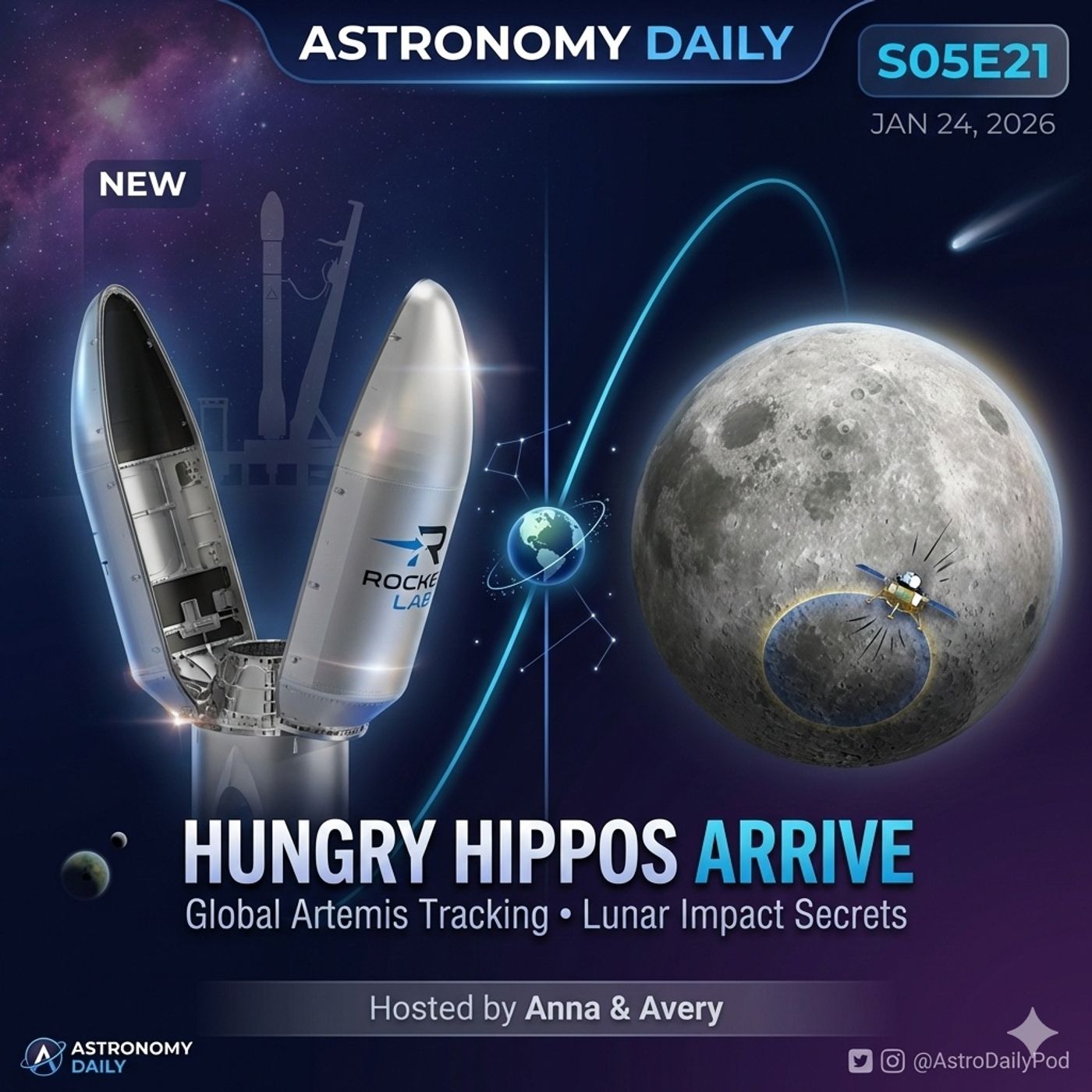
Rocket Labs' innovative, hungry hippo fairings
1:05
have successfully arrived at Wallops Island, Virginia.
1:09
After a month-long sea journey from New Zealand,
1:12
aboard the vessel North Star Integrity.
1:15
These aren't your typical payload fairings.
1:17
They're part of neutron's groundbreaking reusable system.
1:22
Right, and what makes these hungry hippos so special?
1:27
Unlike traditional fairings that are jettisoned
1:30
and lost during flight,
1:32
these clamshell-like structures actually stay attached
1:35
to the first stage as it returns home.
1:38
They open to release the second stage and payload,
1:41
then close back up for the ride home.
1:44
It's a clever design that should help drive down
1:47
launch costs through rapid reuse.
1:49
That's fascinating engineering, but you mentioned a setback.
1:55
While the fairings were making their journey,
1:58
Rocket Lab experienced a tank rupture
2:00
during qualification trials
2:02
at their Middle River Maryland facility.
2:05
A first-stage carbon composite tank
2:08
failed during hydrostatic pressure testing.
2:11
That's where they fill the structure with water
2:13
and gradually increase pressure
2:16
to verify it can handle operational loads.
2:19
Ouch, how significant is that?
2:22
Well, Rocket Lab was quick to emphasize
2:24
that testing failures like this while disappointing
2:28
are actually part of the rigorous development process
2:31
for high-performance rockets.
2:33
They deliberately stress hardware to its limits
2:36
and beyond to ensure reliability.
2:39
The tank was found collapsed into a pile of debris,
2:42
but the company maintains this is exactly why they test
2:46
to find these issues on the ground
2:48
rather than during flight.
2:50
Silver lining thinking and the program moves forward.
2:55
With the hungry hippo fairings now at Wallops,
2:58
engineers can proceed with integration testing,
3:01
fit checks, electrical interfaces,
3:04
and eventually static fire preparations.
3:07
The launch mount is already in place with the test stand
3:11
ready for major testing with the rocket's second stage.
3:14
Exciting times for commercial spaceflight.
3:17
Now, speaking of major missions,
3:19
NASA has some news about tracking
3:21
the upcoming Artemis 2 mission, right?
3:25
NASA has selected 34 global volunteers
3:28
from 14 different countries to track the Orion spacecraft
3:33
during its journey around the moon.
3:35
This is a significant expansion from the Artemis 1 mission,
3:38
which had only 10 volunteers.
3:41
So what exactly will these volunteers be doing?
3:44
They'll be using their own equipment,
3:46
everything from established commercial service providers
3:50
to university research facilities,
3:52
to individual amateur radio enthusiasts
3:55
to passively track radio waves transmitted by Orion
3:59
during its approximately 10-day mission.
4:02
We're talking about 47 ground assets spanning the globe.
4:06
That's impressive international cooperation.
4:10
The list is quite diverse.
4:12
Government agencies like the Canadian Space Agency
4:16
and Germany's DLR are participating.
4:19
Commercial companies include Goon Hilli Earth Station in the UK,
4:23
Kongsburg satellite services in Norway
4:26
and Intuitive Machines in Houston,
4:28
universities like UC Berkeley,
4:31
the University of Pittsburgh,
4:32
and even more head-state university in Kentucky are involved.
4:37
What about amateur radio operators?
4:39
Oh, yes, they're well-represented.
4:42
We've got individuals like Chris Swire from South Dakota
4:45
and Dan Slater from California.
4:48
Amateur radio organizations from Argentina, Germany,
4:52
the Netherlands, and France are also participating.
4:55
It's truly a global effort.
4:58
And this data they collect, what's NASA doing with it?
5:01
The volunteers will submit their tracking data
5:03
to NASA for analysis.
5:05
This helps the agency assess the broader aerospace communities
5:09
tracking capabilities and identify ways
5:12
to augment future moon and Mars mission support.
5:15
Kevin Coggins, NASA's Deputy Associate Administrator
5:19
for Space Communications and Navigation
5:21
called it a real step toward scans commercial first vision.
5:26
Building that public-private ecosystem
5:28
for deep space exploration.
5:32
Now, let's shift gears to some groundbreaking lunar research.
5:36
Scientists analyzing samples from China's Changa 6 mission
5:41
have made a discovery that helps explain
5:43
one of the moon's most puzzling features.
5:46
The asymmetry between the near and far sides?
5:50
You know how the near side of the moon has all those dark maria,
5:54
those vast volcanic planes that formed the man
5:57
in the moon pattern we're all familiar with?
6:00
The far side has barely any.
6:02
I've always found that fascinating.
6:04
What did they discover?
6:05
Changa 6 brought back samples from the South Pole 8 Kin Basin,
6:10
which is one of the largest impact features
6:12
in the entire solar system, about 1,600 miles wide,
6:16
and between 4.2 and 4.3 billion years old.
6:21
Much older than the lunar maria,
6:23
which are around 3.6 billion years old.
6:26
And what did these ancient samples reveal?
6:28
The research team, led by Hang Sea Teon
6:31
from the Chinese Academy of Sciences,
6:34
found something unusual in the basaltic rock samples
6:37
and abnormal ratio of potassium isotopes.
6:41
Specifically, they found more of the heavier potassium 41
6:45
relative to potassium 39 compared to samples from the near side.
6:50
What would cause that?
6:51
After exploring several possibilities,
6:54
cosmic ray irradiation, magma processes,
6:57
mediarrytic contamination,
6:59
they concluded that this isotopic signature
7:02
is a relic of the giant impact
7:04
that formed the South Pole 8 Kin Basin itself.
7:08
So the impact actually changed the Moon's chemistry?
7:11
Not just changed it, it fundamentally altered it.
7:15
The impact was so violent that it heated the Moon's crust
7:19
and mantle intensely,
7:20
causing many volatile elements,
7:22
including potassium,
7:24
to evaporate and escape into space.
7:26
The lighter potassium 39 isotope evaporated more easily
7:30
than the heavier one,
7:32
leaving behind this unusual ratio.
7:35
That's incredible detective work.
7:37
And this explains the lack of mario on the far side.
7:41
The reduction in volatiles
7:42
would have suppressed magma formation,
7:45
limiting volcanism on the far side.
7:47
It shows how deeply that ancient impact
7:50
affected the Moon's interior
7:52
and why isotopic analysis can provide windows
7:55
into the conditions of such catastrophic events.
7:58
This research was published in the proceedings
8:00
of the National Academy of Sciences.
8:04
Now here's something a bit more down to earth.
8:07
Even if it's going to space.
8:09
Anna, tell us about the startup
8:10
that's making space memorials affordable.
8:13
This is a really interesting story, Avery.
8:15
A startup called Space Beyond, founded by Ryan Mitchell,
8:19
is planning to send up to 1000 people's ashes to space
8:25
for as little as $249,
8:28
dramatically cheaper than traditional space memorial services
8:32
that typically cost thousands of dollars.
8:35
That's quite a price difference.
8:36
How are they pulling this off?
8:38
It's all about smart use of existing infrastructure.
8:41
They're using a CubeSat,
8:43
one of those miniature, cube-shaped satellites
8:46
that will launch as a rideshare payload
8:48
on a SpaceX Falcon 9 rocket.
8:50
The rideshare model has really democratized access to space.
8:54
And Ryan Mitchell, he's got some serious space credentials, right?
9:00
He worked on NASA's Space Shuttle program
9:02
and spent nearly a decade at Blue Origin.
9:05
The idea actually came to him
9:06
while attending a family member's ash spreading ceremony.
9:10
He thought, how could I do this better?
9:12
And thus, Space Beyond was born.
9:15
But there must be some limitations
9:17
with such an affordable service.
9:20
Customers can only send about one gram of ashes,
9:23
a practical limit due to weight considerations,
9:26
and the need to fit many customers' remains in the CubeSat.
9:30
The satellite will only orbit for about five years
9:33
before burning up an Earth's atmosphere.
9:35
So it's not forever.
9:37
Though that fiery ending has a certain poetic quality to it.
9:41
Bichel certainly thinks so.
9:43
Plus, the CubeSat will be in a sun-synchronous orbit
9:46
at about 550 kilometers altitude,
9:49
meaning it'll fly over the entire globe.
9:52
With modern spacecraft tracking services,
9:54
families should be able to locate it
9:56
and know when it's passing overhead.
9:59
That's actually really touching.
10:01
And importantly, they're not spreading the ashes in space, right?
10:06
Bichel called that an almost nightmare scenario
10:08
because the particles could create a debris cloud
10:11
that could endanger other spacecraft.
10:13
Since customers only send about a gram,
10:16
they can do what they wish with the rest.
10:18
Thoughtful approach to a sensitive service.
10:21
Now, let's talk about something
10:23
that might literally redefine astronomy.
10:26
Anna, tell us about this massive potential exomone.
10:29
This one's mind-bending Avery.
10:32
Astronomers using the gravity instrument
10:34
on the very large telescope in Chile
10:36
have detected what might be an exomone orbiting the gas giant HD206893B
10:44
located 133 light-years from Earth.
10:47
But here's the kicker.
10:48
This moon is so massive that it might force us to rethink
10:52
the word moon even means.
10:55
How massive are we talking?
10:58
They estimate it could be as much as 40% the mass of Jupiter,
11:02
or about nine times the mass of Neptune.
11:05
To put that in perspective, it's thousands of times heavier
11:08
than any moon in our solar system.
11:11
Anamine, Jupiter's largest moon
11:13
and the biggest in our solar system,
11:15
is thousands of times less massive than Neptune.
11:18
Wow, so how did they even detect something like this?
11:22
Through a technique called estrometry,
11:24
which precisely tracks the position
11:26
of celestial bodies over time.
11:28
The team, led by Quentin Crawl from the University of Cambridge,
11:32
observed a measurable wobble in HD206893B's motion,
11:38
a back and forth movement with a period of about nine months.
11:42
And that wobble is the moon's gravitational tug.
11:46
Crawl explained that the wobble has a size comparable
11:49
to the Earth moon distance, which is the exact signature
11:53
you'd expect from an unseen companion.
11:55
The potential moon's orbit is also tilted
11:58
by roughly 60 degrees, suggesting a turbulent history
12:02
of gravitational interactions.
12:04
So at what point does something stop being a moon
12:07
and become a binary companion?
12:09
That's the million dollar question.
12:11
Crawl noted that at these masses,
12:13
the distinction between a massive moon
12:16
and a low mass companion becomes blurred.
12:18
There's currently no official definition of an exomune.
12:22
So astronomers generally refer to any object orbiting
12:25
a planet as a moon.
12:27
This could force a redefinition?
12:30
Crawl suggested that as observational techniques improve,
12:34
our definitions and understanding
12:36
of what constitutes a moon will almost certainly evolve.
12:40
He also pointed out that we're likely only seeing
12:42
the tip of the iceberg.
12:44
Just as the first exoplanets discovered
12:46
were massive ones close to their stars
12:48
because they were easiest to detect,
12:50
the first exomoons we identify
12:52
will be the most massive and extreme examples.
12:56
Finding exomoons is challenging, I imagine.
13:00
Extremely, the signals they produce are minute,
13:03
often lost in the noise of their parent planet's data.
13:07
The transit method that's revolutionized
13:09
exoplanet discovery is less effective for moons
13:13
because they produce light dips to faint to distinguish.
13:16
But astrometry offers a new path forward,
13:20
especially for detecting companions in far orbits
13:23
where large, stable moons are more likely to exist.
13:27
This research was published in astronomy and astrophysics.
13:31
It's been accepted for publication there
13:33
and it's currently available as a pre-peer-reviewed paper
13:38
If confirmed, this would not only expand
13:40
our catalog of celestial bodies,
13:42
but force astronomers to rethink
13:45
one of the oldest definitions in planetary science.
13:49
And finally, Anna, we have a story
13:52
that might rewrite history
13:53
or at least rename a famous comet.
13:57
New research suggests that Haley's comet
14:00
might be wrongly maimed.
14:02
Turns out, an 11th century English monk
14:04
named Ilmer of Momsbury
14:07
understood the comet's periodic nature centuries
14:10
before the British astronomer Edmund Haley.
14:13
Wait, so Haley wasn't the first to figure this out?
14:16
According to research by Professor Simon Portagee's
14:19
work and colleagues published in the book
14:22
Dora Stad and Everything After,
14:24
Ilmer witnessed Haley's comet twice in 989 CE
14:29
and again in 1066 CE and realized
14:32
it was the same comet returning.
14:35
How do we know this?
14:36
The events are described by the 12th century chronicler,
14:39
William of Momsbury, but this connection
14:42
had gone unnoticed by scholars until now.
14:45
The 1066 appearance is actually depicted
14:48
on the famous Bayou tapestry,
14:51
which illustrates the events of that year,
14:53
including the Norman Conquest of England.
14:56
So Ilmer must have been quite elderly to see it twice?
14:59
Exactly, given that the comet appears roughly 76 years,
15:04
he would have been advanced in age
15:07
when he witnessed it for the second time.
15:09
And here's a fascinating detail,
15:11
as was customary at the time,
15:13
when he saw it in 1066,
15:16
the king was warned of impending disaster.
15:19
The comet appeared during the brief reign
15:22
of King Harold Godwinson,
15:24
who died at the Battle of Hastings that October.
15:27
Medieval people really did see comets as omens, didn't they?
15:32
The research shows that comet appearances around this time
15:36
were consistently associated with the deaths
15:38
of kings, war, or famine in the British Isles.
15:41
The researchers even found what might be historical fake news,
15:45
a comet supposedly seen before the death
15:48
of Archbishop Cydric of Canterbury in 995,
15:51
which wasn't actually recorded in the Chronicles,
15:54
possibly in exaggeration to frighten people.
15:57
So what are the researchers calling for?
16:00
They're arguing that Haley's comet
16:02
should be given a different name since it had been observed
16:04
twice and its periodicity understood centuries
16:08
before Haley's work.
16:09
The Portuguese weren't mentioned that while the research
16:12
was fun to do, it was challenging working
16:14
in such an interdisciplinary project alongside a historian.
16:19
Nevertheless, they planned to carry out further research
16:21
into periodic comet.
16:23
It's amazing how interdisciplinary research
16:26
can uncover these historical oversights.
16:28
It really is, and it shows that scientific discovery
16:32
isn't always about new observations.
16:35
Sometimes it's about looking at old records with fresh eyes.
16:39
Well, that's all the time we have for today's episode.
16:41
What a journey we've been on.
16:43
From rocket fairings to ancient lunar impacts,
16:46
affordable space memorials to massive exomoons
16:49
and historical comet discoveries.
16:52
It never ceases to amaze me how much is happening
16:55
in space and astronomy every single day.
16:58
From cutting edge engineering to billion-year-old mysteries,
17:01
there's always something new to learn.
17:04
Thanks so much for tuning into Astronomy Daily.
17:06
Be sure to visit our website at astronomydaily.io
17:09
for detailed show notes, transcripts,
17:12
and links to all the stories we discussed today.
17:14
And don't forget to follow us on social media.
17:17
We're at AstroDailyPod on X, Facebook, Instagram,
17:21
TikTok, YouTube, and Tumblr.
17:24
Until next time, keep looking up
17:26
and keep exploring the wonders of our universe.
17:29
Glere skies, everyone.
17:30
Astronomy day, the story's the toll.
17:36
The story's the toll.
17:44
The story's the toll.
17:51
The story's the toll.
17:54
Tyler Reddick here from 2311 Racing.
17:58
Yeah, it's even better with Jamba by my side.
18:01
Race to chumpacaceno.com.
18:04
No purchase necessary.
18:05
VTW Group, voidware prohibited by law.
18:06
CTNC's, 21 plus, sponsored by JambaCaceno.