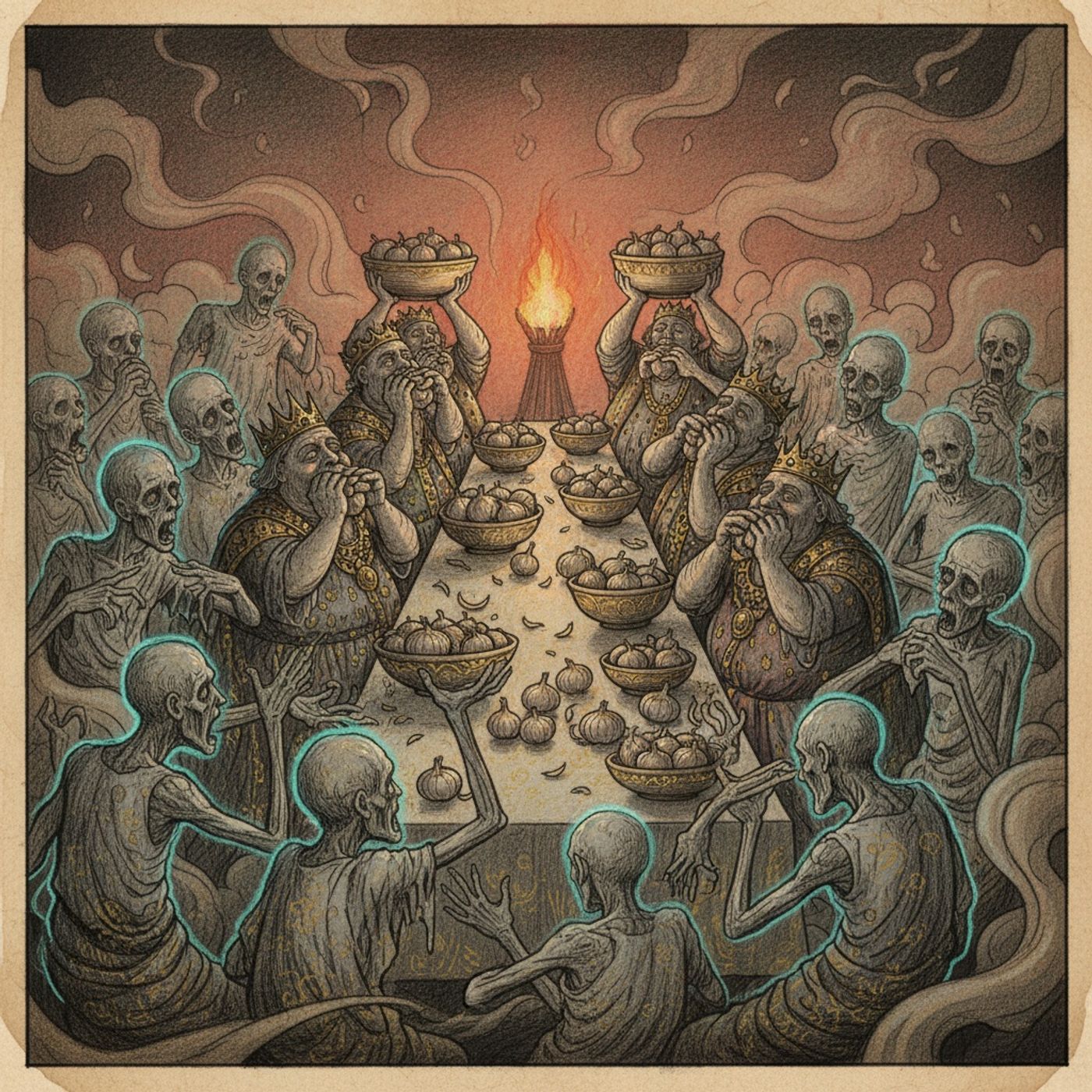
EPISODE 3098: The Stolen Birthright
About this episode
Join us as we explore this true crime story wrapped in folklore and psychological distress. It’s a story of greed, loss, and the quiet suffering that echoes through fields, warehouses, and homes. This episode touches on themes of hunger, corruption, death, and the emotional toll on those caught in the supply chain’s darker side.
Listener discretion is advised.If you have stories that need to be heard or want to support our work, find links and more in the show notes.
DISCLAIMER 📢
This episode might be ad-supported. You can support us by subscribing for as little as $5 a month on our Patreon page or through Apple Podcast Subscriber-Only Audio. 🎉Subscription Benefits 🌟
- Ad-free weekly podcast
- Exclusive podcast promos
- Early access to select episodes
👉 Or subscribe using the Apple Podcasts app
Thank you so much for your generosity! 🙏
Connect with Us
📱Visit us on Facebook
Episode Sponsors
Noota: The best transcription and AI Meeting Zoom alternative!
Sign Up here
Get every episode summarized
Each time Stories Philippines Podcast - Pinoy Horror Stories publishes, we email you a written briefing from the transcript — the topics, who appeared, and any specific claims, with the ad reads skipped.
Email me new episodesFree for 3 shows. No card needed.
Hosts & guests
Transcript ready
1,411 searchable segments. Every word is indexed and playable.
Full transcript
Stories Philippines Podcast - Pinoy Horror Stories — EPISODE 3098: The Stolen Birthright. Machine-transcribed; use the interactive transcript above to jump the player to any line.
Control, compliance, confidence, that's what the American Express Corporate Program helps deliver. Customize rewards, centralize company spending, and count on world-class customer care. With corporate cards from American Express, your company can be covered. Explore more at americanexpress.com slash corporate, terms apply. Most people know American Express for our iconic personal cards. Some know us for our business cards to help entrepreneurs grow, but American Express also offers something built for companies at scale. The American Express Corporate Program. With the corporate program, you can apply for employee cards tailored to their needs, issue virtual cards to your team and suppliers, and even automate accounts payable with American Express 1AP. Along the way, your company can earn rewards or cash back as a statement credit to reinvest where it matters most. And because it's all backed by American Express, you get the service, insights, and flexibility to help keep your business moving forward. The American Express Corporate Program, designed to help companies grow with confidence, terms apply, enrollment required, and fees may apply, including an auto-renewing monthly
platform access fee. Suppliers must be enrolled and located in the United States. Let's Shamba. No purchase necessary. VTW Group. The first time it happened, the night watchman thought it was rats.
A soft scratching from inside the cold storage building, like nails dragging across wood, then a faint thud, then the sound that made his stomach turn. A slow, wet cough, as if someone was trying to pull breath through a throat full of dirt. He raised his flashlight and swept it across the rows of metal doors. Each one marked with numbers. Each one sealed. Each one holding food that should have been moving outward into markets and kitchens. But instead sat here in the dark waiting, aging, shriveling, turning hunger into profit. The watchman took one step closer and the air changed. The cold smell of concrete and diesel gave way to something older. The scent of sun-baked soil, the bitter bite of dried onion skin, and underneath it all, the sour odor of sweat that never cooled, as if a field worker had just walked through these halls and left their exhaustion, hanging in the air like fog. The second time it happened, the magnate heard it in his own home, not in the warehouse, not in the farms, not in the places where suffering could be filed away as someone else's problem.
He heard it behind his bedroom wall, right as he was drifting off, just as the city's noise softened and the world became quiet enough for guilt to speak. A whisper, not words at first, just breath, then a voice, thin and cracked, like a man who had not eaten in days. Why is my child hungry? And that was the terrifying part. The voice did not ask for money. It did not beg for mercy. It did not curse him with anger. It asked a question, because some questions do not leave you alone once they have found you. This episode contains themes of hunger, corruption, death, and psychological distress. Some listeners may find it disturbing. Please take care of yourself as you listen. I am Echo, and you are listening to Stories Philippines podcast. This is season 87, episode 9, The Stolen Birthright. If you have your own story to share, a moment that still follows you into the quiet hours,
you can send it to the email in the show notes. And if you want to go deeper, you can find show notes and support options in the description, including exclusive content on Patreon. And for daily folklore facts and more stories between episodes, follow us on social media. Now let us talk about hunger, not the simple kind, not the kind you fix with a late snack, a warm bowl, a quick trip to a store, the kind of hunger that changes a person, the kind that creeps into a home and rearranges what love looks like, what pride looks like, what a parent will do to keep a child from crying at night. In the Philippines, food is not just fuel, it is family, it is celebration, it is comfort, it is a kind of language, a way to say I am here with you. So when food becomes a weapon, it does not only hurt the body, it steals dignity, it steals peace, it steals something that feels like a birthright, because to be born into a land with soil, sun, rain, and farmers who know how to grow, and then to still go hungry is not an accident.
It is a decision someone made. And that decision, when you follow it far enough, does not end in the marketplace, it ends in a locked room, in a ledger, in a handshake, in a cold storage warehouse where onions sit in the dark while people count coins and pretend they do not hear the coughing in the walls. There is a word people use when they want to make this kind of suffering sound normal. Supply chain, it sounds clean, like a diagram, like a lesson in school, but the supply chain is not clean. It is made of hands, and those hands belong to farmers who wake before dawn, to workers who load sacks until their backs burn, to vendors who stand over produce in heat and exhaust fumes, and to mothers who count their money twice because they know it still will not be enough. And then there are the other hands, the hands that never touch soil, the hands that sign papers, the hands that call people like pieces on a board, the hands that can decide with one order whether a harvest moves or rots. This story lives in that space between the hands that grow and the hands that take.
It is a true crime story about agricultural graft and cartel behavior, and it is also a horror story because there is a kind of haunting that comes from mass suffering, not one ghost, not one curse, but a slow accumulation of pain that refuses to stay buried. In late 2022 and into 2023, the Philippines faced a shocking surge in onion prices. At one point reports described prices reaching around 700 pesos per kilogram. That number landed like an insult in ordinary homes. Onions are not a luxury item in Filipino cooking. They are a base note, a foundation, something you expect to be there, like salt or water, and yet suddenly they were priced like treasure. Public anger followed the smell of sotang onions straight into the halls of government. Investigations began, hearings, accusations, journalists and lawmakers used words that sounded like something from a crime film, cartel, hoarding, smuggling, price manipulation.
The idea repeated again and again was that the shortage was not purely natural, that something artificial had been created, that supply had been controlled, that storage, importation and release of onions could be used like a valve, tightened and loosened to squeeze the public. In a report covered by Rappler, President Ferdinand Marcos Jr. ordered the Department of Justice and the National Bureau of Investigation to probe an alleged onion cartel and investigate smuggling and hoarding of agricultural products. That same report described findings from house hearings that pointed to a cartel controlling parts of the onion supply chain, with attention on cold storage warehouses and alleged collusion among industry players. The details were messy, as corruption always is. It hides inside paperwork, it spreads through favors, it wears the face of normal business until you look close enough to see how many people have to suffer to keep it alive. And while that suffering played out, farmers faced their own kind of ruin.
In a Senate hearing reported by Rappler in January of 2023, stories emerged about onion farmers under crushing debt and loss. There were mentions of suicides in farming communities, of storms and infestations destroying crops, of miserable prices that barely paid for production costs. In those accounts, the pain was not abstract. It was personal, a family, a husband, a debt that felt like a noose. That is the part that makes this story more than economics. When people begin taking their own lives because they cannot survive the system built around food, something has gone deeply wrong. And when those deaths become just another line in a hearing, just another sad detail in the news cycle, the wrong becomes something worse. It becomes normal. In folklore, there are many kinds of spirits that linger. Some stay because of violence, some stay because of betrayal, some stay because they cannot accept what happened to them. And some, in the oldest stories told in rural places,
stay because they died with an empty stomach. In different parts of the world, hunger ghosts take different names. In parts of Europe, there are stories of restless dead who return during famines, their mouths black with earth, their hands reaching toward the living. In East Asian traditions, hungry ghosts are described as being cursed with endless craving, unable to satisfy themselves, a warning about greed and imbalance. Those stories are not just fantasy. They are moral maps. They are cultures turning suffering into something people will remember because memory is a form of protection. And in the Philippines, we have our own ways of describing what happens when something unnatural is done to the natural order. When a harvest is stolen, when food is held back, when profit is placed above life, sometimes we call it greed, sometimes we call it a curse, and sometimes when the night is quiet, we call it a haunting. Let us build a picture together. Imagine a stretch of farmland in Newaver, Asija, where onion fields can run like green ribbons
under a hard bright sky. In harvest season, the air is sharp. Onion scent clings to clothes and skin. It gets into your hair, into your fingernails. It makes your eyes water even when you are not crying. The soil here is dark and crumbly in the right months, but it can also turn to dust when heat bites too long. Farmers walk it with careful steps. They know where water pools, where pests hide, where the wind cuts across the open land like a blade. 200 days a year rolling down the highway, the bus can start to feel smaller than a guitar case. Everyone wonders how I stay chill while the hours crawl by. Truth is, one good luck spent on chamba and suddenly the trip feels a whole lot shorter. Finding your space, even when there isn't much to spare. Need some chill? Let's chamba! No purchase necessary, BGW Group voidware prohibited by law, 21 plus TNC supply. Sponsored by Chamba Casino. This is Mike Voilo of Lexicon Valley.
And I'm Bob Garfield. Are you one of those people who sometimes uses words? Do you communicate or acquire information with, you know, language? Hey, us too! So, join us on Lexicon Valley to true over the history, culture, and many mysteries of English. Plus, some life cracks. Find us on one of those apps where people listen to podcasts. Hi, I'm Alicia. And I'm Stacey. And we make trashy divorces. Everybody's favorite good podcast about bad relationships. Looking for something true crimey without the gore or the body count? We've been shurning out funny, feisty, feminist episodes since 2019. So if you're looking to put some scandalous stories told well into your ears this summer, check out trashy divorces wherever you listen to podcasts. Trust us, we've covered someone you love or someone you love to hate. Now imagine a farmer named Ethan. Not a public figure. Not someone whose name you would find in an article.
Just a man in his early 30s with cracked hands, and a phone full of photos of his kids. The kind of man who does not think of himself as part of history, even though history depends on him. Ethan's day begins before the sun is fully up. He checks the field like someone checking on a sleeping child. He looks for signs of trouble. Leaves that curl wrong. The early damage of insects, soil that feels too dry beneath his fingers. He thinks in numbers all the time. Seed cost, fertilizer, fuel, labor, debt. He is not greedy. He's trying to survive. His wife, Kyla, keeps track of payments. School expenses, medical needs, food, and like many families, they live close to the edge where one disaster can tip everything. When the prices begin to shift. At first, Ethan hears talk in the Barongi.
A rumor that buyers are offering less this week. That imports might come in. That there is too much supply, or not enough, depending on who is speaking and what they stand to gain. He shrugs it off because he has to. Farmers cannot afford to panic every time gossip moves through the air. But then he goes to sell. The trader looks at the onions, runs a hand through the sacks, and offers a price that makes Ethan's stomach drop. It is not enough to cover the cost of production. Not even close. Ethan argues. He tries to reason. He points to what people are paying in the city. He points to the news. He points to the simple fact that a farmer should not lose money feeding the nation. The trader just smiles like a man behind glass. This is the price today. And if you do not take it, you can watch your harvest rot. Because that is the trap. Onions are food, but they are also time-sensitive. They can be stored, yes, but storage is power. Storage belongs to people with warehouses. Not people with small farms and unpaid loans.
So Ethan sells at a loss. And when he goes home, he tries to hide it from Kyla at first because shame is another kind of hunger. It eats you quietly. But the truth comes out in the bills. In the silence at dinner. In the way Kyla stares at the rice like she is doing math with her eyes. And in the weeks that follow, their home begins to change. Not dramatically. Not like a movie. It changes in small, brutal ways. Meat disappears from meals. Snacks disappear from the cupboard. Kyla stretches everything. Ethan begins skipping breakfast. He says he is not hungry. The children ask for things and are told maybe next time. Then one night, their youngest, a little boy named Lucas, wakes up crying. His stomach hurts. Kyla holds him and whispers comfort. But her own belly is empty too. And comfort does not fill it. Ethan sits on the edge of the bed and feels something inside him crack because he knows why this is happening. It is not drought. It is not war. It is not a natural disaster.
It is people. And that is the kind of truth that turns into a ghost. Because when human choices cause suffering at scale, the dead do not always stay quiet in the imagination of a country. Sometimes they come back, not as monsters with claws, but as reminders, as sounds and walls, as cold spots and expensive rooms, as dreams that feel like accusations. Now let us move to the other side of the story. Music Picture Metro Manila, where towers rise like polished teeth and the air tastes like exhaust and heat. Picture an upscale subdivision where gates open for the right plates. Where the street lights glow clean,
where the walls are high enough to keep the world out. Inside one of those homes is a man we will call Victor. Victor is a magnate or something close to it. He has fingers in importation, distribution, storage. He has friends whose names matter. He wears nice watches and smiles for cameras when it benefits him. Victor will tell anyone who listens that he is simply doing business. He will say he provides jobs. He will say he moves goods efficiently. He will say he is part of the engine of the nation. And maybe in a narrow sense he is. But engines can run on blood. Victor eats well. Victor's pantry is full. Victor's life is buffered by money. The way wealthy lives always are. Problems become inconveniences. Inconveniences become things someone else handles. When onion prices rise, Victor hears about it like weather. Interesting, he might say. Then he hears about hearings. Then he hears about probes. Then he hears the word cartel. And that is when he starts to feel something. He is not felt in a long time.
Fear. Not fear of guilt exactly. Fear of being caught. Because that is the real shape of corruption. It is not always ignorance. It is often calculation. And calculation can turn cold. Victor begins making calls. He begins asking what people know. He begins shifting assets. He begins moving like a man who has practiced the stance before. And then one night, he hears the sound behind his wall. A cough. A whisper. And the question. Why is my child hungry? Victor sits up in bed, heart pounding. He tells himself at his stress. He tells himself it is imagination. He tells himself it is nothing. But the sound comes again, closer this time, like breath pressed through plaster. He gets up, walks down the hallway, and the lights flicker as he passes. That detail sounds dramatic, I know. But sometimes the mind builds a stage for guilt. Sometimes it uses the language of horror to express a truth the conscious self is trying to bury. Victor checks his security system.
Cameras show empty halls. Empty gates. The guards outside are still. The street is quiet. No intruder. No threat. Except the one that lives in his own mind. But what if it is not only his mind? What if the suffering has weight? What if it has memory? What if hunger, when multiplied by thousands of families, becomes something like a weather system? A pressure front? Invisible but real? And what if that pressure finds the people who caused it? In many Filipino beliefs, the dead do not always move on cleanly when something is unresolved. There are stories of spirits that linger near places of injustice. Stories of souls that return to ask for what was taken. Stories where the supernatural is not random, but moral. Because in the deepest part of folklore, the world is supposed to balance. And when humans unbalance it, the universe notices. In older rural stories, there is also the idea that land remembers. That soil holds history. That places where people suffered carry a kind of stain.
You can hear it in the way elders speak about certain roads, certain bridges, certain fields. Do not go there at night. Not because something will jump out at you. But because the air there feels wrong. Because something happened. Because something is still happening. Now, let us connect this to the real world mechanics of what people allege during the onion crisis. Reports discussed cold storage control, alleged collusion and manipulation of supply. When a product can be held back from the market, scarcity can be created or sustained. And when scarcity rises, prices rise. When prices rise, everyone feels it, but not equally. A rich household can complain. A poor household can break. And farmers caught between costs and buyers can be crushed from both sides. There is a bitter irony here. The people who grow the food can be among the first to go hungry. Because the system is not designed to reward them. It is designed to extract from them. An extraction is a haunting word. It belongs to mining, to colonialism, to old empires.
And yes, to modern graft. Because agricultural graft is not only about money changing hands. It is about life being reduced to a number, a kilogram, a metric ton, a margin, a cut, a share. And when you reduce life to numbers long enough, it becomes easy to forget the face is attached to those numbers. But the dead do not forget. Let me tell you a listener's story. Not a name you can verify in a newspaper. Not a case number. Just a story that came in the way stories often do. From someone who said they needed to tell it, because keeping it inside felt like choking. A woman named Saline wrote about her cousin, a driver for a logistics company contracted to deliver produce. He was not a farmer, but he lived close enough to farmers to smell the truth. He spent weeks hauling loads from provincial collection points toward storage facilities. Sometimes he delivered to markets. Sometimes he delivered to places that were not on the official route. She said that during the height of the onion price surge, her cousin began coming home different.
Quieter. Not proud of his work, like before. He told her once, in a tired voice, that he was asked to deliver sacks of onions to a warehouse that already smelled like rot. The onions were still edible then, he said. Still firm. Still good. But he watched as the sacks were stacked and left. Days later, when he came back with another load, the first stacks had begun to soften. Some sacks leaked liquid. The smell hit him like a slap. He asked the foreman why they were keeping them instead of moving them out. The foreman answered like a man repeating a rule. Not yet. Wait for the signal. Celine's cousin said that was the moment he understood. This was not only storage. It was control. He tried to quit. But quitting was hard when you had children. When you had rent. When you had your own hunger. So he stayed and the guilt ate him in small bites. Then one night, he had a dream. He was standing in the warehouse and the sacks began to move on their own like something crawling beneath them. The smell of rot became the smell of death.
The lights went out and when they came back, the onions were gone. In their place were people. Then, gray skinned. Their eyes too large, their cheeks hollow. They stood in rows like the sacks had. And then one of them looked at him and opened its mouth and all that came out was dirt. Not a scream. Dirt. As if hunger had filled them so completely that even their voices had turned to soil. He woke up shaking. Selene said he began hearing things at work after that. Soft tapping sounds from inside sealed rooms. Scratching. Coughing. Once he swore he heard crying from behind a cold storage door. When he told the foreman, the foreman laughed. Ghost stories, he said. But Selene's cousin did not laugh. Because he had been inside the chain long enough to know that when a system hurts enough people, the mind will create ghosts even if the universe does not. And then months later, Selene's cousin died in a road accident. That is what the official story said. But Selene wrote that he had told her something days before.
A thing he never set out loud until then. If anything happens to me, look at who I drove for. Look at the warehouses. Look at the names behind the names. That is the reality of graft. It is not only theft. It is intimidation. It is silence. It is a world where people learn to swallow their own truth. Because speaking it can cost them everything. And when the living cannot speak, the dead often become the storytellers. Let us step back and look at the wider history. Because what happened with onions did not appear out of nowhere. Food control has always been a form of power. In colonial times, control of crops meant control of people. Land was seized. Labor was redirected. Communities were shaped around what colonizers
wanted produced and extracted. Even after colonization, those patterns can remain, wearing new clothes, new names, new logos. But the same idea persists. If you control the basics, you control the bodies. And when people begin to starve, even slowly, even in partial ways, they become easier to manage. Easier to distract. Easier to buy. A hungry person is not free. And that is why this story is called the stolen birthright. Because the birthright is not only a piece of land. It is not only a harvest. It is the idea that in a country capable of feeding itself, people should not be cornered into hunger. When that happens, something has been stolen. And theft leaves traces. Sometimes those traces are financial. Sometimes they are political. And sometimes they are supernatural. Because folklore often appears where justice fails. It shows up like smoke in the cracks of society. It gives faces to crimes that never get punished. It gives voices to victims who are ignored.
And in that sense, a ghost story is not a distraction from reality. It is a form of protest. In some provinces, there are tales of farm spirits, guardians of fields and harvest. Not always named the same way. Not always described the same way. But the idea is consistent. The land has owners beyond humans. The land has watchers. And when humans abuse the land and the people who tend it, those watchers take notice. You might think of it as superstition. But superstition is often just memory with a costume. Now let us return to Victor. Hello, it is Ryan. And I was on a flight the other day playing one of my favorite social spin slot games on chumbacaceno.com. I looked over the person sitting next to me. You know what they were doing? They were also playing chumbacaceno. Everybody's loving having fun with it. Chumbacaceno is home to hundreds of casino-style games that you can play for free anytime, anywhere. So sign up now at chumbacaceno.com to claim your free welcome bonus. It's chumbacaceno.com and live the chumbacana. Sponsored by chumbacaceno. No bridges necessary. VGW group void for prohibited by law.
21-plus terms and conditions apply. Hi, this is Alex Cantrowitz. I'm the host of Big Technology podcast. A long time reporter and an on-air contributor to CNBC. And if you're like me, you're trying to figure out how artificial intelligence is changing the business world and our lives. So each week on Big Technology, I bring on key actors from companies building AI tech and outsiders trying to influence it. Asking where this is all going. They come from places like Nvidia, Microsoft, Amazon, and plenty more. So if you want to be smart with your wallet, your career choices, and meetings with your colleagues and at dinner parties, listen to Big Technology podcast or ever you get your podcasts. After that first whisper behind the wall, his nights begin to change. He starts waking up at the same time every night around three in the morning when the world is quiet enough for the mind to speak clearly. At first, it is only sounds. A dragging. A cough. A faint, steady tapping like knuckles on wood. Then it becomes images. He sees onions everywhere. On his kitchen counter, they appear shriveled and black.
Even though the house staff insists they bought them fresh. When he cuts into one, the layers are dry like paper and the smell is wrong. Not the sharp, clean bite of onion, but a sickly sweet rot. Like something left too long in the sun. He begins to avoid eating. He begins to lose weight. His doctor says it is stress. His friends say he is working too hard. Victor says nothing, because how do you tell someone that your wealth has started to feel haunted? One evening, he attends a dinner with other people and suits. The kind of dinner where everyone speaks in polite tones and laughs at the right moments. They talk about business. They talk about the market. They talk about government probes like they are weather updates. Victor smiles, but he feels cold. Because as he sits there, he notices something. The waiters are moving strangely. Too slowly. Their eyes are dull. And their hands, when they set plates down, are dirty as if they have been digging. Victor blinks. The illusion breaks. The waiters are normal. The plates are clean.
The room is warm. But Victor's heart will not slow down because the boundary between guilt and hallucination is thin when you have buried too much truth for too long. Science has a word for this kind of experience. Not ghosts, but the mind under strain. The brain is a storyteller. It looks for patterns. It creates meaning. It tries to make your inner truth match your outer world. When you have done harm, or when you have benefited from harm, and you refuse to acknowledge it, the mind sometimes finds other ways to speak. Through dreams, through intrusive thoughts, through hearing a voice when no one is there. Psychologists might call it stress-induced phenomena. Anxiety. The mind externalizing guilt. And yet, even if you explain it scientifically, the horror remains. Because the horror is not only that Victor is hearing things. The horror is that the things he hears are true. Somewhere, someone is hungry. Somewhere, someone's child is crying because a basic ingredient became too expensive. Somewhere, a farmer is staring at a debt they cannot escape.
And whether or not a ghost is speaking, the question is still real. Why? Now at theology. In many religious traditions, there is a belief that wealth comes with responsibility. That to take more than you need while other's starve is not simply unkind. It is sinful. It is a violation of the moral order. And in Catholic thinking, which has deep roots in Filipino life, there is also the idea that injustice cries out. That the blood of the innocent calls from the ground. It is not hard to imagine hunger doing the same. Not as poetry, as a spiritual reality. A wound in the fabric of what is meant to be right. In that sense, a haunting is not a ghost story. It is a moral correction. A reminder that you cannot build a life on stolen bread and expect to sleep peacefully. Victor tries to fix it in the way wealthy men often try to fix guilt. He gives donations. He funds a feeding program. He sponsors a public event. He posts about charity. But the whisper does not stop. Because charity does not undo theft.
And the story, the real story, is not about Victor feeling bad. It is about what happened to everyone else. So let us go back to Ethan, the farmer. After selling at a loss, he tries to keep going. Farmers are resilient because they have to be. But resilience is not infinite. The debt grows. The stress grows. And then Ethan hears about another farmer in a neighboring town who took his own life. People speak about it softly, like saying it too loud might invite the same fate. Ethan feels a numbness settle in his chest. Not sadness. Not exactly. More like a hollowing. A sense that the system is designed so that some people can never win. And then one night, as he walks the edge of his field, he sees something by the irrigation canal. A figure. At first, he thinks it is a worker. Someone checking the water. But as he moves closer, the moonlight reveals the truth. The figure is too thin. Its skin looks like dried leaves. Its eyes reflect light like an animal. And when it turns toward him, Ethan smells onions.
Not fresh. Rotting. The figure opens its mouth and a whisper comes out. Not words. Just breath. A long exhale that sounds like hunger. Ethan freezes. He wants to run, but his feet feel planted. The figure lifts one hand in points, not at Ethan, but toward the road, toward the direction of the warehouses. Toward the direction of the city. Then it dissolves, like mist blown apart by wind. Ethan stands there shaking, and he knows what his mind is doing. He knows he is exhausted, overworked, starved, sleep deprived. He knows grief can create visions, but he also knows something else. Even if that figure was only in his mind, it was born from something real. A truth that has taken shape. A hunger that has become an image. A spirit made of the suffering of farmers like him. He goes home and tells Kyla. She listens without interrupting. Then she says something that makes Ethan feel colder than any ghost. My grandmother used to say, when people steal food, they steal life.
And life comes back looking for itself. They do not speak of it again. But the next day, Ethan makes a decision. He begins documenting everything. Price is offered. Names of buyers. Messages. Photos. He sends copies to someone he trusts. Because even if the system is powerful, truth can be powerful too. If it survives long enough to be seen. And that is something I want to tell you directly. If you have a story like this, if you have witnessed corruption, coercion, strange movements of goods, threats, intimidation, anything that needs daylight, consider sharing it. You can submit your stories to our email that can be found in the show notes. Some stories are not just for fear. They are for record. Now there is another layer to this. Because onion crises and agricultural graft are not unique to the Philippines. History is full of examples where food became a lever of power. In different countries and different eras, hoarding and supply manipulation have created artificial scarcity. People have profited during famine.
Merchants have hidden grain. Governments have redirected food away from the poor. And every time it happens, stories follow. Ghost stories. Monster stories. Cautionary tales. Because when the human system fails, the imagination builds its own courtroom. It builds a place where the guilty are visited in the night by the faces they tried not to see. And in this episode's horror beat, that is what happens. Not because the supernatural is guaranteed, but because it is earned. Victor's haunting intensifies after the government probes begin. He watches the news, sees officials talk about investigating cartels, smuggling and hoarding. He hears words like economic sabotage used in public statements. And he feels the walls of his world shake slightly like a building during a distant quake. That night, the whisper becomes a chorus. He dreams he is standing inside a cold storage warehouse. The lights hum overhead. The air is freezing. And the floor is lined with sacks. He walks between them. And the sacks begin to breathe.
Not metaphorically, they rise in fall like chests. Victor steps back, horrified, and then one sack tears open. A hand reaches out. Not a monster's hand. A human hand thin, dirt under the nails, trembling. Then another. And another. The sacks split open down the middle, and people crawl out, coughing, blinking, stumbling like newborns. They're farmers, workers, vendors, mothers, children. Their lips are cracked. Their eyes are sunken. Their bodies look like they have been emptied. They do not attack Victor. They do not chase him. They only stand there. And then in unison, they ask him the same question. Why? Victor tries to speak,
but his mouth is full of onion skins. He spits them out, but more come. Dry, papery, endless. He wakes up choking. His wife turns on the lamp and asks what is wrong. Victor says nothing. Because how do you explain that you are being haunted by the consequences of your own comfort? The next day, Victor visits one of his facilities. He tells himself he is checking security. He tells himself he is looking for leaks. But really, he is going to face the place that has become the setting of his nightmares. The warehouse is ordinary in daylight. Concrete, steel. Fluorescent lights. But as he walks the corridor, he notices something on the floor. Dirt, just a little. As if someone walked in with muddy shoes. That makes no sense. The place is controlled, cleaned, guarded. Victor kneels and touches the dirt with his fingertips. It feels dry. It smells like soil from a farm. And for a moment, Victor hears it again. A cough. A whisper. This time it is close enough
that he feels it against his ear. Return what you took. Victor stands up fast, heart racing. The guards look at him strangely. Victor forces a smile and leaves. He will never admit it. But he is afraid. And fear, when it finally finds the powerful, can make them do reckless things. It can make them lash out. It can make them silence witnesses. It can make them double down. Or if they are lucky, it can make them change. But change is rare in men who have built their lives on extraction. So Victor chooses a different path. He calls someone, a fixer. Someone who knows how to make problems disappear. Because if the haunting is not supernatural, it can be solved like any other problem by removing what feeds it. Evidence. Whistle blowers. People like Celine's cousin. People like Ethan. And that is where the true crime part tightens like a rope. Because corruption is not only stealing. It is maintaining the theft and maintaining it requires darkness. Hello, it is Ryan. And I was on a flight the other day
playing one of my favorite social spin-slot games on chumbacacino.com. I looked over the person sitting next to me. And you know what they were doing? They were also playing Chumbacacino. Everybody's loving having fun with it. Chumbacacino is home to hundreds of casino-style games that you can play for free anytime, anywhere. So sign up now at chumbacacino.com to claim your free welcome bonus. It's chumbacacino.com and live the Chumbalai. Sponsored by Chumbacacino. No purchase necessary. VGW group void for prohibited by law. 21-plus terms and conditions apply. Hi, this is Alex Cantrowitz. I'm the host of Big Technology podcast. A long time reporter and an on-air contributor to CNBC. And if you're like me, you're trying to figure out how artificial intelligence is changing the business world and our lives. So each week on Big Technology, I bring on key actors from companies building AI tech and outsiders trying to influence it. Asking where this is all going. They come from places like Nvidia, Microsoft, Amazon, and plenty more. So if you want to be smart with your wallet, your career choices, and meetings with your colleagues and at dinner parties, listen to Big Technology podcast wherever you get your podcasts.
Now let us bring in another listener story. A man named Jerome wrote in about his aunt, a vendor in a wet market. During the onion price surge, she began buying less, selling less, losing customers. People would ask the price and walk away, anger in their eyes as if she personally had raised it. One evening, Jerome visited her stall to help pack up. The market was closing. The air smelled of fish, damp concrete, and old vegetables. The lights were dim. As they worked, Jerome's aunt looked up suddenly, like she had heard something. Jerome asked what was wrong. She pointed toward the onion section. There, in the shadows between stalls, a figure stood watching. A man maybe. Or maybe a woman. It was hard to tell. It's clothes hung loose. Its face was mostly hidden by darkness. But its hands were clear. They were holding onions. Not in a bag. Not in a basket. Just holding them, like precious stones. Jerome's aunt whispered, that is not a person. Jerome looked again.
The figure lifted one onion and squeezed. And instead of juice, black liquid ran down its fingers. Then the figure turned and walked away, vanishing into the maze of the market. Jerome laughed nervously when he read that part back to himself because it sounded ridiculous on paper. But he insisted it happened. And his aunt, he said, refused to sell onions for weeks after that. Not because she could not get them, because she felt like selling them made her part of something cursed. That is what folklore does. It takes a complex system and gives it a face. A figure in the shadows holding blackened onions. A symbol of rot. A reminder that something is wrong. Now we should talk about the so-called onion cartel allegations, because this is where the story's spine is built. Public reporting in 2023 described government actions to probe alleged collusion and supply manipulation. Rappler reported that the president ordered the DOJ and NBI to investigate an alleged onion cartel, smuggling and hoarding.
And that findings from house hearings pointed to a cartel controlling cold storage access and influencing supply. Philstar reported that the DOJ was building a case of economic sabotage against an alleged onion cartel, studying onion smuggling and gathering evidence based on congressional hearings and their own notes. Those are official actions, official words, but what the public experiences is different. The public experiences empty shelves, high prices, anger, the sense that they are being toyed with, and farmers experience something else. They experience powerlessness, because the same system that can make prices rise can also make farmgate prices crash. High retail prices do not guarantee high farmer income. In fact, in many cases, the gap between what farmers receive and what consumers pay is where exploitation lives, middlemen, traders, storage, transport, permits, imports timed poorly or suspiciously. When people say cartel, they mean a concentrated control of those choke points
and choke points are where hunger is created. This is why I want you to imagine the onion not as a vegetable, but as a symbol. It is layered. It has skin. It makes you cry even when you do not want to. It can rock quietly from the inside while looking fine on the outside. And when you cut into it, you find what was hidden. That is what happens when a nation cuts into its own food system and finds corruption inside. The question is what happens next? In folklore, when someone steals from the land, the land responds. Sometimes with poor harvest, sometimes with illness, sometimes with haunting. In this story, the haunting is the ghosts of starving farmers, not necessarily literal in every detail, but real in their moral weight. They follow the money. They find the people who profited. They step into boardrooms and bedrooms. They ride elevators in high-rise buildings. They stand behind mirrors. They whisper through air-conditioning vents. They do not scream. They do not rage. They ask questions.
Why did you do this? Why did you let this happen? Why is my child hungry? Victor tries to drown them out with noise. He hosts parties. He travels. He buys new things. But the haunting follows because it is not attached to a place. It is attached to him. One night, after a long day of calls and meetings, Victor goes into his kitchen for water. The house is silent. He opens the fridge. Inside are onions. Dozens of them. Too many. His wife did not buy them. The staff swears they did not buy them. Victor stares at the onions. And as he watches, one of them begins to leak a dark stain onto the glass shelf. Then another. Then another. The smell hits him. Rot. And something else. A human smell. Sweat and dirt. Victor slams the fridge door shut. He backs away. And then he hears footsteps behind him. Slow. Bear feet on tile. He turns. No one is there. But the air is colder. And in the reflection of the dark window,
he sees them. Figures standing behind him. A line of thin shapes, like scarecrows, their faces blurred, their eyes bright with something like hunger. Victor spins around. Empty room. He looks back at the window. Still there. He closes his eyes. When he opens them again, the figures are gone. But the feeling remains that he is being watched, that he is being measured, that he is being judged. This is where horror and true crime meet. Because corruption often feels invisible to ordinary people. It feels like a rumor. A suspicion. A story everyone tells, but no one can prove. Horror gives it shape. It gives it teeth. And it makes the powerful feel for one moment what it is like to be powerless. Now you might be wondering, do these ghosts get justice? Do they drag Victor into the dark? Do they ruin him? Do they make him confess? This is not that kind of story. Because real life is rarely so neat. Sometimes the guilty walk free. Sometimes investigation stall.
Sometimes the public gets distracted by the next crisis. Sometimes the onion becomes cheap again and everyone's size with relief. And the system quietly resets, ready to hurt people again. But haunting is not only about punishment. It is about memory. It is about refusal to forget. So in this story, justice takes a different form. It takes the form of truth spreading. Ethan's documentation reaches a journalist. It reaches an advocacy group. It reaches someone with enough courage to speak in a hearing. Names begin to circle. Not always the biggest names at first. Smaller figures. Middle figures. People who thought they were safe because they were not famous. And the system begins to crack. Victor's fixer calls him and says there are problems. A driver is talking. A warehouse manager is nervous. A paper trail is being followed. Victor feels the walls close in. And that night, the ghosts return, not as whispers but as a storm of sound. He hears coughing in every room.
He hears crying from the hallway. He hears the scrape of sacks being dragged across floors that have never seen a farm. He runs to his bedroom and locks the door like a child. Then he hears a knock, soft, polite, like someone at a neighbor's door. Knock. Knock. Knock. Victor calls out, who is it? And a voice answers from the other side, calm and thin. It is the one you fed to the dark. Victor's throat tightens. He backs away. The doorknob turns slightly as if tested. Victor grabs his phone and calls security. No answer. He calls his fixer. No answer. He calls his wife, even though she is asleep in the other room. No answer. Then the voice speaks again. You thought you could store hunger in a warehouse but hunger does not stay put. Victor slides down the wall shaking. And in that moment for the first time, he does not think about court or prison or reputation. He thinks about the faces in his dream. He thinks about the question, why is my child hungry?
He begins to cry, not from compassion, but from terror. Because terror is often the first honest emotion the powerful feel. The next morning, Victor wakes up on the floor. The house is quiet. The door is still locked. There is no sign of intrusion. No broken window. No footprints. He tells himself it was a nightmare. But when he goes to wash his face, he sees something in the sink, onion skins, dry papery layers scattered like evidence. He stares at them for a long time. Then he does something unexpected. He calls a lawyer, not to defend him, to negotiate, to trade information for protection, to offer names, to offer documents, to offer the truth, not because it is right, but because he is afraid of what follows him in the dark. That is not redemption. That is survival. But sometimes survival is how truth escapes. Now let us pause here because this is where I want to speak to you, the listener, in the way these stories always demand. It is easy to listen to an episode like this
and think the villain is one person, a magnet, a cartel, a corrupt official. But systems do not survive on one villain. They survive on many small silences. On people who shrug and say it is just how it is. On people who accept suffering as background noise. On people who benefit a little and look away from the rest. And that is why the ghosts in this story do not only haunt Victor. They haunt everyone who has ever said that is not my problem because hunger is never only one family's problem. It is a mirror held up to a country, a test, a question about what we tolerate. Rappler reported that in a Senate hearing in January 2023, onion farmer stories included crushing debt and accounts of suicides in farming communities. It is hard to sit with that fact. It is easier to scroll past it. Easier to treat it like a sad headline. But folklore does not let us scroll past. folklore forces us to look. It turns headlines into faces. It turns numbers into voices.
It turns corruption into a thing that can walk into your home. Because maybe that is what it takes. Maybe a society needs ghost stories when justice moves too slowly. Now for the final movement of our story, we go back to the land. Ethan stands in his field again, months later, after the hearings, after the news cycle has shifted, after the world has moved on in the way it always does. The onions are growing again, because farmers do not get to stop. The soil does not care about politics. The sun does not care about probes. And yet, Ethan feels something different, a cautious hope, not that the system is fixed, but that cracks have appeared. That truth has leaked out like light under a door. Kyla brings him water. Hey, it's Cole Swendell. After I give everything I've got to land a perfect vocal, I usually take five before jumping into the next track. And I've learned exactly how to recharge in that time. Some folks grab coffee. I hit a quick good lookspin. Next thing you know, the break is just as fun as land down the track.
A better break makes for a better take. Need a break? Let's chumbo. No purchase necessary. BGW Group void were prohibited by law. 21 plus TNC supply. Sponsored by Chamba Casino. Hi, this is Alex Cantroids. I'm the host of Big Technology podcast, a long time reporter and an on-air contributor to CNBC. And if you're like me, you're trying to figure out how artificial intelligence is changing the business world and our lives. So each week on Big Technology, I bring on key actors from companies building AI tech and outsiders trying to influence it. Asking where this is all going, they come from places like Nvidia, Microsoft, Amazon, and plenty more. So if you want to be smart with your wallet, your career choices, and meetings with your colleagues and at dinner parties, listen to Big Technology podcast wherever you get your podcasts. She stands beside him, looking out over the field. Ethan tells her he still thinks about what he saw that night by the canal, the thin figure, the smell of rod, the pointing hand, Kyla nods, then says something soft.
Maybe it was not a ghost. Maybe it was your hunger-taking shape so you could understand it. I think it's not a ghost. It's not a ghost. It's not a ghost. It's not a ghost. It's not a ghost. It's not a ghost. It's not a ghost. It's not a ghost. It's not a ghost. Ethan looks at her. He asks what she means. Kyla gestures to the field. Hunger is not only empty stomachs, she says. It is empty futures. Empty promises. Empty justice. And when you have enough emptiness, it becomes something you can feel in the air. A presence. A haunting. Ethan breathes in. The air smells sharp, green alive. But in his memory, beneath it, is still the scent of rod. A reminder that the line between feeding and starving is sometimes controlled by people who never touch the soil. That night, Ethan dreams too.
In his dream, he walks into a warehouse. But it is different from Victor's dream. This warehouse is open. Bright, the doors are wide. The onions are moving out, not stacked to rot. Farmers stand in a line, not thin and gray, but solid breathing alive. They hand onions to vendors. Vendors hand onions to families. Families cook. Children eat. The air fills with the smell of food and laughter. Then Ethan sees something at the far end of the warehouse. A dark corner. A shadow. He walks closer and sees a figure sitting there. It is Victor. Or someone like him. Head in hands. Alone. No guards. No money. Just a man and the weight of what he has done. Ethan does not attack him. He does not curse him. He only asks him the question. Why? Victor looks up, eyes wet, and tries to answer. But the dream ends before he can. Ethan wakes up before sunrise, heart pounding. He sits on the edge of the bed and listens. No whispers in the wall.
No coughing in the dark. Just the sound of morning beginning. And that is the final horror of this story. Not the ghosts. Not the nightmares. Not the cold storage. The final horror is that the question remains unanswered in real life far too often. Why do we let food become a weapon? Why do we let farmers suffer in silence? Why do we accept that hunger can be profitable? And if the dead truly do haunt the living, then maybe they do not do it to scare us. Maybe they do it to remind us that what we tolerate becomes tradition, that what we ignore becomes policy, that what we profit from becomes a curse. If you have a story to share about strange things you have seen in markets, warehouses, farms, or anywhere the truth felt heavier than it should, submit your stories to our email
that can be found in the show notes. And if you want to support this show and help us keep telling stories that dig into the dark roots of reality, find show notes and support options in the description. You can also access exclusive content on Patreon. And for daily folklore facts and updates, follow us on social media. Now, let us leave you with one last image. A kitchen at night. A small home. A parent cutting onions on a worn wooden board. The knife is dull. The light is weak. The onion skin peels away in dry layers. The parent's eyes water. Maybe from the onion. Maybe from something else. And as the onion is sliced, the layers fall apart like secrets finally exposed. Some secrets make you cry. Some secrets make you angry. And some secrets when you see them clearly make you wonder if the real haunting was never the ghosts at all. But the greed. So here is the question I want to leave you with. If hunger can be created by human hands, then what else can those hands create? And what kind of ghosts will follow us
if we keep looking away? And here is a quote to carry with you tonight, an old truth dressed in new words. A nation is not judged by what it sells, but by what it refuses to let its people suffer. If you want more episodes that explore the dark truth behind ordinary life, from folklore to crimes that were clean suits, listen to other episodes of stories Philippines, podcast on Spotify. There are past and future stories waiting there. Stories about curses that follow money, about haunted places built on silence, and about the strange line where history becomes a ghost. Do not forget to like, subscribe, follow, and share this podcast. Support the podcast financially in ways you can find in the show notes. Thank you for spending your night with me. I am Echo. And this has been Stories Philippines podcast. Good night and goodbye. And remember, the truth is often far more frightening than any monster we invent, because sometimes the monster is not under the bed. Sometimes it is in the mirror, wearing our own face.
Bubba Wallace here from 2311 Racing. You know what's slower than a pace car? Waiting at the car wash. That's when I fire up Chamba Casino. It turns those slow minutes into fast fun. With new games every week, you'll never get bored. Next time you're stuck in the slow lane, speed up with Chamba. Play now at chambacasino.com. Let's Chamba. Sponsored by Chamba Casino. No purchase necessary. VGW GroupFord. We're prohibited by law. 21 plus terms and conditions apply.
More episodes
More from Stories Philippines Podcast - Pinoy Horror Stories

The Mandurugo of Iloilo
Stories Philippines Podcast - Pinoy Horror Stories
True Encounters Vol. 286
Stories Philippines Podcast - Pinoy Horror Stories
The Ghost of Fort San Pedro in Cebu
Stories Philippines Podcast - Pinoy Horror Stories
True Encounters Vol. 287 - Voices in the Dark
Stories Philippines Podcast - Pinoy Horror Stories