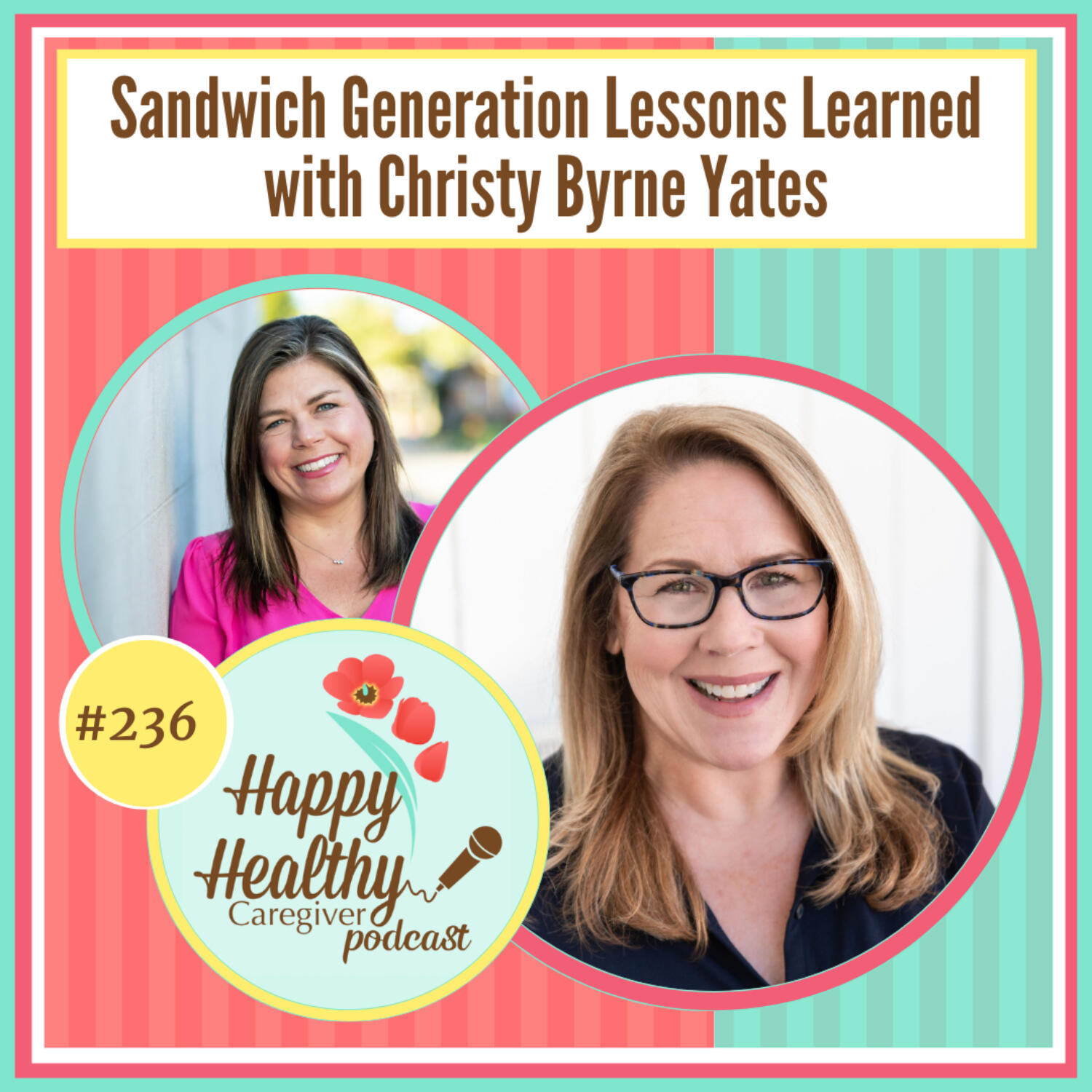
Sandwich Generation Lessons Learned with Christy Byrne Yates
About this episode
Christy Byrne Yates is a sandwich generation caregiver, author, and retired school psychologist who worked with young adults with disabilities.
In this conversation, Christy shares the wisdom and practical tools she has gathered over years of caregiving and coaching. We talk about her CARES framework — a five-part roadmap for sandwich generation caregivers that covers everything from consciously choosing your caregiving role to enlisting a team, recharging your own batteries, and surrendering the need for perfection and control. That last one is a big one — and Christy gets real about what it means to surrender even when the outcome is not what you wanted or hoped for.
We also dig into the very real and sometimes complicated dynamics of managing expectations with siblings, and how the relationships around caregiving can be just as challenging as the caregiving itself. Christy shares her powerful perspective on intentionally choosing your caregiving role as a way to protect and sustain your energy — because how you show up matters as much as what you do.
We talk about her favorite mantra, "connection over correction," and how leading with connection first changes everything — whether you are caring for an aging parent, raising children, or navigating any relationship in your life.
Show notes with product and resource links:
Receive the podcast in your email here:
Order a copy of Elizabeth's book Just for You: a Daily Self Care Journal:
For podcast sponsorship opportunities contact Elizabeth:
https://happyhealthycaregiver.com/contact-us/
The Happy Healthy Caregiver podcast is part of the Whole Care Network. Rate and Review the podcast:
Get every episode summarized
Each time Happy Healthy Caregiver publishes, we email you a written briefing from the transcript — the topics, who appeared, and any specific claims, with the ad reads skipped.
Email me new episodesFree for 3 shows. No card needed.
Transcript ready
1,039 searchable segments. Every word is indexed and playable.
Full transcript
Happy Healthy Caregiver — Sandwich Generation Lessons Learned with Christy Byrne Yates. Machine-transcribed; use the interactive transcript above to jump the player to any line.
This is the Whole Care Network. Helping you tell your story one podcast at a time. Content presented in the following podcast is for information purposes only. Views and opinions expressed in this podcast are solely those of the host and guests and may not represent the views and opinions of the Whole Care Network. Always consult with your physician for any medical advice and always consult with your attorney for any legal advice. And thank you for listening to the Whole Care Network. It's easy to forget that in the sandwich, a lot of our attention goes to the older person we might be taking care of or the elder or might even be a spouse.
I mean, look, you know, like I said, I've said before, it's like there's a million different sandwiches, but your kids are part of that sandwich. And so it does impact them. Are you caring for others while working and trying to live your own life? Wondering how to find the time for your own health and happiness? Well, you're in the right place. The Happy Healthy Caregiver Podcast, which is part of the Whole Care Network, is the show where real family caregivers share how to be happy and healthy while caring for others. Hello and welcome. I'm your host Elizabeth Miller. I'm a fellow family caregiver, a care advocate, a professional speaker, author, certified caregiving consultant and certified senior advisor. If this is your first time listening, thank you for being here. This is a show produced by Weekly to help family caregivers integrate self care and caregiving into their lives. Each episode has an accompanying show notes page. If you'd like more detail about the topics, products and resources we speak about or you want to see any of the related photos, you'll find the show notes by going to the website.
Happy Healthy Caregiver.com and underneath the podcast menu, click the image or episode number for today's show. The link for the show notes will also be in your podcast platforms episode description. Now let's get to it. Let's jump into this episode. Before we dive into this episode, I want to just share what's been going on in my life recently. And also I want to share a really fun resource that I haven't shared in a long time. I was reminded to share it because I recently celebrated my 55th birthday and my birthday landed on a Friday, which was perfect the night before felt like a Friday night, right? Because I took the day off of work on my birthday. And so I played majong with a group of girlfriends. One of my friends made me this yummy hummingbird cake. And then on my birthday, I had a great workout. I went thrifting with some friends at a few estate sales. I worked on some of my needle point. And then my hubby and I got together with another couple and we did something that's been on my 20 for 26 list. It was to go to a candlelight concert.
But we went to one indicator Georgia, but they have candlelight concerts all over. So I'll link to maybe where you can find one near you. And basically what it is is we went to an old church and it was a string quartet. So they had two violinists, a viola, and a cello. And they played an hour worth of music and all of the music for this particular concert was Fleetwood Mac music. And it's in its beautiful candlelit room. So it's very soothing and cathartic and joyful. They do ask you to not sing. And so I will say my husband in particular at a hard time with that before the concert. We went to a Spanish topest restaurant nearby called the Iberian pig. I'll link to that if you're in the Atlanta area because we tried so many different dishes and they were all super tasty over the entire birthday month. I've been treating myself to all of the freebies. And so this is the resource that I want to share with you because I have a whole blog post on the Happy Healthy Caregiver website that's rounded up the best birthday freebies out there.
My daughter helped me put this together. And you'll see thing from getting your Starbucks, which is on your particular birthday to Sephora, Kendra Scott, Cremble Cookies, Alta. And some deals are just good for on your actual birthday. Some of them last. You can take advantage of the whole week or some stretch into the entire month. Many of them you have to kind of sign up to be a rewards member. So it's not like I'm taking off all the freebies on this list. But there's really not an excuse to celebrate yourself during your birth month. I'm going to link to this full birthday freebie post in our show notes so that you can sign up for the rewards that you think that you were be interested in before your big day happens. And happy early belated birthday, depending upon where you fall in the calendar. I want to thank our episode sponsor newly. I have been renting clothes through newly for four years and I'm obsessed every month. I pick out six items to try. And it's totally changed how I get dressed in my life for every day and for special events. I attend when I'm shopping to go and lean towards the basic items that I'm going to get a lot of value for my dollar out of, but what I'm finding through newly is that I'm wearing bold patterns and styles.
I'm trying different colors because I don't have to commit to owning them. I'm just trying them out for the month. The reviews are everything I can find people who look like me. You can find people who look like you and look at the pictures and see what they wrote and that helps guide me towards the choices that I make for the six items that month. And when I'm done, I put all of the dirty stuff into this newly pre-addressed bag and I just drop it off at the UPS store. You can also keep any of the items. So if I fall in love with something during the month, I look and see what the amount is that they're asking for. And so sometimes I choose to buy those. And as a newly member, I also get access to the newly thrift store. Probably the best refined that I got out of newly is that I bought this made well green dress that I wore to a wedding earlier this year. And I might likely wear it to another one or another special event. And it was super affordable. So use my code. You'll get $30 off your first month of newly six items. No long term commitment.
Go to share.nuly.com forward slash Elizabeth 729 for our what I'm reading segment. I want to share a recent read that I gave four out of five stars. It's called the girls in the stilt house and it's written by Kelly. It's a question. It's set in the Mississippi Delta. It has that fear of swampy southern feel with a compelling mystery woven throughout what I enjoyed. Probably the most was the characters in this book. Both the good ones and the bad ones are both well developed. And that makes for a satisfying read at the heart of the story are a few beautiful themes. Female friendship and perseverance that are going to stay with you long after you read the last page. I'll link to it so you can check it out. Favorite thing that I want to share with you is this slave city vanilla cream all in one protein smoothie powder. This has been one of my go to honestly that when I run out, I just order it again and have it in my pantry.
What I love about this particular protein powder is how clean the ingredients are from slave city. It's 100% grass fed way collagen. They've got real vanilla bean powder coconut milk powder functional mushrooms natural sweetener is like this one's particularly sweetened with bananas. So you're not going to get artificial flavors stillers and other kind of junk stuff in it. It's all in the scoop. So it's not like you have to combine a bunch of different ingredients together. Each scoop has 25 grams of protein 10 grams of collagen, which is going to support your nails and your hair and your skin and your joints. I use this vanilla protein powder two different ways primarily blended into a smoothie is kind of the. You know the one that they market the most and then my personal favorite that I really use it a lot with is I mix it with almond milk and coffee. I make it in my mocha pot the coffee and I blend the milk and the slave city together. And then I make ice coffee on the way to my strength workouts so that I'm getting kind of protein and caffeine you know on the way to those workouts that are in the morning.
If you're looking for a clean protein powder that is also tasty, this one might be worth trying. You can find slave city on Amazon and I'll link to it so that you can check it out. If you like, let's share caregiver in the spotlight. Christy burn gates is a sandwich generation caregiver author and retired school psychologists who worked with young adults with disabilities in this conversation. Christy shares the wisdom and practical tools that she has gathered over years of caregiving and coaching. We talk about her cares framework. It's a five part roadmap for sandwich generation caregivers that covers everything from consciously choosing your caregiving role to administer the team recharging your own batteries and surrendering the need for perfection and control. The last one is a big one. Christy gets real about what it means to surrender even when the outcome is not what you wanted or hope for. We also dig into the very real and sometimes complicated dynamics of managing expectations with siblings and how the relationships around caregiving can be just as challenging as the caregiving itself.
Christy shares her powerful perspective on intentionally choosing your caregiving role as a way to protect and sustain your energy because how you show up matters as much as what you are doing in your caregiving role. We talk about our favorite mantra, which is connection over correction and how leading with connection first changes everything, whether you're caring for an aging parent raising children or navigating any relationship in your life. I hope you enjoy the show. Hi, Christy. Welcome to the happy healthy caregiver podcast. Hi, Elizabeth. I'm so glad to be here. Thank you. Yeah, excited to dive into our conversation and spotlight your story and the resources that you have to offer. And you know, I we have a connection. We have a couple different connections. We certainly have the whole care network connection where you were podcast host for the All's Authors podcast of untangling Alzheimer's and dementia. So that's kind of it. You know, there's a lot of great episodes out there that people can check out to learn more about that. And then we also intersected our past on.
We worked on a white paper together and the white paper was called the importance of supporting working family caregivers perspectives of human resource leaders and recommendations for improved support. So that was mouthful, but essentially like I think any employer who cares about the caregiving issues would certainly get a lot of value out of that white paper. And so I'll take this opportunity to kind of share that again in our show notes so that we can get that out to the world. But before we dive into all of the stuff, I first want to get your thoughts on this quote from the caregiver jar. Okay. And don't stumble over something behind you. So a little short and sway. Don't stumble over something behind you. How do you? How do you deal with stuff that happens in the past? Like do you? I ruminate for sure for a little bit. And then I realize I'm ruminating. This is not making me go anywhere. I'm just stuck. So you know, it's kind of like I have my fill of it.
It's my little indulgence. And then I'm like, okay, look, get over yourself. Let's move on. Yeah. Because you can't it's it's a trap. It's a really it's a big trap and it keeps us stuck and it comes from a place of fear. It's almost like we're comfortable with that old stuff because we've been through it. And we can keep rehashing it. It's not going to change it. But we know it. It's it's like our comfort of yeah, I know this crappy stuff. I understand that. And I'm fearful of what crappy stuff is ahead of me. But you know what? We learned hopefully from that other stuff in the past and ruminating isn't going to change it. But we can move forward with the courage knowing, hey, I got through my worst days so far. 100% of us 100% of those worst days. And you know, I think it's normal. Like you said, to kind of just think about the past and and rehash it and and unpack it. And also want to remind people who are listening here that like we make the best decisions with the information we have at the time. So we can go back and you know that hindsight can be 2020 but you you were living in the moment and making the best decisions and trusting yourself.
So thank you for sharing that. Well, let's talk about your your background and first of you know kind of before I wanted to get into your caregiving story going even back before that. Like you have a personal care story, but I wanted to highlight something that makes your perspective a really unique is that you spent years in your career as a job coach and an independent living counselor for young adults who were living with developmental disabilities. And so of course, as a caregiver for my brother Tom, who lives with intellectual developmental disabilities and is on the autism spectrum that really, you know, sparked my interest. So you found yourself caring for for those folks. What what was your experience like and working with young adults with disabilities? Yeah, it was it was great. It was a wonderful experience. I really enjoyed it. I had finished my masters at USC and counseling psychology and I was just I was really working in student affairs for a while. And then I stumbled on to a place where I could do some work in the evenings with young adults with learning disabilities. And that was a different population for me.
And I really fell in love with it. And it was just helping people who you know were really struggling with how to live in an apartment, have a roommate, how to menu plan, grocery shop, manage some things, possibly find work. And my job was really then job coaching. So I would help them find work. I might interface with the employer. And this was way back Elizabeth. This was right around the time the Americans with disabilities act was being signed. So like I really dates me right now. That's where I was. And so I was talking to employers about tax credits and why they want to hire somebody and I'm here to support or whatever. And so we were all learning the ropes professionals in that field about that. But and then I was doing the work. So it was really interesting. And I loved seeing young adults. And this was really kids that were like 23 to up to 30. And they had aged out of the educational system. And now they're, you know, probably getting some services through department of real business. And it was through department of real build rehabilitation or things like that. But it was a private pay. So it wasn't available to everybody. So that's unfortunate. And unfortunately not a lot of that has changed. But just helping people find their way. It was super encouraging. And I learned a lot. It was great. So good.
And thank you for that because I'm curious to do you feel like your professional background kind of pivoting in your personal care story. Do you feel like it helped you in any way? Oh yeah. Yeah. And I want to say that with a caveat because I feel like to be a caregiver doesn't mean you have to have a professional background because I was the best don't right. But I do have that. And then I went on. I went back to graduate school and became a school psychologist. So the idea of sort of using some assessment tools from others. I didn't do all the assessments for kids and looking all of that and kind of having a plan was really something that came in handy for me when I was caring for my parents while raising my kids, you know, being sandwiched and kind of looking all that, looking at all of those different dynamics. But yeah, for sure that came into it came to bear because I kind of knew about. I was just already comfortable with the patients I had to have even when I was really, really impatient and realizing there's only so much control I have over this situation.
So what do I need to bring to this relationship with my parents that's going to be helpful rather than you know pushing them around, you know. So yeah, it really it did help me. And I it's sometimes it's hard to articulate as a speaker and and someone supporting people in the sandwich generation how to like what are those skills you need. And so I try to pull from real life because I think even like you come from the business world. And that's brilliant because there's so many things that we have to do that are project management that are, you know, looking at supply chains and how do we make things happen and return on investment. I mean, you can use pretty much any profession and think about how do you apply this now to the situation. And that's what I think is important because we don't all have to go back and get some graduate degree to be able to care for people right right there's a lot of skills that we need and we pull from and caregiving and so likely what you've been doing in your past has enhanced some of those things and you'll certainly get on the job, you know opportunities to keep using those well, you you mentioned that you remember the sandwich generation raising kids caring for aging parents at the same time, you know, give us a little context.
What was the little context of what, you know, what life was like, you know, certainly in the thick of it like sure when did you realize you were in the sandwich generation and that this was you were being pulled and squeezed. Yeah, exactly. You know what I don't even think I thought of the term sandwich generation until after my parents had died and I was processing a lot of the my experience through writing and and then I was like, oh man, that's it. That's what it was, you know, and but what happened is. You know in the early 2000s I started having I lived five minutes away from my folks my kids were teens and tweens I have two. Okay, children and so middle school high school and then I'm starting to do more and more and more for my parents sometimes it was little things and then suddenly it was a lot of things and and then it was then it was like a snowball, you know, and I talk about. I was really consciously choosing to be a caregiver and I know that I didn't make that conscious decision I have two siblings but they live far away so I love you know in some ways I was just I got the short straw but I don't think I did really in my experience it was a gift to me and to be able to do this for my parents but it wasn't easy and there was resentment and there was frustration and all the things I mean I'm a normal human so but it was just managing how do I show up joyfully for my kids when five minutes ago.
I'm having to you know talk to my parents about something really difficult you know how about the times I had to cancel something with my kids because my parents needed me and vice versa canceled something with my parents because my children needed me and I didn't have enough space to move around and meanwhile I'm working a really stressful job as a full time school psychologist you know I was up till one o'clock in the morning writing you know I.e.p. reports because that's when I could do it. That's when I could fit that in you know because I was the daytime hours were filled with so many things so it was a lot. What did you really tap into and I'm sure you know some of this you've written in your book too like how did you how did you get to a point where this was sustainable for you to do all of these things because that's not sustainable right like staying up to 1 a.m. Riding reports and then rinsing repeat probably upperally off to off to the next thing. What were some of the things that you that you put in place I have an amazing husband so that was really helpful so I and I'll tell you it was with I had all of the things like my parents had already formed a trust they had managed their money well they weren't rich but they had managed they were depression
era people who saved their money. What a con. I was like, oh my gosh, you can do that. All right, let's do that. So it would, so I had everything in place, but it was still really hard. I think what kind of really pushed it was when I took some control, right? I had the conversation with my brother and sister about, okay, look, I will do this. Here's where I'm at. Here's what I need from you. And specifically, this is what I don't want from you, right? If you guys are okay with me taking this on, and I'll be the point person, I will do that. I'll keep you informed. You tell me what you want. They were so grateful that I was willing to do all these things. And, but I said, I don't want back seat driving. I'm gonna ask for that right up front. You know, if I tell you have done something, and then you think, well, you know, you shouldn't have done that, Christy, I don't need to hear that because I'm boots on the ground. And so you just need to trust me. So I had it that go, that conversation. You know, well, it went well. I think they were like, they were just so grateful because it would have meant them flying. You know, my brother lived in Michigan,
my sister lived in Montana. I'm in Sacramento. It's not an easy trip, you know? So they were just grateful to have me there, willing to talk to people. And then I leaned into professionals. And I think that definitely came from my background as a school psychologist, and then working with different populations is I can't be an expert in everything. So I talked to their attorney. We did the paperwork to eventually give me the power of attorney when it was appropriate. I didn't, you know, rest all of that away from my parents. I could talk to their financial planner. I talked to their doctor. I used the team that was around me because that's how I knew how to do it because I couldn't do everything. But it was really eye-opening. I had different aha moments along the way. Some that were incredibly painful. And, you know, like, when I got to a place where it was really clear that my dad was really entering the end of his life probably. And we didn't know, of course, how much time. But I remember being at a doctor's appointment
and he was seeing a doctor for his kidney disease. And my dad said, I don't wanna do dialysis. And I'm thinking, oh, but dad, you know, this is important staying alive. He's like, I don't wanna stay alive like that. That's not what I want. And after we had that meeting with the doctor, I, he was in a wheelchair at that point. I pushed him into the waiting room. And I had to go back in and make another appointment. And I just started crying with a receptionist. And so she pulled me into a room. The doctor came in and I just said, I didn't know we were at this place. And he said, yeah, this is where we are. And it's about quality of life now for your dad. So if he doesn't wanna do this, don't worry about that. Don't you can't control that. It is his decision. And to keep him alive in a way, he doesn't wanna be kept alive. Is that really, is that the agreement you have with him? You know, and I'm like, we didn't talk about that. You know, so those are those things that we have to learn to start hard. So I had a girlfriend go through this similar thing recently, Christie with dialysis. So super hard. Yeah.
So along the way, you learned different things. And so I would say it was when I consciously decided to be a caregiver that gave me some agency to then put some things in motion. And I, like I said earlier, it's like a snowball. You start doing one or two little things. You think, oh, I'm just helping out. I'm just helping out. But it becomes, you know, a snowball, a landslide. You can't get ahead of those. So you have, I believe, it's really important. The first thing is to consciously claim and choose to be a caregiver. And you have to keep, keep reminding yourself that this is what I am. This is what I'm doing. Because it's easy to get just consumed. And so it's important to do that. Why do you think that mindset is so important? Like it's the accept, it's really accepting it. And saying like, okay, this is it. Like I can't, if all of your energy is fighting that, fighting, no, I'm not, no, I'm not, no, I'm not. I'll just do this little thing. You are constantly at war with yourself. And that's a lot of energy that you could put back into self-care, into finding out how do I care for myself right now.
That's really important. It's energy that you're expending on. You know, you just think about it. You're pushing back when you could be saying, you know what, I'm just gonna, I'm just gonna go with the, go this way with it. You know, I'm not going to punch back. I'm going to move it to the side and move through. And you have to do that by saying, I have some agency here. I have some, the control I have is that I am stepping up to do this and I can set boundaries. I won't do this. I will do this. I won't do that. And those kinds of things are really important to take charge of. And you don't know what those are until they show up. But when you have consciously chosen to take on this role, you know you have the ability to do that. You've given yourself permission. Yeah, yeah, I like that. I also think until you accept it too, like you don't know that there's even all this stuff out there. It's like you got to kind of, you have to claim the role and identify it. And I know, you know, people get frustrated. Like who's job is it to figure out, you know, that we're caregivers, but it's until we claim it,
we don't get the support that we need and the can in tapped into the community. And so that's important. I think that's an important part of it. Well, you talk about, you know, looking at how this has impacted, you know, when a caregiver feels squeezed, but it also impacts your children and the family as well. You know, speak to how the season of life of caring for your parents had a ripple effect outward to your whole family system. Not just for you as the primary caregiver. Yeah, that is, I think key. And it's easy to forget that in the sandwich, a lot of our attention goes to the older person we might be taking care of or the elder or it might even be a spouse. I mean, look, you know, like I said, I've said before, it's like there's a million different sandwiches. But your kids are part of that sandwich. And so it does impact them. And now I know this as a school psychologist too. There were plenty of times when I was in meetings with a student and parent and it's clear the child was struggling. And one of the first questions I would ask is what has anything changed at home?
And it wasn't unusual to hear about caregiving stories. They could be things like, you know, my father just moved in with us and he has stage four colon cancer. It could be my grandmother just passed away and she lived with us and she was their first caregiver. So right there, I know there's some stuff going on and how can we support the parent to also be able to support the child? So it shows up in schools like, you know, kids are tired, kids maybe haven't had time to do homework. They haven't had support to do certain things. They come tardy to school. All kinds of things can happen because parents are really pulled in different directions. I think for me, what it meant was really trying to work with my husband and my kids that we as a family were taking this on. They were very close to my parents. So they knew this is what's happening. Grandma Grandpa are having difficulties. These are some of the things. And you know, and some ways it was, because my daughter was the youngest at the time, she was in middle school, but she, you know, she's smart. She could see what's going on. Both my parents had some form of dementia
and my daughter was brilliant at talking with them. She answered the same question five times, the same with joy every time. You know, she just kind of knew. And so, and my son was really great about supporting me and my parents. And so I think, but we talked about it a lot. We processed what was happening because I didn't want them to be completely overwhelmed. But I also needed to tell them I'm grieving. You know, there was a one incident where I just kind of was a really frustrated daughter of my parents and my kids were witnessing that. And I thought, and my son was like, mom, be nice, you know. Yeah. I was horrified. But I realized, oh my God, I'm training them. I'm training them to treat me like, like I'm treating my parents. This is not good. Right. Let's come back, but I just, you know, we came together as a family and we talked about grief and we talked about how hard this is. And so because we had that language in our home and we could talk about it, again, not with laying responsibility on their plates,
but also letting them talk about their grief and how they were feeling. You know, so I think sometimes we want to protect our kids and keep them away from it. And sometimes, you know, we can maybe give them too much to do. There are a lot of kids who have caregiving responsibilities and might mean they miss out on things at school because they got to come home and take care of a grandparent. So it's just that balance and finding it and being aware of what's going on. And I mean, you know, the, you and I both talk about this. The cost of caregiving is outrageous. And so I understand my families might need to have all hands on deck. And that's hard. That's hard for families. Yeah. Life is messy. Like I think, you know, there's not really any way we can completely hide it, especially if the human beings are living in our, in our own home. And so they are watching us and so figuring out the tools and the things, you know, and being kind of open and honest, like, hey, I'm going to try this. I mean, I'm going to see if this helps or is teaching them, you know, how to cope with some difficult stuff
that could be, you know, down the line. It already is happening to them, but then, you know, for your future tools as well. Well, I know you said that your folks had some different types of dementia. And one of your mantras that you say is connection over correction. And can you impact that for us? Like, what does that mean to you? Sure. I think, and this is true. I think that we're working with kids and we're with everybody, right? If we move right, if somebody says something that's that we feel is incorrect, this is a broad, broad brushstroke of this. You know, if our first response is to correct them, we've absolutely severed the connection and some level, right? It's best to feel good, right? You can also just say, you can sidestep a little bit, like I would do this with kids, you know? Like, hey, that's interesting. That's interesting. You have your thought about it this way, you know, because telling them the wrong isn't going to get me a better connection with them. It's not even going to help them, you know, want to participate. But I found that especially true with my parents, right? My mom might say something and I'm like,
are you kidding me? That's not true, okay? You're not going to do that when you're talking about it, you know? But if that was my interaction with her all the time, then I'm not helping her on any level. And I really came to that knowledge over time because there's definitely a feeling for people I can relate to, like, oh, if I just keep her knowing what's real, keeping the facts straight, then maybe she won't fall further and further into her dementia. Well, it didn't work that way. It just doesn't work that way. And so it's really about connecting with where they are, you know? And I told a friend recently, I said, listen, you just got to connect with your mom. And if she tells you she danced on Broadway and you know for a fact she did not, ask her how to win. That's all you do. Like that's charming. How wonderful. How to great story with her. Talk about it. See the laughter. See the, you know, the joy. Is it really important that she knows she never danced on Broadway? Probably not. So right. The connection with her is really important.
Yeah, yeah, it could lead to what kind of tunes do you want to listen to? What was your favorite part that you played? Like, I know it, my mom had some adventures for sure and we did have to kind of enter her world as well as toward the end there. Well, let's talk about your book. So you've obviously, I'm thinking you put some of these stories, some of these strategies, some of these things into your book. It's called Building a Legacy of Love, Thriving. I love the word Thriving, Thriving in the Sandwich Generation. What are you hoping that readers take away from this book? Yeah, thank you. I really wrote it, part memoir, part, hey, this is a heads up. So it has multi-purposes really. But I just wanted to share some stories that might help people connect with what this is really like in the Sandwich Generation, juggling your kids and your parents and your career and everything else. Also, as a way to be a catalyst for what are the some of the discussions you need to have with your parents?
And when I say need, I mean, it's really helpful if you have some of these discussions before you need to. Because if I had waited to have some of these discussions and my parents both have dementia, there's very little we might be able to discuss really. And so I was grateful to them that they had done a lot of work. Like I said, they had a financial planner, they had a trust already set up, their end of life wishes. And I just had a blueprint and that was very helpful. So I wanted to share that perspective with people. So I kind of talk about the different things that are a heads up. And then I tell my own story in each of those chapters. But one of the things too is finances. We don't talk, I don't know about you, but like now, me growing up, we didn't talk about money. I mean, my parents, you know, were smart with their money and they'd talk somewhat, but I never knew what my dad's salary was or my mom's salary. Was we didn't talk about things like that? And it's not that we talk, you know, at length with our kids about it right now, but we're a little bit more open about, look, this is how it goes, you know, sometimes you're here,
sometimes you're there, here's things we've learned money wise. And so those are discussions that I hope people start to have a little bit more openly because it can save you in the end. And end of life wishes are a big one. How do you have those conversations? And really leaning into, you know, those are tough conversations and they're fearful, but understanding that you can ignore them, but you're ignoring the elephant in the room. And that's just, you know, that's not gonna go well. And in the end, then you might have more discussions with siblings that are not well done, you know, because you're fighting over who's supposed to do what and no mom wanted this, no, I don't want that for mom, those kinds of things. You know, and then I talk a lot about grief too and how do you handle that? What is anticipatory grief? What is the grief that you feel afterwards? How to talk to kids about dying, death and dying, and you know, developmentally appropriate ways to do that? At different ages. And so that's what I wanted to do. It's really mostly, I think it's interesting,
Elizabeth, sometimes I'll talk to people who are target audience, people in the sandwich generation or maybe headed towards that, but a couple times I've been hired to talk to older people, you know, I'll go, or I didn't know it was good being older. Okay. I went to some rotary clubs and I'm like, oh, these are my other end. No, yes. So how do I can uplift this? Yes. And yeah, and it's like, okay, there you go. Let's talk about that. Hey, if you have these kinds of conversations or whatever, and it's wonderful because people are like, yeah, I really need to. That's great. I got to think about that. Oh, I've already done that. Or I don't know. It's just been really eye opening for me and good for them too. So I think that really, that's what the book is for. It's my number of my experience just to be able to bring the real to it, but then just some things that I think provide some framework for people. Cause yeah, that's what I try to do. What, you know, what was one of those examples with your parents where you felt like you hit some resistance, whether it was finances or driving or downsizing
or whatever, like, is there an example of that and like how you how you overcame it? Because I think that's so real, right? And what we hear in this space is like, my parents don't want to X, Y, Z, and we really need them. And we're kind of going that through that, frankly, now with my in-law side. So that's hard. Yeah, no, I get you. I get you. So my parents had purchased an insurance policy that only paid for nursing home care or assisted living. They had both had good experiences with assisted living with their own family members. So they were not, so that was, so they have this policy that nobody's writing anymore, right? John Hancock had this policy that was just about that. That's the only thing that would pay for. Wouldn't pay for in-home care. So, and they were very rough with us, that we'd, look, we love you three kids, but we don't want to live with you. We want to live as independently as we can. And then when the time comes, if we need to go somewhere, we would rather go to assisted living. So that was their choice. So that was awesome for me. And that was great that they thought that through. And then I, you know, but the time came
and you know, they were a little resistant. I'm thinking you guys, I think maybe it's time or whatever my mom was in the early stages of Alzheimer's. We knew that. She was taking medication. My dad had a lot of different things going on. And he had a lot of pills he had to take. He had had a stroke. He had some mini TIAs and he took a lot of different medication. And my mom would go and fix his medication pills, you know? And it was scary because I'm like, you know, and my dad might call me and say she's done it again. I don't know what I'm taking. And I would put notes on the medication and say, don't touch this mom until you call Christie. She would just ignore that because that's how she was thinking. So what I did is I hired an outside agency to come in and do an evaluation. So they, what kind of an agency does that? Yeah. So it was a geriatric case manager and a geriatric nurse through here in my area in Sacramento is Escaton. And so they do assisted living, but they also do independent living
and some other things. And they provide you with services that are supportive services. Now their insurance paid for part of that. This insurance policy they had. But even if it hadn't, it was well worth the money because what that did is they had this outside person coming in and they were very kind and they were wonderful. They saw things I didn't see. But then they could sit down with my mom and dad and say, here are findings. So suddenly I wasn't the nagging daughter. Right. Right. They were hearing, they were using it with data and like presenting what they were finding. There were experts in this space. Right. So a neutral party that had some authority and that was important to my parents. I knew that of my parents that they would respond to that. Made it easier for us to move into that next situation. So I think that was very eye opening. It's like, okay, yeah, we got to lean into these things because I don't want to be the bad guy. I need some help. Yeah, I need some help. And I think sometimes people could reach out to their area agency on the aging. Yes. I'm not going to hire about getting this kind of assessment done to.
Yeah. So probably any in any area where you live in, it's harder in rural places because there aren't as many facilities or that kind of thing. But you can contact any assisted living. And I would look for ones that are maybe higher regarded. Right. They maybe want to. That might not be the place you end up going to. But you want a skilled nurse and geriatric case manager. You can find geriatric case managers. You can google that in your area and you'll find some. But they're very helpful. Again, neutral party with some ability to interact with your people and help them hear this differently. Yeah. I have found some success with the neutral party is whether it comes to driving or getting my brother to drink more water or anything coming from the doctor coming from his case manager. It always lands better than family. Well, I want to switch to your self-care, Christy. And you talk and have developed a framework called CARES, which is a great acronym. What is CARES stand for? And why were these the pillars that you landed on?
I would be asked quite often, what are the five steps you have to take? And I'm thinking, well, everybody has different five steps. But I took a broader view of other themes that are common. And the first one is choose. That's what C is. Choose to be a caregiver. When you claim that and you consciously claim that you can set some resources in motion, your emotional resources, your talents, your strengths. So that's C, CARES. Choose. A is address issues directly. Because you have to have difficult conversations about things you might not want to talk about. But address the elephant in the room is really my message. Don't let those things go away. Because they come back and they bite you pretty hard. So address big issues. R is recharge, just another term for self-care. And I really think it's about learning how to notice in your body and in your mind. Are you running on empty? Are you getting there? Because you wouldn't let your car go to... I have done that, right? I have done that in my car where I ran out of gas. Yes.
Yeah. It's humiliating. It's hard. It's scary. Scary. Never comes with your pro. I was on a hill. It's horrible. Anyway. So starting to pay attention to how your body is feeling and emotionally. And I would feel it up in my neck. And you know, like me earlobes are touching my shoulders and I'm like, I'm too stressed. That's the time to take a break. And what do you do to take a break? So recharge is one that's important. And E is enlist a team. And so like I did, I reached out to professionals who had better knowledge about a lot of things and have them advise me and help me understand what role I could play and how I could help. And then the last one asks is surrender. Because I think we have to surrender. Not giving up. We have to surrender the belief that we're in control of all of this. We're just not. No. And that's a really hard pill to swallow. Like my parents, my dad not wanting to do dialysis. That was, I had to surrender that. It was hard for me to say, you had to don't do it's advisable. But he was 80, 82 at that time.
And he died at 83. Was it my right to tell him he had to do something that was going to be uncomfortable and unpleasant for the rest of his remaining time? I don't know. I had to surrender that. I had to just say, you know what? I'm not in control of everything. I'm not in control of what other people think of me right now. I'm not in control of the decisions my parents want to make. I wish they had done some other things, but it wasn't mine to... They're adults. They're adults. They're yes. So that's it's the right thing. You know, you just, and we have to do that with our kids too. I mean, our kid, we raised them to be independent. But then maybe they make choices that we wouldn't have wanted them to make. And I'm, I sure did. It's true that decisions. And I learned from them. Like I said, I survived best of my worst days. So 100% of my worst days. So we just have to surrender that we're in control of everything. And I think that's a hard one. Yeah. When we fight against that, again, we're using up our resources and internal resources
to just move on and survive. So yeah, I like the way that you say that. So it's like protecting your energy, your emotional energy, your physical energy. We need them. You know, we don't know what kind of is coming down, coming down the pike. When you talk about recharge, what do you felt like what were your tools in your closet, you know, that you often went to for maybe a quicker recharge or a longer-term recharge that really had a big impact for you? So I really like things that are getting some physical work in. So maybe it's taking a short walk. It, you might not have time to do an hour-long walk. I got that. But you can stop and do some things, right? So maybe it's taking a quick walk outside, you know? It could be things like, you know, if you have opportunities to do something longer, that's great. So I think some physical work is really important. And then also, how do you just bring that energy down? And I talk a lot about energy, but I do feel like that's a really essential piece. So it could be guided imagery. It could be, you know, other kinds of techniques.
I like things that are, you know, really help you kind of release that stress level. You've got to bring that cortisol level down. I definitely think joining support groups are helpful, not everybody's into that, but there are a lot of free support groups. And it's sometimes it's just healthy to hear another person say, yeah, I've been there, done that, that's hard. And so those are important to look for in your community. I went to some Alzheimer's support groups, and that was really eye-opening for me. So those kinds of things I think are important. And then it's simple things. It's not like getting, you know, master chef to come in and cook for you. It might be, you, you know, you do menu planning a little differently, you know? And involve your kids more in that, involve your whole family in that, take some of that stuff off your plate so that you're not always doing everything. I don't think of myself as like a tradwife kind of person, but I did all those things, you know? And then I had to say, yeah, guys, I can't do this anymore. You guys got home. Yeah. Yeah. Open me out. Yeah. And it was great, because my kids got to step up,
and that was, that was terrific. They became incredibly, they were always compassionate, and then they became really resilient and good. That's great. That was great. Yeah, I think that's one of the things, as a sandwich generation working caregiver for myself too, is like they are a part of your team, your kids, and maybe while they're not taking on caregiving tasks, there was a lot of other things that they can help take from your plate, take ownership of so you don't feel like you have to keep visiting their plate, right? Like having conversations about that. You know, I need for you to own your schoolwork. I need for you to figure out, you know, I need for you to get to the bus in the morning. I had, you know, we don't, we can't handle the, the late bus, I'm already gonna be at work, and all of the things. So I think having those conversations with them and managing expectations has really been something that I've reflected back on them been like, okay, we were team Miller, we still are team Miller, but it's like, how do we divide and conquer so that we can kind of get, get all of the needs met, and still have some time to do the fun things together.
Right. Well, speaking of fun, like, you know, we do something happy, healthy caregiver community, how the 20 for 26 lists. What's something, Christy, on your list for the remainder of this year that you're like, I really wanna do that because it's gonna help you and fuse more joy in your life. That's a good one. I already this year, I did some really lifelong wish travel. So I did some amazing travel in the beginning of the year, but I still have some travel coming up. So that is something I'm looking forward to. We're gonna, my kids are spread out, you know, I'm in California, one of them's in Ohio, and the other one lives in Amsterdam, you know, so but we're all going to, I know it's so great. And but we're all gonna come together the week before Thanksgiving, because it was a little bit more doable for everybody. But I'm looking forward to that. So I think for me gathering with my adult children and my family and then doing something fun like that being outdoors and doing something in the sun and we're gonna go to Hawaii, so that'll be great. But then, you know, I've got other things on my bucket list. I really wanna write a second addition to my book.
I've learned so much, you know, from the work that we've done, whole care network and Al's authors. I just, I have so much more than I wanna say and things I wanna refine, you know, and okay, not a perfect book, so I wanna, you know, and there's never gonna be a perfect book, but you know, doing some things like that. So those are really the kinds of things that I think bring me joy and fun. I love it, love it. When I wanna ask you a couple of questions from the just for you, Daily Self-Care Journal, no wrong answers here, Kristi. Okay, so what's a creative way that you could squeeze a few minutes of physical activity into your day? Well, you know, this is gonna sound silly, but you can put on like, there are a million YouTube dance videos, right? And you just put that on in the background and you can be cleaning your house while you're doing some salsa. I mean, any kind of movement like that can really get your energy up. Let's go of a lot of that cortisol. You know, when we get stressed out, that cortisol just rises in our bodies and from our stress response.
And it's sometimes the most important thing you can do is some physical and it could be moving around, but man, jumping around to some music while you're cleaning the house, even while you're doing the dishes or something or you're folding laundry. I don't know, but get up and do it, you know? Get up and do it. And move and listen to the music and pop around. That's a great way to kind of get some physical activity. And it just brings you joy too, you know? Fun tunes and stuff like that. So I think that's why it's a mid-shifter for sure. Okay, if you could make a living doing anything, what would you be doing? I love what I'm doing right now, honestly. Okay. I'm retired. I'm not in the school system anymore. I still maintain my license as an educational psychologist, but I talk a lot to work groups. So employee resource groups and I'll do those virtually. So much fun. I love doing that. I love talking to people about hearing where they're at and then maybe giving them some food for thought. I enjoy that so much. So I'm kind of having the best of everything right now
and I have to tell you, it took me a long time to enjoy retirement. I felt like, is this right for me? Maybe I should be doing something else. But I volunteer, I work at, I go once a week to an assisted living and I just have, I have something, a little group called conversations and coffee and just different people come in and we sit and chat. And I love these people. It's just so wonderful. And then I'm also doing some things with kids. So it kind of gives me both sides, you know? And I enjoy doing that and I have the opportunity to be able to, and I'm super, super grateful that I have that opportunity to volunteer and do things that are meaningful to me. Yeah, nice. It doesn't sound like the retirement where you're kicked back by the pool and you're reading a book. And maybe I'm open, there's some moments like that. I know I love reading books too. I'm like, yeah, I'm reading more now. I love it and writing, but I get to do things I like to do. But yeah, I also really enjoy people. And so I get out and do that as well. Yeah, connect, connection. Okay, last question. If someone told you that self-care was selfish,
what would you say? I would say, hey, I hear you. I hear how that feels. On the other hand, if you're not taking care of yourself, the people that you care for could be harmed. And so really, it's the selfish thing is not taking care of yourself because you could be the person that is important to somebody else. And so if you're not charged up and ready to go and healthy, how's that gonna impact people that you work with, your children, your spouse? I think it's the opposite of selfish actually. It's really, it's an important thing to keep in mind. The selfish thing would be to say, I don't care about myself. And that gets communicated to the people around you that you don't care about yourself. How much can you care about me? Yeah, or are you kicking the can down the road? And it's gonna just faster. And become a lot for someone else to take care of it. Some kind of, well, how do people stay connected to you, Kristi, and I know there are any parting words of wisdom you have for family caregivers? You know, my parting wisdom is just, this isn't forever, but it will change you.
And it will probably, it can very much change you for the better and moving forward. It helps you visualize and understand what's the end of your time here going to be like. So think of it that way. It's like you're constructing that as you go along. So put that kind of energy into it. And you can see some fruits of your labor. Connect with me. Best places on my website and that's Kristi Yates.com. So it's CH-R-I-S-T-Y-Y-A-T-E-S.com. And you can find contact information and other things. And I even have just some informational stuff on the website. So it's sort of chock full. But, yeah. Amazing. Well, I've enjoyed, you know, getting to know you, and learning more about the CARES acronym and choosing caregiving and surrendering and a lot of things, I think, that people can take away from this episode. And so thank you for the work that you do in the corporate world as well. They need it, right? We want the sandwich generation caregivers to feel supported and the working ones to feel
like it can continue working. And if they need to do that or want to do that. So such important messages. And I'm, again, glad that I got to work on that way, paper with you and that we share this CARES space together. People need us. Exactly. I love the work that you do and have admired your work for a long time. It's so important. And there are so many people out there doing great work like this. And it takes all of us and even more. Yeah. And more. Let's do many. Too many people. Thank you so much, Kristi. OK. Thank you. Thank you. Bye-bye. We are Su Ryan and Nancy Treester. Together, we host the Caregivers Journey podcast. Our podcast delivers practical tips and candid conversations to help you tackle day-to-day dementia, family caregiving challenges with confidence, patience, and peace of mind. We share answers to the questions you don't know to ask. And the resources we wish we'd had.
Our goal is to help you learn faster and more easily than we did. Listen to our show on demand at theCaregiversjourney.org or on any major podcast platform. Thanks for listening to the Happy Healthy Caregiver podcast on the whole care network. I hope this episode provided encouragement and practical tips to infuse into your life. You'll find the show notes and all the resources mentioned at HappyHealthyCaregiver.com. I also invite you to check out previous episodes of the podcast that you may have missed. If you enjoyed the show, be sure to subscribe so you never miss an episode. Ratings and reviews also help others discover the podcast. And sharing with a fellow caregiver is a great way to spread support. Stay connected with me between the episodes by following Happy Healthy Caregiver on your favorite social media platforms. And subscribe to the weekly newsletter where every week I share something happy, healthy, and care-related.
Just visit HappyHealthyCaregiver.com to join. Until our next episode, I'm Elizabeth Miller with a reminder to take care of you. Are you still here? Well, it's time for the disclaimer. I am not a medical, legal, or financial professional and I am not providing medical, financial, or legal advice. If you have questions related to these topics, please seek a qualified professional. I have taken care to spotlight family caregivers and experts, but their opinions are theirs alone. This podcast is copyrighted, and no part can be reproduced without the written permission of Happy Healthy Caregiver, LLC. Thanks again for listening to the Happy Healthy Caregiver podcast on the whole care network. This is the Whole Care Network. Help new tell your story one podcast at a time.
More episodes
More from Happy Healthy Caregiver

Finding Your True Self While Caregiving with Susanna Peace Lovell
Happy Healthy Caregiver

Uncovering Your Roots with Tamara Adams
Happy Healthy Caregiver

Do It Now: Living Fully While Caregiving with Heather Butchen
Happy Healthy Caregiver

Living with Uncertainty with Marisa Renee Lee
Happy Healthy Caregiver