About this episode
Sex After Sixty
Get every episode summarized
Each time Sex Talk publishes, we email you a written briefing from the transcript — the topics, who appeared, and any specific claims, with the ad reads skipped.
Email me new episodesFree for 3 shows. No card needed.
Hosts & guests

Transcript ready
397 searchable segments. Every word is indexed and playable.
Full transcript
Sex Talk — Sex After Sixty. Machine-transcribed; use the interactive transcript above to jump the player to any line.
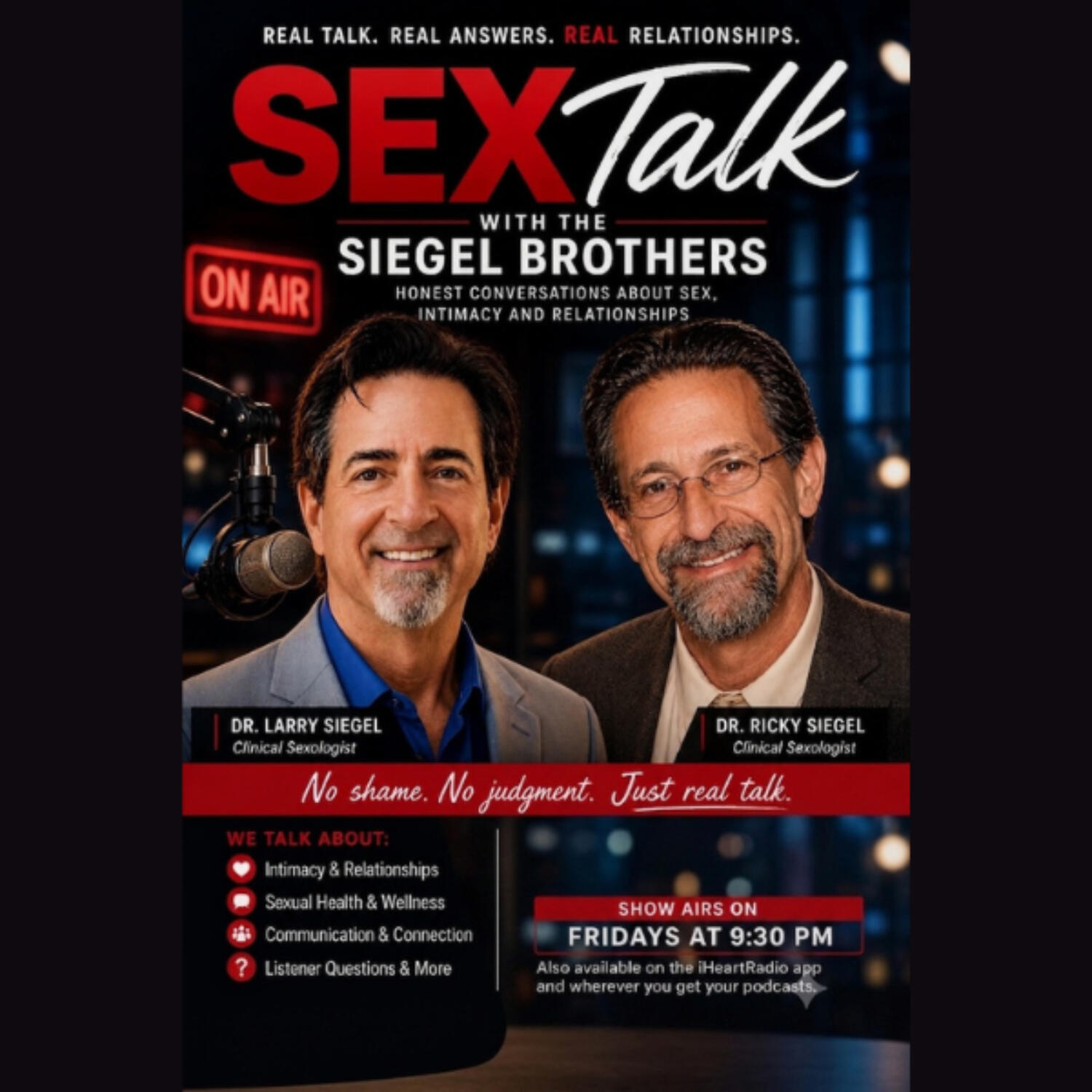
Welcome to Sex Talk with the Siegel Brothers, a weekly program designed to uncover and explain many of the issues and debates around the fascinating and wonderful world of sex and sexuality. Richard and Larry Siegel are recognized around the world as sex therapists, educators, counselors, and researchers, so tune in and discover some of the answers to your most burning questions, even the ones you didn't know you had. Thank you for joining us and welcome to Sex Talk. Hello and welcome to another episode of Sex Talk with the Siegel Brothers. I'm Dr. Larry Siegel, a clinical sexologist and certified sexuality educator and supervisor. And I'm Dr. Richard Siegel, a certified sex therapist and co-director of modern sex therapy institutes. And my favorite person in the world. Thank you, big brother. It's good to see you, my brother, and thank you for joining us on this week's episode. We are going to kind of reach out to people who don't necessarily think a sexist is for them. And it is this opportunity that we want to take to talk to older adults that are massively
underserved in the entire conversation about sex and sexuality. Are you a man or woman suffering from ED or sexual dysfunction? If so, you're not alone. Did you know that there are nearly 50 million men and almost as many women affected by it and many of you are suffering in silence or may be treating the symptoms instead of a long-term cure? That's where RegenMax comes in, powered by sexual wellness centers of America. RegenMax addresses the underlying causes with each individual patient using unique, non-surgical comprehensive therapies. In fact, RegenMax is the only padded cure for ED. So if you're tired of the temporary band-aids, a little blue pills, pellets, or potions, contact RegenMax today. With their team of leading MDs and PhDs in cities across America, there's probably a clinic in a city near you. RegenMax is all about improving sexual wellness in both male and female adults of all ages. Go to RegenMax.com today, RegenMax.com.
And thank you again for joining us on Sex Talk with the Seagal Brothers. Hello, hello. Hello. How are you? I'm doing great. I want to, before we start, take an opportunity to share something with all of our listeners that this is your birthday. Ah, go on. Happy birthday to you. Happy birthday. Happy birthday to you. And a happy, happy birthday. Thank you, my drug. Thank you, thank you. Right, yeah, it's a good way to spend our time and all these other people from all around the world who get to give you good vibes and things on your face. I feel it. I feel it. You know, it's actually pretty timely that we are talking about this topic of sexuality and aging sex after 60, in particular. Yeah, especially, it's kind of funny. We started talking about this when we were in our 30s, and now we are in our 60s.
Right. And I am officially a senior citizen. Oh, boy. My own birthday being next week. That's right. It entrenched me even more deeply into senior citizen status. Yeah. And yeah, you're right. It's, you know, much, much younger. I remember when I began to specialize in this, you know, or I should say, focus on in a lot of my training, probably at this point, 15, 16 years ago. Oh, it's older than that. 50F, not longer, but I remember. Yeah, we started doing sex after 60 workshops in the years PV, pre-viagra. Yes. Right back in the 90s. Yes. Absolutely. I mean, you started writing about it good 15 years ago. Right. Oh, yeah. But when my 16 or so years ago is when I started to focus on seniors with dementia. And yeah, the healthcare settings. Yeah. Right.
Remember talking with an administrator in a nursing home about doing programs for the residents there, you know, they usually just, if anything wanted to talk about HIV. But I remember having this conversation with this administrator and it just really hit me that, you know what? And at the time, probably about 30 years from now, you're going to have me as one of your residents. And I remember looking at her and said, you ain't ready. You are not prepared. Well, I mean, yeah, I guess it's just a function of our age or perspective, but I really believe that our grandparents are not today's grandparents. You know, your grandparents grandparents were old people. That's right. You know, we used to kid around with our parents when they first moved to Florida, following the kids down unlike the usual pattern. And, you know, they lived a two community that was like camp.
We're running around activities every day in sports and creative stuff and clubs. And, you know, they were active with drugs and drugs and dating going on. And there is an area in Florida that is particularly known for seniors and sexual activity. Oh, yes. You mean where people ride around in their golf carts with color-coded scrunchies, the way gay men used to in the bath houses in the 70s? Yes, exactly. Of course, we're talking about the villages. Some children. A lot of people all over the world are familiar with that little slice of North Florida life. That's right. And, you know what? And it's very telling that they're not necessarily known for being sexual and older and looking at this in a healthy light. What put them on the map was the highest per capita rate of sexually transmitted infections.
And this is where we want to try to fill a little bit of this gap that is there that especially now, like you said, people are aging differently than they were before. And now people are more and more people are now coming into their 50s, 60s, 70s and beyond. Still sexually interested and still in many, many cases sexually active. But what kind of resources are there available to them? Who is talking to them? How many people are talking to their doctors about healthy sexuality as they are older adults now? No, certainly not. Yeah. I mean, even back then, when we were both more involved in the sex ed and public health side of things, when we started doing the sex after 60 workshops, it was the sharp increase in HIV infection rates among seniors that certainly got people's attention. And remember, even among medical people, there was an awful lot of denial.
A lot of like, well, it must be because they're in the hospital more than anyone else. They have more surgeries than anyone else. They're more likely to have blood transfusions. Right. You're getting a blood transfusion. Anything other than sex. I think most doctors are not that they do to any real degree, but they're more likely to ask an 18-year-old about whether they're not they're sexually active. But yeah, I would like to find that unicorn of a doctor who will ask an 80-year-old if they're not sexually active. Right. I talked about previous show about Gen Z and the mind-boggling lack of sexual activity. I would think older adults nowadays are probably more sexually active than high school and college age. You know, that is just another piece of this upside down world that we are living in. Yes, you're absolutely correct.
People in their in general in their 50s and 60s overall are more sexually active than people in their 20s. That's insane. And even with some of the studies, you know, talking to people like 65 to 80, one of these studies half of respondents reported being sexually active. And let me add to that because I used to cite this data in a lot of again, my sex after 60s, my aging, my seniors, my dementia stuff, then in the last 20 or so years, that not only are half sexually active between 65 and 80, but even those that are not sexually active, whether that's because of a medical issue or a lack of a partner, we're looking at closer to 80% will still say that sex and erotic intimacy remains an important part of their relationship. Even if they're not quote having sex. Right.
So, you know, again, another age group, another interest group that we're dropping the ball with. Yeah. So, we should probably start a natural place with kind of physiological changes in how sexuality and aging, or how I should say aging certainly doesn't have to mean the end of one's sex life. No, no. And that's, you know, that is something that I do want to kind of bring it. Let's go ahead and put that in now before we take our break. This idea of the script, right, that if we're getting old, we're not supposed to want to be sexual anymore. Me, right. And why people buy into that so much. So, let's take our first break and we'll come back. Wake up and text. Text and eat. Text and meet up with a friend you haven't seen in forever. Hi. Okay. Text and complain that they're on their phone the whole time. Text and listen to them complain that you're on your phone the whole time.
Text and whatever. But when you get behind the wheel, give your phone to a passenger. Put it in the glove box. Just don't text and drive. Visit stoptextstoprex.org. A message from NITSA and the Ad Council. And we are back. Thank you again for joining us on Sex Talk with the Seagal Brothers. And again, we want to big shout out to Brushwood Media Network for hosting us and putting us out there. You can find our podcasts on all of the major streaming networks. And again, also proud to say that we can be heard now on the iHeartRadio network as well. So, thank you again to all you wonderful people at Brushwoods. Yes. So, this idea of not supposed to. We've spoken to enough people over the years. We've really seen how people buy into that idea and buy into that script. Especially if somebody has lost their partner, their lifelong life.
Right. Right. Usually it's the adult children, isn't it? Parents has gone through an appropriate morning period. And they're still vital and interested in dating. And what do the adult kids say? Oh, mother, please. Act your age. You shouldn't be interested in that anymore. You're a grandma. Right. Exactly. Or if one of these surviving parents start dating again, these adult children will shame them into just like, what would dad think about that? You're really stepping on our mother's memory by doing that. That's so terrible. I mean, that's a whole nether bucket of issues when we look at the adult children of older adults. Yeah. Instead of realizing that, you know, sex is healthy and a good part of maintaining vitality and youth and, you know, aliveness. No, it's still embarrassing.
Right. Right. And, you know, that's, again, an important point. I want to follow up with what you just brought up because especially for older adults, I think we really do need to focus on the many benefits that come with being sexually active. You know, vascular health really across the board, right? There's that classic essay from one of our heroes, the late great Albert Ellis, who, you know, four or five pages on all of the health psychological and physiological health benefits of regular organisms. Right. Including, and again, it's a little controversial, but, you know, a possibility of reduced incident of prostate cancer in men with a particular regular ejaculations throughout life. Sexual activity and at least, you know, even just embracing intimacy and pleasure, even if it is not a physical sexual act, does help strengthen the immune system. Organisms are great for pain reduction.
They're great for sleep. Circulation and blood pressure. Bladder problems, memory, self is. Sure, even the long term endocrine and hormonal function, right? But, you know, this is this is a kind of science that, you know, again, even in the early 2000s, we wrote that chapter for the sexual health series, our old friends. Pepper and Owens. And, you know, again, it really hasn't. Why hasn't the world been listening to us? We haven't seen a real sweeping change in the way, like you said, medicine, especially gerontology. I mean, we live in South Florida, right? How long has this been referred to as God's waiting room? Big positions would be more hip to this, but no, it's the same kind of denial. Well, I mean, it also comes along with the fact that very few professionals. We're very unique in our profession because our profession focuses on this.
But what other profession does? Most psychologists don't really deal with, they don't have training dealing with sex. They have an A course. Physicians have a course on sexuality that they teach. Yeah, for decades. What are they telling the sexual medicine folks that, or the urologists and kind of colleges that have shown an interest, right? We would remind them that the genitals they're working on all day have people attached to them. That's right. That's exactly right. We often, you know, equally, if not more railed against marriage and family therapists who have these words, marriage and family in their name who just across the board don't talk about sex. Yeah, the plumbers don't do toilets as I like to call them. Yes, yes, it's still one of my favorite reports. So, yeah, we have to kind of bridge the gap. We understand the physiological changes. There needs to be a lot of acceptance. I think like we talked about recently with ED and the Viagra commercials.
Guys in their 60s and 70s need to accept that they're not in their 20s and 30s. And they can't expect sex to be the same, right? But there's also this, you know, what has to change is, how long have we said that Viagra kind of brought this out of the closet, this senior sexuality? But that was 1998 and it's still fighting to stay in that closet. They still don't want to normalize and talk about and even encourage seniors to embrace their sexuality. Yeah. And, you know, an important point that we've also, I think, consistently made over the years with Viagra is, you know, this is like most other things, especially medications and medical interventions. It's a tool, not a solution. And the things that, especially older guys need in order to be able to get nice, healthy and functional erections with Viagra are still the fantasy, the erotic thoughts, the relaxation.
Yeah. Friction and fantasy is always the recipe. Yeah. But see, well, the physiological things change, you know, maybe needing more time, increased friction, more reliance on sexy thoughts. But, you know, certain things don't change, like desire. And that needs for connection and intimacy you were just talking about. And the capacity for pleasure. Right. Absolutely. Now, let me, let me say something about that because I think there are some important changes that have to be acknowledged when it comes to desire. You know, when we're younger, we kind of take for granted that our desire is spontaneous. And that's one thing that may have to be a shift as we get older. If we're, if we're waiting for the desire to just happen, we'd be waiting for a while. So we, you have to learn how to make a shift from that spontaneous desire to more responsive desire. We have to do a little bit more planning, a little bit more, more communication.
Right. A little more interesting than we respond to it. Right. Exactly. More responsive in that way. So why don't we go ahead and take our next break and pick this up on the other side. As an Olympic athlete, I prepare for everything. So when I became pregnant, I thought I was ready. But at 32 weeks, I was diagnosed with severe pre-classia and had an emergency c-section. Looking back, had I known the warning signs, I would have talked to my doctor sooner. Too many women die of pregnancy-related complications. And most are preventable. If you were someone you know as pregnant or recently had a baby, learn the warning signs. It could help save her life. Hear her. And welcome back once again. The sex talk with the Seagal Brothers. We are talking about basically sex after 60. Yeah. But because we get older, doesn't mean we lose automatically. Lose our interest in sex, sexual pleasure, intimacy, affection.
I mean, these are things we never, ever lose. Yeah. But we also don't seem to be able to lose this assumption that like you just said before the break, older people either orange or aren't supposed to be sexually active or don't consider it a priority. And to the last point, you know, about the more responsive desire versus spontaneous, I think that's what most of us think of as horniness. Right? Just because you may not walk around feeling like, oh, I'm horny. Like, you know, someone in their teens or 20s doesn't mean that we're not, as I said, have the same capacity for pleasure. It just might take more to get the engine revving. Yeah. Remember, especially when we first started doing these things, like you said at this point, we're talking about like 40 years ago, you know, 30 plus 40 years ago. And because we were younger, I think, you know, every time it did like a sex after 60 type of presentation,
there was always some guy, you know, some 80 year old guy waiting to talk to us afterwards that just couldn't wait to tell us how many times they were, they were having sex. Yeah. And it's, it's, yeah, you actually had a point in my head that I just, I just lost. Well, you just reminded me of that one wonderful guy. I mean, we did one of those giant ones that had a do-or-synagogue in vocal arts on. And the guy stood up and said, oh, you boys are lovely. Thank you so much for coming in. Like, you know, so condescending. He says, if I understand what you're saying, he says, I'm 85 years old. And thank God I'm still having sex. And you're telling me I have to worry about getting a disease that could kill me in 15 years. I should be so lucky. Right. I think that was one of the rare times we were both a little speechless. Yeah. Yeah. And again, I wonder what the thing that just jumped out of my head just jumped back in was one of my favorite quotes. Again, he's talking about how our desire changes.
And we may not be spontaneously horny. We may have to work at it. And this is one guy that came up afterwards, also probably in his 80s. And he said, look, I just want you to know, I am just as interested in his act today as I was when I was younger. I feel just as much pleasure as I ever did. But at this point in my life, I don't beg for it as often as I used to be. Yeah. Yeah. So, you know, one of the things we've been talking about long before COVID where this became a popular kind of term is when we as we get older, especially when it comes to embracing and accepting and understanding our sex and sexuality is we have to create this new normal. So, I think the biggest expectations we may have had in our 20s and 30s cannot be the same expectations we have in our 50s, 60s and beyond. And this is the biggest problem with Viagra is that it's kind of a way of telling particularly guys that you're supposed to get erections as easily whenever you want them, every time you want them, just like when you were younger.
Yeah. It's not realistic. Yeah. And not to leave our lady listeners out. Like we should mention that we get probably get into a whole other thing. We'll have to devote another show to. But we should say that there was a sad thing that happened in the early 2000s with a flawed study that really just terrified women everywhere that there was a time when hormone replacement was the number one most popular prescribed medication. In the country. And then the study came out, terrified women and women were flushing their hormones down the toilet. And it's been very, very slow to come back to realize that the flaws in that that infamous women's health initiative study back in 2002. That do with women's risk of cardiovascular disease and women were afraid if they took hormones to ease the changes of menopause that they would be putting a gun to their head.
Right. And just really reinforce that hormones are safe, especially for women who are pre or perimenopausal. In fact, even have some cardio protective effects. So you really should talk to your medical specialist and go back to the days when women didn't need to suffer needlessly from the changes of menopause. Right. And you know, there's still there's still a lot of fallout from that there because, you know, let's face the reality that most people operate from is a they say kind of reality. Once that was put out there, I mean, it doesn't easily come back and there are people that still are afraid of that and women that are denying themselves necessary care. It's just unreasonable and it's another sort of spike, if you will, against physicians who are not talking about any of this stuff with their older patients, male or female.
But again, we do have to look at the part of this new normal is, you know, we could talk about guys needing more time to get or maintain erections, more stimulation to get or maintain erections, less ejaculatory volume. That's something that a lot of guys are focused on, maybe a decrease in sensation. But we do have to also understand that for women, there are a number of vaginal and urinary changes that their bodies go through as well, including less lubrication. Well, when there's estrogen loss, then they're going to expect changes. The vagina atrophysic bit tends to be dryness, but that's why God made lube and moisturizers. And a lot of women don't know the difference between lube and moisturizers, right? So just like the name implies, we used all the time every day. And again, if a woman's health profile allows it, then there can be like compounded estrogen that can be used topically and in around the vulva and vagina to shoot useful.
There's no cancer risks or things like that. And you know, there's a lot of current stuff as well, you know, like the topical viagra stuff doesn't really work very well, but there is a lot now showing like topical cannabis preparations. Like psilocybin, a kind of stuff. So there's a lot of things, but we have to talk about it. We have to let people know that these are available and how to talk to their providers about this. And well, here's a biased tip, a good one nonetheless. Talk to a sex therapist, and they can help you navigate finding the right medical care as well. Absolutely. Just talking a little bit about sex in our older years. It really is not something that we should be easily and quickly giving up just because we're older. Now, we focus a lot. We generally on the physical changes that come along with aging that may change how people function and perform sexually, but another really important factor.
And again, in the years that we were doing this and even the last 20 or so that I've been focusing on this area, one of the things especially for women that has come up more than any other issue. That when we ask women over 60, what is the one of the main reasons why you are not engaged in sexually or physically intimate activity is because they don't have a partner. And there's still a bias and a default where an older guy can more easily find a sexual partner than an older woman. So there's one of the things that we've been talking about for a long time, but also we're a little bit inspired from Dr. Ruth. A few years ago, and she got into the game and was talking about getting back in the dating game. And that's something that is, I think, a little bit more difficult for older women just because of the social stigmas that still exists for older women being sexual.
That's true. Yeah. And sad. Yeah. But again, there has to be a lot of acceptance and embracing, like you said, the new normal and stop trying to chase a fantasy that media and advertising is all too happy to chase us with invisibility, right? The same thing you're talking about with older women. We also hear from aging gay men that they say after past 50, they feel completely invisible in their respective communities. And again, that was one of the things in talking with nursing home and adult residential facilities across the board. The biggest issues around sexuality and intimacy really were the invisibility of women of gay men as they get older and people who identify as transgender. Yeah. There is nobody talking to any of these people. So it's, you know, it's sort of like it's not that they're not seen.
It's just like after a certain age, who then let's face it, these people are not necessarily visible in their prime when it comes to clinical acknowledgement and really having these conversations with, but once they hit 60, actually even 50, they are just being nobody is looking at it. It's like even beyond invisibility. It's like a year from any conversation. That is a wonderful way to wrap it up. Indeed. The usual art time goes by way too quickly. So I will just thank you and thanks to everyone who's tuned in and keep on having good sex talks and reach out and let us know your comments and questions and topics for future shows. Absolutely. Thank you all and stay well. Thank you for tuning into another episode of Sex Talk with the Segal Brothers. You can also follow us on Facebook and subscribe to our YouTube channel to stay on top of the latest developments in the ever-changing world of sex and sexuality.
More episodes
