Loading...
artsperformingbooks
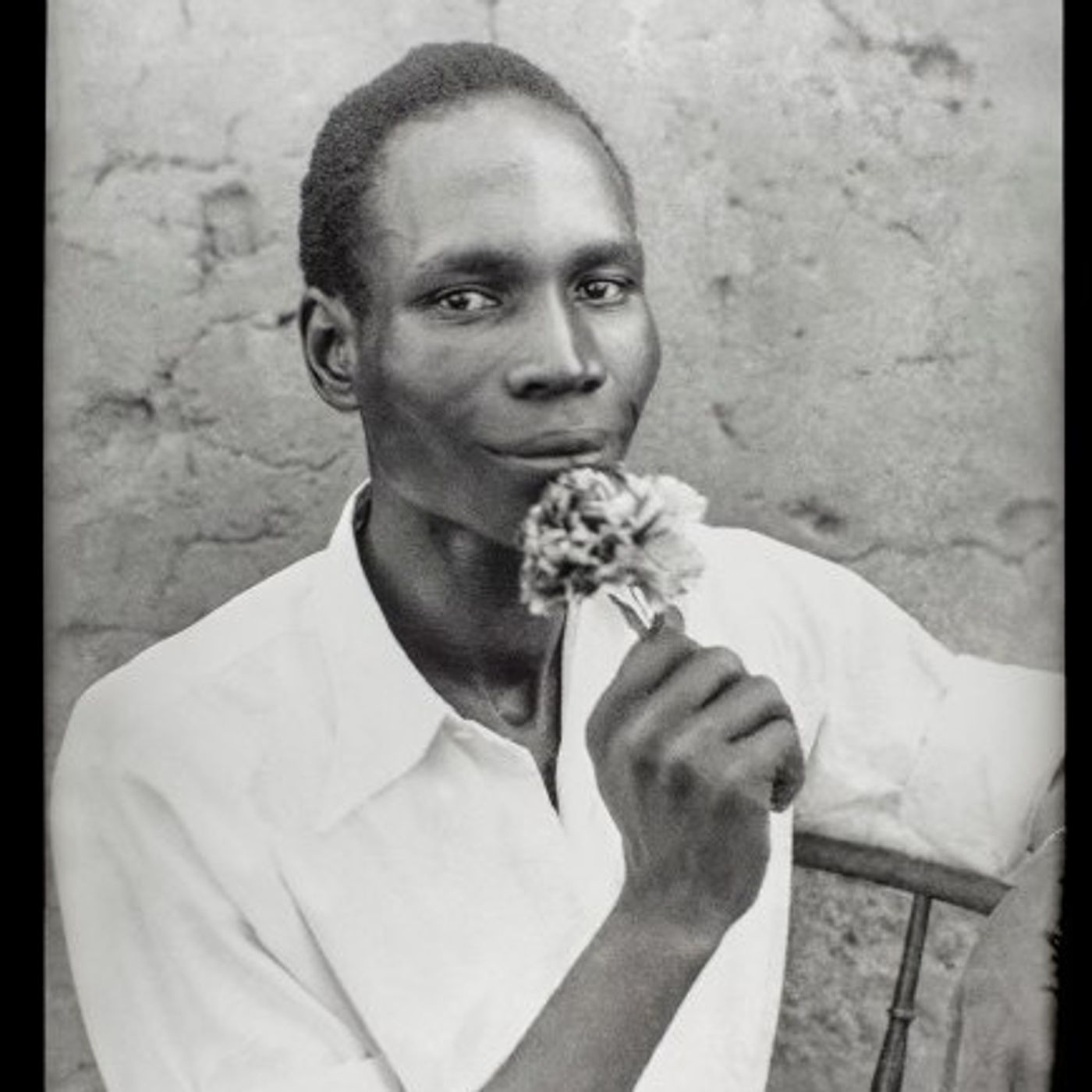
“Seydou Keïta: A Tactile Lens” Celebrates the Famous West African Photographer
About this Episode
A Brooklyn Museum show features more than 280 works from the groundbreaking Malian portrait photographer Seydou Keïta, including iconic prints, never-before-seen portraits, textiles, and Keïta’s personal possessions, brought to life with unique insights from his family. Guest curator Catherine E. McKinley and Brooklyn Museum's photography curator Pauline Vermare discuss the exhibition, 'Seydou Keïta: A Tactile Lens,' on display through Sunday, May 17th.
Self portrait by Seydou Keïta, courtesy of the Brooklyn Museum
Hosts & Guests
Transcript
All of it is supported by progressive insurance.
Do you ever find yourself playing the budgeting game?
Well, with the name your price tool from Progressive,
you can find options that fit your budget
and potentially lower your bills.
Try it at Progressive.com.
Progressive casualty insurance company and affiliates,
price and coverage match limited by state law,
not available in all states.
Few things are as uplifting as the greatest moments in sports.
And nothing brings us together quite like team USA
at the Olympic Winter Games.
From NBC Universal's iconic storytelling
to the innovative technology across Xfinity and Peacock,
Comcast brings the Olympic Games home to America,
sharing every moment with millions.
When team USA steps onto the world stage,
we're not just watching.
We're cheering together.
This winter, we're all on the same team.
Comcast, proud partner of Team USA.
Spring starts at the Home Depot
and we are bringing the heat to your backyard this season.
Fire up the flavor with our wide variety of grills
for under $300.
Like the next grill for burner gas grill
that's perfect for hosting your spring cookout.
Then set the scene and turn your outdoor space
into the go-to spot the patio sets for every budget.
Bring it this season with grills that deliver flavor
and patios that set the vibe from the Home Depot.
Start your spring with low prices guaranteed
at the Home Depot,
exclusively supplies at home Depot.com,
slash price match for details.
This is all of it from WNYC.
I'm Allison Stewart from the 1940s through the 60s.
Legendary photographer Seydu Keta
developed a studio practice show placing his clients
in the finest fabrics, suits, and jewelry
during a time of political unrest in his home country of Mali.
Now, a Brooklyn Museum exhibition
refers to one of the most beautiful places
in the U.S.
in the U.S.
Now, a Brooklyn Museum exhibition reflects on the artist's work
in one of his most expansive North American retrospectives.
It's titled Seydu Keta a tactile lens,
including more than 280 works such as
never before seen portraits, textiles, and necklaces.
The show explores Seydu Keta's life and career
through the lens of a burgeoning nation.
Mali's independence was on the horizon.
It became free from French rule in September 22, 1960.
Mali had already begun forging a new cultural identity
informed by its own rich pre-colonial history,
deeply rooted Islamic tradition,
plus the effects of French colonization.
It's all captures in Keta's images.
The New Yorker magazine stated that Keta's legacy
continues to send shock waves through Mali's creative world
and through the arena of contemporary photography.
Seydu Keta's a tactile lens is on display
at the Brooklyn Museum through May 17th.
And the film featured in the show Keta La,
well Keta LA will also be featured
in the 33rd New York African Film Festival in May.
Joining us now to discuss is guest curator,
Catherine McKinley, who organized the show.
Hi, Catherine.
How are you?
I am doing well.
And we're also joined by Brooklyn Museum's
curator photography, Pauline Vermar.
Hi, Pauline.
Hi, lovely to be back.
Listeners, are you a fan of Seydu Keta's work?
What is it that resonates with you the most?
Have you seen Seydu Keta's exhibit at the Brooklyn Museum?
Call and tell us your thoughts about this exhibition.
Our number is 2-1-2-4-3-3-9-6-9-2.
2-1-2-4-3-3-W-N-Y-C.
Catherine, what did you first learn about Keta's work?
I first saw Keta's work in 1991.
It was displayed at the then African art museum in Queens.
And it was displayed anonymously.
There were three or four prints that were really intriguing
and kind of captured everybody's imagination.
And then it propelled people to go to Molly
and investigate who he was.
And he was soon part of the international art scene.
He began taking photos at just 12 years old.
Catherine, can you tell us a little bit about his background
and how he got into photography?
Keta was the son of a very skilled craftsman
who worked with his brother.
Keta's uncle, who actually introduced him
to his first camera.
And Keta was completely unschooled.
He had some Quranic school training.
And he was otherwise working in the workshop
with his father and uncle.
And the uncle traveled to a family event in Senegal,
which was part of the same larger colony
and came back with a small brownie camera.
And Keta commandeered the camera.
And that was kind of history from there.
He was completely self-trained until he was in his 20s
and then had interaction with a local French-owned photographer
and owner of a photographic material store.
I like how you said it, commandeered it.
Yeah.
Pauline, why did you feel like now was the right time
for a retrospective of Cedocata's work?
So this conversation, I believe,
this was a long time coming.
This exhibition actually was a museum
had been wanting to show the work of Cedocata for many years.
And Catherine McKinley was really who
came in to the story and made it possible.
And it's actually a wonderful timing
that the show is now.
At the Brooklyn Museum, I feel like we need to see Cedocata's work
at the moment.
It feels good.
It's incredibly relevant, obviously,
to our times, but also to Brooklyn.
And so we feel like it couldn't have been better timing.
Catherine, I understand you spent quite a bit of time
with Cedocata's family.
I'm assuming you saved Cedocata's family in Mali.
First of all, what did you want to find out
from these people?
Well, at first I was approaching this archive
of 30,000 images and it was overwhelming
and I was thinking there's so many gorgeous photos,
but how do we make meaning of them?
And the question of who Cedocata was was kind of foremost
because there's a lot that's misunderstood.
There's a lot of information that's missing.
He was famously enigmatic.
And so I decided it would be good to touch down in Mali.
I'd been to Mali before, but I had never attempted
to meet the family or to visit the old studio space.
So I just decided to go and to see what I could find
and what I found was a very, very welcoming family
who were eager to share information
and really shared intriguing information
that completely changed my perspective
and really informed the curation of the show.
What was something they shared
that really made it into the show?
I think really the life of the family in the studio.
We think about studio photography
as this kind of private experience
between the photographer and the sitter
where you become this person within four walls.
And Cedocata was really, for the most part,
shooting out on the street and in the family compound.
His studio was right at the edge of the family compound.
It's a large compound there.
When I visited, there were more than 200 family members
living there and it's a compound
that they own since the 1900s.
So it has a lot of historic feeling
and kind of a long history as a family community.
And I really met something very close to the environment
he would have worked in and I met children
who grew up holding the backdrops
and participating in all of the conversations,
the tea ceremonies, the complete culture of the studio.
And I would like to add to this, to Catherine's,
you, thanks to Catherine McKinley,
the museum, the exhibition includes material
that has never been seen before,
those negatives that we are showing in the show
as a slide show and night boxes.
And this is all thanks to those connections
that with the family that Catherine McKinley
made when she traveled there.
A Brooke Museum exhibition is shown
some of West African photographers,
Cedocata is defining portraits.
Guest curator Catherine McKinley joins us alongside
the museum's photography curator, Pauline Vermar,
to discuss Cedocata attack tile lens,
which is on display through May 17th.
Listeners are you a fan of Cedocata's work?
What is it that resonates with you?
Have you been to the museum and seen the exhibit?
Give us a call.
Two on two, four, three, three, nine, six, nine, two,
two on two, four, three, three, W and YC.
Pauline, one of the first images you see
in this exhibition is a self-portrait of Cedocata.
How does Cedocata's images of himself and his family,
as we've learned, communicate to the viewer
what his values are?
That's a very good question,
because we always spend quite a lot of time
in that little room.
So it's the introduction to the show, really.
It's all self-portraits, including his kids.
In fact, some of whom have now been
the main actors of this exhibition,
now adults and help with the curation
and the content of the show.
I think one of the things that strikes me
and many people the most is the way
that Cedocata looks or actually doesn't look into the camera.
There's a subtlety to his gaze
and a kindness, a gentleness, I would say,
to his persona.
There's an aura that will inform the whole exhibition.
What kind of man was he?
What kind of relationship did he have
with the camera and with photography?
And all of those very nuanced traits of character,
I would say, that really are obvious from the start.
And I love that Catherine found so many of those
and collected so many of those self-portraits
and portraits of the family
because it really does carry through all the way
into the show.
What are we looking at and who took those photographs?
And for listeners, if you would like to see some of his work,
you can go to our Instagram at all of it WNYC
and you can see some of his images on our stories
as we're having this conversation.
Catherine, what sort of themes are motives?
Motives, did you notice?
Why are you looking through all of these images?
Surprisingly, I mean, I've
approached Kate at first thinking about all of the,
what I call the beautiful flowers,
because this is a succession of really beautiful women
who are in their finery.
And looking at it again through the family lens,
I started, what started to emerge
was really a political story, a story of community,
and also a story of a strength and kind of, I don't know,
like an agency in those women that goes beyond the kind
of surface of their beauty or their elegance.
How did you decide on the organization of the show?
It emerged, it's the kind of wonderful process of curation
is that you go in with ideas and then particularly working
in a museum, you're with a team and you're in conversation
all the time, and they're constantly kind of challenging
and bringing other aspects of information and expertise
to the conversation, so it's a very dynamic process.
So the process itself moved from one place
to another over two years in a really kind of wonderful
unfolding.
So what you see at the end is the show
with a lot of multiple entry points,
a very kind of complex narrative that came out of,
for instance, conversations with Pauline
about some of the more technical aspects of photography
that are not my forte or somebody else's challenge
to particular ideas.
So it's really, it's a wonderful process.
I'm a writer by training.
I tend to work all alone in a room.
And so this was a conversation that was really
pretty wonderful.
It's like photography itself.
It's this constant unfolding and looking at new details
and discovering new things and something you think you know.
And one of the big, big questions I should say also was,
you know, photography and textile intertwining like this
in this large space.
That was one of the recurring conversations.
You know, where do the textiles go?
How do we display and everything that Catherine had collected
or borrowed from institutions in Mali and other places?
You know, where will this go to highlight your research?
Catherine, research the best is possible.
Yeah, Pauline, please explain for our listeners
how textiles are woven into the show.
Well, I'll describe it, but I think Catherine
McKinley should talk about the textiles themselves.
So as you enter the space, it's a very large,
beautiful exhibition.
And so as you enter the space, you have a first glimpse
at what is coming along further along in the show.
You have beautiful textiles hanging from the ceiling.
I think correct me if I'm wrong, Catherine,
but from Mali, Senegal and Niger, one of them.
Yeah.
And then as you move along into those galleries,
you approach a room at the very end.
In fact, it's not the end, it's the middle of the show
because you come back on your steps.
And you arrive in this incredible room that's all textiles
and jewelry and all sorts of the items
that are in the photographs.
And that way, as you go to the textiles,
you focus on the photographs.
And as you come back from that room with the textiles,
you have them in your mind.
And it plays with the whole color and black and white.
The photos are in black and white.
The textiles are in color and indigo.
And so you now, as you come back and look at the photographs
once again, you have that.
It's the new way of looking at the photographs.
And I think this is a really very interesting mind game
on us.
There's something going with that visualization of the textile
that really enhances the experience quite a lot.
The textiles themselves represent innovations
from really the 11th BC.
They're fragments of the very same textiles
in that were taken by archaeologists
from caves and various places in Mali.
And so you get to see this kind of evolution of textile development,
particularly at the moment of independence
where there's a very rapid innovation in design ways
and those designs show up in Keta's photography.
So it's a kind of wonderful.
It's not just this idea of tactileness.
Materiality is very, very important to the show
and even to our sense of the photographs themselves.
But it's also a way to look at this issue of modernism
that Keta captured like no one else has.
We got a text here that says,
say to Keta's exhibit is great.
I've seen it at least three times.
I love the addition of fabric, his camera, glasses,
same style I wear, and the beautiful Mali and music,
including Salif Keta playing some of the spaces.
Thanks for a great exhibition.
Let's talk to Kay, who's calling in from Westchester.
Hi Kay, thank you for taking the time to call all of it.
Hi Allison, thanks for taking my call.
Yeah, I haven't seen the exhibition at the Brooklyn Museum.
Yeah, but I'm super excited for it.
I saw Keta's exhibition in Paris about 10 years ago.
And I saw it with a group of black expats
who were just part of a meet-up, who
were just looking for friendship and community in Paris.
And the exhibition was where we met up.
And looking at Keta's work, the first of all,
the sheer size of the photographs really captured me,
as well as the resting amount of texture
between the backdrop of the textiles
and the style of the hair of these beautiful, beautiful women.
And also the black and white aspects of some of these photos,
as well.
And it led to one life-long friendship,
that has also led to me doing research in Benin
and learning more about West African aesthetics.
So it was a real entry point and turning point for me.
And the work on its own is really a gift
and I can't wait to revisit it here at home.
Oh, it sounded like it was a life-changing experience for you.
That's fabulous.
OK, thank you so much for talking to us.
Keta, and I want to ask you about a photo of a small boy.
He's sort of in French garb.
He's got a beret and a short sleeve marinere.
He's looking directly into the camera.
What's going on at this image that
gets to a major part of the show?
Yeah, that's a really iconic image of wonderful image.
I think Keta himself, because he accrued a lot of wealth
through his photographic practice,
bought things like berets for his children.
It was kind of part of the culture of the household.
Those were kind of rare and hard, expensive, imported items.
And we talk about those photos as the,
we talk about the subjects of those photos
as the quote unquote pretenders, that they were people
who have been traditionally seen as colonized subjects
who loved France too much.
So they were criticized by their children
for their portrayal in these photos
and for their love of that portrayal.
But it really gets to Molly's position in that very moment
between 1948 and 1962, which was the short period
of Keta's practice.
And it gets at this kind of interesting,
it's an incredible nature of the society
that I think is really misunderstood.
Because if you start to really study the photos,
you see these really interesting tensions
and a kind of humor that emerges
about the relationship between Molly and France.
And what we also don't see is the really deep relationship
between Cuba, between Latin American culture,
which also had a huge influence on Molly at the time.
So just as much as French music was beloved
and you see the accordion, players, et cetera,
what we don't necessarily have an awareness of is also
this kind of revolutionary culture
that was impacting Molly in sense of self
and their awareness of the world.
And there was also a pretty deep critique of France
at the same time, the ways in which people wore their head
a gear or a scarf was also a kind of,
it expressed a sense of humor and a critique as well.
So people weren't passively engaging with French culture.
Pauline, what is one image that you want people
to spend an extra 10 seconds in front of?
Well, so we talked about the large black and white photographs
and of course that's what Cedu Keta became very well known
for and they're incredible.
Some of them are larger than life
and really people should come and see them for themselves.
It's really very impressive.
But what I love about the curation of Catherine McKinley
is those little vintage prints as well
and they're all shown together.
And one of them, I always say is my favorite photo
in the show, it's the print and the image that I love.
I love that it's a vintage print, it's a small object
and it's two women on a scooter, on a vest bar
and there's so much joy coming out of this image
and I think it's one of his well-known photographs.
It's close to the entrance of the show.
So if when everybody comes to the show,
comes back to see the show, don't miss it
because it really, for me, it encapsulates the spirit
of not only the exhibition, but I would say Cedu Keta,
the way he photographed women is extraordinary.
There was a sense of freedom in that studio, I would say.
People spent a lot of time with him, right?
Getting ready for the right shot.
Is it true that he only shot once?
Yes, right, everybody was allowed one shot.
Oh my gosh.
Which is incredible when you think about it.
And so to have those two women with the vest bar,
yeah, that would be my favorite.
How about for you, Catherine?
I think there's one I have a lot of affection for.
It's a large man and a large oversized print.
His name was Balali and he's in a very beautiful booboo
and he's holding a child on his lap
who has the kind of the same visage.
And that one, it's just, it's an extremely joyful photograph,
but then there's an interesting backstory
because he was friends with Keta.
He spent a lot of time around the studio.
And Keta was famously, he started a lot of clubs
and was part of a lot of social clubs.
And he and Balali were part of this club called The Gentleman.
And they were dandies.
They were well dressed men and close friends.
And that one just, it's so joyous.
And the idea of these brotherhoods,
there were typically a lot of Islamic brotherhoods
that then progressed into these social brotherhoods.
And I just think that that photo is really a special one.
I've been speaking with Catherine McKinley and Pauline Vermaar.
The name of the exhibit is Sadu Keta, a tactile lens.
It's on display through May 17th at the Brooklyn Museum.
Thanks for joining us.
Thank you so much.
Few things are as uplifting as the greatest moments in sports.
And nothing brings us together quite like Team USA
at the Olympic Winter Games.
From NBC Universal's iconic storytelling
to the innovative technology across Exfinity and Peacock,
Comcast brings the Olympic Games home to America,
sharing every moment with millions.
When Team USA steps onto the world stage,
we're not just watching.
We're cheering together.
This winter, we're all on the same team.
Comcast, proud partner of Team USA.
Spring starts at the Home Depot.
And we are bringing the heat to your backyard this season.
Fire up the flavor with our wide variety of grills
for under $300.
Like the next grill for burner gas grill
that's perfect for hosting your spring cookout.
Then set the scene and turn your outdoor space
into the go-to spot the patio sets for every budget.
Bring it this season with grills that deliver flavor
and patios that set the vibe from the Home Depot.
Start your spring with low prices guaranteed at the Home Depot.
Exclusive supplies at home Depot.com slash price match for details.


