Loading...
newspolitics
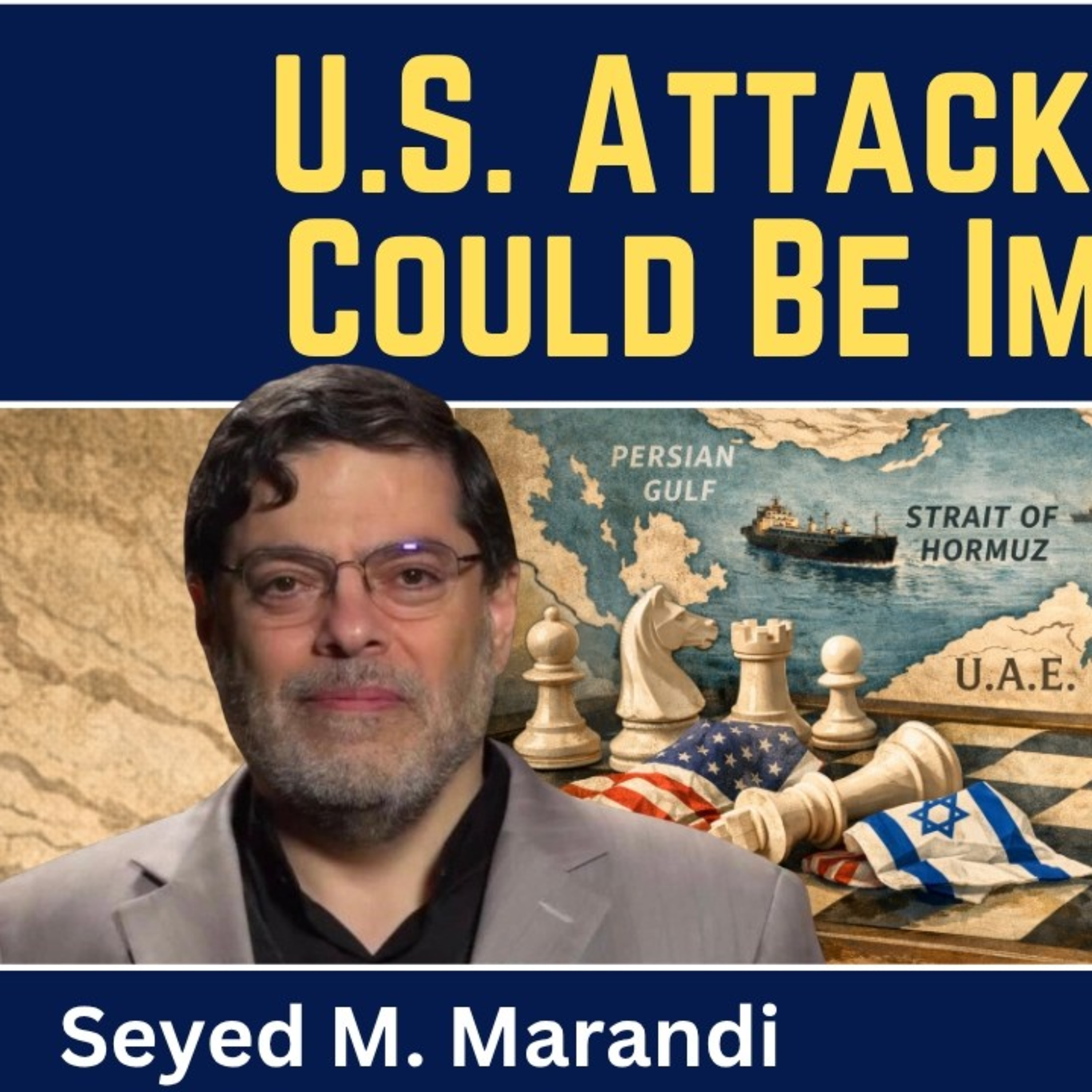
Seyed M. Marandi: U.S. Attack On Iran Could Be Imminent
About this Episode
Seyed Mohammad Marandi argues that another U.S. strike on Iran is likely imminent. Marandi expects huge escalations on both sides when the war restarts.Marandi is a professor at Tehran University and a former advisor to Iran's Nuclear Negotiation Team. (Recorded May 1, 2026).Follow Prof. Glenn Diesen: Substack: https://glenndiesen.substack.com/ X/Twitter: https://x.com/Glenn_DiesenPatreon: https://www.patreon.com/glenndiesen Support the research by Prof. Glenn Diesen: PayPal: https://www.paypal.com/paypalme/glenndiesenBuy me a Coffee: buymeacoffee.com/gdiesengGo Fund Me: https://gofund.me/09ea012fBooks by Prof. Glenn Diesen: https://www.amazon.com/stores/author/B09FPQ4MDL
Hosts & Guests

Transcript
Welcome back.
We are joined again by Sayyad Muhammad Marandi, a professor at Iran University and a former
advisor to Iran's nuclear negotiation team.
Thank you for coming back on the program.
These are here to be quite troubling time, though.
What I hear is that another U.S. attack on Iran could be imminent, which could also have
an additional component that of a limited land invasion.
I was wondering how do you see it from there in Iran?
How stabilist is ceasefire?
Well, thank you very much for inviting me, Glenn.
It's always a great pleasure being on your show.
Since the ceasefire began, they've been preparing for war, literally 24 hours a day.
And the assumption was that this is not over, especially since Trump is not the sort of
person who will accept defeat.
And the 39-day war did not go well for the United States.
It was a horrible war for the world and for humanity.
But ultimately, the Iranians won the war.
And so the belief here was that that would not be acceptable for Trump, and that would
not be acceptable for the designist lobby in the Israeli regime that is the true force
behind the war, as we recall, Joe Kent and his resignation letter.
He said that this war is all about the designist lobby in the Israeli regime.
So there's no reason to think that anything has changed in the last couple of months.
So it is possible that we will have war.
No one knows for certain in Iran, but it is possible we will have it this weekend after
the markets closed because apparently killing Iranians when the markets are closed is better,
so that God forbid stock prices don't go down or anything like that.
It could of course be tomorrow morning, it could be tomorrow evening.
It could not happen this weekend.
But I think that the problem is that Trump is incapable of using an off-ramp.
We saw that earlier when the Iranians and the Americans had a ceasefire agreement Netanyahu
tried to wreck it by carpet bombing Lebanon.
And so the Iranians said as long as he is violating the ceasefire deal, we won't allow those
extra ships to go through this rate of foremost, because I should point out that this rate
of foremost was never closed by the Iranians, it was only closed to ships that were linked
to Iran's adversaries.
So Iraq had no problem, the Russians, the Chinese, and of course Iranianships never had any
problems.
But the agreement was within the agreement there was going to be more ships passing through.
That included ships belonging to the Emirates, the Saudis, the Kuwaitis, the Bahrainis,
and I don't know which one I missed.
And in any case, those extra ships would be going through.
And because of Netanyahu, it didn't happen, and Trump sided with Netanyahu, even though
the Pakistanis pointed out clearly that the ceasefire included Lebanon.
But here's the point, when Netanyahu ultimately was forced to accept the ceasefire, even
though now he's again killing Lebanese citizens 24 hours a day, like in Gaza, he could
have Trump chosen the off ramp, because the Iranians, when Netanyahu accepted that ceasefire,
the Iranians said, okay, now we'll allow those extra ships to go through.
And Trump almost immediately afterwards said, the straight-up foremost is open, it's never
going to be closed again, the Iranians have promised, and we said a lot of nonsense,
of course, but then he said that, but I'm keeping the siege on Iranian ports and the Persian
Gulf, the straight-up foremost, in place.
So he could have chosen that as an off route.
That was possible, especially since Netanyahu accepted ultimately the ceasefire, at least
for a couple of a few hours.
So the belief is that he is incapable of moving in that direction, and therefore he's going
to continue following into the escalation trap.
And that's why they believe that inevitably we're going to have another round, which will
be devastating for the global markets and for the global trade and for the global economy,
because as things stand, the global economy is going to suffer enormously, and we're just
seeing the tip of the iceberg.
But even if there's some sort of agreement that's in a few weeks' time between Iran and
the United States, allow more ships to get through and the siege, let's say, on the
straight-up foremost to come to an end, then things will still be very bad.
And the pain is still on its way, the real pain.
But if there is war, then that means that not only will there be devastation, especially
if they target Iran's critical infrastructure, Iran will do the same to the Israeli regime
and to those Arab family dictatorships in the Persian Gulf, which will, of course,
make in future much less oil and gas and energy and fertilizer available for the global markets
for a very long period of time, and need to global economic depression.
But if the war is a major war, and it goes on like the 39-day war, the Ramadan, then
I think we can be confident, we can be pretty sure, that there will no longer be any oil
or gas coming from this region for the years to come.
I mean, it will just be a very long-term economic depression for the world.
But even if it's a short war, and as I said, it will still, in some critical infrastructure
is destroyed, it will lead to an economic depression for two reasons.
One, because there will be less oil and gas available.
But the second reason is that any negotiations to partially open the straight-of-hormones
or to open the straight-of-hormones and to lift the siege and to revive the cease-fire
in Gaza and Lebanon, that will be put back for many weeks.
Because there will be fighting, no one is going to be negotiating about ships going
through the straight, Iranian or otherwise, or cease-fire in Lebanon and Gaza.
And that will definitely be catastrophic for global trade and business and the global economy.
The Trump diplomacy is quite strange because, you know, besides all the propaganda and his
efforts to control the narrative, we know some things for certain.
That is that the U.S. was in getting into deep trouble and the Trump was getting desperate.
We know this from the numbers of the missiles, intercepted missiles, that this was not sustainable.
It couldn't absorb the pain and they couldn't, essentially, they didn't have enough ammunition.
So we knew that things were going bad.
They wanted a cease-fire.
We also know this because otherwise the U.S. wouldn't have accepted Iran's 10-point plan
as a condition for cease-fire, whatever Trump says about Iran is begging him.
But what happened thereafter is, again, I guess it's a lot of deception.
He walked away from, he never talked about those 10 points again and then he offers now
an extended cease-fire as if he's doing the Iranians a favor.
So in some regards, sometimes he can be good at controlling the narrative, sometimes he
goes, well, it stops being believable.
But that's why it's a bit strange that after finally getting the guns to go silent,
he wants to start this thing up again, which, you know, make you think that they have something
up their sleeves, something that they would do different this time around.
And, you know, from your perspective there, sitting in Iran, what do you think the U.S.
would do different if they now, as you suggest, could invade or attack over the next few days
if not today?
Well, the only thing I can think of is that they will continue to do the same as they did
before, assassinate bomb infrastructure, terrorize the population, and also probably go more
after critical infrastructure as he had threatened to do so before.
But the problem would be that the Iranians will strike back.
And we've heard just today from a very senior Iranian MP, who is a part of the delegation
in Islamabad, that if any assassinations take place this time route, that Iran will take
out the leaders of the Arab regimes in Persian Gulf, meaning Kuwait, Bahrain, the Emirates,
Assad, and Saudi Arabia.
That's what he said.
And because he said that they are complicit, they, without them, this war can't take place,
so if they start murdering our leaders, then they will destroy their policies.
And I would assume that would also mean destroying their, not just their critical infrastructure,
but their intelligence agencies and their defense ministries and that sort of thing.
So Iran will take the, it's retaliatory violence to a very different level.
So Iran has already said that critical infrastructure will be responded by striking critical infrastructure
in this, in this ready regime, but also in our region.
So when you, it's not a situation where the Americans will win.
And we already see that Iranians are defiant, people are on the streets.
They see the United States as the aggressor.
The world sees the United States as the aggressor.
I don't see how this will do it, Trump, any good, it will just make things a lot worse
for him.
Because at the end of the day, Trump is going to be answerable to Americans for their economic
hardship.
One of the disturbing things that we often hear in the United States is that there are
people who are sincerely anti-war and who are against the murder and slaughter of innocent
people who care about the children in Minab who the Americans massacred on day one.
And there are others who don't really care, but they say they talk about jobs and they
talk about inflation.
And like many elites, they talk about American lives and American soldiers.
We're not victims at all in all of this.
But in any case, both groups of people, their voices are going to grow, louder, whether
those who see the United States regime as being as they point out that it is aggressive
and barbaric and doing all of this for the sake of Zionism and for genocidal regime.
For and those who are going to say that you're ruining our livelihood, our farms are going
to go bankrupt, our businesses are going to get ruined.
American lives will be lost and the U.S. economy will suffer and the deficit will grow.
These two forces combined, though completely unrelated to one another, one is moral and
the other one is simply selfish.
But it's going to make Trump suffer enormously as a result of the war.
It's not a situation where he can win.
I don't even believe that the Israeli regime will win.
This is not because after two and a half years, we've seen what has happened to the image
of the Israeli regime.
Across the world, it's despised.
People are watching now what's going on in Lebanon, even though Western media is not
reporting it, and Western journalists are quiet about it, or they're misrepresenting
it, trying to portray it as like Hezbollah targets, and they're ignoring Gaza.
But people across the world are still seeing these images in a much censored social media.
It's still coming through.
But in addition to that, as people's personal lives become much more influenced by the global
economic catastrophe heading our way, they're going to blame Israel.
They're going to blame Zionism.
They're going to blame Netanyahu.
They're going to blame Trump.
So I don't see how the Israeli regime benefits from this.
It hurts this.
It is hurt from all of this.
The only person who would probably benefit would be Netanyahu, who thrives on crises
at these for now, and the fanatics in his coalition.
Well, with the usual Iranian response, though, it's what's been interesting in this 39
day war has been this tit for tats.
That is, they've been able to essentially follow always up the Americans up the escalation
ladder denying this to the U.S., which is quite important.
But what is interesting is the assassination of Iranian leaders.
We never saw the Iranians doing this kind.
And also the attacks on Iranian nuclear plants.
This is also something we didn't see the Iranians doing either.
Do you think it's possible that Iran will, I guess, yeah, go.
Go further up that escalation ladder this time around.
Well, I think what the MP said about the Arab regimes would basically mean that they would.
The chances that they collapse altogether would be much greater because if the United
States starts targeting Iranian leaders and the Israeli regime as well, this Epstein
coalition is like calling it, I like to call it.
And then alongside that they start targeting Iran's critical infrastructure like power stations
and so on, then these Arab leaders and their elites around them, they'll be targeted to.
And then their critical infrastructure will be targeted.
And that will be at a time.
And this is, I think, very important that we are nearing the hot season in the Persian
Gulf region and in the Arabian Peninsula.
So the month of May is a transition month.
By the end of May, it gets very hot.
And in the middle of May, it is getting hot.
And then the sandstorms and the humidity and all that, you combine that comes very difficult
to anyone to work in these countries unless they are as electricity, unless they have
the ability to say, cool, if they lose their electrical power plants, it is going to
be very difficult for the, I don't know, 50, 60, I don't know how many American troops
are there now because they brought in a lot of equipment for a ground attack.
So there may also be extra troops.
But the tens of thousands of American troops stationed there is going to be much more difficult
for them, not a great thing for morale.
And the population too.
So let's say their leaders are being targeted, their kings and princes are being targeted.
And they also lose their electricity and the heat and the humidity is flowing through
the roof.
I think it would be catastrophic.
Not just for the global oil and gas markets and so on, but also just being in these countries.
And Iranians have warned them.
I mean, the Iranians don't want to target anyone.
The Iranians are far more humane than any of their antagonists.
When they fired missiles at the Israeli regime, they didn't target schools and synagogues.
And when they did the same in these Arab regimes, they didn't target civilians either.
Iran has something like 3,400 marchers.
The five Arab regimes that were targeted, American assets targeted, American bases targeted
and retaliatory targets, the targeting of infrastructure linked to the West.
In all, despite all the damage in these five countries, only handful of people were killed.
Something like 10 to 20 people died.
Something like that.
I mean, I checked the number on deep seek and that was more or less the number I got.
People can look up.
Look that up for themselves.
So compare the 3,400, 3,500, I don't know the exact number, I don't remember it now.
Iranians who died and a handful of people who died in all these countries and the same
is true in the Israeli regime.
So Iran does not want to kill people.
Iran has been very careful not to kill people.
It's been very careful to fire at targets and installations in a way in which ordinary
people don't die.
But people will have to leave.
They will have to leave if Iran's critical infrastructure is struck.
And their critical infrastructure is struck.
It is far worse the weather in those countries than in Iran.
And right now in Tehran, you've been to Tehran in the mountains.
We have snow.
You see the snow above the city.
It would be difficult if they start targeting our critical infrastructure, but there would
be just completely intolerable.
And then again, if the ruling families are targeted, that would mean the collapse of each
of these regimes.
I don't think that the United States is thinking this through.
Maybe in their arrogance, they're saying that all will just hit them and they'll collapse
like they did before the 12th they wore and before the 39th they wore.
But I still think that this exceptionalism that they have, and of course, Zionist ethnic
superiority, this sense of superiority, perhaps leads them to believe that, well, this
time will make this so-called regime fall apart.
But I just wanted to go a bit back to the possibility of the United States attacking.
So we kind of can, it will figure out what they might do.
But what make you suspect that an attack could be coming?
Have you seen significant shifts in the troop levels?
What kind of weaponry are you seeing?
And also, what do we know about the whereabouts of these troops?
Just in terms of what they might go after, they're going to invade some islands in the
straightover moose.
Are they going to go after Yemen?
Obviously, because of the troop levels, it can't be some kind of a full-scale invasion
as what they did to Iraq.
But surely there's something else, a smaller limited invasion I'm assuming.
They brought in a lot of equipment for ground troops.
They've also brought in ammunition for their planes and so on.
But most of my, from what I've been told, most of these flights have been to prepare
for a ground war.
And I don't know details, but two places that I've heard that there's a large,
dense contingency that's practicing or training, or at least already for fighting.
One is in Kuwait, and one is in Bahrain, and where there are large numbers.
I don't know.
Maybe there are more now in the Emirates and Saudi Arabia and Qatar, too.
But these are the two countries that I've heard of, and Kuwait in particular, and Bahrain
in particular, I've heard that in Bahrain, they were practicing and in Kuwait there and
there and large numbers.
So the expectation is that they could play out in two ways.
Either the Americans want to go for a long war, again, which is, I don't think they can,
personally.
They may go for a short war as we've been hearing, where they would strike very hard and fast,
but Iranians will retaliate.
And there could be, and there probably will be some sort of land offensive, and also attacks
deep inside Iran, like if the attempt that was made near Esfahan before.
But again, you know, the thing that I, what I said earlier,
regardless of the fact that the Iranians are going to retaliate, and Iran has missile and
drone bases across the country, and the Iranians will definitely allow them to come in if
they carry out a land attack, and the Iranians will then pound them.
The Iranians are not going to sit there and let, you know, they're not going to prevent
them from taking territory.
They're going to play smart, they're going to let them come in and then pamper them for
days and weeks and months if necessary.
But, but more importantly, for in the broader picture of things than all that, you know,
is that any attempt, any move to ease tensions to open up the straight of hormones is going
to be delayed for many, many weeks, because the fighting will, you know, take weeks for
it to, you know, finish and then to die down and then have some sort of deal.
So it is going to make the global economy definitely move towards a depression, regardless
of how much critical infrastructure is destroyed, regardless of that.
So, any violence will put the global economic situation much worse, in a much worse situation.
And this, I think, kind of Trump can, does not comprehend.
Iran is not controlling the straight of hormones from the shores.
It's not the 19th century, it's not even the 20th century.
The ability to control the straight of hormones comes from hundreds of kilometers inside
the country and from many, many different locations.
And he runs capabilities near the shores of the Persian Gulf and the Gulf of Oman and
the straight of hormones are also unknown to the United States.
That is also major, they miscalculated on Iranian missiles and drones and these sort of
capable Iran's anti aircraft capabilities.
It's definitely the case that they're going to miscalculate on Iran's other capabilities.
Iran has not shown them and it has not used them.
They're deep underground and the mountain, the mount, the areas around near the Persian
Gulf and all the way up to the border of Iraq and until northern Iraq, it's all mountain
is territory.
And the terrain is very difficult and the lots of Iranian installations are hidden in
these different areas.
And when the time comes, the Americans will have to deal with them, things that they know
very little about.
The reason why the Americans have made so many miscalculations about Iran's missile and
drone capabilities is that the factories
themselves that produce them are underground.
The bases are underground, the factories are underground.
So the Americans think they know the numbers, but they have no idea how many missiles and
drones Iran has.
As we speak, as you and I are speaking, Iran is making missiles and drones.
And other military hardware because everything that is of great significance is deep underground.
Well, Trump recently made this comment that Iran is at the state of collapse.
So apparently everything is falling apart, you know, they're begging for a deal.
And this blockade, naval blockade is tightening every day, which is suffocating Iran.
But if this is the case, though, if the economic war on Iran is so successful, one would
think that time would be on the side of the Americans, which I guess begs the question,
why, you know, it doesn't fit in their narrative.
If they're so successful at this economic war, why go to war with Iran?
So it does seem to be, well, there's been this honesty from the beginning.
So let's say, not be too surprised here.
But how do you assess it?
It's like this economic, a traditional warfare that is both the Iranians and the Americans
are taking pain.
But how do you see, you know, time being on the Iran side?
Well, what is a good way of assessing it, if you're?
Well, you know, this is very similar to the argument that the Iranians are deeply divided
in the leadership.
You know, I always stress and interviews that no, there's no division.
That doesn't mean they're different, not differences.
There are 90 million Iranians and 90 million different views.
And I'm sure that when political leaders and military leaders and security leaders,
or, you know, when they're sitting around at the table among themselves, they have very
different opinions.
But that, that is very different from a division in decision-making process.
The decision-making process is clear.
You have a Supreme Master of Security Council, you have a leader, they've designated the
Speaker of Parliament to be in charge of negotiation.
He makes the decisions.
So it's clear that there's no division.
So saying that it's chaos and there's division, that serves someone's interests,
or it's either propaganda, or it's serving some other purpose.
In this regard, the claim that Iran is falling apart and the sanctions or what are the
the sieges working in Iran, well, first of all, it's quite interesting how they
gloat about starving Iranians.
It's just like they gloat about starving Cubans or Syrians, and it's like, you know, these
people really, there's nothing left in, you know, there's no sense, they have no concept
of humanity as people.
But this is nonsense.
I mean, is the economy suffering?
Of course it's suffering.
They bombed pharmaceutical factories.
They bombed, you know, many different factories.
They destroyed businesses.
And then, you know, when they block ships from coming and going to Iranian ports, of course,
it's going to have an impact.
No doubt.
But we're at war.
And just like during the 39-day war and the 12-day war before that, the Iranians won
the war, not because they were not hurt, but because they tolerated the pain.
And they tolerated the pain more than the Americans did.
That's why, as you earlier pointed out, Trump accepted Iran's 10-point plan as the
frame for, for negotiations because he needed a ceasefire, whereas at the beginning of
the war, he said Iran must accept unconditional surrender.
And the same was true that during the 12-day war, he said that then too.
So of course, Iran is going to be hurt, and it's ordinary Iranians will face difficulty.
But that's war.
But how about the other side?
I mean, they keep talking about the siege and how as effective it is, well, that siege
is intensifying the damage being done to the global economy through the very few ships
that go through the straight-of-hormos.
Now less ships than even before are going through the straight-of-hormos.
So the global economy is going to suffer catastrophe faster than before.
And one critical mistake that they made, Glenn, is that the Iranians at the beginning
of the war, they expected a siege on Iranian ports, and they planned for it.
And they're implementing those plans, obviously, to minimize the hurt, you know, trade routes
through neighboring countries, and Afghanistan, and Pakistan, and Turkmenistan, and on Central
Asia, the Caspian Sea, to Russia, Kazakhstan, Azerbaijan, Iran has many borders, Armenia, Turkey,
Iraq, and so on.
But all that aside, the Iranians thought that the Americans were going to impose a siege
on the ports when they initiated their joint aggression with Israeli regime.
They didn't.
And so the straight-of-hormos was almost closed for a month and a half, and Iran was selling
its oil at very high prices, and early on its petrochemicals too, before they targeted
Iran's petrochemical plans, but at very high prices, and then only late in the day that
they began to implement this siege on Iranian ports.
So Iran is way ahead of them, and also Iran has been selling its, I don't know exactly
how much it is, but between 150 to 200 million barrels of oil on the seas, and from what
I'm hearing, it's almost finished.
And they have all that money, and they sold that oil at huge, or had a huge, you know,
at very high prices, before they couldn't sell that oil, that oil was on the high seas.
So they've sold all that oil at very high prices, and they have that money now.
It's a lot of money.
And in times of war, expenditures do go down, because the focus is on managing the war.
So the Iranians have a clear advantage.
The Iranian economy has already been under siege.
This nonsense about oil wells, you know, that's just propaganda.
Iran has had its oil wells exports shut down under Trump during the first term.
You recall, as well as I, that it was Trump's revived the maximum pressure.
We were not exporting any oil, except for very small amounts.
And most of that was a debt that we had to China, for projects that, a project or something
that they did in Iran, Iran was paying them back with oil like 100,000 barrels a day.
Very small amount.
So Iran wasn't exporting them.
So Iran knows how to deal with its oil wells.
It's not like the Arab regimes and the, you know, on the other side of the Persian Gulf
where they never experienced sanctions.
But the Iranian, and the entire Iranian economy has been constructed in an environment of
sanctions.
I'm not saying sanctions prove, but it survives more easily.
It sustains itself much more effectively than countries across the world that are now
going to experience a crisis.
Because they don't have sanctions, and then suddenly they're going to be facing a catastrophe
thanks to Trump and Netanyahu that they don't know how to deal with.
So the siege against Iran began late.
Iran has sold a lot of oil at a very, very high price, and Iran's economy has been living
with under siege and sanctions for decades.
And Iran's adversaries, they have none of those experiences.
Yeah, when I hear this talk about another US wave of attacks against Iran and planning
for a short war.
It feels like they already made this mistake.
Why go down this route again?
Again, if I was to one advising, I would say, you know, my warning would be that the US
doesn't get to decide when the war is over.
Also, as Iran showed the first time around, they're not able to dictate the terms of the
war.
That is claiming, you know, Iran can't stress, shut down the state of Hormuz, Iran can't
hold the Gulf States accountable for participation.
You know, all of this was essentially very, very flawed.
And that's why I was wondering what possible surprises the Iranians might have, because
again, it seems almost, you know, very predictable that Yemen would shut down the Red Sea.
It wouldn't be inconceivable that Iraq could make a move against Kuwait.
The Gulf States could lose their desalination plans and oil installations.
I mean, it's going to be very hard to control all the variables to the point that one would
feel comfortable in confidently predicting how this war against Iran would go.
I guess this is why it's so hard to comprehend after just getting out of it and getting the
ceasefire and then being able to pull off this narrative that it was the Iranians who came
to Trump, despite all the evidence pointing the other way.
Going back to this, it seems like a disaster, but yeah, just a last question, what surprises
might the Iranians have helped their sleeve?
I'm not saying the government are whispering in your ear, telling them what to plan to do.
But, you know, you're there in Tehran, you have a general idea what cards can be played
and also, Iran has allies, they have autonomy of their own.
So what do you expect?
Well, just as Hezbollah has shown itself to be far more powerful than the West was expecting.
And we discussed this before. They were saying how Hezbollah has a spent force, the West basically
took control of Syria through al-Qaeda and ISIS, and there's now a proxy of the United States,
and they imposed puppets in Beirut, the prime minister, and the president, and then you had
this ready regime. So Hezbollah was finished. But now we're seeing that Hezbollah is hitting
this ready regime hard, and there's talk that they're removing some of their troops from southern
Lebanon because they're so vulnerable. So, you know, imagine if those capabilities exist in Iraq or in
Yemen, and I'm talking about on the ground troops that can move beyond borders and do damage.
That's one thing that I can think of. Second is when the Iranians start striking this ready regime
again, the regime obviously does not have the number of surface terror, missile capability,
the surface terror missiles that they would need. The last few weeks is not nearly enough to make
up for what it needs. So Iran, if they continue down this path, then they can swiftly begin
start striking targets within this ready regime without much difficulty, if any.
The third is that the Iranians would go after more sensitive targets in the Persian Gulf region.
That could include the ships now. If they could start targeting the ships in the Persian Gulf,
they can start targeting the critical infrastructure that they haven't destroyed yet.
I think the commander of Iran's missiles said that don't count on oil from the Persian Gulf for
many years to come, if there's war. So that could happen. But also, I think, and I'm
speculating here. I've heard, and I don't know, I don't remember who told me this.
I think it was some, I mean, this was a wild back. This was during the previous war at the
beginning. And I don't remember a call who told me this, as I said, but I think it was someone
credible. That person was saying that the Iranians have the ability to sink US ships.
But they don't do so because that would, we would need to be higher up on the escalation
level for Iran to do so. And as you know, and as everyone knows, Iran did not start this war.
Iran did not initiate any phase of escalation, whether against the Israeli regime or against
US proxies in the region or US assets. Every time they escalated, Iran escalated. One good example
was when they bombed Iran's gas installations in the south parts field. And then Iran struck
Qatar and the Emirates and someone else, I don't remember. And then Trump put out that two
social saying, I didn't know about it. The Israelis won't do it again. That was Iran's retaliation.
And they hit very hard. So Iran does not initiate escalation. And as I said earlier, Iran is very
careful not to have people killed. And the numbers show that. I mean, anyone can do searches and they'll
find out. But if the Americans now go for critical Iranian infrastructure, that would be I would say
very high up the escalation matter. And then I think that if Iran, if Iran indeed has those
capabilities to strike deeper, deeper than what it has now, then I think Iran would start thinking
US ships. And there have already been statements made by senior Iranian officials that is on the
card. So there are many things I could do. I, but also remember what we discussed earlier on,
where Iran, the Iranian said that if our, if their assassinations carried out, then the leaders of
these regimes, a, a member of the delegation who is with us in Islamabad, a senior MP said this.
Very well-known public figure. And he said this with, he said this as a fact, not his opinion,
that Iran will take out these regimes, these leaders, because they are a part of the war effort
against Iran. Because without these five Arab regimes and Jordan, the United States cannot wait
to work at Iran. It's just not possible. Logistically, it's not doable. And so there are all these
options that Iran has. And again, the United States has brought in lots of weapons to the region,
but Iran has been preparing itself during this time. And for Iran, it's not that difficult.
This is, it's on home turf. And it's been preparing for this war for two and a half three decades.
So, you know, we are where we are. We didn't have to be here. I spoke about this before in your
show, the, the leveraged book going to Tehran. I advise all your viewers to read it.
They deal with a lot of the lies and myths that Western media and Western think tanks and Western
academia has been saying about Iran for all these decades. But also, they point out that,
you know, if the United States doesn't move towards rapprochement, it will move in this
direction. And that's it. And when they wrote this book, they were antagonized, demonized,
and marginalized, and read everything that they said turned out to be correct. So now we have
a global economic crisis. The lives of everyone will inevitably be impacted in a big way.
And as, and if we continue to go up the escalation ladder, then I think the catastrophe will be
beyond, beyond imagination.
Well, let me squeeze in the last question. I have the Putin and the Iraqi meeting. That is
four minister of Iran. He met with President Putin in Russia. There's been a lot of talk about
this. Apparently, it didn't make Trump very happy at all, which led to a 10s, 90 minute
phone call between Trump and Putin. What do you think is the significance of this? I mean,
because whenever one looks at this greater Eurasian chessboard, one always looks at these three powers,
that is Russia, China, and Iran getting closer. Of course, if you throw India into the mix,
it's becoming, you know, Kissinger's worst nightmare. So how can we interpret what happened?
Or what do we know? What was what happened there in Russia?
I think many Indians are realizing, just before I respond to the first part of the question itself,
many Indians are realizing that their economic suffering, and they've suffered a lot,
even though Iran has allowed a number of Indian ships and Pakistani ships and Bangladesh ships
that to go through, even though they belong to these regimes in the Persian Gulf that were
complicit in the war. The suffering of Indians is at the hands of the United States and Israeli
regime, and they're increasingly recognizing that. So that may have a significant impact in the
months and years ahead on how they deal with these countries. But the meeting with President Putin,
apparently, went very well. President Putin's praised the Iranian people a lot, and that sort of
reminds me of another book of one of our mutual friends, and that's an Alistair book once wrote a
book on resistance and Islamic revolution. The book is called Resistance, and then the subtitle
is about the Islamic revolution and so on. And that's also a good book to read. The resistance
of the Iranian people during this period, of course, decades of sanctions and terrorism,
and three wars, but this particular war has made people across the world see Iran in a very
different light, and Iran has become very popular. And this is what people from across the world
tell me. From Latin America, I don't know if I told you this before, in private, I'd said this
on a couple of programs. One of my Brazilian friends, who's a Marxist, and has very good connections,
he told me that a very well-known Brazilian Marxist, one of the major figures in Brazil,
said that if Iran wins this war, I'm going to become a Shia. So the sort of the way in which people
are now viewing Iran is very different from what it was just a few months ago, or especially after
God's had been changing, but like Hezbollah, Iran, the axis of resistance. And this is the exact
opposite of the situation for Zionism and the Israeli regime and Trump and the United States.
They see that in a much more negative light. So there's a big transition taking place in the
way in which people in many parts of the world are viewing Iran and the world. Even in the United
States, Iran is gaining support from quarters that I would have imagined, I would have imagined to be
impossible just a while back. But Trump, I mean, Trump obviously, when he spoke with Putin,
it was definitely linked to the trip. But I would imagine that this trip went, I think the trip
went very well from the statements made by the foreign minister and from the statements made by
President Putin and the foreign ministry in Russia. Because Iran's, I think, two things are
happened here. One is that, and this I know for a fact, Iran outperformed Russia and China's
wildest expectations, even though many of us in Iran were not surprised. I would say that I
think Iran did better than I expected, but I expected Iran to win this war. But I think that many of
our friends, you know, they've been influenced by Western narratives, even those who are in the
non-Western world and those who are critical of the West. And they're in shock that the war ended
this way. So President Putin, I think, this meeting went very well, but it's very different
because Trump, when he won the presidency, took all the swing states, won the majority of the vote.
He had a mandate and he said clearly, many times on the campaign trail that he's going to end
the war in Ukraine in one day. Well, it's a year and a half now and the war in Ukraine is still
going on as far as I know. So, and they met in when was it last year in Alaska? Nothing came with that.
And they've had multiple phone calls. Still the war is going on. So I'm not quite sure that it's
going to have a much of an impact. I think at the end of the day, it's going to end on the battlefield.
And probably with the collapse of the global economy, unfortunately.
Yeah, I think you also, Iran has created a bit of an uproar in Russia in this regard as well,
because they began to question what they've been doing over the past few years, because the US,
I mean, they have a lot of similar experiences as the Iranians, that is this fraudulent diplomacy,
the deals, which would never be followed through to begin with. And of course, this existential
threat, which is based on the efforts to degrade and weaken and try to collapse the country.
Many people in Russia now from what I hear is argue that they should have changed course already
in June, when not just Iran, but Russia also had this surprise attack that was the same
one month the Russians had the attack on the nuclear deterrent, which was quite obviously
was not only Ukraine who carried out this one. So now, of course, there's a lot of pressure for
the Kremlin to do as the Iranians, that is being more prepared to go up the escalation ladder,
restore their deterrence, and yeah, except that the emperor doesn't really have any clothes.
Anyways, you've already taken a lot of your time, so thank you very much as always.
And I hope to see you again very soon.
And it's a great pleasure being on your show Always Glenn. It's a thank you very much for having me.
More from Glenn Diesen - Greater Eurasia Podcast
View all episodes →
Scott Ritter: Iran War Reignites as U.S. Pushes to Reopen the Strait of Hormuz
Glenn Diesen - Greater Eurasia Podcast
May 4, 2026·22:59·pending

John Mearsheimer: Alliance System Collapses & Risk of Nuclear War
Glenn Diesen - Greater Eurasia Podcast
May 4, 2026·1:02:09·pending