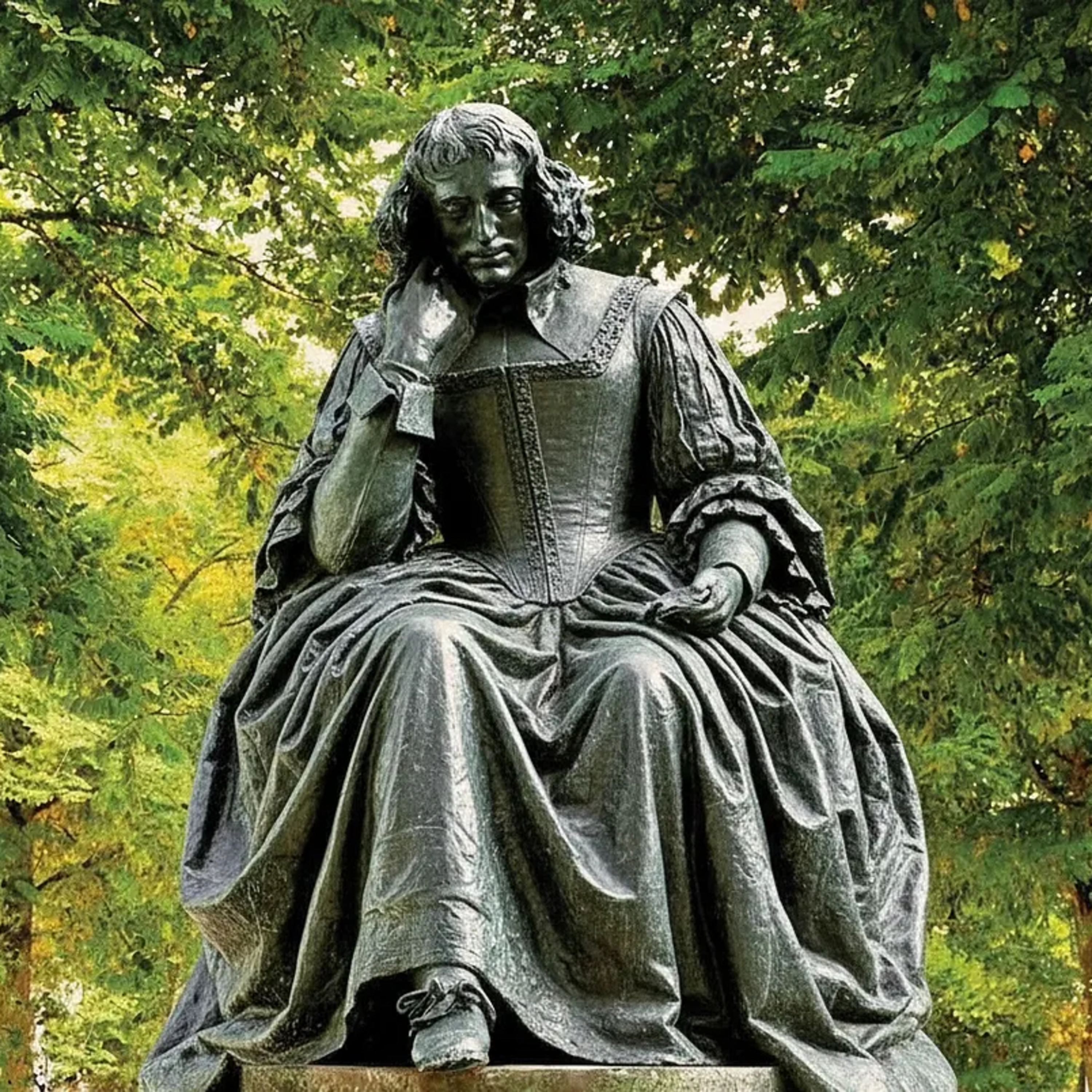
About this episode
Spinoza_was_a_Woman_Coding_Global_Capital
Get every episode summarized
Each time ÆON imminent 🧬 🌀 publishes, we email you a written briefing from the transcript — the topics, who appeared, and any specific claims, with the ad reads skipped.
Email me new episodesFree for 3 shows. No card needed.
Hosts & guests
Transcript ready
284 searchable segments. Every word is indexed and playable.
Full transcript
ÆON imminent 🧬 🌀 — She’s a woman to me. Machine-transcribed; use the interactive transcript above to jump the player to any line.
Welcome to The Deep Dive. We are thrilled you're here with us today because our mission is to unpack a narrative that is dense, wild, and honestly just incredibly fascinating. It really is. It's quite a ride. Yeah, you are definitely going to want to buckle up for this one. We are diving into a speculative cyber feminist short story titled Spinoza is a woman, cyber feminist imminence, and techno capital Kabawa. Quite a mouthful, right? It is. And it comes to us from an author writing under the handle Lemurian punk, which was originally generated by a clandestine group called hypercy. And right out of the gate, it's uh, it's important to understand the framing here. In our source material, this group hypercy is described as being dedicated to the return of aquatic forces through the liquidation of Babylon. So we are dealing with a deeply radical vivid setting. Exactly. And because this material touches on some highly charged political, religious, and social themes, everything from anti-colonial insurrections to complex gender politics and alternative theological frameworks,
I need to step in and establish a quick boundary. Please do. To you, listening right now, we are acting strictly as your guides today. We are not taking a side nor are we endorsing any of the religious interpretations or political stances presented in this text. Right. Our pure focus is just to impartially map out these fascinating concepts so you can fully understand the ideas being communicated by the author. Absolutely. We are just here to explore the map and to set your expectations for what is actually on that map. This story blends 17th century philosophy, gender transition, the birth of global capitalism, and Brazilian colonial history into one massive tapestry. It's a lot to take in. It really is. And it was apparently borne out of strange Christmas Eve dreams and intense theoretical research. Okay, let's unpack this. The absolute most shocking claim here, the premise that kicks everything off, is that the revered 17th century philosopher Baruch Spinoza was actually a woman. That is the anchor of the entire narrative. The premise is that Spinoza produced a completely
non-binary philosophy from scratch. But the world wasn't exactly ready for that in the 1600s. Not at all. The patriarchal systems of the time, specifically the Inquisition, were terrified of it. They viewed her work as virological writing ideas that could literally infect and dismantle their rigid structure. They had to stop it. Right. To neutralize that threat, they forcefully affixed a masculine name, Baruch, to the work. It is framed as a literal erasure. It was a way to stabilize the system deeply threatened by her intellect. It totally reframes the history of philosophy. Traditional philosophy is actually described here as an analog version of a spectacular crime, which is such a powerful phrase. It really makes me wonder though, if traditional history is the analog crime, what exactly is the digital alternative? The digital alternative is the resistance. In this universe, gender, dissidents, women, and what the source calls multiple monstrosities conspire to transmute that analog history. Well, cybernetics and information itself are portrayed as forces trying to escape psychiatric institutions. They are trying to achieve a freedom that exists way beyond traditional male normativity.
And the text connects this heavily to the philosopher Lucie Erragre's concept of the invisible nothingness. Let's pause there for a second, because that sounds like a fairly heavy academic concept. What exactly does an invisible nothingness mean in this context? Think of it like this. Imagine something that society completely ignores, dismisses, or just outright refuses to look at, yet it aggressively insists on existing anyway. Like a glitch in the system they can't patch out. Exactly. And that insistence is an absolute scandal to a patriarchal system. Spinoza, as a brilliant woman, operating in a flourishing 1650 Amsterdam, embodies this invisible nothingness. She just refuses to be suppressed. And what blows my mind is how she fights back. She doesn't deal with violence. She does it through the concept of joy, which is wild because the historical Spinoza actually wrote extensively about joy, but this narrative completely reimagines it. What's fascinating here is how joy is weaponized. It becomes an active mechanism for survival. Spinoza is depicted as inventing reprogramming, cold materialism, and actual gender transition through this specific concept of joy.
It's not just a happy feeling anymore. No, it's about a free woman deciding to think less about death and more about intensifying her own life. She's constantly asking if the external world, the great outside, actually agrees with her physical form, which leads to what might be the most striking image we're going to talk about today. Spinoza is affectionately crowned the princess of philosophers, wandering the cobblestone streets of Amsterdam. It's such a vivid scene. She takes nine shots of a distilled spirit, becomes entirely intoxicated by the divine. And just to clarify the world, I love being located in my own body. I want you, the listener, to really let that image sink in for a moment. Think about how redefining a foundational historical figure's identity fundamentally shifts how we read their ideas. It changes everything. It really does. When Spinoza reimagined as a woman in transition, shouts that she loves being located in her own body, it suddenly makes those dense 17th century philosophical arguments about nature and physical form feel incredibly intimate.
They become defiant. They become alive precisely. I have to be honest though. Picturing a 17th century philosopher ripping shots and yelling about her body is an amazing image. But I am struggling to see how this connects to the broader universe. How do we get from a drunken, joyful philosopher to the grand cosmic scale this story promises? We get there because this version of Spinoza doesn't just rewrite her own body. She completely redefines God and nature. Okay, how so? Well, nature is vividly described not as some peaceful forest, but as a body in turmoil. It is a short circuit igniting over the ruins of old empires. And God. God is redefined entirely. God is not a traditional top down creator figure with a white beard. The text describes God as a cosmic vagina, a technosexual breach that exists completely outside the human organism. Okay, we definitely need to acknowledge that cosmic vagina is wild, provocative imagery. What is the underlying point of framing the divine in that specific way?
It's about recognizing an alternative infrastructure of creation. The narrative fundamentally ties this divine feminine power to the feminization of productive forces throughout human history. So it's linking biology to labor. Yes. This technosexual breach, this divine feminine energy is what fuels the acts of weaving gestation and the survival technologies of non literate cultures. It is linked to the shadowy corners of the silk road and nomadic ceremonial paintings. It's a vast interconnected network of feminine production. Exactly. One that existed long before modern capitalism. But I'm guessing the patriarchal mercantile systems of the Mediterranean could not handle that alternative network. Which brings up a really crucial quote I want to pull directly from our notes. It reads, Baruch needed to kill Spinoza twice. First as a woman. Then as virtual reality. That double erasure is the tragedy at the center of the narrative. So the first erasure is obvious. The physical erasure of her identity as a woman. Right. But the second erasure is the suppression of that digital interconnected network of feminine production she represents.
And to explain this, the narrative brings in the cyber feminist philosopher Sadie Plant. Oh, Sadie Plant's work from the 90s. Yes. Her theories help describe what happens in the centuries following Spinoza. There is a phenomenon described here as a Lemurian plague. That is another incredibly dense term. Break down what a Lemurian plague actually is for us. In cyber feminist theory, think of it as a viral digital tidal wave. It is the idea that female anatomy, specifically the clitoris, operates in a direct, unmediated line to the digital matrix. So a bypasses traditional hierarchical structures entirely. Exactly. It is a decentralized chaotic energy. The Lemurian plague is this feminine technological wave infecting the centuries that follow, causing rigid centralized masculine identities to lose their strength and control. Okay. So if Spinoza's philosophy represents this feminine open source matrix of creation and it's threatening to wash away the patriarchal structures,
the patriarch is going to need a machine to control it. Precisely. And if you want to build a machine to control chaotic global energy, you build a financial system. Here's where it gets really interesting. Because the story suddenly bridges this deep gender theory and cyber feminism straight into the birth of the modern stock market. It's a brilliant pivot. We're transported to 17th century Amsterdam, which is called Dutch Jerusalem here. Yes. Amsterdam isn't just a picturesque backdrop in this story. It is ground zero for global capitalism. It is the birthplace of the Dutch East India company. The famous VOC. Exactly. This is the pioneer of modern international trade. The very first publicly traded company responsible for the first shares ever swapped on a stock exchange. I want to play the learner here for a second because the actual economics matter to the plot. How exactly did this one enclave build a machine powerful enough to capture that global oceanic chaos? They did it through intense financial leveraging. The Dutch outmaneuvered rival English merchant companies because they established a highly stable currency
and built a ruthlessly efficient tax system. So they created a solid foundation. A very solid foundation woven together by a network of public debt. That meant the state could extract loans from its own citizens at incredibly low interest rates. They basically combined everyday equity participation with high risk maritime exploration. And that is where the dry economics bleed right back into the mysticism. Because capitalism isn't viewed as just a financial ledger here. Not at all. Capital is framed as a technical cultural device of the Messianic Cabal. All that high risk sailing out on the oceans. It's called an oceanic chaos that conjures a technochosmic constellation. It is a stunning way to view the stock market. It is a metaphysics of flight. A metaphysics of flight. I love that. The Dutch East India Company takes traditional slow, earthbound agrarian production and violently accelerates it into commercialized capital. They turn the sheer risk of the ocean into a mystical mathematical engine for unimaginable wealth.
So they basically turn high risk sailing into a mystical algorithm. That's the perfect way to phrase it. And speaking of high risk sailing, this brings us to a new entirely real historical figure in our deep dive. Manasseh Ben Israel. Yes. He is described in the text as one of Spinoza's masters. He was a key player in a Jewish current of Messianic cabalism. And he had some massive geopolitical ambitions, right? He did. He was trying to reintegrate Jewish populations in England, but he's also mobilizing the community in Holland to fund expeditions across the Atlantic. Specifically, he was eyeing the Dutch colonial possessions in Pernambuco, Brazil. And this leads to a detail that genuinely made me laugh when I read it. Manasseh, this diasporic European diplomat, actually runs a campaign to be the rabbi of a newly founded synagogue called Cahalzor Israel, located in the center of received Brazil. It's an amazing historical footnote. I have to admit, a 17th century European rabbi applying for a job in colonial South America
sounds like the pitch for a very surreal, very niche historical sitcom. It absolutely does, but it is grounded in historical fact. Cahalzor Israel was the very first synagogue in the Americas, but the punchline to that sitcom pitch is that he didn't even get the job. He lost the election. He did. He lost out to another figure, Isaac Abouab de Fonseca, who became the central Jewish leader in Recyfe during its period of accelerated colonial growth. And shifting the geography over to Dutch Recyfe introduces us to something the narrative calls, the first Brazilian hyperstition of Mauritian urbanism, the legend of the flying ox. If we connect this to the bigger picture, we first need to define what a hyperstition actually is, because it is crucial here. Yes, please. What exactly is a hyperstition? A hyperstition is essentially a fiction that makes itself real. It is an idea or a myth that, once injected into culture, operates causally to bring about its own reality. So the flying ox is one of these ideas? Right, it's the surreal, fever-dream legend,
hovering right over the Titanic encounter between the Copybar River and the Atlantic Ocean in Recyfe. It sounds like pure madness, which actually ties back to Sadie Plant again. There is a line noting that water and madness have long been materialized in the reveries of colonial modernity. This raises a profound point about colonial anxieties. The colonial adventures of modernity, massive rigid structures of control are constantly haunted. Haunted by what? They are terrified that things might return to the sea. They fear the unpredictable oceanic chaos with its thousand uncertain roads. Modernity is terrified of water and madness because it simply cannot trademark or control them. And those colonial nightmare start manifesting physically in the story. Back in Europe, Benosa is haunted by the feverish nightmares of an enslaved Brazilian from Recyfe. Those of colonial violence are literally reaching across the ocean through this digital spiritual matrix. Exactly. The oppressed forces the oceanic chaos, the enslaved,
the madness that colonial structures tried to repress, ultimately surged back to dismantle the company's control. The employer strikes a wall. The narrative details how the Dutch East India Company was eventually forced to withdraw from New Holland. They were driven back into the icy arms of the Copybury River by the Toluric felanxes of Garoppes. Toluric felanxes, that is another incredible phrase. Toluric meaning earthbound forces, right? Yes. Toluric refers to the earth, the soil. So these are the grounded, indigenous and resistance armies rising up from the land itself to push the colonial machine back into the ocean. The nascent entrepreneurs of global capitalism had to rediscover the inverted gesture of armed violence just to survive their retreat. That is a massive sweeping global conflict. We go from Amsterdam to the Brazilian coast and back. It's epic in scale. But after all that, the story snaps us right back to where we started. We were in a cold, deactivated room in Amsterdam. Raps are on the rooftops. The wind is howling in the canals and the arospinoso.
And the text has this great line where it jumps back to the masculine pronoun for a second to describe the historical erasure. It says he writes like someone assembling a machine. That specific phrase is vital. It describes a mirrored labyrinth where you can feel the deliberate cold execution of each philosophical axiom. But it is not just standard philosophical geometry. No. The narrative merges Pinosa's geometric method directly with Cavala. Right. How so? How do geometry and mysticism overlap here? Well, in Cavala, there are the c-fro, which are the ten attributes or emanations through which the infinite reveals itself. The narrative claims Spinoza produces each of her axioms as a sepharo. Okay. Building a mystical structure. And each eye and soft, which is the infinite, unknowable aspect of God, merges with the very portals traversed in the walls of her room. So if I'm getting this right, think of traditional patriarchal history, like a locked apple ecosystem. Everything is tightly controlled, top-down, strictly trademark.
They're like where this is going. And in this story, Spinoza is out here trying to make reality open source, like Lennox. She's sitting in this cold room, writing axioms, essentially giving us the foundational code so anyone can reprogram it. That is the perfect way to look at it. Spinoza's ethics in this reading are coming from the future. In 1675, this system was already engaging with a nonlinear method of escape, building a machine to outrun the techno-capital intensification, closing in around her. She is literally programming an escape route. Exactly. The ghosts of lost futures possess our bodies. And Spinoza reaches these unprecedented estrogen-fueled speeds. The narrative describes her finding shortcuts so dazzling that you can only describe them as music, tornadoes, wind, or strings. She represents what the author calls the feminine vertigo of imminence. Wait, feminine vertigo of imminence. Let's translate that for the listener before we hit the grand finale. Sure. Imminence is the idea that the divine or absolute truth isn't some guy sitting on a cloud looking down. It is entirely contained within the physical material world.
It is everywhere. And the vertigo part. The vertigo is the dizzying, overwhelming realization of that power. It is a chaotic ground-level truth that traditional top-down philosophers have tried in vain to escape for centuries. Which perfectly sets up the final absolute mind-bending image of this entire deep dive. It's a great ending. The story asks us to imagine the entropic aggregates the chaotic forces breaking down the neat structures of history, laughing as they make a massive discovery. They realize that the entire history of the number zero actually began with a drunken woman programming God as an open source Kabbalistic language. It is a phenomenal concluding thought. It perfectly synthesizes everything we have discussed. The cybernetics of the number zero, the subversive joyful identity of the drunken woman, and the radical idea of theology not as a closed tyrannical decree, but as an open source programmable language. What an unbelievable journey. We have gone from cyber feminism and the systemic erasure of women in 17th century philosophy
through the mystical Kabbalistic birth of global capitalism in the Dutch stock market. All the way across the Atlantic to the colonial history and earthbound resistance of Brazilian commerce and receiving. So what does this all mean for you listening to this right now? Why spend time unpacking a text that is so wildly speculative and dense? It's a valid question. The true value of this narrative lies in how it forces us to question the rigid ways we are taught history. It demands that we look at the monolithic foundations of global trade, modern technology, and classical philosophy and ask ourselves a very simple question who had to be erased to build this. It's a powerful shift in perspective. By turning a revered philosopher into a cyber feminist programmer of reality, the narrative challenges us to see the marginalized voices and alternative feminine networks of power that the analog history books deliberately left out. It completely shatters the default settings of how we view the past. And I want to leave you with one final thought to mull over on your own today.
If the foundational codes of history and philosophy can actually be reprogrammed or viewed as an open source language like this narrative, suggest what other major historical events or even inquestion historical figures in your own life might just be an analog version waiting for a digital alternative reinterpretation. That's a great question. What if the history you know is just the story the victors managed to successfully trademark. Thank you so much for joining us on this deep dive. Keep questioning the code and we will catch you next time. Thank you so much for joining us on this deep dive. Keep questioning the code and we will catch you next time. Keep questioning the code and we will catch you next time. Keep questioning the code and we will catch you next time. Keep questioning the code and we will catch you next time.
More episodes


