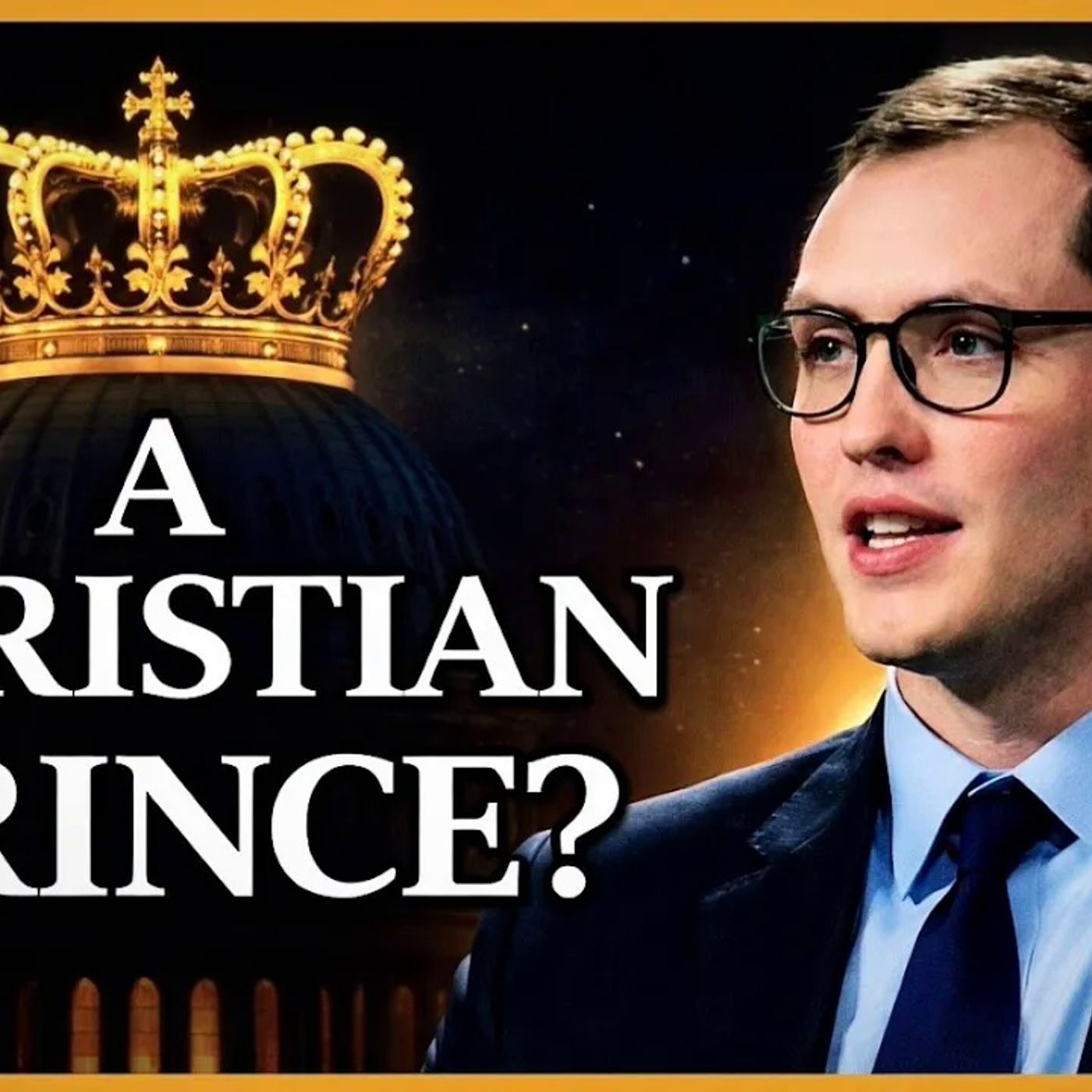
Should Christians Have a Prince? The Case For A Christian Prince
Get every episode summarized
Each time Eschatology Matters publishes, we email you a written briefing from the transcript — the topics, who appeared, and any specific claims, with the ad reads skipped.
Email me new episodesFree for 3 shows. No card needed.
About this episode
“Looking for excitement, Chamba Casino is here. Play any time, play anywhere, play on the train, play at the store, play at home, play when you're bored. Play today for your chance to win, and get daily bonuses when you log in.”From the transcript
In this episode of The Magistrate, James Baird responds to the claim that “magisterial Christian nationalism” ignores the reality of human sin and promotes a utopian political vision.
Drawing on the writings of the Protestant Reformers, historic Reformed political theology, and the ideas of the American founding, James examines the historic concept sometimes called the “Christian prince.”
Did figures like Calvin, Knox, and the early Protestants believe civil magistrates had a duty toward true religion?
Does human depravity make Christian governance impossible, or does it simply require wise limits on power?
This episode returns to the original sources to explore what historic Christianity actually taught about civil authority, the role of the magistrate, and the relationship between church and state.
Watch all of our videos and subscribe to our channel for the latest content >Here<
For blog entries, articles, and much more, visit our website >Here<
Get every episode summarized
Each time Eschatology Matters publishes, we email you a written briefing from the transcript — the topics, who appeared, and any specific claims, with the ad reads skipped.
Email me new episodesFree for 3 shows. No card needed.
Hosts & guests
Transcript ready
531 searchable segments. Every word is indexed and playable.
Full transcript
Eschatology Matters — Should Christians Have a Prince? The Case For A Christian Prince. Machine-transcribed; use the interactive transcript above to jump the player to any line.
Looking for excitement, Chamba Casino is here. Play any time, play anywhere, play on the train, play at the store, play at home, play when you're bored. Play today for your chance to win, and get daily bonuses when you log in. So why are you waiting for, don't delay? Chamba Casino is free to play. Experience social gameplay like never before. Go to Chamba Casino right now to play hundreds of games, including online slots,ingo, slingo, and more. Live the Chamba Life at chambacasino.com No purchase necessary VGW Group void for prohibited by law, 21-plus terms and conditions apply. Should we be worried about bulldozers pushing down Christian churches in America? That's what we're going to talk about today on the Magistrate part of Eschatology Matters. Our sponsors steadfastsigars.com promo code eschatology10 rockwallbibles.com
Benefits Media Grayson Truth Press Grayson Truth Records Well, today I am not joined by my co-host, Josh. He has lost power, so you're stuck with just me today, and I'm going to do something a little different. I'm going to do a reaction to an article that was posted last week. Here on the substack elephant in the room, this was written by Casey McCall. It got some attention online, so I thought that I would do a live reaction. I briefly skimmed it last week, but I haven't given in a careful read. What we're going to do is I'm going to read this article. We're going to go through it and now respond to the points that he's made. The first thing to note is the title of the article. It's that Magisterial Christian nationalism doesn't take sin seriously enough. The Magisterial part is interesting. My first reaction to this is that I'm skeptical. Of course, it would be hard to call, let's say, Calvin, a Christian nationalist.
That's a very modern term nationalism as an idea doesn't really start appearing until the 19th century takes off in the 20th. I think probably what he means here is the Magisterial idea of Protestant political theology. That's my guess. That would include guys like John Calvin, John Owen, Samuel Rutherford, George Gillespie. You're kind of mainstays of reformed theology and their view of political matters. The claim here is that it doesn't take sin seriously enough. If he's talking about what I think he's talking about, I'm skeptical. After all, it's Calvin and Owen who has a richer, more serious take on the depravity of sin than those guys. Let's see how he makes his case. He says several years ago, a group of students at a classical Christian homeschool co-op got into serious trouble for participating in illicit activity during school hours. Details don't matter. However, I remember a perverse sense of shock from this tight-knit school community.
How could this have happened right under our noses? These were strong Christian families trying their best to do things right. At each chosen, this educational path in part to prevent things like this from happening. They were attempting to raise their kids in the faith and partnership with the church and other like-minded Christian families. Yet here we are dealing with this participation in activities that these families wouldn't have allowed their kids to watch on television. Okay, so he's setting up this scenario where you have Christians at a Christian school doing something that they should not do. And I'm assuming he's saying that good Christian families, quote unquote, can surprise us with the evil that they participate in. Let's see where he takes this. How did the enemy so successfully breach the secure walls of this Christian community? Jesus provides the answers. It's not what goes into the mouth that defiles a person, but what comes out of the mouth? This defiles a person. This shocked community forgot one very important thing. The enemy already resides behind the walls. So he's saying even the best of Christian communities are still affected by sin.
That's true. So as I often think about this experience when I hear the various sales pitches for magisterial Christian nationalism, within reform Protestantism in America, a growing number of people seem to be warming to the idea that a Christian prince could solve our cultural problems and defeat the woke agenda. So Christian prince, what is this idea? It's a mainstay of reform theology going at least all the way back to Calvin. If you want to know what that doctrine is, go and read your favorite reformers commentary on Psalm 101. Why don't we go read that right now? Psalm 101. This is where the idea of a Christian prince comes from. This Psalm is traditionally taken as a vow that David makes when he sins the throne. This is what it says. I'll sing of steadfast love and justice. To you, O Lord, I will make music. I'll ponder the way that is blameless. Oh, when will you come to me? I'll walk with integrity of heart within my house. I'll not set before my eyes anything that's worthless.
I hate the works of those who fall away. It shall not cling to me and perverse heart shall not be far from me. I will know nothing of evil. Whoever slanders his neighbor secretly, I will destroy. Whoever has a haughty look and an arrogant heart, I will not endure. I will look with favor on the faithful in the land that they may dwell with me. He who walks in the way that is blameless shall minister to me. No one who practices deceit shall dwell in my house. No one who utters lies shall continue before my eyes. Morning by morning I will destroy all the wicked in the land. Starting off all the evil doers from the city of the Lord. This is the vow that David takes to be what Paul and Romans 13 calls a terror to evil doers that he will establish order in Israel and he will establish justice in Israel and that order in justice will be defined by God's law. So this is, let's turn to Romans 13. And every person be subject to the governing authorities for there is no authority except
from God. And those that exist have been instituted by God. Therefore whoever resists the authorities resists what God is appointed and those who resist will incur judgment. For rulers are not a terror to good conduct, but to bads, a ruler should be a terror to bad conduct. Would you have no fear of the one who is in authority? Then do what is good and you will receive his approval for he is God's servant for your good. But if you do wrong, be afraid for he does not bear the sword in vain. So you see these two biblical ideas, right? Psalm 101, David vowing to be a terror to evil doers, Paul here saying, Romans 13, civil rulers there to be a terror to evil doers. And so the idea of a Christian prince was that pastors theologians would do a commentary on Psalm 101 to try and teach young rulers the moral standard that they should abide by and the type of wickedness that they should oppose with the power of the sword as well as the righteousness that they should countenance or favor in the land. And probably the best thing to read on this is put out by brief press.
It is Francisco's Junius's little booklet called The Education of a Christian Prince to give you an idea of how the reformed tradition thought that young men who were going to be rulers ought to learn the way that they should rule in justice. That's the idea of a Christian prince. So here it seems that what McCall is saying is that the idea of a Christian prince that that that could solve all our cultural problems and defeat the woke agenda. We should doubt that idea because of sin. So let's keep reading. If we could replace classical liberalism with a government that legislates according to Christian law, then we could create a truly Christian nation that champions the values we treasure. Our kids could grow up safe and secure in a community of like-minded people. I'll ignore now the racist ideologies. Well, I don't know why he's bringing racism into this. I mean, if he's talking about magisterial reformed theology, just go read Junius on the education of the Christian prince. Does it seem racist? It seems like he's poisoning the well here trying to create guilt by association.
Let's just take the Magisterial Christian nationalist argument at face value. So let's appoint a few things out here. So he seems to be connecting the idea of a Christian prince with a very utopian idea of what will happen in society if we have this. I mean, it's certainly the case that if you have a ruler ruling according to God's law, according to God's prescriptions for rulers, that the nation is going to be healthier in every respect. Wickedness will be put down, righteousness will be lifted up, and that certainly is good for society. That's why God prescribes it this way. So we would certainly expect that a good Christian prince would lead a nation towards goodness and prosperity, peace, piety, justice. But he's suggesting that this is going to, that people think this will lead to utopia. I mean, maybe some anonymous Twitter accounts would, but that's not the magisterial idea. It's just that it is right and good, and we should expect that when we follow God's plan, we'll enjoy blessings.
And when we don't follow God's plan, we'll enjoy curses. It says here, here's the problem. It's a utopian fantasy. Conservatives have rightly critiqued communism for its unrealistic anthropology as the French philosopher Ernest Renan observed communism is in conflict with human nature. It only works if people are willing to cooperate and share their possessions. Human beings have proven that they're not willing, often resulting in a turn to violent authoritarianism to force the issue. You know, I already, I can kind of tell, I don't see McCall really working to be conversant with the arguments for the magisterial idea. Again, he presumably is critiquing magisterial Christian prince, not just some knockoff online content. Maybe they would be the proper target for these critiques, but certainly not Calvin or Junius. They weren't utopian by any stretch of the imagination.
They understood that, I mean, David, right, we see sin in David's life with the census, obviously with the Shiba, it doesn't seem to have been like an awesome father with what happens with his son, Absalom. So sin certainly a problem, but David's still the greatest king in the Old Testament. And wouldn't we want great rulers in America? I think so. Okay. He says, human sin is the proverbial fly in the ointment for all utopian visions, including magisterial Christian nationalism. John D. Wilson writes about those who believe we can advance by turning back to the clock to some ideal age. They are utopian in the same way that revolutionaries are, because the society they envision is predicated on obscurantist nostalgia, which is just as abstract as the leftist revolutionary's dreams of a perfected society. Because ironically, the very people who celebrate our Christian heritage seem blind to many of that great heritage's most prescient historical lessons. We've had Christian princes and kings.
We've instituted established churches. Okay, established churches aren't necessarily connected to the Christian prince, but all right. How have those projects fared? The history is far too complex where deep dive here, but the prevalence and Europe of Christians being arrested for praying outside abortion clinics and cathedrals turn into bars and restaurants seem relevant. How are they relevant? There aren't any Christian princes or not many, but definitely not in the countries that are doing that, because remember, Christian prince isn't just that you call yourself a Christian. Christian prince is that you're ruling justly that you're putting down wickedness as defined by the Bible and you're lifting up righteousness. So if there were Christian princes in Europe, they would be doing the opposite. They would be closing abortion clinics and lifting up prayer. They would be opening new cathedrals and trying to suppress, let's say, bars that are encouraging alcoholism or maybe they don't stop bars, but you get the idea that they'd lift up the
cathedrals, not replace them. So this isn't a critique. This is actually an example of the opposite of what the Christian prince is. The decisions by states to end established churches in America, he's talking about establishment, that's not the same idea. So yeah, America did end established state churches in 1833, good. In favor of religious liberty, did not lessen Christianity's cultural impact? Okay, so we're saying, even though we didn't have established churches, Christianity was still influential, that's true. In fact, according to the Tokville, America's choice, institutionally, unmore religion from government contributed to Christianity's influence over the mores of society. So these are two different ideas. He's now confusing. He's saying they didn't have established churches, that's true, but now he's saying that's the same as unmooring religion from government that did not happen in 1833. I'm not sure that's ever happened in America, although the furthest we've gotten is currently today.
I mean, in 1833, you still have blasphemy laws, people blaspheme Jesus or the father, the Holy Spirit, or say, reduce the authority of the Old New Testament. They get in trouble. They break the Sabbath. They get in trouble with the civil government. You even have the Supreme Court, state Supreme courts, then eventually the federal Supreme Court saying Christianity is part of the common law in America. It's actually legally part of the law. You even have the Supreme Court saying later in the 1800s, America is a Christian nation. So don't confuse states not having official churches with states not no longer legally preferencing Christianity and being a Christian government. They were. Talk about one of our sponsors here, Rockwall Bibles. So Rockwall Bibles, they build heirloom quality custom Bibles using the finest premium cow hide and goatskin leathers that you won't find in any mass produced Bible. Each one is handcrafted, and you can customize nearly every detail from the leather type
and the stamping to pay judges and liners. As a family-owned Christian business and the Ozarks, Adam, coming from a background in mechanical engineering, brings precision and top tier build quality to every Bible. Whether you want to build a new Bible or extend the life of the one you already use, Rockwall Bibles is the place to go. Follow them on X, Instagram, or Facebook to see examples of their work, and you can visit rockwallbibles.com to place a deposit for your custom Bible today. They also drop ready-made Bibles every Friday, but they typically sell out pretty quick. So visit Rockwall Bibles to make sure that you don't miss out. Our Baptist forebears advocated for universal religious liberty because they wanted the chance to Christianize society through preaching the gospel. The history on the Baptist view of this is more complex than people would like to make it out to be. Certainly there's plenty of Baptist who did not want a un-Christian society or un-Christian government. All right, 1772, the Scottish particular Baptist John McGowan observed that whenever
any Christian, ah, listen to this, this is another switch up here, he says, whenever this Baptist guy would go in, McGowan observed that whenever a Christian sect has been happy enough to grasp the reigns of government for the time being, it persecutes its competition. Yes, Presbyterians and Baptists were against one particular Christian sect being lifted up over other Christian sects. So they didn't want like Presbyterians to rule and have all the preference, but then not Baptist. That is different than saying they didn't want the government to be, ah, Protestant or Christian. What they wanted was no particular Protestant, ah, denomination to be preference. That doesn't mean they didn't want Christianity in general to be preference. So because of confusing submissions here, while many dream of bulldozing mosques and gay bars, if you consider what they will do when the bulldozer turns toward first Baptist and second Presbyterian, what point is he making here?
That does make sense, okay? I don't know what his argument is here, um, is, I mean, who's, it's very confusing. Let's keep reading. What happens when the hypothetical Christian prince has theological convictions about secondary matters? Okay. I see what he's saying here. Listen, the American tradition is that our rulers do not preference one denomination over another. They do not use coercive power against Presbyterians for the sake of Baptists. In America, we said, let's stop fighting about that. We're all part of the Church of our common Lord. That's how 1788 Westminster Confession puts it. This is a very Protestant idea, right? Because for Catholics, only the Catholic Church is the true Church, the Church of our Column of our Lord. But Protestants say, no, Baptists, Presbyterians, even Episcopalians, I know, risque.
All true Churches. And so the Civil Government ought not to, like, support one, not the other, or persecute one, not the other, right? But you can say that and still say, but we want the government to still be Christian, okay? We want the government to still lift up Christianity and actually to discounting its non-Christian religion. Because, sure, it would make a big difference in society if your Baptist Presbyterian makes a huge difference if you're a Christian versus a Hindu or Muslim. So you can say the Christian Prince, which would be just civil leaders, civil rulers who are ruling according to Godly justice, would lift up and encourage Christianity and discounted it and discourage non-Christian religions without them having to worry about the Christian Prince turning around and bulldozing the Baptist Church because they're not baptizing babies. This is a big mistake that is being made here. Basically, what he's arguing is we should allow total religious liberty for everyone to
make sure Baptist don't get in trouble. But the truth is, if you have total religious liberty, Christianity and non-Christianity are put on an equal footing, you're going to have non-Christians that get power. And religious liberty, on any conception, is a Christian idea. It's not a Muslim idea, certainly. It's not really a Hindu idea. So if you have non-Christians who don't believe in religious liberty, who get power because you want an absolute religious liberty, you should expect then for churches to be persecuted. That's what's going to happen. So this argument doesn't work. It's also very utilitarian. What's the biblical principle here? The Christian Prince idea, biblical idea, Psalm 101, Romans 13, we could cite more passages. This is what a ruler is supposed to do. What's the principle here? It looks very pragmatic, saying, hey, we don't want the chance of our church to be bulldozed down. So we're going to offer absolute religious freedom for everyone. All right. You get the idea. Let's keep reading.
Hey, it's Cole Swindell. After I give everything I've got to land a perfect vocal, I usually take five before jumping into the next track. And I've learned exactly how to recharge in that time. Some folks grab coffee. I hit a quick, good looks pill. That's the thing you know, the break is just as fun as land down the track. A better break makes for a better take. Need a break? Less chumbo. No purchase necessary, BGW Group void were prohibited by law, 21 plus TNC supply, sponsored by Chumba Casino. At the UPS store, we understand the importance of a first impression. That's why we're here to help you put your best foot forward and be unstoppable with our printing services, with high quality paper stock options. We make sure your small business stands out and your message reaches the masses. After all, we're the one stop, print that pop store. Most locations are independently owned, product services, prices, and hours of operation may vary. See center for details. The UPS store. Be unstoppable. Come into your local store today and get your print on.
What happens when the authority at the top leverages government in pursuit of his own self-ashames? It's not good. It's terrible. Don't vote for that guy. That's the answer, right? You can't say, I don't want my ruler to rule according to godliness because what if we get a bad ruler and he doesn't? Well, yes, if you get a bad ruler and he doesn't rule according to godliness, he'll do bad things. If you get a good ruler, ruling according to godliness, he'll do good things. So vote for the good people. Pretty straightforward. Says, I'm currently preaching through proverbs and my study has reminded me of the importance of authority for every person, true. We spend our days trying to get to the top so that no one can tell us what to do. However, proverbs reminds us that the person who ceases to hear instruction, who longer submits to authority, is a fool, true. The longer I live in this fallen world, the more I see past, after past, or fall, the more I'm convinced. The ideal Christian prints doesn't exist aside from Christ himself. So here's a deal.
Imagine we use this argument, let's say, against husbands being the head of their household. Right? We don't want husbands to be the head of their household because they're sinful and if you give them authority, they'll do bad things. Well, no, just because a husband may abuse his authority doesn't mean he doesn't have that authority. Just because he may abuse his authority doesn't mean he isn't called to use it the right way. You cannot make the argument, this could be abused as grounds to critique the idea. This was made by god to be properly used. This is a classic principle, it says, abuse does not negate proper use. Otherwise you would just stop believing in everything god made, you know, oh my goodness, I shouldn't have a body because I'm sinful and I could use that body for bad things. True. But the solution to that is not, get rid of your body, the solution is use your body the way that it's meant to be used. So yeah, this argument that because it could be abused means it's not proper or not
god ordained is bad argument. So the history of Israel's kings ought to provide all the proof we need that sinful people aren't capable of justly wielding that degree of power unchecked. Ah, okay, let's talk about this. He's assuming that the idea of a Christian prince means unchecked power, false, not true. Even in the great monarchies of, you know, remember, America really modeled its system in many ways off of the British system, which had checks and balances. And many of the Americans during the revolution weren't upset with the king, they upset with parliament, you know, they're a version of Congress. So we have to remember that, first of all, monarchies had checks and balances many times, right? So even if you're arguing for a monarchical view of the Christian prince, that doesn't mean you don't have checks and balances. Second of all, the Christian prince idea does not entail monarchy at all. It could be any form of government besides peer democracy. Especially a mixed form of government, right?
The idea is just whoever your civil rulers are, right, whether that is a president, state governor, city councilman, senator, representative, Supreme Court justice, whatever your polity looks like, whatever form of government you have, the people in those civil positions ought to rule according to godliness and therefore put down wickedness and wicked people, rule according to godliness and therefore lift up righteousness and righteous people as defined by God's word. So there's no sense in which the Christian prince entails unchecked power. One, even if you had a monarchy, you still have checks on the power, two, it doesn't entail monarchy. It's just the standard of righteousness by which rulers ought to rule, however your government, whatever your form of government may look like. Because interestingly, our great nation's founders grasped this principle better than the reformed Protestants or Catholic integralists pushing Christian nationalism.
All right, so Robert, so apparently the founders of America understood original sin better than the Protestant formers, I mean, that's kind of what is implying here. Robert Tracy McKinsey calls the framers of the United States Constitution realist to the core and quotes Oliver L as well as representative of their view. Religion is not the lot of human institutions, that which has the fewest faults as the best we can expect. True, you, you'll never create a perfect polity, but if you want to make a good polity, you got to know what a perfect one looks like, right, you got to, you got to know the target you're aiming at. You may never hit the bull's eye, but if you know where the target is, you'll get closer than shooting randomly. That's the idea. So in the Western political tradition, you'll oftentimes have people talking about this is the ideal polity. This is what a great government would look like, not because they're utopian or idealistic, but because they're trying to figure out the target they're shooting at. But it's also true, the point that's being made here is since we can't be perfect, oftentimes
we're just trying to have the fewest faults that we can. That is true. But even think of James Madison in the Federalist Papers, he's obviously one who believes in limited government. But the first point that he makes is that government ought to reign in the sinfulness of the people. And then second, the second thing you do is make sure that government doesn't turn into tyranny. But what's the first? This is Madison. What's the first? Rain in the wickedness, the disorder, the injustice, the lack of peace, reign it in. That's the first shadow of government. But then second, you also got to make sure your government doesn't turn into tyranny. I see too many people flipping that as if the first thing the government we ought to do is make sure government is small enough that it never turns into tyranny. Well, then you might make a government so small, never turns into tyranny, but you have people who aren't governed, which is anarchy. And as bad as tyranny is, anarchy is worse. Tyranny may cause much persecution and suffering. Anarchy is nothing but red, tooth, and claw.
So I don't think this is very accurate. In other words, the founding generation wisely envisioned a government that minimizes the impact of fallen human nature through a system of checks and balances. No one's disagreeing there. But if your checks and balances are so tight that your rulers can't do what God's word says they should do in Romans 13 and Psalm 101, who has the biblical view there? You've castrated the magistrate to such a degree that they can't do what God's called them to do. Sort of like, yeah, it's good to have accountability on a husband to make sure he doesn't use his power. Not accountability is so intense that he's no longer the head of his home. You've missed the point entirely. So under a constitutional republic, no single entity, neither President, Congress, Courts, or even the majority of citizens, can assert its will unhindered. True. Perhaps the cultural decadence we're experiencing today is more the fruit of abandoning these principles than failing to enthrone a Christian prince. All right. I also want to go back to one thing earlier.
So he's talking, he's trotting out the founders in a way that makes it seem like they would support absolute religious freedom. Not true. Allow anyone to practice any religious principle. Again, they didn't want the federal government to be the one making those laws. That's the first amendment. It limits Congress, the types of laws that Congress can pass. That they did allow the states. The 10th amendment said whatever power we're not given to the Fed goes back to the states, which means what? The states can't have these religious laws. And they did. I just used two examples there, blasphemy and a Sabbath breaking. Blasphemy and Sabbath breaking, those are religious laws, right? Those are religious transgressions and they were enforced by the states and many of the founders believed in them. Thought they were incredibly important. My favorite is John Witherspoon, the great Presbyterian minister, signed the Declaration of Independence. He was for blasphemy laws and he thought it was so important to have them to ensure that
the people were pious. Why? Because Witherspoon said, if you don't have piety among the people, you won't have virtue. If you don't have virtuous people, you can't have a republic. The people can't be self-governing if they're not virtuous. Otherwise, they'll just be chaos and bloodshed. So they believed in the importance of these laws. They did not support absolute religious freedom at all. They just wanted to limit the federal government. So yeah, I don't find this article persuasive. I think it doesn't actually understand the idea of a Christian prince. It sounds like maybe McCall is annoyed by some people on X. But his critique here is magisterial, magisterial. If he said Twitter, Christian nationalism doesn't take sense seriously enough, then it might be true. But he says, just stereo Christian nationalism. If he's going to make that claim, he needs to argue with Calvin, Owen, Junius, and lots of other guys too. And if you're going to try and argue, they didn't take sense seriously enough.
Something may be wrong there in your analysis. In fact, they did take sense seriously. That is the reason why they believed that we ought to uphold God's institution of government. Obviously, the point of government is strain, sin, promote righteousness. That's his point. Since there is so much total depravity, you need rulers who are going to do their jobs. And if you limit the government so much that it can't restrain, sin, and promote righteousness, then you're not taking total depravity seriously enough. Well, that's it. Short episode. I hope this was useful. And we will see you next time. Make sure you check out rockwallbibles.com. They do beautiful work. See you next time. Tell a reticure from 2311 Racing. Game night's fun until someone spends five minutes lining up one shot. Chalk, breathe, re-chalk, still aiming. While they figure it out, I fire up Champa Casino. I can spin anywhere, anytime, and there's always a new social casino game every week.
Spins happen way faster than that shot. They now at chumbacacino.com. Let's chumbac sponsored by chumbacacino. No purchase necessary. VGW Group Voidware prohibited by law, 21 plus terms and conditions apply.
More episodes
More from Eschatology Matters

"Why I’m Not a Christian Nationalist": Responding to J.D. Greear
Eschatology Matters

Stop Living Like the Gospel Loses | Habakkuk 2:14
Eschatology Matters

The Seven Churches Were Standing at Ground Zero
Eschatology Matters

Why Ingratitude Is More Dangerous Than You Think
Eschatology Matters