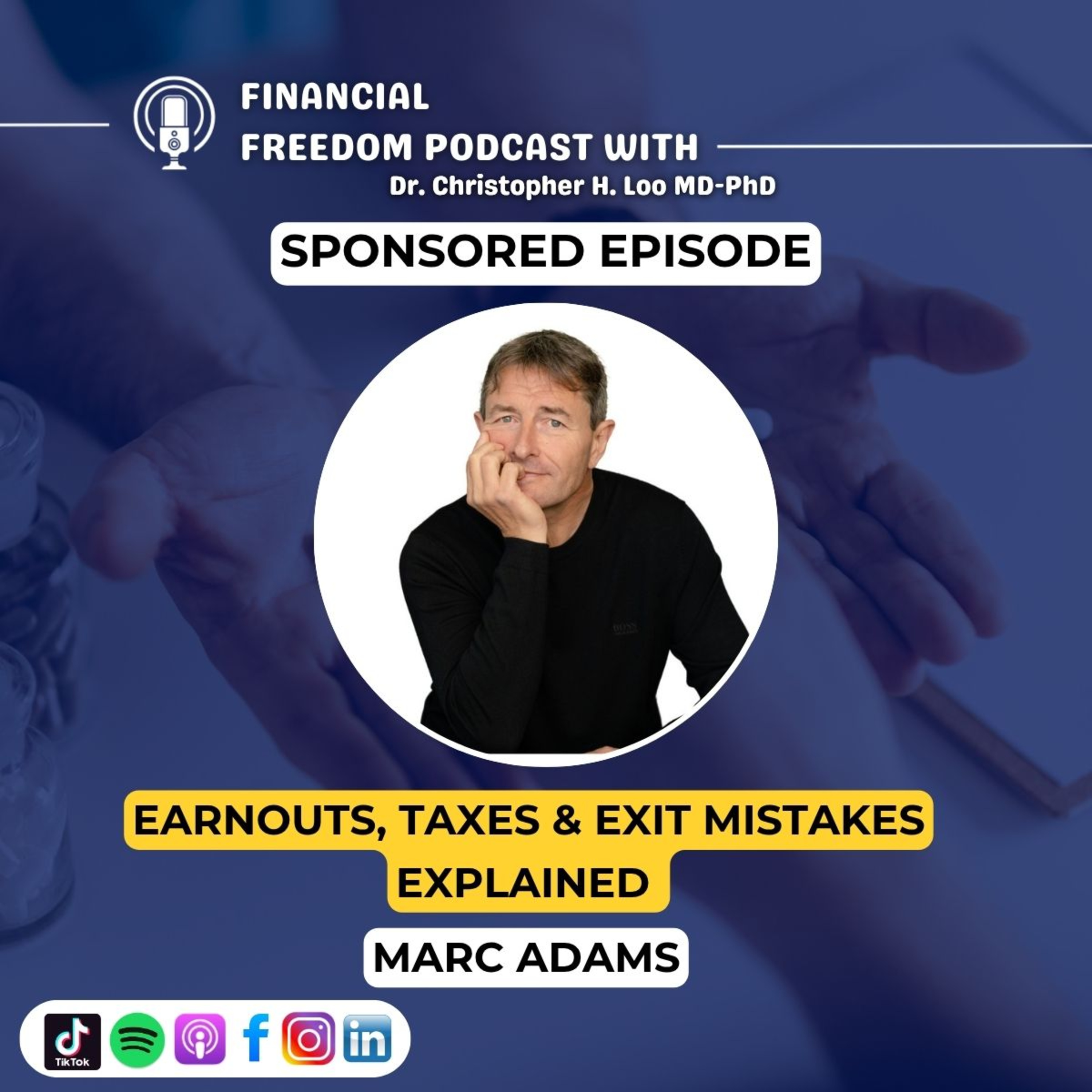
🔥 Sponsored Episode: Business Exit Strategy: How to Double Your Company Value & Keep More When You Sell | Marc Adams
About this episode
Disclaimer: This is a sponsored episode. Educational purposes only. Not an endorsement for or against. Results not vetted. Views of the guests do not represent those of the host or show.
To book a PREMIUM spot on the Podcast: https://www.drchrisloomdphd.com/_paylink/AZpgR_7f
Book a 1-on-1 coaching call: https://www.drchrisloomdphd.com/booking-calendar/introductory-session
Subscribe to our email list: https://financial-freedom-podcast-with-dr-loo.kit.com/
email [email protected] with "Podcast freebie" to book a coveted FREE guest spot on the show.
🧠 Business exit strategy is the difference between building a valuable company… and actually keeping the money when you sell—and in this sponsored episode, Marc Adams reveals how most founders lose millions without realizing it.
If you're a founder, entrepreneur, or investor searching for how to maximize your exit, reduce taxes legally, and avoid costly deal mistakes, this episode breaks down exactly what you need to know before selling your business.
Most business owners focus on revenue and valuation—but ignore the real factors that determine what they actually walk away with. In this episode, Marc explains how deal structure, timing, and preparation impact your final payout far more than the headline sale price.
You’ll learn how to:
- Avoid losing 30–50% of your exit to poor planning
- Navigate LOIs (letters of intent) without hidden risks
- Understand why earnouts often destroy expected value
- Use proven strategies to double your business value in 12–24 months
- Legally reduce your tax burden and keep more of what you’ve built
Whether you're planning to sell your business soon or just want to build with the end in mind, this conversation gives you the clarity, strategy, and framework to exit smarter and wealthier.
Marc Adams specializes in helping founder-led businesses scale, optimize, and exit efficiently—without debt, disruption, or equity dilution—using his “Double & Exit Framework.”
- business exit planning
- how to sell a business
- exit strategy for entrepreneurs
- earnouts explained
- letter of intent (LOI) risks
- tax strategy for business sale
- increase business valuation
- private equity deals
- founder liquidity events
⏱️ TIMESTAMPS (11:04 TOTAL)
00:00 – Intro + Sponsored Episode
00:45 – Marc Adams’ Story & 10X Framework
02:00 – LOI Mistakes That Cost You Millions
04:15 – Earnouts Explained (The Hidden Risk)
05:45 – Tax Strategy & Keeping More of Your Exit
07:10 – What to Do After Selling Your Business
08:30 – Tools, Resources & Final Advice
10:00 – Outro
This episode is for:
- Founders preparing for an exit
- Entrepreneurs building toward a sale
- Investors buying businesses
- Anyone searching for how to maximize business exit value
If you’ve ever wondered:
- “How much will I actually keep when I sell?”
- “What mistakes should I avoid in a business sale?”
- “How do I increase my company’s valuation before exiting?”
This episode answers those questions with real-world strategies you can apply immediately.
📌 HASHTAGS
#BusinessExitStrategy #SellYourBusiness #Entrepreneurship #BusinessGrowth #WealthBuilding #PrivateEquity #StartupExit #FinancialFreedom #BusinessTips #FounderJourney
Financial Freedom for Physicians, Copyright 2026
Get every episode summarized
Each time Financial Freedom Podcast with Dr. Christopher H. Loo, MD-PhD publishes, we email you a written briefing from the transcript — the topics, who appeared, and any specific claims, with the ad reads skipped.
Email me new episodesFree for 3 shows. No card needed.
Hosts & guests
Transcript ready
106 searchable segments. Every word is indexed and playable.
Full transcript
Financial Freedom Podcast with Dr. Christopher H. Loo, MD-PhD — 🔥 Sponsored Episode: Business Exit Strategy: How to Double Your Company Value & Keep More When You Sell | Marc Adams. Machine-transcribed; use the interactive transcript above to jump the player to any line.
Most entrepreneurs believe that if they build a successful business, everything else will take care of itself. If you grow the revenue, increase valuation, find the buyer, and one day cash out. But what if that's not how it actually works? What if the number you think you're selling for isn't the number you actually keep? Today's sponsored episode, and for good reason, because this conversation might completely change the way you think about building and exiting a business. Behind every headline exit, 5, 10, 50 million, there's a hidden story. The story of deal terms, tax structures, timing decisions that determine whether I found their walks away financially free or walks away wondering where most of the money went. Most business owners don't lose money when they sell because of taxes alone. They lose it long before that. In the structure of the deal, LOI, earnouts that never fully pay out. In decisions they didn't even realize they were making. And by the time they figured out, it's too late. In today's episode with Mark Adams, we're breaking that pattern.
You're going to hear how founders can not only double the value of their business in a relatively short period of time, but more importantly, how to engineer an exit so they actually keep what they build. Because building a business is one game. Exiting it successfully is a different. If you get it right, it doesn't just change your business, it changes your entire financial future. So let's get in today's sponsored episode. Good morning guys and welcome to another episode of the financial freedom podcast. I'm delighted about today's sponsored episode. Mark Adams from the UK, the strategy and business exit planner. He helps founder led businesses double company value in 12 to 24 months and cash out as tax efficiently as possible. Mark, welcome. Thank you for that introduction. I'm Mark Adams author of a book, the secrets to 10x in your business and caching out tax free. Before the book, if I took you to the pandemic, I went for a routine medical check to discover that I had stage four cancer.
I got COVID gone from having six months to live to 28 days. Luckily, my back home, I get a call from a friend of mine trying to sell a business scenario where the price that an owner really needed to get for that business. It was more than the market was going to pay. And six months lead up to selling that business, they could see up to 50% of it stripped away. It took me two years to write secrets to 10x in your business and caching out tax free. Somebody pick up the book, invited me on to a podcast, who waited to get the message out. The book led to speaking to share the message. So people could get to a point that they could afford to sell the companies that they built and keep more of what's theirs. Keeping more of what's theirs wasn't enough. You had to grow the value of it by accident when I came off stage. Somebody came to me and said, we'd like to help. That led to two conversations with two family offices that got behind us and subsequently private credit's been added to that. Fast forward, we're looking for business owners to double the value of their business and position them to keep much more of when they exit.
Rather than lose 30 to 50%, we'll get it down to 10% or less. We're focusing on improving value quickly without disruption, debt, without equity dilution. That's the double the next framework. Quick pause here. If this episode is making you rethink how your income is structured, that's intentional. Information doesn't create freedom. Structure does. At the end of this episode, I'm going to show you how to diagnose whether you're building leverage or just scaling complexity. Let's get back into it. Do you have this concept called you didn't money on taxes? You lost it in the letter of intent. You talk about how terms plus timing quietly destroy the keep rate even when the sale price looks huge. It's a multi-faceted area. There's a whole bunch of things that can work against you in the LLI. What I would say to anybody that's thinking about buying a business is get it under LLI as quickly as you possibly can. Because it gives you breathing space to go and figure out how you're going to buy that business.
What you've got to be careful of is not agreeing to any penalties or starting to incur costs too early. Let's imagine that you go under LLI to buy a business. You want to start building as much as you can for the due diligence process. You could spend a lot of money on that. You can use AI to help you. We've built AI based software that can take that whole process and do it in minutes. So we can get a very good view of before we've even signed the LLI which saves us time because money loves speed and speed loves money. We make sure in the LLI that if they decide to work with someone else. They're responsible for reimbursing whatever money we spend on due diligence up to that point. You always want to ask that. Nine times out of ten. Information's been presented in the most positive light and you're not going to get under the covers of it until you're in DD. Be careful. Get your LLI's. Do your due diligence. Do as much as you can out from with AI to minimize your cost before you start getting the lawyers and the CPAs because that's going to cost you a little money.
Make sure the business has cash inside the business to give back to you once you've acquired the business over time. Make sure that if they pull out you're going to get your fees back and make sure that you're doing as much as you can with AI these days to minimize that risk as you move forward. For our listeners high net worth individuals for those that might be making their first business purchase. Go a bit slower. Get help if you need help from us will happily help you will have an issue discussions with anybody free of charge. Make sure you go slow because you're risking your own money into some of these deals. Make sure that you take it slowly and methodically to minimize any risk you might have of it falling apart because it happens all the time to the big boys. And so it's going to happen to us. You talked about two different themes one is earnouts are a tax problem. This guy's as a deal term and why earnouts change risk timing and what the founder actually keeps. That business is valued a buyer will say okay you want 10 million but we see that it's worth six.
In order to get the deal done they'll agree to the 10 million but that other four million is on milestones revenue or profitability targets being met. Unfortunately those additional milestones don't get met you find that the owners who thought they were going to get that 10 million only get six. That leaves a lot of sour taste in the mouth from the investor side they see it as a great business but the numbers don't necessarily perform to allow them to offer the price that the owner wants. So they don't do a deal or they bridge it they're trying to be fair but it makes them look bad private equity got a really bad rack for this kind of thing. Figure a question on the tax side. I think too much money gets left on the table by owners because they don't think about how they're going to prepare the business. There's nothing wrong with tax minimization. Tax invasion is illegal nobody supports that everybody should pay their appropriate taxes. If you can organize yourself so that you pay less tax there's nothing wrong with that everybody should legally and ethically be doing that and keeping more of what's there.
The combination of the two increase the value and keep more of it makes a massive difference. If we go back to a business that's worth five million and keeps three. That three million goes in their bank for the next 20 years they want to earn from that you can do some very simple things put it into insurance products from companies like Aliens. There's a property related approved IRS investments that you might be able to make with decent return over seven years. If all goes well you compound enough to double that when seven years you doubled your three up to six. Through the double and exit framework start off with closer to nine and do the same thing you've compounded over that same period of time to 18. Even if it wasn't 18 then it was only 14 you're still so far have had it starts with organizing your next steps. I realize everybody won't want to do passive income a lot of investors go back and they get bored take some of that cash that they'd earned and put that into a new venture.
They could go and help other entrepreneurs go through that same journey where they doubled their value. Organize their exit so they could keep more of what's theirs and get a bump percentage equity in that business they're helping so when it sells they get another bonus. That could make half a million a year for them on 10 to 15 hours a month wicked way to enjoy your next days of life especially retirement not many people think about it less implemented what a fantastic way to conclude this how can people connect with you and learn more go to acquisitions for you dot com on the landing page you'll see a video of me and if you want to see how you could double the value of the business click here no heavy sell no requirements to talk to us they want to talk to us they can reach out. Book a call there's free tax software that we built on our website seconds minutes to answer eight or nine questions will give them a very good overview of what their positions going to be if you're making 250,000 in profit you're not probably going to make enough when you sell to worry about what you're going to save on the tax side of it if you're going to come into for million or more this is something you definitely should be trying to maximize especially if you are jointly owning that business with other shareholders.
Thanks so much for coming on and showing your expertise and keep up the great work. Thank you for having me it's been a pleasure to be here today and I hope it helps some of your listeners. Let's zoom out if you're a physician founder or high and confessional and you feel like you're working harder every year but not structurally fear you're not alone. The mistake is an effort its architecture this show exists to help you convert expertise into scalable leverage faster and with fewer expensive missteps. Here's the diagnostic I mentioned before if your income requires your constant presence your capital isn't compounding outside your profession if your highest value talent is doing low value tasks you don't have a growth problem you have a leverage design problem. And if you want to fix it with clarity instead of guesswork I offer a limited number of one-on-one leverage strategy sessions each month. We audit your income model capital deployment authority positioning and structural bottlenecks and design your highest return rule.
If you're serious about compressing years into months going to apply is below.
More episodes
More from Financial Freedom Podcast with Dr. Christopher H. Loo, MD-PhD

📈 Making $500K But Still Not Financially Free? | Mike Milligan
Financial Freedom Podcast with Dr. Christopher H. Loo, MD-PhD

🎙️ The Healthcare System Missed Her Disease Until Her Lung Collapsed | Aaliyah...
Financial Freedom Podcast with Dr. Christopher H. Loo, MD-PhD

📌 Sponsored Episode: Can Algorithmic Trading Protect Your Portfolio? | Jeff Sek...
Financial Freedom Podcast with Dr. Christopher H. Loo, MD-PhD

🎯 The Dangerous Lies Behind Every Addiction: Success, Gambling, Alcohol, Drugs,...
Financial Freedom Podcast with Dr. Christopher H. Loo, MD-PhD