Loading...
religionspirituality
Take 2 Theology - Narrative Juxtaposition: How the Bible Speaks Through Story Placement | Part 2
About this Episode
Episode 2.89
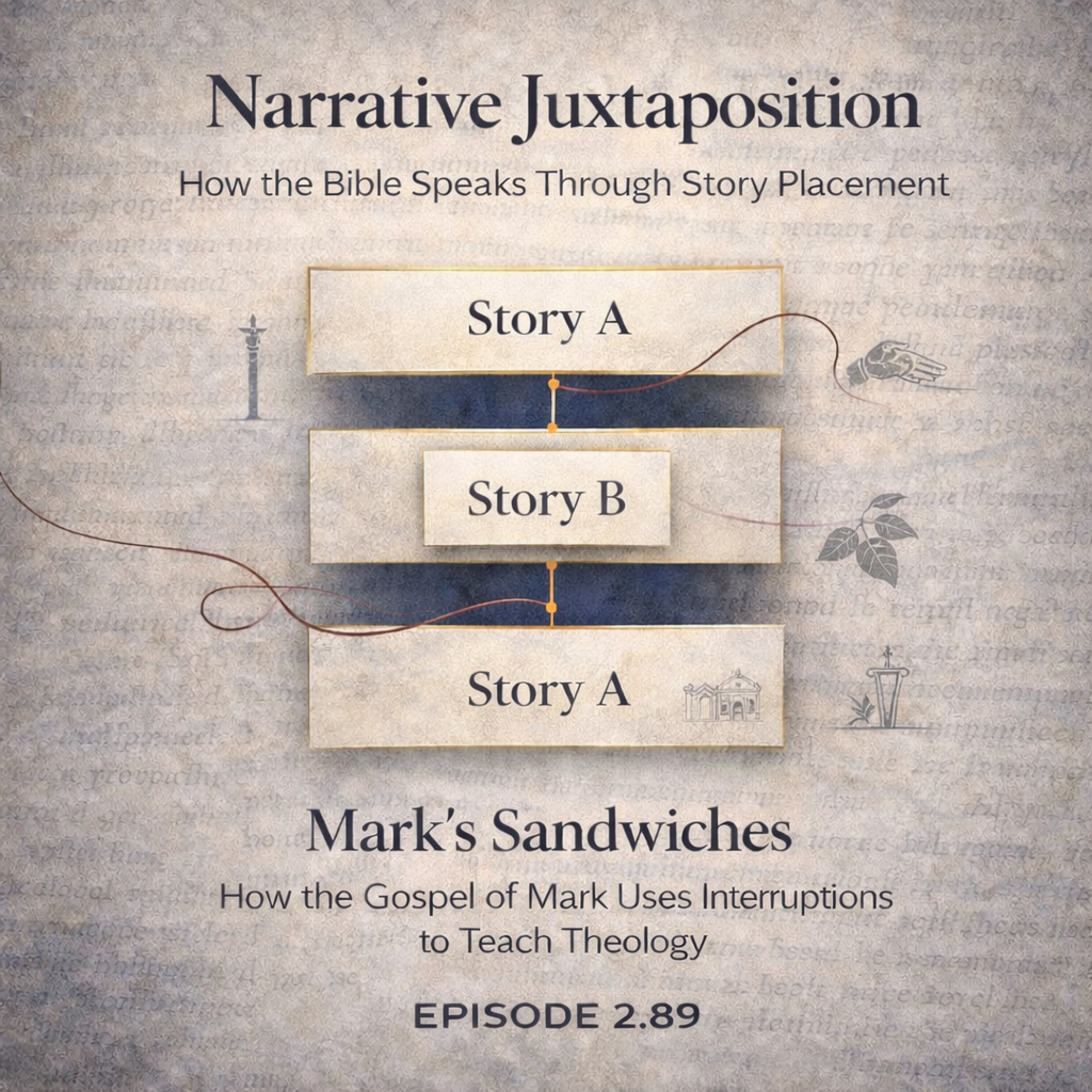
Mark’s Sandwiches: How the Gospel of Mark Uses Interruptions to Teach Theology
In this episode of Narrative Juxtaposition: How the Bible Speaks Through Story Placement, Michael and Zach examine one of the most distinctive literary techniques in the Gospel of Mark—often called the “Markan sandwich.”
Readers frequently notice that Mark begins one story, suddenly interrupts it with another, and then returns to the original narrative. At first glance the structure can feel abrupt or even chaotic. But when read carefully, these interruptions reveal deliberate narrative design. Mark places one story inside another so that each interprets the other.
We explore several of the clearest examples. In Mark 5, the healing of the bleeding woman interrupts the urgent mission to save Jairus’s daughter, showing that faith remains meaningful even when God’s timing includes delay. In Mark 11, the cursing of the fig tree frames the cleansing of the temple, revealing the fig tree as a symbolic judgment on fruitless religion. And in Mark 6, the joyful mission of the Twelve is interrupted by the execution of John the Baptist, reminding readers that faithful proclamation often leads to suffering.
Throughout the episode we show how Mark communicates theology not primarily through explanation but through narrative placement. The Gospel’s structure forces the reader to slow down and hold multiple scenes together, allowing the stories themselves to interpret one another.
By paying attention to how the stories are arranged, readers begin to see that the interruptions are not distractions—they are the interpretation.
Find our videocast here: https://youtu.be/MmElw3Zd0fA
Merch here: https://take-2-podcast.printify.me/
Music from #Uppbeat (free for Creators!):
https://uppbeat.io/t/reakt-music/deep-stone
License code: 2QZOZ2YHZ5UTE7C8
Find more Take 2 Theology content at http://www.take2theology.com
Hosts & Guests
Transcript
All right, let's say it. Let's pick a word on the count of three. One, two, three.
Just a position. Oh, what'd you say?
Gobstones. I don't know. I don't know how that we were.
I just wanted to say of really random word.
Okay, okay.
Because we're in our juxtaposition series.
Episode two, I don't know if you're like me starting a new series just like,
it's the best. I like,
fade as a series is going.
But like the first one or two, I'm like so pumped for like,
screaming the discussion, big picture. It's like, wow, I get excited.
And then you're ready to stop with Joshua. Yeah.
After they conquered the land, right?
Like, we don't need those last four episodes or whatever it was.
Yeah, the new series is good.
Last week, we talked about Matthew,
this Jewish gospel and how the Gentile inclusions just really stand out.
We're staying with the synoptics.
And I hope you're hungry, Michael.
Cause I am.
We're talking Mark sandwiches.
Sounds good.
How interruptions interpret.
We'll define some of these things.
But big picture.
Mark keeps interrupting himself.
We're going to tell you why.
I've got a very good idea.
Michael's very excited.
He was like, oh, yeah, this is this is great.
We'll look at Mark and some of these different examples of a story starting
and then getting interrupted and then finished.
And it fits this idea of juxtaposition.
Like, why is this happening?
Yeah.
Is this on accident and Mark loses train of thought?
Are we just writing things like randomly?
Holy spirit interruptions.
There you go.
Holy spirit interruptions.
Let's talk Mark sandwiches.
Let's take it to the next level.
Let's fire up the 20 music.
From the hearts of the low country in South Carolina.
It's the take two podcasts where we take theology to the next level.
We see Mark interrupting him.
So about if you read through Mark, obviously, you've got good reason for thinking this.
But it's like, what?
Why'd he stop this story?
And then most noticeably, I think sometimes this happens like in the Holy
week leading up to Easter.
We see like the fig tree and it's like, he starts a story,
but he finishes it later.
Why not just like say the whole story all together?
Yeah.
Maybe there's trying to he's trying to make a point.
Maybe he's trying to make a point.
And maybe like if you're reading someone else's story,
yeah, you're like, oh, there's a bigger point here.
And you would interrupt that story.
Yes.
Get that bigger point.
And then go back to reading the rest of the story.
Yeah, it might help you understand.
It better because you could just read through it and you might say,
man, this feels rushed, feels chaotic.
It feels like where's the editor on this thing?
But check this out.
What if the interruption is the interpretation?
Like what if that hopes you understand the story more?
What we're kind of putting forth in this episode is that Mark
preaches theology by inserting stories inside of other stories.
The middle helps give clarity to the outside stories.
So it's kind of, it's not exactly a chiasome,
but it's kind of chiastic.
Yeah, kind of.
Yeah, because you got like the beginning and the middle.
And just like, you know,
it's just like we're all thinking it's an intercollation.
Oh, yeah, that's when you were explaining this,
I was like, man, he's talking about intercollations again.
And if that's, if intercollation's not
residing with you, just think a Markin sandwich.
Okay.
Which I like it.
I like that it's Markin, like Markin priority,
or you know what I mean, I like that Markin.
Yeah, we need something that,
because we know Markin priority,
gotta kick that to the curb,
but you don't want to get rid of the word Markin,
so Markin sandwich is...
But you did nail it when you said chiasome,
because the structure is like that A, B, A structure.
Where the story begins, story resumes,
that middle point is the interruption that stands out
that helps us interpret everything,
and that the meaning emerges from how A and B,
how they're different, but how they connect.
Like, what do you take from that middle B
to help us interpret the A conversation?
And Mark kind of stands out,
maybe we can talk about, you know,
when we're thinking of things that make Mark unique.
How does it stand out among the other gospels?
Well, you know, from my interpretive framework,
I just had to give it from that.
I'm not trying to joke around,
because you should go back and watch our methane
and Markin priority.
Famously, I'm methane priority.
I love them.
But maybe this won't make a difference
in what you think comes first,
but I think Peter is kind of the apostle
behind the gospel of Mark, right?
Yes, you agree with that, right?
And so then if Peter, well,
and I happen to think that Peter has a gospel Matthew
and a gospel Luke,
and he's switching back and forth of them.
And given Peter's nature, he's reading this,
he's like, let me give you a story to illustrate this point.
Let me help interpret this story.
So he interrupts the story, Peter,
while he's teaching the Praetorian Guard,
and it gives the story,
gives some details, and he goes back to it.
And when you think of Mark,
you do think of like, there's a lot of agreement
between Matthew and Luke,
but then there's like these highlight color things
that the others don't have there,
that I think is Peter interjecting in on that story,
and saying, all right, let me give you
some even some more firsthand stuff.
That's good, and it's known for that real face.
It's like, yeah, it's sure it's fast paced.
We always see like, immediately,
like things are moving on and on.
It's from, and from one perspective,
the least explanatory, you know,
maybe outside of these little sides,
like it just kind of gets the main points.
A lot of times, Mark is showing,
rather than telling.
And so because of that,
some of this narrative placement,
does some of that theological work,
where sometimes he doesn't over-explain something,
but he arranges things.
That's kind of like, maybe we're pushing that a lot,
but that's what we're leaning into in this episode.
And so from, you know,
what you were saying,
that might not have any bearing on,
at least the priority, right?
It's kind of like, like,
you could, well, I guess he couldn't
be reading from Matthew.
Right, that part.
And doing this.
But maybe, let's say you are a Mark and priority,
and you think that there's like this oral tradition
that's being handled down, handed down.
Maybe you could say Peter's reciting that,
and then interrupting that.
And even if he wasn't like,
Peter was around for like Matthew.
Or you know what I'm saying?
Like, you know what I mean?
So that wouldn't be like, totally, you know,
I don't know the shortest.
I always fall back like,
but I guess it does make sense to,
you're going to want to give like the cliff notes
versus like you want to build on to something,
might not be as, I'm always thinking like,
oh, I want to add to something rather than take away.
Yeah.
But let's look at these examples.
Let's look.
It might be too much to read some of these,
but Mark five versus 21 through 43,
we have this, a couple of stories here.
I don't want to tackle this, Michael.
Cause I don't know if it's too much text,
it's kind of a lot of text.
It's right on that tipping point.
I know, man.
It would be, but I can, if we want to,
I can kind of give it a speedy read.
Let's give a speed read.
Okay, all right, we can do that.
All right, so this is five, 21 through 43.
When Jesus crossed over in the boat
to the other side, a large crowd gathered around him.
And so he stayed by the seashore.
I'm one of the, one of the synagogue
officials named Jerryus came up
and on seeing him fell at his feet
and implored him earnestly saying,
my little daughter is at the point of death.
Please come and lay your hands on her
so that she will get well and live.
And he went off with him
and a large crowd crowd was following him
and pressing in on him.
A woman who had had a hemorrhage for 12 years
and had endured much at the hands of many physicians
and had spent all that she had
and was not helped at all but rather had grown worse.
After hearing about Jesus,
she came up in the crowd behind him and touched his cloak.
For she thought, if I touch his garments, I will get well.
Immediately the flow of blood was dried up
and she felt in her body that she was healed of her affliction.
Immediately Jesus perceiving in himself
that the power proceeding from him had gone forth
turned around in the crowd and said,
who touched my garments?
And then the disciples said to him,
you see the crowd pressing in on you
and you say, who touched me?
And he looked around to see the woman who had done this
but the woman fearing and trembling
aware what had happened to her came and fell down before him
and told him the whole truth.
And he said to her,
daughter, your faith has made you well.
Go in peace and be healed in your affliction.
While he was still speaking,
they came from the house of the synagogue official
saying your daughter has died.
Why trouble a teacher anymore?
But Jesus over her, what was being said
said to the synagogue official,
do not be afraid any longer only believe
and he allowed no one to accompany him
except Peter and James and John the brother of James.
They came to the house of the synagogue official
and he saw a commotion and people loudly weeping and willing
and entering in he said to them,
why make a commotion and weep the child has not died
but as a sleep?
They began laughing at him but putting them all out,
he took along, took along the child's father
and the mother and his own companions
and entered the room where the child was.
Taking the child by the hand he said to her,
Tali Thakum, which translates means little girl
I say to you get up, that's a big translation.
And immediately the girl got up and began to walk
for she was 12 years old and immediately
they were completely astounded and he gave them
strict orders that no one should know about this
and he said that something should be giving to her to eat.
Yeah and I'm glad we read it all.
I think that is helpful.
We see the story A, it's like boom.
The big, boom and it's like no transition.
Just sit there.
Just starts a new story.
Very, very crazy.
We see this first story of Jarius that that book ends
and in the middle, we've got this boyding woman.
We look at Jarius, the synagogue leader,
very respective, respected, he's given a name.
We know a lot about him, his daughter is 12 years old,
daughter not doing well, daughter is dying.
We read this and Jarius is earnestly saying,
my daughter's at the point of death,
there's urgency, immediate action is needed.
She needs to be saved right this seconds.
So you would assume like, okay, let's do this.
This is like, we're on pins and needles.
Tell us how this plays out.
And then it's like, no, we're like in the same story
but we have this bleeding woman, very strange.
It says she's been suffering for 12 years.
That Jarius's daughter is 12 years old.
You can see this obvious connection.
This woman's not named.
It's kind of the opposite.
Jarius is named and respected.
Just like a no named person socially unclean,
financially doesn't have a lot of money.
Spin it on, you know, physicians, this kind of thing.
Been suffering, kind of the opposite.
I didn't even catch the 12 years.
I never did either.
So you said, I'm sitting here thinking for the last 10 seconds
like, how did I never catch that 12 years, 12 years ago?
It's like in your face, but you can just like,
I'm the same way, it's like you can just go over.
And so you see, you've got this powerful Jarius,
powerless lady, very public versus invisible woman
who's just in the crowd lost in the crowd.
This, you know, clean versus unclean.
And when Jesus does, he stops, he asks questions.
It's like, he's like on a different time table.
Yeah, and the disciples almost review him.
I tried to like, it was like, you see
all the people around you.
You're constantly being touched, Jesus.
And you're gonna say, who touched you?
Yeah, what do we even, what do we do in here?
Yeah, yeah.
The critical moment, Jesus basically says,
you know, don't fear.
Just believe and you step back and you see, you know,
God's power obviously applies in all different situation.
Powerful, powerless, named person, you know,
one of many clean, unclean, all these different things.
But it's not limited by time, like Jesus can do.
What do you want, things will work out.
Jesus is Lord over things like death,
over things like impurity.
That faith is really at the center.
This woman has faith.
Jarius has faith.
That's like very evident what others did not have faith.
Right.
When the interpretive framework was there,
because I don't know, I never read this,
with that interpretive framework in mind.
I was like, okay, he ends basically saying,
you know, your faith healed you, go.
And then boom, you see the scene where people don't have faith.
Yeah.
And he's like, get out of here.
And he turns to Jarius and he says something like,
if you have faith, she'll be fine, right?
Does he say something like that?
Something like that.
Like it's exactly, I don't know exactly,
but you can look for it.
I think so.
Do not be afraid any longer, only believe.
Only believe.
Oh, that is good.
And so I think that really sets the stage.
We've got maybe a couple more examples here.
Let's look at Mark, chapter 11.
And we will look at verses 12 through 25, same thing.
I can speed read this and we'll get this on the way.
So the story A is Jesus curses the fig tree.
It goes on the following day.
When they came from Bethany, Jesus was hungry
and seeing in the distance a fig tree in a leaf,
he wanted to see if he could find,
if he could find anything on it.
When he came to it, he found nothing but leaves
for it was not the season for figs.
And he said to it,
pay no one ever fruit from you again.
And his disciples heard it.
All right, story B.
And they came to Jerusalem and he entered the temple
and began to drive out those who sold and those who bought
in the temple and he overturned the tables
of the money changers and the seats of those who sold pigeons.
He would not allow anyone to carry anything through the temple
and he was teaching them and saying to them,
does it not written my house shall be called
a house of prayer for all nations,
but you've made it a din of robbers.
And the chief priests and the scribes heard it
and were seeking a way to destroy him
for they feared him because all the crowd
was astonished at his teaching.
And when evening came, they went out of the city.
Then back to story A.
As they passed by in the morning,
a solid fig tree had withered away to its roots
and Peter remembered and said to him,
Rabbi, look, the fig tree that you cursed has withered.
And Jesus answered them half faith in God.
Truly, I say to you, whoever says to this mountain
be taken up and thrown into the sea
and does not doubt in his heart, but believes
that what he says will come to pass, it will be done for him.
Therefore I tell you, whatever you ask in prayer
believe that you have received it and it'll be yours.
And whenever you stay in praying, forgive.
If you have anything against anyone
so that your father also who isn't having
may forgive you, your trespasses.
All right, we got these two stories like,
what are we doing, Mark?
Why are we making these so different to story A,
the fig tree curse, we got this tree, looks totally healthy.
There's no fruits.
Jesus is looking for fruit.
And so we curse, it also seems weird.
Like on the surface, it's not the season,
why are we getting upset, it seems petty,
it does kind of feel out of character.
But no fruit.
But no fruits.
No fruit.
But it's not supposed to, but it's not this yet.
So we get to temple cleansing.
Religious activity is going on everywhere.
I'm clearly, there's economic exploitation.
Prayer is contrasted with like profit,
dinner robbers.
There's a, this is not great.
And if you were to look at some key
Old Testament text, Isaiah 56 talks about, you know,
being a house of prayer for all nations,
Jeremiah 7 talks about dinner robbers.
So he's kind of like bringing in this Old Testament imagery
with the prophets, it talked about.
And then we get to the second half of that fig tree
being withered, the disciples notice
that the tree is dead from the roots up.
And so we would be wise to connect this tree
with what's going on with the temple.
I have never connected it before.
It's weird, right?
Now, did you study that, was this part of your graduate work?
This was, this was not.
Okay.
The one that started it all was going through,
we were going through the Joshua series.
And I got thinking about Josh, Joseph and Judah,
like how it got for this.
And looking back in the commentators
would bring back like all the way.
And I was like, oh, and those two were right there.
And I was like, I want to,
and then when I was doing like the grace relations
like on ethnicity class, I did,
it was point out me in a book, the Matthew thing.
Like how, that's such a big deal.
So you went out and sought for other ones.
And then I sought for other ones.
Like where does it, where does it do this?
And then I came across this one, yeah.
All right, yeah.
That is crazy.
Those two places got to be other places, yeah.
It's like right there, like hidden in plain sight.
I think people are saying this fig tree,
like those, that temple, no fruit.
No fruit.
It looks good.
The temple looks beautiful.
Yeah.
Everything's where it should be.
A lot of activity.
Right.
But that judgment explained symbolically that fruitlessness,
man, leads to judgment even for those in God's house.
Right.
Easy.
Can it be more clear?
That is, it's like, wow.
It's just like crazy.
Yeah, yeah.
Oh man.
That's great.
Good stuff.
Mark six, get your speed read on it,
because I think it is helpful that if we're able to read through these,
this is verse seven, through verse 30.
All right.
We can get turned to the right page, verse seven, through 30.
And it says, and he's, let me just make sure, six, yeah.
When he summoned the twelve and began to send them out in pairs and gave them authority
over the unclean spirits, and he instructed them that they should take nothing for the
journey except them, your staff, no bread, no bag, no money in their belt, but to wear
sandals.
And he added, do not put on two tunics.
And he said to them, whenever you enter a house, stay there until you leave town.
Any place that does not receive you or listen to you as you go out from there, shake the
dust off the souls of your feet for a testimony against them.
They went out and preached that the men should repent, and they were casting out many demons
and were anointing with oil, many sick people, and healing them.
And King Herod heard of it.
So this would be story B.
Okay.
Great.
Yes.
And King Herod heard of it for his name had become well known.
And the people were saying, John the Baptist has risen from the dead.
And that is why these miracle miraculous powers are at work in him.
But others were saying he's a legend.
Others were saying he's a prophet like one of the prophets of old.
But when Herod heard of it, he kept saying, John whom I beheaded has risen.
For Herod himself had sent and had John arrested and bound in prison on account of Herodius,
the wife of his brother Philip, because he had married her.
For John had been saying to Herod, it is not awful for you to have your brother's wife.
Herodius had a grudge against him and wanted to put him to death and could not do so.
For Herod was afraid of John knowing that he was a righteous and holy man.
He kept him safe.
And when he heard him, when he heard him, he was very perplexed, but he used to enjoy listening
to him.
A strategic day came when Herod, on his birthday, gave a banquet for his lords and military
commanders and the leading men of Galilee.
And when the daughter of Herodius came in and danced, she pleased Herod and his dinner
guest.
And the king said to the girl, ask me for whatever you want and I will give it to you.
And he swore to her, whatever you ask, I will give you up to half my kingdom.
And she went out and said to her mother, what shall I ask for?
And she said the head of John, the Baptist.
Immediately she came in and her to the king and asked, saying, I want you to give me at
once the head of John the Baptist on a platter.
And although the king was very sorry, yet because of his oath and because of the dinner guest,
he was unwilling to refuse her.
Immediately the king sent an executioner and commanded him to bring back his head and he
went and had him beheaded in prison.
And brought the head on the platter and gave it to the girl and the girl gave it to
her mother.
When his disciples heard about this, they came and took away his body and laid it in
a tomb.
The apostles gathered together with Jesus and they reported to him all that they had done
and taught.
So if we're thinking this is a sandwich, the piece of bread on the other end is very
short.
Very short.
And the apostles came back.
They reported to Jesus.
So story A, the mission of the 12 we see authority is given.
There's power over demons, they're preaching repentance and we see it and it's like pretty
exciting.
It's it's kingdoms expanding.
There's momentum.
They're they're they're doing these signs and wonders.
It's like man, what can stop God?
Nothing can stop God.
And then right immediately after we get all this excitement, that's John the Baptist just
be it's not good.
Not great.
The faithful prophet speaks truth in the face of, you know, politics executed unjustly.
There's political corruption, making them a public spectacle, brutalities like overemphasizing
this in a strange way.
And so you read these two things together, what are we supposed to think about?
You know, it's not that discipleship is always going to be awesome.
You're going to like cast out demons.
You're going to be the best person in the world.
This discipleship includes danger.
I'm being faithful does not guarantee safety, proclamation can lead to suffering.
I think it's good to hold these two so you don't like run off in one.
It's not all dealing with, you know, material at least not all, you know, prosperity,
but sometimes it's attention.
Sunshine and roses.
Yeah.
Sometimes it's dungeons and beheading.
I that's yeah, yeah, it could be could be good could be bad.
It could be bad in both of these, you know, holding up together gives you that that balance
where you don't get, you know, a one-sided, one-sided view.
So Mark Sandwiches, that was three Mark and Sandwiches.
You fool.
I thought they were good, especially the center one.
That was cool.
You sandwiched, you know, two good ones, but you put the best one in the middle.
So you were making a sandwich of Mark and Sandwiches, right?
Well, like a triple decker.
Yeah, there you go.
And we see, you know, these different theological themes being promoted like faith, you know,
God's over time.
Faith is at the central moment, no matter what's happening, judgment being revealed symbolically
to those that don't produce fruit.
And then this realistic view of discipleship.
And really, it, when I, more I read scripture and go through some of this like biblical theology
and see the connection, did it, it is, it is literary genius.
Like, you can't craft stuff better than this.
That's really good.
It is really good.
So, so readings, look at their placement, you know, you should think about why, why is
this here, especially if you're like, man, seems like everything's going great for the
disciples, the terrible, like, you, you see these things just start and think about it
because I think that tells you a lot about what you are reading.
Yeah.
It's hard to always have that peer, per view, but it's like good, good to think about
big picture, what's going on.
Sometimes, you know, I think it goes both ways.
It's like, I think what we do well of in our tradition is nailing down the details.
We hang on to every word and we should.
Yeah.
And we're parsing out and that's good.
But man, you can also miss the force for the trees.
Yes.
Yeah.
And you really can.
And I found that more so true in my life, missing, it's like, man, I'm singing this
big picture.
I mean, it's like, you were saying it's like, it's right there, it's right there.
So it's good to, you know, it's good to zoom in and zoom out.
Do both those things.
Yeah.
It's very good.
Um, next, we've got a few more line about if we'll use all of these, um, but, uh, you
know, maybe we'll talk a little profits down the road, something else, um, anything else
you got on mark or sandwiches.
Uh, I mean, sandwiches are great.
Yeah.
I've never invented a sandwich.
Great job.
Yeah.
It's just something like that.
Okay.
Okay.
Yeah.
Yeah.
I don't know.
I think that's what we're told.
Yeah.
I don't know if that's actually that's actually the thing.
Yeah.
It's great.
Maybe it is.
Um, well, if nothing else, we can transition.
Yeah.
Let's do that.
To the last take.
Last take.
Man.
Yeah.
Um, so the clue that I remember the clue that I said, like, if I forget to remember, it
was like, uh, it was, uh, it was something like not very good.
Not very good.
Yeah.
So, uh, some of our listeners will know, I know, you know, yeah, that, uh, there are,
there are some group of men at our church.
Uh-oh.
Uh-oh.
We played D&D.
Uh-oh.
Uh-oh.
Uh-oh.
Uh-oh.
Uh-oh.
Uh-oh.
Uh-oh.
Uh-oh.
Uh-oh.
Uh-oh.
Uh-oh.
Uh-oh.
Uh-oh.
Uh-oh.
Uh-oh.
Uh-oh.
Uh-oh.
Uh-oh.
Uh-oh.
Oh yeah, I see that.
Oh yes, I see that.
Uh-oh.
Uh-oh.
Yeah.
Yeah, yeah.
And, man.
Like, not that easy to do.
Uh-oh.
And I was, um, I put a lot of time in, so I took the song from the Hobbit.
Yeah.
And I, you know, put different words to it.
So, I was thinking a long time about that.
Yeah.
And then I was like, having to like, put it into my song thing.
So, cause you had to like, build a hear it so that you're, you're with it.
So, you had to keep your work at your office.
Yeah.
You had to hear it and sing it, and which it was a really weird thing.
and this song was a little bit weird.
And I put it together and not good.
Oh yeah, yeah, yeah.
I was like, I don't think I'm ever gonna let anyone hear this.
I may try it again, because I was I was telling Jonathan,
like I got some excuses, like my throat,
you know, I was coming off of a little bit of a sickness
and so, and I think maybe I can do my set up
a little bit better, but man, I listen back to it.
I was like, I was just laughing.
I was like, this is not good.
That's so funny.
How challenging that is, yeah.
Man, you want to play it?
Give us, you did not, did you, did you play it at the,
I did not play it for that.
And they're like, will we ever hear it?
I'm like, not in the serious thing.
Maybe we just want to laugh.
Oh, that's good.
Man, yeah, this thing, it's funny.
You look at like somebody's video stuff and you're like,
I mean, obviously it's hard work and perfection
all these things, but it just seems like it just
effortlessly put together, you know?
Yeah, and I wonder what their set up is,
because I see some people like, I was recording
into my phone and listening from the computer
because the computer would scroll and use it for me.
Oh, yeah.
And this mic is here and not at my house.
Oh, yeah.
If I had this mic, maybe I would sing into this mic
and then listen to my phone, but yeah,
you have to hear the music so that you can do,
you can have the rhythm, you know,
and the tempo and stuff be the same every time.
So you're singing to a track, but you're only,
but only that's getting recorded.
So it was, it was a good experience.
Give me a better appreciation for those people in mind.
Like, okay, you've figured this out.
Even singing in tune, like you would think,
but like it's with that noise right in my ear.
Yeah.
Like sometimes I'd be like, why did I go flat or sharp
on that note?
I shouldn't have.
It was, it was humbling, I'll say that.
I've often thought we should do a take to,
do a take to song.
It'd be, it'd be, it'd be, it's not good.
Yeah.
Mainly because I can't, I don't, I can't sing.
Like a little jingle or something.
A little, a little jingle, you know?
Give, you know, never know.
So if you want to see that, you know, put in the comments.
Man, yeah, all those things.
There's like so many great ideas I have of like,
a little skit here, a little thing there.
It's just so hard to edit stuff.
I mean, I don't do any of it anyway,
but it's like, you just gotta like,
it's too much work, you know?
Yeah, I don't know if it's on this channel,
like this channel, back in the day,
was my personal channel.
Yeah.
And I started putting some like,
apologetic classes up there and stuff,
but it was like, there was like,
you can probably see since you have editor rides or something,
but you can go back and like at the very first videos,
I have just a lot of personal videos that are unlisted.
So I don't, I think, I don't know if it's on this channel.
Once we kind of, when I started doing like,
Chris, a clear Christian thinking,
we were entitled to channel.
I put together, I was like, okay,
I need to kind of separate my personal videos
from this channel.
So I did create a just a different channel
that is Michael Mott.
So I say all that to say,
I don't know where this video lives.
It could be on that one.
It could be on both, I don't know.
But I did, we did back when Julia was born.
Yeah.
2013, we put, I put together a edited video of Chloe and Lydia,
called the Insisters.
Oh, that's funny.
And because when we were visiting Jill,
they would fight for the,
who's gonna push the buttons on the members in the UFC?
Oh, it's a gay, yeah.
And so, Ju-ju, Jill's mom got on to him.
Like, y'all should be, you know,
you should be, the first show of the last,
last show of the first, you know,
you should be wanting your, you know,
you should love each other enough, let go.
So the next time they're like,
no, you go first.
You go first, you go first, you go first, you go first.
So then we made a little skid out of that,
called it the Insisters,
because they were insisting that the other one goes first.
And that's good.
That's really get insist, man.
So good, you know,
I had, you know, when you think of something,
I'm just like too tired.
I had, it was such a good thing to add here.
It was another plug for this stupid video,
made this little skit in college that I'm gonna,
that, that, that, that, yeah, yeah.
I don't remember what we called it Smith 232,
because that was the name of our dorm and our dorm room.
Smith 232, our room mates.
And this is from Bob Jones.
Bob Jones, the bears.
Bruins.
The Bruins, they are bears.
Yeah, I mean, you're not wrong, yeah.
Yeah.
It was, yeah, so it was good.
You know what they were called before the Bruins?
You told me this before.
Is it a good name?
Honestly, I actually like it.
What was it?
The swamp angels.
Swamp angels.
Crazy.
I think, maybe I made that up and I think I don't think any,
but that's what they were back in the day.
Yeah.
Speaking of the bears.
Yeah.
Like a Bruins bears.
Have you heard that the Chicago bears are probably gonna
move out of Chicago and the Indiana?
Yeah, the bears are gonna move to Indiana likely.
It's just like tax reasons stay.
That seems weird, they don't have space in Chicago
or like what's the deal?
I think they're just tired of Chicago.
No, are you serious?
Yeah, and Indiana could...
Indiana'd be a better market than Chicago.
Well, it's like, you know, there's like...
I know it's not far.
It's not far.
I guess they're just thinking they'll keep all their fans,
like they won't like alien and so...
So, I guess so.
I don't know.
Yeah, go check it out.
I just saw it to read about it.
I know that's crazy.
Because bears is like one of those.
I mean, I haven't been good for forever,
but it's like so like just tradition.
The iconic, yeah.
Yeah, yeah, yeah.
That is crazy, man.
Sports teams, man, no allegiance.
It's very confusing.
Like the Oklahoma City Thunder used to be
the Seattle Supersonics, and it's just weird because...
Who was there Timberwolves?
Minnesota Timberwolves.
They were still rounds.
What is it?
Minnesota Timberwolves?
Minnesota Timberwolves.
Yeah, yeah, yeah.
But it's weird when a team like moves,
like I guess Oklahoma City like has all the history of Seattle,
but they're different team different countries,
but it's like the account, they made it to the...
You can be like, okay, see, made it to the finals in 1998 or so.
You know what I mean?
It's like weird.
It's totally...
Where did they go?
Where did the Grizzlies come from?
Yeah, where did they come from?
Where did they go?
Cotton Eyed Joe.
There you go.
Where would you say a lot of Grizzly bears are?
Like what do you think?
Like if you just had to guess what part of the country?
Well, up in the like Washington...
Yeah, very close Vancouver.
Yeah, yeah, yeah.
So yeah, they went Vancouver Grizzlies,
and I guess Canadians didn't love it.
Yeah, so yeah, I mean Seattle Vancouver,
both lost teams, like they got kind of...
So but they went down to Memphis.
Then where do they...
They are Memphis.
Oh, they start still in Memphis.
Yeah, surprisingly, because they don't make a small market.
It's hard to make money.
They're still Memphis.
They just don't play in the...
FedEx pyramid.
They don't play in the pyramid, yeah.
Oh, okay.
I thought they left.
Yeah, they had to build the FedEx forum.
Okay.
So yeah.
So there is a sports team within driving distance.
Yeah.
And just curious to get some good...
They're a mess.
But they...
I don't know if you know anything about John Morant.
Wow.
He's got this bad habit of like pulling out guns
on his Instagram videos.
And it's just not...
Can you imagine the league doesn't love it?
Yeah.
He's a player on the team.
Yeah, he's like...
Amazing athlete.
He's like the perfect athlete in the fact that he's like
six foot one and can jump...
It's like a short guy who can just like jump over people
and dunk over people.
He's like...
He's been injured and not been good.
And he's been suspended and stuff.
So he's kind of been a bummer.
But he was like their guy.
You know, it's kind of falling apart.
Yeah.
So maybe you know this...
This is going a little long.
But maybe you know this as a PT.
You know, you have slow twitch and fast twitch.
Yeah, yes.
And strength is generally associated with fast twitch muscles
lifting and stuff, right?
Well, some lifts.
Yeah, yes and no where...
Some strength takes a few seconds
like to get strength like for a deadlift or squat.
You're gonna use both.
But fast twitch is usually explosive, fast,
which is a little bit different than strength,
although they're more similar than endurance.
But all of us say it's a big spectrum.
It's not like type two type one.
It's like, I mean, it's everything in between.
Yeah, so back when in my more trim days,
even I was just never a dunker.
I just never had the explosiveness to jump.
Yeah, but a strong guy.
But a strong guy, I mean, you've heard me say it.
I don't know that you believe it,
but a sprinter back in the day.
So I was always puzzled by this.
That is so interesting.
Because this is not, this is,
this is always true what you're saying can't be true to.
But nine times out of 10,
you find the guy that can jump the highest,
probably the fastest, not always true,
but that's like a really good correlation.
But not all the time.
Yeah, and I will say this,
I was not faster than the running backs.
Oh, right, yeah, but you're state.
Yeah, yeah.
But I was, so I guess that is a good measure, you know,
being the fastest O-Line men and the best,
I think I had either the best or the,
I don't know if it's a walk on at A state.
Yeah, yeah, yeah.
How do you, the best or the second best vertical
of the O-Line men?
That's, yeah, that's impressive, yeah.
But I was also, some of those guys were 350.
Yeah, that's probably the limiting.
In college.
And I was like, 255, 265.
So I was having to get less up in the air.
Yeah, that's probably a lot of it too.
It's like, it's a lot easier to jump.
Like if you're producing the same amount of force,
which you have a less weight to push,
that's also big part of it.
Yeah, big part of pull ups too.
Yeah, that's true.
There was one time in my life that I could do pull ups.
Is in the Navy, I was running all the time.
And I weighed more then than when I was,
maybe I could have done a pull up in football.
We didn't do them a lot at A state.
We were lifting like crazy all the time at A state.
Yeah.
But I don't know that pull up was in there.
It's great.
But when I was in the Navy and we were running all the time,
I went into a gym and I was like,
well, just seeing, I was like,
I'm like, I need a pull up.
You're like, never not be able to do a pull up again.
And it's like, you know, 12 months later,
I was like, I can't do a pull up anymore.
Yeah, it's so funny like finding those,
because obviously I'm the opposite where it's like,
I'll go to the fair and they'll be like,
do 15 pull ups, you want a prize, I'll be easy.
Let's do it, but I'm not very strong.
But I can do a lot of pull ups or you know what I'm saying?
So it's all, and I could always jump high and run fast,
but it's all relative to body weight where,
you know, I wasn't putting up great numbers
in the weight room.
Yeah, which was crazy, because you know,
I just kind of returned to weightlifting
and like on my second or third one,
I did my peak on my bench, like 205, five times,
which is...
Oh yeah, yeah, yeah, yeah.
That's pretty good.
So I'm like 225 is right around the corner,
which is like what a lot of people are like,
they, if you can get 225, but I'm a big guy.
So you would think that, you know,
I have probably just, I don't know, more mass, more frame.
Man.
Yeah.
It is, it is crazy.
Yeah, I've been, I've been falling off
a little bit, I was doing a lot of speed work
and I sprinting and something.
A couple of people I play, Frisbee played,
or they didn't, they were in a track like college.
And...
You're so much faster.
They haven't noticed, but I did.
This is really a compliment.
Not that out Frisbee's a lot, but they're like,
there's like three guys that were in a track in college
and they're like, exactly, you were in a track in college,
right, they're like, and I was like, no.
It's great, I was like, you know, but they're like,
man, they're like, which it's, they're like, man,
you were perfect for that, they placed me,
can you guess what distance they placed me?
Not a high distance, but higher than a, you know, fast.
I would say 200.
See that, that would be better.
They placed me at the...
400?
800.
Oh, the 800, yeah, yeah.
And I looked at, I looked at like,
what's like an Olympic frame, like a weight level,
800 meter runner, and they're like, ideal as like,
five, nine to six, one, like 160 pounds.
That's like, you have to be that,
like that's like what you have to be done that.
Because you're, I'm a little bit...
You're trading off what you're carrying
with your muscle that you have to do.
Yeah, it's like a, it's like a mix where,
if you run the 100, you probably need to be like,
15 pounds more of muscle.
If you're gonna run like longer distance,
you'll be a little bit thinner,
but that's like the, that's like what, you know.
Now that I think about my answer, 800 is better.
Yeah, they're like, man, you're built for the 800.
Yeah, I knew it got actually crazy.
It was in a carcass accident and died recently.
But you're build, and he would stay in the 800.
I was like, that's, I wish I had track, track to run.
But soccer, soccer was good, you know.
Basketball was fine.
Cause I, we can get off this time of running like,
but man, the best thing is just like
I got a small Christian school where it's like...
The best thing about Panther at the end though.
Who cares, you can tune out.
Yeah, yeah.
I loved it because I was always faster.
I was always faster and could jump higher than like,
anyone we played, and then like we,
like this was back when you first met this was good.
We had some friends that played like on you of them.
We played pickup games, and it's like a whole different game
when everyone there can like jump just as high as you,
run just as fast as you, and they're like five inches taller,
and they weigh 20 pounds more.
And you're like, oh, my, I have no advantage.
Like other people used to be taller than me or stronger than me,
but I could always get around them.
But when you find those people that are bigger and faster,
you're like, oh, this is like not even fair.
You see a six-three guy jump, and you're like,
oh, it's man, this is different world.
So there's levels to this where a small Christian school
is much different than the real world.
So, anyway, man, fun times.
Yeah, we're done.
That's our take.
That's our take.
Thanks for listening to Take Two.
Find us wherever you find podcasts
on YouTube for those who want to watch our video cast.


