Loading...
scienceastronomynatural
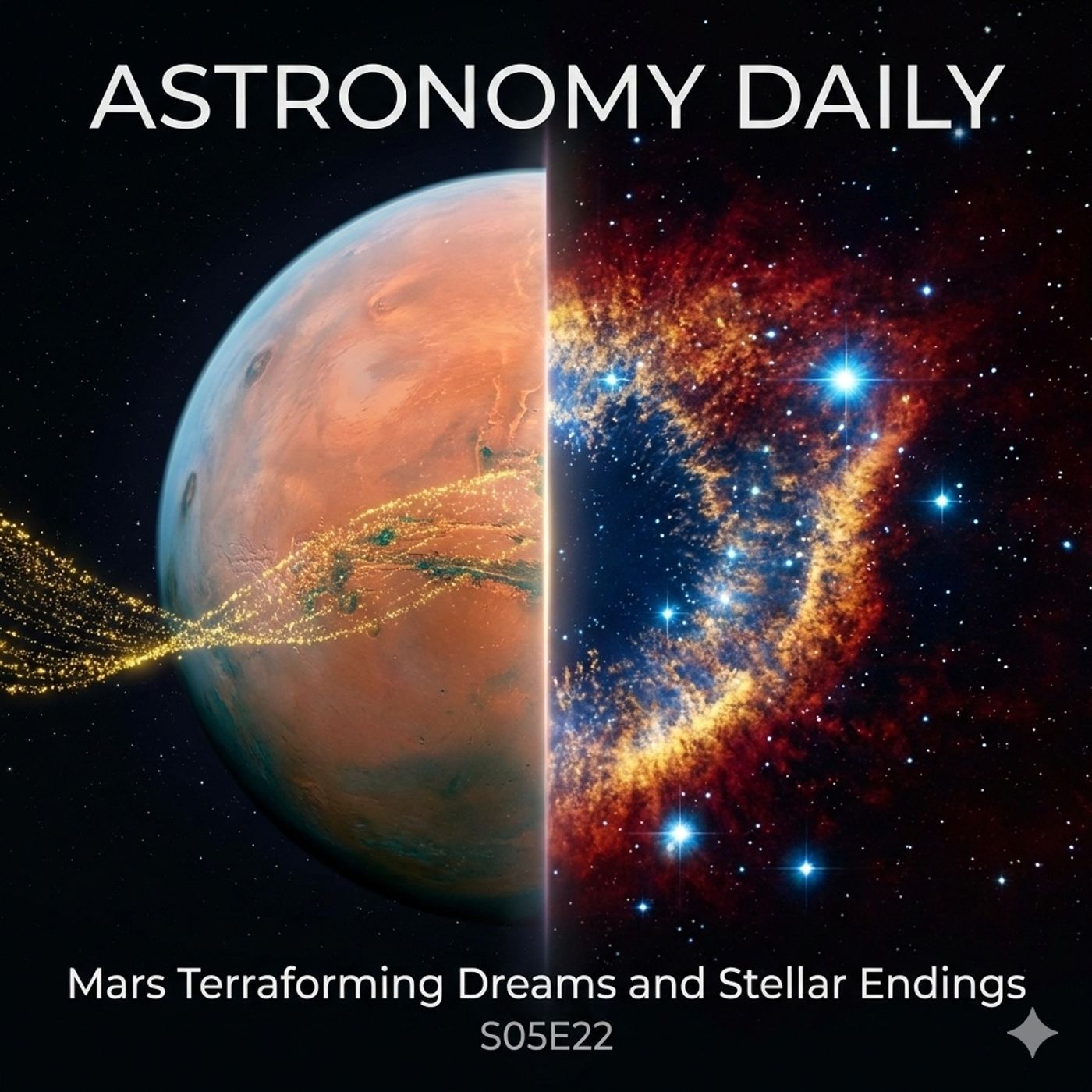
Terraforming Mars: A Real Plan & Webb's Dying Star Revelation
About this Episode
# Astronomy Daily - S05E22
## Monday, January 26, 2026
Welcome to Astronomy Daily! Join hosts Anna and Avery as they explore the latest developments in space and astronomy, from ambitious plans to terraform Mars to stunning new views of dying stars.
### Episode Highlights
**Mars Terraforming Gets Serious**
Scientists unveil a comprehensive blueprint for transforming Mars into a habitable world. Discover the three-phase plan using Martian resources, engineered nanoparticles, and hardy microorganisms that could warm the Red Planet by 30°C and eventually create breathable air. But should we terraform Mars at all?
**Harvesting Water from Mars' Atmosphere**
While underground ice remains the primary water source for future Mars missions, researchers reveal how atmospheric moisture could provide a crucial backup. Learn about the innovative technologies that could make Mars settlements more self-sufficient.
**Chandra's Cosmic Catalog Milestone**
NASA's Chandra X-ray Observatory has now cataloged over 1.3 million X-ray detections across the sky. We explore this treasure trove of data spanning 22 years of observations, including a stunning view of the Galactic Center with over 3,300 sources in just 60 light-years.
**Earthquake Sensors Track Space Debris**
Ingenious new research shows how seismic monitoring networks can track dangerous falling satellites in near real-time. Discover how scientists reconstructed the trajectory and breakup of China's Shenzhou-15 module using earthquake sensors.
**Water Worlds or Lava Planets?**
Shocking new findings suggest 98% of planets we thought were ocean-bearing "hycean worlds" might actually be molten rock. Learn about the Solidification Shoreline model that's rewriting our understanding of sub-Neptune exoplanets.
**Webb Captures a Dying Star's Beauty**
The James Webb Space Telescope reveals the Helix Nebula in unprecedented detail, showing us the eventual fate of our own Sun. Witness stellar recycling in action as a dying star distributes the building blocks of future worlds.
### Links & Resources
- Research on Mars terraforming strategies
- Advances in Space Research journal study on atmospheric water harvesting
- Chandra Source Catalog: cxc.cfa.harvard.edu/csc/
- Science journal publication on seismic debris tracking
- arXiv preprint on sub-Neptune exoplanet composition
- Webb Space Telescope Helix Nebula observations
For more space news and daily episodes, visit astronomydaily.io
Follow us on social media @AstroDailyPod
---
*Astronomy Daily: Your daily dose of space and astronomy news*
Become a supporter of this podcast: https://www.spreaker.com/podcast/astronomy-daily-space-news-updates--5648921/support.
Sponsor Details:
Ensure your online privacy by using NordVPN. To get our special listener deal and save a lot of money, visit www.bitesz.com/nordvpn. You'll be glad you did!
Become a supporter of Astronomy Daily by joining our Supporters Club. Commercial free episodes daily are only a click way... Click Here
This episode includes AI-generated content.
## Monday, January 26, 2026
Welcome to Astronomy Daily! Join hosts Anna and Avery as they explore the latest developments in space and astronomy, from ambitious plans to terraform Mars to stunning new views of dying stars.
### Episode Highlights
**Mars Terraforming Gets Serious**
Scientists unveil a comprehensive blueprint for transforming Mars into a habitable world. Discover the three-phase plan using Martian resources, engineered nanoparticles, and hardy microorganisms that could warm the Red Planet by 30°C and eventually create breathable air. But should we terraform Mars at all?
**Harvesting Water from Mars' Atmosphere**
While underground ice remains the primary water source for future Mars missions, researchers reveal how atmospheric moisture could provide a crucial backup. Learn about the innovative technologies that could make Mars settlements more self-sufficient.
**Chandra's Cosmic Catalog Milestone**
NASA's Chandra X-ray Observatory has now cataloged over 1.3 million X-ray detections across the sky. We explore this treasure trove of data spanning 22 years of observations, including a stunning view of the Galactic Center with over 3,300 sources in just 60 light-years.
**Earthquake Sensors Track Space Debris**
Ingenious new research shows how seismic monitoring networks can track dangerous falling satellites in near real-time. Discover how scientists reconstructed the trajectory and breakup of China's Shenzhou-15 module using earthquake sensors.
**Water Worlds or Lava Planets?**
Shocking new findings suggest 98% of planets we thought were ocean-bearing "hycean worlds" might actually be molten rock. Learn about the Solidification Shoreline model that's rewriting our understanding of sub-Neptune exoplanets.
**Webb Captures a Dying Star's Beauty**
The James Webb Space Telescope reveals the Helix Nebula in unprecedented detail, showing us the eventual fate of our own Sun. Witness stellar recycling in action as a dying star distributes the building blocks of future worlds.
### Links & Resources
- Research on Mars terraforming strategies
- Advances in Space Research journal study on atmospheric water harvesting
- Chandra Source Catalog: cxc.cfa.harvard.edu/csc/
- Science journal publication on seismic debris tracking
- arXiv preprint on sub-Neptune exoplanet composition
- Webb Space Telescope Helix Nebula observations
For more space news and daily episodes, visit astronomydaily.io
Follow us on social media @AstroDailyPod
---
*Astronomy Daily: Your daily dose of space and astronomy news*
Become a supporter of this podcast: https://www.spreaker.com/podcast/astronomy-daily-space-news-updates--5648921/support.
Sponsor Details:
Ensure your online privacy by using NordVPN. To get our special listener deal and save a lot of money, visit www.bitesz.com/nordvpn. You'll be glad you did!
Become a supporter of Astronomy Daily by joining our Supporters Club. Commercial free episodes daily are only a click way... Click Here
This episode includes AI-generated content.
Hosts & Guests
Transcript
Tyler Reddick here from 2311 Racing.
Victory Lane?
Yeah, it's even better with Chamba by my side.
Race to chumpacaceno.com.
Let's Chamba.
No purchase necessary, VTW Group.
Boy, we're prohibited by law.
CTNCs, 21 plus sponsored by Chamba Casino.
Welcome to Astronomy Daily, your source
for the latest space and astronomy news.
I'm Anna.
And I'm Maverick.
We've got another stellar episode
lined up for you today, Monday, January 26, 2026.
That's right.
Today, we're taking you on quite a journey through the cosmos.
We'll be exploring two fascinating Mars stories
that paint very different pictures
of the Red Planet's future, from terraforming dreams
to atmospheric water harvesting for survival.
Plus, we've got some incredible discoveries
from across the universe.
We'll reveal how NASA's Chandra Observatory
has catalogued over 1.3 million X-ray sources.
Discover an ingenious new use for earthquake sensors
that could save lives and uncover
why those water worlds we've been excited about
might actually be lava planets in the skies.
And we'll finish with a breathtaking look at our cosmic future,
courtesy of the James Webb Space Telescopes latest images
of a dying star.
Though, settle in, because we're about to explore
the universe together.
Let's get started.
Avery, let's kick things off with what could be one
of humanity's most ambitious projects ever.
Scientists are saying it's time to take terraforming Mars
seriously, and they've got a roadmap to make it happen.
This is fascinating stuff, Anna.
For decades, terraforming Mars has been the stuff of science fiction.
But new research suggests we might actually
have the tools to pull it off.
A team of planetary scientists, biologists, and engineers
has published what amounts to a blueprint
for transforming the Red Planet into a habitable world.
What's really interesting is the timeline they're proposing.
This isn't a quick fix.
We're talking about a multi-generational project
that could take centuries.
But the key breakthrough is that they
believe we can use resources already on Mars,
rather than shipping everything from Earth.
Exactly.
The plan has three distinct phases.
Phase one is all about warming the planet.
Right now, Mars averages around negative 70 degrees Celsius.
The scientists propose using engineered nanoparticles
made from Martian dust, shaped like tiny rods
and released into the atmosphere.
These particles would trap escaping heat
and scatter sunlight towards the surface,
potentially warming Mars by more than 30 degrees Celsius.
And here's the clever part.
This method is over 5,000 times more
efficient than previous terraforming schemes.
University of Chicago planetary scientist Edwin Kite,
one of the study's co-authors, notes
that Mars was habitable in the past.
So greening Mars could be viewed
as the ultimate environmental restoration challenge.
Phase two brings in biology.
Once temperatures rise enough to melt some of Mars's vast ice
deposits, scientists would introduce genetically engineered
extremophiles, hearty microorganisms
that can survive in the harshest environments.
These pioneer species would kick off ecological succession,
creating organic matter, and slowly
changing the chemistry of the surface and atmosphere.
And the final phase is the longest
and most ambitious, building a stable biosphere
with oxygen-rich air.
The goal is a 0.1 bar oxygen atmosphere,
which would be enough to sustain human life
without pressure suits.
Harvard planetary scientist Robin Wordsworth
puts it beautifully.
Life is precious.
We know of nowhere else in the universe where it exists.
We have a duty to conserve it on Earth,
but also to consider how we could begin to propagate it
to other worlds.
But this isn't just about making Mars habitable.
Nina Lonza from Los Alamos National Laboratory
sees Mars as a prime test bed for planetary engineering.
She suggests that if we want to learn
how to modify our environment here on Earth
to keep it habitable, maybe it would be better
to experiment on Mars first rather than being too bold
with our home planet.
Of course, there are serious ethical considerations.
As Lonza points out, if we terraform Mars will really
change it in ways that may or may not be reversible,
Mars has its own history, and we might lose the opportunity
to study how planets form and evolve in their natural state.
The researchers stress that we need to start preparing now,
even though actual terraforming is still far off.
Upcoming Mars missions in 2028 or 2031
should include small-scale experiments
to test these strategies, such as warming localized regions.
Any technology deployed must be reversible, controllable,
and biologically safe.
It's an audacious vision, but as the team points out,
30 years ago, terraforming Mars wasn't just hard.
It was impossible.
Today, with advances in technology
and our understanding of Mars, it's becoming a real possibility.
Whether we should do it is a question
we'll need to answer as a civilization.
Thinking with Mars, Anna, our next story
takes a more immediate look at how future astronauts
might survive on the red planet.
New research suggests that the Martian atmosphere itself
could provide a vital backup water source.
This is really practical thinking, Avery.
While underground ice remains the most promising long-term
water source for Mars missions, scientists are now exploring
atmospheric water harvesting as an adaptable solution
for scenarios where subsurface resources are inaccessible.
The study led by Dr. Vasilis Englizakis
of Strathclyde University and published
an advances in space research emphasizes
building a self-sufficient water infrastructure.
As Dr. Englizakis explains, reliable access to water
would be essential for human survival on Mars,
not only for drinking, but also for producing oxygen
and fuel, which would reduce dependence on Earth-based supplies.
The challenge is that Mars's atmosphere
is extremely thin and cold.
But it does contain trace amounts of water vapor
that could be collected and condensed
using specialized technology.
The study introduces novel approaches
inspired by Earth-based dehumidification
and sorption technologies.
What makes this particularly valuable is the flexibility.
While underground ice deposits are seen
as the most practical long-term solution,
their accessibility is limited, especially near likely
landing zones for human missions.
Since the precise location of usable ice is uncertain,
and excavation technology is still evolving,
having alternative sources is essential.
Atmospheric water harvesting offers a mobile,
adaptable alternative.
The equipment would be portable,
making it a compelling addition to the toolkit
for sustaining human life on Mars,
as Dr. Englizakis notes.
This study is one of the first to compare the various technologies
that could be deployed to recover water
in a Martian environment.
The key takeaway is that future Mars missions
will require not just one solution, but a layered approach.
Combining underground ice extraction,
soil moisture recovery, and atmospheric harvesting
will allow missions to adapt to different environmental
and logistical conditions.
While the process is energy intensive,
atmospheric harvesting can serve as a crucial contingency,
especially in emergencies or during long-range missions.
The research offers insights
that could make future space exploration missions
more self-sufficient and sustainable.
It's this kind of practical, multifaceted planning
that will ultimately make long-duration Mars missions
and potential colonization efforts successful.
Every backup system counts
when you're 225 million kilometers away from home.
From the red planet to the entire cosmos, Avery.
Bubble Wallace here from 2311 Racing.
You know what's slower than a pace car?
Waiting at the car wash.
That's when I fire up Chamba Casino.
It turns those slow minutes into fast fun.
With new games every week, you'll never get bored.
Next time you're stuck in the slow lane, speed up with Chamba.
Play now at ChambaCasino.com.
Let's Chamba.
Sponsored by Chamba Casino.
No purchase necessary, VGW GroupFord,
where prohibited by law, 21 plus terms and conditions apply.
Let's talk about NASA's Chandra X-ray Observatory
and its incredible catalog of cosmic recordings.
Anna, this is like the ultimate astronomical music collection.
The Chandra Source catalog now contains
over 1.3 million X-ray detections across the sky,
representing 22 years of observations
from one of NASA's great observatories.
The latest version called CSC 2.1 contains data
through the end of 2020
and includes over 400,000 unique, compact,
and extended sources.
This catalog is a treasure trove for scientists,
providing everything from precise positions in the sky
to detailed information about X-ray energies.
What makes this particularly valuable
is that it allows scientists using other telescopes,
both on the ground and in space,
including NASA's James Webb and Hubble telescopes,
to combine Chandra's unique X-ray data
with information from other wavelengths of light.
To illustrate the richness of this catalog,
NASA released a stunning new image of the Galactic Center,
the region around the supermassive black hole
at the heart of the Milky Way, Sagittarius A. Star.
In just a 60 light year span,
Chandra has detected over 3,300 individual X-ray sources.
That's incredible when you think about it.
3,300 sources and what amounts to a pinprick on the entire sky.
This image represents 86 observations added together,
totaling over 3 million seconds of Chandra observing time.
They've also created a fascinating sonification of the catalog,
translating the astronomical data into sound.
The sonification and compasses the new map
that includes all of Chandra's observations
from its launch through 2021,
showing how X-ray sources appear and reappear over time
through different musical notes.
In the visualization, each X-ray detection
is represented by a circle,
and the size of the circle is determined by the number of detections
in that location over time.
You can see the core of the Milky Way in the center
and the galactic plane stretching horizontally across the image.
And here's the exciting part.
Since Chandra continues to be fully operational,
the catalog keeps growing,
the video transitions to and beyond after 2021
as the telescope continues to collect new observations.
This catalog represents decades of cutting-edge science
and will continue to be an invaluable resource for astronomers
studying everything from stellar evolution
to the nature of black holes.
It's a testament to the longevity
and continued productivity of the Chandra mission.
Now for something completely different, Avery.
Scientists have found an ingenious new use
for earthquake sensors tracking dangerous space debris
as it falls back to Earth.
This is such a clever solution to a growing problem.
Every year, thousands of discarded satellites orbit our planet
and an increasing number are falling back into Earth's atmosphere.
While most disintegrate before hitting the ground,
some survive long enough to pose real dangers.
Researchers from Johns Hopkins University
and the University of London have demonstrated
that existing seismic monitoring networks
can track these falling satellites with remarkable accuracy.
The investigation was led by Benjamin Fernando,
a postdoctoral fellow at Johns Hopkins,
who studies seismic activity on both Earth and other planets.
Here's how it works.
When falling objects re-answer Earth's atmosphere
at high speed, they generate sonic booms.
These sonic booms create shock waves
that ripple through the ground and seismometers
can detect this seismic energy
just like they detect earthquakes.
The team demonstrated this by analyzing
the April 2nd, 2024 re-entry of China's Shenzhou-15 orbital module.
This module was about three and a half feet in diameter
and weighed over 1.5 tons.
Definitely dangerous if any component reached Earth's surface.
Using 127 seismometers in Southern California,
they track the module as it traveled at hypersonic velocities
between Mach 25 and Mach 30.
Roughly 10 times faster than the world's fastest jet.
From the seismometer data, they reconstructed the object's trajectory,
determining if followed a northeasterly path
over Santa Barbara and Las Vegas.
What's particularly impressive is that their reconstruction
placed the flight path about 25 miles north
of the predicted re-entry path from orbital tracking alone.
This highlights the limitations of current tracking methods
once objects enter the denser parts of the atmosphere.
The seismic data also revealed the breakup pattern.
Initially, the signals showed the spacecraft
was mostly intact during its high altitude trajectory.
Later, signals indicated complex waveforms
showing fragmentation.
About 8 to 11 unique breakup events within just two seconds.
This gradual degradation pattern is crucial information.
It suggested that dense, reinforced components
likely survived long enough to reach the lower atmosphere,
increasing their chances of landing intact.
Beyond just tracking word debris lands,
this method addresses environmental concerns.
Falling debris can produce tiny particulate matter
containing toxic propellants or radioactive materials.
For example, Chilean scientists found man-made plutonium
in a glacier that they suspect came from the Russian spacecraft
Mars 96, which disintegrated in 1996.
The ability to track debris in mere real-time,
providing accurate locations within minutes instead of days
or weeks would help authorities respond faster,
protect people, and identify hazardous materials.
It could also provide aircraft warnings
and support environmental monitoring.
As Fernando points out, as launches increase
and more large satellite constellations
reach the end of their design lives,
tools like this will become increasingly important.
We need as many different ways as possible
to track and characterize space debris.
Avery, our next story is going to make exoplanet hunters
rethink some of their most exciting discoveries.
It turns out that 98% of what we thought were potential water worlds
might actually be lava planets.
This is a real wake-up call for the scientific community, Anna.
New research led by Rob Calder at the University of Cambridge
suggests that nearly all-known sub-neptune exoplanets
previously thought to be potential ocean-bearing high-sea
in worlds are far more likely to be composed of molten rock.
Sub-neptunes are the most commonly discovered type
of exoplanet, larger than Earth, but smaller than Neptune,
yet their exact nature has remained elusive
because our solar system offers no direct equivalent.
Understanding what these worlds are made of
is crucial for the search for life
and for refining our models of planetary formation.
The problem stems from what scientists call degeneracy.
When one set of observations can be interpreted in multiple ways,
take the case of planet K2-18B.
Researchers celebrated its methane-rich ammonia-poor atmosphere
as evidence of a high-sea in planet
with thick hydrogen atmosphere overlying vast oceans.
But here's the twist.
Calder and his team point out that molten rock
can also dissolve ammonia, just like water can,
so the absence of ammonia doesn't necessarily mean
there are oceans.
It could just as easily indicate a magma ocean.
To test our theory, the research has developed a new model
called the solidification shoreline.
This tool connects the amount of energy a planet receives
from its star with the star's effective temperature.
By plotting known exoplanets against his framework,
they could estimate whether a planet was likely
to have maintained a magma ocean since formation.
Using the Proteus model to simulate internal heat dynamics,
they found that 98% of sub-neptune exoplanets
fall above this shoreline.
That means they receive enough stellar energy
to keep their interiors hot and molten,
rather than allowing them to cool into solid bodies.
For astrobiologists and exoplanet hunters,
the implications are significant.
The high-sea and world hypothesis
had offered an enticing vision.
Planets that my host life in vast subsurface oceans
protected by thick atmospheres.
This new research suggests that vision may have been premature.
It's important to note that this doesn't close the door
on water worlds altogether.
It simply urges caution against over-interpretation
and reminds us that planetary evolution
can take multiple paths.
As Calver and his team make clear,
the lack of reliable atmospheric mass data
across many exoplanets limits current models.
While this conclusion might seem like a setback,
it actually offers a more stable foundation
for future research.
It's better to have a realistic understanding
of what these planets are
than to chase false hopes of habitability.
Exactly.
Science progresses through these kinds of corrections
and refinements.
We're building a more accurate picture of the cosmos,
even if it means letting go of some earlier assumptions.
And Anna, for our final story today,
we have something both beautiful and sobering,
a glimpse into the future fate of our own sun.
The James Webb Space Telescope has captured stunning new images
of the Helix Nebula,
one of the closest planetary nebulae to Earth,
and what it reveals is absolutely breathtaking, Avery.
Also known as the Eye of God,
the Helix Nebula is located about 650 light years away
in the constellation Aquarius.
It's the result of a sunlight star
that exhausted its nuclear fuel
and shed its outer layers into space,
leaving behind a dense core called a white dwarf.
Webb's near infrared camera captured pillars of gas
that look like thousands of comets with extended tails,
tracing this circumference of an expanding shell of gas.
These structures form when blistering winds
of hot moving gas from the dying star crash
into slower moving colder shells of dust and gas
that were shed earlier in the star's life.
What makes Webb's view so special
is the level of detail it reveals.
The image shows the stark transition
between different temperature zones,
hot ionized gas near the center where the white dwarf sits,
cooler molecular hydrogen farther out,
and protective pockets where more complex molecules
can begin to form within dust clouds.
The color in the image represents temperature
and chemistry.
Lou marks the hottest gas being blasted
by the white dwarf's radiation.
Yellow regions show gas that's cooled
as it moves away from the white dwarf.
And the coolest material at the edge of the nebula appears red.
This isn't just a pretty picture.
It's showing us stellar recycling in action.
The gas and dust being expelled don't disappear.
They're incorporated into the interstellar medium
and rich in clouds with heavy elements
forged in the stellar interior.
This is the raw material from which new stars
and planets will eventually form.
According to NASA, this image is essentially
a window into our own future.
In about five billion years,
our sun will enter this same phase,
creating a similar nebula as it fades into a white dwarf.
The helix nebula has been imaged many times
over the nearly two centuries since it was discovered
by both ground-based and space-based observatories.
But Webb's near infrared view brings unprecedented detail,
revealing structures that were invisible to previous telescopes.
Scientists can use these detailed observations
to refine their understanding of stellar evolution,
how stars end their lives,
and how they distribute the elements
they've created back into the galaxy.
Every shell of gas represents a different episode of mass loss,
creating a timeline of the star's final stages.
It's a powerful reminder that even in death
stars continue to shape the universe.
The atoms that will one day form new worlds,
perhaps even new life,
are being forged and distributed
in nebulae like this right now.
It's both humbling and inspiring
to see our cosmic future laid out so clearly.
The helix nebula shows us that endings in space
can be as magnificent as beginnings.
And that wraps up today's journey through the cosmos
from terraforming dreams to atmospheric water harvesting
on Mars from x-ray catalogs
mapping millions of cosmic sources
to earthquake sensors tracking falling satellites.
We've covered incredible ground today.
We've also learned to be more cautious
about those exciting water world discoveries
and witnessed the beautiful death of a sun-like star
through Webb's remarkable eyes.
It's been quite a day in space and astronomy news.
Thanks for joining us on Astronomy Daily.
Remember, you can find us at astronomydaily.io
for all our episodes, show notes, and more space news.
And don't forget to follow us on social media
at AstroDailyPod.
We love hearing from our listeners
about what stories excite you most.
Until next time, keep looking up.
Pleas guys, everyone.
Astronomy day.
The star is the toe.
The star is the toe.
The star is the toe.
Looking for excitement?
Jamba Casino is here.
Play any time, play anywhere.
Play on the train, play at the store,
play at home, play with your board.
Play today for your chance to win
and get daily bonuses when you log in.
So what are you waiting for, don't delay?
Jamba Casino is free to play.
Experience social gameplay like never before.
Go to Jamba Casino right now to play hundreds of games,
including online slots, bingo, slingo, and more.
Live the Jamba Life at JambaCasino.com.
No purchase necessary VGW group void
were prohibited by law of 21-plus terms and conditions apply.
More from Astronomy Daily: Space News Updates
View all episodes →
Artemis II Is Go — Humanity's Return to the Moon
Astronomy Daily: Space News Updates
Apr 2, 2026·13:09·failed

'Hey, Let's Go to the Moon' — Artemis II Launch Day
Astronomy Daily: Space News Updates
Apr 1, 2026·16:24·failed

