Loading...
societyculture
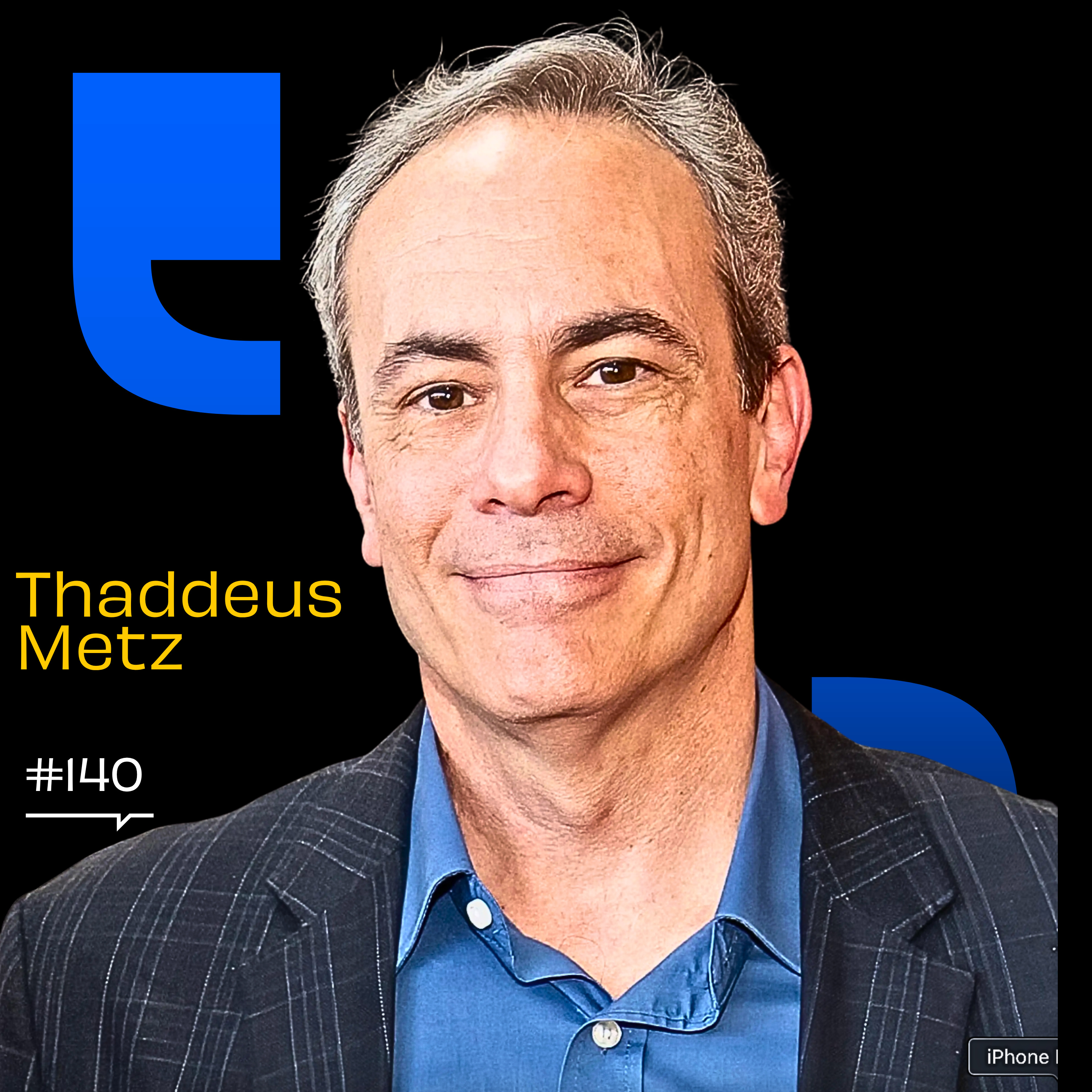
The 3 Pillars of a Meaningful Life - Thaddeus Metz
About this Episode
In this conversation, Thaddeus Metz explores the nature of a meaningful life, contrasting subjective and objective views on meaning, and discusses the African concept of Ubuntu, the role of religion, and practical steps for finding purpose.
Chapters
00:00 Exploring Meaning in Modern Life
02:22 The Role of Purpose and External Signals
04:42 Subjective vs. Objective Meaning
06:58 The African Concept of Ubuntu
09:19 Digital Relationships and Community
12:06 Religion and Meaning Without God
14:32 Success, Metrics, and Personal Fulfillment
16:53 Practical Steps Towards Meaningful Living
Grab your copy of The Time is Now and start your journey toward living a more intentional and fulfilling life - https://a.co/d/aDYCQ9o
Join this channel to get access to exclusive perks:
https://www.youtube.com/channel/UCl67XqJVdVtBqiCWahS776g/join
// Connect With Me //
ORDER MY BOOK, THE TIME IS NOW: A GUIDE TO HONOR YOUR TIME ON EARTH: https://www.timeisnowbook.com
Website: https://throughconversations.com
Substack - https://throughconversations.substack.com
YouTube community -
https://www.youtube.com/channel/UCl67XqJVdVtBqiCWahS776g/join
// Social //
X: https://x.com/ThruConvPodcast
Instagram: https://www.instagram.com/thruconvpodcast/?hl=en
YouTube: https://www.youtube.com/channel/UCl67XqJVdVtBqiCWahS776g
Hosts & Guests
Transcript
Hello everyone and welcome to this very special edition of Through Conversations
Pubcast where we explore the truth through conversations with the most brilliant minds.
Today in front of me is Tadeus Metz. Tadeus, thank you so much for joining me today.
My pleasure.
It's an honor to have you here and it's exciting and at the same time I'm, you know, right before
we were started recording is just it feels that there is this crisis of meaning and a lot of things happening at the same time
in the macro sphere and also, you know, in the micro how it affects the individual.
And so Tadeus, you've spent your, much of your career asking what really makes a life meaningful
and it seems as though with today's world obsessed with success and metrics and happiness
and also being thrown with all of the potential fires that are just spurring across the world.
Do you think we're getting meaning from them mentally wrong?
Do you think we're losing the track of what our meaningful life really is and how can we get closer to that reality?
It depends who counts as we, I guess, but I mean if we're talking about sort of modern urbanized industrial societies,
then I wouldn't say that a lot of the focus of those societies is on meaning or enabling meaning.
A lot of the focus is instead on comfort or pleasure on the one hand or freedom having options on the other.
And I don't think meaning is, I think meaning is different than comfort or freedom.
I think if we're talking about meaning we're instead talking about roughly something having to do with achieving a purpose higher than our own happiness
or we're talking about something that merits pride in what we've done or aberration from somebody else for what we've done.
Or we're talking about making a contribution or authoring a life story that's compelling and interesting.
I think we're talking about meaning it's that cluster of concepts that are quite different from a focus on pleasure and freedom.
And so I wouldn't say our lives are meaningless or that we don't care about it, but the thrust of the societies we live in doesn't exactly push us towards meaning.
And you mentioned here a lot of interesting themes that seems as though, you know, purpose in life, finding that purpose through those several avenues that you mentioned, those pillars, you know, admiration, contribution.
So do you think that this is an intuition intuitively based trajectory for each individual? Do you feel that each one of us has that hunch on where we can make the most of our time on Earth?
Or do you think this is something that as we go along in life and we get these external metrics, external checkpoints, say, you know, admiration, praise, or just seeing the impact, external impact that we're having.
Do you think that's our signal of where we have the our purpose in life?
Hmm.
I think probably both sources are useful.
Certainly we know people who don't have an inner voice and are sort of lost or
existentially adrift as I know you've said at times.
And so they they do don't have the voice or they can't hear it if it's if it's coming from inside, but some of us in contrast do have a sense of of what we would like to achieve, even if we're unable to do it.
On the other hand, we do learn a lot about ourselves from other people from our friends and family and colleagues and peers.
It's hard to to know about yourself just from yourself. You get a lot of information from from those who can see you and speak to you.
And I think one would be wise to listen to them and see what they say when it comes to charting the life course.
When it comes to those individuals who don't have that voice, what's the best way to try to find it?
Because you know, maybe it is there, but maybe it's lost in the you know, lost in the noise of of everything around or just going through the motions of mother and life.
Hmm.
I don't know what the best route is.
But my hunch actually is that to hear one's own inner voice, it might well help to talk to somebody else.
So you know, I think perhaps it would help to talk to, for example, a career counselor.
Somebody who would interview you and question you about what you like and what you're good at and what gets you excited and what makes you feel alive.
Or it could be that a more traditional psychological therapist could could help and really digging deep and learning about what drives you as an individual.
It could be those kinds of conversations would be really useful for some people.
But going back into, you know, what we were talking about, how meaning sometimes can be felt as purely subjective, but also the external signals that we can have.
It's, you know, sort of your work has also involved in, you know, you can't really create your own purpose in that way by your own self-subjectively.
A little bit on that. So what's at stake if we just reduce meaning to only our personal preference, rather than, you know, also thinking about, like you say, the impact that we do in the external world.
What's what's the risk of thinking about what makes us fulfilled subjectively?
Right. So you've used these terms subjective and objective and we philosophers use them quite a lot as well.
So one big way of categorizing different ways of approaching meaning and life is we have subjectivism, which is the view that meaning and life varies depending on the subject, depending on the individual person and what he or she likes or believes or pursues in life.
And from that perspective, meaning is highly relative, right? It's there isn't a single meaning or even a cluster of meanings that apply to all of us.
Instead, what's meaningful for you is going to depend on your psychology, your interests roughly, and what's meaningful for me is going to depend on mine.
In contrast, we've got the objective approach, which says, no, there's something about meaning that's independent of anybody, any particular person psychology.
There's certain ways of living that we ought to like or ought to pursue or ought to believe meaningful are meaningful.
And from this perspective, meaning isn't highly relative and it's something about which we can be mistaken. We might be making a mistake.
And so I with probably most contemporary philosophers of life's meaning think that there's a big objective element to it.
We're not subjective as some of us are, but those are still, I think, a minority.
And so from our perspective, the risk of reducing meaning to just personal preference is that you could miss out on what's really meaningful, truly meaningful.
To sort of poke at the subjective view point, we point out that we imagine people who want and pursue very strange and idiosyncratic and inane things.
So if you look at the Guinness Book of World Records, there's a fellow who has succeeded in putting the most number of toothpicks in his beard.
More than anybody else in the world, and he spent quite a lot of time perfecting, you know, that art, so to speak.
I don't think anybody should stop him.
You know, he's not doing anything wrong.
I'm not a guru. I shouldn't have, you know, controlled over his life.
So if we ask, is that a meaningful enterprise? Well, he might find it meaningful, but very few of us philosophers who thought about her for living would say that it is.
And so if he spends an awful lot of time, perfecting his ability to put toothpicks in his beard, you know, from our perspective, he would be wasting a chunk of his life.
He could be doing something more important, objectively speaking, he could be pursuing love and wisdom and beauty for examples.
Well, that's the main risk of thinking of meaning strictly in terms of subjective conditions.
There are probably objective conditions out there and that ought to guide our psychology and I to guide what we do in life.
That's interesting, because on one hand, I agree, like, putting stuff in your beard, maybe not the best use of our time on earth, on the other.
If I can push back on this a bit, what if that fit in itself, even though it's absurd on the subjective, you know, for the individual who gained,
who won the Guinness record, what if it inspired others to pursue their own subjective meaning?
And in itself, it just creates this spiral of positivity and then the impact is, you know, maybe not that tangible in the sense of, you know,
well, you mentioned love and purpose, which are not tangible themselves in and of themselves as well.
But for others, that meaning is through those objective goals.
So maybe the, you know, what I'm trying to say here is the end result is the beard with the, you know, the world record with so many things in it.
But the outcome may be inspiring others to pursue their own objective goals.
Look, I agree that it's useful to distinguish sort of the putting the toothpicks in the beard as an activity or project on the one hand and then the long term consequences of that on the other.
And your suggestion is maybe some meaning it's not going to come from that activity or that project, but maybe it'll come from the consequences.
That's, that's a useful question. It's revealing.
For me, it depends on what the consequences are.
So if the consequences are simply more sort of inane trivial projects, then I don't think much meaning comes to comes to the initial project.
That as a result of putting toothpicks in his beard, he is now inspired somebody to go count the number of blades of grass in my garden outside.
Or inspired another person to maintain exactly 3,000 hairs on her head at any given time.
And she counts and when 3,000 and one pops up, she plucks the one to make sure it's 3,000.
We can multiply, you know, we can multiply these kinds of cases.
We philosophers like to use hypotheticals, right?
So you might say, well, no one's actually going to come and count blades of grass in your garden.
But we can go back to the Guinness Book of World Records and find other, you know, somewhat silly activities.
So there's also a person who has on a calculator added one plus one plus one plus one until he got to a million.
And then he subtracted minus one minus one minus one, until he got back to zero.
And, you know, inspiring people to do those sorts of things I don't think would confer much meaning.
But an interesting case is suppose somebody looks at our toothpick, toothpick concertor and realizes they've been wasting their life doing something trivial and are now inspired to do something more objectively worthwhile.
Well, now we start to get some good candidate for real meaning, I think.
Yeah, it depends on the activity itself, makes sense, and I agree on that.
And then also you work also draws heavily on the African concept of Ubuntu that we become persons to our relationships.
And so would you care to share a little bit about this for listeners who might not be familiar with this concept and how it might differ with our own Western concept of individualism and like it connects with what we're talking just now, like having this atomic purpose search for, you know, just subjective interests.
Yes.
So the maximum that's often used to sum up an African way of thinking about how to live is a person is a person through other persons.
And that doesn't say much in plain English, and it's an overly literal translation of some sayings that are influential.
And we need to translate a bit to make sense of what's going on.
Part of the idea is that we ought to become a real person.
So for the African tradition, you can be more or less of a person.
And your goal should be to become a complete or a full person or a genuine human being we could even say.
The main way to do that is through relationships with other persons.
And typically, you know, begs the question, well, how am I supposed to relate and typically African philosophers will talk about harmonious relationships or communal relationships, but it's going to be some kind of some kind of positivity.
And typical understandings of how to relate properly would involve enjoying a sense of togetherness with other people.
And thinking of oneself as part of relationship or part of a group, cooperating with people, participating with them as opposed to remaining isolated or trying to dominate others, helping others, sympathizing with them, going out of one's way for others for their own sake, not for yours.
These kinds of relational ideals of how to live are very prominent in African philosophy and African cultures in so far as they've resisted the encroachments of the West.
And so from this perspective, yes, if we refer to our Guinness book of world record holder in terms of numbers of toothpicks in his beard.
He would say of him, well, he's not become as much of a person as he could have.
You know, it's an isolated activity. He's just doing it himself.
It's not really helping others. It's probably not an inspiration to others if we're realistic about it.
It might be something authentic for him. He might have some special drive or really identify with the project. And he, of course, should be free to do it.
But from a characteristically African perspective, he wouldn't be as much of a person as he could be and, and for that reason, wouldn't have as much meaning as he, in his life as he could have.
He would turn his attention outward and do something that's going to help others in his community much more.
And now you mentioned togetherness and you mentioned positive meaningful relationships, sense of community.
How does one know that they fit in that community that, you know, that the impact or rather the fostering of those relationships are indeed spiraling towards positivity, if my question makes sense.
I mean, I think a lot of the question boils down to how do we know when we're improving other people's lives.
And there are different ways people's lives can go better. We can make them happier. We can give them joy or pleasure.
We can help to put meaning in their lives, right. So perhaps we can enable them to help other people.
We can help them become better at relating. So we can help them become better friends or better parents, better family members.
We often think a good life is one that's vigorous and alive. So a person with confidence and energy is more attractive.
It seems to be living better than one who is very insecure and depressed and lethargic. And so a healthy life is also a better life than one full of injury or disease.
And so in all these, right, I've mentioned five or six different ways people's lives can go better.
And so I think we just need to be attentive. Are we, how are we doing?
Are the people around us living better along some of these dimensions because of what we're doing or do we need to shift and reflect on what we're offering the people around us?
And what do you think those about our shift towards a more digital reality? For example, you and I are talking virtually now.
It seems as though we're creating good rapport and we're getting to know each other through this conversation.
Do you think this is a good replacement or sort of proxy towards creating meaningful communities and relationships?
Look, at least we're having a conversation. That's, that's a plus.
So, you know, presumably we are expressing what we truly believe.
And the way we see the world and we're open to hearing the other's point of view and giving it serious consideration.
And then expressing our own viewpoint. I mean, there's something, there's something real about that kind of connection.
But what I worry about is that we don't really tend to have conversations much on, on social media. Right. So, we will text, we will post, we will like, we will look at somebody's pictures.
And we can't say that there's conversation there.
There's not even something face to face much of the time. And so it's, you know, not only are we, you know, looking at just a sliver of a person as to being able to really get their state of mind completely at a given time.
We can't even enjoy a sense of togetherness with people on social media. We still feel alone. And that's because we are.
So, look, I use social media. I left my home country more than 25 years ago. And it's important for me to maintain contacts, you know, that I formed when I was much younger.
I'm in touch with people who know me for a long time. That's, that's valuable to me. And so I still have a Facebook account, for example.
But, but it would be a poor substitute. If I just spent time on Facebook, as opposed to really meeting people face to face and having genuine conversations with them.
You know, I think about also the, what we're talking about Ubuntu and the contrast between Western values, which is self-actualization and also part of a way through, through, or that we think about to get that sense of meaning is also through, through God and through religion.
And part of your work has also argued that life can be meaningful without a figure such as God.
And so, do you think that religion, religious frameworks still get it right? What do they get right rather than about meaning that secular culture might not get right?
Right. So I don't believe that meaning in life requires a deity of, of any kind.
And even many religiously inclined philosophers, again, not all of them, but many agree. So we have a thought experiment.
We suppose for the sake of argument that God doesn't exist at the moment. And then we go looking around and, you know, can we find anybody with a meaningful life and out pops the likes of Albert Einstein or Nelson Mandela.
And their lives look like exemplars of meaningful lives for what they accomplished.
So I'm open to the idea that if God existed, our lives might be more meaningful.
And if God existed, we should listen to what God has to say, because God knows everything. And so if we're able to, you know, get a reliable stream of communication going with them, OK, listen, listen up.
But if God doesn't exist, still, I think there's some meaning possible in a life.
That said, there's a broader question of whether we should be religious, regardless of whether God exists.
And I myself have found it personally very difficult to believe in God.
I also attend religious services fairly regularly, and I've gone to Mosque and explored Islam.
I've been to Temple, explored Judaism, gone to church, explored Christianity.
And I do think that religious frameworks can offer something in respect of meaning, apart from the metaphysical question of whether God is there or not.
So one thing I like about religious services is that they're an occasion just to stop and think about how we're living and to pose questions about whether we're living in the right way or the best way.
And so lately, I've been going to a Christian church with my wife.
And when the reverend says that God loves your enemy as much as he loves you, and that you should be loving your enemy as much as you love yourself, those kinds of things.
I mean, it makes me pause. That's not how I, you know, go about. I don't see the world that way day to day.
And I think it's worthwhile stopping and reconsidering how we're living and pausing and thinking about the, you know, what we're doing in the light of these kinds of these kinds of images or prescriptions.
I think another thing that religious frameworks offer is a direct consideration of meaning in life.
Typically, you know, I mentioned earlier that our modern societies tend to be focused on comfort and freedom, right?
Having pleasant experiences and lots of options at our disposal.
And those aren't quintessentially the topics of a religious service.
They are instead more about, you know, how do you tell a good life story with the time you have left on the planet?
How do you make a contribution?
What is your purpose? You know, what can you take pride in having achieved?
And so they naturally direct us to think about meaning more specifically.
Still more, I think religious services are good for pointing us towards holiness or perfection.
So, you know, we are stuck in the mundane and the day to day and it's worth taking time out and thinking, what would be perfect? What would be ideal?
What should I strive to be like?
And we get these images of perfection from, from religions.
And the last thing I can mention about religious frameworks and that I appreciate or have appreciated about attending religious services is the sense of community.
That we find, right? There's a sense of togetherness, there are people cooperating with each other, trying to do good for each other.
And, you know, outside of the family, that's not an easy thing to find in modern societies.
And so I appreciate it.
Yes, the sense of community is a big one indeed and it's, you know, it's difficult for me to be honest to separate between, you know, going to these religious events, going to the churches, going to the mosques, the temples,
and separating it from God, from God itself.
And so, how were you able to make that separation between those two, between religion and God?
Because the striving towards perfection itself is, and those aims, and, you know, love your neighbors, your love yourself, and God loves your enemies as much as you, it still implies the existence of God, at least in the conversation.
So how were you able to make this distinction?
I think, I think religious reflection on God and the divine is a way of bringing together our highest values.
And that's what we're doing, essentially, when thinking about the divine or the holy, we're appealing to our most important values.
Roughly, they are ones beyond the animal kingdom. So, you know, physical pleasure, satisfying desires, being alive, those are things we share with animals.
But when we're in a religious context, we're thinking about something greater, and something that's fairly unique to the human person.
So when I hear talk of God, that's the way I interpret it. We are thinking of perfection. We are thinking of an ideal.
And so, regardless of whether there actually is a God, a person who created the universe, I can still make sense of the language.
I can still make sense of the point of thinking about such a being, because it directs my attention roughly away from the animal and towards something much higher.
It's an interesting way of thinking it, because a lot of, also, you know, statistically not going into those kind of numbers, it seems as though individuals who are part of a religious community or are religious themselves have a much greater satisfaction in life.
So, there is a benefit, and like you say, the other externalities, community, sense of belonging, definitely help to at least have a more meaningful life.
But those thinking a bit more about success in life, through metrics, modern metrics, if someone is listening to this and is successful in the conventional sense, but feels strangely empty, what question do you think they should be brave enough to ask themselves?
So, for thinking of success, conventionally understood, usually we have in mind somebody who's earned a lot of money, or they've climbed kind of hierarchies, so they've got, it's sort of high up in a company, or maybe they have a lot of political power in government.
And a broader sense of success would be you just do well at your job.
And from the perspective of meaning, those things are not in themselves meaningful.
So, from the perspective of meaning we would ask, what are you doing with all that money?
What are you doing with all that power and influence? Are you putting these things to good use?
What are you doing on the job? Do you have a job that actually, you know, benefits people?
Or are you taking advantage of people's weakness, trying to get them addicted to things that aren't good for themselves?
So, simply having money and power and doing well at a job isn't enough for meaning.
And it would not be surprising, therefore, that somebody might feel like something is missing.
And so, I think for that person, I think one of two questions, they're one of two questions they might ask themselves.
On the one hand, they might ask themselves whether they're doing enough for others.
So, if you look at surveys around the world, if you ask people at various cultures, you know, what makes your life meaningful.
The number one answer is helping other people, particularly a family, but not only that, but particularly that.
And so, that's the first question to ask is, am I using my money and my influence to make the world a better place?
Do I have the sort of job that, you know, is not exploiting people or cheating them or offering them things that are not good for themselves?
Am I selling them trying to sell them something that's actually going to make their life go better?
That's one question to ask, but it's not the only one.
Because I can imagine somebody who is doing enough for others, but still feels something that something's missing, still feels dissatisfied in a way.
And in the philosophical literature, a colleague of mine named Susan Wolf has given the example of a bored housewife, 1950s sort of stereotypical American housewife.
And she and Susan supposes in the thought experiment that the housewife is actually doing some good, she is actually, you know, raising a family with love.
She's putting making meals, keeping a clean house, getting the kids to school, what have you.
She's doing some good.
And yet there's a part of her that is dissatisfied, we suppose, in the thought experiment.
And so, a further question is, am I doing enough to realize myself?
And in the course of my activity, am I doing something that's going to bring me a sense of pride or a steam in what I'm doing.
And so, most of us have some kinds of talents or abilities.
And I think, you know, one thing to say about the bored housewife is she might be doing good, but she might not be doing enough good for herself, she might not be doing enough to perfect herself.
So, you know, our housewife isn't a magician or an entrepreneur or a musician or a tennis player or a chess player or the like.
And it could be that even if you're doing enough for others, you have certain capacities that would be meaningful to exercise.
And so, both of those questions, am I doing enough for others? Am I making their lives go better? And am I doing enough to realize myself in the course of that? That would be the second question.
And in an ideal world from your perspective, if we zoom out all the way, all the way out, how does the world look like if we, all of us would follow those questions, rather follow the answers to those questions.
Do you feel that the world itself would be a different reality?
Do you think that maybe part of all of what's happening across the world stems from our lack of meaning and self-realization?
Look, I can't say that, yeah, I don't know that ongoing wars stem from a lack of meaning.
They often seem meaningless. And I'm not sure they certainly doubt that they enhance the meaning in anybody's life. They seem pretty pointless to me.
But I wouldn't want to necessarily trace all the world's major ills to a lack of meaning.
But the big picture, if we ask what in general makes life meaningful, what would that kind of life look like?
I think an awful lot of meaning involves using one's talents, roughly one's intelligence.
So when we were talking about capabilities or talents, we're talking about kinds of intelligence that a human being has and that an animal won't have.
So it could be a musical talent, it could be an intellectual cognitive talent, it could be emotional intelligence sporting intelligence, what have you.
But, you know, we've all got something that we're capable of doing using using our reason and our deliberation.
And I think a particularly meaningful life is one where we find what that is at us. And we develop it with sophistication and intricacy.
And we engage in projects that take some effort, some hard work. And they are positive. They do some good.
We're making advance for other people.
So we take what's inner and we work on it and we develop it into something that has a positive result for others in our society.
That looks like a pretty meaningful life to me captures, I think, an awful lot of our intuitions about what's meaningful and what's not.
And if we want a standard to hold up for ourselves, I think that would be an ideal.
I'm hoping that this conversation does impact others to ask themselves those questions.
I'm certainly going to ask myself that question, those questions throughout my day and throughout, you know, poster conversation and so that it was if, you know,
after listening to this, what would be a good one first step for anyone who's just grappling with those big existential questions of meaning or like they're off just one practical step.
When we exercise our talents in ways that are challenging and do some good that have some concrete manifestation for us and for others around us.
Often we get in what psychologists call a state of flow.
So if you're in a state of flow, you sort of forget the time is passing, right, the hour is just sort of flipped by you are completely absorbed by what you're doing.
It's not so easy that you don't have to concentrate, but it's also not so hard that you're constantly frustrated.
Instead, there's this sweet spot in between where it's challenging, but you're able to make headway and keep going and to continue your focus.
And so I think one good test is to ask yourself, when have I been in a state of a flow?
When have I been completely absorbed by an activity and been able to to put my mind to something for a long good stretch of time and feel invigorated.
And and a sense of pride afterwards. That's a good, a good question, a good place to start, I think.
Excellent. It's an excellent question and excellent place to start and hopefully the outcome is not someone saying I like putting peace.
You're right, be heard. But that is thank you so much for for joining me today. It's been an honor. Hopefully we'll get to have another conversation along the way and continue exploring these big, big themes of life that I think resonate with everyone listening.
So honor to have you here and thank you. Thank you for joining me.
Good to have met your Alex and I appreciate the opportunity.
Thank you very much.