About this episode
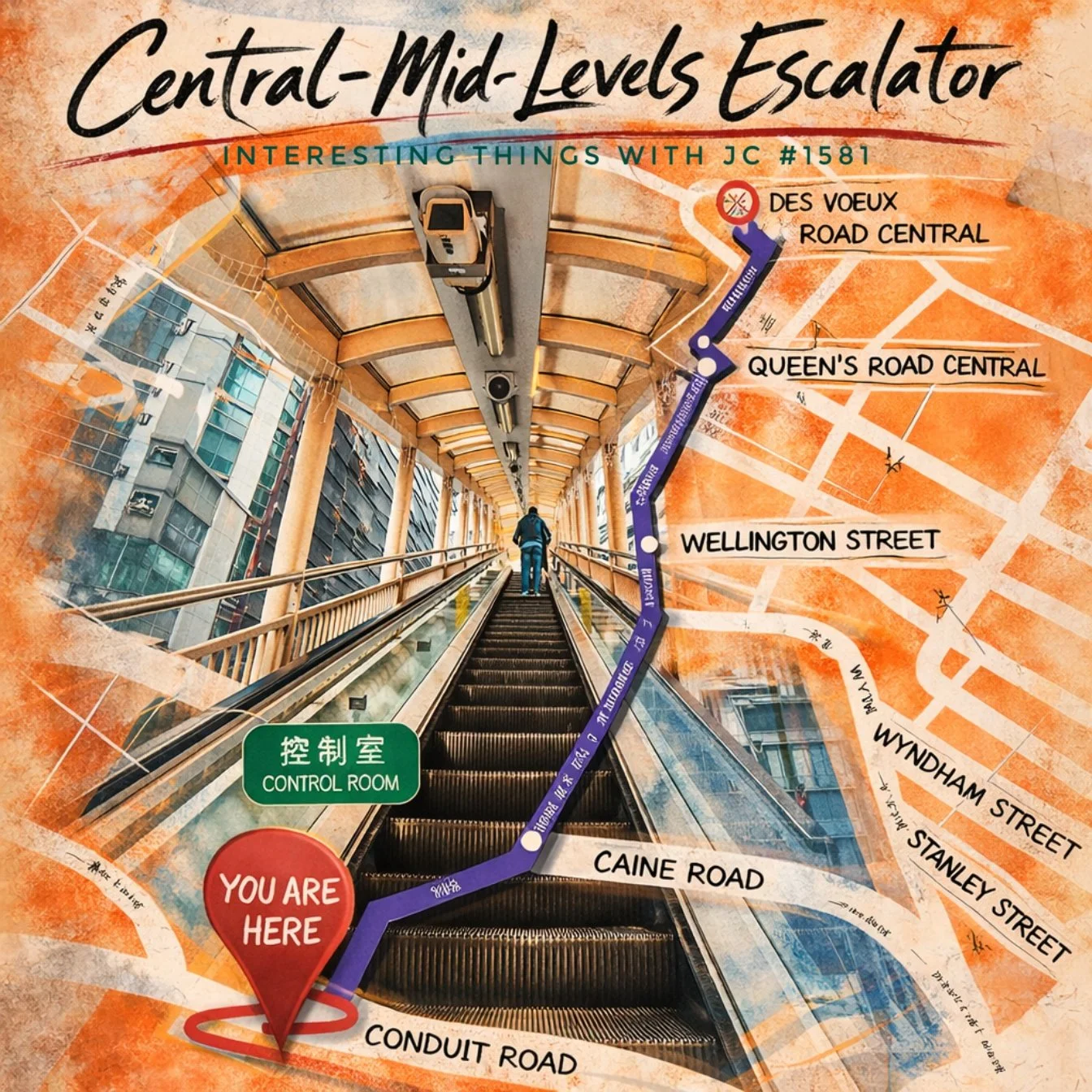
Interesting Things with JC #1581: "The Central–Mid-Levels Escalator" – In Hong Kong, the hill behind the harbor used to demand a daily climb. Then the city built a half-mile chain of moving steps that flips direction with the clock, and rewired an entire neighborhood around the flow of footsteps.
Get every episode summarized
Each time Interesting Things with JC publishes, we email you a written briefing from the transcript — the topics, who appeared, and any specific claims, with the ad reads skipped.
Email me new episodesFree for 3 shows. No card needed.
Hosts & guests
Transcript ready
40 searchable segments. Every word is indexed and playable.
Full transcript
Interesting Things with JC — 1581: "The Central–Mid-Levels Escalator". Machine-transcribed; use the interactive transcript above to jump the player to any line.
In Hong Kong, Yonggong, the land rises quickly behind the harbor. The central district sits along the Victoria Harbor, filled with office towers, banks, and trading firms. Just above it, the city climbs steeply into a residential area called the mid-levels. For decades, residents living there face the same daily climb. Steep roads and long staircases just to reach the businesses below. By the late 20th century, central have become one of the most concentrated financial districts on earth. Tens of thousands of workers move between the waterfront offices and hillside apartments every day. But the hillside posed a problem. Streets were narrow, buildings tightly packed, and the slope between central and the mid-levels rises more than 443 feet, 135 meters, over less than half a mile. Building a road-of-rail system through those crowded streets would have required
demolishing large sections of the neighborhood. So city planners chose a different solution. In October 1993, Hong Kong opened the central mid-levels escalator system. The project cost about $240 million, Hong Kong dollars, roughly $30 million, US dollars, in early 1990s currency. Instead of one continuous escalator, engineers built a system as a chain of 20 escalators and three moving walkways connected by elevated platforms. Together, they stretch about 2,625 feet, that's 800 meters, climbing roughly 443 feet, 135 meters up the hillside. That segmented designs solved several problems at once. The steep gradient meant one long escalator would have been difficult to maintain and unsafe during breakdowns. By dividing the system into multiple sections,
individual escalators can be stopped for maintenance while the rest of the route continues operating. The segmented layout also allowed construction crews to thread the system through narrow streets and existing buildings without major demolition. Platforms connected to sidewalks at different levels along the hill, allowing riders to enter or exit at dozens of points. Today, the system moves roughly 85,000 passengers every day. It even changes direction depending on the time of day. From about 6am to until 10am, the escalators run downhill so residents can reach offices and transit lines in central. After that, the entire system reverses and runs uphill for the rest of the day. A full ride from bottom to top takes about 20 minutes. Over time, something else happened along the route because thousands of people passed the platform's daily restaurants, bakery,
markets, small shops clustered around the entrances. Cafes and noodle shops filled the narrow streets connected to the escalator walkways. A piece of transportation infrastructure reshaped the neighborhood around it. Today, the central mid-levels escalator carries residents, workers and visitors up a hillside that once required a long climb through steep streets. In Hong Kong, Yanggong, a half-mile chain of moving steps became part of the city's daily life. These are Interesting Things with J.C.
More episodes
More from Interesting Things with JC

1770: "When a Parasite Rewires Behavior to Spread Itself"
Interesting Things with JC

1769: "Football Brain Injury Cover Up"
Interesting Things with JC

1768: "The Science of Jealousy"
Interesting Things with JC

1767: "The Spider-Man of Paris"
Interesting Things with JC