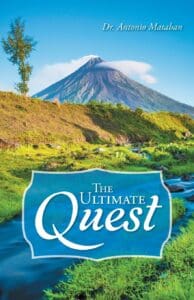
The Ultimate Quest by Dr. Antonio Mataban is an epic historical fiction that spans five generations, beginning at the tail end of the Spanish colonial era in the Philippines. Dr. Mataban’s narrative sweeps through time, immersing readers in the lives of characters whose personal journeys intertwine with the shifting tides of history, offering a rich tapestry of culture, struggle, and triumph.
Set against the backdrop of a nation in transition, the novel masterfully captures the intricacies of Filipino identity, societal change, and the impact of historical events. From the waning days of Spanish rule to the complex, post-colonial era, Dr. Mataban deftly explores the personal and political conflicts that shaped the Philippines’ evolution. His portrayal of the era is vivid, grounding the characters’ experiences in real historical events, yet the author also crafts a compelling fictional narrative that keeps readers invested in the human side of history.
The book’s structure, spanning five generations, provides a panoramic view of the impact of time on individuals and families. Each character is deeply developed, their lives shaped not only by their personal desires but also by the political and social forces at play. This generational scope allows Dr. Mataban to explore the long-term effects of colonialism, revolution, and independence, showing how history is passed down through families and how the scars of the past continue to influence the future.
One of the standout aspects of The Ultimate Quest is Dr. Mataban’s ability to blend historical facts with compelling storytelling. The attention to historical detail is impressive, and the author’s research shines through, adding depth to the plot without overwhelming the reader with unnecessary exposition. The book doesn’t just recount events; it brings them to life, placing readers right in the middle of the action, whether it’s a struggle for independence or a personal confrontation with the legacy of colonialism.
While the historical context is rich and vital, the real strength of The Ultimate Quest lies in its characters. The author’s skillful development of multi-generational storylines offers a nuanced understanding of how deeply the past shapes the future. Each generation faces its own unique challenges, but the echoes of the past resonate, highlighting the enduring pursuit of identity, justice, and belonging.
For fans of historical fiction that goes beyond the surface to explore the personal consequences of history, The Ultimate Quest is a remarkable journey. It’s a tale that will resonate with anyone interested in the complexities of Filipino history and the ways in which the past continues to inform the present. Dr. Mataban’s novel is a beautifully crafted, emotionally charged exploration of heritage, resilience, and the ultimate quest for freedom and self-determination.
You wanted the best, you've got the best podcast, the hottest hotest podcast in the world.
The Chris Vosho, the pre-eminent podcast with guest so smart you may experience serious brain bleed.
The CEOs, authors, thought leaders, visionaries, and motivators.
Get ready, get ready, strap yourself in, keep your hands, arms and legs inside the vehicle at all times.
Because you're about to go on a monster education roller coaster with your brain.
Now, here's your host, Chris Vosho.
And those Vosho here from the Chris Vosho.
Die, come on.
Please tell me there are only six that makes official.
Welcome to 16 years in the 20-800 episodes of the Chris Vosho.
We've been bringing you all the most amazing minds in the world.
Opinions expressed by guests in the podcast are solely their own and do not necessarily reflect the opinions of the host or the Chris Vosho.
Some guests in the show may be advertising on the podcast, but it's not an endorsement or review of any kind.
Today we're joined by an amazing young man at 93.
He has written a book that we're going to be discussing today.
And I think you like and he does too.
The book is entitled The Ultimate Quest.
Out July 30th, 2025 by Dr. Antonio Madabon.
He's joining us on the show.
We're going to get into with him and find out more about his book.
Welcome to the show, Antonio.
How are you?
I think I'm managing fellow world.
93, congratulations.
What a what a feat to get there.
We'll tell you what I think is this.
You try to stay alive as much as you can and stay within the parameters of good fortune and there you are.
There you are.
And I've been there.
I'm just right now.
I'm living alone because I lost my wife was my co-author about a year ago.
I'm sorry to hear that, but you wrote this beautiful book about your lives together.
Is that correct?
More or less, but also what it's not written directly for was.
It's really more or less any third person.
Yes, too.
You know, interpret in other words what the social activity is going on and many, many other things that involves a family as it is originally.
Yeah, I'll tell you one thing is this.
When I first told a lot about the book, I thought I'm going to write it for my, you know, recollection of all my past activities and everything else.
And when my wife saw the first few pages look at me and says, you know, this is not very nice.
And it's not looking.
And it says, what do you mean?
I think you should write something.
I know you can write something, but write something about some other people.
And if you like to, you can always use your activities, describe your activities as theirs.
And so what it was.
Now you are Philippine born.
You witnessed the events of World War II as you're growing up in the farming area.
You graduated from the University of Santo Tomas in Manila.
And you briefly practiced on the island before migrating to the United States for further training yourology.
You practiced your art in Long Island, New York.
After four years, you joined the Air Force.
You retired after 21 years.
A Colonel.
And as a urologist in flight surgeon, you served the veterans for 14 years before retiring with your family in California.
With your wife 63 years, you guys were married.
Is that correct?
That's correct.
That's right.
And three of your boys have been veterans and have independent professional responsibilities.
That's an awesome life.
So this is an epic historical fiction that spans five generations beginning at the tail end of the Spanish colonial area and the Philippines.
And you go through the characters and shifting tides of history.
Give us a little bit more filling if there were.
Why did you start at the Spanish colonial era in the Philippines and move through the rest of it?
I'll tell you a reason why I started with the colonial area.
Just because of the fact that our great-great-grandfather was the Spanish or the Spanish Spanish.
He was, he was, he was with the Spanish army.
And originally I had not, I did not even consider that.
And could you, can you hold on a second, please?
Yeah, I, if you could kick it.
Anyway, that, you know, and so when I rewrote the book, I went back to that time.
And it's not as well because I was going to dramatize if you will.
The events that would have taken place and why we got into the Philippines and why we were there and how we managed to stay, you know, stay on for so many generations.
By doing this in a third person, it sort of gave me a little more freedom to be able to express myself and express anything that needed to be said.
Ah, so is it like a fictionalized story? Maybe your family or is it to the whole thing?
The whole thing is more or less fictionalized, but the activities and all the descriptions and everything else were all from my family.
Ah, that's, that's really good. That the, what are you going to, that's really good.
You know, what, what do you hope, what do you hope people learn and read from the book?
What do you hope that they get when they read it?
Actually, when I initially started the book, I was just doing it just to kill time, if you would just just express it like that.
At the time when I was writing it, my wife was not feeling well.
So I was next to her all the time just to keeping her company and caring for her.
Because I used to, I said, I excuse, excuse to kill my own time, I keep myself busy and not feel bored.
And I found it to be a very refreshing, if you will, refreshing, you know, it's a state of my health at the time.
And so I was writing it and every day we have a new subject to talk about with my wives reading everyone of the pages and correcting what I was in need.
And you know, what a great story. And now do you talk about your kids in the book and what they did?
I beg your pardon.
Tells the story about your children and raising them and living your life with them together.
My children have been with us all along.
You know, since they were very successful, a couple of years when I moved from the Philippines to the United States and they were left behind for a while.
But then after that, they have been with us all together until we have retired and they have their own families and so forth.
Hmm.
Hmm.
It's an interesting life you lead.
And do you find that maybe it's a story about immigrating to America as well and integrating and of course raising a family here and living the American dream maybe?
I apologize, sir.
I didn't catch what you were saying.
Sure.
Do you think it's a, do you see that it's a great story for, you know, the immigrants coming to America and finding the American dream and living the American dream?
Well, I think it is.
It's a matter of fact.
That was the intention.
That was secondary intention, actually.
I thought it was just when I wrote the book.
I just wrote it for people who were reading, keeping their time busy and reading the material that they can later answer.
But then that's a matter of fact.
I didn't never, never, never thought about this advancing to this stage as a matter of fact.
And I found that that to my, you know, my own satisfaction that I actually bounce beyond the boundaries of my expectations.
Hmm.
Hmm.
I mean, you've found the right boundaries now, I suppose, when it comes down to it.
One other thing that let's see here.
What do you see writing maybe future books about this and your family or maybe future insights as well?
I'm sorry.
Do you find that what do you cite your future interests are in doing stuff?
Is there any future books of stories that you're going to tell?
Are there any stories that I accept?
No, is there any future books maybe coming out?
Well, right now, as a matter of fact, I'm writing a second book and again about the Philippines.
And this one addresses one particular spot, but particular place in my, in the country where I grew up in, especially during the Japanese occupation,
where I learned a lot of things to grow up in and become more mature in humanistic expression.
I learned a lot of things up there and that, that, that is still being clarified.
I have not even, I have already done the, the initial phase of it.
I'm going to review, review the whole thing once I had the time.
So there is another book coming.
Is that correct?
Maybe, and I don't know, not this year, so not soon enough.
Okay.
Historical fiction.
Did you, did you, did your wife get a chance to read the book before she passed?
No.
Yes, part of it.
Because as soon as it, it, it took more, you know, it is, say, a connolly going to read.
Okay.
You know, I, I, my, but at least one thing is this, I can only say one thing that she contributed to about 85 to 90% of the book.
Wow.
Yeah.
Plus she was there.
I will see.
Is there all five decades?
Five generations actually.
I started with my generation, but then I went back further because of the fact that I wanted to include the history behind my family.
Hmm.
Blending the, was it hard to create storytelling where you blend fiction with reality?
It's basically a very challenging thing.
It was not difficult, but it was challenging because the fact that you have to be very sure that what you are telling is a,
are events that are actually that have happened.
Like there's an instance over there where by a cousin of mine who was a prisoner of war during World War II.
He's capable and as able to go, go back to our hometown, but everybody knew about him and the Japanese would be looking for him.
So consequently, we had to find a way to, to hide him and what else can we hide him?
We put, we gave him under the auspices of the church and the church that the priest over there was up and to be a very close to the family decided that he will do all right.
And he would live in the building during the entire course of the Japanese occupation and serve as an assistant in the altar.
That's what it was.
Yeah, it's interesting, the journeys that happen there.
World War II probably affected your family a lot, is that correct?
I'm sorry.
World War II had some effect on your family as well?
World War II has, you know, has more or less, I have to give credit to World War II because it sort of taught me a lot of things to be maturement rather early.
World War II came in when I was only about ten years, ten years of age.
And from there, within the next four or five years, I learned to mature so quickly.
And that's how it was written in the book too in a different manner though.
So what, what are some of the aspects of the book maybe we haven't talked about that you want people to know?
Somebody asked me why the title, the ultimate question and why they, when they saw the cover with the volcano.
That volcano happens to be the only volcano we have in the Philippines, Mayone volcano that has a beautiful outline and everything else that, you know, that pointed from a white base to a very narrow top.
And I remember many years ago when I was a stilly student, I had, I invited a couple of my friends and we tried to climb the mountain.
See, we could go up to the very top.
Unfortunately, it was so densely, you know, it was so dense and in a tree and everything else that we could only climb up way.
But the only reason that this, this like an analogy, you go from a white base problem to, to eventually, went up into a point of success.
And that's where the top of the volcano was. And that's where it was.
So volcanoes are really important analogy in your book then.
It's symbolically.
And that's what's on the cover of the book is it as it were.
The ultimate quest.
And so how else the book been received? What does your, what does your family think about being fictionalized in a book?
I don't know how to describe it, but the fact is now that they're in getting me interviewed or getting me to chat with you.
You know, boost me up a little bit, but bottom of that to me is just like a regular old fashioned author who likes to have his books be read.
And that's about it.
All right, all right.
Anything more we need to know before we go out on the show about what's in the book and how it goes.
I'm sorry.
Anything more we need to know about in the book before we go out.
Actually, I think we have more or less presented all these subjects.
So we're interested regarding the book.
It's origination.
It's authors and the purpose of the book and all that.
And that's about all I can possibly explain or expound to you.
All right. Sounds good then.
It's been wonderful to have you on the show and get into details of this.
Antonio, thank you very much for coming out.
My pleasure, as a matter of fact, I look forward to this interview.
And I'm so glad that you have the patience, if you will, to tolerate me because of my difficulties sometimes.
And listen, I hear you because of my hearing problem.
It's been wonderful to have you on.
Thank you, Antonio.
All right, good night.
Thank you very much, sir.
And I do appreciate very much your time.
Thank you.
Folks, order up his book wherever fine.
Books are sold.
It's called the Ultimate Quest out July 30th, 2025 by Dr. Antonio Madembon.
Thanks for tuning in.
Go to goodresearch.com for just Chris Fos, LinkedIn.com for just Chris Fos.
Chris Fos, one on the TikTok and all those crazy places in it.
Be good to each other.
Stay safe.
We'll see you next time.
You've been listening to the most amazing Intelligent Podcast ever made to improve your brain and your life.
Good morning.
Good evening to much of the Chris Fos show podcast.
Can lead to people taking a smarter, younger and irresistible sexy.