Loading...
educationcourses
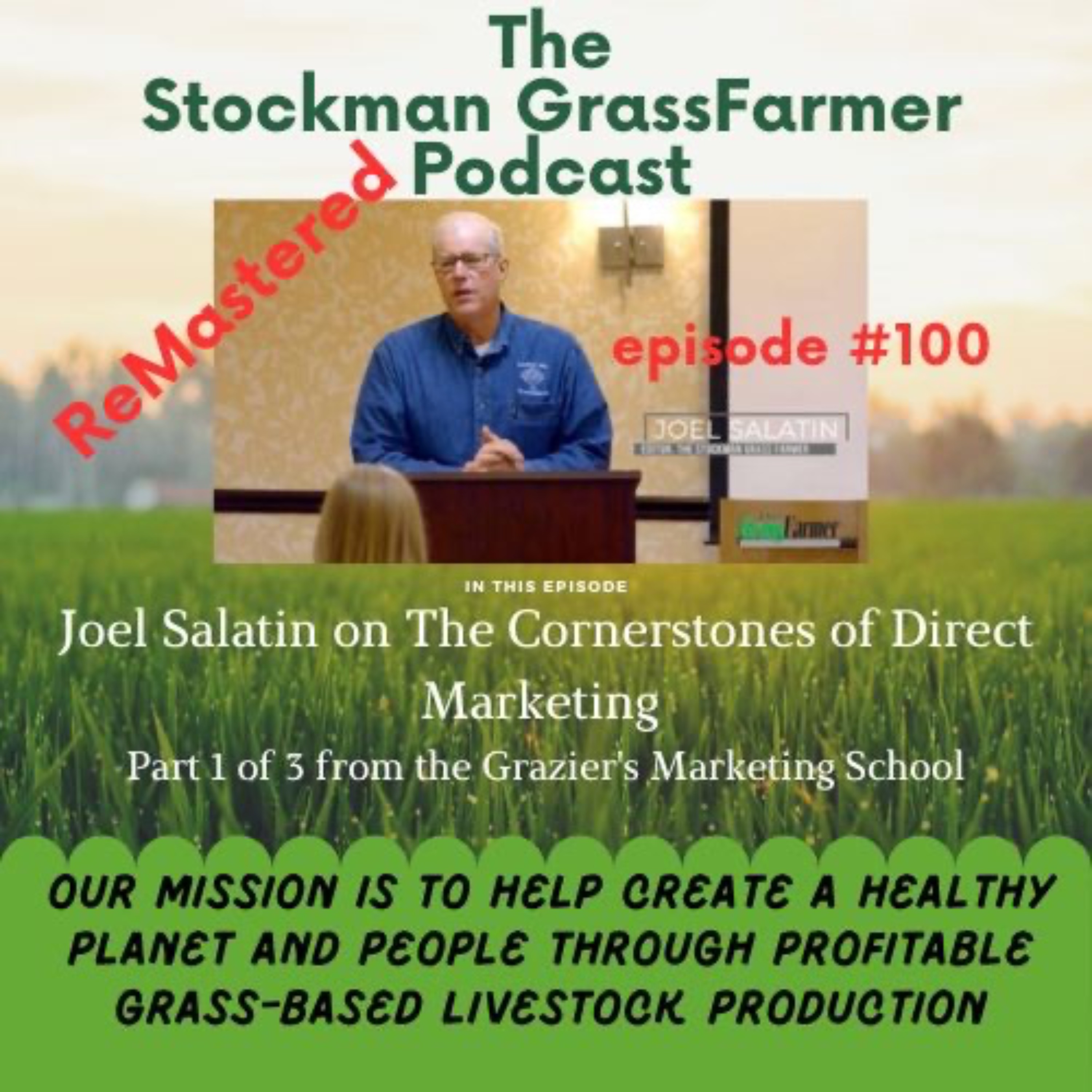
The Cornerstones of Direct Marketing with Joel Salatin Part 1 of 3
About this Episode
This special episode marks Episode 100 of The Stockman Grassfarmer Podcast, and to celebrate the milestone we’re launching a three-part series featuring one of the most influential voices in regenerative agriculture, Joel Salatin.
In Part 1 of this series, Joel lays the foundation for understanding why direct marketing is such a powerful strategy for modern farm businesses. Drawing from decades of experience building a successful direct-market farm, he explains how farmers can stabilize income, capture more of the food dollar, and create resilient businesses by expanding beyond production into processing, marketing, and distribution.
Joel also explores the mental barriers many farmers face when it comes to marketing — from fear of rejection to discomfort with self-promotion — and why separating marketing strategy from sales execution can help farms grow more effectively.
This episode sets the stage for the rest of the series by introducing the key principles that guide successful direct-market farm enterprises.
🔑 Key Points Covered:
-
Why Direct Marketing Creates Stability
Most farms earn income only from production, which is heavily influenced by weather, pests, disease, and market volatility. By capturing value in processing, marketing, and distribution, farms can build more stable revenue streams. -
Capturing the “Middleman” Margin
Instead of complaining about middlemen, Joel argues that farmers should become the middleman by participating in more stages of the food chain. -
Rebuilding Local Food Commerce
Direct marketing reconnects farmers and customers, reviving historically normal local food systems while strengthening community relationships. -
Marketing vs. Sales
Joel explains the important difference between the two: marketing is the strategy, while sales is the execution that flows from that strategy. -
Overcoming Farmer Mindset Barriers
Many farmers resist marketing due to fear of rejection, discomfort with self-promotion, or peer pressure. Recognizing these barriers is key to overcoming them. -
The Goal of Two Incomes
Joel emphasizes that truly resilient farm businesses should aim to support at least two salaries, reducing risk and building long-term sustainability. -
Prototype Before You Scale
Instead of asking “How big can this be?”, Joel encourages farmers to ask “How small can it be?” when testing new ideas. -
Building a Strong Customer Base
It’s often easier to grow a business by increasing spending from existing customers rather than constantly chasing new ones.
🌱 Actionable Insights:
-
Expand your farm’s revenue beyond production whenever possible.
-
Develop a clear marketing strategy before focusing on sales tactics.
-
Start small when testing new business ideas or enterprises.
-
Build strong relationships with loyal customers and increase their lifetime value.
-
Focus on creating a farm business that can support more than one income.
This episode is Part 1 of a three-part series, where Joel begins unpacking the principles behind successful direct marketing and farm business resilience.
📌 Episode 100 Special:
To celebrate our 100th episode, we’re offering listeners a special opportunity to go deeper into the principles discussed in this series. Get the entire The Grazier's Marketing School for just $37.
The three-part podcast series you’re hearing now makes up the first module of the full course, where Joel Salatin walks through the foundations of building a profitable direct-market farm.
👉 Click here to learn more.
👉 Tune in with your favorite podcast app to The Stockman Grassfarmer Podcast and discover practical insights from leaders in regenerative agriculture.
🌱 Here’s to the next 100 episodes!
Hosts & Guests
Transcript
Welcome back to the Stockman Grass Farmer podcast and today is a special one.
This is our 100th episode and we want to thank all of you who have been listening, sharing,
and learning alongside us.
Reaching 100 episodes is a milestone for the podcast and we're grateful to the entire
grazing community that continues to support and grow with us.
To mark the occasion, we're kicking off a three-part series featuring one of the most
influential voices in regenerative agriculture.
In this episode, part one of three, the cornerstones of direct marketing, Joel dives into
why direct marketing has become such a powerful tool for modern farmers.
Drawing from decades of experience building a thriving farm business, he explains how
moving beyond simple production into processing, marketing, and distribution can create stability,
capture more value, and build stronger connections with customers.
Joel also explores the mindset shifts farmers need to make when stepping into marketing.
From overcoming the fear of rejection, to understanding the difference between marketing
strategy and sales execution.
If you're looking to build a more resilient farm business, this conversation lays the
groundwork.
And because this is our 100th episode, be sure to check out the show notes for a special
episode 100 listener offer you won't want to miss.
Let's jump in!
Why farmers should direct market?
I'm going to zip through this very quickly because I think you all have already drunk
the Kool-Aid and you know why we need to direct market.
But sometimes it's good to just encapsulate it so we know where we are.
And by the way, let me tell you, we are very open to questions.
This is not just lecture style.
We will have some interactive stuff.
I've actually got some new stuff for us to play with, some new ideas, and so there will
be some interactive so please, please don't be reluctant or shy about jumping in.
But one of the main reasons to direct market in my opinion is for overall business stability.
In general, a quarter of the retail dollar comes from each of four components.
They're listed here for your production, processing, marketing, and distribution.
The problem is most farms get all their income from one of these, which one?
Production.
OK, and only one of these is subject to the vagaries of nature that makes every farmer feel
like farming is different than any other business because we have, as Alan Nation used to call,
the four horsemen of the apocalypse, you know, weather, price, pestilence, and disease.
It's what every farmer leans on the side of their pickup truck and whines about every
day, right?
Which one of those four is most subject to those vagaries?
Production.
When the locusts come, they don't eat the tires of the delivery vehicle.
When the drought comes, it doesn't stop the internet access from working, right?
When the rain comes and you get way too much rain, it doesn't, you know, destroy the stainless
steel in the processing.
So for no more reason than to create stability, stable income streams, here's the thing.
The more dollars we load into non-production, OK?
The more dollars we pull away from that, the vagaries of weather and price and pestilence
and disease and those become more stable, more stable income dollars.
That's one huge reason.
As we know, you know, we hear the middleman makes all the money and these processing marketing
distribution, that's the middleman hat, right?
Well, if that's where the money is, I want to be one, OK?
I want to be one.
And so rather than whining about that middleman that makes all the money, why don't we just
join him and enjoy the largest, OK?
So there's a lot of reasons here.
Number two, it's historically normal.
I mean, direct marketing, the idea of actually purchasing from, you know, within a local
commerce, you know, was the backbone of secure food systems for many, many years.
It attracts the best and brightest, all these other things.
As soon as you start talking about messaging and, as Jenny was saying, you know, sound
biting and how do we compress complex ideas into simple little slogans, you know, that
kind of stuff, man, I'm not saying that it doesn't require a lot of whatever genius
and imagination to know where to place the crossfins for the cows.
But it is a different set of, it's a different set of challenge, isn't it?
It's a different set of imagination, creativity, it's a different skill set.
And so I'm really big on trying to attract smarter people into farming.
I don't know how much gentler to say it, but we've actually had rural brain drain for
a long time, right?
You know, as the society has condescended toward rural, toward agriculture.
And basically, you know, if you're an A or B student, you're supposed to go, you know,
become a lawyer and attorney, work in IT, you know, sit in front of a deal, cubicle, and
press numbers into cyberspace for your career.
And that's supposed to be, you know, this wonderful thing.
And if you're a C minus or less student, then, all right, well, then maybe agriculture's
a path for you.
And what I want to bring, I want to see us create cerebral imaginative pathways where
our best and brightest come back to the farm and be affirmed in it and be encouraged
in it.
That's, I think that's a noble goal.
Another reason direct market is that your clientele is portable.
Many of us are working on least farms, barbed farms, shared farms, and our clientele, as
long as you don't move 200 miles away, our clientele is portable.
They can move with us.
So it gives us, it gives us the wiggle room and flexibility to lease places, to create
collaborative things because clientele is portable.
By direct marketing, you get your own built-in support group.
You know, farming is a lonely occupation, right?
You're out there in the field, moving the cows, moving the chickens, running that tractor,
making hay, whatever, farming is a very lonely, lonely thing.
Compared to other vocations, you know, we're at least, even in a small office, you know,
you got the, you got the, yeah, you got people.
You got the little, you know, sometimes a soap opera, right?
Sometimes it's paid in place, but, but, but, but, at least there, there's community.
There's people, there's, you know, there's things, I mean, our daughter works at a very
small office.
She's the agritourism director for a, for a seven county area.
It's a fairly small office.
And it's just amazing how fast, oh, you know, we went down and saw a movie with, you know,
and so it worked.
I mean, I mean, work is becoming now kind of a, a catch-all for everything.
It's, it's becoming life fulfillment.
We'll talk about that more as we go, but anyway, your customers, when they come, and they,
I can remember, you know, our kids growing up and the customers would come and, and, and,
and tweak their cheek, you know, and say, oh, we, our family just depends on your so
much.
We would, we would not be able to be healthy if we didn't get your food.
Thank you for doing this.
You know what that does for a kid, you know, for the farmer, all right, to have that kind
of emotional supports like Evan, you know, it's having a, a, a, for, or a, whatever,
a, a, a, a, a, a, whatever, you got it, whatever it is, all right, but, but you got your
support group, okay, and, and, and, and a, and a vocation that's inherently lonely, direct
marketing is really good, and especially if you're a stopman grass farmer reader, it's
even more lonely because even your farm neighbors think you're crazy, right?
I mean, our farm neighbors still call us typhoid Mary and, um, you know, bio-terrorist, you
know, because we have unvaccinated chickens that run around in the fields, and they're
going to commiserate with red-winged blackbirds and take our diseases, I mean, they got to
be disease because they're not vaccinated, right?
And, and they're going to take that to, you know, their Tyson chicken houses and they're
going to lose their farm, and every child in Bangladesh is going to starve to death because
we let our chickens, you know, commiserate with red-winged blackbirds that didn't vaccinate
them.
I mean, this is, this is the thing.
And so, and so when we're, when we're outside that orthodoxy, um, it's even more lonely.
And so our customers become, people say, you know, who's encouraged us to be our customers?
Our customers are, they're our support group, they're the ones that, you know, and over
the years, we've had, you know, we've had tough years, you stay in it long enough, you
will have a tough year.
We've had people come in and just, you know, stuff, stuff a bill in my pocket say, you
know, I know you've had a tough time, just, just take this and they leave and you open
it up and it's a hundred dollar bill, okay?
I mean, we had a, we had a customer once he came and it was fairly early on there.
And you said, look, you've written a book now, you need to have a higher, higher profile
of success.
This driving this 500 dollar car, it just, you know, it's just no good.
You need, you need a better car.
He said, I'm getting ready to trade mine and I'm either going to give it to you or the
Salvation Army.
And Tracy said, we'll bring it down, we didn't ask him what it was.
And so the next time he came down to pick up chickens, you know, he drove down and he said,
cars out front, you want to take it around and so we went around front and it was a Lincoln
town car.
And we drove it around the block.
We parked it back in the front and Tracy said, went around to Clint, and they was Clint
Miller.
And she said, where do I sign?
And we bought that car from him for a dollar and drove it for two years.
And man, I mean, that thing had a trunk the size of a pickup truck.
I mean, you know, it was a, but anyway, that's emotional support, okay?
That's good.
And then another one of, you know, the thing that I've really come to believe is that
you really don't have a viable business until you generate two salaries in the business,
okay?
That's a kind of a hard saying.
But if you know the cycles of life, you know that as you age, your energy wanes, your
creativity wanes, and you just don't have to get up and go mentally, mentally I'm 20.
But when I get up in the morning, I don't feel 20, you know, if it ain't hurting, it ain't
working.
You know, it's, it's a different thing.
And so, and so, six all really successful, especially legacy businesses don't just have
one person at the helm.
And in farming, I mean, what do you do if you're sick?
What happens if you break a leg?
What happens if, you know, two, two people are a big deal.
So I really believe that if we want a viable farm business, we have to set our sites and
have a vision, a trajectory out there that we're going to get to two salaries as fast as
we can get there.
Because a one salary business is a very vulnerable fragile business, okay?
And marketing, jumping into that, to all that, you know, processing and marketing and
distribution, what that does is that it increases the pie big enough so that there is a place
to assimilate a second person, all right?
That's a big deal.
Now, there are reasons why farmers don't want a market, okay?
It's hard work, you know?
You know, it's, it requires creativity.
It involves people and most of us farmers, we're farmers because we don't like people.
So, so realize over these two days as we do this whole marketing thing, remember, we're
here to talk about marketing.
Some of you sitting here, the idea, and when Sherry gets up here, you'll be blown away.
I mean, Sherry thrives on making a cold call to a chef.
Now I'd rather you pull out my toenails, okay?
I don't like, I like to go places where kind of, where people are already kind of in
it, you know, and want you to come.
I don't like to nose my, whatever nose, into a trough where I'm not really welcome.
So, that's different in temperaments, okay?
Different personalities.
So as we talk about this marketing, the thing I want you to understand is you are here
because you realize that marketing is important for your business.
You might not be the salesperson.
There's a big difference between marketing and sales, okay?
And so marketing is the strategy, sales are the execution, all right?
Sales grow out of a marketing strategy, all right?
And so, and so you don't have to be the one knocking on doors.
For some of you when I talk about knocking on doors, you get cold chills and want to run
out that back door, okay?
I get that, totally get that, all right?
And we are going to talk a lot about sales, but we're mainly focused on marketing as a strategy
and anyone can do that, extroverts, introverts, people that don't like to make cold, you know,
cold calls, whatever it is, sales is not marketing.
So you very well may come from this school, go back home and you're going to find a sales
person.
But from here, hopefully, you will take back a marketing strategy, all right?
So that you can get on the same page with your salesperson or team or whatever, you with
me?
So don't break into a cold chill that you're going to fail this two day, whatever time,
if you don't become a lover of knocking on doors and picking a cold song.
We've all read, you know, Zig Zigler, you know, who made millions selling fuller brushes
door to door.
You know, some of us can't even imagine doing it and cyclopedias and, you know, all this
stuff that used to go on door to door, Zig Zigler was a master, you know, and he loved it.
But most of us are not like that, so it's hard work.
You're, another reason why farmers, another one of our kind of emotional barriers is that
we fear rejection, because we're so emotionally invested in a product.
Unlike a lot of things, products and services, you know, you're part of a team, you're part
of a thing, you know, okay, so we're making, you know, gummy bears or whatever, okay,
yeah, it's not a great big, personally invested field, but for us as farmers, we're loving
those animals, loving those tomatoes, loving that t-bone steak, right?
We're loving that into health production on our place or a place that we've, that we've
been blessed to be a part of.
We wake up every morning and we see the dew on the grass.
We see the sparkling of the sunshine on the dew and the garden spiders in the fall and
the, right, and we're so emotionally invested in this, that the fact that everybody in the
world is not clamoring to our door is emotionally tough, okay, it is, and we have to recognize
that, and that's why sometimes, sometimes it's important to have a collaborator sales
person and us not do the sales because we do get, you know what, my chicken, I, I, I
stayed up with him at night, I kept the rats away, I, you know, I played, you know, Beethoven's
fifth, you know, I, I sat out in a field with a shotgun because the fox was coming for
three days and then finally got the guy, you know, we're so, we're so emotionally invested
in it that it's, it's been a bit of a, that's real, that's real, peer dependency, okay,
we farmers, you know, we, we don't like generally our peers to dislike us, we like to be affirmed
by our peers and, and when you start direct marketing by, by definition, you have to differentiate
yourself, you know, you have to explain, well, here's, here's what mine is and, and, and, and
people start taking um, um, um, um, um, um, Allen Nation used to say, um, if you have an
idea and you go to your neighbor and you present your idea and your neighbor thinks it's a great idea,
don't do it. If you go to your neighbor and you have your idea and neighbor says, that's a stupid
thing I ever heard, that's probably your answer, okay. And finally, the fear of sounding self-promoting,
you know, we farmers were a pretty kind of, um, self-deprecating lot, aren't we, you know, I mean,
have you ever gone to a party and somebody comes up, introduces themselves and says, you know, hi,
I'm, um, you know, I'm, I'm Mitch, you know, Cabinol, whatever. And, and, uh, I'm, I'm just a heart
surgeon. I'm just a heart surgeon. No, no, no, no, I don't say I'm just a heart surgeon. I'm a heart
surgeon, right? We farmers, you know, we can always say, I'm Joel, I'm, I'm just a farmer, I'm just a
farmer, you know, right? It's too bad, too bad. But this, this, this is our mentality, right? Because
because we've been, we've been marginalized, uh, blue-collared, condescending to, right? Through the
culture, right? And, and so, so when we start, Martin, he said, man, I got to bet, you know, well,
in, in our mind, down in our soul, man, I feel like a huckster, right? Uh, we do, you know, uh, self-promoting,
we're just not, the, the farmer's psyche is not set up. It's not conducive to self-promotion.
We, what, we work. We work, we put our head down, we work, right? You, you carry your water,
you move your cows, you pull your weeds and your beans, you, you work, right? And, and, and we love
it. It's not, it's not bad work. We love it. But we're not, our, our vocation, our, the agricultural
career path does not promote selling and we at the best and coming, you know, it doesn't promote
circus theatric, right? Self-promotion. And, and that's, and that's, that's, that's an emotional
hurdle that we have to think about, uh, which, again, is a reason why sometimes a partner is better.
Yeah, that's great. That's great. Yeah. Yeah. Yeah, healing the planet, one bite at a time.
It's on every one of our little bags. Yeah. Yeah. That's good. But that's, that's, that's part of
messaging. It's part of coming out of that hole, uh, that, that we've, that we've kind of been put
in. All right. Um, yeah, most farmers really don't like people. Okay. And then I just put down some
of these, just, just to remind us that there are goals that can get in our way, I think as we,
as we head down this path and, and, and, and beware of these goals. I, I call them anti-goals. They,
they, they, they actually, you know, hurt us from being able to go where we want to go. Uh, one is,
I want to have the highest price product. Um, um, Alan, I used to argue about this a little bit, you
know, and, and, um, I'm not a pure capitalist. Okay. Uh, I'll just say that. I'm not, I love
capitalism, but I'm not a pure capitalist. And if my dad were alive today, he was a economics
business, you know, dude, and, um, and, and, and if he were alive today, our, some of our attention
would be about, he'd always say, well, price it whatever the market will bear. Well, no, I, I,
I want to actually put Tyson's out of business. And, and I'm not going to do that with the highest
price product. So we price it, and we forgot efficiently how to grow it with a margin. It makes
it work so that we can scale it, duplicate it. And, and, and that's just, you know, uh,
so we can heal more land, touch more land, and that sort of thing. All right. Um, I want to be the
bigger. I want to, or the biggest or whatever, you know, that, that gets into it. I want to
franchise. Nothing wrong with franchises. Man, franchise has been very, very successful.
But don't, but don't, don't, don't aspire there out, out the, you know, what we want to do is,
is have a prototype. You know, at our farm, our, our question every time we have an idea,
and we're going to launch something or do something different, our first question is never how big
can it be? It's always how small can it be. Because if it doesn't work small, it won't work big.
There's nothing about getting bigger of a, of a, of a dysfunctional or a malfunctioning prototype.
There's nothing about making it bigger that will make it better. Uh, we talk about that a lot
with, uh, interns and apprentices and things. You know, if, if you think, if you think that, um,
that adding an educational, uh, component to your place is going to solve your inefficiencies,
think again, it's going to compound your inefficiencies. Okay. So, um, I want, uh, I want to do
everything the customer wants. Yeah, you can't do everything in customer wants. You are never
going to please every single person all the time. Okay. And by definition, we're going to talk a
lot about finding our tribe and what is the core? What's the soul of what we're, what we're doing?
And, um, and, and if we, if we think, if, if we're so thin-skinned, that we can never have a
customer complaint, we're not going to be successful marketers. Because, um, no matter what you do,
you're never going to please every single person all the time. It ain't, and you can't create a
product that pleases every single person all the time. Um, I want to make a lot of money. That's
not a, that's not a good one. And I want to sip wine on the beach and they came in islands. That
will get you derailed every time. So, um, let's, let, let, let's jump in now to some of these corner
stones of, of direct marketing. The first one I would say is diversity. And, um, if you don't
remember anything, remember this. It's easier to find 100 people to spend a thousand dollars with
you than a thousand people to spend a hundred dollars with you. But the cost of marketing is customer
acquisition. Every customer costs something to acquire. Okay? And once you have a customer,
especially if it's a loyal customer, they want to buy more. The one-stop shop works. Why? Why does
Walmart work? Where you can get your oil change, get diapers, bananas, and, uh, and TV dinners all
in one place. Okay? Now, we're not going to be a Walmart, but what I am suggesting is that the,
the closer we can come to a one-stop shop, the better off we're going to be. Because if we can take
an existing customer that's a hundred dollars a year, and we can turn them into two hundred dollars
a year with another product or a value-added product or a totally, um, complimentary product.
Because remember, the person that makes the sale owns the customer. The person that makes the sale
owns the customer. So if you collaborate with 10 farmers in your area to present a pretty well-rounded
cornucopia of options to your customer, and you can take that customer that was just buying beef,
and that customer can now buy squash, watermelon, pumpkin pie, and, um, you know, radishes, okay?
The cost, the cost of customer acquisition was handled at the first sale. You know, Alan used to
always say, you never make money on your first sale. Stopman Grass Farmer. We never make money
on the first subscription. We only make money on renewals. Why? Because, because of turnover rate,
and because of the cost of acquiring that first customer. So we're constantly thinking about
diversifying our portfolio, owning that customer. So if all you're doing right now is grass-finished beef,
think about either you producing or collaborating with somebody or bringing somebody into the
program where you can offer chicken, pork, okay? Apples, vinegar, all right? Because the cost of
customer acquisition is that high. Which brings me to the next point is that you can't do it
all, okay? Nobody can do it all. So you're going to start to put together complimentary people.
Now every single one of us has strengths and weaknesses. If you're familiar with the business
program, strengths finders, okay? Strength finders. Some of us grew up with, with, um, you know,
grandma, grandpa, whatever, telling us, you know, you're pretty weak here. You need to, you need to
work on that, okay? Now I'm not talking about character development, like, you know, telling the truth.
But I'm talking about we have different strengths and weakness. Some, some people tend to be more
analytical. Some people tend to be more, you know, engineer type. We have introverts, extroverts,
you know, messes, cleanies, um, organized, disorganized. We've got people that are planners,
and people that are spontaneous. And, and that's all good, all right? And in farming, almost
always, we see people migrating to certain themes. You don't normally see a person who is equally
passionate and good at raising both plants and animals. We tend to gravitate either toward
livestock or toward plants, and in plants, we even gravitate between annuals like gardening
versus perennials like orcharding, okay? So, so it's, there's enough, there's enough to go around
here that it can occupy everybody's ambition and passion and talent. But it's also so diverse
that we can't be experts in all these fields, okay? And the truth is, almost no successful business
works by itself. When we do the business school, Steve and I spend a fair amount of time on this
illness. I'm not going to belabor this point. Just, I want, I want us to understand that sometimes
the weakness of our business is that we simply don't have enough on our platter to offer
to be able to leverage the customer that we have, okay? This is one of the big problems with
exotics. Some of you are old enough to remember back several years ago when imusing ostriches,
that was a big deal. We're all going to get into alpacas and llamas, and then it was bison.
The problem, the problem with all those exotics is that they are, where everybody wants to
try ostrich once, right? But are you going to eat it every Sunday afternoon? No, okay? And so,
this was the problem, bison, you know? Anything that's a bit exotic, the reason it's exotic is because
it's a specialty. It's a, it's a once in a while kind of thing, okay? And so,
so, complimentary people. Now, this also is included in talents, all right? And so, you say, well,
my lens, I'm not even making a living on a farm, how am I going to get a, you know, a salesperson?
All right. That's why I've got commissions written there, okay? Commissions allow you to
tap into somebody else's talent without getting into a wage thing. Again, we spend a lot of time
on this in the business schools. I'm not going to belabor it here. Just realize that of our 20 people,
not a single person is an hourly wage earner. I don't believe in it, okay? You either do salary
with clearly defined objectives or you do salary, you do a hybrid salary plus bonus or you go
completely to piecework or you go subcontractor, okay? But this hourly thing is for the birds.
And so, you know, my favorite story is that beautiful lady sitting in the back,
share her daughter-in-law. See, we handpicked her for Daniel. You know, we had a,
we had a series of criteria here. We sat down and what we were looking for is that said,
what do we really want here? Well, we want a gal that can go square dancing on Friday night,
all gussied up and Saturday morning enjoys gutting chickens. That's what we're looking for. And we
got it. All right. Well, when they got married, Sherry's poking around, you know, well, you know,
what can I do? And I mean, at the time, there were, what, four or five,
salad and women. And now there's another one, you know. And so, you got to kind of poke around
and see where you're going to find a spot at this trough. And we had just started the,
the buying club idea about a year before they got married. It was fledgling. It was totally
prototype, very, very small. And she said, yeah, I think I'd like to take that over. Well,
problem was, you know, we didn't know, we didn't know she could sell. You know, for all we knew,
she just wanted to get, yeah, wanted to just, you know, eat chocolate bond bonds and get paid by
the hour to, you know, knit. And so, and so we said, well, how about we, how about we put you on
commission and to her credit, self confidence? Yeah, yeah, I'm going commission. And so, no guarantee pay,
are you with me? No, nothing. In other words, she hadn't sell done cost anything. And that was,
because we can't take the risk of, of hiring somebody on a prototype, a fledgling deal,
and guarantee some sort of a $10,000, you know, maybe it's going to be a part time deal.
But still, how do you know if it's going to work, you know? And then you got tension. And then,
of course, if she turned out to be a dud, then you got to fire your daughter-in-law, and that
doesn't help the family situation very much. And so, we started down. And within 10 years,
she ran this up to almost a million dollars in annual sales. And she's going to talk to you about
it this afternoon. But what I'm getting at is that was a partnership that allowed us to tap into
somebody else's talent without the risk of a paycheck. So, the only way, the only way that
that it was going to cost us anything was it was going to make sales go way up. That's not a cost,
that's a benefit. So, as long as you know your margins, and as long as you have this cost of
commissions plugged in to your price, you can have as many partners out here as you want. So, we have
several people who sell, and they're all on commission. That, you know, worldwide, sales people
are always on commission pretty much, right? Why? Because that's an easy way to measure performance.
That wraps up episode 100 of the Stockman Grass Farmer podcast, and part one of our three part
series on the cornerstones of direct marketing. In this episode, Joel challenged us to think
beyond production and recognize that true farm resilience often comes from capturing value
in marketing, processing, and distribution, not just growing the product. He also reminds us
that building a successful direct market farm business requires intentional strategy,
finding your customer base, building a diverse product offering, and creating systems that allow
your farm to support multiple incomes and long-term stability. If you enjoyed this conversation,
stay tuned. Part two of this series is coming soon, where Joel continues unpacking the principles
behind successful direct market farms. And again, to celebrate our 100th episode,
make sure to check the show notes for our special episode 100 offer and additional resources.
Thanks for being part of this journey with us. Until next time, keep learning, keep grazing,
and keep building better farms.


