About this episode
Then, O’Dowd heads to Las Vegas to understand the “desperate cry” for affordable housing there as real estate prices surge, but wages in the city's multi-billion-dollar hotel and gaming industry remain stagnant.
See pcm.adswizz.com for information about our collection and use of personal data for sponsorship and to manage your podcast sponsorship preferences.
NPR Privacy Policy
Get every episode summarized
Each time Here & Now Anytime publishes, we email you a written briefing from the transcript — the topics, who appeared, and any specific claims, with the ad reads skipped.
Email me new episodesFree for 3 shows. No card needed.
Hosts & guests

Transcript ready
318 searchable segments. Every word is indexed and playable.
Full transcript
Here & Now Anytime — The 'desperate cry' for affordable housing. Machine-transcribed; use the interactive transcript above to jump the player to any line.
Support for here and now comes from the VCU School of Business. Curious about grad school but not ready to apply? VCU offers a low commitment way to look closer through informational webinars and events. Details at business.vcu.edu slash info sessions. WBUR Podcasts. Boston. I mean, I've been doing this for 18 years. I have never ever seen such a desperate cry for health for housing. Nevada has gotten so expensive that hotel and casino workers in Las Vegas can't afford their own homes. It's Friday, March 27th and this is here and now anytime from NPR and WBUR. I'm Chris Bentley. Today on the show, we're taking a whirlwind tour through Nevada for a close-up look at the
economy. There are bright spots with some rural mining towns riding high on the price of gold. Anytime you have mining, we call it a roller coaster ride. You have peaks and valleys. Good times, bad times, good times, bad times. And this is living proof of it right here. But, Nevadaans are also struggling with the cost of living, especially housing. And that is one of the things that Peter O'Dowd went to Nevada to talk to people about. And he's here now to tell me a little bit more about his trip before we hear his stories. You know, Peter, we talk a lot about the economy on this show and there's the economy of GDP and stock prices and interest rates. And then there's the economy that you and I and everyone else in the country actually experience on a day-to-day basis. You wanted to explore that economy, so to speak, right? Why was Nevada a good place to do that? Well, Nevada is, well, first of all, it's a really important swing state politically, like it's going to play a key role in, you know, the congressional elections and more, especially
the presidential elections in a couple of years. So it's an important state politically, but I also think it's a really fascinating state because it's out there in the Sun Belt. You know, it's one of those states where the cities like Reno and Las Vegas, they're really fast, fast growing cities. Some of the fastest growing places in the entire country. They've got the hospitality industry, tens of thousands of workers who've got this political cloud through the culinary union. Lean, you know, very far to the left politically. It's a really, you know, cities are really blue. Then, you know, leave the cities, Chris, and all of a sudden, you're in what, you know, people refer to there as the rurals. And it is incredibly, incredibly rural. And I think that plays a really important part in the culture and the politics of the state like Nevada as well. So I really want to do explore what the economies of these two different places looked like in this key state. And it's interesting because they're really quite different. Right. Exactly. Now, I remember in the Democratic primary Bernie Sanders picked up
Nevada. The cost of living has always been, you know, a salient issue politically, but really coming to the fore this midterm election year. And I know you heard from people across the political spectrum about that. We'll hear about a housing in particular in a few minutes, which is something that's on everyone's minds to some extent across the country. And I confess that before I heard your reporting, I thought of Nevada's kind of like the poster child for where to find cheap housing. But that is not true. Is it not anymore? No, Chris, that is what's so important here is I grew up in the Sunbelt in Phoenix. That's where I am now. It's sort of the same story here. These places that everyone flocked to decades ago because the weather was good and their housing was cheap. And you know, you could get a job and you didn't have to have a fancy college degree and you could still have a pretty good cost of living or a pretty good lifestyle. But especially in Nevada, that focuses primarily, its economy focuses primarily on the hospitality industry for folks who are making like $56,000 a year. You know, God, housing is so incredibly expensive. It's completely
out of reach in just one anecdote that I'll share with you. Chris, you know, drove around town a lot. This trip I've been there many times reporting. But this time I was taking Uber's and lifts the whole time. Every single Uber driver that I got was a casino and hotel worker who was moonlighting a second shift trying to make extra money. And I think that tells you a lot about what the economy is like. Yeah, absolutely. And they were actually well drivers, not Waymo's like our Oliver Phoenix, right? Yeah, that's right. Real human drivers. I mentioned a few times I think that Nevada kind of speaks to what's happening all over the country. But it's also got some particular quirks in its economy that are a little more unique, like the huge hospitality and casino industry that you mentioned or mining, which plays a really big role in the culture and economy of Nevada. And those industries specifically are going through a lot of changes right now, aren't they? Well, the mining industry, the minerals industries, always been a big deal in Nevada. So you've got, you know, you've got hospitality and mining driving the economy. And the rural economies are really
sort of feel the benefit of a mining economy or the new mines. And with the Trump administration, as soon as he came into office last year, President Trump said, I want to expedite as much as possible fast track critical mineral exploration across the country. And you know, Nevada is sort of ground zero for that. It's everywhere for everything from like geothermal energy to lithium to gold and silver. All these things are there. And so folks who are watching the economy, their own local economies and the rural part of the state are really hoping that what Trump has done will help develop new mines, new extractive industries all across the state. And so yeah, that's that's critical. But it's also kind of dangerous because the price of these materials goes up and down, you know, pretty drastically. And you know, Trump promised to expedite stuff, although all he wants, but, you know, sometimes the just the economics of the market are at play. So if the cost of gold drops precipitously, even though it's been up, you know, that kind of changes some of the fortunes quite
literally. Yeah. And especially in places like Tonipa, which we'll hear about in just a minute, let's go to a break and when we come back, you're going to take us to a town where new mines have a lot of promise for one small rural community in Nevada. Peter, thanks. Thank you. Support for here and now any time comes from the VCU School of Business. Life is full of milestones. The VCU School of Business could be your next step. If you work in government, consulting, healthcare, data and technology, finance or the military, VCU's graduate programs with flexible online and hybrid options can help you move forward without putting your life on hold. The VCU School of Business is open for business, open for opportunity. Learn more at business.vcu.edu slash GRAD. Support for here and now any time comes from Select Quote. If you're new to life
insurance, you're not alone. Thankfully, there's Select Quote. For over 40 years, Select Quote is helped more than 2 million Americans understand their options and get the coverage they need. Select Quote takes the guesswork out of finding the right life insurance policy. Life insurance is never cheaper than it is today. Get the right life insurance for you, for less and save more than 50% at selectquote.com slash anytime. That's selectquote.com slash anytime. This Earth Day, a one and a kind adventure begins. From WBUR, the creators have circled round an endless thread. You prefer your fruit hot or not. Comes a new interactive story. 100 years into our flooded future, the midnight rebellion is coming. April 22nd. Wherever you get your podcasts. My travels through this beautiful state brought me recently to the town of Tonapau.
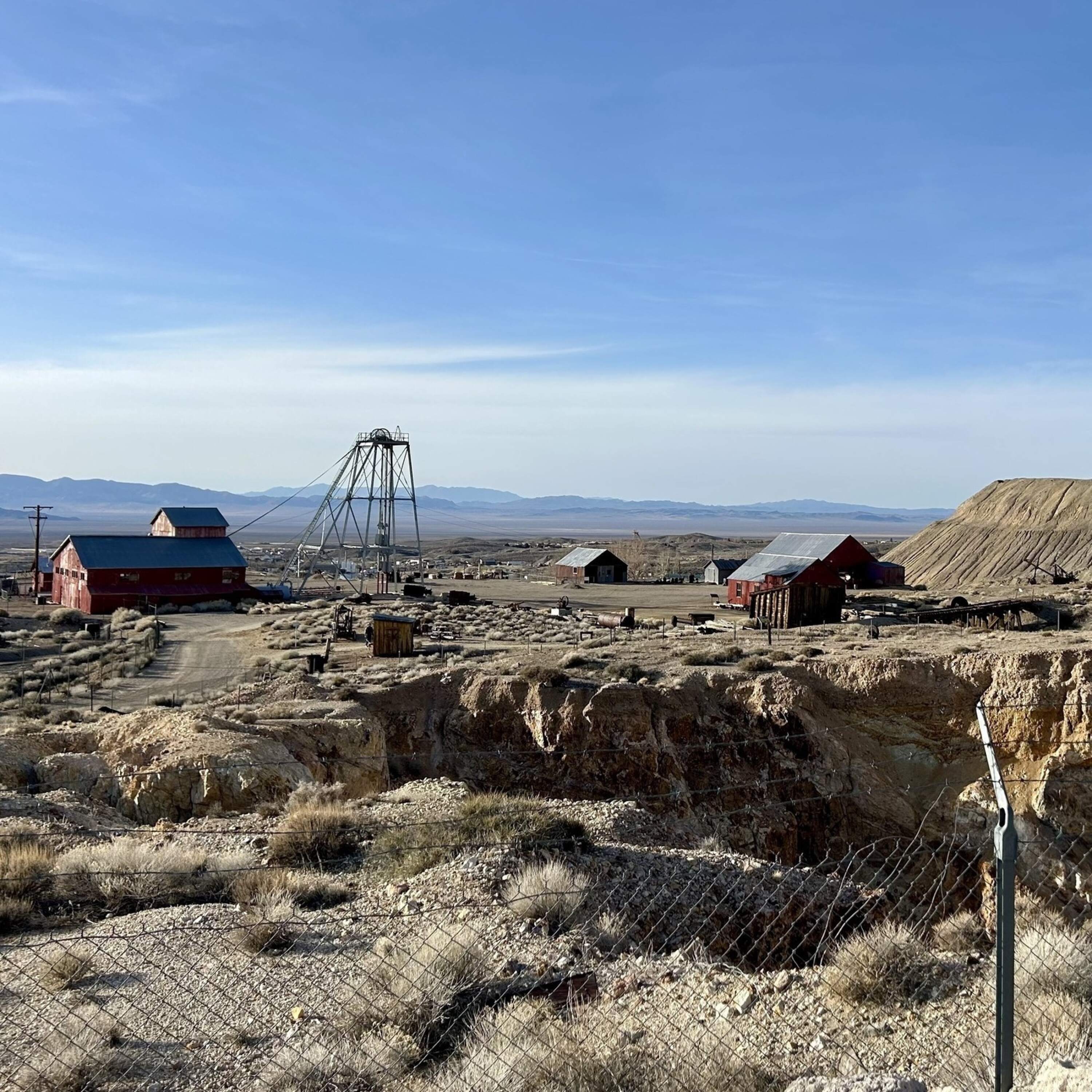
If you blink, you'll miss it on the seven hour drive from Reno to Las Vegas. But if you've got time to stop, you'll find a charming little place that says a lot about Nevada itself. It was built on the promise of silver and gold. This is the reason why Nevada is still a state. Jeff Martin at the Tonapau historic mining park knows all about it. We're on the side of a mountain. A few blocks from Tonapau's main drag. Mining equipment is scattered about, crusted with a century of rust. Get a little bit of a look up here, grill quick. You can see the desert queen up the mountain here. Yep, that's the desert queen. What's that equipment that's coming out of the mountain? So that's a head frame. That's what these structures are. And that's where they hoist the material from the deeper depths and bring it out. 120 years ago, this place was crawling with miners. It was dangerous work and loud. This miniature model of a stamp mill doesn't sound like much today, but Martin says the originals were monsters that crushed ore from these mountains all day long. 24 hours a day, seven days a week. The only time it didn't run
was Christmas day. The mines in town went quiet long ago, but generations later digging metal out of the earth is still a multi-billion dollar cog in Nevada's economy. It's the top gold producing state in the country. Anytime you have mining, you're always going to have, we call it a roller coaster ride. You have peaks and valleys. Good times, bad times, good times, bad times. And this is living proof of it right here. What kind of times are we in now? We are in good times. That's because the price of gold and silver are soaring, and there's a president in the White House eager to greenlight the development of critical minerals. I feel like we're in a boom right now at the beginning of it. Town manager Joe Westerland grew up in Tonapau. He wears a wide straw hat to protect his bald head from a lifetime open of at a sun. And we used to run through here, and it was nothing like this. It was in shambles. We used to run through here and play and run over
and eat at the frosty freeze and then go back and play. I met Westerland along with former Nigh County Commissioner Joni Easley at the local graveyard, which by the way is a point of town pride, a scene straight out of the Old West. We're going to cut through right here. The plots of old miners are perfectly manicured and marked by piles of white stones in the dirt. More than a century later, mining jobs are still revered here. Easley says government work in a military test range also boosts the local economy. What I like to say is we aspire to be rural some day, but right now we're still part of the frontier. From a practical point of view, what does that mean? From a practical point of view, it means there are few services. You got to drive a long way to get where you want to go. Aspirations for developing tone-apause rural economy may hinge on a vast expansive open desert outside of town. An array of new projects are coming to life. People here are buzzing with talk of a new lithium mine. Geothermal energy is hot in Nevada,
and a company just announced plans for a new power plant nearby. And to the south, near the town of Goldfield, Westerland says work is getting underway on a new gold mine. It's scheduled to open in 2028. We support it 100%. This type of development is what President Trump ordered the federal government to fast-track in his second term. Trump is popular here. He got 70% of the vote in tone-apause nine county in 2024. Trump is kicking butt, and I love the administration, and I think all the things they're doing is what the United States needs. That's my personal opinion. Is he doing what you want to see on the issue of the economy? Yes. That's what I agree with Joe. Yep. What about in terms of here? What is he doing in Washington that's helping folks here? Lowering gas prices. We spoke before President Trump's war in Iran sent gas prices skyrocketing higher. That's huge, especially when you live in a town where you got to go 200 miles to the doctor. I feel like the administration's getting a hold of that. Well, he's a big proponent of mining too, which you've gotten in your backyard.
Is that trickling down? Yes. The mine is opening in Goldfield. That's giant for this town. Nevada does benefit from the pro-mining attitude in the White House, according to state geologist Simon Jawet. There's a lot of interest in all sorts of different commodities in the state, so we've got exploration looking at gold, silver, lithium, geothermal, zinc, copper. You name it, people are looking for it. But prices for this stuff are volatile. A boom won't last forever. In Jawet says in some cases, the president's aggressive cuts to the federal workforce have actually slowed things down. It's hard to fast track when you don't have the people to help the fast tracking along. There's no doubt Tonapa could use the boost. Westernon says the median household income here is $37,000 a year, far below the rest of the state. That number would go up if a few hundred new high-paying jobs come to town. But where will the people live all across Nevada developers are having a tough time building houses that workers can afford? There's probably a hundred vacant houses, but they're not livable. And we don't have
anybody that we can hire. We do, but they're so busy, you can't hire them because there's very few in town. And so you can't get a housing development put in like that. From the town's perspective, is there a risk that you can miss out on some of these development opportunities because there's not any place for people to live and it's hard to get new stuff built? I don't think so, because the mines are willing to work with us and try and figure out a way to fix it. This town's resilient. We will make it happen one way or another. And maybe with some help from people like Harry Chahal. On a warm winter day, I found him cleaning up the parking lot of his roadside lodge, The Dream Inn Motel. And lately, it's gotten a little dreamier. Oh, it's nice. Yep, we just remodeled that these one, you know, smells like fresh paint. Oh, yeah, clean carpet, clean carpet, fresh paint. Chahal says business has been tough lately. And 2017 to last four or five years, like it's like super slow. But with the price of silver and gold,
it's not going to be a little bit boom. That's why you're renovating this hotel, I bet. Yes, yep, yep. Chahal is betting that a rush of new workers will need a place to stay. For a few weeks or even a month at a time to save money, he's renovating all 39 rooms himself. Yes, I've been investing for long. Are you worried about the risk of the bust? I am. I am my personal opinion. If you not take the risk, you cannot success. And he's not the only business owner in Tonopal with an eye on the future. Our last stop on the Nevada Frontier is here in the kitchen at the El Marquez, Mexican restaurant. The staff is washing up at the end of the lunch rush. Pablo Quiroz was born in Wahaka, Mexico. He's owned this place since the 1990s. He's seen the ups and downs. A decade ago, he says business took a hit when the only hospital shut down.
Today, he's concerned about the price of meat and avocados. He's no fan of the president's tariffs. The consumers are paying the price because everything went up and we had to pay no matter what. So I think his study is not helping from the low class people in America. Did you support him in any of the elections? Why mistake? Yeah, but I am very disappointed. I don't approve totally what he's doing. But like other people I spoke with here, Quiroz feels pretty good about Tonopal. New minds mean new customers. He says he doesn't have to get rich. He's secure in this town. Right where he is. It's not a place where people will become admittedly. It's a place that will give you comfort. It's a place to help you to see a food that you table or give your shelter well to sleep. No, I think that's enough for me. That should be enough.
After the break, Peter leaves Tonopal for the big city, Las Vegas, where finding an affordable place to live has become a huge problem that's getting a lot of attention from lawmakers and developers. Stick around. Support for this podcast comes from Is Business Broken, a podcast from the Meirotra Institute at Boston University. On the show, host Kurt Nickish asks the thorny questions necessary for this moment about the role business plays in society. Questions like why are executives paid so much? Why is innovation and healthcare so hard? Is ESG just greenwashing? And of course, Is Business Broken? Follow Is Business Broken wherever you get your podcasts. This Earth Day, a one and a kind adventure begins. From WBWR, the creators of Circle Round
and Endless Thread, you prefer your fruit hot or not, comes a new interactive story. 100 years into our flooded future, the Midnight Rebellion is coming. April 22nd, wherever you get your podcasts. This message comes from Carvana, who makes car selling easy. Enter your license plate or Vin, get a real offer in minutes and have your car picked up from your door. Sell your car the easy way with Carvana. Pick up V may apply. Outsiders know this city for its bright lights and late nights. But if you live here, these days Vegas is infamous for its cost of housing. Sometimes I stop and think like how are my coworkers feeding their kids and paying their bills off the same salary that I'm making. Brian Torres Suazo is a food runner at the Westgate Hotel in Casino, a job that pays him $56,000 a year, which means he needs roommates. Something I was hoping not to be doing as I exit my 20s.
So if I were to ask you, the economy feels like, what? What would you say for your life? How does the economy feel? Empty, sluggish, slow. I still know a lot of young people that like just have no hope to everyone at home. I mean, again, that's why I was able to find roommates. Torres Suazo is not alone. He's part of a legion of Las Vegas workers propping up the city's multi-billion dollar hotel and gaming industry who can hardly afford to live here. We are a blue collar tam with white collar house prices. Nicholas Irwin is a housing economist at the University of Nevada Las Vegas. With students on skateboards zooming past us on their way to class, Irwin tells me the median home price in Southern Nevada reached record highs late last year, close to $490,000. How to reach for people? A home ownership is increasing out of reach for a lot of folks. We have some recent data to suggest that the average median household income that someone needs to afford a house in town, comfortably afford, is about $120,000 a year,
and that's not the median wage in town for a household. You know, I think that's worth pointing out. Nevada Las Vegas, I think like many sunbelt cities, has had this reputation over the years, correct me if I'm wrong, is a place where you could move that would be more affordable, where you might be able to buy a house, where you could have a job and make a living. Is that changed? Is that reputation changing? That is definitely changed. That is something that is in everyone's recent memory, but the circumstances have changed here. Since about 2000, incomes have roughly doubled in town, median household income, but the price of housing is up four times that. That's just affordability, throwing through. It would be a huge change if we started to see a decrease in population, or at the very least like a smaller increase year over a year, because affordability starts to bite into people. Nevada lawmakers are well aware of the problem. In 2022, the state channeled $500 million of federal pandemic relief money into housing. And last year at the state capital, the legislature approved a bill from Republican Governor Joe Lombardo, who's running for reelection in November. That was the single largest state investment
ever into housing. Steve Acroft is administrator of the Nevada housing division. The new law expands the definition of affordable housing. It provides loans and grants for new construction. It also gives first responders, teachers, and other essential workers up to $20,000 for a down payment. Acroft says that is a significant accomplishment. In a place where you have heightened political conflict, I'll just phrase it that way. Pass the assembly 42 to nothing. But some issues the state still hasn't worked out. In Nevada, the federal government owns about 85 percent of the land. There's an ongoing debate whether more of it should be sold for housing. And speaking of the federal government, another pillar of the American dream that has been under attack is homeownership. At last month's State of the Union address, President Trump blamed corporate homeowners for driving up prices. We want homes for people, not for corporations, corporations to do and just fine. And he called on Congress to ban large Wall Street investment firms
from buying up into thousands, single family homes. Which is pretty much exactly what state Senator Dina Neal has been saying for years. The Nevada Democrat has tried unsuccessfully at the Capitol to put a cap on corporate homeownership. It was a little awkward when I asked her what it's like to be aligned with the president. I think we have it in the reverse. I think he's an alignment with me. I am not an alignment with President Trump. I have actually no interest in being in direct alignment with his policy. It's just it's this weird thing in the universe that allowed this to occur. I met Neal in her district of North Las Vegas. She brought me to this neighborhood for a reason. The dozen or so homes on this block are tidy and new. Neal says they're rentals and investor built them. It's not mom and pop. It's large institutional investors. You'd have to be a large institutional investor to come in and build homes from scratch and then rent
them out. When corporate investors come into a neighborhood like this, what happens to the people who live here? I think they are perpetual renters and I think there's a level of instability that is created within the neighborhoods themselves because the house is constantly flipped. What does it do for prices? It raises them. So the average rent is about 2,500 for these homes. So when you think about your ability to save, how are you supposed to save for the down payment assistance when you're paying for the rental property? You're not going to be able to save. More than a quarter of the homes in Las Vegas are owned by an investor according to the real estate statistics firm batch data. That's one of the highest rates of corporate ownership in the country. But housing economists like UNLV's Nicholas Irwin aren't convinced a cap on investor housing will do much to help. He says there's really only one way out of this problem. You build more housing, more housing of all types, everything from low income housing, all of it to high
in housing. And you have to build a lot of it. Irwin says the state needs 200,000 more homes to meet demand and stabilize prices. It's a tall order. But Michelle Merced is trying to help a few houses at a time. We are here in the beautiful historic west side, City of Las Vegas. Merced is CEO of a nonprofit called neighborhood housing services of southern Nevada. We're walking through an empty gravel lot near the Las Vegas strip, the instantly recognizable observation tower of the Strat Hotel pierces the skyline a few miles away. Merced says the west side is known for its churches and its rich black history. Back in the 40s and 50s at one point, this is where all the African Americans could only live and play, honestly. You could work on the strip, but you had to live here. Today, many of the lots in this neighborhood are empty after generations of disinvestment and housing discrimination. The homes Merced plans to develop here are for working families who make
too much to qualify for affordable housing, but not enough to afford market rates. And so this is going to be eight single family homes detached. It's going to be a three to four bedroom, two to two and a half bath purchase price. Gosh, we're hoping less than 450,000. You know, if I can get it lower, I will definitely try. Merced says her target buyers are people burdened by rising prices. She calls them the murky middle. It's the teacher. It's the nurse that works on you in the hospital. It's the person that stocks the groceries. It's the firefighter. Everybody's got different circumstances. You can still be making six figures, but if you've got three kids under 10 years old in daycare, and that doesn't include food, gas, car payment, insurance, none of us are here to judge. As we're talking about the cost of housing, a man approaches the empty lot. We are the church. Listen up, boys and girls.
He's singing and praying with a Bible in hand. He says his name is David. We chat a little bit about the plans for the new homes here. What do you think about that? The thing is what you're building houses for, and we'll got to prove it. You want him to be a proof of whatever you do. David says he's living by one of the neighborhood churches. That's where my car had, and I stay inside my car until I get another place. In recent years, Las Vegas and other cities across the country have seen a sharp rise in homelessness. Housing experts say rent prices are part of the problem. After David moves on down the road, Merced reflects on his situation. But wouldn't it be cool if we could build something where he was feeling safe? I can't help but just notice the irony of, you know, someone coming up to us who lives out of his car. As we're sitting here talking about how difficult it is to find a place to live in this. There's a lot. I mean, I've been doing this for 18 years. I have
never ever seen such a desperate cry for help for housing. Merced calls it in affordability crisis, and that's something politicians will grapple with here in Las Vegas and around the country as the march toward the midterm elections begins. And if you want to know more about how those midterm elections are shaping up in Nevada, we've got more on that right now at here and now.org. In February, the lone Republican in the state's congressional delegation announced his retirement, giving Democrats a chance at flipping a seat. And maybe the House says Paul Boger of KNPR. If this is a blue wave election and Republicans are very, very frustrated with the affordability crisis or what's going on with Iran, if that stretches into months, you know, they may choose to stay home and Democrats have a better chance if you will. But Northern Nevada, CD2, this is the heart of conservative Nevada. So I do think it's going to
be a long shot at this. There's lots more to that conversation than you can find it all right now, along with a closer look at how Liffian minds are changing the economy there. And of course, pictures of the Tonipa historic mining park. All that at here and now.org. But that's it for the show today. Here and now, anytime comes from NPR and WBUR Boston. Today's stories were produced by Peter O'Dowd and edited by Shiko Theority and Cat Welch. Michael Scotto edited the podcast, Technical Direction from Caleb Green and Matt Reed with help from James Trout. Our theme music is the Mike Nusketto, Max Liebman and me, Chris Bentley. Our digital producers are Allison Hagen and Grace Griffin and here and now's executive producer is Alan Price. Thanks for listening. If you like what you heard and you want more reporting from all over the country, click the follow button in whatever app you're listening to us on right now. Here and now, anytime has new episodes
every single weekday of the year. Then we'll be back with you on Monday. This message comes from Betterment. You know when you sell a stock or any investing asset and start to feel the dread of getting a surprise tax bill. Betterment's tax impact preview tool shows you the estimated tax impact of the sale so you can make informed tax smart investing decisions. Get started today at Betterment.com. Investing involves risk, performance not guaranteed. Betterment is not a tax advisor nor should any information herein be considered tax advice. Please consult a qualified tax professional. This message comes from Easy Cater, the workplace food platform. Easy Cater helps organizations order food from favorite restaurants, meat dietary needs, and stay on budget. With employee meal programs, flexible payment options, and 24-7 customer support all on one platform. Learn more at EasyCater.com.
More episodes
More from Here & Now Anytime

The story behind the photo that captures the horror of 9/11
Here & Now Anytime

The conservative movement, one year after the killing of Charlie Kirk
Here & Now Anytime

9/11 and the long shadow of Islamophobia
Here & Now Anytime

Israel faces global outrage over West Bank violence
Here & Now Anytime