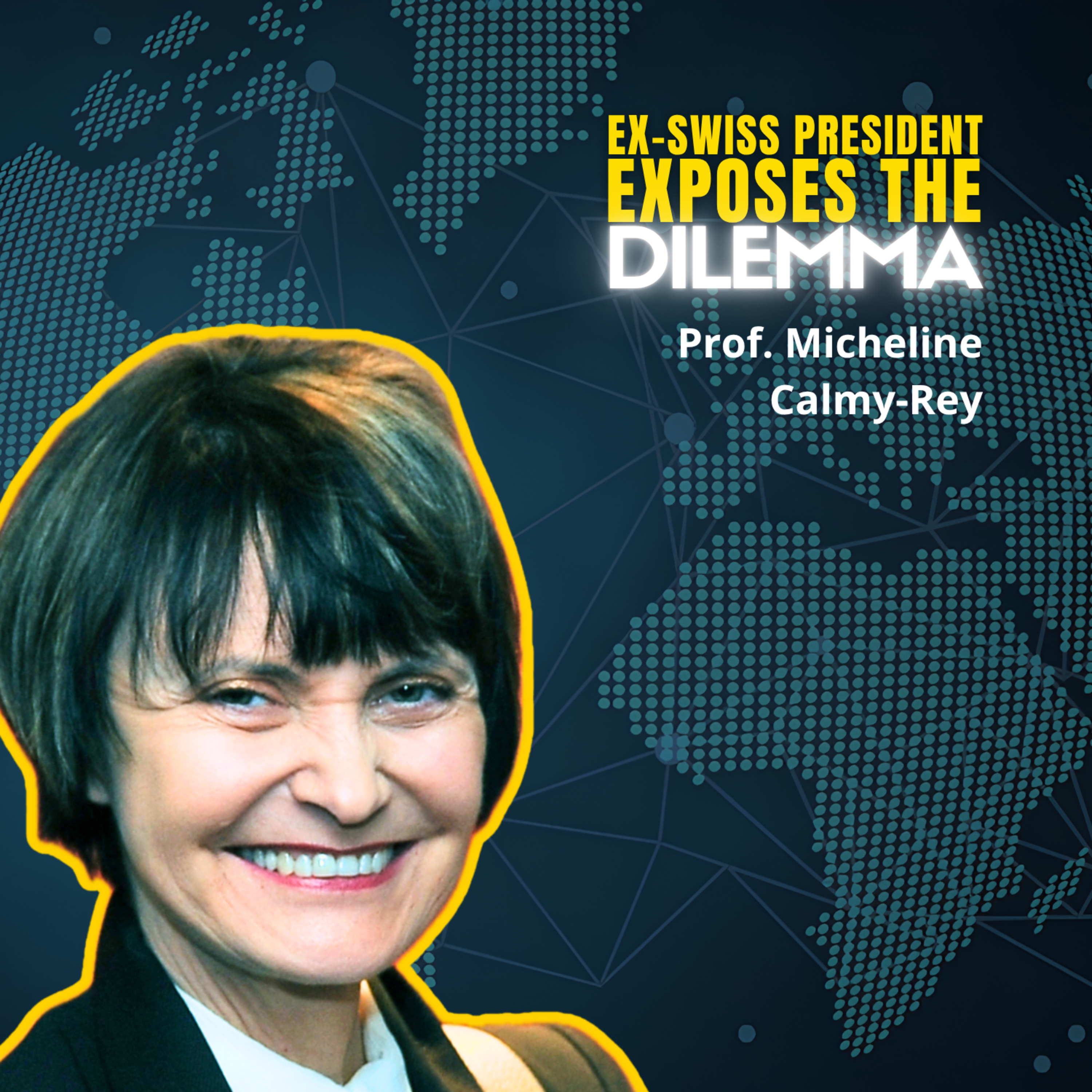
The Greatest Foreign Policy Dilemma Yet | Ex-Swiss President Micheline Calmy-Rey
About this episode
Original Video in French Here: • Notre Plus Grand Dilemme: La Neutralité | ... Micheline Calmy-Rey, former Federal Councillor and two-time President of the Swiss Confederation, analyzes the foundations of Swiss neutrality and the challenges it currently faces. Ahead of the vote on the Neutrality Initiative, she reflects on her experience during the Iraq War, explains the difference between the law of neutrality and neutrality policy, and examines the controversial issue of international sanctions.The interview also addresses the war in Ukraine, the role of the United Nations, military cooperation with neighboring countries, arms exports, and perceived inconsistencies in Switzerland’s application of neutrality. Micheline Calmy-Rey explains why she opposes the initiative while warning of the political and diplomatic consequences that an overwhelming rejection could have.To discover the project by Micheline Calmy-Rey and her students on Swiss foreign policy: [https://zone-neutre.org](https://zone-neutre.org)Subscribe to Neutrality Studies for our upcoming interviews and analyses on neutrality, diplomacy, and international relations.Substack: [https://pascallottaz.substack.com](https://pascallottaz.substack.com) Merch: [https://neutralitystudies.com/shop](https://neutralitystudies.com/shop) Donate: [https://neutralitystudies.com/donate](https://neutralitystudies.com/donate)Chapters:00:00 Introduction and presentation of Micheline Calmy-Rey 00:53 The experience of neutrality during the Iraq War 05:22 Ukraine, sanctions, and the role of the United Nations 09:29 The inconsistencies of Swiss neutrality policy 12:15 What the Neutrality Initiative would change 20:49 The political and diplomatic risks of a “No” vote 24:00 Rethinking neutrality and the issue of arms exports 29:09 Should neutrality be defined in the Constitution?
Get every episode summarized
Each time Neutrality Studies publishes, we email you a written briefing from the transcript — the topics, who appeared, and any specific claims, with the ad reads skipped.
Email me new episodesFree for 3 shows. No card needed.
Hosts & guests
Transcript ready
786 searchable segments. Every word is indexed and playable.
Full transcript
Neutrality Studies — The Greatest Foreign Policy Dilemma Yet | Ex-Swiss President Micheline Calmy-Rey. Machine-transcribed; use the interactive transcript above to jump the player to any line.
Did you know that mosquitoes have killed almost half of all people who have ever lived? Today, people are fighting back. With support from the Gates Foundation, American scientists and partners around the world have developed a new generation of bed nets that can kill up to 90% of mosquitoes exposed to them, helping cut malaria rates in half. The result? A safer, healthier future for everyone. The Gates Foundation, partners of human potential, search Gates Foundation.org slash mosquito to learn more. A few days later, there will be an uncertainty afterwards,
recently called toclears the catastrophe as we could in this century. Finally, a할-?) A volatile, headsed wedding. I wanted to know if you want to have a debate on initiatives out of the abrupt needs ofIDS and how to enhance our abandonment on a Cy plataform in the Scottish region. today in the year 2020. I have not only written books on our country, but I have practiced our reality when I was a federal teacher in 2003, when a coalition brought by the United States entered in Iraq without the Council of Security. Switzerland applied to the neutrality. At that time, I was considered to be how complicated to apply to the neutrality. How was it? It was not that.
You are confronted with a multitude of administrative decisions, concerning the survival of the Swiss territory. First, concerning the qualification of the conflict, the right of neutrality can be applied if it is a inter-ethatical conflict. That is, between two states. The right of neutrality, as it is defined by the convention of the year of 1907, does not apply to the conflict of civil rights. It is multiplied today. The nature of conflicts has changed since 1907. So, there, it was necessary that the Swiss caliphate the conflict was a inter-ethatical conflict between two states. And from that moment on, we can consider the applied role of neutrality. When there is a violation of sovereignty in a state without the Council of Security, without a decision of the Council of Security.
So, it means a multitude of administrative decisions, as it is defined as the actions of the Nigerian parties, cannot survive the Swiss territory. It means that, in some cases, the transition from the Swiss territory to the use of the Swiss territory is interrupted. So, it is not as easy as that. In addition, you have to have a political decision of the federal council, and, in the end, we had re-required the approval of the federal assembly, which is a complicated process. And then, how to put the end to the application of the right of neutrality? When Mr. Bush, president of the United States declared that the war was over, the Swiss territory,
said, OK, the war is over, so we know this applied to the right of neutrality. So, it is a series of decisions. Now, we have to distinguish the right of neutrality with the obligations that the right of neutrality has not so many obligations. There is, especially, the obligation to be able to defend its territory, the obligation to not let the transits of troops by the Swiss territory, the obligations to not survive the Swiss territory, that is, it can finally be quite a bit of obligation, but the duty to be able to defend its territory. That is the limit, that is the limit to the army. On the right of neutrality, there is the political of neutrality. That is, if you are not aware of it, you must take a foreign policy that will make the country credible.
You can't do absolutely anything, because at this point, you are not credible. These are the things that must be attentive to the peace. And then, as soon as we start the conflict, or as long as the conflict is Ukraine and has become wider in 2022, there is already a conflict, but this conflict was a ... We are a debt in the end. And then, in 2022, this has become wider. This was the Russia that is between Ukraine and our federal council to decide to apply the right of neutrality. But on the other hand, we have also taken the decision after a few days to apply sanctions.
And then today, the question of sanctions is not to be regulated in the right of neutrality. But what do you think is the right to see the ... The sanctions. Yes, sanctions are not part of the right of neutrality. The conventions of the EU do not speak of sanctions. And these sanctions are coming on the table with the fact that the Swiss is going to be in the United Nations. It is the United Nations Charter, where we are now linked, where we are engaged in respect and the United Nations Charter says that if the Security Council decides there is a violation of the international law, at this moment, the Security Council, General Assembly of the United Nations, can decide to qualify the fact that there is a violation of the international law and the idea of a sanction of the military economy.
The Swiss cannot be associated with the military sanction because it is in the law the fact that it is not authorized. But the federal council declared the entry of the Swiss in the United Nations that the sanction application was compatible with neutrality. There was no contradiction. So the Swiss, the reserve initiative, besides the sanctions of the Security Council, the initiative did not interfere with the sanctions which would be decided by the Security Council. The problem is that the problem is that due to the veto of the great power that the Security Council is very often blocked. So it is General Assembly that takes resolutions. But the Swiss, since, even before being in the United Nations, the Swiss followed the sanction policy
since the war between the Iran and the Kuwait. So the Swiss followed and considered that the fact that the United Nations is in the effect of its entry is the sanctions are applied. The initiative, again, does not interfere with the sanctions since it reserves the sanctions taken by the United Nations. And so, and so, in addition to that, the initiative tells us, yes, and then, in addition, the Swiss can take measures. It is a different word for sanctions. And measures to avoid the counter-tournament of sanctions taken for example by us, for example by the United Nations. So, that means that you can simply continue with the sanctions against Russia. Yes, yes, yes. Because if the United Nations takes sanctions against Russia
and that the Swiss did not take at all, at this point, there is an advantage in the Swiss. But there, it remains true the will of the federal council and it could be very well not to take sanctions. In the spirit of Mr. Blochert, it is probably this interpretation that is dominant in the measure for him, the initiative is a business plan. It will allow the Swiss to export. So, the other countries decide to export more, so with an immense advantage, what has been done, for example, with the South African, what has been brought back to the Swiss. Yes. On the other side, how do you see the political neutrality of the Swiss? Because we have this problem today that we have the countries that are going to be able to take the United Nations
as Russia and the country, but also the United States and Iran. And then, the Swiss, the Swiss, the Swiss has never taken sanctions against Israel, has never taken sanctions against the United States. How do the United States take control? I am aware that the right of neutrality in the concern of the war between the United States and Iran, it has not changed much because it concerns the Iran, since the Swiss has already applied sanctions to the country against the Iran. But because it concerns the United States, the Swiss has applied the right of neutrality, saying that the renunciation of commercial relations with a country of dangerous, has applied to the future commemoration, and not to the already-racked commemoration.
So it is a way to consider things. But it applied the right of neutrality against it, it did not apply to the counter of Israel, which has violated the sovereignty of not only Iran, but of the Libyan, for example, and the Swiss has remained nothing. So, if you can say that, it is a problem for many people, because it is the confusion you want. It is the fact that there is no constant in the application. It is that once we apply the right of neutrality, we say that it concerns the future commemoration, and once we apply it not at all. So we know very well what it means.
It has a lot of coherence. And that is a problem, because neutrality actually exists, and it gives us interest in the interests that it is accepted by others. And if it is so fluctuating that other countries do not know more what to do in Switzerland, it becomes a little complicated. And how? That's why I think it is a good thing, that we have a national debate on neutrality, we must speak the initiative, that we will vote on the 27th. But how do you see the development of neutrality, or the interpretation of neutrality changing during the last 10-20 years, 20 years? Have you ever observed that? If we are on the same level? Yes, you are right.
It has changed the fact that the entry of Switzerland is in the United States. It has changed this fact. It means that sanctions, that they may not be contrary with the right of neutrality, but the right of neutrality does not speak of sanctions. And that is what is different. Since the entry of Switzerland to the United Nations, the international rights violations may be sanctioned. But it is a little problematic in the initiative. Because the initiative, under the trap, wants to put in the constitution an article on neutrality, but it includes sanctions, under the trap of neutrality. So it is not the case. The sanctions do not have the right of neutrality. It has the right to follow the United Nations, the violations, etc., created by the organized nations of the United Nations. The right of neutrality applies to subsidiarism compared to the United Nations Charter and international rights.
So, in the initiative, they introduce, in neutrality, sanctions. Yes, which is not the case until now. So, in order to obtain the obligations of the right of neutrality, in the initiative and in the constitutional article proposed. So, I am one reason why I say, I can't accept it. Otherwise, for what is concerned, if you want international cooperation, international cooperation, the Swiss cannot cooperate with the United Nations, in terms of interoperability, in terms of trust, we must know our friends, whether compatible with those of the United Nations, then work together, etc. And here, it is something that Switzerland has already done. The initiative remains a little bit, it is said that in a permanent attack or a preparatory act,
then, we can only cooperate in a permanent attack or a preparatory act of an attack against Switzerland. Well, that means that if I am at the federal council, I interpret this, the current situation is must be considered as preparatory acts. If you have cyber attacks, if you have threats, then you can start to increase if you want interoperability and work with the countries of cooperation. The initiative does not really interfere with the cooperation. In what concerns the sanctions, they reserve the sanctions of the United Nations, they reserve measures that can avoid returning the sanctions from the Swiss territory. So that, for me, is not so much the problem. The problem is, it means that it will not change a lot
to the current practice. In contrast, the problem is indeed in the obligations to inscribe a limited principle. Including these places. May this year, most rewarding season ever with Fandru, age and location restrictions apply. Product availability varies by market. CFandru.com for eligibility, gambling problem called 1-800-Gemma. All right, everyone. Welcome to ARCO Rewards Orientation. I'm Hannah. Whoa. Is everything okay? That's a code green. Someone just earned at least five cents a gallon in rewards. Wow. Another one? Well, that one's a code gold. The customer just redeemed savings above to a dollar a gallon. Impressive.
What does that one mean? Oh, that's just picky. He gets excited when we talk about rewards. Savings of up to $1 per gallon redeemable with 20 rewards dollars in your loyalty account. Participating locations, terms and conditions apply. In the right, in the obligations of the Swiss. For me, that remains too much. Yes, can I ask you two questions? There are two things I think that are important on the initiative. One is that we change the principle. The principle that Switzerland will follow the sanctions of other European countries practically automatically. We don't follow them automatically today. We decide, but we often follow. The sanctions. And then the initiative changes the principle. We don't take the sanctions anymore, except when there are exceptions. And on the other hand, we also have the United Nations to introduce the sanctions that are not prepared by the United Nations.
So there is even a day. No, no, no, no, no. They don't. It's us. The Swiss can take the initiative of measures to avoid the counter-tune of other sanctions by the Swiss territory. Measure this interme qui va long as sanctions. Yes. Because if the Swiss takes measures, they have to take measures that others can avoid that their territory becomes, and they can avoid that it is an advantage for the French to be dangerous. If the European Union has forbidden the importation of the Russian oil, and that the Swiss take the authorities, then it can be avoided by the Swiss. If you want to give an advantage to the Swiss as a dangerous leader, the Swiss takes measures. That is, they have to be forbidden. Otherwise, otherwise, the world will be imported by the Swiss.
Yes, it will. The Russian oil cannot come from the Swiss, it will come from what I have said. If the oil cannot pass the European Union, it is the same thing with our space for the planes. We have closed our Swiss space for the civil planes of the Russians, but the Russians can't even come from the Russians. We, if they can't transit the European Union, then there are some measures that we don't really need in the sense that we have to take them as we have to. We have to take everything. Simply, if we take the states to the Russian and the Russians, and that we don't take everything, then we find ourselves in the situation where we find the South Africa. That is, we have an advantage in the South.
So we say yes, but that means normal currency. It means that the Swiss maintain the commercial relations that they had before the conflict. And so that is possible. No, if the normal currencies also means a commercial advantage because maintaining a currency before the war, while all the other states take sanctions and restrict the commercial relations, that are the business plan of Christophe Leucher. On the other hand, there are many countries that don't have any sanctions against China, all the prices. They are not, they are not, they are not the same. We have, we are a country that will go to the market and say when there is a violation of international rights, the Swiss, sanctions. And it is not an act of war, because
it is not an act of war, because it is to establish a situation that was, that it has nothing to do with military. The right of the neutrality is the military concern. Yes, but the charge also says that it is that the security council that can find that there is a general supply. Where the general supply. Where the general supply. The general supply has not been applied to apply this decision. And it can be a decision of a general supply. Again, the right of neutrality is not applied to sub-cihired categories. When we applied the right of neutrality in 2003, we will talk about sanctions. Well, that's all. We applied the right of neutrality to the accounts of the United States and to the accounts of the other Nigerian countries that were Iraq. We applied the right of neutrality to intervene on the Vol, retreat and uh its export쳐 . You also mentioned it in a piece
that you wrote your kg. lol For example, does it promise to contribute? attdrafts you want to change on this project? One day that the initiative is accepted. The Sunday, I'm sorry, it means that the problem is a communication problem. You will explain to the international community that the Swiss vote for neutrality, but it is still neutral. How will you explain that? It's already complicated for us. But how will other countries understand that? They will say, but there are more and more. But we have to vote yes, we are the same. If we don't vote, this is the problem. That's all the dilemma.
I said that the UNICEF would rather not launch its initiative. Because it has a real problem. It has a real dilemma. The neutrality again has to be accepted and recognized by the international community so that they can defend our interests and position themselves in the world. But if no one understands what we do, if no one knows how to communicate, I don't know. If I was at the UNICEF, I would say, wow, how can I explain that? How can I explain that we are still together? But we have voted against each other. Yes, but if we reflect on that, you say that one side, the initiative doesn't change a lot in the practicality. On the other side, we could really do bad. So, we shouldn't vote yes,
even if we are not really in agreement with the content. There are many people who pose this issue. In a saying, they would rather, when the initiative doesn't change a lot in the score. So I voted yes. That's a question that everyone has to pose for themselves. But, indeed, seeing the difficulties that the UNICEF had explained, especially at the time of the Russian aggression against Ukraine, there was a moment where it was a little difficult to understand what the UNICEF did. And many countries called me, contacted me, said, oh, the support is no longer mine. So I had to explain it to them, yes, the support is still mine. But, as it was once, a new neutrality in a new context. So, that's always difficult to explain.
Yes, I think there is... I think that neutrality has a problem. It's not the right to international and corruption. It's a problem of coherence, our political neutrality. Because it's difficult to follow the measures of the decision of the federal council. We talked about the application of the right to the war between the United States and Iran, but not to Israel, so it's a little complicated to follow, but between there, I mean, that's the reason for which the other countries... And then, very often, we forget that the sanctions have nothing to do with the right of neutrality and that's the fact of the decisions of the Security Council or the organizations of the United Nations. And there, the initiatives,
they also create a little confusion in the institutions in the obligations of the United States that... Well, the negative obligations, not to take part, but that doesn't exist until now. So, that's the remaining, in fact, the March of the federal council. And for the rest, I mean, it's true that some countries also have the sanctions made of more and more other, but it's a false interpretation of the right of neutrality. Well, I think the neutrality is useful. It served me when I was a federal council, it served me, it created a certain reputation. It allows us to appear as media-runners, as negotiators, all-in-one-runners, who don't take part between the legitimate parties,
but who wants to try to approach the point of view when there is a conflict, moreover, we are small people, that's my daughter of ours. I think that neutrality today should be repented due to the change in the movement in the international conflicts. At the time when the comments were written, it's true that international conflicts were between us. Today, the multiplication of internal conflicts to a civil society, for example, the conflict will be in the Palestinian world. It's not touched by the right of neutrality, because the Palestinian world is not a state that is recognized by the international community. It's not touched by any peace, it's not a problem. There is a problem. So it's true that there should be, if you want people to understand
why we don't export weapons to Ukraine, but why do we export to the Saudi Arabia? They are confused. They say, they want to say, but they are confused. So, people understand that. I think that the interpretation of neutrality should be extended to conflicts that are dis-scived or inter-scived or inter-scived, they should be caliphied. In any case, the multitude of tensions that are in the world are not all between two states and so, it should be in my opinion, to portray neutrality in a way that is not more than 30. Yes, then we must say that we are certainly the laws that are being treated on things like exportation and weapons, that are not part of neutrality, but that is what we say, that we will not export to conflicts,
but the definition of a... ...including these places. May this year, most rewarding season ever with Fandru, age and location restrictions applied, product availability varies by market, cfandru.com for eligibility, gambling problem called 1-800-Gemma. All right, everyone. Welcome to ARCO Rewards Orientation. I'm Hannah. Whoa! Is everything okay? That's a code green. Someone just earned at least five cents a gallon in rewards. Wow! Another one? Well, that one's a code gold. The customer just redeemed savings of up to $1 a gallon. Impressive! What does that one mean? Oh, that's just picky. He gets excited when we talk about rewards. Savings of up to $1 per gallon redeemable with 20 rewards dollars in your loyalty account,
a participating locations, terms and conditions apply. Conflict is something that is still fluid on the level of federal council. The export of arms is a quite controversial subject. The neutrality of the internalization of arms to the legitimate parties, when the product of arms is the fact that the company belongs to the public corporation. However, what concerns my private enterprise, we can export weapons to the public and the public. So, if we export weapons to Russia, we should, if we export weapons to Ukraine, we should export them to Russia. So, finally, we even told the export of arms to the public that we already sold to the public. What is provoked,
that there is a few incomprehension of the partnership, we could modify the law because it is not very viewed in the details like that. And finally, you see, I have many friends in the foreign sector who were astonished that the Swiss had not a decrease in neutrality. We have, now, we have the word of neutrality in our constitution, but we have not a definition. Do you think that we are the principle of a good idea to have a proper definition of the constitution? Or do you think that it should be high in the constitution? Yes, I have no problem with what it would be, indeed, in the constitution. Why not? It will put some of the cost, the activity of the federal council, which makes the federal council against, because they say we want to keep the flexibility. However, where I am not aware, it is that once again, we detect the sanctions
in this article, that the constitution is on neutrality, so when the corruption of the people do not speak. So that is a consequence of our belonging to the United Nations. And again, the right to neutrality is to be subsidized. That is, if the United Nations cannot decide. How is the common law with the Ukraine, with the United States? We have blocked in the council of security, the general assembly, it does not seem to be mandatory decisions that they can take, do not they? That is, there is not the means of putting them in work. There is not the means of putting them in work, but, indeed, it is not the same thing that if the Security Council takes a decision and decides the right to work in certain number of sanctions. But, therefore, the following has always been repaid by the anonymous years. We have always repaid
sanctions, not by the United Nations. And when the United Nations was incapable of taking a decision, for the right to work, at this moment, we have repaid the sanctions of the European Union. So the initiative said, we could no longer take the EU automatic sanctions, but we could take measures to avoid the contours of the EU. So, there, we can, we have more autonomy, if we want, in the choice of sanctions, we can decide, for example, what we do now, what we do not apply to the European sanctions, concerning the political personality that they have blocked. So, we could decide not to do it. Yes, one way, this initiative to give this definition to give, to its legal solutions and it is, we need it. It is true. But there are some
lawsuits that have been made and are continuing to exist, the IPn number of the EU is termically correct. It is also possible to trick against new trends which reveal how many countries processes can occur to me. Because, in our combo, the international We are not forced to take all the federal council, to take them to court, if they are medically. We are taking them to the court, but sometimes they pick up things. Yes, they pick up things. Manam Kabiré, thank you very much for all these explanations. Is there anything on the theme of neutrality that we haven't even talked about yet? Do you want to tell everyone? There is just another last thing, in the focus of the results. If the initiative is too risky, I am a bit afraid that it encourages turbo-turbines or turbo-turbines.
Let's go further. And here we are still in a gray zone. We saw it with the attitude of our federal council to the Ukraine's guards. It was obvious that there are big companies, the citizens of the Burgenstock, so we don't invite the Russian. All that, it's a little limited. I think we have even more time. We are waiting for a very bad score to say, we are approaching now, we are slowly moving out of the limits of our political neutrality. Thank you very much. For the people who would like to follow you, I know you started a podcast with your students. Is there any people who follow you?
Yes, it's on our website. Thank you. It's a website for the moment. We hope to develop it and make a podcast on the political extrovert of Switzerland with the students in the future. I congratulate you on this initiative, and then I will put the links in the description of this video. Madame Michlin Camirez, thank you very much. Thank you. Have a good day. You
More episodes
More from Neutrality Studies

Ukraine Proxy War End Game Begins, Collective West Total Panic | Alex Christofor...
Neutrality Studies

Europe's War Mentality Goes CRAZY: Switzerland Proofs It | Alberto Togni
Neutrality Studies

🚨 Next Escalation: USA Out of Options, Iran's New Zero-Tolerance Strategy | Dr....
Neutrality Studies
NATO's New Plans To Destroy Russia | Prof. Jeffrey Sachs
Neutrality Studies