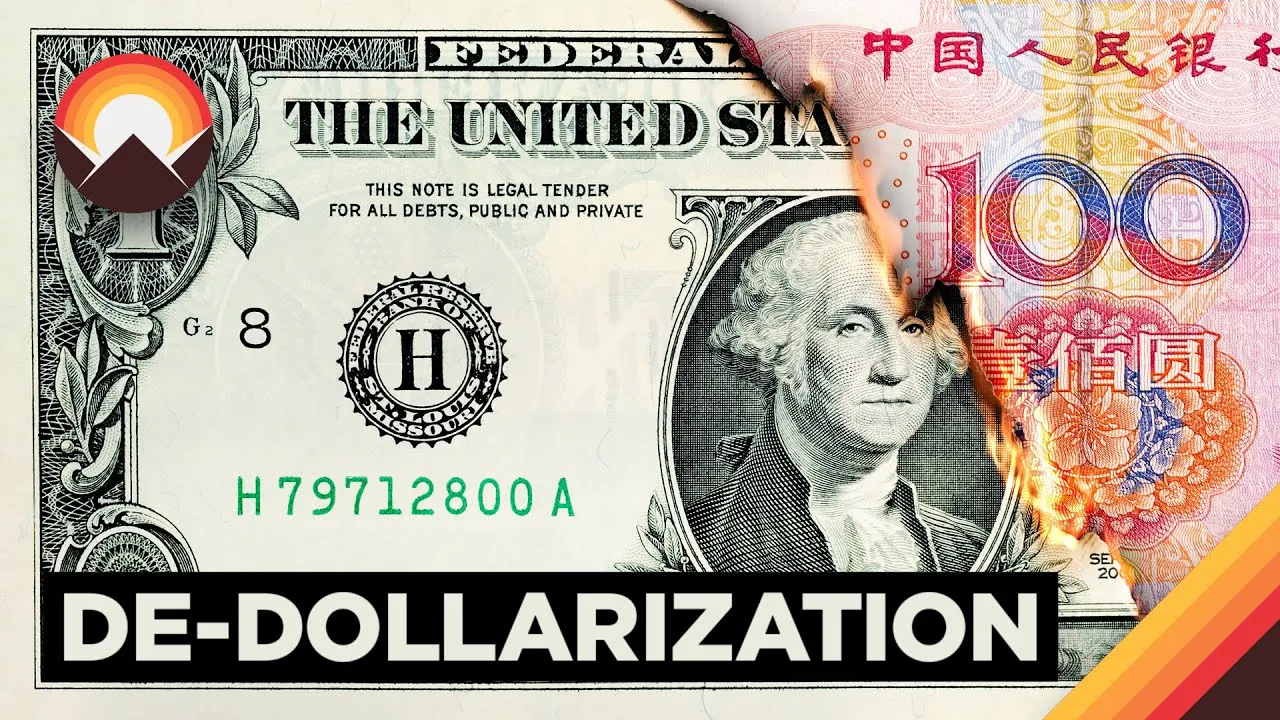
The Growing Revolt Against the US Dollar | Wendover Productions
About this episode
Wendover Productions is made possible by:
Get every episode summarized
Each time Wendover Productions publishes, we email you a written briefing from the transcript — the topics, who appeared, and any specific claims, with the ad reads skipped.
Email me new episodesFree for 3 shows. No card needed.
Transcript ready
320 searchable segments. Every word is indexed and playable.
Full transcript
Wendover Productions — The Growing Revolt Against the US Dollar | Wendover Productions. Machine-transcribed; use the interactive transcript above to jump the player to any line.
If an American wants to buy something in Britain, they'd need British pounds. The easiest way to get pounds is by finding a British person who wants to buy something in America. They'd need US dollars. Each currency represents value that can be exchanged for goods and services, so the logic follows that one can trade two facsimiles of value for each other. But the same can be said for the Swedish Krona and the Samoan Tala. A certain number of each can be traded for, say, a gallon of gas in each country, and yet the two cannot be traded for each other quite suesely. You see, Samoan's only import about $19,000 of goods from Sweden each year, and Swedes barely import anything from Samoa. Therefore, the likelihood of finding a sweet looking for Samoan Tala's at a given time is low, even if a certain number of Tala's always corresponds to the same value as a certain number of Krona. It's just an exchange barrier. But the Samoan can get around this. Some $40 million flows between Samoa and the United States each year, meaning, at any given time, there is almost certainly an American looking for Tala's to pay for Samoan
exports so they can transfer their Tala's into dollars. Then some $25 billion in trade happens between the US and Sweden each year, so it's even easier to convert dollars into Krona, meaning a full Tala's to Krona's transaction can take place just via the US dollar. It only has the transaction occurred faster than if one waited around for a willing Sweden trade for Tala's, it likely costs less since the Samoan didn't have to incentivize demand through offering a higher than warranted number of Tala's for Krona. There are 180 UN recognized currencies out there, meaning there are thousands upon thousands of unique combinations of currency that can be exchanged. Even at the scale of the global economy, this means it's not always easy to find a willing partner to trade currency with when needed. Therefore, 88% of the time, currency transactions occur with the US dollar. It doesn't mean 88% of transactions are ultimately from or for the US dollar, but rather that it's often just easier to facilitate international transactions through the US dollar. It's a sort of self-fulfilling prophecy. It's easiest to trade with the most traded currency, and therefore the most traded currency
is traded most. These days, the US dollar serves that role. It is the plumbing of the global economy, but that's a relatively new role. Before the IMF or the WTO, before this century, last century or the century prior, before central banks or the concept of nations, it was traded. Trade between states, trade across kingdoms and fiefdoms, trade between tribes and clans. In the West, as the world got bigger, the trade networks became more complex and the means of trade centralized around currencies. And since the very beginning of modern trade, there's always existed a currency that's just easier to do business with. A dominant currency, a global currency, a reserve currency. The earliest coins connecting trade across Europe and the Near East originated first in the merchant heavy city states of the Mediterranean, Venus' Duquat and Florence's Florian. Because the coins were nearly the exact same, both being made of gold and minted at nearly an identical weight, the two functioned largely as interchangeable across the Byzantine and Holy Roman Empire from the 13th century through to the 16th, reaching such common use
that a host of other European cities ended up minting the coins. These currencies weren't forced on the rest of Europe by Venice or Florence. But unlike local currencies, they consistently held their value that could be trusted, and because they rode the coattails of their originators' successful trade across an ever-expanding network, they were prevalent. If a genuine boatmaker was seeking funding from a genuine bank, the unit of account would be in Florians. If a Venetian merchant sought to buy salt in Serbia or a Venia and then sell onto their inland neighbors, the transactions would be in Duquat's. If the business was big enough to involve the era's fledgling banks or city-state governments or trade from any of the dizzying array of tiny kingdoms doddling the bustling Mediterranean, it was done not by the local currency but the common currency, the one that both parties trusted and both parties could get their hands on, the Florian or its twin, the Duquat. Then the Western world got a whole lot bigger and the dominant lanes of trade shifted from the Mediterranean to the Atlantic. The center of this newly global network moved west too as the Aberian Peninsula unseated Italian city-states as the world's economic hub.
While fabled cities of gold never materialized in the new world, Portuguese explorers and Spanish conquistadores West River expansion opened an era of truly global trade. And when they did stumble into mountains of silver in present-day Bolivia, it was all but assured that the new dominant currency the world over would be the Spanish Real. With the opening of the Potosi Silver Mines and the coinciding consolidation of territory across Europe, a flood of carefully managed Spanish coins now made its way through the Americas, Asia, Africa and Europe. In a bigger scale, the Real did what the Florian did before it, becoming the world's most readily available, reliable option for commercial transactions, but this time, the world over. In Britain's North American colonies, for instance, the Spanish dollar maintained popularity throughout the 1700s because it was far more accessible. While pounds were difficult to physically obtain, merchants imported goods from the West Indies by paying with comparatively prevalent Spanish currency, continuing to do so even after American independence. Even though the Spanish Empire reached its peak in the 1500s, seating territory and
power for the following two centuries, its silver coinage remained a mainstay across the colonies because it was too convenient. But the Rale sting power as reserve currency proved shorter in Europe as the land poor, but ever-innovative Dutch provided an alternative for European traders in the form of the guilder. With arguably the first central bank protecting Dutch currency from debatement, and the world's first corporate entity establishing the state as the most powerful of trade partners, the Dutch money quickly became Europe's most trustworthy currency. While not the globe-trutting empire the size of Spain's or Britain's that would follow, Dutch guilders were so stable in value and so easy to transact with via notes and receipts that by the mid-18th century, an estimated 85% of all European banks accepted Dutch currency to settle claims. Since the dawn of international trade, the currency of the conquerors, on account of its reach and its steady value, became the global currency out of convenience. It's holding onto that top spot long after the sun had set on the empire that created them. Through such convenience, they became the period's de facto reserve currency, the form
of money that banks and businesses would hold on to to facilitate international transactions. With the arrival of nation-states, central banks, and paper money, the conquerors' cash still ruled, but now its status as a world reserve became codified. Like dominant currencies before it, the pound-stirling rode the territorial expansion of the British Empire, the rapid commercial success robbed by industrialization, and the meteoric rise of its capital city to the top of the financial world. With global reaching demand, central banks around the world began to hoover up pounds, as it would facilitate trade quickly with the world's largest power, it stood a little risk of losing value, and it could easily be reinvested back into the world's most dynamic banking environment in London to further its value in the long term. Central banks, the world over trusted the pound as a store of value, and found it so useful to facilitate international trade that by 1900, the pound accounted for 62% of the world's reserve currency. But the pound's error of dominance, like those before it, wouldn't last. With the US controlling the lion's share of the world's gold after World War II, international
trade and therefore central bank reserves moved to the US dollar. While the specifics of the arrangement have changed as the dollars moved off the gold standard, it has remained the unquestioned international trade currency decade after decade after decade until now. Over recent years, events cascaded into a barrage of questions over whether 2023 marks the beginning of the end for the US dollar, and will hardly the cause, the trigger at least, was of Latvia Putin's decision to send his country's troops on an illegal, unprovoked invasion of Ukraine. In the view of most, this required consequences, but only medium sized ones. After all, Russia is a nuclear power with a massive military and irrational volatile leadership, so rather than engaging in physical warfare, the West can find their actions to economic warfare. But this battlefield was bizarrely confined to the US. You see, in the global financial system, the United States has a degree of jurisdiction if US financial infrastructures used, if US banking institutions are used, if US companies
are involved, if US nationals are involved, or even if the US dollar is used. That's to say, given the centrality of the dollar in global finance, the US has near total jurisdiction over global finance. If it wants to cut off financial flows anywhere, it almost certainly can. It is for this reason why a US sanction is essentially a global sanction. For example, when the US withdrew from the Iran nuclear deal and reinstated sanctions on Iran in 2018, European union nations were still free to do business with the country, but in order to do so, they would need to avoid interacting with US banks, US companies, or the US dollar, which was near impossible. Trade cratered a full 92.8% between 2018 and 2019, even though it was completely legal. Western countries concurred quite a bit more on the US's implementation of sanctions against Russia, but the scale and severity of these financial penalties was massive. The US was able to easily and almost immediately immobilize free or seize some $330 billion
in Russian money in the US and abroad and play a part in freezing half of Russia's central bank reserves, but it didn't stop there. Thanks to the US International Emergency Economic Powers Act, it was able to physically seize assets far outside the United States. For example, Fiji and authorities seized a $300 million yacht owned by Russian oligarch Suleiman Karimov on the US behalf since the Russian owner routed payments for the ship's maintenance and operations through the American financial system. Now few outside of Russia and its allies debated the merits of these sanctions, but their extent and efficacy led to certain nations, especially those sitting in the vast gray area between ally and enemy, to ask whether this was too great a power to bestow to a single country. It's the same debate as with any powerful weapon. The mere existence of a nuclear bomb is worth questioning no matter who holds it, and yet in this case, there was a way to take oneself outside of the range of this economic warhead. Russia fired first, but this time, out of necessity.
For put another way, Russian trading partners set up systems to allow the country to circumvent the sanctions placed uponish them for the unprovoked invasion of a sovereign nation. China led the charge on this side of the equation. Russian volume between the Russian rubble and the Chinese Yuan spiked massively as the nation offered its financial system up as an origin, destination, and intermediary for Russian money. After all, the direct financial connections, circumventing the Western swift payment system that Russia could no longer use, were actually already in place. China had started a concerted push in 2010 to internationalize the Yuan as an alternative to the dollar, and Russia was a willing partner in this mission. The situation has been emulated elsewhere. Russia and Iran are progressively connecting their financial systems and now pay for 60% of their bilateral trade in rubble or yell. Argentina, facing a historic drowtum, therefore low exportsum, therefore a reduced inflow of dollars, agreed to start trading with China in Yuan in order to safeguard its dwindling dollar reserves. Brazil struck a similar agreement, and the South Paulo branch of the Industrial and
Commercial Bank of China started to act as an overseas hub to settle Yuan-denominated transactions with the country. But the de-dollarization push with perhaps the strongest potential comes not from one nation, but from a collection of them. Bricks, Brazil, Russia, India, China, and South Africa. Now this was originally a mere acronym to describe the five fast growing nations expected to dominate the global economy by 2050, but in recent years the group has made a morpheus into a loose intergovernmental organization similar to the G7. In fact, in many ways, considering their growing influence and lack of overlap with the G7 member nations, they're considered a rival to the more western organization, and Bricks is now seriously discussing the potential of creating a new international currency specifically for the purpose of dollar-free trade. In fact, it's expected to be the central topic for the upcoming Bricks Summit in August 2023. Economists agree that, at least on paper, given the scale of their economies, their trade surplus, and the willingness of dozens of other countries to sign on to such an effort,
a Bricks currency might pose the strongest challenge yet to the dollars' range. But is any of this actually happening? Is the world actually rejecting the dollar? Or is this just one big media hype cycle? A convenient configuration of facts that collectively make for a click-inducing headline? After all, that's certainly happened before. As European Union countries bound their economies together to create the Euro, many speculated that an inherently international currency would naturally grow into the global reserve currency usurping the dollar. But then it just… didn't. After initial growth in international use relative to the US dollar, Euro-reserve volume plateaued, stymied by the European debt crisis, the lack of UK integration into the system, and ultimately lower confidence in the currency stability relative to the US dollar. But today, beyond the rhetoric, there is some evidence that can be used to say a D-dollarization trend is occurring. Most directly, the share of central bank reserves accounted for by US dollars has declined
since its peak. But the share has always ebbed and flowed, and today's share is not outside the normal range. The question is whether today's downward trend is truly the start of a long downward slide into oblivion, or just another hype cycle inducing data anomaly. Well, what might answer that is another question. Where would the money go? There has never not been a definitive global reserve currency in modern times, so barring the unlikely but theoretically possible fragmentation of the global economic system in a way that has never happened before, something would have to replace the US dollar. A theoretical BRICS currency, despite its potential to challenge the US dollar, faces massive, likely insurmountable obstacles to usurping its spot at the top. The first isn't actually happening. Despite their increasing cooperation, BRICS nations are hardly strong allies. India and Chinese relationship is strained at best and regularly devolves into deadly skirmishes over their disputed border. Russia's belligerent status makes relations with it tricky.
Just now, South Africa is having to decide whether to comply with an international criminal court arrest warrant for Vladimir Putin when he travels to the country for the upcoming BRICS summit or if to relocate the summit elsewhere. In any geopolitical environment remotely similar to today's, a BRICS currency could likely reach wide-scale use among these developing nations, but not much more as it would be viewed as a tool for Russia to evade sanctions and therefore a tool to finance their war efforts. Western adoption would be low and even as BRICS nations grow their share of the world economy, they alone could not force a currency to replace the US dollar globally. Similarly, the yuan has potential as China continues its march towards world's largest economy status, but the uniqueness of the country's economic system makes it incompatible for further integration with much of the rest of the world. Despite their efforts to internationalize the yuan, there are still sizeable restrictions on moving money in and out of China. Individuals are only allowed to send $50,000 a year abroad without permission and the view is that this could not change without significantly damaging the country's economy.
China has accumulated a tremendous amount of wealth and then propped up its economy by keeping that wealth inside. Considering how hard the country's mega wealthy already worked to get their money out, it seems certain that relaxing these policies would lead to massive capital flights. In reverse, there are massive restrictions on foreign access to Chinese financial markets. For example, the Shanghai Stock Exchange is largely closed to foreign investors. The primary way to get access to it is through the Shanghai Hong Kong Stock Connect Program, which allows investors to purchase Shanghai stocks through the Hong Kong Stock Exchange and vice versa, but there are restrictions in daily trading quotas, especially in the Southbound direction. And even this is a uniquely liberal access point to Chinese financial markets. The US dollar in comparison is about as open as a traditional currency can be. There are essentially no meaningful restrictions on movement of dollars in and out of the country. In fact, while it's surprisingly difficult to know for sure, some are between half and three quarters of US dollars are held outside of the United States.
It is exceedingly common for high net worth individuals and large multinational companies to have US-denominated bank accounts no matter where they are in the world. And therefore, US dollar to US dollar international transactions regularly occur without direct involvement by a US bank. While China is setting up mechanisms for a growing yuan trade abroad, there are restrictions on movement to and from the country make it nearly impossible for the yuan to meaningfully challenge the dollar's international role as access to a robust liquid capital market is perhaps the key tenant of a reserve currency. It's an investment meant to emulate nearly all qualities of one's domestic currency, so it must be transferable to the domestic currency nearly immediately and without restriction. Ultimately, there are two situations that could lead to the end of the US dollar's international supremacy. The first is the more traditional. If the American economy encounters a massive economic collapse to the point where the dollar is no longer the safest store of value, then capital will flee elsewhere. But this would have to be massive, generation defining, and likely isolated to the country
itself rather than a global financial crisis that would make all currencies risky stores of value. This is, after all, how every other reserve currency before has fallen. But today, with the powers unlocked by the modern financial system, there is a new option. The fourth option, the one that the current media hype cycle is based on. Reserve currencies operate off a network effect. They're useful because everyone else uses them. Right now, the majority of the world's economy agrees that the so-called weaponization of the dollar is primarily being done for good, and this will likely stay this way. Ultimately, the US can only use its economic weapons so much because the weapon is granted to it by the rest of the world. This is always going to happen, and so the rare case that could force it to change hands is if there's overwhelming international consensus that the US is using it improperly. But the US is meddling in global affairs thanks to dollar centrality. Which sure is that in today's tense geopolitical environment, those calls are growing louder,
but they're from a minority of nations, and the majority agrees that American action is merely a reflection of international consensus. That means there's always this implicit threat. If the US acts improperly, then countries will move their reserves out of the dollar, that keeps America more or less in line with the international consensus. Redric matters in this system, but the forces keeping the dollar in that top spot are just so strong that the impetus for its fall would not be confined to the columns in the financial section. They'd be a fundamental shake-up of the world order. The fall of empires, the end of American superpower status as we know it. If you're anything like me, you're constantly wondering why it takes so much time or money to eat. Right. Our food supply is now as efficient as it's ever been, but typically there's this trade-off. Almost every meal option is either healthy and affordable, but time-consuming, affordable and quick but unhealthy, or quick and healthy, but expensive. A couple of years ago, I was trying to find a solution to this.
The perfect triad of healthy, quick and affordable, and became a customer of what's come to be our sponsor. Hello, fresh. The idea is pretty straightforward. If you pick which meals you want to eat on their app or website, then the next week, an insulated box shows up on your doorstep filled with fresh, pre-portioned, partially-prepared ingredients so you can home-cook the meals far faster than if you had wasted a lot of time planning, going to the grocery store, and prepping. And not only that, you get everything you need in the right quantities you need. No more throwing away extra ingredients you didn't use, raising both the environmental impact and the cost of what you eat. Oh, and, best of all, the meals actually taste really good. There's a reason I've used Hello Fresh as a genuine customer paying my actual money, making meals like these delicious tropical teriyaki pork bowls for three years now. They are just the best solution I found for regular dinners. If you want to see if I'm right and improve the way you eat, now's a great time because you can go to HelloFresh.com and use code Wendover16 at checkout for 16 free meals plus free shipping.
More episodes
More from Wendover Productions

The Logistics of German Reunification | Wendover Productions
Wendover Productions

The 8 Flights That Show How COVID-19 Reinvented Aviation | Wendover Productions
Wendover Productions

TWL #5: Timekeeping on Mars | Wendover Productions
Wendover Productions

TWL #10: The Day Sweden Switched Driving Directions | Wendover Productions
Wendover Productions