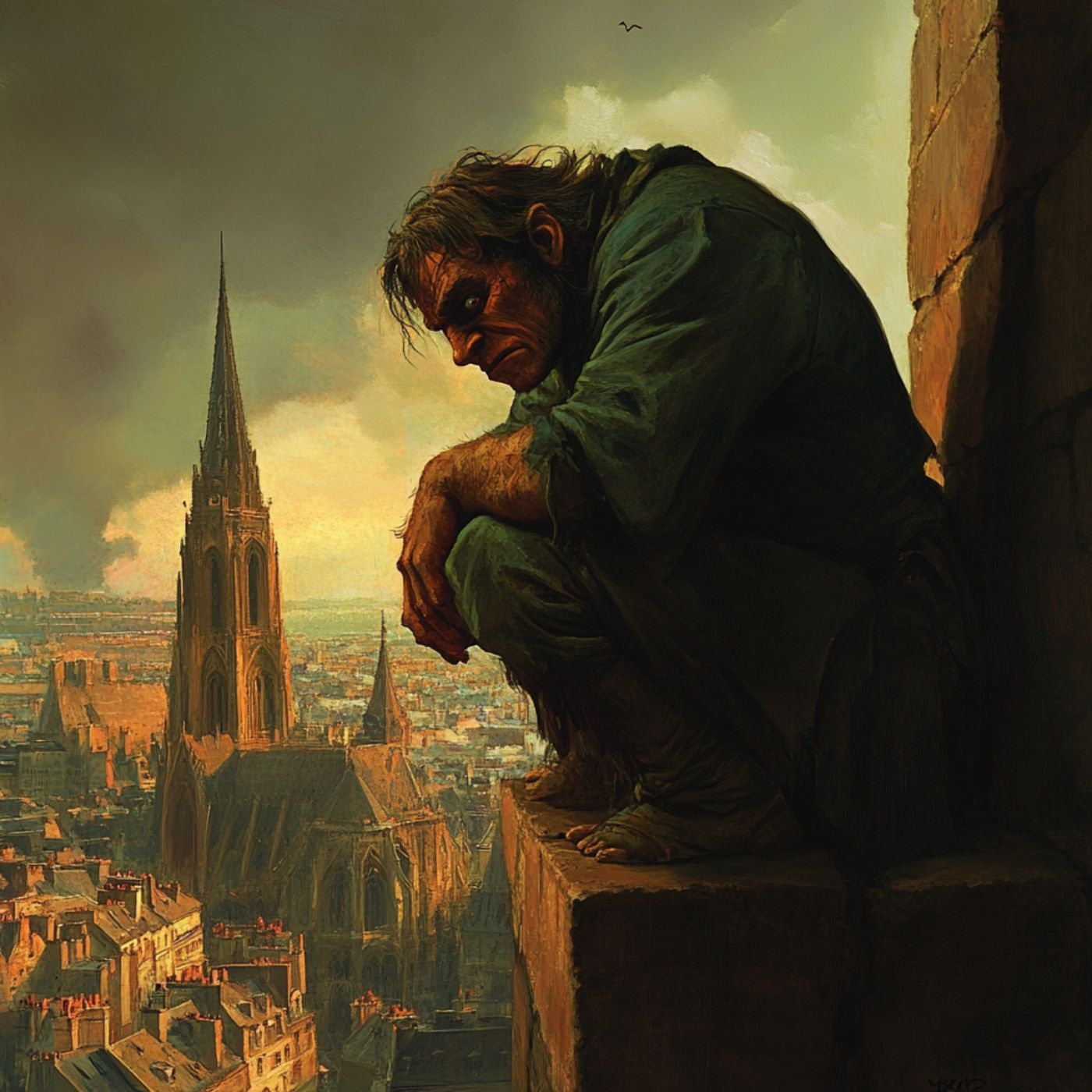
About this episode
Get every episode summarized
Each time The Hunchback of Notre Dame publishes, we email you a written briefing from the transcript — the topics, who appeared, and any specific claims, with the ad reads skipped.
Email me new episodesFree for 3 shows. No card needed.
Hosts & guests

Transcript ready
763 searchable segments. Every word is indexed and playable.
Full transcript
The Hunchback of Notre Dame — The Hunchback of Notre Dame - Part 3 - Victor Hugo. Machine-transcribed; use the interactive transcript above to jump the player to any line.
which is under your feet. I would sob like a child. I would tear my breast, not words, but my very heart and vitals to tell you that I love you. All would be useless. All. And yet you have nothing in your heart but what is tender and merciful. You are radiant with the most beautiful mildness. You are wholly sweet, good, pitiful and charming. And as you cherish no ill will for anyone but me alone. Oh, what a fatality! He hid his face in his hands. The young girl heard him weeping. It was for the first time. Thus erect and shaken by sobs he was more miserable and more suppleant than when on his knees. He wept thus for a considerable time. Come, he said, these first tears passed. I have no more words. I had, however, thought
well as to what you would say. Now I tremble and shiver and break down at the decisive moment. I feel conscious of something supreme enveloping us and I stammer. Oh, I shall fall upon the pavement if you do not take pity on me, pity on yourself. Do not condemn us both. If you only knew how much I love you, what a heart is mine. Oh, what desertion of all virtue, what desperate abandonment of myself. A doctor, I mock at science. A gentleman, I tarnish my own name. A priest, I make the missile a pillow of sensuality. I spit in the face of my God. All this for thee and chantress to be more worthy of thy hell. And you will not have the apostate. Oh, let me tell you all, more still, something more horrible. Oh, yet
more horrible. As he uttered these last words, his air became utterly distracted. He was silent for a moment and resumed as though speaking to himself and in a strong voice. Came what has thou done with thy brother? There was another silence, and he went on. What have I done with him, Lord? I received him. I reared him. I nourished him. I loved him. I idolized him, and I have slain him. Yes, Lord, they have just dashed his head before my eyes on the stone of thine house, and it is because of me, because of this woman, because of her. His eye was wild. His voice grew ever weaker. He repeated many times yet mechanically at tolerably long intervals, like a bell prolonging its last vibration. Because of her, because of her, then his tongue no longer articulated any perceptible sound, but his lips still
moved. All at once he sank together, like something crumbling and lay motionless on the earth with his head on his knees. A touch from the young girl, as she drew her foot from under him, brought him to himself. He passed his hand slowly over his hollow cheeks and gazed for several moments at his fingers, which were wet. What, Emermerd, I have wept, and turning suddenly to the gypsy with unspeakable anguish. Alas, you have looked coldly on at my tears. Child, do you know that those tears are of lava? Is it indeed true? Nothing touches when it comes from the man one does not love. If you were to see me die, you would laugh. Oh, I do not wish to see you die. One word, a single word of pardon. Say not that you love me. Say only that you will do it. That will suffice. I will save you. If not, oh, the
hour is passing. I entreat you by all that is sacred. Do not wait until I shall have turned to stone again, like that jibbit which also claims you. Reflect that I hold the destinies of both of us in my hand. That I am mad. It is terrible. That I may let all go to destruction, and that there is beneath us a bottomless abyss on happy girl, whether my fall will follow yours to all eternity. One word of kindness. Say one word. Only one word. She opened her mouth to answer him. He flung himself on his knees to receive with adoration the word, possibly a tender one which was on the point of issuing from her lips. She said to him, you are an assassin. The priest clasped for in his arms with fury and began to laugh with an abominable laugh. Well, yes, at assassin, he said, and I will have you. You will not have me
for your slave. You shall have me for your master. I will have you. I have a den, whether I will drag you. You will follow me. You will be obliged to follow me, or I will deliver you up. You must die, my beauty, or be mine. Be long to the priest. Be long to the apostate. Be long to the assassin. This very night do you hear. Come, joy, kiss me mad girl. The tomb or my bed. His eyes sparkled with impurity and rage. His lured lips redden the young girl's neck. She struggled in his arms. He covered her with furious kisses. Do not bite me, monster. She cried. Oh, the foul, odious monk, leave me. I will tear out thy ugly gray hair and flick it in thy face by the handful. He reddened, turned pale, then released her and gazed at her with a gloomy air. She thought
herself victorious and continued. I tell you that I belong to my Phoebus, that his Phoebus whom I love, that his Phoebus who is handsome. You are old, priest. You are ugly. Be gone. He gave vent to a horrible cry, like the wretch to whom a hot iron is applied. Die, then, he said, gnashing his teeth. She saw his terrible look and tried to fly. He caught her once more. He shook her. He flung her on the ground and walked with rapid strides towards the corner of the tour-o'-land, dragging her after him along the pavement by her beautiful hands. On arriving there, he turned to her. For the last time, will you be mine?" She replied with emphasis. No! Then he cried in a loud voice. Goudoule, Goudoule, here is the gypsy. Take your vengeance.
The young girl felt herself seized suddenly by the elbow. She looked. A fleshless arm was stretched from an opening in the wall and held her like a hand of iron. Hold her well, said the priest. Tis the gypsy escaped. Release her not. I will go in search of the sergeants. You shall see her hanged. The little shoe, part two. A guttural laugh replied from the interior of the wall to these bloody words. Ha! Ha! Ha! Ha! The gypsy watched the priest retire in the direction of the pot Notre Dame. A cavalcade was heard in that direction. The young girl had recognized the spiteful recluse. Panting with terror, she tried to disengage herself. She writhed. She made many starts of agony and despair, but the other held her with incredible strength. The lean and bony fingers which bruised her clenched on her flesh and met around it.
One would have said that this hand was riveted to her arm. It was more than a chain, more than a fetter, more than a ring of iron. It was a living pair of pincers endowed with intelligence, which emerged from the wall. She fell back against the wall exhausted, and then the fear of death took possession of her. She thought of the beauty of life, of youth, of the view of heaven, the aspects of nature, of her love for Phoebus, of all that was vanishing and all that was approaching, of the priest who was denouncing her, of the headman who was to come, of the gallows which was there. Then she felt terror mount to the very roots of her hair, and she heard the mocking laugh of the recluse saying to her in a very low tone, ha-ha-ha, you are to be hanged. She turned a dying look towards the window, and she beheld the fierce face of the sacked nun through the bars.
What have I done to you, she said, almost lifeless? The recluse did not reply, but began to mumble with a sing-song irritated mocking intonation. The unhappy Esmeralda dropped her head beneath her flowing hair, comprehending that it was no human being she had to deal with. All at once, the recluse exclaimed, as though the gypsy's question had taken all this time to reach her brain, what have you done to me, you say? Ah, what have you done to me, gypsy? Well, listen, I had a child, you see, I had a child, a child I tell you, a pretty little girl, my agnus. She went on wildly, kissing something in the dark. Well, do you see daughter of Egypt? They took my child from me, they stole my child, they ate my child. That is what you have done to me."
The young girl replied like a lamb. Alas, per chance I was not born then. Oh, yes, return the recluse. You must have been born. You were among them. She would be the same age as you. So I have been here fifteen years. Fifteen years have I suffered. Fifteen years have I prayed. Fifteen years have I beat my head against these four walls. I tell you that twice the gypsy's who stole her from me, do you hear that? Who ate her with their teeth. Have you a heart? Imagine a child playing, a child sucking, a child sleeping. It is so innocent a thing. Well, that, that is what they took from me, what they killed. The good God knows it well. Today it is my turn. I am going to eat the gypsy. Oh, I would bite you well,
if the bars did not prevent me. My head is too large. Poor little one, while she was asleep. And if they woke her up when they took her in vain, she might cry. I was not there. Ah, gypsy mothers, you devoured my child. Come see your own. Then she began to laugh or to gnash her teeth for the two things resemble each other in that furious face. The day was beginning to dawn, and ashy gleam dimly lighted the scene, and the gallows grew more and more distinct in the square. On the other side, in the direction of the bridge of Notre Dame, the poor condemned girl fancied that she heard the sound of cavalry approaching. Madam, she cried, clasping her hands and falling on her knees, disheveled, distracted, mad with fright. Madam, have pity, they are coming. I have done nothing to you. Would you wish to see
me die in this horrible fashion before your very eyes? You are pitiful, I am sure. It is too frightful. Let me make my escape. Release me. Mercy, I do not wish to die like that. Give me back my child," said the recluse. Mercy, mercy, give me back my child. Release me in the name of heaven. Give me back my child." Again the young girl fell, exhausted, broken, and having already the glassy eye of a person in the grave. Alas, she faltered. You seek your child. I seek my parents. Give me back my little agnes, pursued good-o'-lay. You do not know where she is. Then die. I will tell you. I was a woman of the town. I had a child. They took my child. It was the gypsies. You see plainly that
you must die. When your mother, the gypsy, come to reclaim you, I shall say to her. Mother, look at that jibbit, or give me back my child. Do you know where she is, my little daughter? Stay. I will show you. Here is her shoe. All that is left to me, other. Do you know where it's made is? If you know, tell me, and if it is only at the other end of the world, I will crawl to it on my knees. As she spoke thus with her other arm extended through the window, she showed the gypsy the little embroidered shoe. It was already light enough to distinguish its shape and its colors. Let me see that shoe, said the gypsy, quivering. God, God! And at the same time, with her hand which was at liberty, she quickly opened the little bag, ornamented with green glass, which she wore about her neck.
Go on, go on, grumbled good-o'-lay. Search your demons, amulet. All at once she stopped short, trembled in every limb, and cried in a voice which proceeded from the very depths of her being. My daughter! The gypsy had just drawn from the bag a little shoe absolutely similar to the other. To this little shoe was attached a parchment on which was inscribed this charm. Qu'un li'paralle, ratu'vare, tomère, tatandre, lebra. When thou shalt find its mate, thy mother will stretch out her arms to thee. Quicker than a flash of lightning, the recluse had laid the two shoes together, had read the parchment, and had put close to the bars of the window her face, beaming with celestial joy as she cried. My daughter! My daughter! My mother!" said the gypsy.
Here we are unequal to the task of depicting the scene. The wall and the iron bars were between them. Oh, the wall! cried the recluse. Oh, to see her and not to embrace her! Your hand, your hand! The young girl passed her arm through the opening. The recluse threw herself on that hand, pressed her lips to it, and there remained, buried in that kiss, giving no other sign of life than a sob which heaved her breast from time to time. In the meanwhile she wept in torrents in silence in the dark, like a rain at night. The poor mother poured out in floods upon that adored hand, the dark and deep well of tears which lay within her, and into which her grief had filtered dropped by drop for fifteen years. All at once she rose, flung aside her long gray hair from her brow, and without uttering a word began to shake the bars of her caged cell, with both hands, more furiously than
a lioness. The bars held firm. Then she went to seek in the corner of her cell a huge paving stone, which served as her pillow, and launched it against them with such violence that one of the bars broke, emitting thousands of sparks. A second blow completely shattered the old iron cross which barricaded the window. Then, with her two hands, she finished breaking and removing the rusted stumps of the bars. There are moments when woman's hands possess superhuman strength. A passage broken, less than a minute was required for her to seize her daughter by the middle of her body, and draw her into the cell. Come, let me draw you out of the abyss, she murmured. When her daughter was inside the cell she laid her jetty on the ground, then raised her up again, and bearing her in her arms as though she was still only her little agnus. She walked two and fro in her little room, intoxicated, frantic, joyous, crying out, singing, kissing her daughter,
talking to her, bursting into laughter, melting into tears, all at once, and with vehemence. My daughter, a daughter, she said, I have my daughter. Here she is, the good God has given her back to me. Ha, you, come all of you, is there anyone there to see that I have my daughter? Lord Jesus, how beautiful she is. You have made me wait fifteen years, my good God, but it was in order to give her back to me beautiful. Then the gypsies did not eat her. Who said so? My little daughter, my little daughter, kiss me. Those good gypsies, I love the gypsies. It is really you, that was what made my heart leap every time that you passed by, and I took that for hatred. Forgive me, my agnus, forgive me. You thought me very malicious, did you not?
I love you. Have you still the little mark on your neck? Let us see. She still has it. Oh, you are beautiful. It was I who gave you those big eyes, Medwozel. Kiss me. I love you. It is nothing to me that other mothers have children. I scorn them now. They have only to come and see. Here is mine. See her neck, her eyes, her hair, her hands. Find me anything as beautiful as that. Oh, I promise you she will have lovers that she will. I have wept for fifteen years. All my beauty has departed and has fallen to her. Kiss me. She addressed her to a thousand other extravagant remarks whose accent constituted her sole beauty, disarranged the poor girl's garments, even to the point of making her blush, smooth her silky hair with her hand, kissed her foot, her knee, her brow, her eyes,
was in raptures over everything. The young girl that her have her way, repeating at intervals and very low and with infinite tenderness. My mother. Do you see my little girl? Resume the recluse interspersing her words with kisses. I shall love you dearly. We will go away from here. We are going to be very happy. I have inherited something in rhymes in our country. You know rhymes? Ah, no, you do not know it. You were too small. If you only knew how pretty you were at the age of four months, tiny feet that people came even from Eppernay, which a seven leagues away to see. We shall have a field, a house. I will put you to sleep in my bed. My God. My God, who would believe this? I have my daughter. Oh, my mother, said the young girl, at length finding strength to speak
in her emotion. The gypsy woman told me so. There was a good gypsy of our band who died last year, who has always cared for me like a nurse. It was she who placed this little bag about my neck. She always said to me, little one, guard this jewel well, to set treasure. It will cause the defined eye mother once again. Thou wearest thy mother about thy neck. The gypsy predicted it. The sacked nun again pressed her daughter in her arms. Come, let me kiss you. You say that prettily. When we are in the country, we will place these little shoes on an infant Jesus in the church. We certainly owe that to the good Holy Virgin. What a pretty voice you have. When you spoke to me just now, it was music. Ah, my Lord, God, I have found my child again. But is this story credible? Nothing will kill one, or I should have died of joy.
And then she began to clap her hands again and to laugh and to cry out, we are going to be so happy. At that moment the cell resounded with the clang of arms and a galloping of horses, which seemed to be coming from the pot Notre Dame, a mead advancing farther and farther along the key. The gypsy threw herself with anguish into the arms of the sacked nun. Save me, save me mother, they are coming. Oh, heaven, what are you saying? I had forgotten. They are in pursuit of you. What have you done? I know not," replied the unhappy child, but I am condemned to die. To die," said Goudelle, staggering as though struck by lightning. To die? She repeated slowly, gazing at her daughter with staring eyes. Yes, mother, replied the frightened young girl. They went to kill me. They are coming to seize me. That gallows is for me. Save me, save me. They are coming. Save me.
The recluse remained for several moments motionless and petrified. Then she moved her head in a sign of doubt, and suddenly giving vent to a burst of laughter, but with that terrible laugh which had come back to her. Oh, oh, no! It is a dream of which you are telling me. Ah, yes, I lost her. That lasted fifteen years, and then I found her again, and that lasted a minute, and they would take her from me again. And now, when she is beautiful, when she is grown up, when she speaks to me, when she loves me, it is now that they would come to devour her before my very eyes, and I, her mother. Oh, no! These things are not possible. The good God does not permit such things as that. Here the cavalcade appeared to halt, and a voice was heard to say in the distance. This way, Miss Yatviston, the priest says that we shall find her at the rat hole.
The noise of the horses began again. The recluse sprang to her feet with a shriek of despair. Fly! Fly, my child! All comes back to me. You are right. It is your death. Horror! Melodictions! Fly! She thrust her head through the window, and withdrew it again hastily. Remain, she said, in a low, curt, and lugubrious tone, as she pressed the hand of the gypsy, who was more dead than alive. Remain, do not breathe. There are soldiers everywhere. You cannot get out. It is too light. Her eyes were dry and burning. She remained silent for a moment, but she paced the cell hurriedly, and halted now and then to pluck out handfuls of her gray hairs, which she afterwards tore with her teeth. Suddenly she said, they draw near. I shall speak with them. Hide yourself in this corner. They will not see you. I will tell them that you have made your escape.
That I reduced you, if ath. She set her daughter down, for she was still carrying her, in one corner of the cell which was not visible from without. She made her crouch down, arranged her carefully, so that neither foot, nor hand projected from the shadow, untied her black hair, which she spread over her white robe to conceal it, placed in front of her, her jug and her paving stone, the only articles of furniture which she possessed, imagining that this jug and stone would hide her. And when this was finished, she became more tranquil and knelt down to pray. The day which was only dawning still left many shadows in the rat hole. At that moment, the voice of the priest, that infernal voice, passed very close to the cell, crying, this way, Captain Phoebus de Chateaupe. At that name, at that voice, La Asmirelda, crouching in her corner, made a movement.
"'Do not stir,' said Goudelle. She had barely finished when a two-month of men, swords and horses halted around the cell. The mother rose quickly and went to post herself before her window, in order to stop it up. She beheld a large troop of armed men, both horse and foot, drawn up on the grave. The commander dismounted and came to order. "'Old woman,' said this man, who had an atrocious face. We are in search of a witch to hang her. We were told that you had her.' The poor mother assumed as indifferent an heir as she could and replied, "'I know not what you mean.' The other resumed. "'Tet, du,' what was it that frightened Archdeak and said? Where is he?' "'Monsignure,' said a soldier. He has disappeared.' "'Come now, old mad woman,' began the commander again. Do not lie. A sorceress was given in charge
to you. What have you done with her?' The recluse did not wish to deny all for fear of awakening suspicion and replied in a sincere and surly tone. If you are speaking of a big young girl who was put into my hands a while ago, I will tell you that she bit me and that I released her. There leave me in peace.' The commander made a grimace of disappointment. "'Don't lie to me, old specter,' said he. My name is Tristan Lamate, and I am the King's gossip. Tristan, the hermit, do you hear?' He added as he glanced at the plaster grave around him. It is a name which has an echo here. "'You might be Satan the hermit,' replied Goudelae, who was regaining hope. But I should have nothing else to say to you, and I should never be afraid of you.' "'Tet-du,' said Tristan. Here is a crone. Ah, so the witch girl hath fled,
and in which direction did she go?' Goudelae replied in a careless tone. "'Through the rude de Montone, I believe.' Tristan turned his head and made a sign to his troop to prepare to set out on the march again. The recluse breath freely once more.' "'Monsignure,' suddenly said Inarcher. Ask the old elf why the bars of her window are broken in this manner. This question brought anguish again to the heart of the miserable mother. Nevertheless, she did not lose all presence of mind. They have always been thus, she stammered. "'Bah,' retorted the archer. Only yesterday they still formed a fine black cross which inspired devotion.' Tristan cast a side-long glance at the recluse. "'I think the old Dame is getting confused.' The unfortunate woman felt that all depended on herself possession, and although with death in her soul she began to grin. Mother's possess such
strength. "'Bah,' said she, the man is drunk. Tis more than a year since the tail of a stone cart dashed against my window and broke in the grating. And how I cursed the Carter too. "'Tis true,' said another archer. I was there.' Always and everywhere people are to be found who have seen everything. This unexpected testimony from the archer re-encouraged the recluse, whom this interrogatory was forcing to cross and abyss on the edge of a knife. But she was condemned to a perpetual alternative of hope and alarm. If it was a cart which did it, retorted the first soldier, the stomps of the bar should be thrust inwards while they actually are pushed outwards. "'Oh, ho,' said Tristan to the soldier. "'You have the nose of an inquisitor of the Shatterlay,' replied to what he says old woman.
"'Good heavens,' she exclaimed, driven to bay, and in a voice that was full of tears in despite of her efforts. "'I swear to you, Monsignor, that was a cart which broke those bars. You heard the man who saw it, and then what has that to do with your gypsy?' "'Hum,' growl Tristan. "'The devil,' went on the soldier, flattered by the provost's praise. "'These fractures of the iron are perfectly fresh!'' Tristan tossed his head. She turned pale. "'How long ago say you did the cart do it?' A month, a fortnight, perhaps, Monsignor, I know not.' She first said more than a year observed the soldier. "'That is suspicious,' said the provost. "'Monsignor,' she cried, still pressed against the opening, and trembling,
last suspicion should lead them to thrust their heads through and look into her cell. Monsignor, I swear to you that was a cart which broke this grating. I swear to you by the angels of Paradise. If it was not a cart, may I be eternally damned, and I reject God.' "'You put a great deal of heat into that oath,' said Tristan, with his inquisitorial glance. The poor woman felt her assurance vanishing more and more. She had reached the point of blundering, and she comprehended with terror that she was saying what she ought not to have said. Here another soldier came up, crying. "'Monsignor, the old hag lies! The sorceress did not flee through the rudimental. The street-chain has remained stretched all night, and the chain-guard has seen no one pass.' Tristan, whose face became more sinister with every moment, addressed the recluse.
"'What have you to say to that?' She tried to make head against this new incident. "'That I do not know, Monsignor, that I may have been mistaken. I believe in fact that she crossed the water. That is in the opposite direction,' said the provost. And it is not very likely that she would wish to re-enter the city where she was being pursued. You are lying old woman. And then, added the first soldier, there is no boat either on this side of the stream or on the other. She swam across, replied the recluse, defending her ground foot by foot. "'Do women swim,' said the soldier. "'Ted, dear old woman, you are lying,' repeated Tristan angrily. I have a good mind to abandon that sorceress and take you. A quarter of an hour of torture
will perchance draw the truth from your throat. Come, you are to follow us.' She seized on these words with a vidrity. "'As you please, Monsignor, do it. Do it, torture. I am willing. Take me away. Quick, quick, let us set out at once. During that time, she said to herself, my daughter will make her escape.' "'Step,' said the provost. What an appetite for the rack. I understand not this mad woman at all.' An old grey-haired sergeant of the guard stepped out of the ranks and addressing the provost. Mad in sooth, Monsignor. If she released the gypsy, it was not her fault. For she loves not the gypsies. I have been of the watch these fifteen years, and I hear her every evening cursing the Bohemian women with endless implications. If the one of whom we are in pursuit is, as I suppose,
the little dancer with the goat, she detests that one above all the rest. Goudelae made an effort and said, that one above all. The unanimous testimony of the men of the watch confirmed the old sergeant's words to the provost. Tristan LeMatte, in despair at extracting anything from the recluse, turned his back on her, and with unspeakable anxiety, she beheld him direct his course slowly towards his horse. Come, he said between his teeth. March on. Let us set out again on the quest. I shall not sleep until that gypsy is hanged. But he still hesitated for some time before mounting his horse. Goudelae palpitated between life and death, and as she beheld him cast about the plas, that uneasy look of a hunting dog which instinctively feels that the lair of the beast is close to him, and is loath to go away. At length he shook his head and leaped into his saddle.
Goudelae's horribly compressed heart now dilated, and she said in a low voice, as she cast a glance at her daughter whom she had not ventured to look at while they were there. Saved her heart. The poor child had remained all this time in her corner without breathing, without moving, with the idea of death before her. She had lost nothing of the scene between Goudelae and Tristan, and the anguish of her mother had found its echo in her heart. She had heard all the successive snapings of the thread by which she hung suspended over the gulf. Twenty times she had fancyed that she saw it break, and at last she began to breathe again and to feel her foot on firm ground. At that moment she heard a voice saying to the provost, go boof, malsier le provol, disnau affair of mine, a man of arms to hang witches, the rabble of the populace is suppressed. I leave you to attend to the matter alone. You will allow
me to rejoin my company who are waiting for their captain. The voice was that of Phoebus de Chateaupe, that which took place within her was ineffable. He was there, her friend, her protector, her support, her refuge, her Phoebus. She rose, and before her mother could prevent her, she had rushed to the window crying. Phoebus, aid me, my Phoebus. Phoebus was no longer there. He had just turned the corner of the Rue de la Cotellerie at a gallop. But Tristan had not yet taken his departure. The recluse rushed upon her daughter with a roar of agony. She dragged her violently back, digging her nails into her neck. A Tigris mother does not stand on trifles. But it was too late. Tristan had seen. Eh-eh! he exclaimed with a laugh, which laid bare all his teeth and made his face resemble the
muzzle of a wolf. To mice in the trap. I suspected as much, said the soldier. Tristan clapped him on the shoulder. You were a good cat. Come, he added. Where is Henriet Cuisin? A man who had neither the garments nor the air of a soldier stepped from the ranks. He wore a costume half-gray, half-brown, flat hair, leather sleeves, and carried a bundle of ropes in his huge hand. This man always attended Tristan, who always attended Louis XI. For Anne, said Tristan Larmate, I presume that this is the sorceress of whom we are in search. You will hang me this one. Have you your ladder? There is one yonder under the shed of the pillar-house, replied the man. Is it on this justice that the thing is to be done? He added, pointing to the stone, gibbet. Yes. Oh, way! continue the man with a
huge laugh, which was still more brutal than that of the provost. We shall not have far to go. Make haste, said Tristan. You shall laugh afterwards. In the meantime, the recluse had not uttered another word since Tristan had seen her daughter and all hope was lost. She had flung the poor gypsy half-dead into the corner of the cellar, and had placed herself once more at the window with both hands resting on the angle of the sill like two claws. In this attitude she was seen to cast upon all the soldiers her glance, which had become wild and frantic once more. At the moment when René Cousin approached her cell, she showed him so savage a face that he shrank back. Monsignor, he said, returning to the provost. Which am I to take? The young one. So much the better, for the old one, Seymoth difficult. Poor little dancer with the goat, said the old sergeant of the watch.
René Cousin approached the window again. The mother's eyes made his own droop. He said with a good deal of timidity. Maddom, she interrupted him in a very low but furious voice. What do you ask? It is not you, he said. It is the other. What other? The young one. She began to shake her head, crying. There is no one. There is no one. There is no one. Yes, there is," retorted the hangman, and you know it well. Let me take the young one. I have no wish to harm you. She said with a strange sneer. Ah, so you have no wish to harm me. Let me have the other, Madame, Tismoncia, the provost, who wills it? She repeated with a look of madness. There is no one here. I tell you that there is,
replied the executioner. We have all seen that there are two of you. Look then, said the recluse with a sneer, thrust your head through the window. The executioner observed the mother's fingernails and dared not. Make haste, shouted Tristan, who had just ranged his troops in a circle round the rattle, and who sat on his horse beside the gallows. Renée returned once more to the provost in great embarrassment. He had flung his rope on the ground and was twisting his hat between his hands with an awkward air. Monsignure, he asked, where am I to enter? By the door. There is none. By the window. Tis too small. Make it larger," said Tristan angrily. Have you not picked axes? The mother still looked on steadfastly from the depths of her cavern. She no longer hoped for
anything. She no longer knew what she wished except that she did not wish them to take her daughter. Renée Cousin went in search of the chest of tools for the nightmen under the shed of the pillar house. He drew from it also the double ladder, which he immediately set up against the gallows. Five or six of the provost's men armed themselves with picks and crowbars, and Tristan betook himself and company with them towards the window. Old woman, said the provost in a severe tone, deliver up to us the girl quietly. She looked at him like one who does not understand. "'Tet you,' continued Tristan, "'why do you try to prevent this sorceress being hung as it pleases the king?' The wretched woman began to laugh in her wild way. Why? She is my daughter!' The tone in which she pronounced these words made even Henrié Cousin shut her.
"'I am sorry for that,' said the provost, but it is the king's good pleasure.' She cried, redoubling her terrible laugh. "'What is your king to me? I tell you that she is my daughter!' "'Pairs the wall,' said Tristan. In order to make us sufficiently wide opening, it suffice to dislodge one course of stone below the window. When the mother heard the picks and crowbars mining her fortress, she uttered a terrible cry. Then she began to stride about herself with frightful swiftness, a wild beast's habit which her cage had imparted to her. She no longer said anything, but her eyes flamed. The soldiers were chilled to the very soul. All at once she seized her paving stone, laughed, and hurled it with both fists upon the workmen. The stone, badly flung,
for her hands trembled, touched no one, and fell short under the feet of Tristan's horse. She nashed her teeth. In the meantime, although the sun had not yet risen, it was broad daylight, a beautiful rose color and livened the agent-dicate chimneys of the pillarhouse. It was the hour when the earliest windows of the great city opened joyously on the roofs. Some workmen, a few fruit-sellers on their way to the markets on their asses, began to traverse the grave. They halted for a moment before this group of soldiers clustered round the rattle, stared at it with an air of astonishment and passed on. The recluse had gone and seated herself by her daughter, covering her with her body, in front of her with staring eyes, listening to the poor child who did not stir, but who kept murmuring in a low voice these words only. Phoebus. Phoebus. In proportion as the work of the demolisher seemed to advance,
the mother mechanically retreated and pressed the young girl closer and closer to the wall. All at once the recluse beheld the stone, for she was standing guard and never took her eyes from it, moved, and she heard Tristan's voice encouraging the workers. Then she aroused from the depression into which she had fallen during the last few moments, cried out, and as she spoke, her voice now rent the ear like a saw, then stammered as though all kind of maladictions were pressing to her lips to burst forth at once. Oh, oh, oh, why this is terrible, you are ruffians, are you really going to take my daughter? Oh, the cowards, oh, the hangman lackeys, the wretched black guard assassins, help, help, fire, will they take my child from me like this? Who is it then who is called the good god? Then addressing Tristan, foaming at the mouth, with wild eyes, all bristling and on all fours like a
female panther. Draw near and take my daughter. Do not you understand that this woman tells you that she is my daughter? Do you know what it is to have a child? A. links, have you never lain with your female? Have you never had a cub? And if you have little ones, when they howl, have you nothing in your vitals that moves? Throw down the stone, said Tristan, it no longer holds. The crowbars raised the heavy course. It was, as we have said, the mother's last bulwark. She threw herself upon it. She tried to hold it back. She scratched the stone with her nails, but the massive block, said in movement by six men, escaped her and glided gently to the ground along the iron levers. The mother, perceiving an entrance affected, fell down in front of the
opening, barricading the breach with her body, beating the pavement with her head, and shrieking with a voice rendered so horse by fatigue that it was barely audible. Help! Fire! Fire! Now take the wench, said Tristan, still impassive. The mother gazed at the soldiers in such formidable fashion that they were more inclined to retreat than to advance. Come now, repeated the provost. Hear you, Renee Cazanne. No one took a step. The provost swore. Tettic Christ, my men of war, afraid of a woman. Monsignure, said Renee. Do you call that a woman? She has the mane of a lion, said another. Come, repeated the provost. The gap is wide enough. Enter three abreast as at the breach of Pantua.
Let us make an end of it. Death of Mahom. I will make two pieces of the first man who draws back. Place between the provost and the mother, both threatening, the soldiers hesitated for a moment, then took their resolution and advance towards the rattle. When the recluse saw this, she rose abruptly on her knees, flung aside her hair from her face, then let her thin, flayed hands fall by her side. Then great tears fell, one by one from her eyes. They flowed down her cheeks through a furrow, like a torrent through a bed which it has hollowed for itself. At the same time she began to speak, but in a voice so supplicating, so gentle, so submissive, so heart-rending, that more than one old convict warder around Tristan, who must have devoured human flesh, wiped his eyes.
Monsignures, Monsignures the sergeants, one word. There is one thing which I must say to you. She is my daughter, do you see? My dear little daughter, whom I had lost. Listen, it is quite a history. Consider that I knew the sergeants very well. They were always good to me in the days when the little boys threw stones at me, because I led a life of pleasure. Do you see? You will leave me my child when you know, I was a poor woman of the town. It was the bohemians who stole her from me, and I kept her shoe for fifteen years. Stay, here it is. That was the kind of foot which she had. At rhymes, las chante flouris, ruffal pain, perchance you knew about that. It was I. In your youth, then, there was a merry time when one passed good hours.
You will take pity on me, will you not gentlemen? The gypsy stole her from me. They hid her from me for fifteen years. I thought her dead. Fancy, my good friends, believed her to be dead. I have passed fifteen years here in this cellar without a fire in winter. It is hard. The poor dear little shoe. I have cried so much that the good God has heard me. This night he has given my daughter back to me. He is a miracle of the good God. She was not dead. You will not take her from me, I am sure. If it were myself, I would say nothing, but she, a child of sixteen, leave her time to see the sun. What has she done to you? Nothing at all. Nor have I. If you did but know that she is all I have, that I am old,
that she is a blessing which the holy virgin has sent to me. And yet you are all so good. You did not know that she was my daughter, but now you do know it. Oh, I love her. Moncia, the grand provost, I would prefer a stab in my own vitals to a scratch on her finger. You have the air of such a good Lord. What have I told you explains the matter, does it not? Oh, if you have had a mother, Monsignor, you are the captain, leave me my child. Consider that I pray you on my knees as one prays to Jesus Christ. I ask nothing of anyone. I am from Rhymes, gentlemen. I own a little field inherited from my uncle, Mahie Pradal. I am no beggar. I wish nothing, but I do want my child. Oh, I want to keep my child. The good God,
who is the master, has not given her back to me for nothing. The king, you say, the king. It would not cause him much pleasure to have my little daughter killed. And then the king is good. She is my daughter. She is my own daughter. She belongs not to the king. She is not yours. I want to go away. We want to go away. And when two women pass, one a mother and the other a daughter, one lets them go. Let us pass. We belong in Rhymes. Oh, you are very good. Messieurs, the sergeants, I love you all. You will not take my dear little one. It is impossible. It is utterly impossible, is it not? My child, my child. We will not try to give an idea of her gestures, her tone of the tears which she swallowed as she spoke,
of the hands which she clasped, and then rung, of the heartbreaking smiles, of the swimming glances, of the groans, the size, the miserable and affecting cries which she mingled with her disordered, wild and incoherent words. When she became silent, Tristan Larmate frowned, but it was to conceal a tear which wailed up in his tiger's eye. He conquered this weakness, however, and said in a curred tone, the king wills it. Then he bent down to the ear of Rene Quazanne and said to him in a very low tone, make an end of it quickly. Possibly, the redoubtable provost felt his heart also failing him. The executioner and the sergeants entered the cell, the mother offered no resistance, only she dragged herself towards her daughter and through herself bodily upon her. The gypsy held the soldiers approach. The horror of death reanimated her.
Mother, she shrieked in a tone of indescribable distress. Mother, they're coming! defend me! Yes, my love, I am defending you." Replyed the mother in a dying voice, and clasping her closely in her arms she covered her with kisses. The two lying thus on the earth, the mother upon the daughter presented a spectacle worthy of pity. Rene Quazanne grasped the young girl by the middle of her body beneath her beautiful shoulders. When she felt that hand she cried, and faded. The executioner, who was shedding large tears upon her, dropped by drop, was about to bear her away in his arms. He tried to detach the mother, who had, so to speak, nodded her hands around her daughter's waist, but she clung so strongly to her child that it was impossible to separate them. Then Rene Quazanne dragged the young girl outside the cell,
and the mother after her. The mother's eyes were also closed. At that moment the sun rose, and there was already on the plasse a fairly numerous assembly of people who looked on from a distance at what was being thus dragged along the pavement to the gibbet. For that was Provost Tristan's way at executions. He had a passion for preventing the approach of the curious. There was no one at the windows. Only at a distance, at the summit of that one of the towers of Notre Dame which commands the grave, two men outlined in black against the light morning sky, who seemed to be looking on, were visible. Rene Quazanne paused at the foot of the fatal ladder, with that which he was dragging and barely breathing, with so much pity did the thing inspire him, he passed the rope around the lovely neck of the young girl. The unfortunate child felt the
horrible touch of the hemp. She raised her eyelids and saw the fleshless arm of the stone gallows extended above her head. Then she shook herself and shrieked in a loud and heart-rending voice. No, no, I will not. Her mother, whose head was buried and concealed in her daughter's garments, said not a word. Only her whole body could be seen to quiver, and she was heard to redouble her kisses on her child. The executioner took advantage of this moment to hastily lose the arms, with which she clasped the condemned girl. Either through exhaustion or despair, she let him have his way. Then he took the young girl on his shoulder, from which the charming creature hung, gracefully bent over his large head. Then he set his foot on the ladder in order to ascend. At that moment the mother, who was crouching on the pavement, opened her eyes wide.
Without uttering a cry, she raised herself erects with a terrible expression. Then she flung herself upon the hand of the executioner, like a beast on its prey and bit it. It was done like a flash of lightning. The heads manhalled with pain. Those nearby rushed up. With difficulty they withdrew his bleeding hand from the mother's teeth. She preserved a profound silence. They thrust her back with much brutality, and noticed that her head fell heavily on the pavement. They raised her, she fell back again. She was dead. The executioner, who had not lost his hold on the young girl, began to ascend the ladder once more. The beautiful creature clad in white. When Quasimodo saw that the cell was empty, that the gypsy was no longer there. That while
he had been defending her, she had been abducted. He grasped his hair with both hands and stamped with surprise and pain. Then he set out to run through the entire church, seeking his Bohemian, howling strange cries to all the corners of the walls, strueing his red hair on the pavement. It was just at the moment when the King's archers were making their victorious entrance into Notre Dame, also in search of the gypsy. Quasimodo, poor, deaf fellow, aided them in their fatal intentions without suspecting it. He thought that the outcasts were the gypsy's enemies. He himself conducted trist and lermatee to all possible hiding places, open to him the secret doors, the double bottoms of the altars, the rear sacriestries. If the unfortunate girl had still been there, it would have been he himself who would have delivered her up. When the fatigue of finding nothing
had disheartened Tristan, who was not easily discouraged, Quasimodo continued the search alone. He made the tour of the church twenty times, length and breadth up and down, ascending and descending, running, calling, shouting, peeping, rummaging, ransacking, thrusting his head into every hole, pushing a torch under every vault, despairing, mad. A male who has lost his female is no more roaring, nor more haggard. At last, when he was sure, perfectly sure that she was no longer there, that all was at an end, that she had been snatched from him, he slowly mounted the staircase to the towers, that staircase which he had ascended with so much eagerness and triumph on the day when he had saved her. He passed those same places once more with drooping head, voiceless, tearless, almost breathless. The church was again deserted and had fallen back into its
silence. The archers had quitted it to track the sorceress in the city. Quasimodo left alone in that vast Notre Dame, so besieged and tumultuous but a short time before, once more it betook himself to the cell where the gypsy had slept for so many weeks under his guardianship. As he approached it, he fancied that he might perhaps find her there. When, at the turn of the gallery which opens on the roof of the side aisles, he perceived the tiny cell with its little window and its little door crouching beneath a great flying buttress, like a bird's nest under a branch, the poor man's heart failed him, and he leaned against a pillar to keep from falling. He imagined that she might have returned, Thither, that some good genius had no doubt brought her back, that this chamber was too tranquil, too safe, too charming for her not to be there, and he dared not take another step for fear of destroying his illusion.
Yes, he said to himself, put chance she is sleeping or praying, I must not disturb her. At length he summoned up courage, advanced on tiptoe, looked, entered. Empty. The cell was still empty. The unhappy deaf man walked slowly around it, lifted the bed and looked beneath it, as though she might be concealed between the pavement and the mattress. Then he shook his head and remained stupified. All at once he crushed his torch under his foot, and without uttering a word, without giving vent to a sigh, he flung himself at full speed, head foremost against the wall, and fell, fainting on the floor. When he recovered his senses, he threw himself on the bed and rolled about. He kissed frantically the place where the young girl had slept and which was still warm. He remained there for several moments, as motionless as though he were about to expire.
Then he rose, dripping with perspiration, panting, mad, and began to beat his head against the wall with the frightful regularity of the clapper of his bells, and the resolution of a man determined to kill himself. At length he fell a second time, exhausted. He dragged himself on his knees outside the cell and crouched down facing the door in an attitude of astonishment. He remained thus for more than an hour without making a movement, with his eye fixed on the deserted cell, more gloomy and more pensive than a mother seated between an empty cradle and a full coffin. He uttered not a word. Only at long intervals a sob heaved his body violently, but it was a tearless sob, like summer lightning which makes no noise. It appears to have been then that seeking at the bottom of his
lonely thoughts for the unexpected abductor of the gypsy, he thought of the arched-deacon. He remembered that Dom Claude alone possessed a key to the staircase leading to the cell. He recalled his nocturnal attempts on the young girl, in the first of which he quasi-moto had assisted, the second of which he had prevented. He recalled a thousand details, and soon he no longer doubted that the arched-deacon had taken the gypsy. Nevertheless, such was his respect for the priest, such his gratitude, his devotion, his love for this man had taken such deep root in his heart that they resisted, even at this moment, the talents of jealousy and despair. He reflected that the arched-deacon had done this thing, and the wrath of blood and death which it would have evoked in him against any other person, turned in the poor deaf man, from the moment
when Claude Frollo was in question, into an increase of grief and sorrow. At the moment when his thought was thus fixed upon the priest, while daybreak was whitening the flying buttresses, he perceived, on the highest story of Notre Dame, at the angle formed by the external balustrade as it makes the turn of the chancel, a figure walking. This figure was coming towards him. He recognized it. It was the arched-deacon. Claude was walking with a slow grave step. He did not look before him as he walked. He was directing his course towards the northern tower, but his face was turned aside towards the right bank of the scene, and he held his head high, as though trying to see something over the roofs. The owl often assumes this oblique attitude. It flies towards one point and looks towards another. In this manner, the priest passed above
Quasimodo without seeing him. The deaf man, who had been petrified by this sudden apparition, beheld him disappear through the door of the staircase to the north tower. The reader is aware that this is the tower from which the Otelle de Vee is visible. Quasimodo rose and followed the arched-deacon. Quasimodo ascended the tower staircase for the sake of ascending it, for the sake of seeing why the priest was ascending it. Moreover, the poor bell-ringer did not know what he, Quasimodo, should do, what he should say, what he wished. He was full of fury and full of fear. The arched-deacon and the gypsy had come into conflict in his heart. When he reached the summit of the tower before emerging from the shadow of the staircase and stepping upon the platform, he cautiously examined the position of the priest. The priest's back was turned
to him. There is an open balustrade which surrounds the platform of the bell tower. The priest, whose eyes looked down upon the town, was resting his breast on that one of the four sides of the balustrades which looks upon the pot Notre Dame. Quasimodo, advancing with the tread of a wolf behind him, went to see what he was gazing at thus. The priest's attention was so absorbed elsewhere that he did not hear the deaf man walking behind him. Paris is a magnificent and charming spectacle, and especially at that day viewed from the top of the towers of Notre Dame in the fresh light of a summer dawn. The day might have been in July. The sky was perfectly serene. Some tardy stars were fading away at various points, and there was a very brilliant one in the east, in the brightest part of the heavens. The sun was
about to appear. Paris was beginning to move. A very white and very pure light brought out vividly to the eye all the outlines that its thousands of houses present to the east. The giant shadow of the towers leaped from roof to roof, from one end of the great city to the other. There were several quarters from which were already heard voices and noisy sounds. Here the stroke of a bell, there the stroke of a hammer, beyond the complicated clatter of a card in motion. Already several columns of smoke were being belched forth from the chimney scattered over the whole surface of roofs, as through the fissures of an immense sulfurous crater. The river, which ruffles its waters against the arches of so many bridges, against the points of so many islands, was wavering with silvery folds. Around the city, outside the ramparts, sight was lost in a great circle of fleecy
vapors, through which one confusedly distinguished the indefinite line of the plains, and the graceful swell of the heights. All sorts of floating sounds were dispersed over this half-awakened city, towards the east the morning breeze chased a few soft white bits of wool torn from the misty fleece of the hills. In the Parví, some good women, who had their milk-jugs in their hands, were pointing out to each other with astonishment the singular dilapidation of the great door of Notre Dame, and the two solidified streams of lead in the crevices of the stone. This was all that remained of the tempest of the night. The bonfire lighted between the towers by Quasimodo had died out. Tristan had already cleared up the plas, and had the dead thrown into the sain. Kings, like Louis XI, are careful to clean the pavement quickly after a massacre.
Outside the balustrade of the tower, directly under the point where the priest had paused, there was one of those fantastically carved stone gutters with which Gothic edifice is bristle, and in a crevice of that gutter, two pretty wallflowers in blossom, shaken out and vivified, as it were, by the breath of air, made frolicsome cellutations to each other. Above the towers, on high, far away in the depths of the sky, the cries of little birds were heard. But the priest was not listening to, was not looking at anything of all of this. He was one of the men for whom there were no mornings, no birds, no flowers. In that immense horizon, which assumed so many aspects about him, his contemplation was concentrated on a single point. Quasimodo was burning to ask him what he had done with the gypsy, but the archdeacon seemed to be out of the world at that moment. He was evidently in one of those violent moments of life when one would not feel
the earth crumble. He remained motionless and silent, with his eyes steadily fixed on a certain point. There was something so terrible about his silence and immobility that the savage bell ringer shuttered before it, undared not come in contact with it. Only, and this was also one way of interrogating the archdeacon, he followed the direction of his vision, and in this way the glance of the unhappy deaf man fell upon the plas to grave. Thus he saw what the priest was looking at. The latter was erected near the permanent gallows. There were some people and many soldiers in the plas. A man was dragging a white thing from which hung something black along the pavement. This man halted at the foot of the gallows. Here something took place which Quasimodo could not see very clearly. It was not because his only eye had not preserved its long range, but there was a group of soldiers which
prevented his seeing everything. Moreover, at that moment the sun appeared, and such a flood of light overflowed the horizon that one would have said that all the points in Paris, spires, chimneys, gables had simultaneously taken fire. Meanwhile the man began to mount the latter. Then Quasimodo saw him again distinctly. He was carrying a woman on his shoulder, a young girl dressed in white, that young girl had a noose about her neck. Quasimodo recognized her. It was she. The man reached the top of the latter. There he arranged the noose. Here the priest in order to see the better knelt upon the ballast raid. All at once the man kicked away the latter abruptly, and Quasimodo, who had not breathed for several moments, beheld the unhappy child dangling at the end
of the rope two fathoms above the pavement, with the man squatting on her shoulders. The rope made several gyrations on itself, and Quasimodo beheld horrible convulsions run along the gypsy's body. The priest, on his side, without stretched neck and eyes starting from his head, contemplated this horrible group of the man and the young girl, the spider and the fly. At the moment when it was most horrible the laugh of a demon, a laugh which one could only give vent to when one is no longer human, burst forth on the priest's livid face. Quasimodo did not hear that laugh, but he saw it. The bell-ringer retreated several paces behind the archdeacon, and suddenly hurling himself upon him with fury, with his huge hands he pushed him by the back over into the abyss over which Dom Claude was leaning. The priest shrieked, damnation, and fell. The spout, above which he had stood,
arrested him in his fall. He clung to it with desperate hands, and at the moment when he opened his mouth to utter a second cry, he beheld the formidable and avenging face of Quasimodo thrust over the edge of the balustrade above his head. Then he was silent. The abyss was there below him. A fall of more than two hundred feet and the pavement. In this terrible situation the archdeacon said not a word, uttered not a groan. He merely ryeed upon the spout, with incredible efforts to climb up again, but his hands had no hold on the granite. His feet slid along the blackened wall without catching fast. People who have ascended the towers of Notre-Dame know that there is a swell of the stone immediately beneath the balustrade. It was on this retreating angle that miserable archdeacon exhausted himself. He had not to deal with a perpendicular wall, but with one which
sloped away beneath him. Quasimodo had but to stretch out his hand in order to draw him from the gulf, but he did not even look at him. He was looking at the grave. He was looking at the gallows. He was looking at the gypsy. The deaf man was leaning with his elbows on the balustrade at the spot where the archdeacon had been a moment before, and there never detaching his gaze from the only object which existed for him in the world at that moment. He remained motionless and mute, like a man struck by lightning and a long stream of tears flowed in silence from that eye which, up to that time, had never shed but one tear. Meanwhile, the archdeacon was panting. His bald bra was dripping with perspiration. His nails were bleeding against the stones. His knees were flayed by the wall. He heard his casak, which was caught on the spout, crack and rip at every
jerk that he gave it. To complete his misfortune, this spout ended in a leaden pipe which bent under the weight of his body. The archdeacon felt this pipe slowly giving away. The miserable man said to himself that, when his hand should be worn out with fatigue, when his casak should tear a sunder, when the ledge should give way, he would be obliged to fall, and tear seized upon his very vitals. Now and then he glanced wildly at a sort of narrow shelf, formed ten feet lower down by projections of the sculpture, and he prayed heaven from the depths of his distressed soul that he might be allowed to finish his life, were to last two centuries on that space to feed square. Once he glanced blow him into the plas, into the abyss, the head which he raised again had its eyes closed and its hair standing erect. There was something frightful in the silence of
these two men, while the archdeacon agonized in this terrible fashion a few feet below him, quasi-modo wept and gazed at the grave. The archdeacon, seeing that all his exertions served only to weaken the fragile support which remained to him, decided to remain quiet. There he hung, embracing the gutter, hardly breathing, no longer stirring, making no longer any other movements than that mechanical convulsion of the stomach, which one experiences in dreams when one fancies himself falling. His fixed eyes were wide open with a stare. He lost ground little by little, nevertheless his fingers slipped along the spout. He became more and more conscious of the feebleness of his arms and the weight of his body. The curve of lead which sustained him inclined more and more each instant towards the abyss. He beheld below him a frightful thing, the roof of San
Sean LaRonde, as small as a card folded in two. He gazed at the impressive carvings, one by one, of the tower, suspended like himself over the precipice, but without terror for themselves or pity for him. All was stone around him, before his eyes gaping monsters, below, quite at the bottom, in the plus, the pavement, above his head, quasi-moto, weeping. In the Parvii there were several groups of curious good people who were tranquilly seeking to divine who the madman could be, who was amusing himself in so strange a manner. The priest heard them saying, for their voices reached him, clear and shrill, why, he will break his neck! Quasi-moto wept. At last the archdeacon, foaming with rage and despair, understood that all was in vain. Nevertheless, he collected all the strength which remained with him for a final effort.
He stiffened himself upon the spout, pushed against the wall with both his knees, clung to a crevice in the stones with his hands, and succeeded in climbing back with one foot, perhaps. But this effort made the leaden beak on which he rested bend abruptly. His casak burst open at the same time. Then, feeling everything give way beneath him, with nothing but his stiffened and failing hands to support him, the unfortunate man closed his eyes and let go of the spout. He fell. Quasi-moto watched him fall. A fall from such a height is seldom perpendicular. The archdeacon, launched into space, fell at first head foremost, without spread hands. Then he whirled over and over many times. The wind blew him upon the roof of a house, where the unfortunate man began to break up. Nevertheless, he was not dead when he reached there.
The bell-ringer saw him still endeavour to cling to a gable with his nails, but the surface sloped too much, and he had no more strength. He slid rapidly along the roof like a loosen-tile, and dashed upon the pavement. There he no longer moved. Then Quasi-moto raised his eyes to the gypsy, whose body he beheld hanging from the jibbit, quivering far away beneath her white robe with the last shutterings of anguish. Then he dropped them on the archdeacon, stretched out at the base of the tower, and no longer retaining the human form, and he said with a sob which heaved his deep chest. Oh, all that I have ever loved! The marriage of Phoebus. Towards evening on that day, when the judiciary officers of the bishop came to pick up from the pavement of the Parvee, the dislocated corpse of the archdeacon, Quasi-moto had disappeared.
A great many rumors were in circulation with regard to this adventure. No one doubted, but that the day had come when, in accordance with their compact, Quasi-moto, that is to say the devil was to carry off Claude Frollo, that is to say the sorcerer. It was presumed that he had broken the body when taking the soul, like monkeys who break the shell to get up the nut. This is why the archdeacon was not interred in consecrated earth. Louis XI died a year later in the month of August 1483. As for Pierre-Gringois, he succeeded in saving the goat, and he won success in tragedy. It appears that, after having tasted astrology, philosophy, architecture, hermetics, all vanities, he returned to tragedy, the vainest pursuit of all. This is what he called coming to a tragic end.
This is what is to be read on the subject of his dramatic triumphs in 1483 in the accounts of the ordinary. To Jahan-Marshant and Pierre-Gringois, Carpenter and Composer, who have made and composed the mystery made at the Châtelet of Paris at the entry of Maussure the Legate, and have ordered the personages, Claude, and dressed the same, as in the said mystery was required. And likewise, for having made the scaffoldings there too necessary, and for this deed, one hundred leveres. Phoebus to Châtelet also came to a tragic end. He married. The marriage of Quasi-Moto. We have just said that Quasi-Moto disappeared from Notre-Dame on the day of the Gypsies and of the Archdeacan's death. He was not seen again, in fact, no one knew what had become of him. During the night which followed the execution of La Asmarelda,
the Nightmen had detached her body from the jibbit and had carried it, according to custom, to the cellar of Montfosson. Montfosson was, as Soval says, the most ancient and the most superb jibbit in the kingdom. Between the farbergs of the temple in Sat-Martin, about a hundred and sixty twas-a from the walls of Paris, a few bow shots from La Courtee, there was to be seen on the crest of a gentle, almost imperceptible eminence, but sufficiently elevated to be seen for several leagues round about, an edifice of strange form, bearing considerable resemblance to a Celtic crumblach, and from where also human sacrifices were offered. Let the reader picture to himself, crowning a limestone hillock, an oblong mass of masonry, fifteen feet in height, thirty-wide forty-long, with a gate an external railing and a platform. On this platform,
sixteen enormous pillars of rough-hound stone, thirty feet in height, arranged in a collenade round three of the four sides of the mass which support them, bound together at their summits by heavy beams, quince hung chains at intervals. On all these chains, skeletons, in the vicinity on the plain, a stone cross and two giblets of secondary importance which seem to have sprung up as shoots around the central gallows. Above all this in the sky, a perpetual flock of crows. That was Montfesson. At the end of the fifteenth century, the formidable gibbet which dated from thirteen twenty-eight was already very much dilapidated. The beams were warm-eaten, the chains rusted, the pillars green with mold. The layers of humed stone were all cracked at their joints, and grass was growing on that platform, which no
feet touched. The monument made a horrible profile against the sky, especially at night when there was a little moonlight on those white skulls, or when the breeze of evening brushed the chains and the skeletons and swayed all these in the darkness. The presence of this gibbet suffice to render gloomy all the surrounding places. The mass of masonry which served as foundation to the odious edifice was hollow. A huge cellar had been constructed there, closed by an old iron grating, which was out of order, into which were cast not only the human remains, which were taken from the chains of Montfesson, but also the bodies of all the unfortunate executed on the other permanent gibbet of Paris. To that deep charnelhouse, where so many human remains and so many crimes have rotted in company, many great ones of this world, many innocent people, have contributed their bones,
from Angerandah Maranille, the first victim, and a just man to Admarao de Corini, who was its last, and who was also a just man. As for the mysterious disappearance of Quasi-Moto, this is all that we have been able to discover. About eighteen months or two years after the events which terminate this story, when search was made in that cavern for the body of Olivier L'Adam, who had been hanged two days previously, and to whom Charles VIII had granted the favor of being buried in Sattleront in better company, they found among all those hideous carcasses two skeletons, one of which held the other in its embrace. One of these skeletons, which was that of a woman, still had a few strips of a garment which had once been white, and around her neck was to be seen a string of a drasorac beads with a little silk bag ornamented with green glass, which was open
and empty. These objects were of so little value that the executioner had probably not cared for them. The other, which held this one in a close embrace, was the skeleton of a man. It was noticed that his spinal column was crooked. His head seated on his shoulder blades, and that one leg was shorter than the other. Moreover, there was no fracture of the vertebrae at the nape of the neck, and it was evident that he had not been hanged. Hence, the man to whom it had belonged had come thither and had died there. When they tried to detach the skeleton which he held in his embrace, he fell to dust. The end of the hunchback of Notre Dame by Victor Hugo.
More episodes
More from The Hunchback of Notre Dame

Wigwam Evenings Sioux Folk Tales Retold-Elaine Goodale Eastman, Charles Alexande...
The Hunchback of Notre Dame
The Hunchback of Notre Dame - Part 1 - Victor Hugo
The Hunchback of Notre Dame
The Hunchback of Notre Dame - Part 2 - Victor Hugo
The Hunchback of Notre Dame
Death of Society A Novel of Tomorrow-Florence Roma Muir Wilson
The Hunchback of Notre Dame