The Impossible Ethical Bargain Behind African Safaris | Wendover Productions
About this episode
Get every episode summarized
Each time Wendover Productions publishes, we email you a written briefing from the transcript — the topics, who appeared, and any specific claims, with the ad reads skipped.
Email me new episodesFree for 3 shows. No card needed.
Transcript ready
537 searchable segments. Every word is indexed and playable.
Full transcript
Wendover Productions — The Impossible Ethical Bargain Behind African Safaris | Wendover Productions. Machine-transcribed; use the interactive transcript above to jump the player to any line.
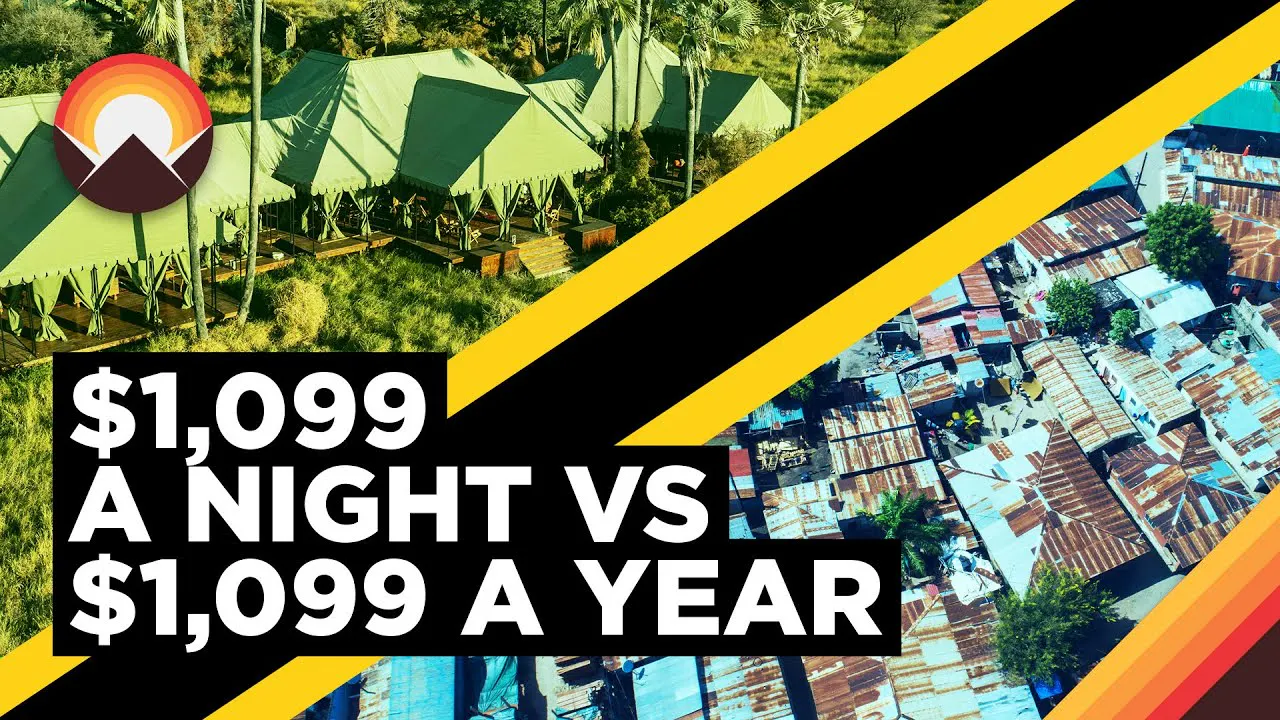
This is one of the most opulent airports in the world, Sarah and Era Airstrip. It's composed of one small, unimpressive terminal, a 7,000-foot dirt runway, and yet it sees dozens of flights per day and an average net worth of those traveling through it higher than almost any other in the world. That's because this tiny airstrip is the gateway to the massive, Sarah and Getty National Park. A safari destination so storied, so legendary that it's one of only a handful globally that the average person might recognize by name. For the fanciest few, their touchdowners met with a heavily modified Toyota Land Cruiser, quickly whisking them away across the savannah to the four-season safari lodge, one of the most expensive outposts of one of the most expensive hotel chains. Rumors demand a minimum of $1,100 a night and minimum is the key word there. In peak season, during the Great Migration, this same room will near $3,000 and the most expensive, the three-bedroom presidential villa demands over $10,000 per night.
With a pool, spa, gym, multiple bars and restaurants and plenty of optional activities for an upcharge, the lodge has everything you'd expect from a hotel of its caliber, but perhaps not a hotel here. Hours away from anywhere, surrounded on all sides, by seemingly endless savannah. But zoom out just ever so slightly more, and it becomes clear that the four-season Sarah and Getty is hardly alone. The National Park is home to over a dozen five-star hotels, some of which best even the four seasons is prices. Camps like the one-nature hotel in Yarswiga, for example, sell a night in their most affordable luxury tents for at least $3,000. Sarah and Getty National Park has developed into the destination for luxury safaris, and so the remote stretch of savannah has become a bizarrely busy hotspot for the world rich and famous. And yet, zoom out once again, and it all starts to seem even more ludicrous. The Sarah and Getty is located in Tanzania. A sub-Saharan African country that,
according to World Bank estimates, is the 30th poorest in the world on a GDP per capita basis. Average income is $1,099 per year, almost exactly equal to the cheapest night in the cheapest room at that four seasons. The region that encompasses it, Mara is even poorer than that national average, despite tourism's boost, so for its residents, if they were to take a quick trip into the park and up to the lodge, a salad at the restaurant would equate to four and a half days of income, a chicken sandwich about six, and a main course would demand some eight days of labor. This degree of difference just feels wrong. There's something about such a stark degree of income inequality in such a close proximity that conjures up concerns of exploitation. But beyond the emotions of it, beyond the near-primal instincts of perceiving rich people in poor places as wrong, is it? Well, you probably already intuitively know the broad upsides and downsides. For example, many who live in this remote region
are now able to earn a living, serving as guides for the ultra wealthy, touring their ancestral home, turn pristine, unpopulated wilderness. Of course, that brings up the fact that they were kicked off the land in the first place. But a lay without people, on the other hand, is of a measurable benefit to the animals. And for their part, while the animals largely go free, they still have the occasional safari party to navigate. Human presence stresses elephants, getting to near feeding cheetah leads to the skittish cat abandoning the kill, and normalizing the presence of humans doesn't serve any animals' best interests once it inadvertently wanders into a hunting preserve. But ultimately, human presence is what drives the revenue that makes the park possible to begin with. And then the side effect this creates is the country's tourism industry, which relies on the park to bring customers in. In this system, there are undeniable trade-offs. People are kicked off their land, animals are poked, prodded, and tamed for tourists, and the seized areas are quietly developed into nature-themed parks managed by governments with spotty track records. But this is what the rest of the world relies on to protect dwindling species and shrinking natural wonders only left in Africa.
It's certainly a compromise. In fact, it's outright unfair to some. And while it's easy to recognize the moral trade-off that undergirds' photosopharies, it's tough to critically examine because when brought down to the individual level, it's such a small downside for such a small upside. No single person is making a meaningful difference, positive or negative. It's the phenomenon that does. So perhaps it's more useful to examine this trade-off in starker form. A near-equivalent where individuals make the same moral trade-off, but with an enormous life or death difference. Safari hunting. You can legally kill almost any animal in Africa for a price. Zebras, drafts, buffaloes, hippos, cheetahs, lions, elephants, and even the critically endangered white rhino, of which only 6,000 exist, upon purchase of a $350,000 permit. Tanzania, one of the top trophy hunting destinations,
regulates and publishes a remarkably specific price list for buying the right to kill its wildlife. The ever-present order only costs $170, the abundant yet enormous hippo goes for $1,500, and then you get into the rare species. Leopard's fetch a $4,500 fee, lions some $7,000, and the top price in Tanzania is bestowed to the elephant, an endangered species known for its highly valuable ivory tusks, which justifies the $20,000 trophy hunting fee to bag those with the largest tusks. Such commodification of the world's rarest and most beloved species draws up immense emotion. It feels like a failure of humanity. Historically, humans hunted these species into near non-existence, then they stole their habitats to turn them into farms and fields and cities, and then after all that, after facing the precipice of extinction, they put a price on their lives. Their protectors, the authorities in charge of keeping them safe in a world that structurally imperils them,
have signed up on their deaths. All to have them skinned, stretched onto a mannequin, then mounted above a Texans fireplace to serve as a talking point at dinner parties, kicking off the conversation about the time they went on safari in the Serengeti. It feels tragic. However, in certain circumstances, tragedy can minimize tragedy. You see, as unfortunate as it may be, pure conservation can't exist today. Animals in Africa or anywhere cannot live as they did in centuries past, because the human population has exploded and spread to every corner of the globe. Excluding the most barren, dry, inhospitable reaches, essentially any land has value in the human economic system. Certainly in a fertile, agriculture-productive place like Tanzania, there is always a way to turn a profit off of any swath of open land, and therefore it's always under threat. In rural areas, agriculture is the driving force behind the destruction of wilderness.
Like on just fields for farming, there's cattle grazing. Letting livestock forage for their food is cost-efficient compared to paying for feed, assuming the grazing land is cheap enough. Inherently, almost any stretch of land that can sustain wild animals can also sustain cattle, and with virtually endless demand for beef, there's always incentive for farmers to gobble up more land if the price is right. So nowadays, there is no such thing as valueless land, and correspondingly, there is no free land. The problem that presents for humans is that uninhibited, essentially, everything would be turned into something. And any human use of land presents an issue for wild animals as even something as simple as cattle grazing leads to diminished resources and disrupted ecosystems, which makes it tougher and tougher for already endangered wild animals to survive. But animals don't interact with our economy. Their habitats have tremendous existential value for them, just as ours do for us, but they're competing against the system in which that value is not incorporated.
Therefore, when you distribute land through a capitalistic, supply, and demand-driven model, you have to work against that model to save these habitats. That's the role of conservation. You take land and specify its use as disuse, but conservation has a cost. Not just a setup, but perhaps more importantly, to enforce. Serengeti National Park is massive. In fact, it's larger than the entire nation of Qatar. Without enforcement, it'd be very easy for a farmer to bring their cattle in for illegal grazing and go undetected, and that's hardly the biggest threat. Many of the animals, directly due to their scarcity, are worth eye-popping amounts. For example, a single rhino horn is estimated to sell for $100,000 to $300,000 on the black market, or in countries like China and Vietnam, the crushed-up form of it is perceived to be a powerful tool as a traditional medicine. Back in Tanzania, with its average annual income of $1,100, that takes truly life-changing sum of money, so there's enormous incentive to illegally hunt
and dehor the animal. Well, that's the most extreme example. There's also plenty of profit to be made by killing elephants, lions, cheetahs, and other rare and endangered species in protected areas like the Serengeti, so proper conservation requires effective spending on enforcement across a huge swath of land. So that's all to say, conservation in the 21st century can't be passive. It has to be an active process, and therefore, it demands a very real, sometimes significant cost. Tanzanium, and essentially every major safari destination in Africa, is not a wealthy place. The government does not have bounds of money to throw around, especially when their human population faces myriad life or death issues that can be solved rather simply with government spending. So trophy hunting works as a tragic, but possibly effective bargain. Giving animals a means to generate economic value in our economic system in situations where, regrettably,
there are few practical alternatives. There are a huge number of hunters around the world who are willing to pay $20,000 to kill an elephant, and $20,000 can go a very, very long way in saving other elephants from habitat destruction, poaching, and more. The concept, therefore, is clear. Kill one to save more than one. From a pragmatic, utilitarian perspective, this is a worthy bargain. And when you put it in a real world context, the case is bolstered further. Guiding hunting trips is an exceptionally good employment opportunity for those living around conservation areas, and even offers a legitimate use for the skills a former poacher might have acquired. Trophy hunting can typically only happen on a certain land with an approved guide for which hunters pay enormous sums. A 21-day hunt in Tanzania typically costs $40,000, $50,000 or $60,000 all in per person, and then it costs more to get extra permits to kill more than what's included in that government-regulated package. It's also an exceptionally strong mechanism
for generating conservation revenue in places that might be too dangerous or undeveloped for a competitive photosafari industry. For example, Mozambique has a healthy safari hunting industry despite just a minor photosafari one. And then, there are the case studies. South Africa has an off-toded story of boosting its white rhino population from the dozens to the thousands through trophy hunting. Zimbabwe used the industry to double its conservation lands, and Tanzania itself insists that the industry is a critical factor in its abnormally high-lying population. Theoretically, trophy hunting can objectively create more good than bad. It can be a tragedy that minimizes tragedy. It only takes a simple understanding of the system to understand that. But does it balance out? Well, like, if frustrating many of things, it depends on who you ask. In fact, one of the fiercest debates centers around the fact that one would think would be the easiest to confer. How much revenue trophy hunting creates? For example, the safari club international,
a US-based organization that, according to its mission statement, seeks to quote, protect the freedom to hunt and to promote wildlife conservation, most of that trophy hunting contributes $426 million annually to the GDP of these eight Southern African economies. That number originates in a study they commissioned from Southwick Associates, a Florida-based marker research firm that, according to its own website, proudly supports pro-gun organizations like the National Shooting Sports Foundation. It also states that their quote, economic impact analysis calculates the importance and activity or initiative has on the economy or quality of life of a region generating greater support for that activity. In this study, certainly generated that support, putting forward one of the highest economic impact estimates of any purportedly legitimate study to date. In response, the Humane Society International, which does not hide its position against trophy hunting, commissioned its own study by Australia-based economists at large, which laid out numerous methodological errors in the Southwick analysis. The overall structure of the Southwick study involves serving hunters on their in-country spending,
multiplying that by the total number of hunter visitors, then adding a multiplier to that to inflate it to a corresponding GDP figure. From the very start, Southwick reached an eye-popping $20,600 and $2 estimate of in-country spending per hunter. While plenty of hunters pay for the most expensive, elephant, lion, or cheetah permits, far more engaged and shorter cheaper hunts for less dangerous game, which in most other studies has pulled the average down far below this $20,000 figure. In fact, even their own data indicates a strong sampling bias as they divided their survey into three rounds. The first two found an average of about $16,000 in spend and the third reached $25,600, a 60% inflation, which properly sampled studies should not see. And perhaps more fundamentally, the Southwick study considered trophy hunting entirely in isolation, assuming that exactly zero income would occur from the land, businesses, and visitors engaging in the industry if it didn't occur. That is clearly false and such a basic failure
in the process of economic impact analysis that it's covered in the second paragraph of its Wikipedia page. Though it would be like arguing that you've created economic benefit by selling scrap metal, even when it came from demolishing a perfectly good building. Southwick itself admitted that 11% of its surveyed hunters would still have traveled to the destination country if not for trophy hunting, and yet they attribute all of the revenue these brought to trophy hunting, even when much of it would have happened otherwise. Again, they've completely ignored the counterfactual case because it was convenient to their clients. The study also found that only about 5% of total in-country spending was attributable to non-hunting related activities, which is far lower than the 30 or 40% found in previous studies, and then with this already deflated amount, they still attributed that spending to hunting itself further boosting the figures. Issues like this mount and mount, so economists at large revised and corrected the methodology to create their own economic impact estimate, $132 million, less than a third of what Southwick possibly.
While other studies seem to converge on a number more than the 200s, the point is less about a systematic over-or-under exaggeration, but more so about the inherent inability to actually reach any confident consensus on the economic effect of trophy hunting on GDP. But trophy hunting is not even supposed to be about GDP growth. It's not supposed to be a system designed for economic growth. That can be a nice side effect, but the bargain is about sacrificing the few for the many on behalf of the animals. Establishing a figure of how much revenue actually ends up used for conservation has proven even tougher, and concerningly, even Southwick suggested that only some $27 to $40 million of their reported $426 million went to conservation. That means that a $7,000 line in Tanzania has unwillingly sacrificed at least $6,300 of itself for humans and only $700 for its brethren. At the simplest least academic level, the systematic slaughter of a species of only $20,000 globally for only $700 in benefit to that species
is a much tougher bargain to argue for. There is a world in which trophy hunting works, but when you dig into it, it's increasingly difficult to believe it's this one. It's a theoretically viable concept that has crashed head-on into the dirty, difficult realities of a flawed world, and that increasingly operates as a profit generation device rather than a pragmatic bargain. So when coming back down to the less destructive bargain, Photo Safaris is clear that it's less useful to look at it from the basis of its theoretical underpinnings and more so, its real world realities. In Tanzania, Photo Safaris and their rising popularity through the lens of conservation are becoming increasingly problematic. In the past two decades, the annual number of international tourists in Tanzania has tripled while the country's total tourism receipts has surpassed that of Kenya. Their northern neighbor with a more mature tourism sector. That means more people than ever are spending more than ever to visit. This increased alert has set up a land-raised and development boom across northern Tanzania.
Luxury resorts like the four seasons aren't confined to Serengeti National Park, but are instead spread across the area. This network of tour companies, roads, airstrips, national parks, and conservation areas from Mount Kilimanjaro to the Serengeti is now so well established that it has its own name, the Northern Circuit. The rise of the Northern Circuit has made it clear that in Tanzania tourism doesn't serve conservation, but rather conservation serves tourism. Within Tanzania's park system, further and further development seem an opportunity they're trying hard to capitalize on. As each year, they release an annual investment prospectus for those who might be an retaining idea of building a lodge within the park's boundaries. The parks are undeniably changing, but this new age scramble for Africa is being most acutely felt in the lands directly around the parks, where wildlife still roams, but regulations are more relaxed and restrictions remain relatively loose. Some companies, like Dorobo Safaris, have entered mutually beneficial agreements to lease from and work with the local Messiah people to establish wildlife watching services outside the park. Others have opted instead to work
with the Tanzanian government directly to establish safari or hunting reserves. The UAE owned a Terlo business corporation, for instance, relying on close connections to the Tanzanian government to create a hunting resort here and government force to relocate locals to the ones that began to expand. Regardless of how they go about it and regardless of their reputations, developers and outfitters are riding the region's newfound notoriety, putting pressure on locals and forever altering the very landscapes driving the region's rise in popularity. For the sake of pure conservation, tourism's proving too successful. It's leading to more roads, more airstrips, more suspect-private entities running hunting reserves and safari lodges. It's leading to strife between local populations and Tanzania's federal government that has the potential to destabilize the region. The downstream effect of this land rush is a landscape marred by shining new resorts, freshly cut roadways, and burned down villages monitored by officials stretched too thin and supervised by a federal government with a spotty record. Northern Tanzania is quickly becoming a landscape
where the rules of conservation take a backseat to the economic potential that Africa's brilliant biodiversity affords. Moral bargains can seem effective when discussed theoretically, but then you go from concept to reality. For decades upon decades, Serengeti National Park has conserved its land. So simply, it's tough to recognize how this recent buildup, this ruination has equivalently worked to further that conservation mission. And this seems to be a moment that most moral bargains reach. When the side effect, the bonus revenue seeking justification that enables the bargain becomes a disconnected profit-seeking motive. This happens slowly, quietly, and then suddenly, when takes a look back, any theoretical good has taken an entirely different form. Therefore, any bargain is only as effective as those maintaining and enforcing the bargain. Safari's are no different. There's no slam dunk, there's no this is bad, and this is good. It's rather a reminder of the value of nuance.
A reminder that this, like any bargain, is defined by the boring, quiet, unglamorous task of enforcing it. Scarcity drives value. That's almost universally true, and it's certainly the case with domain names. There can only be one instance of a given domain, and so especially when that domain uniquely matters to you, it's hugely valuable to you. For example, you might want to own your last name.com, but once it's gone, it's gone. And if you ever really, really want it, you'd probably have to pay a domain squatter a huge fee to get it, unless you just get it now. That's always been my approach with domains, so whenever I land on a name for a new channel, for example, even if it's still just a concept, I head to our sponsor hover to buy it now, before it's gone. The reason I've always used hover is because I know they have fair transparent pricing, a super quick and easy purchase process, and if there's ever the need, they truly have some of the best customer support of any business I've used. They also allow you to get creative with your domain with over 400 domain extensions that allow you to land on something like our Wendover Dot Productions domain.
People are always blown away that that's actually our domain without any dot com or dot org, and the way I found that was with hover. We also use them for our company email addresses since you can set up a custom professional looking email address at your custom domain truly in seconds, which means that when we reach out to people, they know it's from us and not some scammer. All around, hover just gets the domain purchasing and management process right, and it's the kind of thing that you want to make sure you get right. So click the button on screen, or head to hover dot com slash Wendover to get 10% off your first purchase, and thanks in advance, since you'll be supporting Wendover while you're at it.
More episodes
More from Wendover Productions

The Logistics of German Reunification | Wendover Productions
Wendover Productions

The 8 Flights That Show How COVID-19 Reinvented Aviation | Wendover Productions
Wendover Productions

TWL #5: Timekeeping on Mars | Wendover Productions
Wendover Productions

TWL #10: The Day Sweden Switched Driving Directions | Wendover Productions
Wendover Productions