About this episode
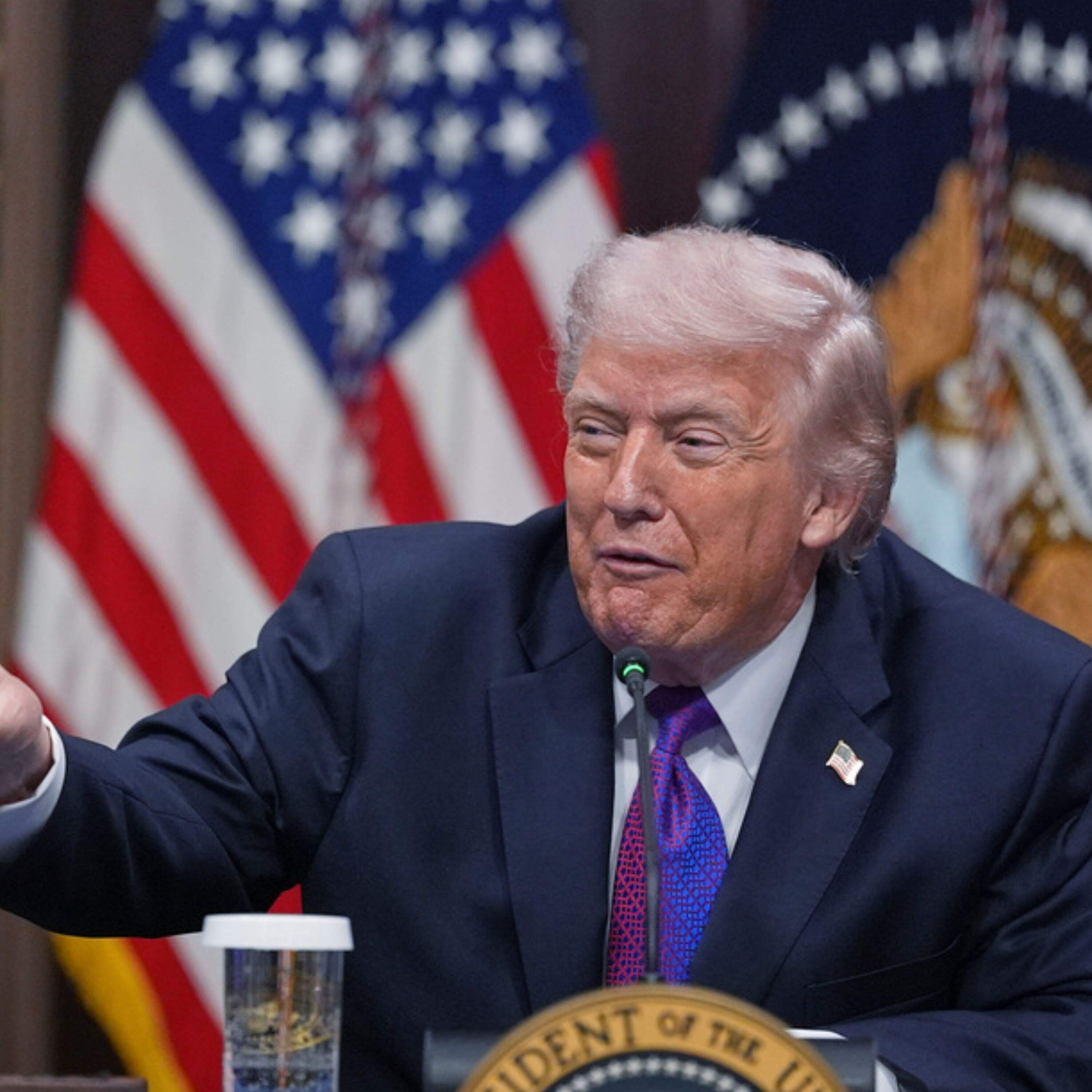
On Point news analyst Jack Beatty on the corrupting influence of the president’s power to wage war, and the failure of the 1973 War Powers Resolution to check that power.
*** Thank you for listening. Help power On Point by making a donation here: wbur.org/giveonpoint
Get every episode summarized
Each time On Point with Meghna Chakrabarti publishes, we email you a written briefing from the transcript — the topics, who appeared, and any specific claims, with the ad reads skipped.
Email me new episodesFree for 3 shows. No card needed.
Hosts & guests

Transcript ready
388 searchable segments. Every word is indexed and playable.
Full transcript
On Point with Meghna Chakrabarti — The Jackpod: The founders’ worst fears. Machine-transcribed; use the interactive transcript above to jump the player to any line.
Support for on-point comes from the VCU School of Business. Careers evolve and sometimes growth means continuing your education. VCU graduate programs offer flexible evening and weekend options for working professionals. Learn more at business.vcu.edu slash grad. Um, are you stuck staring at your W2? Our tax refund worry is holding you back. You probably have FOMO, the fear of messing up. The fix? Using turbo tax on into a credit karma, they find every credit and deduction to help you get every refund dollar you deserve. Or your money back. It's time to overcome your fear of messing up and get your taxes done right. Start filing today in the Credit Karma app. WBUR Podcasts. Boston. I'm Megna Chakrabardi and this is the jack pod,
where on-point news analyst Jack Bede helps us connect history, literature, and politics in a way that brings his unique clarity to the world we live in now. Hello there, Jack. Hello, Megna. It's episode 110, a couple of things going on around the world and what's your headline? The founder's worst fears. Uh, that could mean a lot of things these days, jacks, of sadly, of so tell me more. Well, I'm quoting California Democratic Senator Adam Schiff, speaking this week on the war powers resolution in the Congress. He's talking about Trump's war of whim on Iran, a war without authority from Congress, as the Constitution requires. And you know, if you Google founders in the war power, you will find entries like this from James Madison. The Constitution supposes what the history of all governments demonstrates
that the executive is the branch most interested in war and most prone to it. The Constitution has, accordingly, with studied care. Vested the question of war in the legislature. The Constitution says Congress shall declare war. It split up the war powers between the President and the Congress. The President executes the Congress decides. And here's another bit of clairvoyance from John Jay in Federalist 4 at the time of the Constitutional Convention. He said absolute monarchs will often make war when their nations are to get nothing by it. But for purposes and objects merely personal. It was, yeah, that he's just, it's like a moral x-ray of where we are, for purposes and objects merely personal.
And of course, that's what the founders, they were haunted by what had been the case that monarchs made war, even in England, which by then had had a, you know, the glorious revolution, parliamentary ascendancy, war powers vested in the king. And they didn't want that in America. So they vested it exclusively in the Congress. And that mischievous phrase, commander-in-chief, which is used to invoke awe at everything that people say, he's the commander-in-chief, how can you disobey him? That was a phrase that the barred from the British that they only used as a kind of, they meant a sort of super admiral or a super general that the monarch was the commander-in-chief in that sense, just in almost in the tactical sense. It had nothing to do with these vast and mind numbing, stupifying powers that people invoke when they use the phrase, he's the commander-in-chief. So that, that's a piece of mischief that lived on from the
Constitution. But this idea of merely personal objects, here we have this week, Carolyn Levin, she's the White House press secretary. She said that Trump had a good feeling, quote, good feeling, that Iran was about to attack something somewhere somehow. So he attacked first. We have John Jay warning about purposes and objects merely personal. And here we have Carolyn Levin confirming that founder's fear that the president had a good feeling that Iran was about to attack. And Edmund Randolph of Virginia, at delicate and the constitutional convention, he took that a step further and he won that a war-tempted presidency, quote, could be the fetus of monarchy. And the fetus of monarchy, that that war make, that the president making war, that is the, that was the pattern, all history showed,
and our constitution was set up to vest that power in Congress, not in the president list. Uh, he, he become a monarch and Trump, well, he sure sounds like a monarch in this answer to Katie Rogers of the New York Times. Is there anything that could stop you if you wanted to? Yeah, there's one thing, my own morality, my own mind. Okay, Jack, this is, this was an incredible, just short summation of the warnings from the founders and where we are now. But I'm curious about if they had such grave misgivings about sort of an innately dangerous power in the president. Um, yes, they gave the power to declare war to Congress, but as far as I understand, I get, I hear you about the perniciousness of, uh, the mischievousness of the phrase commander in chief, but it is also technically true, right? Because the president
appoints the secretary of defense, et cetera, et cetera. Um, I mean, it seems that the system, in fact, is set up, and we've seen it in, in subsequent, you know, generations into 20th century, especially to vest, uh, anordinate amount of power of, in warmaking in the president of the United States. Yes. Uh, and, and, you know, our greatest war or example of that, a presidential war, would be the Vietnam War of the 20th century. And, uh, and Daniel Ellsberg, of course, we know him as one of the authors and the man who released the Pentagon papers, the secret history of the Vietnam War to the press. And, and in his memoir, um, it's called secrets, the memoir of Vietnam and the Pentagon papers, Ellsberg wrote this, this pertinent, uh, observation of the early volumes
of the Pentagon papers confirmed for me what I had begun to suspect with my reading of the subsequent volumes over the last two years. Quote, the president was part of the problem. This was clearly a matter of his role, not of his personality or party. As I was beginning to see it, Ellsberg writes, the concentration of power within the executive branch since World War II had focused nearly all responsibility for policy failure upon one man, the president. At the same time, it gave him enormous capability to overt or postpone or conceal such personal failure by means of force and fraud. And then he concludes confronted by resolute external resistance as in Vietnam, that power could not fail to corrupt the human who held it.
In other words, the vast expectations on the president have helped, and especially when he makes war, is intrinsically corrupt. It will, again and again, he will choose what is expedient for him to prevent people recognizing this failure, to preserve him in office. He will do that over against the national interest almost every time. And with Trump, that needs to be put in italics. You had a former national security adviser to Trump, a John Bolton on the program, and John Bolton said, Donald Trump does not think in terms of the national interest. He thinks in terms of his own interest at every point. And this is exactly what Ellsburg is warning about that there's something in that office that corrupts the men or women soon who hold it. And that is all the
responsibility is on them because, of course, they don't go to Congress. And they can't show failure. Jack, I wonder if that phrase absolute power corrupts absolutely applies here, right? I mean, technically, the president does not have absolute power under our system of government. But again, for all intents and purposes, that's where we've landed as a country in terms of the use of military force. That's the abdication, really, of Congress. Ellsburg, after he's talked about how the presidency corrupts the office corrupts the person that holds it, he said, the only way to change the president's course, he's talking about Vietnam, was to bring pressure on him from outside, from Congress and the people, from Congress and the people. I can't wait for your take on how Congress is doing right now, Jack. But I presume you're speaking of the war power's resolution that Congress ostensibly has the power to either pass or not pass.
Yes. And that's the war power's resolution or act of 1973. And indeed, it was supposed to be the the answer to things like Vietnam. This wouldn't happen again because the war powers act with check it. And under the war powers act, presidents have to report to Congress within 48 hours of introducing armed forces into hostilities. Within 60 days, the president, and the president can extend that to 90 days, he must come to Congress for authorization for further military action. So he's got essentially a window of 90 days. Well, one of the authors of the original authors of the war power's resolution, Thomas Egelton of Missouri couldn't believe the resolution as it came down, because as one scholar writes, the war power's resolution grants the president
unbridled discretion to go to war anytime, any place against any enemy anywhere for at least 90 days. And prior to getting that authority, as I said, the legislature pointed out before the passage of that measure, the president would simply have been accused by the Congress of usurping authority. And he would have either been impeached or Congress would have denied money for his adventure. But with the war powers act, he essentially said, do anything you want for 90 days and then come back to us and we'll decide. So it was a perverse, unintended consequence of an effort to prevent another Vietnam. And presidents have Reagan struck Libya, George H. W. Bush intervened in Panama, Bill Clinton intervened all over the place. Obama had
air strikes in Yemen and Libya. Trump had air strikes in Syria, all of this without congressional approval. Jack, do you mind if I just jump in here? Because when you just laid out that list of military actions over the past several presidencies, this is the America that I grew up in. And I always remember when I was younger learning about the Constitution, having a hard time believing that the power to declare war actually rested with Congress, because one president after another, as you just said, sent US military troops abroad to various places and then only in retroactively said, can I do this? And I think one of the things that in 1973, as you're mentioning, that is quite different from now, is the attitude about the US military, sort of that the politics around the military itself. And correct me if I'm wrong, because I don't know what it was like in the Vietnam era. I think a lot of people were quite critical of the military. But nowadays, first of all, the president
can send troops into the theater of war, then only have 48 hours later have to ask for permission to do it, or up to 90 days later. So there's basically the sunk cost fallacy. They're already out there. And on top of that, Congress, it's political kryptonite to say, I'm going to cast a vote against the United States military. You will get throttled, absolutely throttled in the next election, because politically, the military is untouchable. You cannot criticize them if you're running for for re-election. So those two things in combination, I think, I mean, I didn't know the history of the war power resolution, but upon hearing you, it has rendered that act of 1973 moot from the start. Moot from the start. And, you know, the Constitution, as experts point out, can't enforce itself. Rather, and this is a famous phrase from a constitutional scholar, rather,
the Constitution is an invitation to struggle. An invitation that our Congress, this current Congress, this GOP Congress, has refused this week into a resolution voting in the Senate. And I, I remember we're in advance of it, but almost certainly in the House, to turn down invoking the War Powers Act. And essentially, to say, there are no. The president can do whatever he wants. Not for 90 days, but for as long as he wants. Right. I mean, how long did we have the authorization for the use of military force for Iraq and Afghanistan, right? Oh, 20 years. And it was cited. And, you know, in the most tenuous connections to Afghanistan. Yeah. You know, I think it was, you know, you had some mild, you had Syria, you had wherever it was, it was always that, you know, war powers, that war resolution. Yeah, you know, in addition, Congress, right now, and you know this as well, but it just, it just makes my stomach turn a little
bit. Yes, it's the Republicans are absolutely like, we don't even want to have to deal with this resolution because let the president have free reign. But they're, they're Democrats who've just in the past, we're recording this on a Thursday. In the past 24 hours have said, well, you know, if the president asks us for more money, more than the billion dollars a day, that this, this war with Iran is already costing, I think it was Alyssa Slachkin who said, well, we're already in it. So, yes, exactly. That's just the logic you were talking about. It's the fly paper. We've only been in it for what? 100 hours, but that's enough to give an excuse where we can't abandon the troops. We can't leave the troops out there. And of course, the troops are out there because one man decided to send them because he had, quote, a good feeling. Remember, there's no rationale for this war. And the administration has searched for it as one searches in a Trump
statement for the truth in vain. They can't find one. They light on one and then another. And finally, it comes down to the president having a good feeling that, man, boy, oh boy, Iran's going to do something bad. I'm going to hit him first. That is what's endangering the troops, not denying them funds. But of course, in the political world, that's not how that will be spun in campaigns. And a good feeling in people, their patriotism, their respect for people who join the military, all that will be used to trap them in a malignant cycle serving one man's whim. Yeah. And Jack, I'm just going to add one more thing before you move forward. And this man, the president of the United States, who is uniquely driven by his own self-interest, is now also surrounded people who are rapidly ideological to an extreme which, to me,
it just reminds me of the crusades of history passed, right? Because I'm just looking here, Thursday morning, Secretary of Defense, Pete Hegseth gave another one of his briefings. And here's a quote from what he said, all the nations represented in this room are offspring of Western civilization. Our nations are and always will be united by our heritage, history, and geography in this new world. We share the same interests. And because of this, we face an essential test. Hegseth goes on and says, whether our nations will be and remain Western nations with distinct characteristics, Christian nations under God. Oh my God. Christian nationalists have been calling for this for a long time, an all-out war with Islam. And it seems like they are getting what they want now.
As you say, this is the crusade. And remember, George Bush was at pains when one of his people, you referred to the war in Iraq as part of a crusade, you know, no, no, we don't want to talk about crusades. But now what a horror. I mean, I'm shocked by that. Yeah. But this gets back to what you're saying. Okay. On paper, our constitution of the United States, which I still believe is one of the greatest documents ever written for as long as people choose to defend it, says that, yes, as you've been saying, it is Congress that has the power to counter these monarchical impulses from the president and his secretaries. Yet Congress isn't doing it. So what now, Jack? Well, Ellsberg says the only way to change the president's course he's talking about Vietnam but it applies today was to bring pressure on him from outside, from Congress and the people.
If not Congress, can the people check a president, bat on war? Well, you know, I was recently watching a seminar on C-SPAN about Melvin Leard. He's pretty much forgotten today, but he was a congressman from Wisconsin and a very highly respected who was a secretary defense on the president Nixon for the first term. He was one of the architects of getting the U.S. out of Vietnam and pursuant to that strategy, he announced that there'd be a phase withdrawal from Vietnam of U.S. forces. And President Nixon would say occasionally say to him or maybe regularly, let's hold off on that withdrawal just for now. And Leard would say, or memo, Mr. President, there are demonstrations out there every day. The pressure is on the people
understand that you have committed yourself to withdrawing from the war. You know, if it's bad now with the demonstrations think what they will happen if you say we're going to postpone. And again and again, Nixon, as a practical politician, would yield to Leard's point. But the point is, people are always saying, oh, they don't pay attention to demonstrations and so on. And you know, that's just, but he has an example from history of how a secretary defense used the what was happening in the streets as an argument for the president to retreat from a war. And you know, when you look how many of these demonstrations there were in that first Nixon term, one estimate is that between 10,000 and 30,000 discrete events, teachings, protests,
demonstrations, you name it in that period. I found that a revelation that the establishment could so pay attention to what the people were doing. And you know, so in a way any war protest worked. It worked. And last week we had a caller, a Keith Grace of Point Pleasant, New Jersey. He made the essential point about the people checking a president acting unlawfully at home. But his words fit Trump's whim war in Iran as well. He said, I know that our dissent is growing. And maybe that's all we have. Maybe all we got is our dissent to get us through this. That may indeed be all we've got, either domestically or abroad. But the example of Vietnam says that is enough. Congress fails. The president is rampant. The people can bring the president to
heal. Public demonstrations did it then, and they can do it now. All of this is complicated, of course, by the wickedness of the Iranian regime. But you know, the North Vietnamese regime was pretty wicked too. I mean, they were blood on their hands from purges and anti-Catholic pogroms and on and on. Never mind the character of the enemy. It's us. It's what the war does to us. And all along, looking at Roman history, the founders would say, you know, there's an essential and almost inevitable connection, inexorable connection between foreign adventures, military adventure abroad, and the loss of liberty at home. And people have to understand that what we saw in Minneapolis, what we see with the ongoing crackdown of ice, is connected as part of the same
apparatus of executive overreach that we see in Iran. Well, Jack Potters, I think I have a two-parter for you today. The first part is to respond to what Jack just said. Like, what do you think the Trump administration's war on Iran is doing or will do to us, to Americans, to the United States of America here in this country. And the second part, I know I shouldn't do this, but I always I'm so so grateful for the analysis that all of you bring. But the second part is how do you think the people Americans writ large can force Congress, encourage, force, what have you, to recapture its role as a co-equal branch of government and the place in our federal
government that decides whether this nation will go to war or not. So I'm really curious about both of those. And as always, if you are a Jackpot listener, but you've never felt motivated to send us your thoughts, I get that. But I have a hard time believing that what's going on right now in the Persian Gulf isn't fomenting some very serious thinking and feeling amongst all of you. So if you're a longtime listener, but first time commenter, please do become a first time commenter. Grab your phones, download the on point Vox pop app wherever you get your app so you can send us a high quality message that way. And of course, for our regular Jackpotters as well, bring it on. Because every time you do, we are very, very hearted and we learn a lot. For example, last week, you talked about the, there's no rationale at all for a war against Iran. And that Jackpot came out on a Friday, low and behold, the next day, the United States went to war.
We got this comment from Patrick in Orange, California. Holy crap, you guys. If you're not careful, you're going to surpass the Simpsons in your ability to predict future events. First of all, the foreshadowing of Alex Prattie's death with the episode on the prerogative state, that was spooky. But I chalked that up to coincidence. Here, you can't do that. Now, you guys for the second time have now within less than a day of this episode dropping predicted that this massive military buildup was for an attack on Iran. I can guarantee you Jack would never have wished that he would be right about that Patrick. But we're going to hear from a lot more Jackpotters when we come back. Support for on point comes from the VCU School of Business. Life is full of milestones. The VCU School of Business could be your next step. If you work in government, consulting, healthcare, data and technology, finance or the military, VCU's graduate
programs with flexible online and hybrid options can help you move forward without putting your life on hold. The VCU School of Business is open for business, open for opportunity. Learn more at business.vcu.edu slash grad. Fox News is now streaming live on Fox One. When news breaks, we don't just report it. We go beyond the headlines to get the full story, get live coverage, in-depth analysis and perspectives from the voices you trust all in one place. Whether you're at home or on the go, stay connected to the stories shaping our world. Stream Fox News on Fox One. Download today. Okay Jack, we are back and last week, just as a quick reminder again, you talked about the fact that there's no actual coherent rationale for an attack on Iran and in fact in the week after the bombing began last weekend, we've heard almost every possible rationale under the sun as if
the president and the people around him are just trying to throw everything against the wall and seeing what sticks not much is sticking yet. So we asked Jack Potters what they thought about this moment and there were a lot of thoughts. Here's Donna from Grand Rapids, Michigan. And she thinks that the president's real reason for beginning a war with Iran right now is to distract. Got trouble at home? Start a war. Your buddy Netanyahu tried it and it worked for him. Don't worry about the law or anything like that. Just make this stuff happen that's so traumatic and awful that it pulls attention away from your misdeeds at home. And here's Joe G from Sacramento, California. I think what is driving the Trump administration's attack on Iran is the same as why they bomb boats in the Caribbean. It has nothing to do with policy. It is simply that Trump and the belief personalities around him have spent their entire lives protecting their fragile
egos and paranoia through intimidation. Attack someone first before they can attack you. And this is James in Syracuse, New York. The Prince of Peace Trump will claim his war is an act of peacemaking. And should the Iran War resolve itself somehow while he's still board president, he will want credit for ending the war that he started. When Trump looks across this country's golden waves and purple mountains and he sees Trump. The plateaus and peaks of Iran and sees Trump. His cohorts and underlings look in the mirror and see Trump. The people of America look into the mirror of the media and see Trump. Well, Jack. I hope that gets into a newspaper because that's you know what I really want. James delivered that with such passion and lyricism. I want it to end
up in a pop song. I'm serious because if you really want to reach the people, do it. Oh, that's the way to do it through popular culture. Like I need a hip hop artist right now to take that and sample in a song. But I know I'm not joking. Like I really, really mean it. But but Jack, your response to the fact that I mean, I look Jack pod listeners might be a self-selecting group of I would say worldly, knowledgeable and intelligent people. But these attitudes that you heard, these views are also being reflected in polling right now. These early polling after the start of the bombing shows not majority support at all in this country for this war. No, and there's no, there seems to be no rallying around the flag. Exactly. And of course, Trump hasn't even tried to do that. And and and that's been part of the problem. He has no reason. I have a good feeling they were going to attack. But you know, I'm going to draw some really important thing. There's nothing to change as the subject like a war. It feels every follicle of, you know, every crack.
It it it you you us the entire attention because of course, it's life and death and it's compelling and it has for all the reasons. And so the subject is changed, changed from what? Well, the cost of living issue. And of course, we do see gas prices rising. All that could get worse. It changes the subject from Epstein. So we don't know what's going to happen with that. And then I think Joe G is very good here on paranoia. You know, you project onto others the thing that you that you fear. So, you know, so Iran's going to attack, but I want to attack. So I have to say they're going to attack. And then it is as we recognize with our friends who show, you know, our ourselves. When we show moments of, oh, they're all against me. They're going to get me that it's our insecurity, our self-doubt that's driving it. It's our, you know, we recognize
it and we back off. We say, oh my god, I'm in a spell here. I've got to stop this. And of course, I think she puts her, she uses the fragile ego and paranoia, how they are connected and how they lead to, you know, intimidation. And that almost sounds like something you could find in a psychiatric manual about Donald Trump. God, you talk about a fragile ego. He can't go through it seems a minute without affirming himself, without saying the best, the biggest, the most expensive. I'm the greatest. It's pathetic. Well, let's hear from Heidi now. She's in a conno-mooc Wisconsin. Trump uses the threat of war as a bargaining chip with complete disregard of the lives at stake or the tragedy that war is and without the realization that war is an instrument of coercion by torture. The reason his irresponsibility and ignorance is so abhorrent is that we had hoped to
move beyond that to a world governed by international law, which saves lives, reduces tragedy, and frees people from living under coercion. If Trump does invade, he'll go after their oil. So, Jack, what do you think? Yeah. Oh, God, that is so, you know, in years past we'd have called that cynical. Now, it seems just, you know, realism, the realism of real life. I mean, it's based upon intimate and painful acquaintance with what Trump is act, you know, what motivates him and what he's apt to do. And then there's just this picture of war that Heidi draws. I mean, after a gap of, I hate to say, at five decades, I am rereading Tolstoy's war and peace. I'm just about finished. And he's got this passage where he says, what is war? It's murder. And he who murders the most gets the most valor and the most credit. And the, you know, in other words,
it's an inversion of everything that we think of as morality in war period. Now, some wars are justified for sure. World War II, the Civil War. But when there was a choice to take on the moral freight of war just by on whim, it is exactly what the founder's worst fear was embodied today in King Trump. Well, here's two more, Jack, of the many, many responses we got. Let's listen to Eris from Hamden, Connecticut. And he recalls that we talked about similarities between Iraq and Iran in terms of the United States, lead up to war in either country. Although I would say, at least in Iraq, there was the theater of caring about what Congress thought or the international community thought we don't even have that here this time. But Eris brings up a different analogy. I think we need to go further back and look at the lead up to World War II.
How Germany was acting, how Italy was acting, how Russia was acting. We're seeing an authoritarian striving to be the next world leader. He's moving to take over as much as he can from Venezuela to Greenland and elsewhere. He's pushed away our allies in Europe. Eris, I think you're spot on there because I'm old enough to remember back when President Trump in the first election that he won back in 2016 said that he was going to get us out of all the quote unquote stupid wars that he would never start another foreign intervention, etc. But as Eris just laid out there, Jack, I mean, Trump is the most belligerent, belligerent president. We've had in recent memory, look at all the places that he's like starting military action slash wars. Okay. But before I let you jump in here, Jack, let me get one last one here. This is Daniel from Harrisburg, Pennsylvania. And he's looking at the president's desire for regime change
in Iran. And Daniel says it is fraught with risk. One cannot bomb away a culture that have been imposed by the Ayatollah in the late 1970s and expect that a homegrown pro-U.S. democracy movement take its place. My question for Jack would be, is the Trumpian legacy the great disruptor who did what previous Presidencies wouldn't do to shake up the world order? Or will he be seen particularly in the Middle East if the Iran operation goes south as America's dictator who tried to impose his will in the world and didn't care about what happened to the societies of the U.S. impacted? Jack? The latter is apt to be the that he's not the great disruptor. But you know, just that phrase that Daniel uses, I quoted last week Thomas Friedman, you know,
pundit of the New York Times. That's what he wrote about the Iraq war. Well, we need to disrupt, we need to break things up in the Middle East and see if something good will result. And you hear echoes of that even now, even after the experience of a war in Afghanistan and Iraq and the idea that democracy is going to sprout. Trump has made us morally cursed, but even worse, he said to the people around, come out on the street, get out on the street. If they go out on the street and they are shot in their thousands, we see going to do something about that. And the only thing he could do is to send in ground forces. Is he going to, you know, essentially take over the Iranian government to make good on his promise to help the people? He is not. They're going to go out on the street. And I hope not, but the chances seem very high that they will be killed and they will have been encouraged to be killed by a reckless, unheeding monarch of the United States. And you
know, the Harris' view of how the dictators acted before World War II, I think there's really something in that. Hitler was going to have a war no matter what. And he was disappointed at Munich. He was disappointed that the French and the British wouldn't stand by Czechoslovakia. They handed him Czechoslovakia. He wanted the war. We recognize now that there just was something evil in that impulse, that there had to be war, that that may be, you know, as somebody said about the philosophy of Saudi honor, the quintessence of rottenness. Wow. Do you mind if I had one last thing, Jack? Yeah. Because, you know, Daniel asked, how will Trump be seen particularly in the Middle East? And I think we're already getting the beginnings of that answer because, I mean, clearly Iran made the decision instantaneously once the United States and Israel started bombing
Iran to retaliate against all the neighboring countries in and around the Persian Gulf, right? And this is not, this is not a surprise at all, right? It is literally the reason why the United States, Israel, et cetera, has, has seen Iran as such a, such a menace for so many decades. So it's just, it's no surprise at all. Every possible intelligence assessment, even though I haven't read them, I'm going to presume said, this is what will happen if you start bombing Tehran. Okay, they ignored that and did it anyway. So now the people who are at risk are not just in Iran. They are all around the region. Okay, so they are the very people of the Middle East that Daniel is talking about. And I ran into this, this interesting social media post that just came across today, again, today's Thursday. It's from Kulaf al-Habtur. He's a billionaire in the United Arab Emirates. Okay, these guys don't talk very publicly very often and they definitely don't put out long, and this is a very long social media post without, I would say, tacit approval from their
governments. And here's what Kulaf al-Habtur writes in a social media post and is directed at President Trump. I'm just going to read the first two bits. His excellency President Donald Trump, he asks, a direct question, who gave you the authority to drag our region into a war with Iran? And on what basis did you make this decision? Did you calculate the collateral damage before pulling the trigger? And did you consider that the first to suffer from this escalation will be the countries of the region itself? Now, those are the first two sentences of a multi-paragraph, social media post from, you know, a Gulf area billionaire who almost never speaks about politics publicly. So I think, look, people are already saying in the region, you have dragged us into what could become an existential crisis. You've made us targets. Yeah, targets in your war. The Iranians can't reach us, but they can sure shoot across the Persian Gulf at the Arab states along
the Gulf, and they are hitting hotels and refineries, and that may just be the start of what they can do. Yeah. And to think that our economy isn't intimately tied, intertwined with that is utter folly. Well, Jack, thank you as always. Oh, thank you. I'm Megna Chakrabarty, and this is the Jack pod from on point.
More episodes
More from On Point with Meghna Chakrabarti
How 9/11 shaped America
On Point with Meghna Chakrabarti

Did the Treasury just make it easier to launder money?
On Point with Meghna Chakrabarti

Who's to blame when AI goes rogue?
On Point with Meghna Chakrabarti

How should e-bikes be regulated?
On Point with Meghna Chakrabarti