About this episode
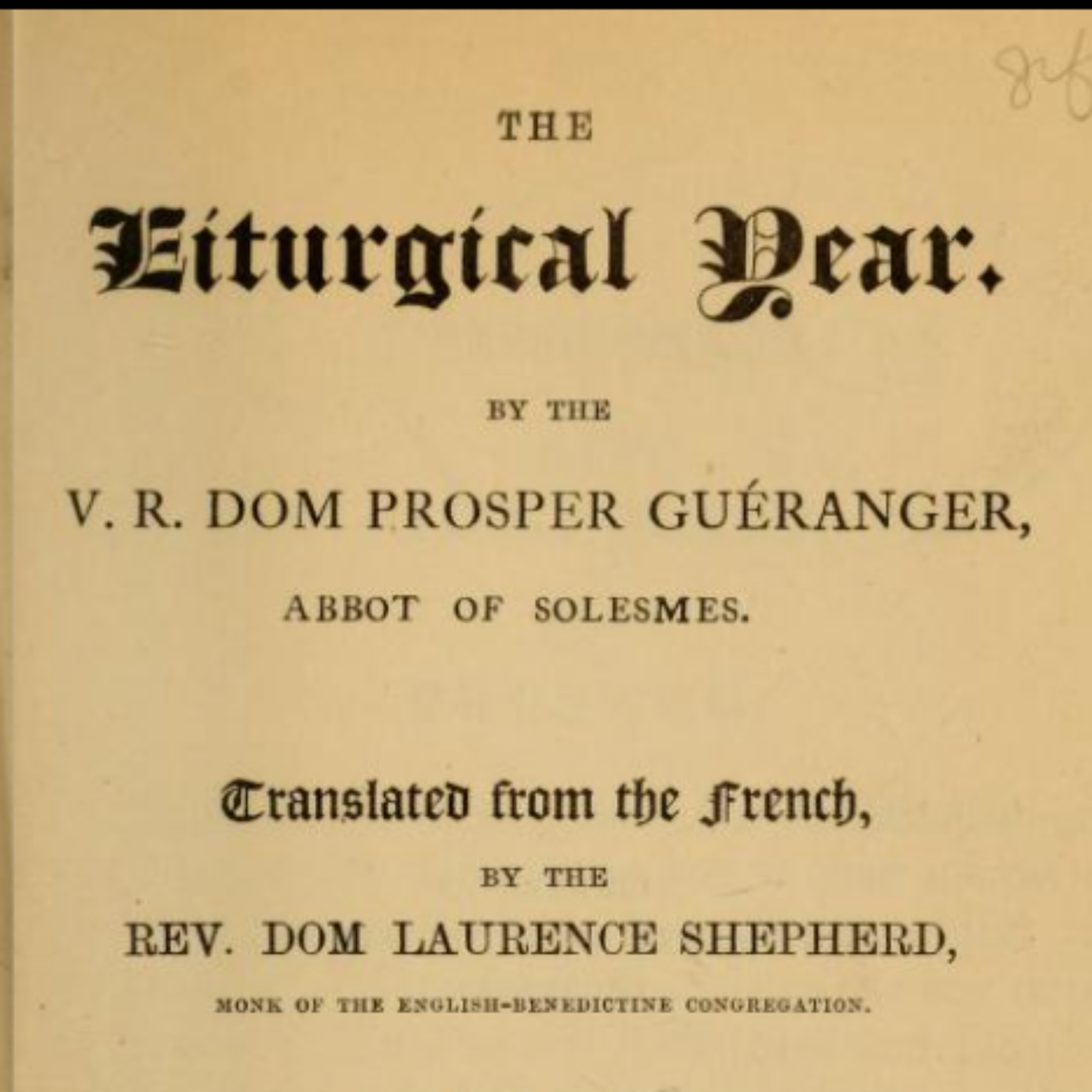
Abridged. The Liturgical Year is a multi-volume work written between 1841 and 1875, by Dom Prosper Gueranger, abbot of the French Benedictine abbey of Solesmes. It is a rich theological reflection on the various feasts and seasons of the Church’s liturgical cycle.
Please consider donating to help keep this podcast going by going to buymeacoffee.com/catholicdailybrief Also, if you enjoy these episodes, please give a five star rating and share the podcast with your friends and family
Get every episode summarized
Each time Catholic Daily Brief publishes, we email you a written briefing from the transcript — the topics, who appeared, and any specific claims, with the ad reads skipped.
Email me new episodesFree for 3 shows. No card needed.
Hosts & guests


Transcript ready
106 searchable segments. Every word is indexed and playable.
Full transcript
Catholic Daily Brief — The Liturgical Year: St. Joseph. Machine-transcribed; use the interactive transcript above to jump the player to any line.
St. Joseph, spouse of the Blessed Virgin Today, Joseph, the spouse of Mary, the foster father of the Son of God, comes to cheer us by his dear presence. In a few days hence, the august mystery of the incarnation will demand our fervent adoration. Who could better prepare us for the grand feast than he that was both the confidant and the faithful guardian of the divine secret? The Son of God went about to descend upon this earth to assume our human nature would have a mother. This mother could not be other than the purist of virgins, and her divine maternity was not to impair her incomparable virginity. Until such time as the Son of Mary were recognized as the Son of God, his mother's honor had need of a protector. A man therefore was to be called to the high dignity of being Mary's spouse. This privileged mortal was Joseph, the most chaste of men.
Heaven designated him as being the only one worthy of such a treasure. The rod he held in his hand in the temple suddenly produced a flower, as though it were a literal fulfillment of the prophecy of Isaiah, there shall come forth a rod from the root of Jesse, and a flower shall rise up out of his root. Isaiah 111. The rich pretenders to an alliance with Mary were set aside, and Joseph was espoused to the virgin of the house of David, by a union which surpassed in love and purity, everything the angels themselves had ever witnessed. But he was not only chosen to the glory of having to protect the mother of the incarnate word, he was also called to exercise an adopted paternity over the very Son of God. So long as the mysterious cloud was over the saint of saints, men called Jesus the Son of Joseph and the carpenter's son. When our blessed lady found the child Jesus in the temple, in the midst of the doctors, she thus addressed him, thy father and I have sought the sorrowing. And the holy evangelist adds that Jesus was subject to them, that is, that he was subject
to Joseph as he was to Mary. Who can imagine or wordfully describe the sentiments which filled the heart of this man, whom the gospel describes to us in one word, when it calls him, the just man. Let us try to picture him to ourselves amidst the principal events of his life. His being chosen is the spouse of Mary, the most holy and perfect of God's creatures. The angels appearing to him and making him the one single human confidant of the mystery of the incarnation, by telling him that his virgin bride bore within her the fruit of the world salvation. The joys of Bethlehem, when he assisted at the birth of the divine babe, honored the virgin mother and heard the angels singing. His seeing first the humble and simple shepherds, and then the rich eastern magi coming to the stable to adore the newborn child. The sudden fears which came to him when he was told to arise, and midnight as it was, to flee into Egypt with the child and the mother. The hardships of that exile, the poverty and the privations which were endured by the hidden God whose foster father he was, and by the virgin whose sublime dignity was now so evident
to him. The return to Nazareth and the humble and laborious life led in that village, where he so often witnessed the world's creator sharing in the work of the carpenter. The happiness of such a life in that cottage where his companions were the queen of the angels and the eternal son of God, both of whom honored and tenderly loved him as the head of the family. Yes, Joseph was beloved and honored by the uncreated word, the wisdom of the father, and by the virgin, the masterpiece of God's power and holiness. He asked what mortal can justly appreciate the glories of St. Joseph. To do so, he would have to understand the whole of that mystery of which God made him the necessary instrument. What wonder then if this foster father of the son of God was prefigured in the Old Testament, and that by one of the most glorious of the patriarchs? Let us listen to St. Bernard, who thus compares the two Josephs. Quote, The first was sold by his brethren out of envy and was led into Egypt, thus prefiguring our saviors being sold.
The second Joseph that he might avoid Herod's envy led Jesus into Egypt. The first was faithful to his master and treated his wife with honor. The second too was the most chaste guardian of his bride, the virgin mother of his lord. To the first was given the understanding and interpretation of dreams. To the second, the knowledge of and participation in the heavenly mysteries. The first laid up stores of corn, not for himself, but for all the people. The second received the living bread that came down from heaven and kept it both for himself and for the whole world, unquote. Such a life could not close, saved by a death that was worthy of so great a saint. The time came for Jesus to quit the obscurity of Nazareth and show himself to the world. His own works were henceforth to bear testimony to his divine origin. The ministry of Joseph, therefore, was no longer needed. It was time for him to leave this world and await in Abraham's bosom the arrival of that day when heaven's gates were to be opened to the just.
As Joseph lay on his bed of death, there was watching by his side he that is the master of life, and that had often called this his humble creature, Father. His last breath was received by the glorious virgin mother, whom he had by a just right called his bride. It was thus with Jesus and Mary by his side, caring for and caressing him, that Joseph sweetly slept in peace. The spouse of Mary, the foster father of Jesus, now reigns in heaven with the glory which though inferior to that of Mary, is marked with certain prerogatives which no other inhabitant of heaven can have. From heaven, he exercises a powerful protection over those that invoke him. In a few weeks from this time, the church will show us the whole magnificence of this protection. A solemn feast will be kept in his honor in the third week after Easter. Today the liturgy sets before us his glories and privileges. Let us unite with the faithful throughout the world, and offer to the spouse of Mary the hymns which are this day sung in his praise. May the heavenly host praise the O Joseph, may the choirs of Christendom resound with thy
name, for great are thy merits, who wast united by a chaste alliance to the Holy Virgin. Seeing that thy bride was soon to be a mother, a cruel doubt of licks thy heart, but an angel visits thee, telling thee that she had conceived of the Holy Ghost, the child she bore in her womb. When Jesus was born doubt it's take him in thy arms and go with the little fugitive to Egypt's distant land. When he was lost in Jerusalem, doubt it's seek after him, and having found him thy tears were mingled with joy. Other saints receive their beatitude after death when a holy death has crowned their life. They receive their glory when they have won the palm, but thou by a strange, happy lot, hatched even during life what the blessed have in heaven, thou hats the sweet society of thy God. O sovereign Trinity, have mercy on us thy sublients, and may the intercession of Joseph aid us to reach heaven, that there we may sing to thee our eternal hymn of grateful love. Amen.
More episodes
More from Catholic Daily Brief

1962 Missal - Commentary on the Mass Readings: Sat, Aug 22 (Immaculate Heart of...
Catholic Daily Brief

Commentary on the Mass Readings: Sat, Aug 22 (Queenship of the Blessed Virgin Ma...
Catholic Daily Brief

Commentary on the Mass Readings: Fri, Aug 21 (Pope St. Pius X)
Catholic Daily Brief

1962 Missal - Commentary on the Mass Readings: Fri, Aug 21 (St. Jane Frances de...
Catholic Daily Brief