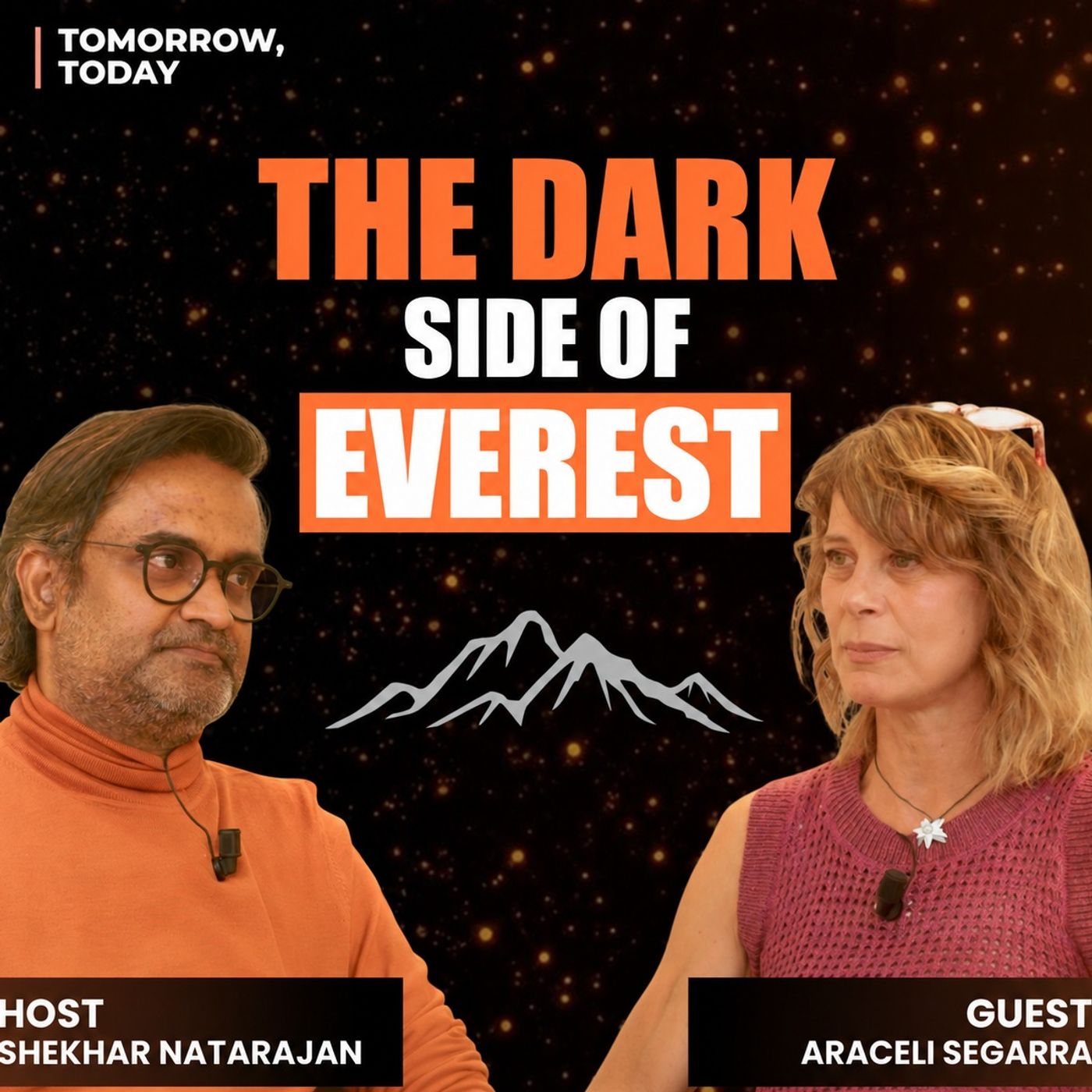
The Mountains Choose You: Araceli Segarra on Adventure & Resilience | Shekhar Natarajan
About this episode
What does it truly mean to clim not just a mountain, but through fear, uncertainty, and the challenges that redefine who we are?
In this powerful episode of Tomorrow Today with Shekhar Natarajan, legendary mountaineer Araceli Segarra shares the extraordinary journey that took her from a childhood fear of darkness to the world's highest mountain.
Araceli explores why the mountains became the one place where she never had to pretend, why uncertainty and adventure may be more connected than we think, and how fear can become a guide rather than an enemy.
The conversation goes far beyond Mount Everest. It explores the mindset behind resilience, the power of embracing uncertainty, the importance of being present, and why the person you become may matter more than reaching the summit.
Araceli also shares powerful insights from her experiences as part of the historic Everest IMAX expedition, including the role of diverse thinking, teamwork, trust, empathy, and human connection in surviving and solving problems under extreme conditions.
From overcoming fear to finding where you truly belong, this is a conversation about adventure, authenticity, courage, and the beautiful, unpredictable journey of being alive.
Because perhaps, in some way, we are all alpinists of life.
Subscribe to Tomorrow Today Show by SKN for more transformative global conversations.
Hosted by Simplecast, an AdsWizz company. See pcm.adswizz.com for information about our collection and use of personal data for advertising.
Get every episode summarized
Each time Tomorrow, Today publishes, we email you a written briefing from the transcript — the topics, who appeared, and any specific claims, with the ad reads skipped.
Email me new episodesFree for 3 shows. No card needed.
Hosts & guests
Transcript ready
1,518 searchable segments. Every word is indexed and playable.
Full transcript
Tomorrow, Today — The Mountains Choose You: Araceli Segarra on Adventure & Resilience | Shekhar Natarajan. Machine-transcribed; use the interactive transcript above to jump the player to any line.
Important thing is not reaching the summit. Is the person you became? I feel like God has given me this gift to keep defeating death. When I'm climbing, I don't need to fake. We are all going through something curbulent in our life, even as the tree defines us. Night picture eyes that in some way we are all out in the midst of life.
nav Yue Welcome to yet another episode of Tomorrow Today with Shaker Natrajan. It's my real honor to actually have Araseli Sagara. She's the first person to actually climb Mount Everest and first I need to do that. Her life story is like simply superb. Amazing. Beautiful person. And I want you all to get to know her just like the way I'm excited to know you too. So with that, Araseli, please welcome to the show.
Thank you so much. Actually, it's my honor after seeing all the things you have achieved. I think this is going to be very interesting. I'm that you've done as much as you did. But I'm like, you know, I was so looking forward to it because I think your life and who you are as a person, how you have processed life in general is going to be a source of inspiration for many because we are all going through something turbulent in our life, events that redefine us and the resilience, courage, risk taking that comes so naturally to you. I want everyone to embody that beautiful spirit. So like, you know, that's why I was very excited, very, very excited when I got to know that like you're going to be in the show. The truth is that I consider and I picturize that in some way we are all out in the midst
of life. As you said, we all go through same, let's say, expeditions in life. We have projects. We have hopes. Sometimes we have fears. Sometimes we cool and nowadays even more through uncertainty. We have people that inspire us. There's moments that we lose hope and so on, so on. So we all climb mountains. I think one thing that we do, we should never lose is a soul. Yeah, but yeah, I agree that we approach things with that inner energy and maybe with all the culture that we belong and even sometimes with the ancestors concepts on your genes,
like things that we do and we don't know what we do it. But I also think that situations and obstacles that we find on our way sometimes can redefine who we are. Who we are, yeah. Awesome. So before we get to Mount Everest, before we talk about the very tragic incident that happened while you were climbing and the rescue operations and other things, I want to get to know you as a person, Catalonian girl, overseeing the Pyrenees and basically climbing the mountains all day long. So I wanted to get the soul of who you are.
Tell me, take yourself back to when you were four or five years old and tell me what was your life like, who's your family, how was your upbringing, why did you start like fascination for climbing and I'm just so curious about you. You know, I belong to a very little family not having a lot of luxuries. But at the same time, I think that because we didn't have luxuries, we didn't have boundaries. It's like anything can be possible. And I was and I'm still a very shy person. It doesn't mean that you cannot develop some skills to survive. But I always was very curious and stubborn.
Where does that come from, your mom or your dad? I don't know. I have no idea. And I was afraid of darkness. I was really, I have a really deep, frightening feeling for darkness. And maybe because of that, I was a track to it. And that's a very weird thing because I was trying different sports when I was a really kid like, athleticism, like jumping, like doing canoing, all kind of stuff until I discovered a splangling. And my brother was letting me to do a curse, which was getting into the darkness, the deepest darkness of a cave.
And because that loving for the things you hate, I was just immediately connected to the outdoors through one of my deepest fears. But the thing is that I overcome that fear after like the whole month that that curse was teaching me how to deal inside the case with robes and all that stuff. And I got just passionate about the outdoors and about the concept of adventure and overcoming all your fears. And from doing that, sports on the Pyrenees being free because you know, my family was like my parents were working all day. So you don't have those helicopter fathers, you know, the ones that are controlling you
and knowing what you're doing all day, teaching you or letting you know or telling you what you shouldn't doing. So you had no boundaries whatsoever. Exactly. And in one hand, you know, my generation, we have some, the lock of some, let's say connection with our parents. But on the other hand, we have the freedom because nobody was telling us to do this. It's too dangerous. So I'm balancing those two things, but I'm really thankful to belong to that generation because I was able to explore and try things that are otherwise. But it's very difficult. Yeah. Very interesting because like, you know, we share some commonality there, at a silly.
So like I come from a very humble family too. And the thing that I used to love the most is basically spending time with my father. And my father's time was very, like it was a small window of time I could like spend time with him, right? You would leave at 6am in the morning on a cycle, go for work and then back at like 8, 8, 13 in the night. And then he would like, he had this ritual like, you know, he would come and he would take a shower or go to the temple, come back. Then I get to spend like that nine to nine thirty or nine thirty to ten o'clock window and I used to sit on his lap. Maybe you could literally see like the moon from the house and then like you talk. There was the happiest thing I had in my memory.
And my mom used to work for a newspaper company. And she was not educated as such not a lot. So she used to wrap newspaper for the next day delivery. They would print and cut and then she would prepare it for the next day. And so I could see my mom and I would be playing on the streets like a free will. Like I used to play with tires, with junk. You know, scrap metal. All of that. I used to, like, they're trying to go for like treasure hunt with like the kids in the slum and then like all of that. And then I would see my mom from a distance, you know, she would be, you know, obviously, like, you know, she would walk and you could see her at a distance.
And then I would run like crazy fast, calling my mother's name out and then like running into the house because for the longest time I thought my grandmother is my mother. And my mother is like, she's like my sister. Oh, yeah, something like that. Like, you know, like, so I used to call her by the name. Yeah, yeah, yeah, yeah. So, and then I used to, like, I used to run literally to the house and then like I would pull my book. And my brothers would be sitting and studying. And I would have my book upside down, pretending, pretending that I'm studying. And then like she would like come right by and then she would say, okay, I think this is how you study. And she didn't want to go. You know, one of my memories, did you just say that and remind me if it's been just
a few times because my mother was all the away working. And I remember sitting in a balcony waiting for her of that little, no, on or the real apartment in a raining day. And my mom was at home. And she and I were sitting on a chair, eating a sandwich in the rain. Looking at the rain outside and before back then, they were not buildings in front of my house on that apartment. And we could see the perines from home. I mean, they are far away, but we are still. That's easy. Yeah. After that, they were building apartments and the view was completely blocked. But do you just say that and it reminds me like a few moments, a few memories like sitting
on the balcony on a raining day, eating a sandwich with my mom. And that's one of the nicest memories because they were never at home. Yeah, they were never at home. And like, you know, I think that's the beauty of what mom and dad do to you, right? Like so and like, like to your point, like, because you don't have luxury, you know, there's no boundary to what you could do. But in the other hand, that was teaching me also to work hard for the things you want. Like, I don't know about you, but I couldn't get the things I wanted simply because I wanted them because they were not able to give them to me. If you want something, you can earn it. Yeah. And I think my parents for that. Yeah. Yeah. Like, you know, so like, you know, we used to have growing up, like we used to have very few
pairs of clothes that we would wear and everyone. So in those days, also in India, we used to stitch all of a piece of cloth like you would take it over a local tailor and they would stitch and like so every one of our, like I have two siblings and all of us used to dress up the same way. Yeah. The same color, the same shirt, the same pants, right? Like, you know, all the same trouser and like one used to be taller, one used to be shorter. So like, you know, someone's trousers was longer, someone's trousers shorter. So it's all like funny. But like, you know, like I look back at all those memories. It's like fantastic and fascinating. But, but those are beautiful memories and like, you know, to your point, the reason why I bring up the book story is like, I got fascinated about sitting and studying because of that. Like, you know, I would see, I would run down the fear and then like, you know, I didn't know what else to do. I know like, you know, she would love seeing me study and I would sit and study and then that sort of became my mental model, like, you know, like I want to please my mom
and mom needs to see me study. Mm-hmm. You know, and so I got like very much into education and like, you know, how I train myself through education. So we all have our, you know, formative days and their experiences that actually define who we are. Very beautiful story. I love what you said. So now let's basically go back to the age from where you were to then becoming who you were as an adult, as a teen and an adult. Like, how was that transition? Like, you know, like, so you said you were stubborn. You said, like, you know, you wanted like to explore the outdoors. You know, darkness was a fear, but you had to overcome the fear and that like, you know, you started loving the nature because of that. So what happens after that? Like, tell me, like, how did you prepare yourselves? Um, you know, climbing, it's not something that I choose.
Um, I would say the mountains choose me. Ah. Um, what, how did you feel that? Um, it's, it's kind of weird to explain. Um, but I'm, guess there's more people who have that kind of feeling is, um, when I'm climbing, I don't need to fake. Hmm. And we'll fake. Um, more or less. Like we, we hide. Yeah. I'm shy and I'm hiding that. When I'm on a mountain, you don't have that. I don't need to hide anything. Like for me, there's not a different, a better place to choose. Enjoy. Enjoy.
Enjoy. And release and grow and test and learn. I mean, it's the place I belong. Hmm. Hmm. So how, um, so how is that like, how do you, what is the feeling inside when you, when you have that like, that feel that I can try in a fail? Hmm. And, um, that's when you feel like you're with something. When I'm climbing, I can try things and I can feel. Yeah. Um, and as I say before, I don't need to fake. I don't need to cover, um, use makeup. I, I, I say it in a metaphorical way. Um, because nature is not judging you. Yeah.
Society, it is constantly in a lower, in a higher lip. You know what I mean, right? Yeah. We are so right. And like, you know, and we, we fall victim to how people judge you. Because sometimes when the closest one judge you, um, or your friends judge you, and they, you know, that is not who you are or you feel that is not who you are or you play the game and you're projecting that. Like, and then they, like, you know, you feel sad or you feel like you played a game. Um, so it's sort of a self validation theory. It's, I mean, there's not many, many people you can be surrounded with that you just stop faking like when I'm climbing. Do you always do you think all people always fake around people?
Yeah. Mostly. Yeah. Yeah. We'll fake. So what, what, what about like people who say, like, you know, I have deep friendship with this person, I feel like I can talk to them anything. They, are they lying? It, it's not. I, I don't think it's like, um, conscious, lying. This is unconscious. Yeah, yeah, it's, it's like the role we are growing with. Mm-hmm. Um, it's like, I, I feel myself pretty confident. I don't need to hide anything. I don't earn like, like, I had not, not the depth metaphorically speaking. But somehow it's like somebody asked you, how are you? Maybe I'm not feeling well in a very best mood.
But you say I'm good. And say, it's not because I want to fake it. Sometimes it's like, wow, let's bring the spirit up. The way I talk to myself, yeah, yeah, it's important to. And the truth, if we were like being honest, I will say, you know, today everything sucks. Like, you don't want to keep going. But you don't say that. So from the point you do that, you're faking. Yeah. So, so, uh, because that's the distinction I wanted to draw. Like, you know, people often confuse comfort with confidence. Mm-hmm. Yeah. So, you're comfortable about around people, but you gain confidence in your true passion of what you do, right? Yeah. And, and that's sort of like a bird line that like, you know, we, we somehow was like assigned, we say, hey, like, you know, that comfort feels like, you know, they're one among stars and like, you know, we're not faking.
But we're deeply actually, we're actually faking. And then the confidence is like when you feel like you're part of something and you belong and you don't have to like, we express yourself. That's the, the fine line. The, yeah, the fine line that is, you know, sometimes I ask you, why are you climbing? And, uh, well, I gotta say that, of course, because that's where I belong, because I can release my soul. But the truth is that also it's like, it's been changing the answer. The answer for that when I was a teenager, it was not the same answer that when I was, uh, an adult. And it's not the same answer that when I'm aging. Of course, there's a common, um, link, but it's developing.
And, uh, that's an interesting also, um, feeling, not being, being always the same boring person, like I climbed because that reason and always staying on the same estate, developing, changing, adapting, being flexible to your soul, exploring, uh, it's part of the romantic of being alive. Mm-hmm. So, then you transition to become a physiotherapist and then climbing was your passion. Yeah, I gotta study something because I'm more family also. Nobody has, um, have a degree. So, you need to please your parents. Somehow, um, but I never to stop being like, do all, like, okay, I can go to school,
but I can also do my passion. And, um, well, it was a kind of a balance for a time, but then, um, you can have your physiotherapist and then be a climber. Yeah, you have to take a decision and, uh, put your energy in where you are good at. You are it. But like, how do you balance that with livelihood? Because physiotherapy is like you keeping you alive because you gotta eat, you gotta sleep. And then if you're just climbing, you cannot eat nature, you can, for sure. You cannot eat rocks. Some people think we can't, but no. But like snow. Yeah. Well, when, when, when you're young, you survive with, um, really, you don't need much. And if you share in apartments and other stuff, but, um, I was very young, just barely finishing
a school when I got that proposition to do an IMAX documentary to climb Everest. I was very, very young. And, um, I take the, the, the, the opportunity. Um, why did they choose you? I like, are you are not like you're not a camera? No, no, they, they, they want me to be, um, on the crew, on the, on the, on the film crew, but, uh, in front of the camera. Um, you know, I was on Everest in 1985. I was trying to climb the north side of Everest through a, what age were you at that time? I was 25. 25. Uh, we were like, you know, you've, when did you finish your, uh, physiotherapy? I was finishing, but like then, yeah, at the time. And, um, we were trying a very difficult line with a very demanding style, which was
Alpingstein. Um, we wanted to climb the Corbin crew, uh, through, um, to, to the, to Everest without oxygen, without fixed lines and without a shirt, but, I mean, we, like, is this the 8,000 feet, like peak 31st climb or? No, I was, uh, when I was 21, I was in the, I was, uh, on Brad Pitt, when I was 22, I was, uh, when she said, Pac-Man, uh, so I was, you're, you're climbing. Yeah. Okay. Why did you get fascinated by Mount Everest? Um, is the highest mountain? So you cannot get higher. How did that, um, was it a conscious thing like you wanted to try that or, oh, yeah, yeah, yeah, yeah. Um, when we were on that 95, experts expedition, uh, we were so young.
Um, we were so, um, how you say, um, unconscious. But you do, those things when you were young, because, uh, if you wait to be 30 something or 40, probably, you're really there to try. Mm-hmm. And, um, I'm so proud of half triad. We did a summit on 95. But because I was on, on that mountain, I made, I, I made, uh, uh, uh, a filmmaker, who was, uh, testing the NIMAC camera. That was David Prishiers, the director of the IMAX documentary. He was testing and brand new camera to see how he will deal with that six months later
on, on his Everest expedition. Mm-hmm. So he met me on, on, on, on the Everest way scan, but on the north side, which is on the north side, and he thought that I would be a great part of the movie, so he invited me to that movie six months later. But the interesting thing is that, you know, some people used to say like, oh, how lucky I was. No, you prepared for it. Yeah, but we cross ways. Mm-hmm. Yeah, I prepared for Everest. But our paths just cross. Yeah. One moment, one day, one place. And I take that opportunity. Mm-hmm. There's like how many times we have opportunities that they cross in front of us. And we are afraid, or we are not prepared, of course.
But there's a lot of taking the risk. And you do that. I now I realize that you do that more often when you are younger. Younger. Because you are not, um, there being your rock sack with, um, fears. Anxiety is uncertainty. Yeah. Yeah. Yeah. Yeah. So, uh, but preparing for Everest is a, uh, is a long process. Like, you know, like people, yeah, people, people go through that. Like, typically, like, how do you prepare for Everest? Um, I'm very fascinated, but I don't think I can do it. What? Oh, you think you know, we got to talk about that. Yeah. Just keep that on mind. We got to talk about that at the end of this. You, I'm going to say I'm going to climb Everest. Yeah. Yeah, it's good. That's why I wanted to be. Um, um, uh,
our team didn't really prepare for Everest. We just climb. Um, yeah, we have one goal. But, uh, it's like what we want is to become better and better and better and stronger, stronger with a better mindset, uh, with a better attitude, with a better team relation. And we'll take you to Everest. Yes. But, uh, focus in what you were achieving while you are getting better. Because sometimes you lose energy, uh, focusing just in what's on the end and not in what you are doing right now. So it's like how you prepare for Everest. Being in the best as you can, it's the, um, in the moment.
Yeah. Interesting. So because I know I know a lot of friends who actually climb the base camp and they prepare for months actually to get there like they're hiking and hiking and they get the energy to so that they could hike. The reason why I said I don't think I can try to climb is I have this condition of heart called by Cuspid. So I have only two alch. Okay. That's a different thing. Yeah. That's a different thing. Yeah. But, uh, if you didn't have that, yeah. What will be your, I think I'm usually a daredevil. Like I, like I don't care about anything in life. Okay. I, I usually don't because you know, so, uh, uh, I came to, uh, that's so many times close to death so many times. And uh, each time something saved me and I don't know what. So, uh, so I, you know, I feel like, uh, God has given me this gift, uh, to keep defeating
death and He will take me when He wants. Mm-hmm. So I don't need to figure out like when I'm going to go, like whenever, like it is meant to be I will. Uh, so I don't process that. Like, you know, so I, I remember like, like literally like, uh, 2005, uh, November, like 2004, November. So I was in, uh, I was going to, uh, Maryland because you know, there was this company called Managersticks, uh, in the Hegersfield, uh, no, Bethesda. So basically they were headquartered there and, uh, there was a training for the software that I was sort of rolling out for the company. I was working for Coke then. And then I, I got, it was a very bad trip. So going in, I hit a bambi. Oh, like I just touched it and like, you know, the poor thing, uh, died, uh, because it, I barely, because it just came right in front of me and they, like, no, it's just lifted
and then, uh, and then like I kept driving and my, my boss came and then we, we actually got it like the car, my car repaired for two days and so that it wasn't a driving condition. Did I come back while I'm coming back, like, you know, I actually hit a puddle of water on 395. Literally, I'd like, you know, 313 the afternoon and my car starts spinning across a five lane highway and I was missing the oncoming truck or Mustang. I was literally like, you know, I was voting my steering wheel and I was like staring at like death literally in front of my eyes and like I missed everything in a millisecond and I went and stopped on the break lane. Like the oncoming traffic is this way. I stopped on the break lane and I was like shocked and then I didn't know what to do. Then I called my brother. I say, this is what happened. I was like, he was like, okay, so you made it.
That's okay. You know what? That's exactly the same feeling I got when I'm climbing. Yeah. It's perspective. When things like that happen, it's like you get the perspective. Yeah. And the bad news is that we tend to forget. Yeah. So, of course, you will not try to get an accident. Yeah. You're knowing me, yeah. Yeah. But I go back to the mountains. Yeah. Because it gives me that perspective that what's really worth it. Yeah. And how to keep on that state of conscious. Sometimes people get it by education. Some people are just got that gift, naturally.
I climb to half that remindness that every morning wake up and just be grateful for the life you have. Yeah. Because you will never wake up again. Yeah. Like if you're not meant to be. Yeah. So, like, you know, I would have probably would have climbed. I still probably will check with the dog. But you don't need it. No, if I can, I will. But like, I think like, you know, that condition actually, I think it may work out for me. I'm like, hypothesizing right now. Because what it does to me is like, slows my heart rate down. And it feels like it's the heart of an athlete. Because the heart of an athlete is like slow. Yeah. Right. So, people used to think I'm very athletic. I'm like, I'm not like, sorry. Like, I'm. Can you go to the doctor for the check? Do you run medicines? Yeah. Like, why is your heart like doesn't pump as fast as like others?
Like, and like, you seem to be extremely quiet and like, you know, severe and all them. Like, I'm like, not that. Well, but it helps you slow how to get to the same mental. Yeah. Yeah. The amount of stress I put my life through and all of the, you know, machinations that I happen in my head like about like how to do like 15 things to like, like take care of my family and this and that. And like, I take on more things than I can do. Like, my mind is such a cluster of a lot of things that, you know, I think like the slower heart actually helps it because the stress could actually kill me. Right. So, so I think it's sort of like my body's way and nature's way of trying to rebalance like the heart and the mind. Well, some, some people will say that if they will have what you have, it's, it's
a curse. It looks like you think it's a, it works for me because it basically, because my mind always is functioning. I cannot like put my mind off. And like that, that restlessness of doing things causes more anxiety, you know, because like you want to keep doing something. Yeah. You know, and that when faced with a lot of uncertainty, you become like very nervous and you become anxious and you were paranoid and I, I don't experience that. Yeah. It's like if that's a gift and that's because of my heart. It's like weird. Like, you know, how your mind and your heart is because of your heart, but it's like, you can, it's like you're a climber without being on the mountains. Yeah. Because you say it's because your heart, I don't agree with that.
It's because your mind said you create a way of thinking certain habits because you're heart, but it's your mind, the one who's leading you to choose and to take those decisions. It's not your heart choosing your mind. So that's what I'm doing on the mountains. Sometimes let's say that are like the heart you have. And it's my mind that choose how to deal with uncertainty. I mean, actually uncertainty, it's there. It's not uncertainty that we need to avoid because it's been there always. This will be like trying to erase the weather. You cannot erase the weather.
It's there. You cannot erase uncertainty. It's there. The only you can do is learn how to deal with it. Deal with it and have the right mindset. So your heart is your mountain. Beautiful. So you and I were talking prior to the getting on the show and you mentioned that you were the 22nd women at the time you climbed. Everest. Everest. So what did it feel like? And I'm sure there were a lot of men who climbed. And I see that your book was signed by like Tenzing Narke. Yeah, my really good friend, Tenzing. Yeah. Was he a Sherpa? No, I mean Sherpa, it's his, I don't know how to say in English, that race. His Sherpa, because those are his ancestors, but he didn't work as a Sherpa.
He was working as one of our declining team. And we sum it over together. And we create a really nice bond from that. And then he, he write a few things, really nice things. We got a really good time. I mean, Jam Ling, it's a brilliant spirit. And he wrote a book. It's called Toting My Father's Soul. And I always picturize that image. It's, I mean, I created on my mind that he was climbing Everest to be closest to his father. Father. And it's like, I can see it. So that's Jam Ling. So being in a, being in a, a field where, or being in a space where, it's, the men are
not allowed. Like, it feels like it's a man's world that like you're sort of getting into. Did you feel that at all? Like, you know, did you feel that it was different or like, did you have any inhibitions? Did you have like people saying, why are you doing it? I got that feeling in different expeditions. I got to tell you that on the Everest IMAX expedition, it was completely different. You know, David Persier, Studio Actor. He was, and of course, the producer company, Maggie Lover Freeman films, they were putting a special energy to make a gender equity team. We were two men and two women in front of the camera. But on the producer side, there was also a few women. Actually there was a 60 year old British historian expert.
She was Audrey. So can you imagine, this team was gender equity. We were from different countries, different ages. Like it was trying to prove that you don't need four sail marines. So climb Everest and bring the camera up. What do you need? There's different ways of thinking. Really? That's what will solve the problems. It's not your muscles that we fix a problem. It's approaching one problem from different points of view. Your culture, your gender, your religion, your age will help to change perspective.
And what you need on a project like that or in different projects is to solve problems while they appear. And you need a tight team. It's not about that you will not have problems. It's about how do you get the final solutions? Confide solution quickly. It's about escaping to talk about that, to create in a safe environment. And if people come from different places, it's adding. As I was saying, why I want four people from the same place, from the same age, with the same amount of muscle thinking in the same direction.
You know one of the best advice I got from a climber once, about rock climbing? It was this idea that if you are trying to move five times and there is not improvement, what you can do in the same move. But if everybody thinks in the same direction, that's what will happen. Some people think from different ways. So the thing is that David Brasheer's was really convinced that bringing that I must camera to the summit of Everest, it was not about muscle, it was about different ways of thinking. Fantastic. And he proved it. He proved it. So that is a very interesting point you bring up because I think there are two aspects to it. I think the diversity of thought that you are talking about.
The second is basically that sense of purpose and bonding that you have, that you create. Because you would simply have a team which is super dysfunctional, different perspectives and you make no progress. Because everyone has an opinion and no one wants to listen to the other person. So I think the sense of purpose and the sense of mission and the fact that you are all there together and to look out for each other gives you that sort of like the mental kind of... Switch. You know it's not easy to keep... It's not easy to have a group of people turn it into a team. Because a bunch of people it's not a team. It's a group.
You're going to find ingredients and fit them. Sometimes I got that comment about our team that they were saying, oh, how lucky you were also because you got to be able to be able to be able to make a lot of attention and make the shirt pass feel part of the team and created the bond. And you have Ed who was so conscious and so taking care and putting everybody together also is like, well, a team, it's not the consequence of being lucky because you got a special people. It's the consequence of feeding. It's like your partner, your loving one. A relation is not about finding the love of your life. It's about in feeding the love of your life every day.
That team was the same. Of course David was making a really good job finding everybody for the team and putting it together. But then it's each of us responsibility to be generous, to know how to say things, to give information, to be empathic, to ask you, how are you or how you feel today? What can I do for you? Paying attention to the things you need. I see you were having a milk with tea. Paying attention to that. And tomorrow when you get in, I will bring you a milk tea. Like trying to understand you and being generous or asking you, getting that information. So those are few ingredients that you need. But you don't pay attention and do that when you don't feel that sense of belonging.
Like you don't feel that connection, like the purpose that drives all of this. Yeah. Exactly. That's why David was making such a good job. I mean, I don't consider there is like good people or bad people on a team. There's just different frequencies. And when you pick up the people for your team, you got to find the same frequencies. Because people are on different frequencies. Yeah. And you know what? I was asking David when we finished this project. And we were in Laguna Beach, a completely different SN area, drinking margaritas. She was teaching me what was a margarita on the rocks. I was asking him, because we were doing the past production of the movie, I was asking
him why he picked it up, the older team. Like he won me on this team when he met me. And he says something I didn't like. He said he didn't want the best climbers in the planet for this expedition. It's like he didn't want the best talent. But he fixed it. Otherwise I would kill him. Like I say, he wanted people able to work together on the best level. Because when you are able to create that synapse, you can go further. But the most interesting thing is that you survive longer.
It's like like organizations. It could be a crisis outside and you keep holding. You hold. If you're alone, you're dead. Mentally, like you run out of energy and you give up. But if you have the team to rely on, you survive longer. And we were able to survive after the big crisis we had on Everest. And actually it became even better. Because that connection was taking the best of us. And I think we create extra energy. Knowing that there's somebody next to you that loves you. In a different way, in a certain way.
But at the end, it should be some love on the groups, on the teams. Interesting. So that's a great segue into life at the base camp. So how was it? Oh, it was non-stopping. We were filming all the time. And there was just a few days of resting. How does the logistics of this work? How do you basically get the camera and the battery and where do you charge? Because I'm sure till you get to the base camp. There was a huge strategy work before having everything ready.
But in the camera, the camera was the average of the weight of an IMAX camera. It's 48 kilos. You cannot carry 48 kilos. You don't look like you can carry 48 kilos. No. 48 kilos is mean. Nobody wants to carry me to the top of any mountain. But the engineers of the IMAX, who I thought someone can carry me, looks like I'm making shit out of luck. So the engineers of the IMAX that were based in Canada, they create a lighter camera for this project. It was a 24 kilo camera. Still heavy. But it's something to start with. And you know what's the hardest thing in any project?
You get to know it's the first step. What does you give? Well, you make the first move, the first step. You get the confidence. And you became in a stop-a-wold. The first step was convincing some engineer to have a camera and say it's okay. We needed half of the weight. And so they create a better, a more mechanical camera. Not teach it though. Because it's easy to run and it doesn't get frozen. And the whole camera battery is tri-put everything. It was made in five rock sacks. And each shirpa was carrying a different rock sack. And every time we have to take a scene, we spend one hour building the camera.
The camera has to be open. The film has to go in. Then we close that kind of light box. And it took about one hour just to prepare everything to film 30 seconds or 60 seconds max. And you would have vantage points where you would do that. Like where the vista points that you would shoot the 30 seconds or was it just random? It was kind of between random and choose. It was like we were creating the thing while it was happening. Of course you have a plan, but how many times have you seen a plan being full of it? From the never, it never happens. It's good to have a plan to just improve it. And that way of working was matting my soul.
Because I think it's better to disuncertainty. I prefer my skills as a being flexible that having a certainty. Now I create a mindset, a mentality that if I know what I have to do in every moment, I get so bored. The interesting thing is knowing what's going to happen. That's the pure soul of adventure. It's scary too. No. It's like adrenal or... I mean if you take the concepts, what's the definition of adventure? Knowing what's going to happen. And what's the definition of uncertainty?
Knowing what's going to happen. Then it's like why people love so much adventure and they don't love uncertainty? It's the same. You're so true. What happens? It's where we put the attention. Yeah. Because one we have associated with a negative connotation, the other one we basically assign it to a positive feeling. Exactly. And you know why is that? It's where we put our mind. And certainty is like thinking all the time about the future. And the possibilities. Yeah. And of course there is an anthropology, I don't know the word, anthropological answer for that. Like we humans. We are made to survive, not to be happy.
Humans be. Humans be. We are not made to be happy. We are made to survive, to procreate, to exist. And in order to that, our brain is fixing all possible options and scenarios that can be the future. But now we don't need that. So our brain tries to fix things that never happens. Like once I heard that sentence, which is brilliant, I think the author was Michel Montain. He says that his life was full of big tragedies. Most of them never happen. Because we are brainless on uncertainty. Instead of just saying, okay, I don't need certainty. I need being flexible and enjoy whatever happens.
That's an adventure. And we can manipulate our brain to get there, to the adventure all the time. Yes. Yes. It's a mind game. It's a mind game. I'm sure you've been going through that. I go through that all the time. And how you fix it or how you deal with that. I don't think I'm perfect. Of course, nobody is. So, I know the distinction between adventure and uncertainty. Because I know the reactions of uncertainty and adventure, like the bodily reaction. So when I'm uncertain, my body's reaction is to basically become more stressed, more
worried. And that worry actually causes imbalance of my cortisol in my body. And I know my body feels different. And what do you do when you're on that stage? Well, what I try to do quite often now is it's very difficult. Like, see, I'm not Gautam Buddha to part my mind and say, I'm not going to worry about it. So I do get into that state. And then, so I sort of wallow for a few times, few minutes, few hours maybe. It depends on how bad or how much I assign that probability of something going really bad and all that stuff, the mental machinations you have. And then I pick up things that I really love to do.
Right? Like, I would say, hey, let me basically start writing something interesting. Right? Or let me paint. You take your brain and then point it in a different direction. Oh, yeah. Yeah. And so I say, maybe I, and then I get into this deep mind state where I'm. I'm physically conditioning myself not to think about it. Like I'm like, I'm so focused not to think about it. And then I get to that state where I have lost the thought about it because I'm thinking about something else. And then you find options. Then I find options. Then my mind is at peace. Then I, then I come back to that thought again and I say, oh, you know what? Like, you know, maybe that's the solution. So most of the times like, I process really well in deep stress in the sense like when things are very uncertain, my mind tends to be brilliant because of this whole thing.
Because I know I can find a solution when I get to that state and then I get the solution because you, you mind already knows that there's a problem. And then the solution lurks somewhere in the space. You've got to just find it. If you keep searching for it in anxiety, you're not going to find it. You've got to search for it when your mind is calm. So you say you like to paint? I like to paint. I like to paint too. And I get more or less the same state that when I'm climbing because it's an edge of mindfulness. Yeah. Like you are there. But you don't allow your amygdala to kicknap your your your preferentow cortex, which is the one will allow you to get all those ideas. So it's your size. That's the same. Yeah. And people have different ways to kind of like do that. Like they have to recognize what works for them and then get into that state.
I know you need to know. First, you need to be aware that that's happening to you. That's the first that's the most complicated thing. Like don't be take it by the current and being on that. Forever. Yeah. So the hardest thing I really agree with you, the hardest the hardest thing is to step aside and let that water run and saying like, okay. Now I'm on the other side. Let's see what we do. But while you're inside of that water, you will drown. You will drown if you don't step aside. Yeah. Yeah. So that's like that work that works a lot and like you know, but there are times and then like, you know, in those times, when I'm not able to get out of it, like as much as I try, then I find.
The person that I trust the most to share. So in this case, it would be my wife who's deeply empathetic person. She's like amazingly empathetic. Like she's like a saint and then my mentor, my next door neighbor. So these are the three people I sort of tend to go first. That's my comfort. Yeah. It's not my confidence. It's my comfort. Yeah. And then I basically express myself to them to them and they know that I'm trying to like express myself and they, you know, what they have also done is they know that I'm going through that phase. So they're not providing judgment, but they're basically like, you know, you know, you nail it. Yeah. They're just like letting me be who I am and trying to be a listener that way I could
get it out. And they know like once it's out, either they can react to it or they could like just let me go away and they let me do my thing and then I come back to my state. That's. This mentioned what for me, it's what in a team that we were talking about before. A team where there's already empathy, generosity and communication, when you upgrade that team to a very high performance team. And the ingredients you were saying, it's a safe environment. You were looking for that safe environment. It's a place where you can talk and nobody will judge you. A place where you can make mistakes.
And that's the only way to fix things quickly. Now high performance team make mistakes, but they fix them very quickly. Yeah. Why? Because people can talk. And we're a team where there is silence. There's not creativity. There's not improvement. You need all those ingredients. And nowadays you need that high performance team because it's very agile. You need to fix things quickly. Very quick. Like the speed of what it's surrounding us. We haven't seen it before. So you need that a safe environment. Yeah. If otherwise you will not enjoy life. Yeah. And I don't know exactly why we exist. And I think we agree that the best thing we can do is enjoy it.
It's so beautiful. So how do you get acclimatized to get to the Everest? Like, you know? Yeah. Well, you know what? It's so interesting with that. Your body gets used to the altitude. So. Why do you feel the pressure going down and you are having more palpitations if you're walking right? The physiologically way of working is as high as you go, there's less pressure. So there's less oxygen. That will be the quick way to explain it. Physically it's another thing is the partial pressure of the oxygen. But it's kind of complicated. An easy way, simple way is there's less oxygen because you go higher.
So your body needs an amount of oxygen to breathe. Like I don't know. Let's say every time I breathe, I need 10 molecules of oxygen. But up there, every time I breathe, there's only five. So my body needs to keep more. It needs to keep more. So what our body does to compensate that lack of oxygen is creating more red cells. The red cells are the one who transport the oxygen. So if I have more red cells, they can grow up a little bit more of oxygen to compensate it. Okay, our body does that naturally, but it needs an amount of time. It needs at least three weeks to build those red cells. Once it's been three or four weeks, if you stay for three months, it will not get better.
It's like that's the limit. It changes more things. It changes the pH over the blood, many different parameters. But if a doctor takes you a test in altitude and it reads all that information, they will say you are dying, but you are not. The thing is, our body has an amazing ability to adapt. So when you fall sick, do you have to take medicine? Of course, I take all the drugs I can. I thought your body has a way to like, yeah, I mean, there's not difference. Because people usually say when you have a flu, don't take a medicine like it will clear itself out.
It does work. Not for me. I guess everybody is different. But you got to climb memories to this project. You have just a short period of time. You cannot, maybe you can just wait and clear yourself naturally. But of course, I will take you longer. If you want to be ready for the day, there is that window of opportunity to climb. You want to be your best. If you got a flu, you just take the same medicines you will take here. Got it. There's not a difference about that. Got it. Got it. No, I was talking about flu as a bodily reaction. In the sense like, I'm not talking about flu in Everest. I'm talking flu in general. If you got a flu or you had a cold or whatever it is, sometimes the best thing to do is
let your body just kill it. Yeah. Here you can do it. But when you are on a project, so demanding, that time constraint. There's that rush. Because there's no more options. You try as much as you can to be of your best. Very good. So the night before the main climb, the day before that, talk to me about the tragic incident and rescue operations. What really happened by this? What really happened in 1996, nobody knows. Because every single person back then has a sense of the reality in a different way.
Like we don't experience reality the way it is. We experience reality the way we feel or the way we think. So in my tenth was, there was a group of climbers trying to reach the summit of Everest. 13 of them, right? 13 people? No, no. There was a bunch, a large group of two commercial expeditions trying to reach the summit of Everest. Some of them didn't even reach the summit. And others did. Very late on the day. But you know back then there were not weather forecasts. And there was a big storm that show up out of nothing.
It was like the water drop that overflow the glass. Because probably there were some mistakes on that strategy. There was people who were not strong enough. Other people were not prepared. Other people didn't want to go back after a limit line of the day. But sometimes you make mistakes and nothing happens. Sometimes we make mistakes. But there was a car and there is another car coming on the other direction. You know, we were like, oh, thanks God. Which is make a mistake that nothing happens.
Well that day there was a truck coming on the other direction. There was bad like. That was the storm. Mistakes, mistakes, mistakes. But weather and the whole thing turned out to be that tragedy that killed the life of a bunch of people. And we were at Camtou on that point. And we here on the walkie talkies. And we were kind of you can see from Camtou you can see a little bit of the last part of the mountain. We saw the storm and we heard on the walkie talkies that things were going wrong. So we start realizing that there was going to be accidents. There was going to be a big problem. We didn't imagine it was going to be that big.
So on the walkie talkies we were telling people because late at night we knew that people were not coming back to the tents. Which means in the middle of the storm you were up there at, I don't know, 50 degrees below zero winds. That were 130 kilometers an hour. You know where it can survive. At 8,000 meters you cannot survive on the perines. Come on, how are you going to survive up there? So we were telling people that they can, the ones who were arriving in a very bad conditions that they can get inside our tents and grow up our food or our oxygen, whatever they need. Because our tents were ready on that last camp. Because we were going to go in a few days for filming and to reach the summit.
So the whole thing was a mess. I mean there was a lot of confusion. There's missing information that things that happens, I mean it's been three years since that. Your mind also creates stories. You know, like fortunately I was writing everything down on my diary. So I don't change my story. But everybody has different stories. Tales. Yeah. And it's the way people were living that. So we were going up to try to rescue whoever was needed. And finally we reached camp four and we were helping the brothers go down. But brothers was one of that, one of the most injured guys.
He spent the whole night backwards on the ground, last in the middle of a storm. He was kind of blind because the coal and the wind was hitting his eyes. And when finally we reached that camp and we find out that whole mess, we were carrying him down. Literally. And it was a huge effort. Back. How many people did you guys rescue? I don't know. We were helping some of them. Of course everybody was, I mean we've run out of all our equipment. All the food, all the tents, all the oxygen we had for the filming was gone.
Wow. So we didn't have equipment for our summit bit later on. But for me, one of the greatest, let's say, we to show, for me, one of the greatest sposhers of a human being was what happens while we were doing the rescue because we couldn't carry big weather through one of the parts of the mountain. It's the ice fall. It's a very dangerous place. It breaks, it's crosses. So we could not carry him down. And somebody called for a helicopter. And you know, but then the helicopters didn't fly. Didn't land.
Because nobody has tried it. Well, I'm lying. Yeah, somebody has tried it in 1982. But the helicopter crashed. So nobody's going to try to do something that it was labeled like impossible. But you know, there was a pilot, a Nepali pilot, the Colonel Madan. He there. Wow. And you know, how much can you achieve, but just trying? He said, like, OK, let me try. And he did something that nobody has done before. He was emptying the helicopter. He was rid of the seeds. He was just flying with a little bit of fuel. I mean, he was really smart guy. He was very talented. Also, piloting.
But he got the attitude. The saying, let me try. And he saved the life of two people. He saved the life of bedwethers. And he came back from another one. But for me, the most powerful picture I have from this Colonel Madan is that now, nowadays, there is rescues. And you hear that there's been a rescue on the Himalayas with helicopter. And you didn't get surprised. Because there was this guy that once was the pioneer. And was risking like tensing. Like tensing. He was the first one to reach Everest, showing that it's possible. But and after that, everybody's going to a risk. But who's the first one who dares
to break that uncertainty, the fear and turns that fear and that uncertainty in adventure? Wow. I'm so glad that I'm talking to you. Because I'm going through a little bit of a turbulent phase with the company I'm trying to build. And I definitely need it to hear this. Because when you're the first to march in certain directions, then people are always going to have. Will this, and I want you to do this? Oh, will this crush you? Because nobody has done it. What it means? Where it has done it? I'm going to do the first one. And I tell myself, you know what? Like, what am I going to lose if I don't try? Like, you know, what's the worst? Yeah, the worst is basically like having the regret that you didn't.
Exactly. Yeah. If it doesn't work, it doesn't work. At least you will feel that satisfaction. That's what I was telling you at the beginning that on the mountains, I don't fake. If it doesn't work, it doesn't work. And I'm going to give you another try. Because you're still alive. Exactly. Exactly. So I think it's all perfective. So tell me this. So now you get to the Everest. After the tragedy. After the rescue. Yeah, because after the rescue, we needed to go down and rest. I mean, we were exhausted. We didn't have equipment. And we get a recomposed ourselves.
Some people say like, you lose motivation. No, that's a very classic concept. And you are also fear. And you have, yeah. Because you've seen death. Exactly. Yeah. I got to tell you this incident that happened to me. So in Grand Canyon, there's something called Skywalk. Yeah, I've been there. Yeah. So me and my wife actually went to Grand Canyon. I think this is 2009. Yeah, 2009. So we go and then basically we view. And then we saw some kids walking out and going to the top of the other side of the mountain. They were going to get out. You can walk up the hill. And so we saw everyone going. And we thought maybe everyone is going. And so we should also go after we are done. So we just go to the other side when we start walking. And then we go up and everyone is coming down. And I'm like, we are wondering why are people coming now? So we have it actually go out, gone up.
So we start walking. And then it starts pouring on the top of the mountain. And it's like red sand. Right? And like, it's like the wind is blowing at you. And we both are holding our hand. Like literally tight. And telling each other, we love so much each other. And I don't know what happened to us. Then all of a sudden we said, let's both sit down. And then walk down on our back. Like literally crawl. Crawl. Crawling. And we somehow, I don't know magically, we got to the bottom again without getting, and it was like 4,000 feet up in the air. So I know like, so like in my wife, I remember very distinctly what she was wearing.
Because we also took pictures that day. And like all the pictures were gone because it was rain and everything. And she was wearing a white pen. And like all the whites, it became red. And then literally because of the fear, like we had stiffness of leg. Like our body's reaction was to get like stiffer. Yeah. And like it was painting. Yeah. And like, you know, we felt like this extreme pain and like, you know, afterwork. Afterwards. And all they adrenaline that was keeping you alive. Yeah. Like five days, like, you know, she literally couldn't like move for five days. And I was feeling very hard like for three, four days as well. And then like, you need some plans to recover. Yeah. So that fear actually gets in. Yeah. And like, you just think like, you know, hey, like, there you go again, you must have lost your lives. Yeah. And you know, the court is so, yeah, that you create, which is,
but, yeah, you need to get rid of it. The good news is that we were doing a sport and exercise. It's one of the best medicine for stress to get rid of. So we were having that situation already on the gym, which was the mountain. So it was helping us to get rid of that cortisol that will collapse. But, but, you know, you don't climb this mountains with your muscles, actually, you climb this mountains with your brain, with the power of your thinking, the control of your suffering. And you get a kind of twist and loving suffering.
I know it sounds weird, but it's like you got to learn than the only way to get satisfaction is through pain. But not because it's painful, because any effort is painful. The nice thing is to sit in the coach and be so comfortable. But also, I think sometimes you have to not panic and exercise the sense of presence, like in a situation, because we didn't, like, you know, have we been both standing, you're got blown? Because we're sad. We are not going to fall down, right? And then we were able to walk ourselves down. So that's like, I don't know how we did that. It was just like literally sat down, both at the same time. And then we started walking. We have that instinct, surviving instinct,
that once in a while, I mean, it just kicks in. You don't need it in this society. But when you go to the Grand Canyon, you would definitely be here. You will meet the presence of mine. Yeah. Yeah. So then you climb the mountain. And then what was the feeling when you get there to the summit? Like when you look at the summit. The summit is nothing. Summit is not there. Up and down. Summit doesn't really exist as a memory. I'm curious, you got nothing. Yeah. You're on the summit. But you got to go back to the base camp. There's still a long, long, long way. So. So you hardly spend seconds trying to be there, right?
Normally, you spend just a few minutes on the summit. We spend a few hours because we were filming. So we got a few more. Yeah. I got the chance to take a nice view again and again and again. But you know, a summit is like a signboard. It's what drags you, what it makes you move. But once you get there, it's done. No, it's not it's done when you go back to the base camp. But for me, the important thing is not reaching the summit. It's the person you became knowing that you will be able to reach the summit.
So once I get to base camp, it's just there's a photo of the summit. But there's a proud photo of where I make mistakes. Where I was daring, all the things I was learning while I was doing. I was able to grow to reach the summit. It's all the experiences. And that's what it's useful. If you ask me, what do you use the summit for? What I use the summit for. But the summit is not a tool for anything. What happens on the way, it's the tool for many things. Mistakes include it. But the summit is the north that my inner compass use to keep moving.
Got it. That's why there's always many summits. That's why some people, the blind people say, why? Well, after you climb Everest, there's nothing else. Oh, there's many mountains, many norths to keep navigating. Interesting. Because people also process failure very negative way. And I keep telling everyone that they should not. Because that also has the same, you should focus on the experiences you gained. When you couldn't get there. And then what would it mean to try again? I think they don't deal with failure. They deal with self-esteem. It's not not reaching the summit.
It's how will I look, how what I think about myself, what the others will think about. As much as you get, sometimes it's just the amount of failure you are accumulating, you care less. That's why I feel often. Because you don't care. Because you have that same environment. And that's why people achieve great goals. Because they keep trying and trying and trying. It's really rare having somebody who had the first try. They had to do something. And the people who give up, because of that, there's a lot. They don't keep trying because they feel ashamed or they feel vulnerable. They are the ones who will not succeed in a bigger scale.
Or the ones that probably they don't have a same environment. They don't have a friend, a neighbor, a wife, a mentor that can talk with, that can get contatious of that knowledge. And try again. Yeah. Yeah. No, this is like so phenomenal. So the movie. Giver as I'm excellent. Yeah. How was that? Well, you know what I tell you something? First of all, it's the best. Why is this conversation is so nice? I hope it never ends. I know. Well, you know a good thing from this Iver as I'm like the commentary. Besides Liam Nilsson, it's the narrator. And he says my name. You know what? When I, what I didn't know it. And when I got to the theater the first time we saw the movie, it just wound.
I heard Liam Nilsson saying, Are Roselli Segarra from Barcelona. Oh, and I melt. I mean, it's one of the best things ever happened to me. Not in the era. Let me focus on this. You know, this is the best IMAX documentary ever. The one that has more bills. And you know there is not images of the tragedy. How can it be possible? You know what people like to click. You know what people like to go and see. They like drama and tragedy. There's no tragedy on this movie. How can that be possible? I guess that what people were buying
was trust. I mean, you can trust our team. We give everything. We put our summit in risk. Because there was humanity. And I think that's the last thing we should risk to lose. Humanity and gratitude. Wow. So beautiful. What do you think about AI and humanity? You know, I think AI can do the how. It helps you a lot to the how. But it will never tell you the why. You, I will always know the why.
And AI can help you with the how. And also, you know, nowadays, comparing to climbing and to untantering. And we need a lot of data. And AI works with a lot with a lot of data. But the risk will always be there. And we knew how to deal with risk. Fear and risk. And for it doesn't matter how many data you have. The risk will always exist. And we know how to manage that. Don't you think like we will begin to rely so much on things that we will not use our own cognition?
Yeah. To solve the problem. I think we shouldn't stop. Adversizing our judgment is not about AI to judge my thoughts. It's like I'm not going to ask for opinion. I have to keep my own opinion. Because we need to have different points of view. If you only fight the whole data, there will be only one way of thinking. And that's the magic of diversity. That we have to keep exercising our judgment and our opinion. We have to keep exercising social relations.
Data is a great tool. But we need to manage and learn how to use it on the right way. So what leadership skills are needed in the world of AI? What skills? Yeah. Curiosity. And? Boil and curiosity. You just mentioned it. What did I need? Judgment. Hello. Okay. Yeah, yeah, yeah. I thought the question was another one. And what I think right now, you know everybody is talking about that uncertainty. And I can see why it is such a problem.
I think that the main question is if we are able to keep the path to a climateis, as fast as the technology is going. So what it's the point, it's the fatigue that it's creating. More the uncertainty. As I was telling you, trying to raise uncertainty is trying to raise the weather. You cannot erase that. What you have to do, it's learn to leave and enjoy this uncertainty. But in order to keep the rhythm of how fast is this technology going, which is how we acclimatize, if we acclimatize too fast, we will fail. Because we will not get our bodies on the optimized conditions to climb this long time.
Maybe we need some help. Maybe we need to slow down. But they were saying a long time ago, that the future is coming, the future is changing. Well now finally, the future is how the way it was told. It's changing, it's going fast. Maybe we can use some oxygen to get used to this altitude faster. We need some tools to create them. I don't know. That's the beauty of it. But I will be afraid of. I will try to control the risk. Got it. I don't think it's danger. For me, danger, it's that object, that thing that can cost you a damage.
Risk is the probability that that damage occurs. Got it. So, you can control the risk. And one thing can be danger if you cannot control that risk. Maybe using some oxygen from the point of view of a climber. I want to do some rapid fires with you. Rapid fire question. Okay. Everest in one word. Wow. Everest in one word. Life changing. The most dangerous moment you've ever been in. Avalent. K2 or Everest.
Everest. The mountain you have not climbed that you think about the most. Nameless tower. Nameless tower. The most overused word in corporate wellness program. Overused word uncertainty. The most underrated survival skill. Gratitude. Gratitude. Fear. Oh. And adventure. Hope. Okay. I'm going to do something. And adventure. Hope. Oh. Okay. Fear. Is it a friend or an enemy? Oh, a loving friend. Loving friend. Best advice anyone ever gave you before a climb.
Who do you think I told you? If you keep doing the same move without progress, maybe you should change the move. Yes. Beautiful. The leadership quality that matters most at altitude. Tompanic. When to turn back instinct or calculation? Experience. Which is instinct. Sort of. Comes through. Instinct is the accumulation of experience. The leader you would most want on a rope with you besides me. The one who laughs all the time. Could. Well, I keep laughing. So is you. Basecamp or summit?
Whatever there is, the coldest beer. The thing you miss the most when you're on the mountain. Nothing. Nothing. Complete the sentence. The most important thing the mountain teaches you. To be alive. Well, my friend, it was like such an honor. Nine. It was like climbing partner. It's like such a beautiful experience. And I think I needed this the most, this session the most. Thank you. Yeah, it was like fantastic phenomenon. We got a rope here. We got a ropes. And I want to have you again. Yeah, let's blend it. Yeah. I'm serious. See this too. So let's do that.
More episodes
More from Tomorrow, Today

Karma, Enlightenment & the Wisdom Beyond the Mind | Shyalpa Rinpoche | Shekhar N...
Tomorrow, Today

How Modern Brands Build Loyalty, Purpose, and Identity | Andy Stalman | Shekhar...
Tomorrow, Today

Why 90% of Projects Fail & How Leaders Can Build Better Projects | Antonio Nieto...
Tomorrow, Today

The Future of Work, Culture & Purpose with Javier Bajer | Shekhar Natarajan
Tomorrow, Today