Get every episode summarized
Each time The Jeremy Ryan Slate Show publishes, we email you a written briefing from the transcript — the topics, who appeared, and any specific claims, with the ad reads skipped.
Email me new episodesFree for 3 shows. No card needed.
About this episode
“We are on the banks of the Rhine River near an outpost of Mogen 18. What you and I would call Mines Germany. The air is freezing, the ground is hard, and inside the Imperial tent a young man is crying in his mother's arms.”From the transcript
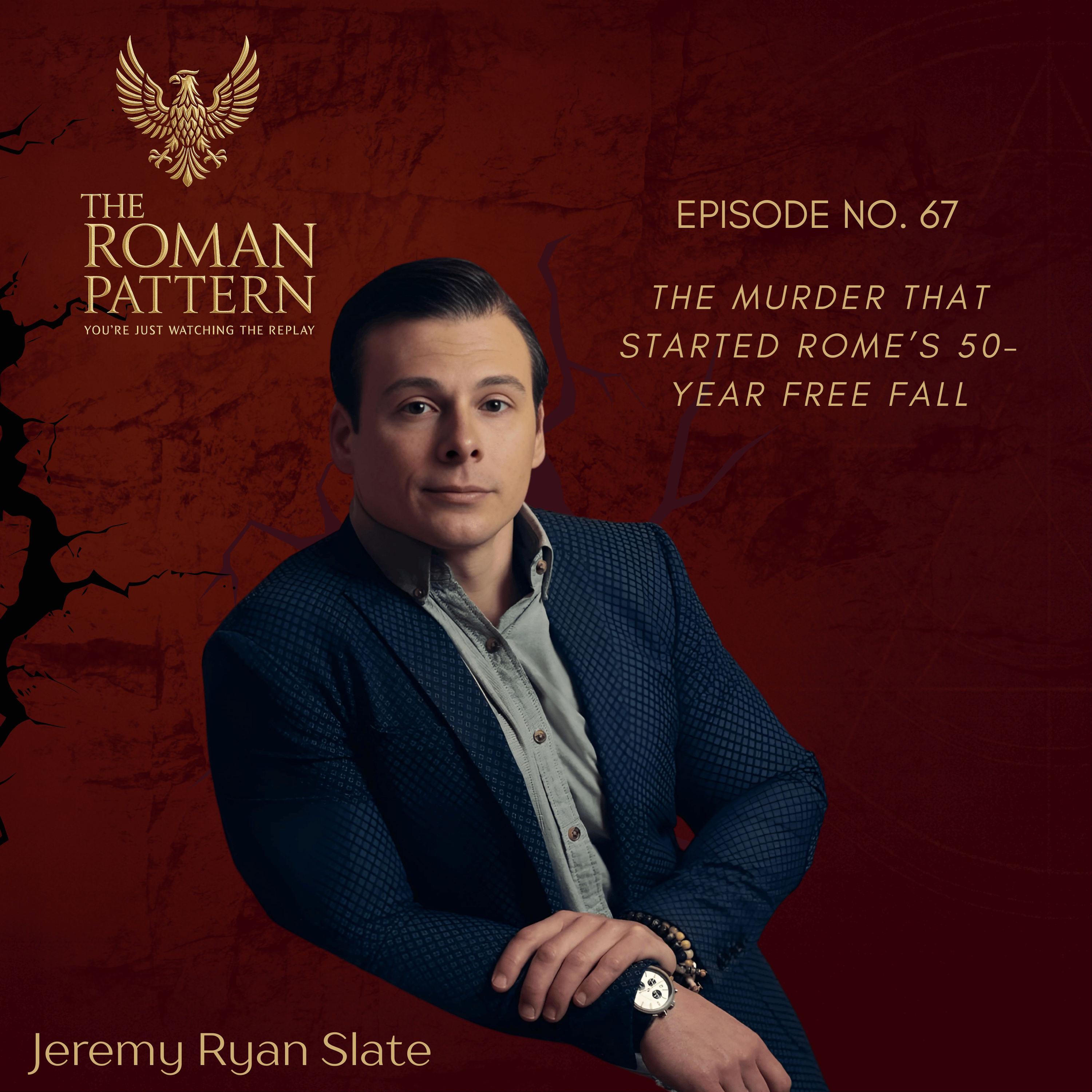
In March of 235 AD, the murder of Emperor Severus Alexander sparked the Crisis of the Third Century—a 50-year free fall that nearly destroyed the Roman Empire. It wasn't just an assassination; it was the moment the Roman army realized its true power: if they could make an emperor, they could unmake one.
What followed was a half-century of chaos that redefined the ancient world. This video covers the brutal timeline of Rome’s near-collapse:
• 26 Emperors in 50 Years: The era of the "Barracks Emperors."
• Hyperinflation & Currency Debasement: When silver was washed off copper coins to pay debts.
• Civil War: Rome splitting into the Gallic Empire, the Palmyrene Empire, and the Central Empire.
• The Alemanni Invasion: When the German tribes crossed the Rhine.
This was Rome’s 50-year free fall. And it started because one leader tried to solve a hard border crisis with a soft solution. The Roman Pattern is simple: Under stress, civilizations adapt. But some adaptations hollow out the system from within.
Was Severus Alexander weak? Or did the Roman system destroy itself reacting to him?
History doesn’t repeat. But it does rhyme.
Get every episode summarized
Each time The Jeremy Ryan Slate Show publishes, we email you a written briefing from the transcript — the topics, who appeared, and any specific claims, with the ad reads skipped.
Email me new episodesFree for 3 shows. No card needed.
Hosts & guests
Transcript ready
104 searchable segments. Every word is indexed and playable.
Full transcript
The Jeremy Ryan Slate Show — The Murder That Started Rome’s 50-Year Free Fall. Machine-transcribed; use the interactive transcript above to jump the player to any line.
It is March in the year 235 A.D. We are on the banks of the Rhine River near an outpost of Mogen 18. What you and I would call Mines Germany. The air is freezing, the ground is hard, and inside the Imperial tent a young man is crying in his mother's arms. His name is Severus Alexander. He is the Emperor of Rome, and he is about to die. History often feels like a slow slide. We talk about declines as if they happen over centuries, invisible to people living through them. We think civilizations rot from the inside out, slowly like wood and damp soil. But sometimes the rot explodes. Sometimes the end of an era doesn't take a hundred years. Sometimes it takes a single morning. What happened outside that tent in 235 A.D. wasn't just a mutiny. It wasn't just an assassination. It was the trigger for the most terrifying period in Western history. The crisis of the third century. For the
next 50 years, Rome would not know peace. It would burn through 26 emperors. It would see its currency debased until the silver washed off the copper coins in your hand. It would see hyperinflation hit 15,000%. It would see the empire split into three rival states. It was a 50 year freefall into anarchy. A half a century where civilization almost turned the lights out for good. And it all started because one leader, faced with a border crisis, tried to buy his way out of a problem he should have fought. Welcome to the Roman pattern. I'm your host, Jeremy Ryan Slate, CEO of Command Your Brand. We have our clients to appear on some
of the biggest podcasts in the world. Check us out via the link in the description. And now our story. To understand the murder, you have to understand the victim. Severus Alexander was not a bad man. In fact, by the standards of the time, he was a decent one. He was moderate. He respected the Senate. He wasn't a psychopath like Nero or a gladiator cosplayer like Commodus. But in the Roman pattern, decency is not a survival trait. Competences, strength is. Severus had come to the throne at just 13 years old for his entire reign, the real power lay with his grandmother. And after she passed his mother, Julia, Mamea, now having a dominated mother isn't a crime. But when you are the commander in chief of the most lethal military on earth, perception is reality. Legion's didn't see an emperor. They saw a mama's boy. Rome was a shark. It had to keep moving,
keep conquering, or at least keep winning to survive. The soldiers respected strength above all else. They tolerated Severus because the pay was good, and the borders were relatively quiet until they weren't. In the east, the Persian Empire was rising again, aggressive and organized. Severus went to fight them. The campaign was a mess. Not a total defeat, but hardly a triumph. He returned to Rome claiming victory, but knew the soldiers also knew the truth. They had bled for a stalemate. But the real threat wasn't in the desert. It was in the north. The Alemani, a confederation of Germanic tribes, had realized something terrifying. Rome was tired. They poured across the Rhine and the Danube, burning forts, sacking villages, and threatening the very heart of the Western provinces. This was the moment, the pattern moment. A civilization under pressure
faces a binary choice. Do you project strength and enforce your borders? Or do you try to manage the decline? Severus Alexander marched north to Magantia com with the mighty Legio 22, Remagenia. The Legionaries were sharpening their swords. They were ready for payback. They wanted to cross the river and burn the Alemani Heartland. They wanted blood. But Severus Alexander, well, he looked at the logistics. He looked at the cost of war, and he made a fatal calculation. Severus decided that war was too expensive. Why risk the legions? Why risk a defeat? He opened diplomatic channels with the barbarian chiefs. He offered them gold, lots of it. He essentially offered to pay them to go away. In a modern diplomat, this might sound like de-escalation. It sounds like smart power. Why fight when you can pay? But to the Roman soldier, to the men of the 22nd Legion,
who had seen their families threatened by these tribes. This wasn't diplomacy. This was treason. You have to understand the psychology of the Roman legions. They were the engine of the state. They believed in the Invicta, the unconquered Rome. When they saw their emperor handing over Roman gold, gold that should have been their pay, their bonuses. To the very savages who had been burning Roman farms? Well, something snapped. They looked at Severus and they didn't see a god emperor. They saw a weakling paying protection money. And in the background, a giant was watching. His name was Gaius Julius Varus Maximinus. But history knows him as Maximinus Thrax. If Severus Alexander was the establishment, soft, educated elite. Maximinus was raw, brutal, and the reality of the frontier. He was a thration peasant. He had risen from the absolute bottom ranks, purely on his ability to inflict violence. Ancient sources claim he was over 8 feet tall.
This is likely an exaggeration, but it tells you how people saw him as a monster of a man, a force of nature. The soldiers looked at Severus, cowering his tent with his checkbook. Then they looked at Maximinus, who was wearing the same armor they were, eating the same bad food, and hated the barbarian insults just as much as they did. The choice was easy. On roughly March 18th or 19th, the troops of the 22nd legion stopped taking orders. They marched to the parade ground, they threw off their allegiance to the emperor, and hailed Maximinus as a gustus. Maximinus the peasant giant accepted the purple cloak, and then he gave the order. The end was pathetic. When the soldiers surrounded the imperial tent, Severus didn't fight. He reportedly clung to his mother weeping and blaming her for the decision to pay off the Germans. It was her idea, he cried. The soldiers didn't care whose idea it was. They butchered them both. Mother and son and cut them
down in the mud of a foreign camp. At that moment, the soldiers cheered. They had replaced a weakling with a warrior. They got what they wanted. Maximinus immediately crossed the Rhine and slaughtered the Alamani. He restored Roman pride, but they had opened a door that they could not close. By murdering a lawful emperor, simply because they didn't like his policy, they established a new precedent. The emperor is not chosen by the senate. He is not chosen by the gods. He is chosen by the army. If the army can make an emperor, the army can unmake him. This was the spark for the crisis of the third century. Over the next 50 years, the Roman Empire tore itself apart. Maximinus lasted three years before his own troops killed him. The next guy, well he lasted months. In the year 238 alone, there were six different emperors. Every general in the frontier looked at Maximinus and thought, if that peasant can do it, why can't I? Civil war
became the permanent state of the empire. And civil war is expensive. To pay for these constant wars, to buy the loyalty of the troops, each emperor did the only thing that they could think of. They debased the currency. Under Severus Alexander, the gold coin, the Antoninianus was about 50 percent pure. It was real money. By the time the crisis ended, 50 years later, that coin was 5 percent silver. It was a copper slug dipped in a silver wash. Imagine your savings account losing 95 percent of its value in a generation. Prices in Egypt, Rome's bread basket, went vertical. We have records of wheat prices skyrocketing. By the year 284, we are looking at inflation calculations hitting 15,000 percent compared to the start of the century. The economy ceased to function. People stopped using money and went back to barter. The complex trade networks that bought pottery from gall to Syria or oil from Spain to Britain, well, they collapsed. Rome became
a collection of walled cities afraid of the dark, afraid of the roads, afraid of their own armies. The empire literally broke into three pieces. It took the superhuman efforts of Aurelian, the restore of the world to sit it back together. But the Rome that survived the crisis of the third century was not the Rome that entered it. The optimism was gone. The civilian government was dead. Rome was now a military dictatorship forever looking over its shoulder, forever waiting for the next general to march on the capital. So why does the murder of a 26 year old man in a tent in Germany matter to you today? Because the Roman pattern is clear. Severus Alexander tried to solve a hard reality, a border crisis with soft solutions. He thought money could be a substitute for strength. He thought he could pay the barbarians to be nice. Well, he was wrong. Weakness is provocative, but the reaction to his weakness, the embrace of the strong man, the rejection of
the rule of law in favor of raw force, was indefinitely worse. We live in a time of currency instability. We live in a time where borders are suggestions, rather than lines on a map. We live in a time where the political center is seen as weak, and the fringes are sharpening their knives. The crisis of the third century teaches us that civilizations are fragile. It takes centuries to build the trust, the trade, and the currency that makes a society work. But it only takes one morning, one bad decision, and one sharpened blade to bring it all, crashing down. Rome survived the freefall, but it never fully recovered its soul. The question is, when are freefall starts? Will we even notice the moment that the knife goes in? This has been the Roman pattern. I am Jeremy Ryan Slate. Remember to like this video, leave us a comment, and smash that subscribe button if you want more of the Roman pattern.
More episodes
More from The Jeremy Ryan Slate Show

Spartacus: The Slave Revolt That Set Up Rome's Collapse
The Jeremy Ryan Slate Show

Sulla: The First Man to Break Rome
The Jeremy Ryan Slate Show

The War Rome Almost Lost to Its Own Allies
The Jeremy Ryan Slate Show

What If Aurelian Never Died? The Rome That Never Fell
The Jeremy Ryan Slate Show