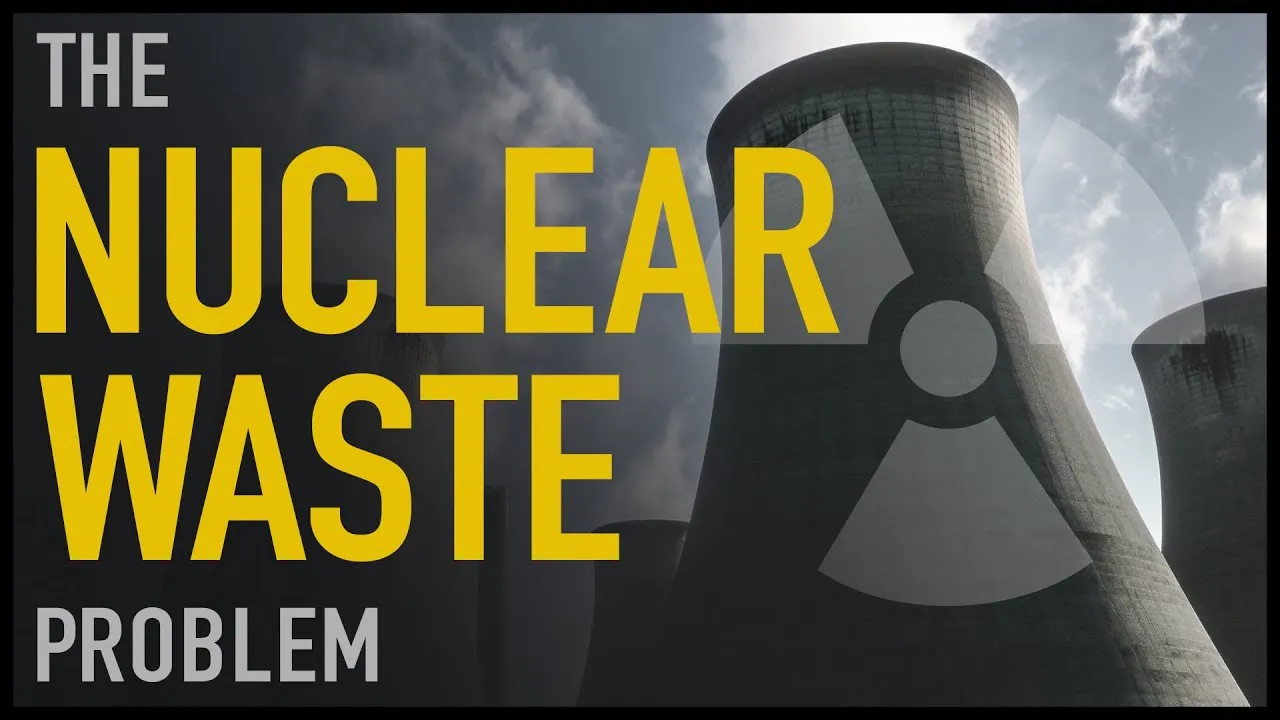
About this episode
Wendover Productions is made possible by:
Get every episode summarized
Each time Wendover Productions publishes, we email you a written briefing from the transcript — the topics, who appeared, and any specific claims, with the ad reads skipped.
Email me new episodesFree for 3 shows. No card needed.
Transcript ready
199 searchable segments. Every word is indexed and playable.
Full transcript
Wendover Productions — The Nuclear Waste Problem | Wendover Productions. Machine-transcribed; use the interactive transcript above to jump the player to any line.
This video was made possible by Brilliant. Learn to think like a scientist for 20% off by being one of the first 500 people to sign up at the link in the description. Nuclear energy is one of the cleanest, most efficient, and most available sources of power on Earth. To generate one kilowatt hour of energy, the amount an American household consumes in 48 minutes, nuclear power plants only emit 12 grams of carbon dioxide, enough to fill about 3-2 liter soda bottles. Meanwhile, to produce the same amount of energy, coal plants emit 820 grams of CO2, about a full bath tub's worth. Factoring in the environmental cost of production, nuclear energy is clearer than hydro power, than geothermal, than solar, than really any energy source except wind. But that doesn't necessarily mean nuclear is the long-term solution for the world, because nuclear material is perhaps the most poisonous substance on Earth. Two times in history have nuclear power plants leaked significant amounts of radiation.
In 1986, in Chernobyl, Ukraine, and in 2011, in Fukushima, Japan, 31 people died in Chernobyl, with at least a further 4,000 expected to contract early lethal cancer due to radiation. Fukushima is better contained with only two deaths, both unrelated to radiation, and only 130 early cancer deaths expected. But additionally, each site still today has massive exclusion zones where humans cannot live due to ongoing radiation. Hundreds of thousands of people were displaced from their homes and will never be allowed to return. The economic damage of Chernobyl is estimated at nearly $250 billion, significantly more than the GDP of Ukraine. The Fukushima disaster, meanwhile, having taken place in a much more populated and developed area, is expected to set Japan back over $500 billion. A full 10% of their GDP. In addition, uranium, the element most commonly used in nuclear reactors,
is not in limitless supply. Using present-day extraction methods, there's only about a 230-year supply of uranium left. Many would say nuclear is only a short-term solution to reduce carbon emissions until truly sustainable energy can become commonplace. But the biggest problem with nuclear energy is not the risk of meltdown, it's not the supply of uranium, it's this. Nuclear waste. All current commercial nuclear power plants work through the process of nuclear fission. As a radioactive element decays, the individual atoms split into two, but when that happens, the reaction also releases energy. There are plenty of different designs of nuclear reactors, but in general, they capture the released energy by using it to heat up water in steam, which runs through turbines that spin generators. The nuclear element used is typically uranium, which, after about six to eight years of usage in a nuclear power plant, will have released enough of its energy that it is no longer useful in nuclear reactors, but that doesn't mean it's done emitting energy.
The fuel rods will remain radioactive enough to emit a lethal dose for tens or hundreds of thousands of years past their removal. So the question is, what do you do with them? The answer is simple, put them somewhere where they can stay, undisturbed, isolated, forever. But that's not all that easy. In fact, no nuclear waste worldwide is currently in what is considered long-term storage. Every bit of nuclear waste in existence is in temporary storage facilities to be used until a long-term solution is built. Most of that nuclear waste is stored in pools of water. Water does a decently good job of shielding radiation, so this is an inexpensive and easy way of storing the rods. Usually, these pools are physically inside the nuclear power plants, so when spent fuel is removed from the reactor, it's put directly into the water and left there. The radioactive material, since it's still emitting energy, continues to heat up the water, but cooling systems and pumps keep the water below boiling temperature.
But to do that, the plant needs power. If the power fails and the backup generators fail, the pumps and cooling systems stop working. So the water heats up and can boil off. The water is what blocks the radiation, so, without water, the radiation just goes right out into the environment. In fact, exactly that happened at Fukushima. Both the primary and backup power sources failed, so the pumps and cooling systems for the spent fuel pools couldn't run leaving the water to heat up. The situation was brought under control before enough water had boiled off to release significant amounts of radiation into the environment, but had it not been, thousands could have been killed. Once nuclear waste has cooled down in storage pools for 10 to 20 years, it typically is encased in casks. These concrete and steel containers block in radiation, but this solution is far from permanent. It does not consider earthquakes, it cannot withstand tsunamis, and it would not work without humans. These casks require security and they require maintenance.
Without humans, they could easily be damaged or breached over time and release radiation into the environment. Modern humans have only existed for about 200,000 years, so one can hardly be sure that the species will survive for the millions of years that the toxic nuclear waste will continue to emit radiation. What's more, one can hardly expect that the dominant civilizations that have nuclear technology today will continue to exist for even thousands of years. The Roman Empire was once without a doubt the most powerful civilization on Earth. Scholars even believe that it is the most powerful civilization to have ever existed on Earth, more powerful than the US, than Europe, than any modern civilization, but it fell and so too will the West. Therefore, long-term nuclear waste storage needs to last longer than any political structure, it needs to work without the supervision of humans, it needs to be truly and unequivocally permanent. Finland is building just that. This region is largely devoid of natural disasters,
it doesn't have earthquakes, it doesn't see tsunamis, it really doesn't encounter any natural phenomenon that could damage a nuclear waste storage site, especially if it's 1,500 feet underground. Beneath an island on the Finnish Baltic Sea coast, the country is digging. They're building the very first permanent nuclear waste storage facility in the world in the stable bedrock 1,500 feet below. Currently, they're just finishing their dig down, then very soon, in 2020, they'll start filling the facility with nuclear waste. They'll dig long tunnels with small holes in which they'll place casks of nuclear waste, and backfill the tunnels with clay to be left for an eternity. With this system, there's near-zero risk of nuclear material leaking out into the groundwater, and once it's filled in the year 21-20, it can just be left forever. Because the material will be so far down and so difficult to get to, no human management will be necessary once completed. No security, no maintenance, nothing, which means it should be truly secure. But before leaving it, they do need to fight against one thing,
human nature. As curious beings, it's hard to combat a person's urge of discovery. If someone finds a mysterious structure from thousands of years ago, it'd just be natural to want to open it up, and that's a problem for nuclear waste sites. We essentially did just that with the pyramids in Egypt. These structures were built as the final, permanent resting places for the elites of Egypt, and we opened them up because we were curious. Opening the nuclear storage facilities would release radiation into a future civilization, so we have to tell them to leave the sites alone, but that's easier said than done. The US Department of Energy commissioned a study on how to communicate the danger into the far future. The key is to create a message that conveys how uninteresting, how unimportant, and how dangerous nuclear waste is. They settled on the following text. Sending this message was important to us. We considered ourselves to be a powerful culture. This place is not a place of honor, no highly esteemed deed is commemorated here, nothing valued is here.
What is here was dangerous and repulsive to us. This message is a warning about danger. The danger is in a particular location. It increases towards the center. The center of danger is here. Of a particular size and shape, and below us. The danger is still present in your time as it was an ours. The danger is to the body, and it can kill. The form of the danger is an emanation of energy. The danger is unleashed only if you substantially disturb this place physically. This place is best shunned and left uninhabited. The idea would be to translate a message like this into every United Nations language, Arabic, Chinese, English, French, Russian, and Spanish. There's a reasonable hope that, at least in the next couple thousand years, one of those languages would be understood. But in the scope of hundreds of thousands of years, there's just little expectation that these languages would survive. There's not even a reasonable expectation that humans will survive. So you need to convey the same message without language.
What the study suggests is to further push the message by building a landscape that conveys danger. It could be a scene of thorns or spikes or forbidding blocks. To satiate the discover's curiosity, it's also suggested to add monoliths explaining the history of the site through pictographs. Also included would be images like this, engraved in stone, conveying that the substance has danger that would be passed onto humans if touched. But the difficulty of this is that it very well might not be humans exploring Earth 100,000 years from now. It could be a species that doesn't recognize the likeness of what might be a long, extinct species. What some have suggested is to just let the site be forgotten, to not mark it at all, to just seal it up and leave. But having something that significant disappear isn't simple. The site in Finland is designed to not need security or oversight, but its current location is very well documented in a potentially irreversible way. With books and brains in the internet,
records of the site might exist until at least the end of human civilization. To truly be forgotten, to truly be left as part of nature, so too must humans be forgotten. If you want to learn about clean energy or anything else, you should try Brilliant. They have a fantastic course on solar energy complete with approachable explanations, straightforward graphics and thought-provoking puzzles. I've really been enjoying Brilliant because their courses do a great job of providing an overview of complex topics in a way that anyone can understand. As a Wendover Productions viewer who enjoys learning or is serious about science, Brilliant's interactive puzzles will help you explore all kinds of interesting stuff. If you want to check them out, head over to Brilliant.org slash Wendover. The first 500 who do and sign up will receive 20% off. I absolutely suggest that you give Brilliant a try because it's truly a great website, and doing so helps make Wendover Productions possible.
More episodes
More from Wendover Productions

The Logistics of German Reunification | Wendover Productions
Wendover Productions

The 8 Flights That Show How COVID-19 Reinvented Aviation | Wendover Productions
Wendover Productions

TWL #5: Timekeeping on Mars | Wendover Productions
Wendover Productions

TWL #10: The Day Sweden Switched Driving Directions | Wendover Productions
Wendover Productions