About this episode
Marketplace is made possible by:
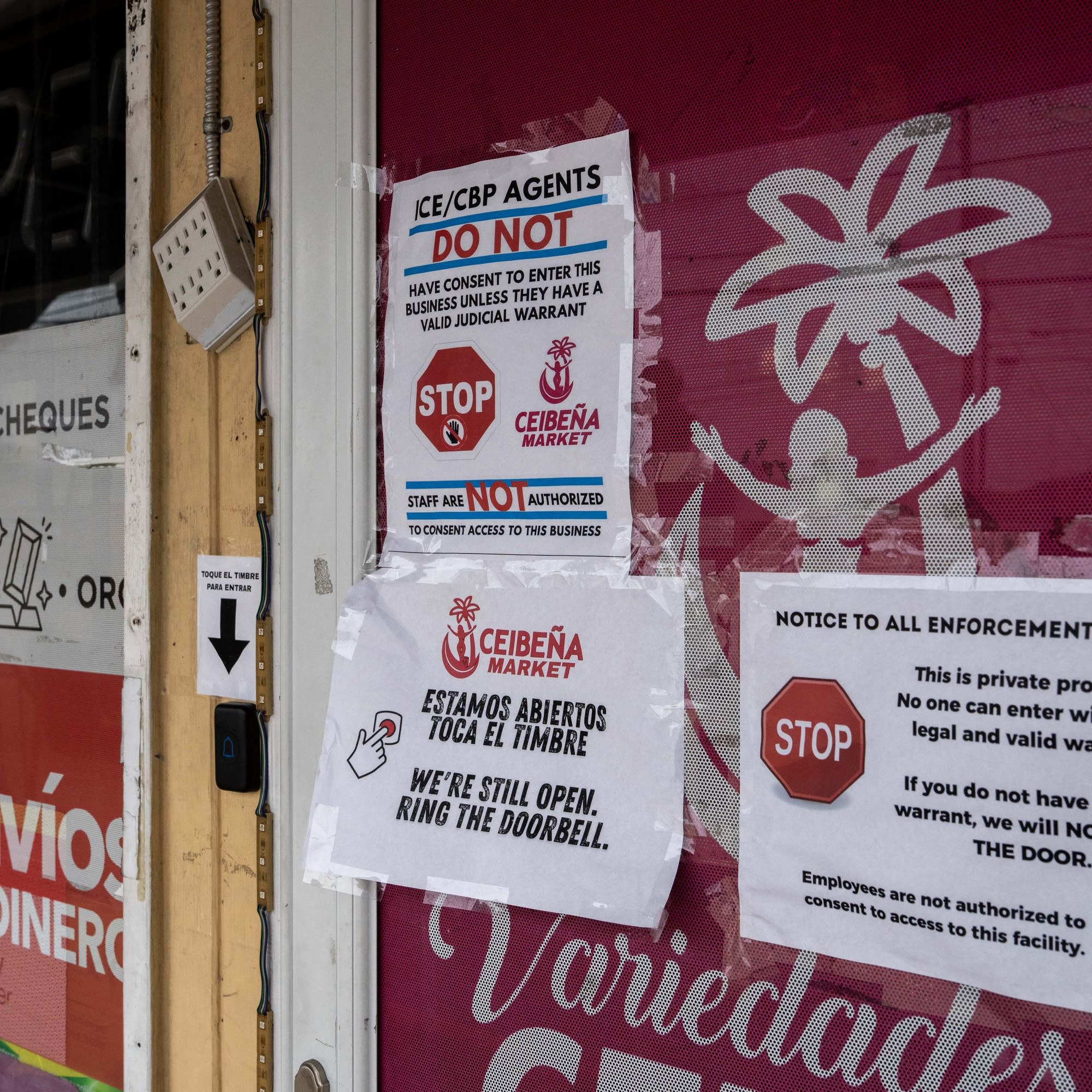
It’s been more than a year since the Trump administration intensified ICE raids in immigrant communities across the U.S. Latino entreprenuers say the toll on their businesses has been worse than the pandemic. In this episode, the ongoing economic harm caused by Trump’s relentless deportation agenda. Plus: Small businesses grapple with more tariff uncertainty, Canada posts strong GDP growth, and we break down Fed Chair Kevin Warsh’s first Jackson Hole speech.
Every story has an economic angle. Want some in your inbox? Subscribe to our daily or weekly newsletter.
Marketplace is more than a radio show. Check out our original reporting and financial literacy content at marketplace.org — and consider making an investment in our future.
Read the stories in today’s episode:
- Was that forward guidance we just heard from the Fed Chair?
- Canada's economy is growing as it heads to a trade war with the U.S.
- Tariff uncertainty means halted production for this camping chair company
- Immigration enforcement leaves Latino businesses struggling for months
- How a 21-foot-tall space cowboy has revitalized a strip of Route 66
Get every episode summarized
Each time Marketplace publishes, we email you a written briefing from the transcript — the topics, who appeared, and any specific claims, with the ad reads skipped.
Email me new episodesFree for 3 shows. No card needed.
Hosts & guests


Transcript ready
227 searchable segments. Every word is indexed and playable.
Full transcript
Marketplace — The ongoing cost of ICE raids on Latino entreprenuers. Machine-transcribed; use the interactive transcript above to jump the player to any line.
Running a business is hard enough, so why make it harder with a dozen different apps that don't talk to each other? Introducing ODO. The only business software you'll ever need. It's an all-to-one fully integrated platform that makes your work easier. From CRM, accounting, inventory, e-commerce, and more. And the best part, ODO replaces multiple expensive platforms for a fraction of the cost. This is why over thousands of businesses have made the switch. So why not you? Try ODO for free at odu.com. That's odu.com. Riddle me this is an outline the same as a trail map, the same as forward guidance from American public media. This is Marketplace. In New York, I'm Kristen Schwab and for Kyra's Doll. It's Friday, August 28th, and it's great to be here with you. When some people picture Jackson Hole Wyoming, they think beautiful mountains and wildlife.
When we picture Jackson Hole, we see Kevin Warsh in a suit talking economic policy. The Fed Chair gave a 30-ish minute speech this morning about AI, the job market, and inflation. And we're going to take some time now to sort it all out. Catherine Rampella is at the Bullwork and MS now. Stacey Vanick Smith is at Bloomberg. Hey you two. Hey, Chris. Hey. I want to start with how Warsh more or less started his speech today or how he set up his speech. Let's give it a listen. You can call it an outline. Call it a trail map. But please just don't call it forward guidance. Stacey, I alluded to this in the top of the show. I'm not sure I really understand the difference between these words, but I'm wondering what you would call the kind of information Warsh gave us this morning. Well, I really appreciated the trail map because I feel like it's very on-brand with Jackson Hole and the great outdoors. It was forward guidance of a sort. I think maybe, I mean, the market certainly reacted that way.
Interest rates rose on his speech. It certainly reacted as if it were forward guidance. It may be that he's just signaling that his style of forward guidance is going to be different, that the market's not going to get as much transparency, as much information, as much disclosure as it did under Ben Bernanke, Janet Yellen and Jerome Powell. So it may be that he's easing us off of forward guidance, but this definitely seemed forward guidance adjacent, if not, full on forward guidance. Catherine, what about you? What do you think about Warsh cracking the door open this morning? Well, markets certainly heard the speech as hawkish. I mean, I don't know if I would call it forward guidance or anything else, but he talked about how inflation is above target, which everybody obviously knew. But also indicated that he did not think that financial conditions were particularly restrictive right now, which implies at the very least that he thinks maybe they need to be tighter.
And if you look at how markets reacted, the chance of a rate hike at their September meeting went from something like 35% yesterday to 60% today. So again, they markets clearly heard this as hawkish. I don't know if Warsh intended it to be because as Stacy pointed out, he kind of doesn't want to sound like anything right. He doesn't want to, he doesn't want to indicate one way or another where he is heading. But markets seem to hope at the very least that this is the plan for getting inflation under control. Yeah, you know, Stacy, another thing I picked up on this morning is that, you know, the word transitory is a very scary word we don't like to use anymore. Warsh has started using the phrase upside down or upside, sorry, inflation risks. Is there a difference difference here and does history matter? I think there is a difference and it is funny every Fed, every Fed share comes in with different turns of phrase that they like to use.
Upside inflation risk is essentially just, you know, a chance that inflation is going to come in higher than we expect. Whereas transitory was more like, oh, don't worry, this is going away. This is not a fundamental, nothing fundamentals happening that's raising prices. This is just, you know, supply chain snags in the case of the pandemic. Today, when he mentioned upside inflation risk, he was talking about commodity prices specifically. So I took that to mean oil and Iran. So it may have been signaling, you know, there's a conflict with Iran. It's pushing up oil prices, oil prices can push up everything, but hopefully that will be resolved soon. Although now, you know, we've got a potential trade war in the works with Canada, also a huge supplier of oil and natural gas, especially to us. So I don't know, upside inflation risk to me. It just, I, it's signaled to me that he was just warning like inflation might come in higher than we want. Gotcha. Katherine, I want to talk about a piece you wrote this week on how Wall Street seems to have soured on Vessent and Warsh already.
What signs of uneas are you seeing and why should we care? Well, both of these men came in and were chosen because markets trusted them. There are a lot of other, shall we say, unconventional picks. People in the Trump cabinet and throughout the administration, these two had relatively traditional CVs. They've both taught, lectured at elite institutions. They both worked on Wall Street. They were people that markets trusted because, you know, there's a lot of money at stake. I don't tell our listeners that what seems to have shifted particularly with Vessent is that markets, I think, based on at least bond market behavior, do not seem to trust that he necessarily knows what he is doing, or at least that he will be as effectual as he thinks he will be. In case in point being his recent announced buyback bond, buyback plan, which was clearly intended to reduce long term bond rates and instead ended up pushing them up a little bit higher because market participants seem to see through the fact that like this was too puny of an action to actually make a difference in the grand scheme of things for why long term bond yields were going up.
That inflation, you know, private companies issuing bonds to finance AI investments, etc, etc. So it does seem a little bit like he has less control. And likewise, if you looked at market reaction after Kevin Worsh's most recent press conference, not the Jackson whole speech today, but it definitely bond rates as well went up. Even though he did not seem to indicate that they were about to raise rates. So it just seems like where they would like markets to be going has become a little bit unmoored from where markets are going. And I wonder if that signals a deeper distrust of economic leadership and the ability for these two men to achieve the tasks at hand, i.e. getting back to stable prices and making sure that we have smooth functioning financial markets. More to come. Catherine Rampello is at the bullwork and MS now. Stacey Vanick Smith is at Bloomberg. Thanks again you too and have a good weekend.
Thank you to. Wall Street today saw a rate hike in its future. We'll have the details when we do the numbers. We got some updated GDP numbers this morning, not for our economy, but for our neighbors to the north. Canada's gross domestic product grew 3.3% in the second quarter. The strongest growth the country has seen since 2023. Now it's not every day we make a big fuss about the performance of Canada's economy, but this has not been a typical week in US Canada relations. Trade talks between the two countries fell apart last weekend. The US announced 50% tariffs on about 20 billion dollars of Canadian imports on Monday.
And Canada fired back with an equal amount of tariffs on US products the next day. Marketplaces Henry App reports on how stronger economic growth could help Canada withstand a trade war. Canada's economy basically stalled out when President Trump first started threatening to put huge tariffs on the country's exports last year and it stayed that way. Says Doug Porter at the Bank of Montreal. And I mean basically zero GDP growth starting at the end of the first quarter of 2025 to the end of the first quarter of 2026. Uncertainty around the trade relationship with the US caused Canadian businesses to pause capital investments says Nathan Janssen at RBC economics, but they couldn't hold off forever because eventually businesses have to replace equipment. So I think we're seeing some of that investment come off the sidelines. Plus Canadian consumers spent more and Janssen says the build out of AI data centers is expanding north of the border. Overall Canada saw a pretty broad economic rebound in the second quarter and that could give Canadian leaders a psychological boost says Julian Caragessian at McGill University.
The stronger growth in the midst of 18 months of trade tensions I would say gives them some courage to stick to their guns and negotiations one other positive in Canada's second quarter exports most of those go to the US Caragessian says especially oil and natural gas but a growing share heads to other countries and that's by design. The government of Canada is laying the diplomatic foundations or expanded relationships with Europe and with the entire global south and lessening its reliance on exporting to the US and Henry app for marketplace. Whether it's trade policy between the US and Canada or trade policy between us and really any other country at this point it seems fair to say that tariffs are the Trump administration's tool of choice.
And I know sometimes it might feel like okay Kristen another day another tariff but for small business owners another day another tariff has the power to unravel plans. Ben Nepler is the co founder of true places a company that makes camping chairs they're based in the US but their production and supply chains are overseas which means Ben has been navigating the tariff situation for over a year now. Ben it's great to talk to you. It's great to talk to you again. So the last time you and I chatted the future of your business was pretty uncertain to the point where you stopped production of your chairs because you couldn't afford to pay the tariffs on them. What's happened since then? Yeah we're still in the same kind of position we stopped production like you said. We went through many months of just trying to keep the business alive which fortunately we've been able to do but we haven't been able to produce again so we had to cut everything back all payroll including ourselves.
Hopefully we can get back to growth in the future but at the moment there's just so much uncertainty that we're not able to do that. We'll get to the business stuff in a second but how are you doing? I imagine that takes a toll. Yeah it's very difficult. It's almost like going through different stages of grief. I'm still personally very angry but really just sad for my business but we're one of thousands, tens of thousands. And lots of people around the country so I'm sad for the country and the economy as a whole. Yeah I did notice you have some chairs though for purchase on the website so how are you able to stock up a bit? Yeah a very limited number. We had a few extra chairs that just needed one final part that we were able to get and we've been able to make those chairs available but it's really like a very small number.
We're not able to produce normally again anytime soon. So how long now have you been in this limbo waiting period? It's really been about a year and so since then we've just been focused on survival mode. We've just been trying to keep the business alive but as I said last time that we do almost everything in the US. Everyone that we work with who's involved in all of those activities we've just kind of cut back and stopped and so it really does have even though we're very small these ripple effects through through the economy. What about changing your supply change or is that kind of a moot point of an idea at this at this stage? I mean that's what we already did. We spend about 12 months moving or manufacturing out of China and into Cambodia.
That's not something that's very easy to do. It takes a long time. It is very very costly especially for a small business and most significantly you don't know if the rules are going to change again. It's very difficult to make those kinds of longer term investment decisions when the goal posts are constantly changing. How do you make some of those decisions and where do you see your business going? Yeah it's really really difficult and when we don't even know what the taxes are going to be tomorrow let alone in three or four months it's very difficult to justify to ourselves making the decision to produce. Ben Nepler, he's the co-founder of True Places in Pennsylvania. Thanks again for chatting Ben. Thanks so much.
I'm coming up. So I thought oh my gosh a space cowboy would be perfect. I mean when is a space cowboy not perfect but first let's do the numbers. The Dow Jones industrial average slid just nine points essentially flat to finish at 53,559. The Nasdaq lost 138 points a half a percent to close at 26,402 and the S&P 500 fell 19 points of quarter percent ending at 77,11. For the week the Dow gained half a percent the Nasdaq picked up 8,10% the S&P 500 also up half a percent. Heading into the weekend to the national average for a gallon of regular gas is $4.08 down a penny from a month ago according to AAA. A gallon of diesel will run you $5.61. Bonds fell the yield on the 10 year T-note rose to 4.72% you're listening to Marketplace.
Vantage score. The modern credit score used by 3,700 institutions including nine of the top 10 banks. Using over 400% more data than legacy credit scores and built with trended and alternative data, Vantage score is more predictive, scoring 33 million more consumers than conventional credit scores. Now accepted by Fannie Mae and Freddie Mac for conforming mortgages, Vantage score 4.0 safely unlocks approximately 2.7 million new mortgages and up to $1 trillion in new loans. Better credit score, better data, better mortgage decisions, Vantage score.com. Running a business is hard enough so why make it harder with a dozen different apps that don't talk to each other? Introducing Odo, the only business software you'll ever need. It's an all-in-one fully integrated platform that makes your work easier. From CRM, accounting, inventory, e-commerce and more. And the best part Odo replaces multiple expensive platforms for a fraction of the cost. This is why over thousands of businesses have made the switch. So why not you? Try Odo for free at Odo.com. That's Odo.com.
AI is only as smart as the data it's built on. When it comes to your e-commerce business, you don't need a general purpose tool. You need an all-in-one intelligent shipping platform built to optimize your workflow and help you make smarter decisions. That's Shipstation. Powered by specialized AI trained on decades of data from billions of worldwide shipments, shipstation simply adapts to your business. It alerts you when stock is low. Recommends the best pre-negotiated carrier rates and automates everyday tasks to effortlessly save you time. With inventory sinking across sales channels and a branded returns portal, Shipstation handles the heavy lifting, keeping you in control, shipping made smarter. The sooner you switch, the sooner you start saving time and money. Get started with Shipstation today and get 60 days free at Shipstation.com with code marketplace. That's Shipstation.com. Code Marketplace. Shipstation.com. Code Marketplace. Taxes and fees apply.
This marketplace podcast is sponsored by the University of Illinois Geese College of Business. For many, the next step in their career is an MBA. But finding the time and budget can be a challenge. The University of Illinois Geese College of Business offers their online MBA, the I MBA. It's fully online, flexible and delivered at a fraction of the cost of a traditional MBA. Students get the same world-class Illinois faculty and an interactive global network all designed to fit their lives. To learn more about the Geese I MBA, visit onlinemba.illinois.edu. That's onlinemba.illinois.edu. This is Marketplace. I'm Kristen Schwab. Immigration enforcement rates have many impacts. Of course, on families, also businesses. Targeted communities often see an immediate drop in foot traffic and in turn, a drop in revenue. But months later, those problems continue to hurt entrepreneurs.
That's according to a recent study by UCLA that tracked how immigration rates in Los Angeles have hurt small businesses. And as Marketplaces Elizabeth Trowall reports, the problem isn't isolated to LA. Juan has run this tireshop for three decades in Houston's East End, a historically Latino neighborhood. He's never seen businesses bad. He calls it a crisis. Juan asked to use his first name only. He's afraid immigration might target his business. He calls this. He works for a session. He's experienced since he immigrated to the US. He missed other decisions, but no, no, no, no, no, extreme. Or now rent and utilities are higher and higher, but immigration policy has slowed foot traffic and demand for tires. People in his community aren't driving less. He says to avoid getting pulled over. And most recently, a fatal shooting by ice of a local community member stopped business in its tracks.
Lodin, so south gado, a dalho was killed near Juan's tire shop earlier the summer. Juan says people are scared. I don't know if it's a Tidumbre. He's offered discounts to bring back customers, but it's tough. He worries he may have to close a shop. It's hard to imagine business bouncing back as long as the Trump administration is in control of immigration policy. In Chicago, small businesses are still recovering from ice raids conducted last year. Hilda Alvarez is with the Illinois Hispanic Chamber of Commerce. T commercial corridors in the city turned into ghost towns almost kind of overnight. And they've had that lasting effect immediately sales revenue dropped. Also the business we have talked to where behind and rent payments for months and inventory bills, right trying to work something out with their utility companies Latino business owners said the economic impact of raids felt worse than COVID.
Because at least during COVID it was there's you know, there's a general kind of effort to restimulate the economy afterwards. The chamber is giving out business grants to help effective businesses stay afloat. And more than a year after immigration rates hit LA County, a mother, Armenta with UCLA says small businesses like food trucks, restaurants and retail shops are still hurting. The struggles include things like fewer customers, but they also include things like people taking on really enormous debt to keep their doors open. She says people are afraid to go out and are spending less money. There's also been pressure on staffing employees afraid to come to work. Employers afraid about their ability to keep their employees safe and their customers safe. Businesses changing their hours either out of fear because there wasn't enough customer base to sustain, you know longer hours in East LA.
Olivia has sold candles and artsy products for four years at her shop, earthy, Corazon. We have like our real hands it that like statues like made of crystals. We have Selena artwork. We have like a mystical loteria deck. She says the neighborhood was much different before the ice rate started. We would be able to walk outside and being our neighborhoods and not have to look twice about what that vehicle looks like. Foot traffic last summer was super slow, she says and over the last year she realized the business wasn't sustainable. So she decided to close the store. She remembers how kind customers wore that last month. I remember a lot of them sharing that like they never seen or experience a place like this. It was definitely a really hard decision to make. A decision she says she probably wouldn't have had to make or not for the immigration rates.
I'm Elizabeth Trollball for Marketplace. All this week we've been bringing you stories from small businesses along Route 66 in honor of the historic highways Centennial. Travelers far and wide have been driving down the 2500 miles of open road to see America from the rear view mirror. And maybe even stop for an attraction or two. My name is Mary Beth Babcock and I am the owner of Buck Adams Cosmic Curios, which is 695 miles from the beginning of Route 66 in Tulsa, Oklahoma.
So I got into retail and as you get older I feel like it hit this moment when my parents they'd always go to antique shops. And I remember kind of drifting off by myself and I saw this giant golden antique cash register and it literally lured me in. And from that moment I was mesmerized. So I went to OSU and got a degree in retail merchandising and I started a shop downtown Tulsa on the old alignment of Route 66. And the building sold rent went up so forced me to make a change. And I said I want to do a retail but something small and 30 minutes later this 1950s PIMCO gas station got posted on Facebook on Route 66 and it was immediate. Owning a shop on historic Route 66 means to me that you have got to get a roadside attraction.
That's part of the fun, part of the lure. And so right off the bat I needed a mascot. So I thought oh my gosh a space cowboy would be perfect. I was introduced to Mark Klein of Enchanted Castle studio who builds these giants, these historic giants that were originally made in the 60s. I gave him a picture of Buck Adams, space cowboy. He sketched him out and now we have a giant. At the end of the day with my giants, stay at the end of the day around $50,000. I sold commemorative bricks. I sold statues like these super cool custom made statues. This was all I'm going to figure this out. Once Buck Adam went up 21 foot tall space cowboy, it was really exciting. The neighbors saw. I've seen so much change in the neighborhood. There was a business next door to me that was a full on transmission shop. He ended up selling the building to an investor and there's four gift shops now in that space.
The fun scene that people come up and taking pictures with him knowing that they're making memories. Like I remember as a child seeing this giant pink elephant water fountain that stuck in my brain forever. So I'm like I know how that impacted me and I hope things like this impact other people and make people smile. Stop be friendly to each other. And also sell some souvenirs while we're at it. That's Mary Beth Babcock owner of Buck Adams the shop and Buck Adams the 21 foot fiberglass giant in Tulsa, Oklahoma. Back in April our reporter David Broncoccio traveled Route 66 to see how the economy has changed in the last 100 years. You can find those stories and our coverage from this week at Marketplace.org.
Too much fed talk today so there's no time for a final note so on to credits. Our theme music was composed by BJ leaderman Marketplace's executive producer is Nancy Fargali. Joanne Griffith is the chief content officer. Neil Scarborough is the vice president and general manager and I'm Kristen Schwab. Have a great weekend. We'll be back here on Monday. This is APM. I'm Lee Hawkins, host of Must Be the Money, a podcast for Marketplace. Each week I speak with inspiring entrepreneurs and business leaders about their lived experiences and they share tangible insights to help guide your path to success. Here from icons like Angelica Nwandu, Van Lathan, Angelie, Matt Barnes and more about how to seize opportunity, manage money and meet challenges with resilience. Listen to Must Be the Money wherever you get your podcasts.
More episodes


