About this episode
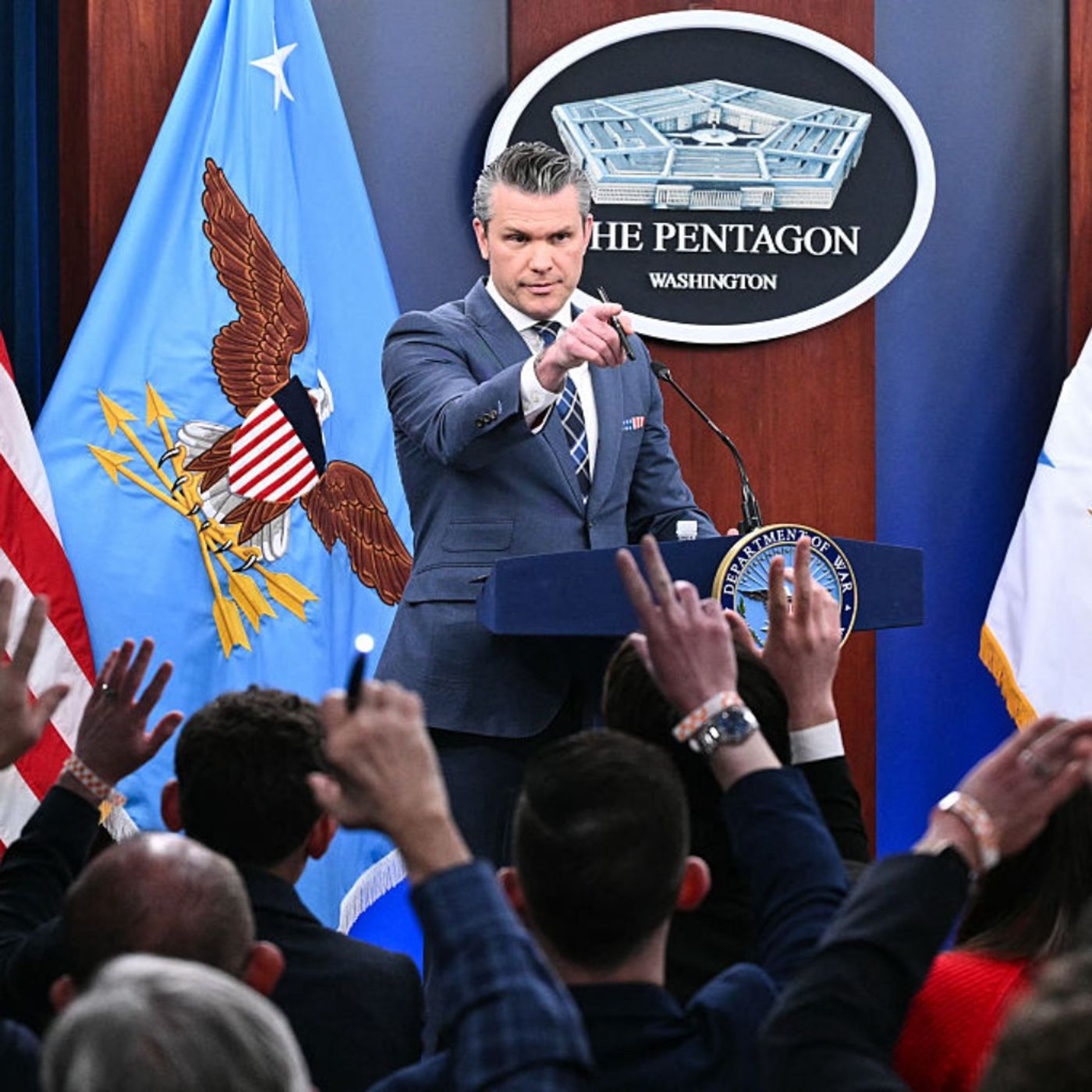
A judge ruled that the Pentagon’s recent restrictions on the press are unconstitutional. On this week’s On the Media, hear how Pete Hegseth’s ever-changing media policies have made it harder to cover military actions abroad. Plus, how a tenacious journalist used access to the Pentagon building to expose war crimes during the Vietnam War.
[01:00] Host Micah Loewinger sits down with Dan Lamothe, who covers the US military and Pentagon for the Washington Post, to talk about leaving the Pentagon press corps alongside reporters from major news outlets in October of last year, after refusing to sign onto stringent new rules on how they could do their reporting.
[09:45] Micah talks with Anna Merlan, senior reporter at Mother Jones, on the cast of right wing influencers and conspiracists now staffing the Pentagon press corps. Plus, Micah interviews content creator Cam Higby, a member of the new press corps, about why he agreed to the Pentagon’s restrictions on access.
[33:23] Micah speaks with Laura Poitras, a journalist and filmmaker whose past works include CitizenFour, All the Beauty and the Bloodshed, and Risk, to discuss her latest documentary, Cover-Up, which chronicles the life of investigative journalist Seymour Hersh and his ferocious drive to uncover government wrongdoing, and what today’s press corps can learn from him.
Further reading / watching:
- “Hegseth order on first Caribbean boat strike, officials say: Kill them all,” by Alex Horton and Ellen Nakashima
- “‘Signalgate’ report contradicts Hegseth’s claim of ‘total exoneration’,”by Dan Lamothe
- “Meet the New Pentagon Press Corps,” by Anna Merlan
- Cover-Up, directed and produced by Laura Poitras and Mark Obenhaus
On the Media is supported by listeners like you. Support OTM by donating today (https://pledge.wnyc.org/support/otm). Follow our show on Instagram, Bluesky, TikTok and Facebook @onthemedia, and share your thoughts with us by emailing [email protected].
Hosted by Simplecast, an AdsWizz company. See pcm.adswizz.com for information about our collection and use of personal data for advertising.
Get every episode summarized
Each time On the Media publishes, we email you a written briefing from the transcript — the topics, who appeared, and any specific claims, with the ad reads skipped.
Email me new episodesFree for 3 shows. No card needed.
Transcript ready
883 searchable segments. Every word is indexed and playable.
Full transcript
On the Media — The Pentagon Kicks the Press Out … Again. Machine-transcribed; use the interactive transcript above to jump the player to any line.
You sit in your air-conditioned offices or up on Capitol Hill and you knit, peck and you plant fake stories in the Washington Post. At a time of war and instability, Secretary of Defense Pete Hegseth loves to lob shots at the messenger. From WNYC in New York, this is on the media, I'm Michael Lohinger. Just at the moment when we need the Pentagon press corps most, they've been replaced with right-wing influencers. Our pumped Tim Poole said, you know, we're not investigative reporters, so just essentially signaling right from the start that they didn't intend to do investigative journalism. Plus, a documentary about Seymour Hirsch, who's lurking in the Pentagon hallways during the Vietnam War, led to the scoop of a lifetime. Instead of going to lunch with my colleagues, I would go find the young officers. Eventually, Army guys just start saying, well, you know, it's murder-incorporated there. That's all coming up after this.
On the media is supported by progressive insurance. Do you ever think about switching insurance companies to see if you could save some cash? Progressive makes it easy to see if you could save when you bundle your home and auto policies. Try it at Progressive.com Progressive casualty insurance company and affiliates. Potential savings will vary, not available in all states. From WNYC in New York, this is on the media. Brooke Gladstone is out this week. I'm Michael Owenscher. Late last Friday, the New York Times scored a win in its lawsuit against the Pentagon. A federal judge has blocked the Trump administration's restrictive Pentagon press access policy, which threatened journalists with being branded security risks if they seek information not authorized for public release. The Times had argued that the policy, which they claimed violated the first and fifth amendments, allowed the Defense Department to freeze out reporters or outlets whose coverage it didn't like. The government disputed that characterization, calling the policy necessary for national
security. Unsurprisingly, the Pentagon plans to appeal the ruling. They also appeared to borrow a tactic from Donald Trump's recent Kennedy Center debacle. When in doubt, throw them out. A spokesman said yesterday an area of the building known as correspondence corridor, which reporters have used for decades to cover the DOD, will close immediately. So at a time of war, the Department of Defense is removing media offices from the Pentagon. A spokesperson for the New York Times said the new policy does not comply with the judge's order, and the newspaper has filed a new motion this evening to compel the Defense Department to do so. In addition to the correspondence corridor closing indefinitely, the Department said reporters will be moved to an annex off site. The location of the annex is yet to be determined. This Pentagon's fight with its dedicated press corps came to a head last fall. When the new policies, later challenged by the Times and others, caused the majority
of mainstream outlets to hand in their press passes and leave the building on mass. In December, I spoke to Dan Lamath, who covers the US military and the Pentagon for the Washington Post, to ask him about having to leave the building at the heart of his beat. It had kind of a surreal feel. And for me, it kind of came in waves back in March. They revoked the specific desk that the Washington Post had, along with several of their outlets. So I cleaned out my desk way back then. But my last day was actually the day before you saw a lot of the other reporters walk out, ironically, because I was asked to go up to New York City for a press freedom dinner with some other Washington Post people. So yeah, I had to turn in my badge, say my goodbyes, I took a photograph in front of the steps in the Department of Defense sign that was up at the time. And yeah, I haven't been back in the Pentagon since October 14, 15th. The rules around reporting there have been changing for a while.
There were already areas of the building that you couldn't visit without an escort, right? I'd heard that maybe the McDonald's was off limits. There have always been parts of the building that were off limits. The hallways are kind of common spaces. And then there are locks on many rooms in the building. And then there are places where we are openly welcome and invited. It would not be uncommon for me to walk 10 minutes to get to the army because the buildings that big and drop in on army public affairs, or walk across the hallway and go see the joint staff. There were places that had been welcoming and accepted spots that the media would go. Over time this year, they had restricted those spaces, basically down to the office space where they specifically were the press sat, the adjacent office where the public affairs officers specifically for headsets teams sat, and the briefing room when it was actually unlocked, which was rare, because they didn't really brief.
So you're kind of restricted down to 5%, 10% of the building. And as recently as a year ago, we probably had access to 70% of the footprint, something like that. Why do you think they had been shutting off your physical access to so many of these spaces? For a lot of years, we had people running the Pentagon from both parties who kind of often had spent time around it previously. There's sort of an expertise there. There's sort of a lived experience there where you're like, all right, I'm used to seeing a reporter around the corner when I'm in the hallway. And I think this team came in with a different set of experiences. They had not been around the Pentagon nearly as much, and they seemed to take exception right away to the idea that the media would be so co-located with them. During your time at the Pentagon, how often would you get a good story, a good scoop, a good lead from just walking around and talking to people?
Did that access translate to good journalism? Being in the building was helpful for building relationships, which come in really handy on these contentious stories, by the way. When you actually know somebody and have talked about their kids playing Little League, and now you got to deal with a difficult story the following day, that helps. But rarely do you ever get pulled aside in a hallway, and some big secret is spilled to you. There's times where they'll be like, hey, I might have something for you tomorrow, just by virtue of being in the building, you're in the loop on things that they're already planning to roll out. But it's way more of that than it is state secret, it's getting handed out in line with the McDonald's. Since you've all left the Pentagon, a crop of right wing influencers have replaced you, the new so-called Pentagon press corps. Of course, these influencers signed that agreement from the Pentagon, limiting their access
to different parts of the building, limiting their ability to do certain kinds of reporting, and exchange for access to press briefings. Give me a little bit more information about what exactly they've agreed to. The new restrictions that were presented to the traditional press corps came somewhat out of left field. There had been some thought that they might crack down again after the earlier restrictions on how freely you could walk in the unclassified spaces in the building. But when it actually came to us, for me, the challenge was, if you're asking me to sign upfront an agreement that says, I will not solicit information and not only classified information, but basically anything nebulously stated as defense information. That could be virtually anything, it could be arbitrarily applied, it struck me as problematic ethically and otherwise as a journalist. Basically this said that if you solicited information from a Pentagon worker who was
not authorized to speak or information that was not authorized to be released, then you could lose access to the facilities. You could lose access. There was also vague language in there that felt pretty threatening the sources as well, which is to say, if they spoke to you even about unclassified matters, let's say front-office knife fights between the headset team, like there was a lot of that sort of stuff this year as well. That could potentially get someone fired, prosecuted, disciplined. The concern was at least there that they were going to go after people that were just trying to explain what's actually happening. So I saw that as a concern and I think the issue that wasn't lost on me as we looked at this, if you're going to tell me I can only get information that is coming through certain people authorized to speak and then the people authorized to speak, never brief, never answer a question with any kind of substance. Where's that leave us? What's the point? With all that said, the job this year already had shifted a great deal.
I spend more time on my phone in the evenings than I ever have because you're catching people when they're available. Tradecraft matters a great deal. Right now, I think you have to be careful with how you're speaking to people and protect your sources. You know, you sold her on. You deal with the job as it is. Dan, thank you very much. Thank you. Dan Lamath still covers the US military and the Department of Defense for the Washington Post, but no longer from his booth in the Pentagon. Coming up, we meet the new Pentagon press corps. This is On the Media. On the media is supported by the Stupski Foundation, presenting the new book Control Why Big Giving Fall Short. If you're a regular listener to On the Media, you know, Brooke and I spend a lot of time deconstructing the narratives of power, who holds it, how they wield it, and the systems
that keep it that way. There's a new book that I think is particularly timely. It's called Control Why Big Giving Fall Short. Author Glenn Gallic, CEO of the Stupski Foundation, offers a rare insider view exposing why billionaire and millionaire donors move so slowly while communities battle urgent crises. In Control Why Big Giving Fall Short, Gallic reveals how our philanthropic system and culture encourage excessive donor control and keep over $2 trillion from reaching communities. By prioritizing wealthy donor interests, power, and control, this system doesn't simply slow social progress. It structurally prevents it. If you're interested in how extreme wealth shapes our society and how to fix it, this is a great book to read. Order your copy of Control Why Big Giving Fall Short by Glenn Gallic. That's Control Why Big Giving Fall Short Out Now. Keeping up with this economy matters.
And in a world full of hot takes and noise, marketplace does things differently. I'm Kyle Arrowsdall, the host of Marketplace, a daily podcast that delivers independent award winning journalism dedicated to making you smarter about this economy. You can listen to Marketplace on Spotify. This is on the media. I'm Michael Lohinger. Perhaps the greatest irony about the Pentagon deciding to kick out its press corps and move them to a random annex in 2026 is that the current crop is a pretty friendly crowd. After the mass exodus of the mainstream media, the Pentagon in October gave out press credentials to a group of about 70 people, including Laura Loomer, a far-right activist known to consort closely with the president, James O'Keefe, founder of the Far-right Sting Operation Project Veritas, Matt Gates, the disgraced lawmaker and former attorney general candidate accused of soliciting underage girls, Tim Poole, a far-right vlogger
who inadvertently accepted Russian funding for his YouTube content and outlets like Lindell TV, owned by the My Pillow Guy, Michael Lindell, who lost a lawsuit brought by a former employee of Dominion Voting Systems for defamation over the 2020 election and Gateway Pundit, a far-right conspiracy outlet also being sued by that same former Dominion employee. Anna Merlin covers extremism and conspiracy peddlers as a senior reporter at Mother Jones, so she's more than familiar with a lot of these names. When I spoke to her last December, she told me that just about everyone present in the Pentagon briefing room had happily agreed to the Defense Department's new policies. They're pumped. When these new rules were first announced, people like Tim Poole, he essentially said, you know, we're not investigative reporters, so just essentially signaling right from the start that they didn't intend to do investigative journalism about the Pentagon and the Department
of Defense. Others have said, you know, that these rules are reasonable and that, you know, the previous media and the building wouldn't agree to them just because they were biased against the president. It's what you would expect. The Pentagon's Deputy Press Secretary, Kingsley Wilson, was the person who fielded questions from the new Pentagon core. You reported on Wilson herself earlier this year, calling her, quote, over-internet troll with a long history of bigoted xenophobic and deliberately provocative posting. What did you mean by that? Yeah, Wilson is an interesting figure. She's the daughter of Steve Cortez, a long time Trump advisor. She was 26 years old when she took the job. She's had a lot of different roles in the sort of mega-internet ecosystem, and she spent a lot of time tweeting, a lot of tweets excruiting immigrants and trans people advocating for what she called, quote, zero immigration and mass deportations, the moaning, the quote,
death of the West, the term that is often used by far right activists. She has also made even more wild and bigoted claims, for instance, repeating debunked lies about the lynching death of Leo Frank, a Jewish man who was lynched and murdered in 1915 by a mob in Georgia. She claimed that Frank was guilty for the murder that put him behind bars, something that most modern historians agree was a wrongful conviction. Just to sit on that for a moment, the fact that she's tweeted about this multiple times just raises for me the question, like, what waters is she swimming in? This is the stuff that occupies her attention. It's pretty extraordinary. It claims specifically about Leo Frank are part of some of the sort of deepest and most obscure pool of specifically anti-Semitic conspiracy theories. They are absolutely rancid when they've been used to justify violence against Jewish
communities, which is specifically pretty extraordinary because the Trump administration has cast themselves as a friend to the Jewish people, has put a lot of energy into supposed investigations of anti-Semitism on college campuses. So to install a press secretary in the Pentagon who had made these statements was in and of itself pretty wild. And then I and other news outlets and even some elected officials called on the Pentagon to respond to these comments and they never did. Nothing happened. In 2024, she tweeted, the great replacement isn't a right wing conspiracy theory. It's reality and she posted this over a screenshot of a Bloomberg article about the growth of the U.S. Hispanic population. Tell me about the question that Matt Gates, former member of Congress asked in the briefing. His question is a really good sort of indication of what this new press corps means to do and his presence. Kingsley, if Nicholas Maduro leaves Venezuela today, what role will the Department of War
have in a post-Maduro of Venezuela? It was a question about regime change positioned in a really supportive way. And what sort of response did he get? Well, so what was funny is he actually didn't get a particularly substantive response. Kingsley Wilson said, quote, the department has a contingency plan for everything. We are a planning organization. So with all the access these folks have, you know, and with all the ideological similarities they have to the people running the Pentagon right now, they're still actually not able to get substantive or newsworthy answers to some of these questions. I want to ask you about the question from Laura Loomer because it was quite interesting. She asked about the conflicting plans to, on one hand, cozy up to Qatar at the same time that the Trump administration is attempting to label the Muslim Brotherhood a foreign terrorist organization. Now that the president has started the process of designating the Muslim Brotherhood as a foreign Islamic terrorist organization, will the Department of War still proceed with
selling F-15 fighter jets to Qatar and how will they be able to train Qatar pilots at their air base in Idaho if Qatar is included in the designation? It's not a bad question. I mean, right? Yeah, no. I mean, specifically Loomer's role is going to be the most interesting one in the new Pentagon press corps. Loomer is a very long time anti-Muslim activist. She is extremely vocal about that often in the most inflammatory of ways, and she is well known to be a pretty key presence unofficially in the White House. You know, there is a verb, Loomer, which means someone getting thrown out of their job in the administration because Loomer calls for it, and this happens several times, right? So if there is any kind of oppositional force within the new Pentagon press corps, it might be her, but it's going to be her in the service of promoting conspiracy theories and anti-Muslim sentiments. All of these outlets and personalities that now have credentials, these are people who
have built brands over many years around conspiracy theories about shadowy government plots. It is sort of tying my brain in knots, watching these people in exchange for access to press briefings, agreed and not attempt to uncover government secrets. Like, isn't that their bread and butter that we're being lied to? Yeah, it is super interesting, especially for people who are part of what I would call like the conspiracy media ecosystem for years. They have set themselves up as adversarial to the US government, have suggested that there is a deep state within the government that is working against the American people, you know, that might be depending on how far in the deep end of the pool they are, like actively trying to kill all of us in various ways, and you know, here they are praising the Pentagon, praising the presidential administration, and yeah, agreeing to sign these rules that most reasonable people read and interpreted as agreements not to do investigative work.
And so for me, there is a real question about how their audiences will respond, you know, people who are distrustful of government, people who might be distrustful of politicians in general, how they're going to feel about these outsider media outlets agreeing to take on a really, really, really different role. I'm super curious if this works for them to maintain their audience. Anna, thank you so much. Thanks for having me. Anna Merlin is a senior reporter at Mother Jones covering disinformation tech and extremism. Cam Higby was one of the online personalities who received a press pass last November representing his independent outlet Fearless Media. He has over 760,000 followers on TikTok and over 430,000 on Instagram, where he posts videos of himself debating college students in the style of Charlie Kirk or say railing against immigration. And I'm talking about illegal immigration. I'm talking about all immigration.
It's not racist to not want that. I don't care if you're coming from Europe. I don't care if your skin is wider than mine. I don't care what you look like. We've got who we've got now. We're full. It's not racist to not want that. Higby celebrated his new gig at the Pentagon by taking photos at a desk that he and others erroneously claimed had been occupied by the Washington Post. Higby posted, quote, mainstream media is out and new media is in. When I spoke to Higby last December, I asked him what he thought the job of the Pentagon press corps was all about and how he saw his new role. The primary role is to be the conduit between the United States government, the military portion of the government specifically and the American people. So of course, to push the government on hard issues, especially when they might be misstepping. But what I don't think it is is to wander about the most classified building in the United States and harass every employee you see with the express purpose of extracting state secrets.
harassing employees? What are you referring to? I don't have specific names of people who were doing this, but from what I understand speaking to lots of people within the Pentagon, do you employees is that a very hostile work environment was created within the Pentagon by journalists who would walk about the building, camp outside of offices, harass people who leave their offices, burst their way into new into offices that they were outside of when somebody would open the door with their card, etc. I believe you're referring to something that Pentagon press secretary Kingsley Wilson said to you about a hostile work environment. Did you ask her for evidence that journalists created a hostile work environment in the Pentagon? Sure. She gave me one anecdotal example of them camping outside of her office and just perpetually ringing her bell to get answers about certain things. But the question I asked Kingsley was actually specifically predicated on conversations that I had with a lot of different people at the Pentagon. I've never heard of some kind of chaos where journalists are hiding around every corner
bouncing on people. Well, of course you haven't, because the people that were inside the building before were the people doing it. So of course you haven't heard about that. That's the main freedom by the way that's drawn back in the new agreement. You can't go into this part of the Pentagon without an escort. It's really just a freedom thing. It's not, it has nothing to do with information sharing. The agreement clearly says that if reporters attempt to solicit classified information, they will be assessed for being a quote security or safety risk. The agreement defines soliciting information as quote direct communications with DOD personnel or public advertisements or calls for tips encouraging DOW employees to share non-public DOW information. A lot of this sounds like very basic aspects of the news gathering process. I explicitly asked the Pentagon about this and I was informed that these have always been the rules for the Pentagon press corps that you are allowed to ask members of the DOW for information related to ongoing issues. But what you are not allowed to do is expressly badger non-authorized employees to give
you information that is not public. But there's a difference between information that is okay to be public, that the government is okay to give out information that isn't because it can literally get people killed where journalists not Chinese spies. That's a pretty absurd way of describing something that's very common in the American press, which is trying to give the American public a view of what their government is doing, even when the government doesn't want them to know about it. Is that not a fundamental part of investigative journalism? Well, it can be. It depends on what the information is. If the information is related specifically to some kind of attack on the American people, then sure, but if it's how do you know that these boats are smuggling drugs? How do you know these are actually narco terrorists on those boats? Why would the Pentagon ever give you that information? Because if they tell you that information, then the bad guys know the information too, and they know how to invade the Pentagon. But if we only report what the Pentagon Press Secretary is saying to you, or we only
report news that has been fed to us by specially curated spokespeople, if we don't do the work of walking around the Pentagon, trying to develop sources and trying to get a deeper understanding into what our government is doing with our tax dollars, then we have no way of calling out their lies. I didn't say that you should never publish non-public information. What I simply said is, A, the people within the Pentagon should know your journalist. They have to wear press badges, and they didn't have to before. They wore DOW employee badges, which is completely different. Here's the thing, Cam. This is the line they use every single time. There's any kind of classified information they don't want us to report. So the New York Times have published the Pentagon papers. That's what they said at the time. Are you like dense? If you pass by and pretend as if there are not situations where you could publish classified information that can get people hurt or killed, that's not my problem. That's probably why you're not in the Pentagon. You know what this really seems like?
It really seems like this administration is very, very frustrated with the large number of people who are leaking to the press. I actually don't think they're concerned about that at all. It's a signal gate thing. I don't think they're concerned about it at all. The double tap thing. I don't think they're concerned about it at all. Actually, having spoken to people at the Pentagon, no, I don't think they're concerned about it at all. Reality, what it seems, is like the mainstream media doing what they always do, making things up and trying to attack the Trump administration, which, by the way, they didn't care what the Biden admin was doing. That's not correct. The New York Times sued the State Department for records related to Hunter Biden and whether his name came up in emails. Three years after it happened and Twitter completely banned the story from the platform. Are you talking about that? Bloomberg routinely sued the Biden administration and previous administrations for records that they refuse to give out. They're digging for scandals. That's what they want. Do you believe that a potential war crime for bombing survivors of a boat who are defenseless is a scandal?
Is that salient information that has been kept secret for two months that journalists have every right to make the American public aware of? No, I think they're trying to make a scandal, just like they're trying to make a scandal out of the New Pentagon press corps by saying things like CNN said very blatantly the other night on air that every member of the New Pentagon press corps is required to have their stories approved by the Pentagon, which the agreement actually explicitly says the opposite. Right. They're lying, just like they always have. They're gripping on for dear life as their boat sinks. Are you posted on X that unethical conditions are that I can't publish information that's classified, CUI or in national security interests without permission? Yeah. So I had been under a misunderstanding. Actually, I was like brainwashed by the story that the mainstream media was publishing after, I don't even remember if this was before or after my first day in the Pentagon, which was just really basic orientation stuff. And then I went to somebody at the Pentagon and I was explicitly informed.
This applies only to DOW employees and not to members of the press corps. So you are a Pentagon correspondent and you signed an agreement with the Pentagon and you thought that you were not allowed to publish classified information? Well, have you ever been castled? Like, so when you read that, it explicitly says that you don't have to seek approval for anything. And then there's a whole mainstream media firestorm where everyone is telling you that you're not allowed to do this. And you haven't had an opportunity because you haven't been in the Pentagon yet to ask people at the Pentagon and you're trying to defend yourself, being gaslit by the entire multi-billion dollar mainstream media empire, I think it's fair to allow a little bit of grace there, don't you think? It sounds to me like you didn't read this thing very closely. I read it extremely closely and I've posted excerpts from it. The people, a lot of the people attacking me haven't read it. They actually were begging for me to release it despite the fact that it's been publicly available. And maybe I should have kept my mouth shut until I spoke with the Pentagon, but it's a little hard not to defend yourself when you're receiving thousands of replies on your
tweets and several mainstream media empires, all closing it on you and attacking you. You laugh at that. I'm just, but it is the case. And you know it's the case. I understand that you've been under a lot of scrutiny recently. I'm not following. But I think your audience is going to follow. I think this is going to look foolish for you. But here, let's talk about, let's talk about the press briefings. You spoke with the press secretary. Where did you ask her? I asked about a French foreign military plot to assassinate Candace Owens because that seems like a silly question. I understand that. But the fact of the matter is that last night Candace Owens had 147,000 people watching her live stream where she was making these claims. And a lot of American citizens are being brainwashed by claims that is making. Obviously, Kingsley was not aware of any French assassination plot against Candace Owens. And it seems that if there was one being that it's such a high profile issue that she would have been briefed on it. It wasn't. And then finally, I asked questions about the second strike from September. What do you say to listeners who have seen the partisan work that you do?
You sometimes make appearances wearing a MAGA hat. You frequently on your social media channels defend the president and the administration. What do you say to people that feel like you can't be an honest broker? You're not going to ask hard questions in those press briefings. Well, if you think I haven't criticized the president or the administration, then you're just not familiar with my work at all. But also the difference between me and the mainstream media is that like you said, I don't claim to be unbiased whereas they do. Every human being is biased and every journalist is biased, including you and you're doing it right now. You obviously have a bias against me and that's why you were laughing at me earlier. Sorry. I apologize for laughing at the Candace Owens thing. No, you don't do apologize. It is funny. Right? Yeah, I was just pointing that out. Well, I, look, because you were laughing with me. You were laughing at me and that's fine and I don't care and not offended. But you obviously have a bias and you're injecting it into your work as we speak. Yes. All journalists have biases. But are you going to hold the Trump administration accountable?
Are you going to ask them hard questions? Yes. And issues that I think they should be held accountable for, yeah, and that's my bias. The difference between me and the mainstream media is that they think a second strike which is standard military practice and has happened in every war. Like it's very obvious that they're just feeding this crap to people who have never seen military action before. Second strikes happen constantly and perpetually in all wars, regardless of who's president. Obama absolutely did it. Bush absolutely did it. Okay. You're saying it's not illegal, according to who? Well, go ahead and cite me the law. That says it's illegal. Multiple legal commentators have said that they believe that it's a word of military justice. Go ahead and cite it. No, I don't care about other people's opinions, Micah. Those aren't relevant. We're talking about me and you right now. I don't care what legal analysts say. They're wrong all the time. Sight me the code. What is it, Micah? I don't know the name of the code, but you know full well that non-combatants who can't defend themselves are not supposed to be killed. That's what international law says. Am I wrong? They are, they are narco terrorists who were transporting drugs that kill people into
the United States. They were struck and then they climbed back onto the boat. They are members of a foreign designated terrorist organization that transport materials into the United States that kill people. That's why we're fighting them. How do we know that they were transporting drugs? Again, I can't tell you that because it's classified and I don't know. Isn't that really important? I think it is actually. The government is not going to tell me how they identify terrorists because if I find that out and publish it, the terrorists are going to stop identifying themselves that way, making it impossible for the government to find them. Okay. Cam, I think we've both found this conversation quite frustrating. I appreciate you're taking the time to speak with me. I'm not frustrated. I'm having fun. I wish you the best of luck in your reporting in the Pentagon and I hope that you're able to hold this administration to account, to scrutinize them, to seek sources outside of the narrow channel of spokesperson people that the Pentagon will push your way and that
you're able to attempt to call out the government when they lie to you. Thank you. I assure you that that will be the case. If I feel I'm being lied to, I will absolutely seek the truth. As I have always done, I have a particular gripe with lies and falsehoods. You can call me partisan, whatever. I have a bias, obviously. I don't know if that makes me partisan necessarily, but... Okay. Cam, I wish you the best. I appreciate it. Thank you, Micah. I wish you the best as well. The Pentagon is a Pentagon correspondent with fearless media. In the month since I interviewed him, there's little to no coverage of the Pentagon to be found on his social media channels. It's also unclear how often Higby or the other new members of the Pentagon press corps attend the briefings. Coming up a new documentary about a journalist who once loomed large in the halls of the Pentagon. This is On The Media.
Keeping up with this economy matters. And in a world full of hot takes and noise, Marketplace does things differently. I'm Kai Arrowsdall, the host of Marketplace, a daily podcast that delivers independent award-winning journalism dedicated to making you smarter about this economy. You can listen to Marketplace on Spotify. This is On The Media. I'm Michael Lunger. To round out this hour about reporting on the U.S. military and the Department of Defense, we go back in time to the 1960s. It's the height of the Vietnam War, and a young investigative journalist named Seymour Hirsch starts attending Pentagon press briefings and finds them pretty damn silly. I'm not tempted to come and give you a little briefing, you file a little something off that. You know, these guys get paid, you know, off a lot of money for doing things like listening to the news conference and waiting an hour to the transcripts typed up and then writing a 500-word story of it. What Hirsch did instead was slip into the hallways of the Pentagon, and that's how he got
the scoop of a lifetime. Instead of going to lunch with my colleagues, I would go find the young officers. You know, talk a little football and get to know them. I had been in the Army. I was in the Army Reserves. Eventually, Army guys just started saying, well, you know, it's murder incorporated there. Well, I said, what do you mean? Hirsch went on to become one of the most famous, complicated, and embattled reporters of the latter half of the 20th century, after exposing several government cover-ups, earning the begrudging admiration and ire of presidents and their top advisors. At Nixon, speaking in his White House tapes, Laura Poitris, an award-winning journalist and filmmaker whose documentaries include Citizen 4 and All the Beauty and the Bloodshed, together with her co-director, Mark Obenhaus, filmed over 100 hours of interviews with
Hirsch for a Netflix documentary called Cover Up, a film that was shortlisted for this year's Oscars. When I spoke to her last fall, I asked her why she wanted to make a film about Hirsch in 2025. I first approached Hirsch in 2005, motivated by some similar concerns that I have today, which is the state of investigative journalism and the importance of investigative journalism to expose government wrongdoing and state power. One of the earlier scenes in the film is of a much younger Hirsch at a Pentagon press conference while he's employed at the Associated Press. During the lunch break, while all the other reporters are like socializing, he slips into the hallway and chats up officers. One of them tells him, quote, we are in a stage of open murder in Vietnam. Another says, well, it's murder incorporated there. So he says murder incorporated? Like, what? Tell me what happens next. He just gets a tip.
And the tip is that there's someone being court-martialed. He doesn't know anything more. And then we start to put the pieces together. He learns then his name is Callie. He meets the lawyer. He tracks him down at Fort Benning and learns about this massacre that we now know is the the Mealai massacre where the US military went into a village of civilians and murdered over 500 people, including babies. And what obsessed side was how is this possible? And he didn't want to leave the story just looking at the soldiers, but what was the chain of command? So what he eventually uncovers is that there was a policy to bring body counts, West Moreland, who was then running this war, needed dead bodies. And so they went and slaughtered this village. It took over a year for the story to break. So a lot of people knew about this massacre and then I got the tip. He wonders who else in the press might have known about this. Exactly. He's convinced that many people knew. After he breaks the Mealai story, Hirsch got a job at the New York Times where he covered
Watergate and the CIA's operation of spying on thousands of college students, domestic anti-war activists. Sihersh has a big reason that the New York Times even started reporting on the Watergate scandal. It seems like he had a great career there. Why did he decide to leave? Somebody who's always had some friction with his editors, he did this big investigative reporting on a corporation, Gulf and Western, which is a story he partnered with Jeff Girthon and they exposed a lot of corporate wrongdoing. His relationship with his editors shifted, that they became very nervous about the story, that all of a sudden talking about corporate power and money didn't make the times comfortable and he got a lot of pushback. He said something in your film to the effect of the New York Times as a part of the corporate world and it's not comfortable scrutinizing the corporate world. Yeah. And in the course of the reporting, Jeff Girth decided to look into the financial records of the Times and their corporate filings and discovered that the executive editor, a browsing thought had gotten a loan to buy an apartment at a discount and he got it
through the board. And so then they had to confront their boss about this favorable loan because they were working on a story that was dealing with executives getting favorable loans. So it kind of created a bit of a blowout. When we were editing, we had a big story board because we needed to see sort of have like a visual, how do we hold all of the size stories in one place. And so we had this big board and there was oftentimes like psych quits, psych quits, psych quits, the AP, psych quits, the New York Times, psych quits. And then at some point it was like, psych quits, the movie, you know, it's a pattern. Another outlet that he worked at for some time and made an impact on was the New Yorker, which was home to his reporting into Abu Ghraib. After 9-11, he wanted to understand how did this happen. How did they not see 9-11 coming? Yeah, yeah, yeah. The more that we know, the more of an a failure we know it to be because the CIA knew the hijackers entered the country and didn't inform the FBI. But then the lead up to the Iraq war. And I think that that just really sets I off because he knew very well that there was no connection between the 9-11 attacks and Iraq.
9-11 was being used as a way to get through some policies that the Bush administration had been wanting to do for a long time, which was invade Iraq. So they used this as an excuse to terrible consequences. And CIA gets this tip. He talks to this general and first learns about Abu Ghraib and he's being told about torture. And then he gets a second tip from somebody who's working for 60 minutes who also is on to this story and they have evidence of torture. But 60 minutes is getting pressure from the government not to publish their story. CIA runs with it. Through his reporting, he uncovers the Tuguber report, which was a general, was assigned to look into Abu Ghraib and found that torture had happened. And so yes, I broke this story, which redefined this war. And part of what helped redefine the war were the pictures that he helped publish in New Yorker. Exactly. And there's a remarkable story in your film about how he was able to solicit the source that gave him those pictures. And not to be too corny about it, but public media plays a role in this.
Is that fair to say? Yeah, yeah. Two whistleblowers of sources for this. The first one is Joseph Darby who was in the unit and had access to the photos after the first story broke. So he goes on to Diane Reamshow and says, get in touch with me, 2028720703. Just call. Leave a number. I'll get in touch with you. And he gets a call that afternoon. And a woman says, you need to come see me. He goes and visits her and she says, I have this laptop that my daughter-in-law came back with a rock and it has photos. And there was additional photos. The use of dogs to torture a prisoner. I mean, they're horrifying photos. And this was somebody who was so terrified of coming forward and speaking to a journalist that she didn't even tell her closest family that she had talked to Sai until actually we started working on the film. She agreed to talk to us. And when we were setting up cameras, she had to pull her husband aside and say, this is why there's cameras here, you know, in 2004, I talked to Sai Hirsch. This is 20 years later. She had kept this as a secret from her family.
She was scared about the repercussion and she was right to be scared because what we've learned is that the only people that are often held accountable for abuse of power are people who expose it. You know, Joseph Darby was subjected to horrible retribution and yet the people who created the framework for this system of torture are allowed to walk. You're speaking to the incredible risks taken in some cases by investigative reporters, but most of all by their sources. And of course, the relationship between a reporter and his or her sources is one of the most sacred in journalism. You were able to get a remarkable amount of access to Sai Hirsch's notebooks and files. These are yellow note pads. We see over and over throughout your film. These are notes taken in the reporting process. In some cases, filled with names and numbers of people who, to this day, he has protected. He allowed you to have a deeply intimate look at his life and his professional career.
How did you pull that off? Again, he trusted us. I mean, he'd worked with Mark before the co-director. He knew my work. But anything he shared with us, we were going to treat with utmost care in terms of source protection. And yet he was still nervous. He freaked out. He freaked out. There's a moment where he sees a note pad that you're handling and he says, what the f*** is this doing in your hands? You know, this is an FBI guy, but most of them are CIA guys. I don't think we're in a position at any point or we're intending at any point. Well, I'd like to quit. I'd like to quit. I'd like to quit. It sounds like this was not the only time that this happened. How did you bring him back? I know what I'm doing in terms of source protection. He came back and trusted us. For me, it was very important to include in the film because the stakes are real. It's the most sacred thing, the relationship between a journalist and their source. You clearly have a lot of respect for him and for his journalism over the years. That said, you did not shy away from a pattern of mistakes that he's made over the years.
It was important to me that we have to tackle size stories where he got it wrong. For me, it was really important to talk about Syria because I had friends who were tortured in Syria by Assad and he knows very well that I have criticisms about that reporting. You're referring to a 2013 piece in the London Review of Books in which Hirsch scrutinizes the Obama administration's narrative that Bashar al-Assad had used chemical weapons against his own people. He wrote Barack Obama did not tell the whole story this autumn when he tried to make the case that Bashar al-Assad was responsible for the chemical weapons attack near Damascus on the 21st of August. Later on, however, it was revealed that Assad's regime was responsible for the attack and you challenged him about this in the film. I read this stuff now and I say to myself, I really misjudged him. I saw him two or three or four times and I didn't think he was capable of doing what he did. Period. That's called that wrong.
Let's call that very much wrong. Is that an example of getting too close to power? Of course. What else is it? I never thought he was mother Theresa but I thought he was okay. But if I have made a claim in prior interviews to be perfect, I would now withdraw. That's all. I wasn't perfect. This is hard to wrap my head around as a viewer because you have documented a long career defined by his deep skepticism of power and really lifting up the victims of state violence. What do you make of this contradiction? How did he fall into this trap? I mean, I share exactly your perspective on this. How is it possible given his body of work and where he's consistently taken a position against power? Again, only so I can speak to that, right? But I knew that I needed to ask it in the film. Another example of your skepticism of his sourcing was his 2023 bombshell report on substack about the Nord Stream pipeline.
This is the pipeline which had allowed Russia to transport gas to the EU. In 2022, there was mysterious explosions that damaged the pipeline and Hirsch wrote a piece alleging that the CIA had collaborated with Norway to blow it up. Who asked Hirsch about his decision to base this piece on a single source? In response to that, he says... So what? So what? I mean, so the gentleman criticism, absolutely. You know, right? Same one. Yeah. What do I... I mean, it is. But the only point I'm saying is that, of course, there was... What am I going to do? I can't write about who I know else was brought in from the army of the Air Force because I'm exposing them. And if there's nine sources, sometimes it's much greater just to make it one, I'm sorry to tell you that. Well, because you don't want to talk... You don't want about sources in the State Department and the CIA, both agreed. What if the source didn't got it wrong and it's a single source? What do you do?
Then I've got 20 years of working with the guy that I've been wrong on time after time. I'm told things that turn out to be right. We're lying in a single source that's very dangerous and it's something that I feel critical of and felt that this is kind of skepticism that need to be brought into the film. I think there's still a lot we don't know about what happened with the Nord Stream sabotage, but there have been a lot of journalists who have reported a very different narrative. One thing that fascinated me about the film is, of course, he's getting called nasty names by Richard Nixon. There are examples of other journalists who are critical of him as a reporter and some of his tactics. Then there's the scrutiny that he gets from the public. We see him on C-SPAN taking callers and it's clear that throughout his career there was a segment of the population that didn't support what he was doing, that didn't actually want to see the truth that he was trying to reveal. That's what the film is all about, right? To ask the hard questions in the moment when the stakes for the highest, he got a lot of pushback because there was a kind of march to war if you're looking at Vietnam or if you're
looking at Iraq. We have a consensus looking back in history that both of these wars were catastrophes, but in the moment that's not the narrative that we were being told and that the legacy media in large part were telling the public, right? This is what the crux of the whole film is, is that we have to be asking those questions, otherwise we're going to keep repeating these patterns. Right now with the Trump administration, we're seeing what I hope is not the beginning of a potential new march to war with Venezuela. The stakes for good national security reporting remain extremely high. At the same time, it's getting harder and harder for legitimate investigative reporters to do their work. Spaces like the Pentagon and the White House that were once more open to journalists to do where I see you shaking your head. I'm going to push back a little. I don't think the problem is an investigative journalist. I think the problem is government lying and institutions not backing investigative journalists. I don't think journalists are going to find the truth at Pentagon press briefings.
I'm sorry, I just don't think that's where truth is going to be found. That's where lies are going to be. I believe investigative journalists will continue to fight and continue to actually risk their lives, which is what we're seeing around the world. Journalist going to prison. Journalists being assassinated. Journalists are willing to fight for the truth. The question I have is about the institutional support for that work and the willingness to take on the government when they come after you. Currently, I'm very concerned about the capitulation of large media organizations to government pressure, both the settlement around 60 minutes and Paramount and ABC not fighting for the first amendment. I think is the biggest threat we're seeing and that's coming from institutions, not from journalists doing their jobs. You do believe that in the lead up to some of our wars, mainstream journalists were too credulous. They were cheerleading. I'd like to know what you think journalists can learn from the film and from reporters like Psyhurst. Right. I mean, I think we need to use the words to describe what we're seeing.
I'll go back to Psy's reporting around torture. When he reported about Abu Ghraib, there were editorial guidelines in the legacy institutions not to use the word torture to describe CIA torture, right, that they're supposed to use enhanced interrogation techniques. It's the job of journalists to be adversarial and to report the facts as they see them, regardless of the consequences without fear or favor. But we're seeing in Gaza, I mean, how can we look at a population that's being starved and civilians being bombed for two years and not call it a genocide? I mean, I distinctly have to use the words that we know to describe what is happening. The erosion of trust in the media is because the public often feels lied to. They feel lied to by their government and they feel that the press is also part of the line. Laura Poitris is an investigative journalist and documentary filmmaker. Laura, thank you very much. Thank you. It was a pleasure to talk to you.
That's it for this week's show. On the media is produced by Molly Rosen, Rebecca Clark Calendar, and Candace Wong, with help from Macy Hanzlick Barrett. Travis Manin is our video producer. Our technical director is Jennifer Munson, with engineering from Jared Paul and Sam Bear. Eloise Blondio is our senior producer and our executive producer is Katya Rogers. On the media is produced by WNYC, Brooke Gladstone, we'll be back next week. I'm Michael Lohinger. Whether it's news from around the world or the latest from your neighborhood, New Yorkers engage with WNYC studios for the information and connection they can only get from our programming. Be a part of that conversation through your business's support. Learn more at sponsorship.wnyc.org
More episodes
More from On the Media

The Pentagon is Waging War on Its Own Paper
On the Media

A Look Back at *The* 9/11 Truther Movie
On the Media

Finance Bros Are Coming for the Public Airwaves
On the Media

How AI Chatbots are Infiltrating Classrooms
On the Media