Loading...

religionspiritualitybuddhism
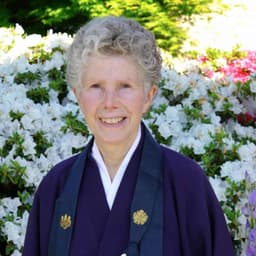
The Perfection of Wisdom - Jogen Salzberg, Sensei
About this Episode
In this talk, Jogen continues a series on the six perfections, focusing on prajñāpāramitā—the perfection of wisdom. Rather than conceptual knowledge, this wisdom points beyond thought into direct experience, where reality cannot be fully captured in language. Using the framework of four “binds” of reality—ineffability, timelessness/spontaneity, non-separation, and openness—the talk explores how perception and awareness are inseparable from the unfolding of life itself. Practitioners are invited to relax habitual patterns of control and separation, and to recognize the inherent clarity and openness already present in every moment.
★ Support this podcast ★Transcript
Hello, and welcome. This is the Zen community of Oregon, making the teachings of the Buddha
Dharma accessible to support your practice. New episodes air every week.
Okay. Being one with Buddha, being one with Dharma, being one with Sangha. Thank you
for your presence here tonight. This is the second to last talk on the
Perfections. So I've been doing a series on the Six Perfections, which is a pretty important
teaching in East Asian Buddhism and in the West. And tonight I'm going to do talk about the perfection
of wisdom. So that leaves effort for last. So one could do this talk and emphasize that if we
just really pay attention to our life and the way life goes, that wisdom grows. And that might
be a very good angle on it. But with the perfection of wisdom, we're talking about a wisdom that
generally doesn't happen from just going through life. It's not the wisdom that's just earned from
maturing, adulting, getting older. It's different because this wisdom really depends on our interest
in it. We have to be incensing a, there is a possibility of another way of knowing, experiencing
ourselves in the world. And then we have to, in a way, incline towards that. We have to make
ourselves available to that. So for Zen practices, knowing stuff about interdependence and emptiness
and all of these beautiful ideas, if they inspire us to realize what they mean through our own
experience, then they're a value. But the ideas themselves are simply not liberating.
They won't help us when we're sick, dying, having a spat, having a dictator. They don't help.
So we go into and beyond our own experience. That's the direction of the perfection of wisdom,
often called Prajna Paramita. Prajna means something like wisdom.
Now, sometimes people just do, when we put it this way, sometimes wisdom just decides to awaken
in somebody. It just happens. And so that's why we can't get to prideful thinking that if you're
a Buddhist, you corner the market on wisdom because it's just not like that. This is a feature of
reality. And it can just awaken in somebody like an Eckhart Tolle kind of person. If he's an
example of when that's very potent, there are many, many, many, many people we will never know
who wisdom just decided to wake up in them or some mysterious causes and conditions.
But in terms of what I want to incline towards that, that these realizations sound like they
would make my life less suffering-like, then the other perfections are foundational.
So I believe, Mule, you talked about the perfection of morality, basically a good heart.
And we talk a good amount, a good heart that leads to remorseless behavior or reduction in
remorse on a deep level of oneself. With a reduction in remorse on a deep level in oneself,
one can concentrate at more and more refined levels, whether that's single-pointed or wide-open.
It's all concentration. And then awareness can open up.
Master Hengier said to empty an open-out body mind as expansive as the sky.
So I want to use a framework from a very old text. It's called a Zogchen Tantra.
And it's a framework that, as far as I know, mostly only the great teacher Lung Champa commented on it.
It, I think it addresses or points us in the direction of what's meant by Prajna Paramita.
This is called the Four Binds of Reality or the Four Samaya.
And in a way, that means that reality promises this is the case.
These are four immovable features of reality. And they are in-effability,
timelessness and spontaneity. That's like my, you know, I have a slash mark there, timelessness,
spontaneity, unity or non-separation and then openness. So in-effability,
whatever arises is beyond words. The gulf between our thinking mind and what things actually are is
amazing. And so the great Yogini, Neguma, prayed to her teacher,
may I continually recognize that everything that arises is beyond words.
It's like life is a grand, vast, unfathomable dragon and our thoughts are these little fish
and abiding at the scales.
So practicing the stance of in-effability, back up for a second, this is not just a concept,
it's an attitude by which one can inform life these four. Sometimes in some traditions,
this is called the view. I think stance is nice to take the stance and appreciate
through that stance that everything is in-effable means appreciating that your experience cannot
be adequately summarized. It can't be adequately imagined. It can't be adequately assessed or analyzed.
You could spend the rest of your life trying to imagine or describe a piece of breakfast sausage
and even the most marvelous poet, prose writer would not give you anything close to the actual
experience of a breakfast sausage. It's just words. It's just words.
And this is true on a daily basis, all that we go through, all that happens in us and through us,
all that we do in the world, at best our imagination, our summaries and our analysis is partial.
Like what a weird thing that somebody has, I don't know how many moments you have in a day,
moments of very rich life and we sum up our day with, it was okay.
Or how is your vacation? It was really good.
Now in a way that isn't wisdom in itself because how could you possibly convey the richness of
what you go through? It's beyond words. It's always the case. Every conversation we have with
somebody, we're stepping into the insurmountability of our aloneness and the ineffability of experience.
You're communicating a vibe, not the thing that happened to you.
At best our imagination, summaries and analysis are partial, often it's complete illusion.
The word breath is not the direct experience of breath.
The image of our bodies and the thoughts and judgments about them at best are a snapshot from a
particular angle. That's what a memory is, right? It's a snapshot from a particular angle.
To what a news bite is, it's a snapshot from a particular angle.
At best, I think that the body is a very interesting thing to look at this because
in practice, you will begin to expose that you carry an image of the body with kind of a mental
image of the body that's just not the body. Everybody has a little bit of body dysmorphia.
The body is happening all the time. The body is a visual perception. It's a tactile experience.
It's continual flow. So taking the stance of ineffability means placing less stock
in our habitual thoughts and images of ourselves, people place things, experiences.
And it's not doing that because, oh,
somebody said thoughts are limited. It's letting life express itself.
This ineffability has a kind of fragrance of wonder.
I really appreciate that I can't boil things down no matter what I experience with my mind.
Then we realize our task as practitioners is just to let life speak.
Continually, just let life speak.
There is another level to this of the four binds of reality.
Ineffability on the path of awareness means tolerating that awareness can be open to,
but it cannot be understood. Awareness neither exists nor doesn't.
Awareness is neither a possession of oneself nor is it separate. Awareness
is neither ordinary nor extraordinary. It cannot be grasped. It can't be understood.
And so this precept is given to yogis to encourage them to give up philosophy
about the nature of mind because ultimately it just hits a dead end.
The mind can't go beyond itself.
And this was described by an old master as just you should be a child of wonder
at this. This that becomes more and more naked, clear and bright through doing our practice.
So that's ineffability and we can practice that. We can appreciate that.
The second of the four binds, again I'm using these to give us some appreciation of what the
perfection of wisdom is, is timelessness or spontaneity.
We are now. The future will be now. The past is now. We can't go anything
or anywhere other than now. Our fantasies about the future happen now. When we get there,
it will be now. When we think about what we should have done, it will be now.
You kind of stuck in eternity. You're totally stuck in eternity.
You can't leap out of it.
We're always in timeless freedom. Or if we appreciate this, it's freedom.
If we fight against it, well we live in regret and future projection.
I had a discovery in a retreat I was in sometime about a month ago. I discovered that one of the
things the brain likes to do is auto intoxicate on anticipation. To continually think about what's
next that might be good and get a little brain juice. There's a probably a little chemical
high and it can do that continually. We can live in auto intoxication of anticipation all the time.
We're free to auto intoxicate our whole life. We're free to dwell on the past no matter how
painful. Nobody can stop us if we don't. And we're also free to be here now where all of that
is illusion like. You deepen your sense of the value of this stance of timelessness
when you come into such vivid presence that you realize why would I want to live in that swirl?
Why would I want to live in that haze of memory continually when this is so fresh?
The second bind of reality also has an aspect of spontaneity and that part of that is freshness.
Everything presents itself fresh. Everything prevents itself. Right now all of us have a hundred
percent of life. It's fully just presenting itself. And how much of that are we doing or controlling?
I make this big deal about being people but like how much are you actually doing each day?
What do you do?
What do you do? Somebody says well I'm an accountant. Yeah but numbers were all there and calculators
were already there and like it's kind of already there how to figure out how to move them around and
charge somebody an invoice because you moved some numbers around. It was all already there.
Yes somebody taught you but
or for me I'm not a very good cook or I'm a good cook like one in five times. Sometimes I get lucky
and it comes out okay but the other time as my partner is just polite or just happy that I finally
cooked. But when I was the cook at the monastery one of the things that was just so beautiful
to me was the universe already presvited all these amazing flavors like nobody made cumin.
Nobody made brown sugar. Nobody made the taste of squash. And so as a cook you could get all like
proud of how good you are but you're just moving stuff around. How amazing that all just happens.
So,
Prajna Paramita has an aspect of yielding the sense of control to let things happen because they are
anyway. I bet it would be very hard for you to pin down a moment that you made a choice.
I know you can see that a choice seemed to be made. You seem to settle on left rather than right
or grad school rather than I don't know trade school. But was there a moment that you made a choice?
I bet it would be hard to pin down that moment.
Spontaneity is an appreciation of life is this beautiful mystery that doesn't need a self.
Like think of a tree. Where is the self in a tree? What part of a tree is the self?
Where is the control unit of a tree?
And so I might think I'm not a plant. Fair.
So, the stance of spontaneity is in a way appreciating the folly of control
or taking a long enough risks to see that mostly life just happens when we get out of the
way. And so, letting what arises arise as we practice in Arzazan.
So, timelessness and spontaneity. The third bind of reality as an aspect of Parajana Paramita
is unity or non-separation. So, experience and awareness are always exactly the same.
It's not that something happens and then the mind goes, oh, I noticed that thing that happens.
Or thought can do that, but there actually was no gap between the happening and the knowing.
We don't actually experience any separation. We experience what happens when the mind
simulates it. In the first moment of hearing, smelling, tasting, touching, even thinking,
there's no separation. It's just intimate. And then, very quickly, the mind labels things I like
and I don't like it. We have a feeling about it and there we are in the sense of separation.
Just like the body is not divided. Perception, the perceptual function of the mind,
divides the experience of body into parts. The body never says, or the body never says,
I'm a foot, not a hand. It's a seamless hole. It's undivided.
Inner and outer are seamless. We weren't continually making the territory, the boundary of,
I am in here and my mind stops at the edge of my school or something and everything
else is out there. There would be a sense of unification. A sense of integration.
There's a little bit like a piece of fabric. Here's a piece of fabric, this handy,
a piece of fabric. This is the moment. I'm a ripple and you're a ripple. I know I'm this ripple
and you're that ripple but also I'm a fabric and you're the fabric and I can know them both at
the same time and that's always going on. Both the ripples in the fabric and the fabric.
But we love our little crinkles and we're very worried about the success, failure, pleasure,
happiness, death of our little crinkles and so we basically forget about the rest of the fabric.
So we could say as a stance, this unity or non-separation is a relaxing of dividing mind
and the wisdom is discovering how that operates in you.
Is to study how self and other subject and object pop up for you and you practice that with
sense objects. How is it that reflexively I have a sense of me that?
What is the genesis? What is the action? Can you catch it in action? The action of me that?
Why is your body of that?
Nice language is the great trickster. I said, why is your body? Why is it even your body?
Where is the belonging of a body? Where is the owner of a body? Point out that which the body
belongs to. You never can and you never will. It's undivided and to really study this to really
appreciate it and there are a number of co-ons that are about this. For example, the greatly misunderstood
the sound of a single hand in a way all of the foundational co-ons are a way of taking
if this has curiosity for you and giving it a form to really put energy into.
But you could just be really curious about how does me that happen?
Start with the body. How does it become that?
Why do we objectify ourselves?
I promise you, if you stop objectifying yourself, your limbs aren't going to fall off.
Nothing will go numb. In fact, when the body is not objectified, when the body is not objectified
by the body, it functions much, much smoother. I learned this through my own suffering.
So the stance of unity is a relaxing of dividing mind, a study of the me that.
The reflex of me that.
And allowing things to resume their harmony in oneness.
This is why Rumi can say, it's like walking into a crowded room and becoming the noise.
So there is no noise.
And this is not featurelessness. This unity is not some kind of mystical or meditation experience
where everything kind of goes away and you're in a formless place. It's not that, but it doesn't
exclude that. Some of the old luminaries would call this the one-taste, one-taste.
I like the wrinkled fabric metaphor better.
So with this bind of reality, we are reminded and this is vital because this is something that
meditators tend to struggle with. Maybe for a good while, is that awareness is not saying
the word awareness is not pointing to something that hovers apart from life.
There is nothing that's hovering apart from life.
Life is completely invested in life. Life is completely entangled in life.
And yet there is the clear, boundless brightness.
But it's not a stirrile retreat from experience.
The last of four binds, a reality that I'm using to explain progeny parameda, unfortunately,
is openness or spaciousness. Now, first of all, openness means things happen simultaneously.
So right now, you can hear these words and you feel your body without any special effort.
It's happening simultaneously. The moment is appearing with simultaneity.
Everything, because the moment, because awareness is wide open, everything is welcome all at once.
You are still feeling your body and hearing these words and seeing these colors.
If any one of them went away, you'd freak out. You'd be like, did somebody put something in my tea?
And where can I buy some more?
So the stance of openness has an aspect of being space, of holding space.
If awareness was like a person, they'd be like the warmest grandma ever that invited all the
people in that you were like, she's kind of weird grandma. And grandma's like, no, everybody's
welcome. I'm not afraid. Not minding how they were dressed or where they came from. Awareness
in itself just has this total openness. And that aspect of our being is always functioning,
but what happens is the fearful mind comes in. The insecure mind comes in. The mind that divides
life into threat and benefit comes in. And then that great openness is, you know, it's what allowed
anything to happen anyway, but so what? We're on the level of, no. Which of course, sometimes we have
to not invite our weird friends in. Is my metaphor making any sense? The weird friend? No, not,
yeah, okay, there's one nod. The stance of openness is a place where one can
verify for oneself that when we don't align with the fearful mind,
we actually navigate life moment by moment with a kind of grace and frictionlessness.
It's the exact opposite of what the fearful mind thinks will happen. And so it narrates a whole
life or lifetimes. In Dogehns and G, a long time ago teaching on the heart sutra,
Prajna Wisdom is space. I encourage, I don't, I've probably been a couple weeks since I was like
pay attention to space, pay attention to space. In your meditation includes space.
So this path of awareness is open.
Openness is the ground of being because of openness, I can utter these words. Because of openness,
you can feel your back. Because of openness, everything. When I was a kid, I somehow was curious about
things like people would talk about God that created the world and I thought, well, what created
the space that God came into? And what created the space, that created the creator of the space
that God came into? And I was just like, my mind was kind of blown. How did this happen?
And I knew that the idea that there was a beginning was just strange.
But maybe that's like a good Western co-on. I'm serious. Yeah, okay. The co-on is God created the
universe, well created the space for God to create the universe. That would be a very good co-on.
Hmm. The other thing that's a vital, especially for a practitioner of a path like Zen or
Zocen, which does not emphasize, like some schools of Buddhism do, that you're a being full of
little naughty bits and desire and all this stuff that maybe you should kind of get rid of and
not have it anymore. And then everything would be okay. Now we're concerned about the naughty bits.
But the emphasis on Zen is discovering the utter purity,
indestructible purity of your being. That quality we sometimes call it mind or awareness.
This means, and this is a transmission of confidence that no matter how much you have been a
crabby, disrespectful, immoral person, this dimension of your being is never stained in the slightest.
You cannot blemish it. Now you are responsible for your karma and by that, by that I mean whatever
you've done will have an effect that you will experience. At least the Buddha thought so. You
could check that out. But that's the karmic dimension. We have to be fully responsible for it,
but even the karmic dimension of a demented serial killer, they have this pure lucid
perfection of being in them and they could drop right into it if they had the right circumstances.
All right, that happened in the Buddha's Sangha a long, long time ago. There is this dude that was
so twisted that he walked around with like a necklace of the ears of the people he killed.
And for some reason, he was impressed by the Buddha's vibe and his monks vibe and he was like,
can I do this? Like even me? And the Buddha, this is a real demonstration of openness. I mean,
this guy had bloody ears around his neck or like dried ears. Kind of like I was at the pet store
today and you could buy dried ears for your pet. It was like a garland of dried pet ears, okay?
And the Buddha knew those were human ears and he was like, yeah, I'll teach you and he recognized
his true nature. You could look up the story if it's Anguli Malah was the name of this
this guy. He still had to deal with his karma but he knew Nirvana.
This means, practically, when you are sitting, there's no excuse if you have a ton of thoughts,
this pure dimension of being is still there. You could just drop into it if you had enough confidence.
This means even though you've done XYZ and you did ABC, okay, you'll have to clean that up in
in the realm of consequences, but you're not, you're totally welcome here in the Buddha Club.
You're a you're a gold star member of the Buddha Club even if you've been a real
lousy sucker because you have the pure nature of being.
So when you sit, don't think, oh, these thoughts are bad. I shouldn't have these thoughts or,
oh, these are really good thoughts. You don't need to do that. They're just,
they're just, let them sail through and they sail through by virtue of this openness.
So in-effability, timelessness and spontaneity, unity or non-separation and openness.
Thank you for listening to the Zen Community of Oregon podcast and thank you for your practice.
New episodes air every week. Please consider making a donation at zendust.org. Your support supports us.