Loading...
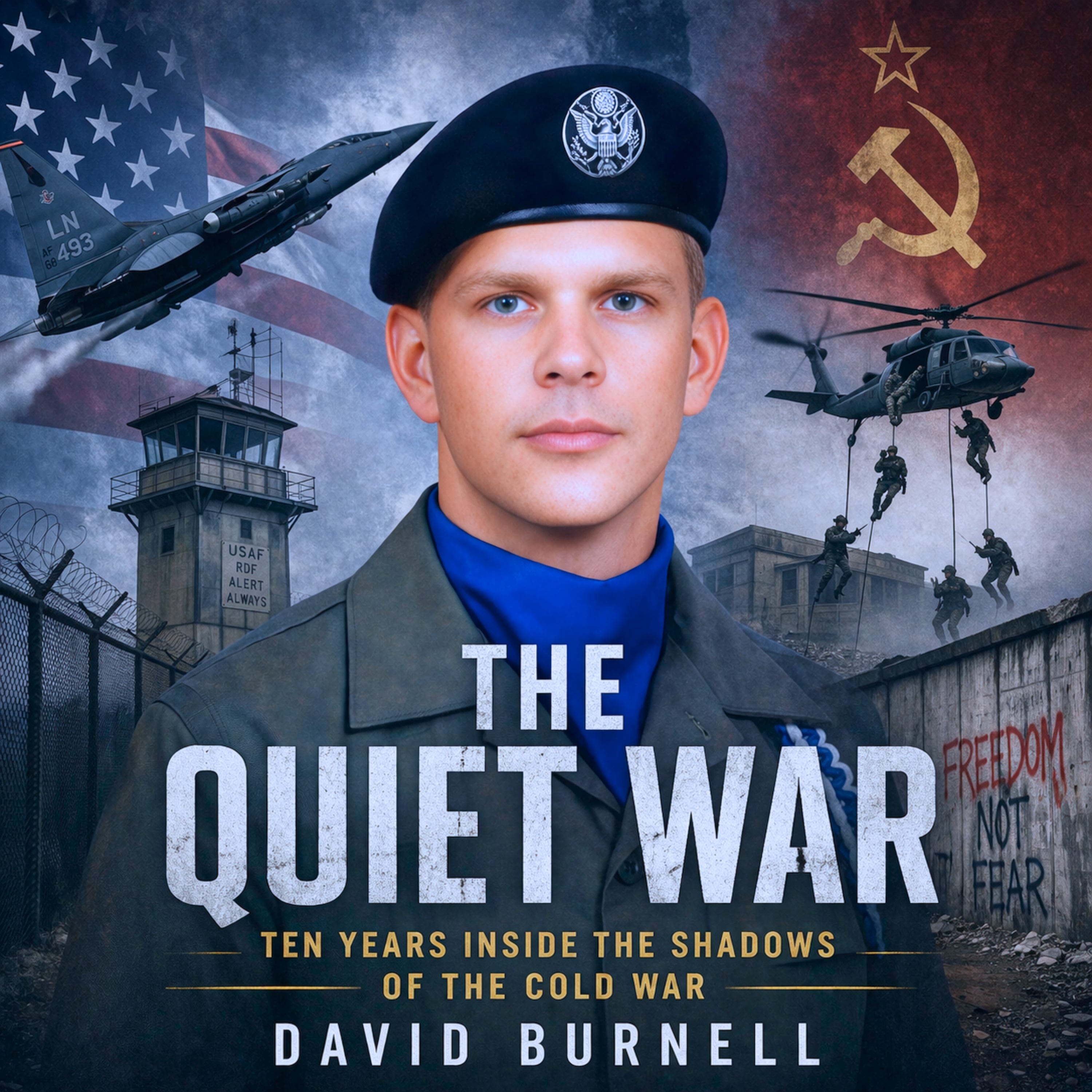
About this Episode
For ten years, David Burnell lived in the invisible war—serving as a U.S. Air Force Communications Operations Specialist during the most volatile decade of the late Cold War.His battlefield wasn’t marked by trenches or gunfire, but by encrypted transmissions, coded messages, and the heavy silence of classified operations.
From the blackout classrooms of Sheppard Air Force Base to the fog-covered runways of RAF Sculthorpe, and from the jungles of Central America to the frozen plains of South Dakota, Burnell’s decade in uniform unfolded behind security fences, within cleared rooms, and beneath the constant hum of secrecy.
In The Quiet War, Burnell opens a window into the unseen world of intelligence operations—where loyalty is tested by polygraphs, trust is earned in whispers, and the smallest mistake can echo across nations.
He recounts the call that changed everything: volunteering for Task Force Bravo in Cabañas ’87, where a last-minute reassignment spared his life when a friendly-fire incident took down the helicopter he was meant to board.He describes the OSI polygraph interrogations after the capture of Navy spy John Walker, and the eerie feeling of serving “in the glass bowl” where every heartbeat was measured for loyalty.He walks through the fall of the Berlin Wall, the rising threat of global terrorism, and the quiet moments on the flight line when coffins draped in flags arrived home without ceremony.
Amid the secrecy and tension, Burnell’s story is deeply human. It is about faith, family, endurance, and the cost of commitment.It’s about the dream that first drew him in—the desire to become a Pararescue operator (“That Others May Live”)—and how that same drive would later carry him into real-world search and rescue, humanitarian missions, and crisis response long after the uniform came off.
The Quiet War is more than a military memoir—it is a testament to those who serve in silence, whose battles are unseen but whose sacrifices are just as real.
For readers of The Right Stuff, American Sniper, and The Operator, this is the untold story of a warrior who lived at the intersection of technology, intelligence, and faith during one of the most complex eras in modern history.
Themes & Tone
* True Cold War service through the eyes of an intelligence operator
* Faith, discipline, and moral courage under pressure
* Psychological and emotional costs of secrecy
* Human connection amidst technology and global tension
* The unseen link between military service and humanitarian rescue
Key Operations & Chapters
* The Road Not Taken – Pararescue Dreams and Duty
* Boot Camp – Breaking and Building
* The 12th Tactical Intelligence Squadron
* Into the Fire: Cabañas ’87
* The Polygraph – Loyalty Under Interrogation
* Signals in the Silence – RAF Sculthorpe and the Shadow War
* Bodies on the Tarmac
* And the Wall Came Down – Berlin 1989
* Ellsworth AFB and the End of the Uniform
* From Airman to Rescuer – A Life Built by Fire
Find this and other episodes from the Echo Valor Podcast by searching “Echo Valor Podcast” on your favorite podcast platform. You can also discover original music by searching “Echo Valor Music” on your favorite streaming platform, and explore books and written works by searching “David Burnell” on Amazon to visit his author page.
Get full access to David Burnell at davidburnell.substack.com/subscribe
Hosts & Guests

Transcript
The Quiet War, 10 years inside the shadows of the Cold War,
written and narrated by David Bernal, copyright 2026 by David Bernal,
for those who served in silence and for the families who carried the weight, preface.
This book is not about a single battle or a single moment of heroism.
It is about a kind of service that rarely makes headlines and almost never gets discussed in detail.
The long quiet work done in the background, where readiness is constant, mistakes are unforgiving,
and silence is part of the job.
From 1984 through the early 1990s, I served as a communications operation specialist
in the United States Air Force. My assignments placed me inside intelligence units,
tactical air control centers, rapid deployment forces, and special operations adjacent environments
during the final decade of the Cold War and into the Gulf War era.
Much of that work occurred behind closed doors under classification or in roles where
acknowledgement was neither expected nor permitted. This book is written from memory,
personal records, and lived experience. Some details have been intentionally omitted,
generalized, or condensed, not to dramatize events, but to respect classification boundaries,
protect individuals, and preserve the integrity of the missions involved.
What remains is the truth of how that life felt, the pressure of permanent readiness,
the weight of responsibility, the strain on families, and the psychological cost of living
in a world where you are always on call but rarely seen. For readers unfamiliar with military life,
particularly Cold War era service, it may be tempting to view history in clean lines,
peace, then war, conflict, then resolution. The reality was far less defined.
The Cold War was not quiet for those who lived inside it. It was marked by constant preparation
for events everyone hoped would never happen, punctuated by moments when they nearly did.
This is not a book written to glorify war, nor to settle old scores. It is a memoir of service
of doing a job well, often in silence, and carrying the consequences long after the uniform came off.
It is also a reflection on leadership, moral responsibility, faith, and the unseen toll that
sustained stress and secrecy can take on a person over time. If you are looking for cinematic action
or simple conclusions, this may not be the book for you. If, however, you are interested in
understanding what it means to live on the edge of history without ever stepping into the spotlight,
then these pages are offered honestly and without embellishment. This is the quiet war,
and this is what it was like to live inside it. Chapter 2 The Decision
In 1984, the Cold War still defined global tension. The Soviet Union and the United States were
locked in a technological and ideological arms race, and the US military was undergoing rapid
modernization under President Reagan's defense buildup. For many young Americans, enlistment
was patriotic and purposeful, a chance to serve on the front lines of deterrence in a world divided
by nuclear threat. In 1984, I enlisted in the United States Air Force, a choice that would shape
the next decade of my life and define much of who I became. My specialty would be communications
operations, which require precision, discretion, and the ability to stay calm under pressure.
Over the years that followed, I found myself in anything but routine assignments.
Each one challenging me intellectually and pushing me beyond my comfort zone.
Growing up in a law enforcement family prepared me more than I realized. My father, a police officer,
had a quiet way of teaching discipline. He didn't need to raise his voice to make a point.
From him, I learned that respect was earned through competence and consistency. He used to say that
keeping your head down and doing your job well would get you through more doors than talking ever
could. That mindset would serve me perfectly in uniform where bureaucracy rewarded steadiness
and punished ego. I found comfort in that culture, a structured, disciplined world where standards
meant something. Before joining the military, I'd already spent two years on a mission for my church.
That experience solidified my sense of duty and service. It taught me to live purposefully,
endure long days with little rest and lead by example rather than command. When I returned home,
I wanted to keep serving this time on a larger stage. My first choice was the Marine Corps.
I went straight to the recruiter, completed all the tests, and scored high enough to qualify
for a broad range of positions. However, the Marines offered me a slot in artillery despite my
desire to work in military police or in a field that better fit my skills. There were no openings
for the job I wanted. I thanked them and walked next door to the Air Force recruiter.
That small act of persistence changed the trajectory of my life. The Marine recruiter had even
tried to tell me I couldn't talk to other branches. As if a signature bound me, but I've never been
one to be told what doors I can't open. The Air Force appealed to me immediately. They had
structure, technology, and a reputation for precision. I also learned that the Air Force housed
several special operations units, though they didn't recruit directly into them at the time.
If I wanted to reach that world, I'd have to take another job first and prove myself once I was in.
That sounded like a fair deal to me. I signed the papers. I entered bootcamp newly married
and determined to excel. The Air Force didn't promise glory, but it did promise opportunity.
And I was ready to earn every bit of it. I planned to work hard on my first assignments, earn my
superiors trust, and eventually chart a path toward the elite units that fascinated me.
I wasn't nervous when I boarded the bus to Lackland Air Force Base. I felt ready. The uniform
fit my mindset, quiet, disciplined, and intent on doing things right. I didn't join the military
because I stumbled into it. I joined because I wanted to, because I believed service mattered and
wanted to be tested in a way civilian life never could. That was the beginning of everything
that followed. A decade that would take me across continents into secure rooms onto flight lines
and deep into the shadows of the Cold War. Chapter 2. The Road Not Taken
During the height of the Cold War, the United States Air Force Para Rescue PJ
program was among the most elite and respected rescue forces in the world. Their motto
that others may live wasn't just a phrase. It was a creed that demanded absolute commitment.
To become a PJ, one must complete the Para Rescue indoctrination course,
followed by nearly two years of grueling pipeline training in combat medicine, survival,
halo parachuting, diving, mountaineering, and recovery operations under fire.
This was one of the longest and hardest training pipelines in the US military,
designed to forge warriors who could jump into chaos, save lives, and survive anything.
The Dream Before I wore the Air Force uniform,
touched a radio or learned a single encryption code, I had one goal to become a Para Rescue operator.
I began training for it the moment I signed my enlistment papers. Every morning I ran until
my lungs burned and my legs turned to lead. I swam endless laps every afternoon,
forcing myself to hold my breath longer, dive deeper, and move faster. I knew that when I got to
bootcamp the PJs would visit looking for volunteers, those who dared to take the physical agility
and stamina test passed. The first gate to entering their brotherhood. When that day came, I was ready.
The instructors stood in their maroon berets, quiet, confident, with the calm eyes of men who'd
seen things most couldn't imagine. They called out, who will try out for Para Rescue?
My hand went up before I could think. The past was brutal, a 500 meter swim, a 1.5 mile run,
pull-ups, push-ups, and sit-ups, each timed, judged, and unforgiving.
I passed. My heart pounded with pride as I walked to the payphone and called my new bride.
I passed, I told her, breathless and exhilarated. There was a pause. Then the question every young
warrior eventually faces. How long will you be gone? At least 18 months, I said, maybe more,
training, schools, and then on the job qualification. After that, deployments, lots of them. Silence.
Not angry, not disappointed, just heavy. The kind of silence that speaks louder than words.
After what felt like a lifetime, I said, the cadre told me I can wait. I'll finish my first year
in my assigned job, then cross train into Para Rescue. It wasn't true, not really. That night,
I made my choice. I would go into communications operations. The job, the Air Force guaranteed me
when I enlisted, and I'd follow the Para Rescue path later. I didn't realize then that later
would become a word that carried wait for years. The waiting game.
My enlistment was for six years. My retraining window wouldn't open for five. That meant five long
years of waiting, five years of watching, working, and hoping the right slot would open. I stayed
ready. I kept training as if the call would come any day. While my peers were relaxing after hours,
I was still running, swimming, and pushing myself to stay at Para Rescue standards.
I somehow got hold of the eighth week evaluation sheets from the PJ indoctrination course.
Each week's physical benchmarks laid out like a blueprint for endurance. I made a copy, laminated it,
and built my life around it. Week one, 500 meters swim under 10 minutes, 1.5 mile run under 930.
Week two, two mile run under 14 minutes, 25 pull-ups, 100 push-ups, 100 sit-ups. Week three,
underwater crossovers, and 50 meter breath holds. Week four to eight, extended calisthenics,
drown-proofing, rough marches, and cold water conditioning. Every week for eight weeks straight,
I would test myself as if I were in that pipeline, then start all over again. My off time wasn't
rest. It was preparation for a destiny that seemed both inevitable and impossible. The years between.
That quiet fire never faded through assignments in Texas, Central America, and Europe.
I respected my communications operations career, vital, technical, and demanding,
but my heart was still on the rescue line. Every time a flare went up, a Medevac launched,
or a team jumped into harm's way to pull someone out, I felt it in my bones. When I reached my
ninth year of service, the Air Force finally opened a slot, not in Para Rescue, but in combat control,
the sister career field. It's a different mission, but it's the same mindset. Elite operators
trained for insertion, control, and precision under fire. I retook the past and passed it.
Orders were cut. My dream reconfigured but alive was finally within reach, but life had its own plans.
By then, I was married with children. My wife had stood by me through deployments,
separations, and countless almos. She deserved stability, and I had to face the truth
that chasing this dream might cost me my family, so I made the hardest decision of my military life.
I stayed. I finished my service honorably, but that longing never truly faded. It became something
more profound, an Ember that would reignite years later. Legacy of the Unfulfilled Dream
Decades after that first past test, I would find myself in the cold waters of Sheridan Lake,
recovering the fallen. I would repel into canyons, search for people on mountains and snow storms,
and coordinate rescues during storms and earthquakes. In every way that mattered,
I became what I had once trained to be, not through the Air Force, but through faith,
purpose, and a lifetime of readiness. Today, the Air Force Special Warfare Command finally
offers structured pipelines and mentorship for those determined to wear the Maroon Beret.
They have modern systems, cross-flow programs, and a unified command. But back then,
back then, the stars had to align, and for me, they never quite did. Still, I trained as if they
would, and maybe that's what defined me. Not the beret I didn't earn, but the calling I never
stopped answering. Chapter 3 Boot Camp
After the post-Vietnam drawdown, the early 1980s saw a return to hard-edged military discipline.
The Air Force, eager to restore readiness and professionalism,
emphasized precision, order, and technical mastery in its training programs. Basic training
at Lackland. AFB became a crucible for a new generation of airmen, one being prepared not
just for combat, but for the intense operational tempo of a high-tech cold war force.
From the first day of boot camp, stress ruled everything. The instructors relentlessly tried
to break us down and rebuild us into disciplined airmen. The process was deliberate,
part science, part tradition, designed to strip away individuality, test limits,
and forge something more challenging in its place. It wasn't cruelty, it was calibration.
Every word, shout, and impossible task was a test to see who would bend and hold.
On that first day, I was unexpectedly appointed dorm chief, the equivalent of a platoon leader.
Overnight, I became responsible for the welfare, discipline, and performance of roughly 50 trainees
from all walks of life. Small-town kids, city kids, some who'd never been yelled at before.
It was trial by fire. I managed them under the constant scrutiny of the training instructor,
TI, the Air Force's version of a drill instructor, balancing my learning curve with the flights
needs felt impossible at first. The key was focus, handling one problem at a time and moving forward.
The attrition rate was real. Out of our original group, 11 didn't make it to graduation.
Some quit, some were dismissed for violations. Others couldn't adapt to the pressure.
Watching them leave, reinforced how fine the line was between staying and going.
Every day felt like a quiet vote of confidence from the system. You're still here.
Our days were built on repetition and exhaustion, wake before sunrise, formation,
chow, inspections, marching, drills, physical training, classes, lights out, then do it again.
The schedule was designed to exceed capacity. The TI made sure of it. He'd push us past fatigue
and frustration until only discipline remained. In that crucible, I discovered I didn't just
endure pressure, I thrived in it. There was something satisfying about operating inside
that chaos and keeping order where others broke. One day, while in the barracks, chaos found us.
A trainee decided to show off by leaping over the doorframe to the latrine. He misjudged the
distance and caught his mouth on a metal hook, tearing open the corner of his lip down to the fatty
tissue. The scream was sharp, echoing off the concrete walls. I ran to him instinctively.
Blood poured down his chin, his eyes were wide with shock and fear. I remember taking a breath
before I spoke. A deliberate pause to steady both of us. You're okay, I told him. It looks bad,
but you're going to be fine. I called the guard desk, reported the injury, and stayed with him
until medics arrived. Staying calm kept him calm. That moment taught me a lesson I would carry
through my career. Under pressure, your tone matters more than your strength. Panic solves nothing.
Another moment that's never left me came one quiet afternoon. I walked into the barracks and saw
a fellow trainee sitting on a chair near my bunk face buried in his hands. Something in his stillness
felt wrong. Before I could ask, the T.I.'s voice cut through the silence across the room.
Leave him alone. His tone was sharp, commanding, but not cruel. He called me into his office and
told me the truth. The young man was being discharged for suicidal ideation. It hit hard.
I had seen him every day for weeks and never noticed the signs. His eyes that day, vacant,
disconnected, have stayed with me ever since. Over the years that followed, I would see that same
emptiness in others. Operators after missions, trainees under strain, even colleagues years
later in the field. It's the look of someone who's still here physically, but already somewhere else
inside. Not all the challenges came from authority. A few trainees claimed to be gang members,
some from Boston, some from the South. Word spread that they planned to confront me because I was
dorm chief and in their eyes an easy target. One morning in the latrine, I found out how serious
they were. I was brushing my teeth when three of them surrounded me. It happened fast, shoves,
fists, noise. I fought back on instinct until my squad leaders arrived to pull them off.
It was over in seconds, but it left an impression. The confrontation had an edge that went beyond
rank or rivalry. There was anger there. Maybe resentment, maybe prejudice. Whatever it was,
it reminded me that leadership meant visibility and visibility meant vulnerability.
Bootcamp was never about learning to march or make a bed tight enough to bounce a coin. It was
about learning who you were when the structure failed, when people cracked, and when fatigue stripped
away everything comfortable. It was about understanding that some people can't handle the noise,
and others learned to move through it like it's home. When graduation finally came, I wasn't proud
so much as relieved and quietly grateful. I'd made it through. The uniform fits differently now,
not because it has changed, but because I have. I left Lacklin with a sharper sense of who I was,
and what kind of man I wanted to become. Chapter 4 Blackout School
During the height of the Cold War, the United States Air Force relied on a small,
highly trained cadre of communications operations specialists, airmen,
entrusted with keeping the nation's command and control lifelines alive. Before satellites and
digital networks made communication instantaneous, secure voice and data transmission,
dependent on operators who could work in total secrecy and precision under pressure.
These quiet professionals connected presidents, generals and pilots to their missions,
across continents, oceans, and into hostile airspace. Every word mattered, every second counted.
The Blackout Building
They trained us in a windowless building without sunlight or a sense of time. It was sealed tight,
a concrete vault where everything that mattered existed within those walls.
The only illumination came from fluorescent tubes and the soft green glow of monitors.
The hum of machinery was constant, like the background noise of classified work.
This was Shepherd Air Force Base, where I learned the craft of secure communications operations.
I had been selected for the Career Field 291X0, communications operations specialist,
a discipline defined not by fixing equipment, but by operating, managing and safeguarding the
systems that carried the world's most sensitive information. Maintenance Airmen repaired the
circuits. We made them speak. Our mission was to keep the message alive, accurate and protected,
whether across a base network or halfway around the world. Inside the vault,
from the moment you stepped through the security door, you were in another world. Badges were
checked, conversations were limited, and notes were never left in the building. We trained inside a
blackout facility, no windows, distractions or leaks. The Air Force ensured we understood early
that we weren't learning theory, we were learning responsibility. Every day began with system
briefings and message traffic exercises. We memorized routing indicators, precedence codes,
and cryptographic sequences, five level and eight level identifiers, authentication challenges,
and hollarith formats that carried the skeleton of military communication. We studied crypto
operations, the controlled process of generating, loading and using classified encryption keys to
protect every transmission. We practiced message relay using encrypted circuits, verifying data
integrity line by line. The instructors drilled us until we could process a flash message blindfolded
and still get every step right. It wasn't about speed, it was about precision. One wrong key
stroke could scramble a secure channel or reveal a unit's location to the enemy.
The art of secure communication. The 291X0 field was more than a job, it was a gateway into almost
every corner of Air Force operations. Graduates could find themselves in radically different worlds,
combat communications units, establishing tactical radio nets, and encrypted lines under fire.
Embassy communications manages diplomatic circuits and secure teletype links in hostile nations.
White House Communications Agency supporting executive command and control with absolute discretion.
Airborne missions operating from platforms such as AWACS, EC-130ODS, and AC-130O gunships
ensured that air and ground units remained connected across combat zones.
Each operator carried a top secret clearance and the unspoken understanding that one misstep could
compromise more than just a signal. It could cost lives. Discipline in the dark.
Our instructors were seasoned veterans, men and women who had run communications during the
Vietnam War, the desert one operation, and cold war flashpoints. They reminded us daily,
you're not just passing messages, you're holding the threat of command. They taught us discipline
in detail how to document traffic, authenticate transmissions, and log crypto material down to
the serial number. We learned how to work in silence, communicate with clarity in chaos,
and stay calm when a net was screaming for priority access. To them, sloppiness was the enemy.
You didn't just transmit words, you carried the weight of command through every character, tone,
and call sign. The Brotherhood of the Line
In that dark building, friendships formed in whispered conversations between drills.
We came from every corner of the country, farm kids, city kids, dreamers, and veterans.
But inside that black out vault, we became a unified voice. We learned to trust each other
completely because when communications go down, you don't have time for egos.
Graduating from shepherd didn't come with a parade. It came with a badge, a clearance,
and a quiet expectation. You would carry your responsibilities wherever the mission sent you.
Whether a jungle in Central America, a control room in England, or an airborne command post
at 30,000 feet, the weight of what we learned. The building had no windows, but what we learned
there opened an entire world. I left shepherd AFB understanding that communications wasn't about
talking. It was about connecting. It was about precision, trust, and silence under pressure.
When the Air Force entrusted you with the flow of classified information,
you weren't just part of the mission. You were the mission.
That was the foundation of a 291-X0. Not maintenance, not repair, operation, execution, protection.
And for the next 10 years, through Cold War tension, jungle humidity, and long nights under
the glow of secure screens, that foundation would carry me deeper into the quiet war. Chapter 5
into intelligence. By the mid-1980s, intelligence and communications operations had become
critical components of Cold War strategy. The U.S. Air Force expanded its tactical intelligence
squadrons to manage global information flow, early warning systems, and secure communication
networks supporting potential flashpoints across Europe, Central America, and Asia.
The push for greater security clearances and compartmentalization reflected the
air's growing fear of espionage and data compromise. After completing my initial training,
I was assigned to the 712th Air Support Operations Center at Bergstrom Air Force Base, Texas.
It was the mid-1980s, and the Cold War was still hot beneath the surface.
The U.S. military was modernizing at an accelerated pace, and every assignment seemed to hum
with quiet urgency. Not long after arriving, my higher-level security clearance prompted
a reassignment to the 12th Tactical Intelligence Squadron, TIS, a move defining the next phase
of my service. The 12th TIS had one mission to provide timely, accurate combat intelligence
to field commanders and higher echelons engaged in global operations. The unit was a fusion of
expertise, analysts, collectors, linguists, human intelligence officers, and specialists from
nearly every corner of the intelligence world. My job as a communications operations specialist
was to ensure secure information flow between them. I was responsible for establishing and
maintaining secure communication channels for roughly 120 intelligence professionals whose work
often depended on split-second precision. Our secure systems were the veins and arteries of
the entire operation. When they functioned, the mission breathed. When they failed, everything stopped.
To do that job, I received extensive tactical and technical training. It covered the full
spectrum, American and foreign weapon systems, nuclear and biological warfare protocols,
and advanced field medical training. I also attended several special operations communications
courses at Hurlbert Field, Florida, alongside operators who would later serve in joint task forces
worldwide. A few other courses I took were never formally recorded in my official file,
which was not unusual for those working within certain operational boundaries at the time.
Our commander, Lieutenant Colonel Kenneth J. Minnihan, set the tone for the unit. Even then,
he was a man of remarkable focus and intellect who didn't need to raise his voice to command a room.
Years later, he served as director of the Defense Intelligence Agency, DIA and the National
Security Agency, NSA, eventually earning his third star as Lieutenant General. His leadership
was a master class in quiet competence for those who served under him. He expected precision,
accountability, and calm execution, no shortcuts, drama or results.
I spent about two years with the twelfth marked by constant mobility and temporary duty assignments,
TDIs. The work tempo was demanding and the stakes were always high. One particular TDI in Norfolk,
Virginia left an impression I've never forgotten. It was late one evening and I'd stopped at a burger
king near my hotel for a quick meal. On my walk back, I noticed a vehicle following me. At first,
I dismissed it. Road paranoia was typical when you were constantly rotating through unfamiliar cities,
but as the car matched my pace, I realized this wasn't imagination. I cut through a nearby park,
trying to lose them, but they intercepted me on the far side. Two men stepped out and a brief
struggle ensued. A adrenaline took over and I managed to break free and sprint back to the hotel.
My hands were shaking as I locked the door behind me. I filed a full report with my first
sergeant the next morning. The Air Force took it seriously as any potential security threat had
to be investigated thoroughly. Given the sensitivity of our mission, the command ordered a psychological
evaluation to ensure I hadn't been compromised or traumatized. It wasn't personal. It was procedure.
The review cleared me without issue, but I couldn't help wondering whether the scrutiny was more
about my sensitive compartmented information, SCI access, than the incident itself. In our world,
stability and discretion were everything. At the time, I was on my third consecutive TDI.
My wife was eight months pregnant with our first child, and my schedule had me home less often
than I wanted to admit. That distance was beginning to show. Years later in our small apartment in
Austin, Texas, I remember sitting on the floor as my daughter pointed to a framed photo of me on
the wall and asked, where's Daddy? It hit me harder than any mission debrief ever had.
My wife had used that picture to help her understand who I was while I was gone.
It was a small thing, but it carried a truth I couldn't ignore. Absence changes the people you
love, no matter how noble the reason. The Norfolk incident and the growing strain on my family
made me reconsider where I could be most effective, both professionally and personally.
I volunteered for a position and a sister unit on the flight line, one that operated as part of
the Rapid Deployment Force, RDF. This role placed me closer to the operational tempo I craved,
and allowed me to apply the intelligence and communication skills I had spent years developing.
It also meant shorter notice, longer hours, and more time in motion. But by then,
I had learned that I function best where preparation met pressure. And that in the world of secure
communications, both could arrive at any moment. Chapter 6. The Honor Guard
During the Reagan era, the Air Force invested heavily in modernization, introducing stealth
technology, advanced bombers, and precision guided munitions, but the human cost of service
remained timeless. The base honor guard stood as a living reminder that, beneath the geopolitics
and technology of the Cold War, every advance came at a price paid by individuals and families
in uniform. During my time in Texas, I joined the base honor guard, dedicating three years to one
of the most solemn duties in the military. During that time, I participated in more than 100 ceremonial
burials. Each service impressed me, shaping my understanding of sacrifice, duty, and the quiet
cost of wearing the uniform. It was the mid-1980s. The Cold War still cast a long shadow over the
world, and military life was defined by precision and discipline. Yet amid the high-tech build-up
and strategic missions, the honor guard reminded us that everything we trained for ultimately revealed
one truth. Service has a price. One of the most impactful moments came with the passing of our
honor guard commander. He was a man whose career spanned history of veteran of World War II,
the Korean War, and the Vietnam War. After 30 years of service and countless combat missions,
he finally retired only to pass away just weeks later. When the day came to lay him to rest,
I felt a profound sense of responsibility. We, his honor guard, were not just performing a ceremony
that day, but honoring a lifetime of courage. As the rifles fired and the final notes of taps
faded into the Texas wind, I understood in a new way what it meant to serve. The folded flag we
presented to his family was more than a symbol. It was the weight of every moment he'd lived in
uniform. Another tragedy would drive that lesson even deeper. A young airman on base was recently
named airman of the quarter, earning an incentive flight. A reward flight in an aircraft tied to his
work. It's a proud tradition in the Air Force, meant to remind people why they serve and give them
a glimpse of the sky that connects every mission. While stationed in Europe, I was fortunate enough
to experience two of these flights, one in an OA-37 and another in an F-111. That flight was
supposed to be a dream come true for this young airman. But while flying low-level training over
the mountains of New Mexico, the F-111 he was in struck a ridge and disintegrated on impact,
both he and the pilot were killed instantly. We, the honor guard, were called to provide the service,
standing at attention by his flag draped casket. I felt a heaviness unlike any other. He had been
alive and laughing with his peers just days earlier. A young man who'd just begun his career.
The ceremony was brief but absolute, leaving silence in its wake. That day, I realized something
profound but straightforward. Every man and woman in uniform is a warrior, regardless of their
job title. Whether working on the flight line in a secure communications room or flying a combat
mission, we have accepted the same contract. That when the call comes, we go. The risk is built
into the oath. The only real choice is whether to step onto the plane, knowing it could be your last.
Once your airborne fate takes over, from then on, I revered those who served beside me.
I learned to appreciate every moment, every ceremony, every mission, every goodbye,
because none of it was guaranteed. The honor guard wasn't just about honoring the dead.
It was about teaching the living to remember why we serve. Every folded flag I held after that
felt personal. Each salute was a quiet promise never to forget what those colors meant.
Chapter 7 Air to Mud
By the late 1980s, the Cold War was entering its final decade. The United States Air Force had
evolved into a technologically sophisticated force built around precision, speed, and global reach.
Tactical air control centers, TACCs, form the critical nerve system linking air power to ground operations,
turning raw intelligence into coordinated strikes. The lessons of Vietnam still hung in every
briefing room, shaping doctrine, and defining the men who now trained a new generation of operators
for the unpredictable conflicts that might come next. After spending two demanding years in
intelligence, I was ready for a new challenge. When the opportunity arose to volunteer for the
Tactical Air Control Center, I didn't hesitate. I wanted to move from information to execution,
from analyzing the fight to shaping it. That's how I was assigned to the 600-second Tactical
Air Control Center, TACC, where timing, technology, and trust determined outcomes.
The mission was straightforward but immense in scope, provide accurate targeting data to aircraft
tasked with delivering ordinance to enemy positions. Every number mattered, and every coordinate
had to be exact. Once a bomb left the rail, there was no bringing it back. The 600-second
was a world of controlled chaos, a hum of secure communications, radio chatter, and constant
coordination between pilots, forward air controllers, and operation staff. Our tools were state-of-the-art
for the time, a network of advanced ground-to-air communication systems, tactical relay stations,
and encrypted data lines that fed into a central computer system, compiling the air-tasking order
ATO. The ATO was the backbone of modern air warfare, a living document that assigned
every aircraft, mission, weapon load, and target window for the coming operational cycle.
It was a job that demanded precision and humility. You learned quickly that there was no room for
assumption or ego. A single digit out of place could send ordinance where it didn't belong.
Many of my mentors were lieutenant colonels who had survived the crucible of the Vietnam War.
They had flown combat missions over North Vietnam, men who had seen
Thud Ridge firsthand, where F-105 Thunder Chief pilots braved dense anti-aircraft
fire on some of the most dangerous missions of that conflict. Their stories were not told
for glory, but for instruction. The loss rates they endured were staggering, yet their professionalism
and courage under fire set a standard none of us could ignore. These veterans taught me the real
art of close air support, CAS, the delicate balance between protecting troops on the ground and
placing ordinance precisely where needed. They drilled into us that CAS wasn't just about
firepower, but about trust and timing. You could feel that gravity every time an aircraft checked in.
Once weapons were released, the process was irreversible. In those days there were no satellite
guided bombs, no mid-flight retargeting, no digital confirmation on a pilot screen. Each strike
relied on calculations, communication, and weather. An equal opportunity killer once airborne.
Every bit of data we sent, every line of the ATO, every radio call, had to be right the first time.
Anything less risked, not only mission failure, but also the lives of those on the ground.
Despite the pressure, there was a quiet pride in the work. I was surrounded by men who understood
risk not as theory, but as memory. Their professionalism was contagious. They never romanticized combat.
They respected it. Through their mentorship, I learned that courage often looks like calm,
the steady voice over the radio when everything else is chaos. Whenever deployment lists came down,
I volunteered. Every Thursday I'd walk into the director of operations office and scan the
taskings from around the world. If something in my field matched, I raised my hand. Many of these
missions were short deployments, quick reaction detachments supporting forward air or special operations
elements. Each one offered new challenges, and I wanted to see how far I could push myself in
service to the mission. Looking back, those years at the 600 second were some of the most demanding
and formative of my career. They taught me that precision isn't about perfection, but responsibility.
When you work in the space between the air and the ground, the margin for error is measured in
lives. Chapter 8. Into the fire and the weight of silence. In the mid to late 1980s, Central America
was a contested zone of the Cold War. US policies sought to blunt Soviet and Cuban influence by
supporting anti-Sandanista forces in Nicaragua. Many operations were deniable, run at the edge of
conventional doctrine, and often classified. For those who deployed, the work felt immediate and
consequential, but it also moved in the dark, cleared, through sensitive channels, and kept
intentionally quiet from the public eye. I volunteered for almost every deployment that crossed my desk
at the 600 second. When the call went up for a detachment to Honduras, Task Force Bravo operating
out of Palmarola, I raised my hand again. We were supporting operations to counter Sandanista
influence along the border, and it was the kind of mission you didn't read about in the papers.
It was quiet, urgent, and real. Before we left, I was read in at the Red Com sensitive
compartmented facility at McDill Air Force Base. That building was the definition of compartmentalized,
badge readers, sealed rooms, and briefings that tightened your throat. Once you walk through
that door, you understood the level you were moving into, serious, sensitive, and small in the
number of people who needed to know. We flew into Honduras on a C-130 and then moved by helicopter
to Palmarola. The base was a forward operating point, a staging area for teams that moved close
to the border. We were small, mobile, and on a hair trigger. The work was classified then and
remained sensitive now. What I can say is that we were there to support a force that was, at times,
engaged in direct contact. Not everyone who left with us came home. One of the helicopters on
that operation was shot down. Everyone on board was killed. In the end, the investigation showed
it was a tragic case of friendly fire, the Honduran military, in a terrible mistake engaged
their own men. The aircraft I had been scheduled to ride on was the one that went down.
My seat assignment was changed at the last moment. Standing on the tarmac afterward, staring at
the empty place where that bird should have landed was one of those moments that doesn't soften
with time. You tell yourself you're ready. You tell yourself that training prepares you,
but standing there, the randomness hits you. The thought that you could have been the one whose name
was red, whose photograph would hang on someone's wall, whose death would be catalogued in a ledger
that never made the evening news. We continued the mission. We were embedded with a small team near
the Nicaraguan border. Contact was brief, minutes that stretched like hours. Everything sharpens when
something happens that fast. You're hearing, breathing, the space between thought and action.
We trained for this, but training is never the same as the real thing.
Afterward, the base went on full alert. Word came that 1,500 Sandinista troops had crossed into
Honduras in what looked like the most significant incursion of the period. Alarms were raised,
defensive positions were manned, and radios lit up. The whole place felt like a movie set for a
while, noisy, urgent, on edge. Then like a breath, the threat eased, and the expected battle never came.
I remember the flight back to Tampa for debrief and civilian clothes. I blended in with families
and tourists in an airport near Disney, people talking about rides and dinner plans, while I sat
with the exhaustion of having been near death and the knowledge that most of them had no idea what
had just happened a few hours away. Public life and operational life ran on separate tracks.
That separation can hollow you out if you let it. Our Joint Maritorious Unit Award from that
deployment was approved, but it had to be cleared by the centralized base personnel office before
it could be entered into our records. That's how sensitive the operation was. The awards, the paper
work, even the recognition had to pass through filters. It enforced a silence that settled in our
bones. You did the work, you were gratified privately, and officially, you were often just a line
in a classified file. The hardest part was never the danger itself. It was the return. You come
home and can't tell the people you love the things you saw. You carry them inside. Those things
resurface as dreams, quiet irritations, and a weight you can't sit down in conversation.
The isolation builds walls that look like strength on the outside and like a burial on the inside.
It was in that jungle with a weapon in my hands and the smell of wet earth around me
that I first had to answer a question, no training fully resolves. Could I take a life? I wasn't
special forces. I was a communications operator assigned to support special missions, but in the
heat of it, the distinction didn't matter. The people next to you were the point of reference.
I thought about my wife and children, about men who had wives and children too, and the calculus
narrowed. Take one life to preserve many. The question wasn't whether I was physically capable of
it, but whether I could live with the choice. That realization altered something fundamental. I learned
I was not a hunter by nature. My instinct was protection, not pursuit, but protection sometimes
requires violence, accepting that line, knowing where you drew it and why, changed my approach to
every mission after that. It wasn't a sentiment I announced. It was a practical anchor for quick
decisions made under stress when there was no time to philosophize. Later, during hostage rescue
and assault training, that question returned in different forms, sharper, pride open by scenario
after scenario. But in the humid silence of Central America, the question arrived raw and immediate,
and it stayed with me. I learned to live with that weight, rather than be consumed by it.
The mission ended. We filed our reports. We went back to base life to communications consoles and
routine checks. But the silence of those operations didn't leave. It simply folded into the long
list of things you keep to yourself. It's part of the service that never makes the headlines,
but shapes the men and women who carry it. Chapter 9. The Polygraph.
During the 1980s, America's intelligence community was shaken by one of the most devastating espionage
cases in modern history. The exposure of John Anthony Walker, a US Navy warrant officer who,
for nearly two decades, sold top secret cryptographic information to the Soviet Union. His betrayal
compromised US naval communications, worldwide, and triggered an unprecedented wave of
counterintelligence investigations across every branch of the armed forces. Anyone with access
to communication security, ComSec, or sensitive compartmented information, SCI, was suddenly under
the microscope. Trust was no longer assumed. It had to be proven, wired, and measured through the
most invasive method the government possessed, the polygraph. The first test, SCI clearance.
The first time I was hooked up to a polygraph, I was in my early 20s, young, proud, and still a
little naive about the machinery of national security. It was part of the process to obtain my
sensitive compartmented information, SCI clearance, the kind that opened doors into the quietest
corners of the intelligence world. The room was plain, almost clinical, the air smelled of paper
and antiseptic, a single chair sat in the middle, wired to a machine that looked more like a relic
from a Cold War spy movie than an instrument of truth. The examiner from the office of special
investigations, OSI, wore a neutral expression, no smiles, no judgment, just the methodical calm of a
man who'd seen it all. Your mother must have taught you right from wrong, he said as he adjusted
the sensors around my chest and fingers. His voice was low, but his eyes never left mine.
Yes, sir, I answered. Good, he replied. Let's see if you listened.
That's how it started. Wires on your skin, heartbeat amplified in your ears,
every breath, a potential confession. The test began with harmless questions. Is your name David
Bernal? Are you in the United States Air Force? Do you live in Texas? Then slowly the questions
turn sharp, deliberate. Have you ever given classified information to anyone not authorized to
receive it? Have you ever lied to a superior officer? Have you ever stolen government property?
Do you believe loyalty to the United States can be questioned? Each no I gave felt heavier than
the last, as though the machine could sense the burden of memory and duty layered behind it.
When I hesitated just for a breath, the examiner would pause, then dissect the question like a
surgeon. Let's rephrase, he'd say. Have you ever shared mission details with someone outside
your clearance level? Intentionally or not? The fragmentation was surgical. Each layer pealed back
until there was no ambiguity left. No place to hide behind language or intent. You learned very
quickly that truth wasn't a statement. It was a landscape they mapped in real time. One nerve
impulse at a time. By the end of that first session, I felt drained but unshaken. When the OSI agent
finally removed the sensors, he looked at me and nodded slightly. You did fine, he said. Your mother
raised you right. It was both a compliment and a warning. Keep it that way. The second test after
the Walker Spy Case. A few years later, I found myself facing the polygraph again, but this time
it was different. We were stationed in Europe when the Walker Spy Ring collapsed. It was one of the
most damaging breaches in US military history. Walker had handed over Comsec Keying material, the cryptographic
lifeblood of secure communications to the Soviets for cash and ego. In the aftermath,
every NATO member with access to Comsec materials became a potential suspect. It didn't matter how
long you'd served or how clean your record was. If you had the clearance, you were getting tested.
The OSI arrived with briefcases, portable machines, and the authority to interrogate anyone in
uniform. We were lined up one by one, professionals with years of trusted service, now reduced to
signatures on a suspect list. I remember sitting in that small, windalous office in England,
the hum of the polygraph filling the silence like a low drone of accusation.
The OSI agent asked me, have you ever knowingly passed a Comsec key to an unauthorized person?
Do you have contact with anyone from the Soviet block? Have you ever been approached by foreign
national seeking information? Do you believe espionage can ever be justified? Each question cut
closer to the bone. I answered clean, steady, honest. I could feel the tension in my chest,
but my pulse never spiked. I knew my truth, and more importantly, I knew my duty. When it was over,
the agent leaned back, eyes scanning the paper scroll still twitching with ink.
You're solid, he said. Then after a pause, your mother must have taught you right from wrong.
The same words, the same tone, years apart, I walked out into the gray European daylight feeling
both vindicated and exposed. It's strange. How something that proves your innocence can also make
you feel dissected. The buddy who almost failed. Not everyone walked out as steadily.
My friend, another comms operator, took the same test a few hours later. We'd worked side-by-side
for months, maintaining secure channels, verifying crypto, and managing key material that couldn't
be compromised. When he came out, he looked pale. They said I spiked, he whispered.
They asked about money, about gambling. I told them I once played cards for beer in the barracks.
He nearly failed, but after a second review, they let it go. No formal investigation, no paperwork.
Still, it changed him. The trust that used to come naturally between us now carried a hint of caution.
Living in that kind of scrutiny changes the air you breathe. It's like living inside a glass bowl.
Everything you do is visible. Every word is recorded. Every heartbeat is measured.
Life in the glass bowl. The polygraph was more than a test. It was a reminder of the world we
served in. A world built on secrets, suspicion, and absolute loyalty. It taught me that trust
in the intelligence community isn't assumed. It's earned, verified, and periodically wired to a
machine. Those experiences left an imprint on me. They reinforced something my OSI examiner had
recognized long before the sensors did. That my moral compass wasn't mechanical. It had been
forged long before the air force. Back when right and wrong were taught around a dinner table,
not in a security briefing. Even years later, I can still remember the sound of the machine,
the slow scratching of the stylus across the chart, and the calm, measured voice asking,
are you loyal to the United States? I always was, and I always will be. Chapter 10, the rapid deployment
force. In the 1980s, the United States military refined its concept of rapid global mobility.
The rapid deployment force, RDF, later integrated into U.S. Central Command,
CENTCOM, was designed to project power quickly in crisis zones, often within 24 hours.
This doctrine emerged from lessons of Vietnam and the 1979 Iran hostage crisis,
where speed, communication, and coordination between air and ground elements became decisive.
Airmen assigned to tactical air control and communications roles formed the connective
tissue of this strategy, ensuring that forces deploying on short notice could still speak,
coordinate, and survive. As part of the tactical air control center, I served in the rapid
deployment force RDF, a force that lived on standby, ready to move at a moment's notice.
We kept our gear packed, our weapons inspected, and our minds prepared for the call that could come
at any hour. The mission was simple in words, but complex in execution. Provide tactical communications,
and coordinate close air support for combat units, entering the fight during the first 24 hours
of a conflict. That meant we were often the first ones in, and sometimes the last ones to sleep.
Life in the RDF carried a strange rhythm. One day, you were home, attending a squadron briefing
or watching your kids play. The next, you could be in another country, unrolling comms cables in
the dark, establishing a forward net so aircraft and ground units could talk to each other under
fire. The intensity of that readiness shaped every part of who we were. I remember clearly the
moment the human cost of that pace came into focus. My daughter, tiny, wide-eyed, with the soft
glow of a lamp reflecting off her hair, looked up from a family photo and asked my wife,
where's daddy? She didn't ask in sadness, just curiosity, but the question landed like a punch.
I realized she had learned to recognize me more from a picture than from my presence.
That's when the pride of service and the pain of absence first collided inside me. Years later,
the pattern repeated. Another conflict rose on the horizon, this time in the Middle East,
and again, I packed my gear while my wife packed lunches for three children. I love my family
more than anything, but duty doesn't wait for timing to feel right. There's always another call,
another mission that someone has to answer. The balancing act between home and service
became an endurance test. Each deployment left its mark, some visible, most not.
The RDF was a constant reminder that readiness is both a discipline and a burden.
You live between two worlds, the one where your family waits, and the one where your brothers and
arms depend on you. Both require all of you, and neither fully understands the demands of the other.
Those years tested everything I was made of, commitment, patience, faith, and love.
They taught me that resilience isn't just about surviving the mission, it's about returning home
and trying to be whole again. Chapter 11, signals in the silence and the shadow war.
By the late 1980s, the Cold War had entered its twilight but remained volatile.
Europe was still divided by ideology and intelligence operations. While major bases drew the spotlight,
smaller installations across England served as quiet nerve centers for NATO coordination
and special operations readiness. Once home to nuclear-capable bombers,
RAF Skullthorpe had become one of these discrete outposts, an aging station with modern secrets.
Operation Flintlock was emblematic of the period, a blend of training and live readiness,
preparing forces for a war that everyone hoped would never ignite.
My next assignment took me across the Atlantic to a quiet corner of Norfolk, England.
A place that felt more like a Cold War outpost than a major installation.
By then, RAF Skullthorpe was a relic, home to maybe 50 Americans and a few British families
whose spouses worked at nearby bases like RAF West Reynum. On the surface, it looked like nothing
more than a sleepy English village surrounded by mist and farmland. But the mission was
anything but sleepy behind the chain link fences in the fog. We were part of Operation Flintlock,
a classified program that hosted special operations forces from across NATO and allied countries
several times a year. Each exercise lasted six weeks, though many were covers for real-world
operations or contingency planning. The teams that rotated through weren't preparing for parade
ground inspections. They were rehearsing for counterinsurgency operations in case the Soviets
made a move, or for counterterrorism missions against groups most people wouldn't hear about
until years later. When those teams arrived, they vanished from the map. They were isolated in
darkened houses with blacked-out windows, operating under total radio silence until go time.
There were no names. There was no open chatter. There was just the steady hum of encrypted radios,
the soft click of switches, and the feeling that something invisible but important was always
in motion. Everything was compartmentalized. Everything was need to know. My role was to keep
the lines alive. I handled secure communications, linking field teams, operations officers,
and NATO channels with data integrity that couldn't fail. When a message came in,
it had to move quickly and cleanly to the right destination. That was my world. A closed loop
of voices and signals bound together by silence and precision. It was demanding work,
but the in-between periods could be worse. I was on 24 hours standby every other week for four
years. No weekend trips, travel, or real downtime. I wore a pager like a live grenade waiting for it
to buzz. I'd throw on my uniform and sprint to the communication center when it did. Crypto systems,
flash traffic, priority orders. It could be anything at any hour. You learned to live in half-sleep,
never fully off duty. That kind of pressure doesn't announce itself. It creeps in through
restless nights, tight shoulders, short tempers. My sleep patterns fractured. My nerves stayed on edge,
wired by anticipation that never released. And eventually the cracks began to show in those around
me too. One of my troops, a woman under my supervision, attempted to take her own life inside our
communication center. She slid her wrists and bled into a cup she'd placed beside her as if
trying to contain the evidence of her despair. The image of that cup never left me. She survived
barely and was medically discharged, but I carried the guilt. I was her NCO. I was supposed to
see the warning signs. I didn't. That kind of failure burrows deep. Moments like that weren't
rare in that world. High clearance, constant readiness, and emotional isolation created a quiet
corrosion. You couldn't talk to your family about what you did. You couldn't vent to your peers
without crossing lines, so you buried it. One classified day at a time until someone couldn't
anymore. Then came Lockerby. I was stationed in England when Pan Am Flight 103 exploded over Scotland.
The debris scattered across miles of countryside, clothes, wreckage, bodies,
259 lives and admit air because of a suitcase bomb. That was the moment terrorism stopped being
an abstract threat in the briefings. It was real. It was here. And it changed how many of us saw
the world we supposedly kept safe. Not long after, we lost an F-111 near the base. Because I was in
charge of communication security, I was sent to secure the site in my personal vehicle. I arrived
before emergency responders. The aircraft was buried in the earth, smoking and broken,
barely recognizable as a machine. Both pilots had somehow survived, days burned and stumbling.
My first instinct was to help them, but the mission came first. Secure the classified materials.
I did both, retrieved what needed retrieval, waited for the medics, drove back to base,
logged it, another day, another line in the duty record. There were other struggles too,
the quieter kind. My supervisor at the time openly expressed contempt for my faith. As a member of
the Church of Jesus Christ of Latter-day Saints, I tried to live with decency and restraint,
which he saw as weakness. His sarcasm and derision became routine. I chose to absorb it rather than
fight back, not out of fear, but because escalation would have distracted from the mission.
It wasn't until the Gulf War built up that I finally addressed it, and by then my tour was
nearly done. Those four years in England remain a blur, a fog within a fog. Not the kind of dream
that soothes, but the kind that leaves you running in place, never arriving. The missions, the tragedies,
the long stretches of silence blend in a way that still defies neat retelling. But that assignment
shaped me more than I realized at the time. It taught me how to lead when no one was watching,
stay steady when the noise of life turns inward, and recognize the unseen cost of service.
Because sometimes the battlefield isn't out there in the world. Sometimes it's inside the
fence line, inside the mission, inside you. Chapter 12. Shadows on the Towers.
By 1988, tensions across the globe were still razor sharp. The Cold War was nearing its end,
but events like the U.S. Navy's accidental downing of Iran Air Flight 655 that July kept
every Western installation on high alert. Bases across Europe operated under constant vigilance
against espionage, sabotage, or retaliation. For American personnel stationed overseas, especially
at mixed or classified facilities, security was a daily undercurrent, even during peaceful moments.
Even a light-hearted act could be mistaken for hostility in that environment.
On a moonlit night between deployments, I hatched a plan that was equal parts boredom,
bravado, and the restless energy of youth. I convinced fellow airmen that we needed to test our
repelling skills from the towering 80 foot water towers on our secluded base. The night air was
cool, the moon high, and the base unusually still, the perfect stage for a bit of adventure before
dawn. My buddies hesitated at first, but curiosity and camaraderie won out. We suited up in our camouflage,
faces streaked with paint, and gathered our ropes and gear like a clandestine team on a secret mission.
We climbed the steel ladders to the top of the tower by creeping past the Ministry of Defense
checkpoint. The wind pressed against us as we hooked in, hearts pounding, then came the rush.
We leapt over the edge one after another, descending face first in an Aussie-style repel.
The ground rushed toward us faster than we expected, and the darkness amplified every movement.
It was reckless, exhilarating, and utterly freeing for a few minutes. We laughed between
descents. The laughter that only comes from knowing you're doing something you probably shouldn't.
But the mood shifted in an instant. A lone man appeared below us, walking his dog under the
glow of the streetlights. We froze mid-air, gripping our ropes, thinking our camouflage and the
shadows would conceal us. The man paused, looked up for a moment, and continued. We exhaled, thinking
we'd gone unnoticed. We couldn't have been more wrong. That same day, half a world away,
a US warship had shot down an Iranian civilian airliner over the Persian Gulf, killing nearly
300 people. In response, bases across Europe, including ours, had been put on heightened alert.
The British security forces assigned to our installation were on edge,
watching for anything unusual. Our dog walker turned out to be no ordinary civilian.
He was a British army sergeant major, sharp-eyed, and disciplined. After spotting our movement on
the tower, he reported it to the Ministry of Defense Guard Shack. Within minutes, the word spread.
Suspicious activity near the towers, security forces mobilized. We saw the first silhouettes
moving below us, a coordinated perimeter forming quietly in the dark. The situation went from
mischievous to serious in a flash. As I started to think about sliding down the rope,
the world exploded into light. Powerful search lights flooded the area, voices barked from below.
Don't move, we have you surrounded. There I was, dangling halfway down a
water tower in full combat gear, face paint and all, suddenly realizing that I might get shot
for what had started as a midnight stunt. My teammates froze beside me, suspended like
mannequins in a spotlight. We shouted back in unison, where Americans don't shoot.
After what felt like forever, the lights dimmed. The British security team moved in,
weapons low but ready. We were escorted to the Tactical Operations Center, T-O-C,
where the reality of what we'd done began to sink in. Sitting under fluorescent lights
still covered in grime and rope burns, I met the British Sergeant Major who'd reported us.
Instead of anger, there was a trace of amusement behind his stern face. He asked what on earth
we'd been doing up there. Without missing a beat I said, training mission Sergeant Major night
operations needed to stay sharp. He smirked. Maybe he saw something of himself in our antics,
or perhaps he just admired the creativity, but he made me an offer instead of writing us up.
He asked if I'd be willing to train the emergency situation team, EST, from RAF Mildenhall,
a rapid response force that functioned like a SWAT unit. I accepted immediately.
What began as a near disaster turned into an unexpected opportunity. Over the next few months,
I taught repelling techniques, tactical movement, and hand-to-hand combat to the EST
and later to personnel at RAF Lackenheath. Those men were professionals, sharp, humble, and dedicated.
What started as an act of youthful recklessness evolved into some of the most rewarding instruction
I'd ever given. That night could have ended in punishment or worse. Instead, it reminded me that
even when misdirected, initiative can lead to growth. The line between discipline and daring
was thin, but sometimes you find your next purpose on the edge of that line. Chapter 13
Hostage Rescue Greenlight
During the late 1980s, the US and NATO forces were refining what would become modern counterterrorism
and hostage rescue doctrine. The rise of global terrorism from hijackings to embassy takeovers
forced military and law enforcement units alike to train for rapid, decisive intervention
when diplomacy failed. Across Europe, American bases collaborated with allied units
to form small, highly trained emergency response teams. These programs emphasized precision,
under pressure, scenario realism, and split-second decision making. Skills that would later
influence military special operations and domestic SWAT procedures. Rumors of my work with
the emergency services team, EST, began circulating quietly through the base. Before long, an
invitation came down. An opportunity to participate in an elite hostage rescue training program.
It was the kind of course you didn't apply for, you were selected. The training focused on that
pivotal moment when negotiations ended and the commanding voice on the radio said two words
that changed everything. Greenlight. That was when we moved. The course ran for several months at
unconventional hours, midnight's, pre-dawn, and long weekends that bled into one another.
We trained in condemned buildings scattered around the base, cracked walls, broken glass,
and debris strewn hallways that smelled of mildew and cordite. It wasn't glamorous,
but it was real. We used M-16 rifles, sometimes fitted with blank adapters, sometimes not.
The atmosphere was raw, authentic, and dangerous enough to remind us what we were simulating.
Instruction came from a mix of combat veterans, law enforcement tactical specialists,
and allied partners who had seen real-world hostage crises. They taught us movement,
breaching, dynamic entry, and the disciplined chaos of close quarters battle, CQB.
But the real lessons came from the stress. Every exercise was a test not only of skill,
but also of composure. I'll never forget one of those exercises, a room clearing drill,
where I was assigned the role of the bad guy. The team stacked up, flashlights cutting through
the dust. The door blew open, and they flooded in, shouting commands, barrels swinging.
It was supposed to end with a simple index once the target was neutralized,
but adrenaline has a way of overriding logic. One teammate lost in the moment's intensity
didn't hear the command to stop. He turned toward me, raised his rifle, loaded with live blanks,
and fired point blank into my face. The muzzle flash lit up the dark room,
before I could flinch. Another teammate, acting purely on instinct, threw his hand up in front
of the barrel. The blast struck his wrist instead of my face. He dropped instantly, the skin burned
and torn, his hand bleeding heavily. The shooter froze, realizing too late what he'd done.
That moment stuck with me. It was a visceral reminder that stress changes everything.
Perception, judgment, even memory. The man who fired wasn't careless, he was overwhelmed.
When pushed past its limits, the human mind reverts to survival instinct.
The shooter was dismissed from the course. My injured teammate recovered, but that scene
replayed in my head for weeks. It taught me one of the most valuable lessons of my career.
A adrenaline must be mastered, not indulged. The instructors later explained that this was
precisely why realistic stress inoculation mattered. You train not just your body, but your mind,
to perform when chaos demands clarity. Repeated exposure under pressure rewires your instincts,
helping you act without freezing or overthinking. That was the essence of the green light philosophy,
make clear decisions in the most unclear moments. The training shaped how I approached every
mission that followed. I learned to anticipate the branching outcomes of each choice. If I do this,
then these things may happen. If I don't, others might. Decision-making under duress wasn't just
a tactical skill. It became a life skill that later applied to combat, rescue operations,
and even crisis leadership. In those abandoned buildings covered in sweat and carbon residue,
we learned more than tactics. We learned about fear, control, and consequence.
The fragile space between preparation and catastrophe. And I learned that every time you hear
green light, you don't just move toward the fight. You move toward the test of who you are
when the world narrows to seconds and sound. Chapter 14, Wings of Honor
Incentive flights are among the highest honors a non-flying airman can receive.
They are awarded to enlisted personnel who demonstrate exceptional professionalism,
leadership, and contribution to mission success. Each flight represents recognition,
not from a single superior, but from an entire command chain that acknowledges the airman
as a standard bearer of excellence. There are moments in military life that rise above the routine.
Rare flashes where the noise of duty fades and you catch a glimpse of why you gave so much
in the first place. For me, two such moments came from the cockpit of two very different aircraft.
Each flight earned not by request or luck, but through years of hard work, sacrifice,
and the quiet determination to serve well.
The first flight, O-37 Dragonfly, Texas
The first was in Texas during my early years in the Air Force. I had just been named
Airman of the year at Bergstrom Air Force Base, home of tactical air command operations,
and a hub for Air Force intelligence and support units. That recognition alone was humbling
but what followed was extraordinary, an incentive flight in an O-A-37 Dragonfly.
The O-A-37 was small, fast, and aggressive, a light attack aircraft that served as a
forward-air control platform. It wasn't just a plane, but a symbol of precision, flexibility,
and raw grit. The pilots who flew them were sharp, decisive men who lived close to the edge of
risk. The honor of an incentive flight was more than a pat on the back. It meant the command
believed you had contributed something exceptional, something that made a measurable difference
in the mission or morale of the unit. You didn't ask for these flights, they were granted.
That morning, as I climbed into the seat of the O-A-37, my heart pounded like it was trying to
escape my chest. I remember the sound of the canopy locking into place, the faint smell of jet
fuel, and the pilot's calm voice as he briefed me on what to expect. The engine spooled up,
and the aircraft came alive beneath us, an animal straining to run. When we lifted off,
the ground fell away like a curtain rising on a new world. We climbed over the Texas plains,
where the horizon stretched forever. I could feel every vibration through the seat, every turn
of the stick. The G-forces pressed me into the seat, and I grinned like a child. Somewhere between
the roar of the engine and the rush of altitude, I understood something. This was what excellence
felt like. Not a trophy or a medal, but a moment of pure, earned freedom. That flight wasn't just
an award. It was a message. Keep doing what you're doing. It matters.
The second flight, F-111-R-Varck, England.
Years later, that message returned across the Atlantic at RAF Lackenheath in England.
By then, I had matured into a non-commissioned officer, balancing leadership,
technical responsibility, and the growing complexity of Cold War era communications.
Life in England was demanding, long hours, constant readiness, and the quiet intensity
of living under the shadow of nuclear deterrence. When I was selected as NCO of the year,
I was proud but also exhausted. Recognition was never the goal, survival, excellence,
and caring for those under my charge. But the reward was unforgettable this time,
an incentive flight in the legendary F-111-R-Varck. The F-111 was a marvel of its age,
a swing-wing bomber built for speed and precision strike. It could fly low and fast,
hugging the earth at supersonic speed, evading radar and delivering its payload with surgical
accuracy. The crews who flew it were elite, and to be invited into that world even for an hour
was an extraordinary honor. I'll never forget the pilots' grin as we taxi down the runway,
he said, we'll keep it tame until we don't. Then he pushed the throttles forward,
and the engines thundered to life. The acceleration slammed me into my seat, and before I could process it,
we were airborne, tearing across the English countryside. We climbed, rolled, and dove through
clouds over Norfolk, and for a moment I caught a glimpse of the North Sea glinting like polished steel.
Every maneuver was a lesson in physics and trust. The pilot's voice came over the intercom,
calm, controlled, confident. It reminded me of every leader I had admired,
the kind who carried chaos like a steady heartbeat. As we leveled out, I realized the significance of
the moment. This flight wasn't just a reward for past work, but a bridge between where I had started
and where I was going. It was the air forces saying, you've served well, you've carried the standard.
Now see the world through our eyes. When we touched back down at Lackenheath, the engines winding
to a whisper, I sat briefly before climbing. My legs trembled from the G forces, but inside I felt
steady, anchored by gratitude. Few ever get to fly twice like that, to see the world from the cockpit
of two machines that defined Eras. A view from above. Looking back, those flights were more than
incentives. They were symbols. They weren't about speed or altitude, but about perspective.
From there, the world looked smaller, but the meaning of service felt infinitely larger.
Each time the wheels lifted off the runway, I carried the weight of the uniform, the people
I'd trained with, the mentors who believed in me, and the unseen chain of trust that runs through
every branch of the military. For a few hours, I wasn't a communicator, I was simply a man reminded
of why he served. Those flights remain among the proudest honors of my career. They were the
Air Force's highest compliment and my most personal reward. Chapter 15, Bodies on the Tarmac.
Between 1987 and 1991, the final years of the Cold War, the US military was engaged in a complex
web of operations across Europe and the Middle East. Intelligence, logistics, and rapid response
units, particularly those stationed in NATO countries, were constantly active, moving personnel,
and classified cargo under a veil of secrecy. While public attention focused on diplomatic breakthroughs
and the fall of the Berlin Wall, covert missions and casualty repatriations continued quietly behind
the scenes. For many stationed overseas, the war's most haunting images weren't from the battlefield,
but from the homecomings no one saw. While stationed at a military base in Europe,
one of my primary responsibilities was to remain on standby for critical communications,
especially during troop movements or classified deployments. This duty involved long stretches
of waiting punctuated by sudden heart pounding urgency. One afternoon, the sharp tone of my
pager shattered the silence. The message was simple, report to the communications center
immediately. I grabbed my gear and started running, boots striking the concrete in a steady rhythm
that became a ritual over the years heartbeat duty focus. When I arrived, I learned we were
clearing the flight line for an incoming aircraft. It was routine. There were no special
briefings or warnings, just standard protocol. I notified the necessary personnel, cleared the
runway and prepared for landing. As the aircraft broke through the gray overcast sky, I caught
its outline against the horizon. Broad wings gliding low, engines humming with a somber tone
that felt different somehow. When it finally touched down and the rear ramp opened,
I understood why. Inside were metal coffins, each one draped with the American flag.
The sights stopped me cold. I'd handled countless classified messages and supported operations
where outcomes were measured in numbers, not faces, but this was different. These were the
silent returns, the human cost of missions that never made headlines, the hanger fell still,
the usual chatter died away. We all stood at attention as the bodies were transferred,
each movement deliberate precise, reverent. No one spoke, no one needed to, no details about who
they were or where they'd come from were given. The orders were brief and professional,
but the air carried a gravity that no words could convey. I had seen tension, fear and risk before,
but this was grief in uniform. In the following days, I couldn't shake the image of those flag
draped caskets lined up on the tarmac. It made me think about the unseen war we were all a part of,
the quiet war that stretched across borders and generations, fought in signals, shadows and silence.
My years in Europe from 1987 to 1991 were marked by that tension. The feeling that something vast
and dangerous was always happening just beyond the visible. Most people think of war as loud,
bombs, battles, fire, but much happens in whispers, coded messages, and unseen movements,
and sometimes it ends not in victory or defeat, but in the arrival of a plane no one expected.
That day taught me something lasting. Freedom depends on actions that will never be public,
and courage often wears the cloak of anonymity. The world sees the ceremonies, the medals, the speeches,
what it rarely sees are the bodies on the tarmac. The quiet funerals, the folded flags handed to families,
the ache that settles into the hearts of those who remain. Some sacrifices become part of history,
others are carried only by those who witness them. Chapter 16 and the Berlin Wall came tumbling down.
In November 1989, after nearly four decades of Cold War division, the Berlin Wall erected in
1961 to separate East and West Berlin, was opened and soon dismantled. It was not merely the collapse
of a physical barrier, but the symbolic end of a global standoff. Years of diplomatic maneuvering,
covert intelligence, military readiness, and economic pressure had weakened the eastern block beyond
repair. For those stationed in Europe, it marked a surreal shift from the tension of constant
alert to the uncertain dawn of a new world order. The air bases, comm centers, and intelligence hubs
that once were prepared for Soviet confrontation, suddenly found themselves witnesses to history.
In 1989, the Berlin Wall, that cold gray scar across Europe, finally came crashing down.
For almost 40 years, it had divided families, imprisoned ideas, and served as a constant reminder
that freedom could be walled off but never silenced. When it fell, the world didn't just watch
history unfold, it exhaled. I was there when it happened, part of the wave of Americans stationed
in Europe who had lived for years under the tension of Soviet readiness. Just two years before,
we had been running high-level alerts, tracking red army maneuvers, and rehearsing for the day the
cold war might turn hot. And then, almost overnight, the unthinkable happened, not through gunfire,
but through jubilation. The energy in Berlin was electric. Crowds poured into the streets,
East Germans, West Germans, Americans, British, French, all converging at the concrete barrier
that had defined a generation. Hammers struck the wall rhythmically. Concrete chips falling
like sparks from a dying forge. People climbed, shouted and cried as flood lights illuminated
faces wet with tears and laughter. I stood among them, absorbing the moment. For years,
the wall had represented everything we trained to resist, oppression, control, the suffocation
of human will. Now, before my eyes, it was turning to dust. The air smelled of cold stone and exhaust,
mixed with something else. Hope. Families reunited at the checkpoints, embracing across the rubble.
Strangers exchanged flags, photos, and pieces of the wall itself. I saw East German border guards,
one symbols of fear, standing dazed and smiling as people streamed past them.
For the first time, there was no line to enforce, but beneath the celebration was a quiet unease.
I heard the questions whispered in multiple languages. What happens now? What about the nuclear
stockpiles? How will East and West merge without breaking apart again? Even amid the euphoria,
I sense that history never ends cleanly. It just changes shape. For me, the fall of the wall was
personal. I'd spent years serving under the shadow of Soviet power, watching intelligence reports
filled with threats that now seem to evaporate overnight. It was disorienting in its beauty.
I felt joy, pride, and gratitude, but also a kind of lingering vigilance,
because while one threat was dissolving, another was already forming. As the dust settled over Berlin,
new fault lines began to emerge, economic uncertainty, political opportunism,
and the first signs of something more insidious, global terrorism. Many of the same forces that once
served under totalitarian regimes were now scattered, unemployed, and angry. Weapons, training,
and expertise flowed into black markets and new causes. The world had traded the predictability
of two superpowers for the instability of a thousand smaller fires. Still, that night in Berlin
stood apart, a rare, luminous moment when the human spirit triumphed over ideology.
Watching families reunite, I realized that freedom, though fragile, is contagious.
The fall of that wall wasn't the end of the story. It was the beginning of a new one,
written in the hope that people would learn to build bridges instead of barriers this time.
The Cold War had ended, but the Quiet War fought in shadows, hearts, and unseen corners of the
world, was beginning. Chapter 17, fighting through an act of terror.
The late 1980s marked a dangerous rise in international terrorism, particularly across North Africa
and the Mediterranean. Groups tied to Middle Eastern factions, including the Palestine Liberation
Organization, PLO, and splinter cells loyal to Yasser Arafat, used bombings and kidnappings to strike
at Western influence. Attacks on airports, hotels, and tour buses became tragically common.
US and NATO intelligence units monitored these events closely, aware that the line between war
zones and safe civilian spaces had begun to blur. For service members stationed abroad,
terrorism was no longer a distant threat. It was a growing storm that could touch anyone,
anywhere at any time. One of my closest friends, John, lived in England. He was a fellow communicator,
a kindred spirit, and one of the best men I've ever known. Over four years, we became inseparable,
training together, working late shifts, sharing meals, and talking about everything from duty to faith
to family. When John married a wonderful English woman, he began to put down roots in the UK,
content with the slower pace of life between deployments. That summer, he told me he and his
wife planned to visit North Africa to see Morocco and Tunisia. I remember the conversation vividly.
I tried to talk him out of it. Intelligence summaries at the time were clear. Terrorism was surging
across the Mediterranean. Tunisia, in particular, had become a quiet hub of extremist planning.
Even Yasser Arafat's PLO headquarters was based in Tunis. It wasn't safe. John just smiled and said,
we'll be fine. It's just a holiday. A few days later, a knock came at my door at night.
My commander stood there, his face heavy with something worse than exhaustion.
David, he said quietly, I've got some bad news about John.
The world seemed to narrow to a single heartbeat. While riding a tourist bus through Carthage,
an explosion tore through the vehicle from underneath. The force was enough to lift it off the ground.
Passengers were thrown against the ceiling and windows. John's legs and feet were shattered,
multiple compound fractures. His wife was poorly burned, the flames searing through her clothes
before the blast even settled. Despite his injuries, John forced himself up, broke out a window
and dragged his wife away from the smoking wreckage. He collapsed only after getting her to safety.
When local authorities arrived, their response was as horrifying as the attack. Police confiscated
cameras ripped the film from tourist's hands and ordered silence. The official statement later
claimed it was an air conditioner malfunction. But we all knew the truth. The blast fit the pattern
of recent terrorist attacks, targeting Western travelers. John was taken to a local hospital,
if it could be called that, and left on the floor for days, barely treated. No proper bed,
no pain medication worth mentioning. The doctors did what little they could, but politics always came
first. In the following weeks, other bombings struck hotels in the area, confirming what we
already knew. It wasn't an accident. It was an act of terror. When word reached me, I was consumed
by a feeling I'd never known before. Pure anger. Not the kind that fades, but the kind that burns
cold and deep. I wanted justice. I wanted someone to answer for what had happened to my friend,
but terrorism doesn't give you a face to fight. It hides behind propaganda and chaos,
and all you're left with is the aftermath, the smoke, the broken bodies, the silence.
Eventually, we managed to get John and his wife evacuated back to England. The recovery was brutal,
multiple surgeries, months of rehabilitation, and pain that defied description. Doctors told him
he would never walk normally again. They were sure his military career was over.
But John wasn't built to quit. He cut the toes out of his combat boots to make room for the
metal pins that jutted from his feet like iron spikes. When the doctors said, you'll never run,
he proved them wrong. He limped, strained, and forced his body forward step by step until one day
he ran again. A year after the attack against every prediction, John completed his mile and a half
run within the Air Force's required time. He stayed in the service. His dream of joining the combat
control team didn't survive the injuries, but his spirit did. He went on to serve several more
years before retiring with dignity. I once tried to get him recognized with a purple heart,
but the policy didn't allow it at the time. Army soldiers wounded in the Berlin disco bombing
had received theirs. But John's case fell between the cracks, victimized by both terrorism and
bureaucracy. John never complained. He never asked why me or sought pity. He moved forward quietly,
stoically, as true warriors do. To this day, I think of him as one of the strongest men I've ever
known, not because of what he endured, but because of how he carried it. He remains the perfect
image of the quiet professional, a man who suffered in silence, healed without recognition,
and never let pain define him. For me, his story was a harsh awakening, a reminder that the enemy
doesn't always wear a uniform, that courage often lives in recovery, and that sometimes the most
extraordinary acts of valor never make it into the history books. Chapter 18, the John Levittau award.
In the early 1990s, as the Cold War officially ended, and the US military transition toward a
new era of regional conflicts and peacekeeping operations, professional military education,
PME, became increasingly vital. The Air Force's non-commissioned officer, NCO,
leadership school, particularly at overseas bases, such as RAF Upper Haiford, was approving ground
for enlisted leaders shaping this new generation. The curriculum reflected the changing times,
a focus on leadership, ethics, and adaptability to meet a future where the enemy was less defined,
but the need for strong, principled leadership was greater than ever. In the early 1990s,
I was selected to attend the United States Air Force non-commissioned officer leadership school
at RAF Upper Haiford, England, an eight-week live-in leadership program designed to forge leaders
from technicians. For many of us stationed in Europe, this was more than just a course. It was a
right of passage. The school demanded everything we had, discipline, stamina, humility, and a
willingness to grow. Our days started before dawn and ended long after most of the base had quieted.
Physical training, formation drills, and classroom instruction filled our hours,
but what made the program extraordinary wasn't its difficulty, it was its intent.
The mission was to transform capable airmen into leaders who could think on their feet,
inspire others, and carry the weight of command with integrity. We studied leadership theory,
ethical decision-making, communication, and conflict resolution. Every written assignment,
every verbal presentation, every evaluation came with the implicit question,
can you lead when it matters most? We didn't just sit in classrooms, we lived leadership.
We were constantly observed in the dormitories during field exercises and during peer evaluations.
It wasn't about grades, it was about character. Could you balance firmness with empathy,
could you motivate without ego, could you keep your bearing when fatigue and frustration
tested your limits? By the final week, exhaustion had a face. We'd been through the ringer,
challenged to break through our personal barriers. When graduation day arrived,
I stood among over 200 NCOs from across U.S. Air Force's Europe, men and women,
representing every specialty imaginable. When they announced my name as the recipient of the John
Levittau Award, I felt the weight of that moment in my chest. The Levittau Award, the highest
honor bestowed in any Air Force enlisted leadership school, was named for Airman First Class,
John Levittau, who during the Vietnam War had fallen on a burning flare inside a C-47
gunship to save his crew. He survived and earned the Medal of Honor for extraordinary heroism.
The award wasn't given solely on the basis of test scores. It recognized the individual who best
exemplified integrity first, service before self, and excellence in all we do, the three Air Force
Corps values. Receiving that recognition from my peers and instructors was deeply humbling.
In that room full of warriors surrounded by men and women who had endured the same crucible,
I felt something shift inside me. I understood finally that leadership wasn't about rank or authority.
It was about responsibility, being steady when others falter, serving when no one's watching
and carrying the torch for those who will come after you. That experience shaped the rest of my life.
The lessons I learned at Upper Hayford would guide me through every mission that followed,
whether I was coordinating intelligence operations, leading search and rescue efforts,
or later founding the Urban Warfare Center to train others for real-world combat readiness.
When I left the Air Force with an honorable discharge, I carried several commendations,
including the Meritorious Service Medal. Still, none meant as much to me as that small, engraved plaque
bearing John Levittau's name, and it wasn't earned in silence. It wasn't hidden behind
classified missions or shadowed operations. My peers, my brothers and sisters and arms
awarded it in the open. It remains a reminder that leadership is not a title or a decoration.
It's a promise to serve with honor, to lead with humility, and never to forget that the weight of
command is born best with integrity. Chapter 19 Desert Storm
In August 1990, Saddam Hussein's invasion of Kuwait sent shockwaves through the world.
Within hours, the U.S. and its allies began mobilizing under Operation Desert Shield,
the largest coalition build-up since World War II. Europe's NATO bases became vital logistical hubs,
launching points for men, material, and communication support heading to the Persian Gulf.
For thousands of American service members stationed overseas, the war brought a new kind of waiting,
watching from the edge of the fight while preparing for what could have become a global conflict.
Though the Soviet Union was collapsing, its military might still loomed, forcing U.S. forces in
Europe to remain vigilant on two fronts. Desert Storm wasn't just a Middle Eastern war,
it was a turning point in how America projected power in a new, uncertain world.
In the summer of 1990, I was still stationed in Europe when the world seemed to tilt.
News broke that Saddam Hussein had invaded Kuwait, and almost overnight everything changed.
It was the start of Operation Desert Shield, a build-up that would soon turn into Desert Storm,
and the air crackled with the tension of what was to come. Like so many others, I wanted to go.
I volunteered immediately, three separate times, for deployment as a combat communicator.
Each time I hoped to be part of the action to contribute in the only way I knew how,
but my name never made it past the list. The taskings went first to National Guard and
Reserve units from the States, while many of us in Europe were ordered to hold the line,
to protect critical bases and resources in case the Soviets decided to test the world's
new balance of power. Even with the Berlin wall down, the Cold War wasn't entirely over.
The Soviet army still loomed, watching, unpredictable. The waiting was brutal.
My pager, a small black box, clipped to my belt, became a symbol of both hope and frustration.
Every buzz sent my heart into my throat. Twice, I was fully packed and ready to board a transport
aircraft, only to be pulled back at the last minute. Each cancellation felt like being unhooked
from purpose mid-mission. So I did what I was trained to do. I stayed sharp. I patrolled the
base perimeter, monitored communications channels, and guarded munitions stockpiles that stretched
across hangars the size of football fields. The technology felt advanced for the time,
night vision scopes, infrared imaging, encrypted systems that hummed quietly in the dark.
We knew what we were guarding. Inside those compounds were bombs and missiles bound for Iraq,
ordnance that would soon light up the desert night. When the opportunity came, I began writing
messages on the bombs. Short, personal notes like, for Kuwait, freedom's price, this one's for
home. It was a small gesture, but it made the distance between war and waiting feel a little
smaller for those left behind. As tensions mounted, I made the most complex life decision.
I sent my family home. Terrorist threats in Europe were rising,
and rumors swirled of possible retaliatory strikes on American bases. My wife and I talked
late into the night before deciding. She would take our daughters and infant son,
just three months old, back to the states. The morning they left remains one of the most vivid
memories of my life. I bundled them into a neighbor's car bound for the airport. My daughters
waved sleepily, unaware of what was happening. My wife tried to smile, though her eyes told the truth.
I held my son close, his tiny heartbeat pressed against mine, the smell of baby powder and milk
still on his blanket. I kissed his forehead and whispered, I'll see you soon. Then they were gone.
When I returned to our quarters, the silence was unbearable. I started sorting through our
belongings for shipment and found myself standing in my son's room. His crib sat empty. A small blanket
folded neatly inside. I picked it up, soft, still carrying his scent and held it against my chest.
That moment broke something open inside me. I sat there for a long time, unable to stop the tears.
When the movers came, I made sure that the blanket didn't get packed. It stayed with me,
on long sleepless nights after patrols. I'd sit in my quarters and hold it for months.
The smell faded over time, but the comfort remained. It symbolized everything I was fighting for,
family, home, and the hope of seeing them again. About two months into the war, my wife sent me a
videotape. I raced to the player and pressed play. The screen filled with light and laughter. My
children's faces smiling, my wife waving from the living room. For a moment, I forgot everything
else, but then my youngest daughter, just two years old, wandered into the frame. She looked around,
calling softly. I want my daddy. Where's my daddy? I couldn't finish the tape. The sweetness of
her voice, mixed with the ache of distance, was more than I could handle. That night, I sat alone
with the blanket, the war raging somewhere far away and made a decision. I asked my wife not to
send any more videos. I couldn't bear to see what I was missing while the world burned.
Those months taught me something no deployment could, that duty isn't always about where you go,
but what you carry. Sometimes it's the loneliness, sometimes it's the silence, and sometimes it's
the memory of holding your child, and wondering if you'll ever have them again.
The war ended quickly by historical standards. For most, it was a clean victory. For me, it was a
quiet war measured not by battles fought, but by the distance endured. Chapter 20. Coming home.
By the spring of 1991, Operation Desert Storm had concluded in a swift and decisive victory.
Coalition forces liberated Kuwait in just over 40 days, and the world hailed a new era of
American military dominance. Yet for many service members, especially those stationed abroad,
the war's end brought not celebration, but an uneasy stillness, the adrenaline that had
fueled long months of readiness suddenly evaporated, replaced by silence, uncertainty, and reflection.
The Gulf War marked a geopolitical turning point and a deeply personal one for those who had
spent their lives in service during the long shadow of the Cold War. When Desert Storm ended,
the relief came quietly. There was no celebration, no moment of triumph, just the slow release of
tension that had gripped us for months. The base went still. The alerts stopped. The air felt lighter,
but the silence was strange, almost hollow. Four months earlier, I had watched my family drive
away toward the airport, my wife holding our newborn son, my two daughters waving from the back seat.
That memory stayed with me every day of the war, the sound of the car pulling away,
the feel of my son's tiny blanket in my hands. Now that the danger had passed, I only wanted to
hold them again. Orders came through and I was finally cleared to leave Europe. I packed what
was left of our life there, the uniforms, the photos, the keepsakes that had survived the separation,
and boarded a flight bound for the States. When I landed in San Diego, the California sun felt
unreal after years of gray European skies. My wife and our children were waiting there. My daughters
ran toward me, but my son, just months old, looked at me with wide, uncertain eyes. He didn't know
who I was. That realization cut deeper than anything the military had ever thrown at me.
I reached out slowly, letting him study me, until finally he leaned in and let me hold him.
The smell of baby powder and his weight in my arms brought everything back. The blanket I'd kept,
the nights I'd spent wondering if I'd ever see them again. In that moment, the war, the waiting,
the years of service felt like it had led to this simple reunion. New orders arrived for my final
assignment, Ellsworth Air Force Base, South Dakota. It felt like the edge of the map, far from
everything familiar, but also like a chance to reset. We packed up and headed north,
crossing deserts and plains until we reached the frozen hills of the Dakotas.
South Dakota was quiet. After so many years of concrete, radar towers, and locked doors,
the wide open skies and endless distances felt cleansing. But the silence also made space for
reflection. The Gulf War was over, the Cold War had ended, and yet I felt like I was standing between
worlds, caught between who I had been in uniform and who I was supposed to become next.
My time in the Air Force was nearing its close, but I didn't realize how much would stay with me.
The habits of readiness, the sense of purpose, and the understanding of leadership and sacrifice
don't disappear when you hang up the uniform. They become part of you, like scars that remind you
where you've been. When I finally received my honorable discharge, I did so with gratitude,
and a sense that another kind of mission was beginning. I didn't know then that it would take
me into rescue operations, humanitarian work, and eventually the creation of the Urban Warfare
Center. All I knew was that the next chapter of my life would have to mean something,
because after living through war, separation, and silence, meaning becomes the only thing worth
pursuing. Chapter 21, The End of the Uniform
By the early 1990s, the Cold War had ended, and the US military was redefining its role,
while the Gulf War highlighted America's global reach, bases nationwide focused on modernization,
technology, and new readiness forms. Ellsworth Air Force Base in South Dakota, home to the B-1
Lancer bomber, became a transition hub, balancing deterrence with innovation. In February 1991,
after years of high-tempo deployments classified operations, and joint missions with special operations
units, I received my final active duty assignment. Ellsworth Air Force Base, set against the
wind-carved plains of South Dakota. After the forward-leaning tempo of Europe and special
ops work, Ellsworth felt almost foreign, life slowed to a steady rhythm of training flights and
paperwork. For someone who had lived on adrenaline, that sudden quiet was jarring. Yet beneath the
slower surface, new challenges were waiting, some technical, some personal, and one that would alter
my course forever. I was first tasked with helping establish a special security office, SSO,
for the B-1 bomber wing, 12 of us cleared to handle sensitive mission data. But as happened so
often in the military, the project was abruptly canceled. One day, I was part of a new frontier
in secure communications. The next, I was sitting in limbo, wondering what came next.
That's when a master sergeant walked in and asked, hey Bernel, you know anything about computers?
I told him I'd been learning independently, tinkering at home, he grinned, good, you're the new
base network manager. And just like that, my career changed direction again. I led the transition
from aging mainframes to a new client server network, the first fully operational base network
control center in the U.S. Air Force. We were wiring the future while most of the world still
thought the internet was science fiction. It was demanding work that fused technology, security
and communication skills that would serve me long after the uniform came off. But my life at
Ellsworth wasn't all behind computer screens. It was also where my second calling, search and
rescue was born. One afternoon, I heard about a local volunteer unit called the pennington county,
Mount Rushmore, search and rescue team. They responded to vehicle crashes, mountain accidents,
flood rescues and missing person operations throughout the black hills. It sounded like the kind
of challenge I'd been missing, the kind that mattered. When I approached my Air Force leadership
about volunteering, they didn't hesitate. Not only did they approve it, they encouraged it.
They recognized that my communications, leadership and field operation skills could save lives
beyond the fence line. The base commander thanked me for representing the Air Force in the
community and fully supported my participation. Soon, my life split between two uniforms.
Air Force Blue and Rescue Red, days were spent in the network center, nights and weekends on
call outs, scaling cliffs, diving in icy lakes, trudging through blizzards to find the lost in the
fallen. My first missions with pennington county SAR came fast and hard. I learned what real cold
felt like on winter recoveries near Mount Rushmore. The sound of rotor blades slapping the air
over granite peaks and how fragile life truly is when the clock is running and the weather is
closing in. The camaraderie among those rescuers reminded me of the brotherhood I'd known in uniform.
We didn't fight enemies. We fought time, terrain and fate. Every call out was a reminder that service
doesn't end with discharge papers. It just changes form. Ellsworth AFB marked the end of one era,
but not the mission. The Air Force had given me structure, discipline and purpose.
Unknowingly, it handed me the next chapter of my life. Through search and rescue,
I discovered a new kind of battlefield, one where saving lives replaced taking them,
and courage came not from orders, but choice. When the day finally came to hang up my Air Force
uniform, it felt less like a farewell and more like a transfer of command. The mission is still
called, but I just answered it under a different patch. The uniform came off. The calling stayed on,
and the next war would be quiet. Fought in the mountains, the cold, and eventually within myself.
Chapter 22 Honours and Recognition
In the military, medals and ribbons tell only part of the story. Behind every stripe,
certificate and salute lies a chain of sacrifice, perseverance and duty quietly carried out far
from the spotlight. Over my decade of service, I was privileged to earn honors that reflected
performance, endurance, and faithfulness to a mission that often unfolded behind locked doors
and classified clearances. The Meritorious Service Medal
Among all my decorations, one stands apart, the United States Air Force Meritorious Service Medal,
MSM. This award is typically reserved for senior non-commissioned officers, E7 and above,
or commissioned officers who have been presented for sustained outstanding performance and leadership
in positions of significant responsibility. For a staff sergeant E5 to receive it is exceptionally
rare, granted only in a small fraction of cases across the Air Force. When my commander pinned it
to my uniform, he said, you've been performing at a level above your rank for years. It's time
that was recognized. That moment carried more meaning than any applause or ceremony. It validated
years of initiative, long hours, and leadership in the shadows. The citation accompanying the
medal detailed superior performance across multiple high security assignments that directly advanced
the Air Force mission. It recognized, established one of the first fully functional base network
control centers at Ellsworth Air Force Base, a prototype for the Air Force's future network
and secure communication systems. Leadership and technical execution in positions usually reserved
for senior NCOs, including training and managing personnel across multiple commands.
Flawless results during joint operations and classified communications missions,
spanning Europe, Central America, and the United States, strengthening allied readiness
in a volatile era of global tension. Receiving the Meritorious Service Medal as a staff sergeant
was more than an award. It was a testament that leadership isn't defined by rank, but by reliability,
humility, and the ability to deliver when it matters most. Recognition at the highest levels.
In 1993, I was honored as the 28th Bomb Wing Non-Commissioned Officer of the Year at Ellsworth
Air Force Base, South Dakota. That distinction led to my selection to represent the 12th Air Force
in competition for the outstanding airmen of the year for the United States Air Force.
The process was demanding. I appeared before multiple command boards,
fielded questions from senior leaders, and advanced through each tier.
Ultimately, I was named one of the outstanding airmen of the year for 12th Air Force,
placing me among the Air Force's top performers of that year,
though I did not advance into the final 12 for the entire service.
The experience itself was a milestone. Standing before generals and chiefs,
representing my base unit and peers, I felt the full measure of a journey that began with a dream
and became a decade of service. A year earlier, in 1992, my family and I were named the Ellsworth
Air Force Base Family of the Year, an acknowledgement of shared endurance and devotion.
That recognition was as meaningful as any medal. It represented the unseen sacrifices made
by those waiting at home when duty called. Education and leadership distinctions.
In 1990, while attending the U.S. Air Force non-commissioned officer leadership school
at RAF Upper Hayford, England, I received the John Levittau Award, the highest honor in enlisted
professional military education. Name for Medal of Honor recipient John L. Levittau,
it recognizes one graduate per class who best embodies leadership, academic excellence,
and service before self. To earn it, one must be chosen by peers and instructors, not for popularity,
but for demonstrated integrity and influence. Alongside the award came the Air Force recognition ribbon,
marking the distinction formally on my record. This moment solidified my belief in leading from
the front with humility and consistency. Early career achievements.
My first significant recognition came early at Bergstrom Air Force Base, Texas,
where I was named Airman of the Year, a validation of hard work and commitment during the
demanding early years of my Air Force career. In late 1988, while stationed in England,
I was selected as the Royal Air Force Skullthorpe and Royal Air Force Lake and Heath Non-Commissioned
Officer of the Year, the award represented a bridge between U.S. and British military cooperation
during the height of the Cold War, an acknowledgement of performance and leadership within one of
that era's most strategically critical allied environments. Decorations and medals of service,
throughout my Air Force career, I was honored with several awards and decorations,
each marking a distinct chapter of commitment and contribution. I ended my career with nearly
six rows of ribbons and medals, the quiet measure of service. Each medal carries a story,
some of triumph others of quiet endurance, some were pinned on during ceremonies and others were
handed over quietly with a handshake and a word of thanks. But the actual value of these honors
lies beyond the medal and the ribbon. It rests in the relationships, the missions, the nights spent
on alert, and the belief that what we did mattered. The Meritorious Service Medal reminds me that
leadership is proven not assigned. The John Levittau Award reminds me that education and empathy
are essential to leadership, and the family of the year plaque reminds me that those who carry
the home front share every act of service. Looking back, I don't see a row of decorations.
I know a decade of people, mentors, teammates, and families united by duty, sacrifice, and faith.
That is the quiet measure of service. It isn't earned once. It's lived. You serve every day,
even after the uniform comes off. Prologue. War doesn't end when the shooting stops.
For many of us, that's when it begins. The quiet war isn't about the battles you see on television.
It's about the ones that unfold in the silence after. The battles of memory, purpose, faith,
and healing. It's about the men and women who return home still wired for danger. The rescuers
who can't unsee what they've seen, and the leaders who learn that survival and peace are different.
This book is part of a larger journey that began in my memoir, Built by Fire, a story about how
hardship forges strength. The quiet war carries that fire forward, revealing what happens when the
mission shifts inward, when the battlefield becomes the heart and mind. Future volumes will continue
this exploration, from war zones to disaster zones, from rescue missions to redemption,
because the work of service never really ends. These stories are for those who carry invisible scars,
those who keep showing up when others look away, and those who have ever wondered whether the fire
inside them could be turned into light rather than destruction. The quiet war is not fought for
metals. It's fought for meaning. And if these pages have a single message, it's this. The mission
isn't over when the uniform comes off. It just changes shape. About the author.
David Bernel is a US Air Force veteran whose decade of service spanned the final years of the
Cold War and the opening chapter of the Gulf War era. Serving as a communications operation
specialist, he worked inside intelligence units, tactical air control centers, rapid deployment
forces, and special operations adjacent environments where readiness was constant and much of the work
remained unseen and unspoken. His assignments took him across the United States, Central America,
and Europe, including extended service in England, supporting classified communications,
NATO special operations exercises, and rapid response missions. Much of his work occurred
behind secure doors, under continuous alert conditions, and in leadership roles that demanded
precision, restraint, and accountability. For years, he lived on standby, with little separation
between his duty and his personal life. During his service, Bernel received multiple awards and
recognition for leadership and operational excellence, including the Air Force Meritorious Service
Medal and the John Levittau Award, the Air Force's highest honor for enlisted professional
military education graduates. He was also recognized at the base, wing, and major command levels as
an outstanding non-commissioned officer. While still on active duty, Bernel joined the pennington
county search and rescue team in South Dakota, a role the Air Force encouraged and supported.
That experience marked the beginning of a second chapter of service, one that extended beyond
the uniform and into rescue, recovery, and humanitarian work in some of the world's most demanding
environments. After leaving active duty, he founded and led multiple training and operational
organizations, including the Urban Warfare Center, and later served in humanitarian and disaster
response missions in Haiti, Japan, and Southeast Asia. His work has consistently focused on leadership
under pressure, preparedness, and the unseen human cost of service. The Quiet War reflects Bernel's
belief that some of the most consequential service happens far from the spotlight,
carried quietly by those who never expected recognition, only responsibility. The story does not
end here, it simply changes form.