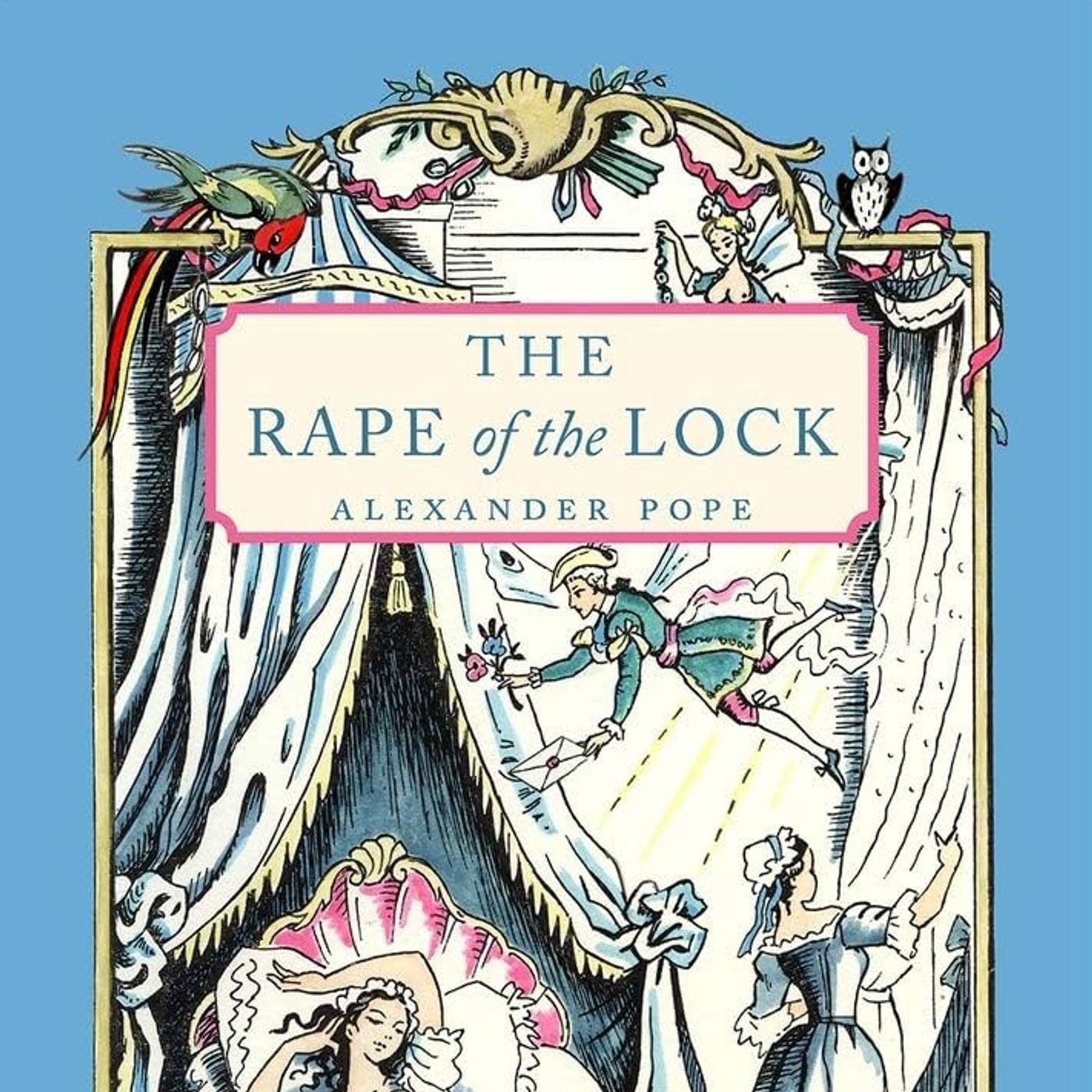
About this episode
You can listen and download our episodes for free on more than 10 different platforms:
https://linktr.ee/book_shelter
Get the Book now from Amazon:
https://www.amazon.com/dp/1912945126?lv=shuf&channelId=500&plpRedirect=mhFallback&linkCode=ll2&tag=cvthunderx-20&linkId=77a6d49b63696336cc6af22f1c02987b&language=en_US&gaOptInStatus=true&ref_=as_li_ss_tl
Produced by Podcai Studio:
https://www.podcaistudio.com/
Get every episode summarized
Each time Book Shelter publishes, we email you a written briefing from the transcript — the topics, who appeared, and any specific claims, with the ad reads skipped.
Email me new episodesFree for 3 shows. No card needed.
Hosts & guests
Transcript ready
266 searchable segments. Every word is indexed and playable.
Full transcript
Book Shelter — The Rape of the Lock. Machine-transcribed; use the interactive transcript above to jump the player to any line.
Welcome to today's Deep Dive. We have a really fascinating one for you today. We are looking at a collection edited by Thomas Mark Parrott. It's called The Rape of the Lock and Other Palms by Alexander Poe. Yeah, and we have a very specific mission for this Deep Dive. We do. We are going to explore this entire book. I mean, every nuanced piece of it, but we're doing it by telling you a single cohesive story. Right. Think of it as the biography of a brilliant, marginalized outsider, a guy who conquered high society with a tale about a stolen lock of hair, tried to map the universe and then basically ended his life at war with the world. It's an incredible arc. It really is. And for you listening, I want you to imagine stepping onto a chaotic, just, brutal battlefield, but you have a condition that makes it completely impossible for you to lift a physical sword. Not even a small one. Exactly. Not even a small one. If you step out there unprotected, you will just be crushed. So what do you do? You build an impregnable, tallying fortress out of words. And you force the rest of the world to fight on your
terms. I hear rules. And to understand the architecture of that fortress, we really have to understand the physical and social reality of the man who built it. Because Alexander Pope was born in London in 1688. And right out of the gate, he faced severe institutional prejudice. Because he was Catholic, right? Right. He was a Roman Catholic in an England that systematically oppressed them. We were talking about a society where Catholics were barred from attending universities. They were excluded from public or political careers burdened with double taxes. Wow. Yeah. And eventually, Pope was legally forbidden to even live within 10 miles of London. So he's essentially an exile in his own country. Exactly. And compounding that social rejection was his physical reality. At age 12, he contracted tuberculosis of the bone, which is known as pot's disease. Oh, that sounds awful. It was a ravaged his spine. He became a humpbacked dwarf. And he reached a final height of just four foot six. He actually described his entire existence as one, quote,
long disease. Yeah. And the sources detail how the daily logistics of his life were agonizing. I mean, he had to be laced into a stiff canvas bodice every single morning just to be able to sit up right. Yeah. And he wore a fur doublet and like three pairs of stockings just to maintain basic body heat. Right. So this is a person who genuinely cannot wield any physical power in an era where, you know, physical presence and aristocratic lineage pretty much dictated everything. But he completely bypassed those traditional gatekeepers. He didn't grovel for a wealthy patron, like everyone else did. Instead, he pioneered a subscription model to publish his translation of Homer's Iliot. Basically, he crowdfunded it. Yeah. People paid up front and he delivered the books. And he became the first English writer to earn a massive fortune. We're talking over 5,000 pounds, which was staggering wealth back then solely from the reading public, which brings us to the first major phase of our story, right? How does a physically frail marginalized outsider, a man whom his enemies would later cruelly mock as an ape or a frog? How does he become the absolute
dictator of English literature? He does it by writing the rule book. Yes. In his early 20s, he publishes this manifesto called an essay on criticism. He just has the audacity to tell the entire literary establishment how to do their jobs. I love that. And his core argument is that true taste, like the ability to judge art correctly, is just as rare as true genius. Right. And he sets up this concept of unhearing nature. He tells critics they have to follow it describing it as this one clear, unchanged and universal light. But I mean, he's not talking about trees and birds here. Is he? No. No. He's talking about an underlying cosmic order. He's talking about the fundamental physics of aesthetics for Pope, the ancient rules of art, the ones established by the Greeks and Romans. They aren't arbitrary constraints. They are in his words, nature, methodized. Okay. That makes sense. Yeah. And he warns critics about the danger of superficial understanding. You write that famous line, a little learning is a dangerous thing, drink deep or taste not the period spring.
Oh, the period spring. That's a reference to Greek mythology, right? A metaphorical spring in Macedonia sacred to the muses, the source of knowledge. It's exactly. So he's saying if you only take a tiny sip, you get drunk on your own perceived brilliance. You have to drink deeply to actually sober up and realize how much you don't know. That's it. Exactly. And part of drinking deeply is learning to look at the whole of a work of art, not just dissecting its parts. Right. Pope absolutely roasts critics who miss the forest the trees. He targets those who judge a poem based solely on like whether the syllables sound smooth. He mocks writers who think a line is profound just because it ends with a predictable rhyme. Like the cooling western breeze and whispers through the trees. Exactly. He also skewers the social climbers. You know, the critics who will praise a terrible poem just because of wealthy Lord wrote it. He demands that a critic must read a work with the same spirit and intent that the author used to write it. Okay, let's unpack this for
a second though. I want to push back on this philosophy. Pope champions this wild universal force of nature, right? Yeah. Yet he spends his entire career obsessing over strict rigid poetic structures like the heroic couplet. And he demands writers imitate ancient Greeks like Homer. Doesn't copy a 2000 year old Greek guy completely contradict the idea of raw natural genius. I mean, it definitely seems like a contradiction to a modern reader. But it really goes to the heart of the 18th century classical mindset. Pope believed that the ancients didn't invent the rules of poetry. They discovered them like physics. Exactly. Think of it like gravity. Isaac Newton didn't invent gravity right. He just observed nature perfectly and wrote down the formula. Oh, interesting. So for Pope, Homer observed human nature perfectly and wrote the formula for epic poetry. The copy Homer is to copy nature. Though Pope does leave a loophole. Poe does he? Yeah, he admits that truly great wits can sometimes quote snatch a grace beyond the reach of art. So breaking a rule
beautifully if it achieves a natural effect is sometimes the tourist form of art. Okay, so he builds this unassailable theoretical fortress. The theory is easy. The real test is application. And that brings us to the centerpiece of the parakelection and really the defining triumph of Pope's life, the rape of the lock. Yes. He is challenged to take his grand rules and apply them to an utterly ridiculous real world crisis. And historical backstories essential here. You have two prominent aristocratic Catholic families locked in a bitter escalating feud. And why are they feuding? Well, at a social gathering, a young nobleman named Lord Peter, snuck up behind the beautiful airbell of firmer with a pair of scissors and snipped off a lock of her hair without asking without asking caused a massive scandal. So a mutual friend of the family's John Carroll goes to Pope and says basically, you're the great poet. Write something funny to laugh these families out of this petty squabble. And Pope's solution is just a masterclass in tone. He takes this trivial society gossip and scales it up into a mock heroic epic. He takes
the theft of a haircut and treats it with the exact same gravity, the exact same soaring language as the fall of Troy. Yeah. And mechanically, the way a mock epic works is by applying massive disproportionate scale to something tiny. And Pope does this by introducing what literary critics call machinery. Right. The machinery in an actual ancient epic, the machinery refers to the gods. Zeus, Athena, Apollo coming down from Madeline Pist to intervene in human battles. Pope decides his poem about a haircut needs gods too. But he doesn't use Greek gods. He uses rose accrucian spirits. He takes this popular, serious occult philosophy of the time, the rose accrucian texts, which proposed an invisible world of elemental spirits and he turns it into a joke. Totally. He populates the drawing rooms of London with sulf, snomes, nymphs, and salamanders. It's like a filmmaker taking a grand booming Hans Zimmer cinematic score and playing it over a video of someone making a cheese sandwich. The sheer mismatch is the joke. That's a perfect analogy. Let's
track how he builds this mismatch through the cantoes because cantoiae opens it noon. Noon, rup starts the day. Right. Our heroine, Belinda, who is the stand-in for Arabella firmer, is just waking up. Her guardian self, Ariel, whispers a dire prophecy into her ear that some dread event is impending. But then her lap dog wakes her up. She reads a love letter and the cosmic warning just evaporates from her mind. Of course it does. She sits at her dressing table and Pope describes her makeup routine not as a mundane chore but as a sacred, ancient religious right. Yeah, she is the goddess and her maid is the inferior priestess making offerings at the altar. She has perfumes from Arabia and comes made from the transformed bodies of the tortoise and the elephant. I mean, the global trade empire of Britain is being distilled down just to put some powder on her face. Brilliant. Then, in canto the second, Belinda sails down the silver tams. Pope describes her beauty outshining the sun itself. She has two perfect locks of hair resting on her neck and the barren
sees them and vows to take them. And now he prepares a so deeply satirical, he builds an altar out of 12 French romance novels, sets them on fire and prays to the powers of love. Yes. An Ariel, the guardian self, senses the danger. He summons an army of transparent, glittering spirits to protect Belinda. He actually assigns 50 selves just to guard the perimeter of her massive hoop pedicote. 50. He stations efferred to guard the fan, reontated guard the diamond earrings, momentilla on the watch, and a spirit named Chris Bisa is assigned to the sacred lock of hair itself. It is so funny because he creates a hoop pedicote like the walls of a besieged city, which brings us to canto the third at Hampton Court Palace. Before the dreaded scissors even appear, Pope stages a battle. Right. But because these are pampered 18th century aristocrats who have never seen a real battlefield, their war is a card game called Ombre. Pope treats the playing cards like warring nations on a velvet plane. Belinda declares spades as trumps. She leads her
matadors, which is the term for the three highest ranking cards, capturing enemy after enemy. It's so intense. But the barren counter attacks with his diamonds. It looks like Belinda will lose until her king of hearts falls like thunder on the barren's ace. She wins the hand and fills the sky with shouts of triumph. But you know, hubris always proceeds the fall. Coffee is served. Pope notes with heavy irony that coffee makes the politician wise. As Belinda bends her head over the steaming cups, a jealous woman named Clarissa maliciously hands the barren his weapon. This is her. The two edge weapon. And the spirits go into an absolute frenzy. A thousand sprites blow back Belinda's hair. They twitch her diamond earring trying desperately to warn her. But Ariel peers into Belinda's mind and sees an earthly lover lurking in her thoughts. He realizes she isn't perfectly pure. And therefore he loses his supernatural power to protect her. Right. The magic fades. The barren expands. The glittering forceps. A wretched silt jumps directly between the blades to save the hair and is literally cut in twain. Oh no. Though Pope dryly notes that
being a spirit he instantly heals, the blades close, the lock is severed. Belinda screams with a horror that Pope says is usually reserved for when husbands die or more importantly to this society when of which China vessel falls and shatters. Oh that line is just the core of the satire. Placing the death of a husband on the exact same emotional level as a broken base, it exposes a society whose values are completely inverted. Completely. And that sends us into canto for the aftermath. Umbrill, a melancholy gnome flies down into the gloomy cave of spleen, which is the surreal psychological underworld ruled by a goddess with a migraine. It's so bizarre. It is. It's where people are deformed by their own anxieties. Umbrill sees living teapots, a sighing jar, a talking goose pie. He gathers a bag of female size tears and the war of tongues and dumps it over Belinda's head. And her grief just turns into rage. Her friend Philestris fans the flames warning that Belinda's honor is lost. She sends her boasts her plume who is a completely vacuous man, very proud of his
amber snuff box and clouded cane to demand the hair back. And how does that go? Well he taxes box scammers out a week, zalz, damn the lock and the barren just flatly refuses. So in canto v diplomacy fails and a literal battle of the sexes breaks out in the drawing room. Fans clap like shields, silks, rustle, whalebone corsets, crack men are dying, but they are dying in metaphor. Right, they're slain by a harsh word or revived by a smile. Exactly. Belinda herself attacks the barren, but she doesn't use a sword. She subdues him by throwing a charge of snuff right up his nose. Brilliant acting. While he is sneezing uncontrollably, she draws her deadly weapon, a bodkin, just a decorative hairpin melted down from her great grandfather's rings. She holds it to his face and screams, restore the lock. But the lock is gone. It was lost in the chaos of the scuffle. So Pope ends the poem by telling us the lock shot up into the sky, drawing a radiant trail, transforming into a sudden start to be viewed through Galileo's telescope. It achieves immortality. Wow. And what's amazing is that editor parrot includes the original 1712 first edition in the
appendix of this book. You can see that Pope added all of that supernatural machinery, the silks, the cave is spleen years later. He woven in so seamlessly that it feels foundational to the text. So what does this all mean though? I mean, the editor calls this a lighthearted poem, but wasn't a woman's honor and reputation in the hurtless society of Queen Anne's day actually a matter of social life or death. Yes, that's the profound a double-edged to Pope satire here. Yes, he is mocking them. But society treated women as frivolous dolls. He had punished them ruthlessly for the slightest breach of convention. Exactly. Losing a piece of herself in public to a man, having him paraded around as a trophy that was genuinely devastating for arabella firmers reputation. Pope captures his paradox beautifully. By elevating this haircut to the level of the Trojan war, he highlights the absurdity of the rules. But by giving Belinda's grief such epic cosmic proportions, he secretly validates her tragedy. He takes her very real, very human humiliation and makes her
loss immortal in the stars. It's an incredible balancing act, and the runaway success of the rape of the lock makes Pope the center of the literary universe. So having conquered the rules of literature and the rules of society, he moves to the next phase of his life. He goes bigger. He decides to map the rules of the cosmos. Guided by his friend, the philosopher Lord Bullingbrook, he writes an essay on man. Yes, it's the massive shift in scope. We go from the trivialities of the drawing room to the eternal laws of Providence. If we connect this to the bigger picture, in an essay on man, Pope articulates a philosophical concept of the great chain of being. Which is what exactly? This was the prevailing idea that the universe is a vast perfectly interconnected, rigid hierarchy. It extends from God at the very top, down through the angels, to humans, to beasts, to insects, all the way to microscopic life. Okay, so Pope argues that human beings are exactly where they are supposed to be on this chain. If we lack the raw physical strength of a bull or the microscopic vision of a fly,
it's because we aren't meant to have them. Our place in the hierarchy is perfectly calibrated by a divine creator. Right. For Pope, the ultimate sin is pride in reasoning pride. It is human arrogance to demand to understand the mind of God or to complain that our lives are imperfect or painful. Pope tries to rationalize suffering by arguing that what we perceive as evil or pain is just a localized shadow in a massively brilliant painting that we are too close to see. Like we're just looking at one brushstroke. Exactly. The grand conclusion of the poem is that all partial evil, universal good, and his most famous controversial decree, whatever is, is right. Think of this great chain like a highly delicate ecological web. Pope warns that if you strike any link in nature's chain, whether it's the 10th link or the 10,000th, the entire chain breaks, if humans try to rise to the level of angels, or if we complain about our lot, we pull the whole universe out of balance and collapse it into chaos. He is building a philosophical fortress now, finding a logical rationale for why things are exactly the way they are.
But there is a glaring, tragic flaw in Pope's philosophy here. A huge one. Right, because whatever is is right is a very beautiful thing to write, but it's a nearly impossible thing to live when your own life is deeply fundamentally painful. Exactly. He writes that the universe is perfect, yet he steps outside his door and faces a world that relentlessly attacks him. His massive success bred vicious, jealous enemies. He hated him. They did. And they didn't just critique his poetry. They attacked his morals. They attacked his Catholic family. And brutally, they attacked his crooked spine. They mocked him as a mutant, a mistake of nature. He can't reconcile his beautiful philosophy of a perfect universe with his ugly reality, which forces him to go on the attack. Right. And this brings us to act fourth of our story. His defense, the epistle to Dr. Arbuthna, which is framed as a letter to his dying friend, but it's really Pope pulling up the drawbridge to his fortress and firing cannons at his enemy. Oh, he fires everything he's got. He describes being practically under siege at his home in Twickenham. Mad aspiring poets are
breaking through his thickets, stopping his chariot, begging him to read their terrible plays. He portrays himself as a weary, patient man, exhausted by fools. He defends his parents' gentle, honest people and claims that he only ever uses his pen to attack the proud and the wicked. But when he does attack, he is surgical. He writes a portrait of the great writer Joseph Addison, calling him Atticus. He describes Addison as a man who gives faint praise. A man who loves to teach, but is too jealous to ever share the throne of wit. It's a critique of intellectual cowardice. But that is incredibly mild compared to how he annihilates the courtier, Lord Hervey. Yeah. Lord Hervey had publicly mocked Pope's physical deformity and his low birth. In response, Pope writes the character of Sporus. And he strips away all of Hervey's aristocratic glamour. He calls him a white curred of asses milk, a painted child of dirt. He calls him an amphibian half-roth, half venom. He compares him to a toad squatting at the ear of Eve, spitting venom, which was a direct reference to Hervey whispering malicious gossip into the ear
of Queen Caroline. And notice this specific imagery Pope uses there, dirt amphibians, toads, asses. He is using the great chain of being as a weapon. Oh, how so? Well, Hervey might be higher than Pope on the social chain because of his aristocratic title. So Pope pushes him down the biological chain. He reduces Hervey to an insect, to a toad, to something fundamentally repulsive and subhuman. That is fascinating. But let's call it what it is. It's immense hypocrisy. Pope just spent the first half of the poem claiming he never attacks virtue. He hates slander. He's above mud-slinging. But calling someone a white curred of asses milk is the definition of a petty, vicious insult. It really is. He abandons his grand philosophy of nature and whatever is is right just to settle a personal score. It is hypocritical, but I mean, it reveals the deeply wounded human being inside the fortress of words. Survival in 18th century literary London was a blood sport. Pope's physical frailty meant he couldn't defend his honor in a duel with a sword or beat someone with a cane, which was how a gentleman often settled disputes back then. His reputation,
his pen, was his only armor. When Hervey attacked his deformity, the very thing that caused Pope constant agonizing physical pain every single day, Pope used the only weapon he had. He made sure history would remember Lord Hervey not as a powerful courteer, but as a toad. The war takes a toll, though, which brings us to the final act of his life, and the closing pages of the paracelection, the endless battles with the critics, the denses, the politicians, it simply exhausts him. The final pieces show Pope's closing visions of the world and more intimately, his closing vision of himself. Yeah, the editor includes the descend of Dullness, the apocalyptic finale to Pope's massive satirical epic The Dense Add, and the scene is just chilling. It really is. Despite all of Pope's lifelong efforts to organize the world through rules, reason, and classical order, his final vision is the total victory in stupidity. He sees night primeval and chaos old, restoring their empire over the earth. Art dies, truth flees to a cavern, religion blushes, morality expires, the curtain falls, and as Pope writes in the final
devastating line, universal darkness buries all. It is so grand, so theatrical and utterly bleak. He sees his entire life's work being washed away by a tide of cultural ignorance, but Parrot brilliantly follows that apocalyptic darkness with two incredibly quiet tender poems. First, Pope's epitaph on gay, written for his late friend, the Poich on gay. Pope praises him for having, in wit, a man, simplicity, a child. That's lovely. It reminds us that behind the vicious satirist who destroyed Lord Hervey was a man who loved his friends deeply and fiercely. And finally, Parrot ends with the ode on solitude. A poem about a man who just wants to live on his own few acres, breathing his own native air. Pope writes of his deep desire to live unseen, unknown, and to die un lamented, without even a stone to tell where he lies. And here's where it gets really interesting, free listening. Think about the profound contradiction there. The man who wrote the ultimate glittering society poem, The Rape of the Lock. The man who fought the loudest, most public, most vicious battles in the epistle to Dr. Arbuthnott,
secretly at his core, just wanted to steal away from the world and be entirely unseen. It perfectly encapsulates the tension of his entire existence. The ruthless public warrior who dictated the taste of a nation and the private, suffering man who just wanted peace. Let's step back and look at the journey you've taken through this book today. We started with a sickly marginalized boy who forced the world to play by his rules and the essay on criticism. We watched him master those rules as a brilliant storyteller exposing the absurdities of society by elevating a stolen lock of hair into an immortal constellation. A true masterpiece. We saw him try to become a cosmic philosopher, justifying a painful universe through the great chain of being. And finally, we watched him turn into an embattled, exhausted satirist, fighting a losing war against the darkness of dullness before retreating into a desire for total solitude. He built a legacy that defined the classical spirit of the 18th century, a true fortress of words. But I want to leave you with a final lingering thought. The editor of this collection,
Thomas Mark Parrott argues that Pope's work lives on today because of his conscious and controlling art. He says Pope was the absolute master of control. But looking at the story we just told, doesn't this entire book actually chronicle a man desperately trying and ultimately failing to control a chaotic world? That's a great point. He tried to organize a petty society feud into a neat epic narrative. He tried to organize a chaotic, painful universe into a neat, great chain of being. But by the end of his life, his control slipped. He saw universal darkness burying it all. Think back to that man who couldn't lift a physical sword, who built a fortress of words to protect himself. Perhaps Pope's true genius wasn't in successfully organizing the world. Perhaps his genius was in writing so beautifully, so fiercely, and so honestly about his total failure to do so. What do you think?
More episodes


