Loading...
educationlanguagelearning
The Real Cost Of Green Energy (B2+) Ep 851
About this Episode
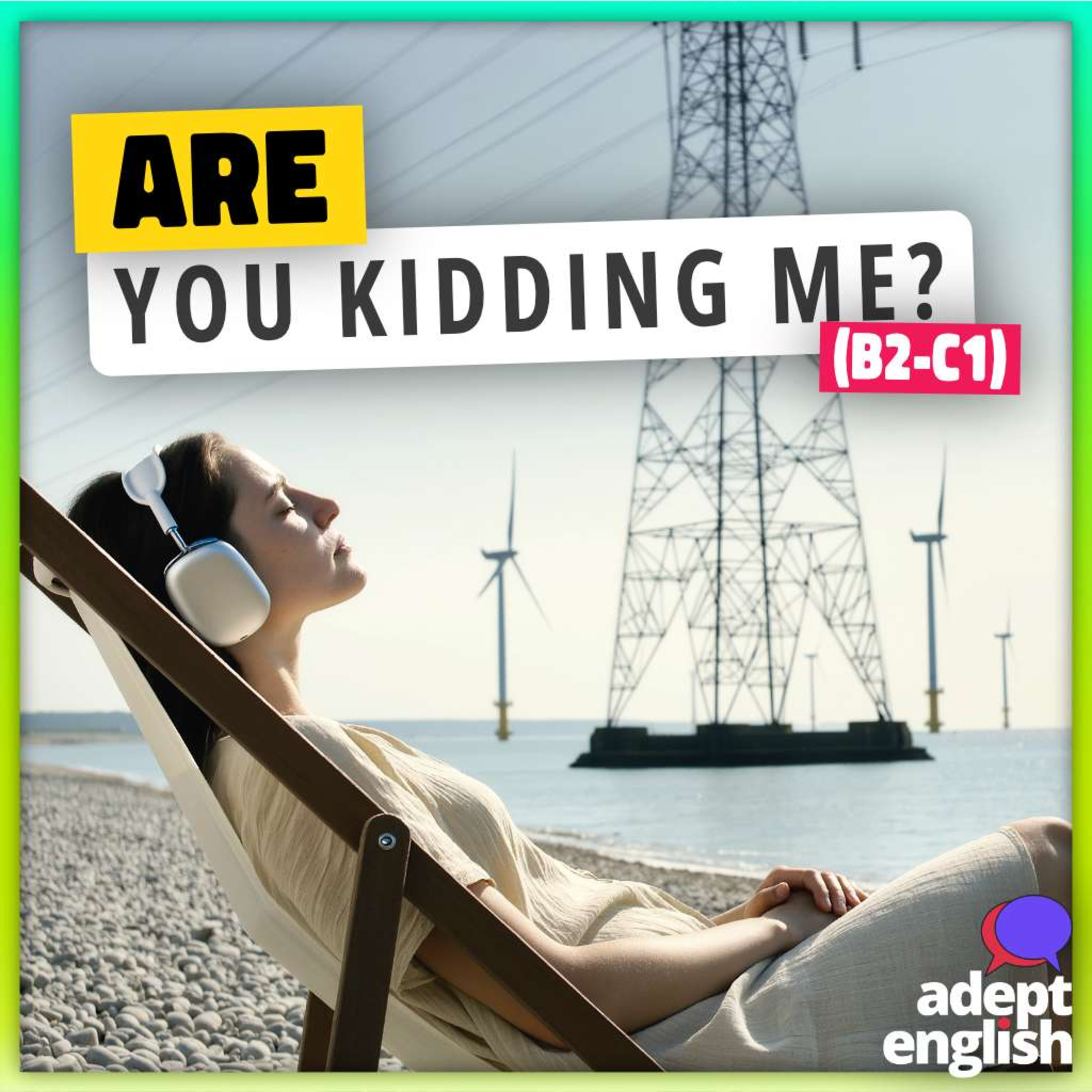
Have you ever noticed how different countries are racing to generate clean energy, but sometimes the biggest challenge isn't the wind or the sun? It's what we build to carry that power. In today's podcast, we'll explore the fascinating world of green energy and the surprising things holding it back in the UK.
Subscribing is simple and works on your mobile phone.
Just visit our FAQ page or click the links below to start listening to 8 new, ad-free episodes every month. FAQ and Help https://adeptenglish.com/faq/subscription-faq/
Spotify https://podcasters.spotify.com/pod/show/adeptenglish/subscribe | Apple Podcasts https://itunes.apple.com/gb/podcast/learn-english-through-listening/id1134891957
We’ll https://adeptenglish.com/company/learning-system/ useful words like infrastructure, the physical systems that make things work, and pylon, those giant structures that carry electricity. We’ll explore the puzzle of a full electricity grid and the very human reasons why building new things can be so difficult. This is your chance to learn the real https://adeptenglish.com/language-courses/ used in global conversations about our planet's future. Press play and let’s start.
LearnEnglish #GreenEnergy #BritishEnglish #EnglishListening #ESLPodcast #RenewableEnergy #VocabularyBuilding
Hosts & Guests

Transcript
We all love to use these, don't we? Or whatever that looks like in your country.
So let's talk about green energy today. Something many of you are keen on, as am I.
And let's talk specifically about wind energy. That's electricity generated by wind and
wind turbines. That's T-U-R-B-I-N-E or giant windmills. The UK is
pretty good at wind energy. We have wind turbines, offshore, that means in the sea,
onshore, that means on the land. And wind power now provides more than 30% of the UK's
electricity. How good is that? We like clean energy. Unless dependence on, well,
whatever country is supplying our gas at the moment. Unless dependence on fossil fuels.
Things like coal, oil and gas. All those bad things that create more CO2.
But something is holding us back. From being able to use more wind energy. That's in the UK.
But it's probably the same in your country too. What is it? Let's find out more today.
I'm Hillary and this is a Learn Through Listening Podcast. We're all about helping you to
learn English through listening. With interesting topics, things that make you think. Things that
maybe make you a bit cross sometimes. They do me. And I'll definitely give you words and phrases
that you'll actually use. Real English. So you can enter the conversation about green energy
in English. Don't forget to listen a few times to let the new word sink in. So while in the US,
Donald Trump is doing his best to shut down green energy projects. In the UK and the rest of
Europe, we want to make more use of wind energy. Not less. What is holding us back? Well,
the wind is free. But the infrastructure that surrounds wind energy is not. That word infrastructure,
infra, INFRA and structure, S-T-R-U-C-T-U-R-E, infrastructure is a great word. It means the
structures around something, the physical things which help a system to work. And here we're talking
about all the things which are needed to store and transport electricity around. You could also
talk about infrastructure in the context of transport. You might mean roads and bridges,
roundabouts and motorways. They're all infrastructure. But for wind energy, we mean wires or cables,
pylons and substations. They're the little junction boxes that distribute the electricity. A
Pylon P-Y-L-O-N is a huge metal structure which supports overhead electrical wires or cables.
You can see pylons all over the countryside. In the UK, we have a particular design,
but they look different in different countries. The ones in France make me smile. They look like cats.
And apparently, they're called pylons chat or cat pylon. In the US and other English-speaking
parts of the world, pylons are also called transmission towers. What do we call a group of
wind turbines? Well, you might call it a wind farm. We are farming the wind, in other words.
And the silly situation is that currently, we pay a lot of money to wind farms in the UK
so that they'll switch off their turbines or stop generating electricity. We pay them to switch
off. That sounds mad, doesn't it? It's like owning a bakery and paying the bakers to stop baking
even when people are hungry. So why do we do that? Well, apparently it's our national grid.
The national grid is the network of wires and cables and pylons and substations
that carry electricity around the UK. And the problem is it's full, congested. Imagine a motorway
full of cars. Absolutely jammed. No one can go anywhere and the system doesn't work. Sometimes
you don't have to imagine that in the UK. It's the reality. I'm afraid. And with our electricity,
it's the grid, GRID. The national grid is at capacity. It's full in other words.
And a grid with too much electricity becomes unstable. So you have to switch the wind farms off.
And the wind farms are paid by the government to do this, to turn off. Apparently this cost
billions of pounds every year. How crazy is that? The solution on paper is simple. We need more
infrastructure, more cables, more pylons, more substations from windy Scotland and the North Sea,
where a lot of wind energy is generated. We need to carry it down to London and to the other
big cities where it's needed. A national grid in the UK have announced a big update called the
Great Grid Upgrade. This is 17 major projects, costing 19 billion pounds. And it's the biggest
change to our electricity infrastructure since the 1960s. But, and there's a big bot. The electricity
pylons and the wires have to go somewhere. And that somewhere is often the British countryside.
The parts we see as beautiful and peaceful and as ours. The British countryside really is a
beautiful thing. So people get angry about pylons spoiling the view. We have an acronym in English.
An acronym is a set of letters like DNA that stand for something. And the acronym I'm thinking about
here is NIMBY. You talk about a person being a NIMBY. That stands for not in my backyard.
Referring to the fact that while most of us support green energy,
none of us would want a new electricity pylon in our backyard or our back garden,
as we're more likely to say, in UK English. And this reflects people's opinions. 70% of people
in a recent British social attitude survey supported building more onshore wind farms. So that's
wind turbines on land. But when the same people were asked about making it easier to build pylons
that carry that wind power, support dropped to 45%. We don't like electricity pylons.
People can feel that pylons spoil the landscape, spoil their view. And for people in towns and
villages who face new, enormous electricity pylons marching across their hills and their land,
it's a big problem. There's a plan in Wales at the moment to build new pylons across the land
in Camarvanshire and Powis. Beautiful rural areas. But farmers there have ended up in court.
For refusing to let surveys happen on their land, these are family farms. Often they've been
farmed for generations, hundreds of years. And suddenly you're telling them they'll be a 50
meter pylon in your view. In fact, they'll be 10. So to be a two has come home to Disney plus.
Let's go. Get ready for a new case. We're the greatest partners of all time. New friends.
Do it this night. And your last name? This night. Dream team.
Get new habitats. Utopia has a secret reptile population.
You can watch the record breaking phenomenon at home.
Zotopia 2. Now available on Disney plus rated PG. Here right now you can get Disney plus
in Hulu for just $4.99 a month for three months with a special limit to time offer ends March
24th. After three months playing auto renews at $12.99 a month terms apply.
Everyone says not in my backyard. There's a danger of all of us becoming nineties.
By the way, if you'd like more English content to practice with, more episodes, more vocabulary,
more fascinating topics, we do have a subscription service. Eight extra episodes, two per week.
Completely add free. And if you'd like a more structured course,
a depth English has two brilliant ones for you. The most common 500 words course will ensure that
you've got all the basic vocabulary covered. You may be surprised by what gaps you have.
Our other popular course is activate your listening. That course prepares you for
listening, understanding and speaking in English conversation. For all of these go to
adeptinglish.com. Click on the word subscription or go to our courses page.
So the nimbis and the farmers and the local people would like the cables to be put underground
instead. Sounds reasonable, doesn't it? Except that underground cables cost between four and
eleven times more money than using overhead cables and pylons. That's not a small difference,
is it? In Wales they're saying that full undergrounding of the cables would mean hundreds of
millions of pounds additional cost. So it's not going to happen. People want green energy,
they want energy independence, lower bills, all of that. But they don't want the infrastructure
in their backyard. One area of the UK where this infrastructure was proposed, but forward as an
idea, the Norwich Tilbury line. That's in the east of England. When they asked for feedback,
they got 20,000 lots of feedback from people. Complaints if you like about the plan. But they
managed to arrive at a compromise, the middle ground. There will now be an underground section of
cables that goes through an area of outstanding natural beauty. Spring starts at the Home Depot,
and we are bringing the heat to your backyard this season. Fire up the flavour with our wide
variety of grills for under $300, like the next grill for burner gas grill that's perfect for
hosting your spring cookout. Then set the scene and turn your outdoor space into the go-to spot
the patio sets for every budget. Bring it this season with grills that deliver flavour and
patios that set the vibe from the Home Depot. Start your spring with low prices guaranteed
at the Home Depot. Exclusions apply to home Depot.com slash price match for details.
It's called Dead and Vale, and nobody wanted to spoil that bit of the countryside. So it can work
with compromise through negotiation. The UK government has proposed that people living near the
new electricity pylons could receive £2500 off their energy bills over the next 10 years.
It's a sweetener. Something sweet to make a difficult situation easier to accept. But for most
people, this won't be enough. There's the worry, of course, that electricity pylons and overhead
cables cause illness in humans. It's not been proved yet, but then these things are hard to prove.
So it may be a matter of time. There's a worry about cancer and about the effect on hormones
in people living near pylons. What I must say, when I go for a walk near our house,
I notice that the land where the pylons carry electricity cables overhead, well, nothing
much grows on there. It's as though the plants don't like it. So I do understand that worry,
I wouldn't like an electricity pylon to be put up in my garden, or overhead wires
going over the top of my house. But where it's about pylons spoiling the view,
unless it is an area of outstanding natural beauty and AOMB, maybe we just have to get used to
those pylons. I used to think that wind turbines were really ugly, but I've trained my eye just
to accept them as part of the landscape. Maybe we have to do that with the new electricity pylons.
Demand for electricity is only going to go up. It's estimated it'll rise by 50% by the year
2035. It seems we may all be driving electric cars and heating our homes with heat pumps by then.
And then there's all those AI data centers. Well, I'm rather hope they don't get built,
but we can't escape the fact that if we don't upgrade the grid,
are going to be in trouble. A report on the website Electric Insights suggests we should learn
from the Victorians. They say the Victorians built big with railways and sewer systems that caused
big disruption at the time, but which infrastructure benefited the UK for over a century. The word
sewer SEWER means all those pipes on the ground that take away our waste water. And the UK's
Victorian sewer system is a beautiful thing. Most of it's still operating today. So let's learn
from the Victorians and rather than continuing to pay lots of money to wind farms so that they
can turn off their turbines, let's build a grid which is going to support us for decades to come.
I bet you're having some of these problems in your country too. It won't just be the UK.
A quick word test to practice your English. Can you explain the following words in terms?
Winterbine. Onshore. Offshore. Bottle fuels. Infrastructure. National grid. And lastly,
a NIMBY. Answer those questions in English, of course. And well done if you can. If you can't,
you know what to do. Listen again. Anyway, the next time you're driving through the countryside
and you see lots of pylons, maybe you'll look at them a bit differently. I know I will.
More from Learn English Through Listening
View all episodes →
STOP Doomscrolling There Is Good News [Learn English Through Stories] Ep 856
Learn English Through Listening
Apr 6, 2026·13:53·failed

The Myth of Boring Language Learning [Advanced English] Ep 855
Learn English Through Listening
Mar 30, 2026·14:25·queued

