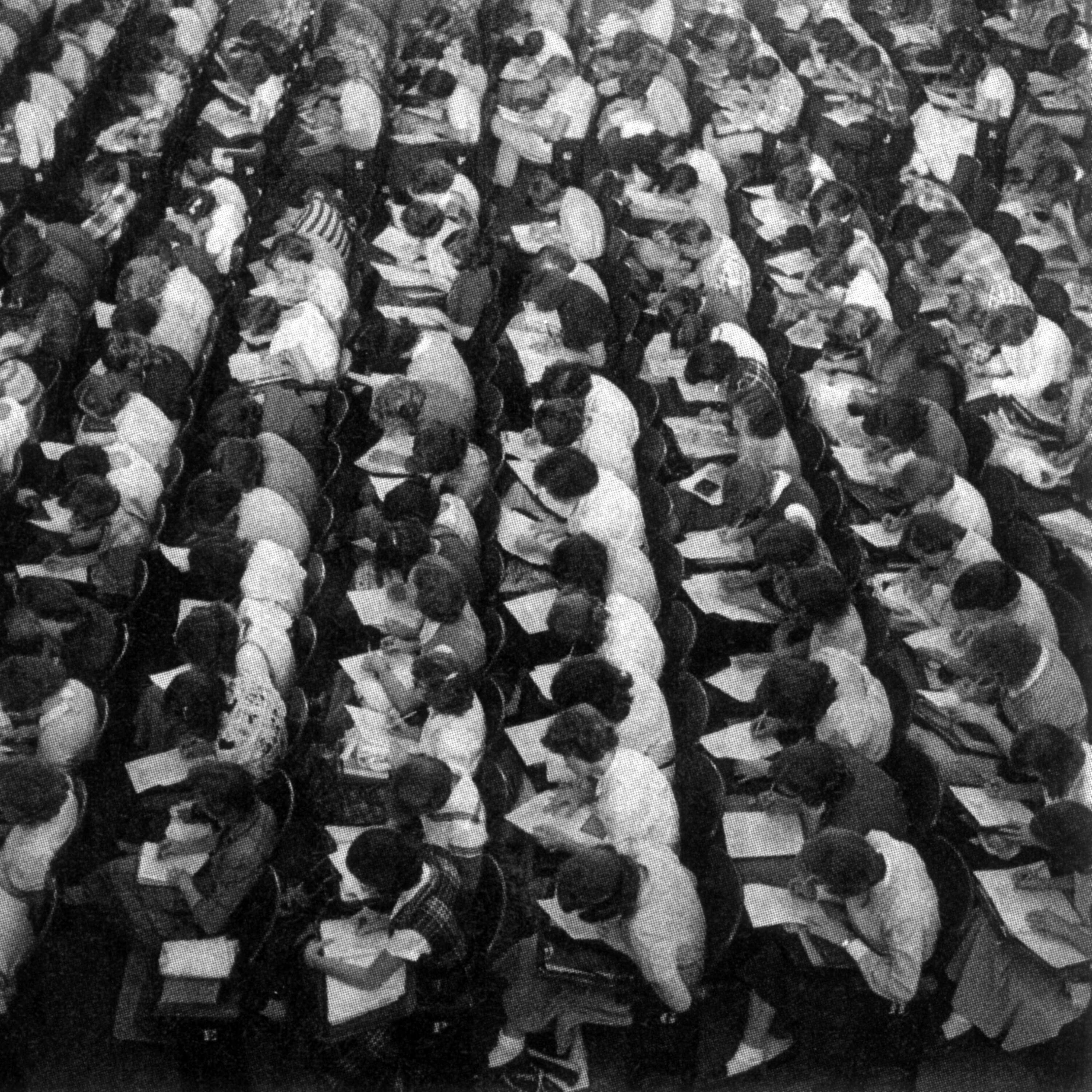
About this episode
Throughline is made possible by:
Guests:
Nicholas Lemann, author of The Big Test and Higher Admissions
Support public media with NPR+ and enjoy perks for over 25 podcasts like this one. This show’s perks include sponsor-free listening. Learn more at plus.npr.org.
See pcm.adswizz.com for information about our collection and use of personal data for sponsorship and to manage your podcast sponsorship preferences.
NPR Privacy Policy
Get every episode summarized
Each time Throughline publishes, we email you a written briefing from the transcript — the topics, who appeared, and any specific claims, with the ad reads skipped.
Email me new episodesFree for 3 shows. No card needed.
Hosts & guests


Transcript ready
246 searchable segments. Every word is indexed and playable.
Full transcript
Throughline — The SAT's 100-year grip on higher ed. Machine-transcribed; use the interactive transcript above to jump the player to any line.
This message comes from Capella University. That spark you feel? That's your drive for more. Capella University's Flex Path Learning Format lets you earn your degree at your pace without putting life on pause. Learn more at Capella.edu. Um, out of curiosity, do you remember your SAT score? I do, yes, and I have chosen not to say in public what they were. Why don't you like sharing what you got on the CT? I don't want to, you know, contribute to the culture of making it a super important thing about you. I bet it free to out a little when I ask that question. Don't worry, you don't have to share your score either. I'm not sharing mine. I used to live in Texas, and somebody told me once never ask a rancher how many acres his ranch is. And I said, why is that?
And he said, well, it's like asking somebody to tell you the how much money they have. And in certain parts of American culture, asking for SAT scores is a little bit like that. That's Nicholas Lemmon. He's written two books about the SAT, and he'll answer any question you have about it, except a score, even more than 50 years after taking it. It's kind of weird how clearly I still remember the drives to and from my SAT prep class, probably because I was so nervous that I was going to end up bombing on the exam. The stakes felt really high, and my first go at it, heading on great. Embarrassing fun fact, to calm my nerves, I would blast Rihanna's dysterbian the car on the weight of the class, singing at the top of my lungs. I know I was so much better. I know I was so much better. I know I was so much better. And you know how sometimes people will reassure you when you're nervous and say, don't worry about it, it's not that big of a deal. It's not like your whole future will depend on this thing.
Well, no one could really say that to me with a straight face, because for sure, it didn't entirely depend on this one exam, but it could make some difference. And in hindsight, I recognize how lucky I was to be able to take that prep class, to be able to afford to take the SAT twice, to try to get a better score. And the fact that college was just assumed as a given in my house growing up. But what I never really thought about at the time was why I had to take the SAT in the first place. Like who decided this was the best way to filter students for higher education? I'm Rannabdir Fetthach, and this is through line from NPR. For the last few months, we've asked you our listeners to write or call in with questions or topics you can't stop thinking about. And today's episode was inspired by Jory Baker, a computer science teacher in Colorado, asking about the college board, you know, that nonprofit testing company that drives the educational assessment of America's students. Jory asked, how do we get here?
So we drilled down on the one big test the college board is most famous for, the SAT, which it turns out was first administered a hundred years ago on June 23rd, 1926. We'll get into that history after a short break. This message comes from Sotfa. Back to school takes a lot of energy, focus, and stamina. Not just for the kids, but for the teachers and parents too. And that requires deep restorative sleep. The kind that every Sotfa mattress is designed to provide, because every tomorrow starts the night before. And now save up to $625 on $1,000 or more at satfa.com slash NPR. That's s-w-a-tv-a.com slash NPR. This message comes from BetterHelp. Imagine carrying a backpack every day. Inside it, every conversation, every mistake, every expectation. It is easy not to notice how heavy it is until someone asks if you want to put it down.
Sometimes feeling better starts exactly like that. Better isn't one size fits all. Better is personal. It's therapy tailored to the individual to help lighten what you carry. Match with a therapist who truly understands. Visit BetterHelp.com slash NPR. Support for NPR and the following message come from FX's The Drop, a Snowfall saga. Wanda and Leon are back, but this time they're chasing a different kind of legacy. As West Coast's rap begins to take over 90s Los Angeles, Wanda is betting on a new generation of artists ready to make a name for themselves in hip hop. But in a city where every opportunity comes with a price, they'll have to decide what they're willing to risk to leave their mark. FX is The Drop, premieres September 8th on FX and Hulu. A host of unemployed citizens face the grim problem of existence and an equally great number of soil with little return.
1933 America reaches the absolute bottom of the Great Depression. The stock market crash has sent millions across the nation into unemployment and poverty. Only a foolish optimist can deny that God's realities are the moment. But the ultra wealthy, the old moneyed class, cushioned by their generations of wealth, remained largely unaffected. In 1933, they retained power through the strength of their connections. Some or many of those connections solidified in the nation's elite colleges. This whole system doesn't sit right with the new president of Harvard University. So 1933, a man named James Conan became president of Harvard. He came from, by Harvard president's standards, a modest background. Middle class, the son of a small business owner. And as he looks over the student body from his wire-rimmed glasses, he doesn't like what he sees.
He had this very strong feeling that the wrong kind of people were going to Harvard and that that had to change. America's elite universities, particularly the private ones, were completely dominated by preps. White Anglo-Saxon Protestant tended to be from the big cities, especially of the East Coast. And they were sort of culturally dominant in these schools. He was very worried about this sort of preppy aristocracy. It wasn't very competent running America. He thought the urgent situation of the Depression demanded a sort of better class of leaders. And he thought this was a real sort of crisis. Conan's whole idea about lifting people up based on merit is an idea he borrows from Thomas Jefferson, something Jefferson dubbed the natural aristocracy.
There is a natural aristocracy among men. The grounds of this are virtue and talents. The natural aristocracy, I consider, as the most precious gift of nature for the instruction, the trust, and government of society. Conan and others loved quoting that passage. For a middle-class guy like Conan, now in a position of power and influence, he's obsessed with this idea of a natural aristocracy. And he's ready to reform, first that Harvard, then the IBS, and then all universities. He thinks there must be this untapped talent in far-flung corners of America. And worries that at this very moment, there could be... people of extraordinary intelligence who would spend their life walking behind a mule and a plow, you know, instead of making great scientific breakthroughs and so on. But how do I identify these natural talents, pluck them from behind the plow of America to come study at Harvard?
How could you possibly identify the hidden gems lost in the education system? Conan calls his assistant Dean Tez House for lunch, a guy named Henry Chansey, and he's like, I want you to go around the country and find a test that I can use to identify these new scholarship students that I want to bring to Harvard. I want something that is background-free and curriculum-free. That's the test I'm looking for. Conan's dream is to find more people like him, super smart white men who didn't come from East Coast generational wealth or a private school pedigree. And his dream collides with a new way of thinking that's sweeping through academic circles in the US. A new theory was taking hold in the early 20th century that things like intelligence, morality, social worth are fixed, determined at birth.
And that society can be engineered by encouraging certain people, namely white able-bodied people, to pass down their genes. It was called eugenics. The standard position of a member of the Liberal establishment of prominent academic and an Ivy University was to be sympathetic to the eugenics movement. And remember, this is pre-hidler, right? And you're a professor at Columbia, the University of where I work. Do you wake up in the morning and say to yourself, it is unacceptable that women can't vote in this country and that the South has the Jim Crow system. We'd want them to think that. Almost none of them did think that. You know. Around this time, American psychologists were trying to figure out how to measure a person's lifelong potential. And the US military was super interested in the research.
There was a whole bunch of IQ enthusiasts who, one of their big victories, was persuading the United States Army to administer an IQ test all military inductees in the First World War. Let us organize our strength and keep the torch still living, be planning throughout the world. America has never lost the world for freedom and with God's help we shall not fail now. During World War I, they turned to the IQ, the intelligence quotient test. For the Army, it's an ideal way to quickly sort recruits, determine who had the aptitude for an officer role, the ability to tackle technical assignments, from those who should be regular soldiers. One of the founders and administrators of this test was a man named Carl Brigham. Carl Brigham is a 30-something psychology professor at Princeton. He's held a seat on the Advisory Council of the American Eugenic Society. And he's tasked with analyzing the raw data of those military IQ tests.
And he concludes that they're pretty successful at identifying key traits of new soldiers. So he wants to continue this research. And he turns to another institution with large amounts of people available to sort, schools. And he hooks up with an association that's in charge of standardizing college admissions, a group made up of mostly elite East Coast universities, the College Board. And they hire him to develop a test to measure the aptitude of high school students. You know, it's the idea that you can have two, three hours with a person and understand their lifelong intellectual potential. Now that's arguable, but just the thought that you could do that was very dramatic. Brigham's IQ testing of high school students, mostly in the Northeast, is experimental, purely for research. But in late 1933, the stars align. Remember that assistant Dean Henry Chansey that James Cohnet had sent out looking for the perfect test?
Well, he comes across Brigham's research. And James Cohnet was looking for this aptitude test to make his dream of meritocracy a reality. He hears about what Brigham is pioneering, and he's excited to try it out. So he decides to find 10 scholarship students to enter Harvard in 1934. It was a multiple choice test as it is now. It didn't have any essays or writing component. But it was, you know, reading comprehension, there was a math component. It wouldn't be entirely unfamiliar to people who've taken the SAT now. The exam goes out to public high schools in the far corners of America. And to the East Coast College crowd, that means the Midwest. The way it was offered was to say to the high school, this a chance to go to Harvard on scholarship. So it's not for the entire student body. It's for, you know, who you think might take advantage of that. With results in hand, 10 scholarship students are selected. All but two get elected into Harvard's Honor Society, Phi Beta Kappa.
And with success on his side, Cohnet repeats the process. By 1937, Princeton, Columbia, and Yale are convinced to use the exam to identify their scholarship students. The irony, as the SAT is gaining momentum, the man who started it all is having second thoughts. In 1934, Carl Brigham, the creator of the test, writes in an unpublished manuscript. The test movement came to this country some 25 or 30 years ago, accompanied by one of the most glorious fallacies in the history of science, namely that the tests measured native intelligence purely and simply without regard to training or schooling. I hope nobody believes this now. What Brigham wants people to understand is that the test measures a sort of mix, where they went to school, who their family is, even how well they speak English. So Brigham was not a believer in using the SAT widely as a college admissions test because of his conversion.
But it's too late. Brigham's creation has been unleashed, and it's taken hold, thanks to its real believers like Cohnet and the ivory towers. To be clear, by all accounts, Cohnet is not himself a eugenicist, but he does believe in the power of the test to measure innate intelligence. As he sees it, it's like... Putting a dipstick into your brain and just getting the reading. So he keeps trying to sell it to higher ed institutions across the country long after Brigham had abandoned it. The SAT needed to go national. All this was sort of building a civilization, you know, it was part of that. On a Sunday in December 1941, a group of college board officials are enjoying lunch at Princeton, talking about how great it would be to get rid of the entrance exam essays to use the SAT for all applicants, not just scholarship students. Right in the middle of this discussion, a telephone rings.
The Japanese military had attacked Pearl Harbor. Once again, the US military needs a way to sort new recruits, and on April 2, 1943, they figure out how to administer the SAT. It's something like 300,000 people simultaneously on the same day all over the country, and then securely score the tests. It's a huge feat, and it's at this point that the college board sees the full potential of the test. The college board dropped its old essay-based college boards and said, well, now we're just going to use the SAT. And that's how the SAT goes from, you know, 10,000 or something administrations before the war to over a million administrations in the 50s. So the press coverage of this was, oh my god, you know, there's the polio vaccine, and then there's the SAT.
It said that level of just inarguable scientific breakthrough. It was covered in this very sort of G-Wiz way, and did initially attract a sort of adoring obedience. By the 1950s and 60s, the demand for a college education explodes. And American students are now studying for it. Test prep becomes a thing. That's because a new reality emerges. A good score could mean admission to a top school, which is a ticket to a good job to money, success, prestige, comfort. By the time the next generation goes to college in the 80s and 90s, nearly all four year institutions require some form of standardized test scores. In the 90s, the SAT rebrands, drops aptitude and adds assessment. It's become a multi-billion dollar industry. And all the while, the SAT, its format, the questions are tweaked and changed in response to waves of critiques, from racial bias to scoring to its very format.
A debate about privilege and the test equity and fairness swirls. The big question, why are we relying on it so much? I mean, the debate over the fairness of these tests, the SAT and ACT, it's really been sheeting up the last several years. And when the pandemic hits in 2020, testing is paused. Initially, it's for logistical concerns. Students can't take the test in person. But soon that gives way to a longer term effect. Colleges wave requirements and make testing optional, citing a push to bump up diversity. But that absence of the SAT, at first in 80 years for the IBS, intensifies the public's curiosity about why we take it, what it actually measures, and why we even need it. Almost since the inception of the SAT, performance varies by well-engrossed race, gender, family income. We don't use SAT scores that are standardized, then what do we use?
For the 2027-2028 admissions cycle, a majority of colleges will remain test optional. But Cohnen's old stomping grounds, the Ivy Leagues, all will require test scores. And more institutions could soon opt to restore the SAT, especially given the latest federal data showing American teenagers falling behind, lacking skills and readiness for first year college courses. Plus, there's added recent research from Harvard pointing to correlations between strong scores and strong academic performance. How then are we supposed to sus out prospective students, given the test's historical baggage, and all the questions that still surround it? Will the SAT continue to be the best and brightest answer? I think at this point, SAT replicates existing class structures more than it doesn't, but there's still a few diamonds in the rough.
And that's it for today's show. Join us Thursday for another new episode, about a 700-page report published 60 years ago that transformed the fight over American public education. I'm Rondavid Fattah, through line was created by me and Romteen Adabluy. This episode was produced by me and... Molly Marcelo. Jasmine Romero. Julia Redpath. Amy Padula. Sarah Wyman. Liana Simstrom. Irene Nguci. Thank you to Johannes Sturkey, Cheyenne Butler, and Tony Kavin. Thanks also to Ryland Barton and Nathan Thompson. Music for this episode was composed by Romteen and his band Drop Electric. Fatt checking was done by Greta Pitinger. And this episode was mixed by Robert Rodriguez. If you have a question you can't stop thinking about, write us at throughline at npr.org. It might be featured in a future Tuesday episode. Thanks for listening. This message comes from NetSuite, the AI-powered business management suite that securely connects all of your data.
It's a unified suite that brings your financials, inventory, commerce, HR, and CRM into a single source. For the first time ever, you can try NetSuite next for free. If your revenues are at least in the seven figures, go to netsuite.ai-shortwave. Built for every industry, ready for every boardroom. NetSuite.ai-shortwave. This message comes from Capella University. You know that feeling when there's a spark building inside you that you were meant for more? That's your own drive, pushing you towards what's next. Capella University gets that. With their FlexPath Learning format, you can set the pace and earn your degree without putting life on pause. You've built experience and know what you're capable of. Now, this is your time to turn that momentum into more. The only real question is, what can't you do? Learn more at capella.edu.
More episodes


