The Six-Country Fight Over These Tiny, Terrible Islands | Wendover Productions
About this episode
Get every episode summarized
Each time Wendover Productions publishes, we email you a written briefing from the transcript — the topics, who appeared, and any specific claims, with the ad reads skipped.
Email me new episodesFree for 3 shows. No card needed.
Transcript ready
285 searchable segments. Every word is indexed and playable.
Full transcript
Wendover Productions — The Six-Country Fight Over These Tiny, Terrible Islands | Wendover Productions. Machine-transcribed; use the interactive transcript above to jump the player to any line.
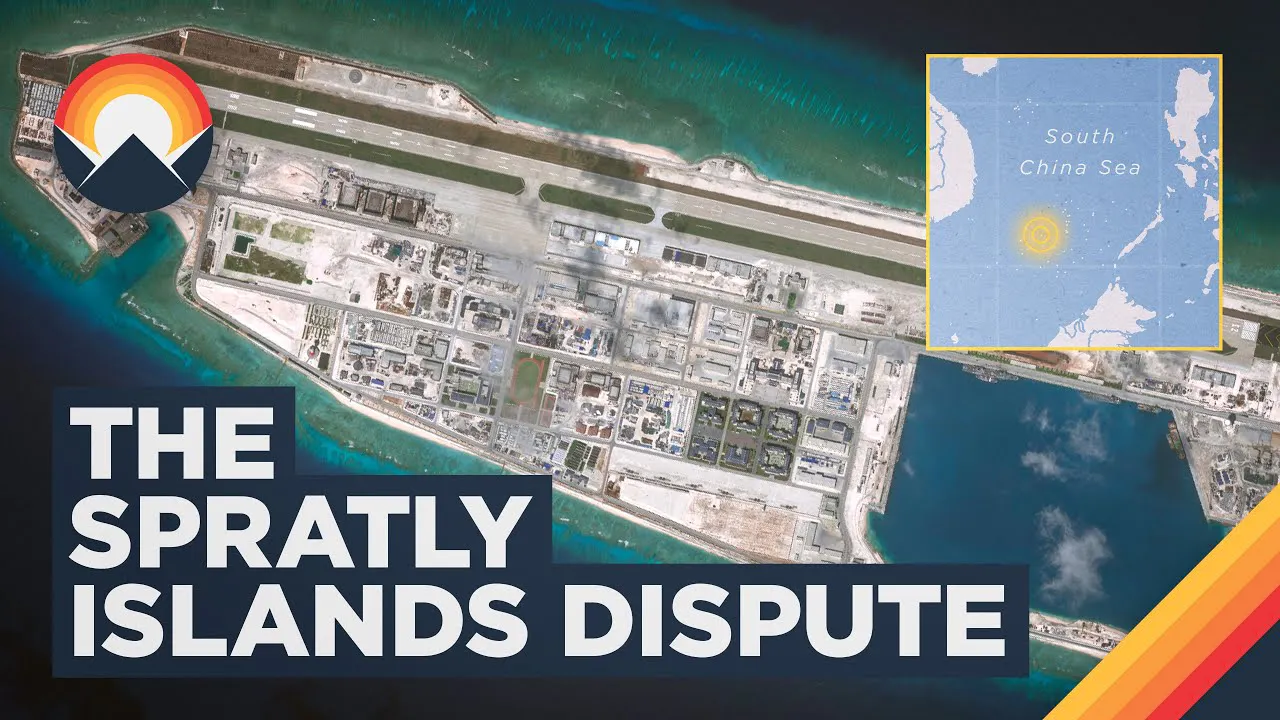
This is a Boeing 737 operated by Hainan Airlines. It's just flown a purportedly domestic flight from Haikou, a city on the Chinese island of Hainan, to a place that can't even be named without eliciting controversy. In English, this is Woody Island, in Chinese, it's Yongshing Dao, in Vietnamese, it's Dao Fulam, but to all, it's the epicenter of one of the most persistent territorial standoffs on Earth. A short drive away from the airport is this. The island's oversized city hall, far-equipsing what is justified by its population, but rather justified by the fact that this is not a city in the traditional sense, but a Chinese prefecture-level city. A single political entity that encompasses all of the people's republic's South China Sea holdings and assertions. The prefecture-level city status bestows these disparate islands the Sainter-Stictional Stature as Guangzhou, Shenzhen, or Wuhan, which inevitably angered, well, everyone else. That's because the South China Sea Islands that the preeminent power claim are simultaneously claimed and held by
the Philippines via Nong, Taiwan, Malaysia, and Brunei, while the entire world has a vested interest in keeping the maritime passages through the area open and international. China, meanwhile, asserts that Sanjay City, headquartered on Woody Island, is an integral part of its territory and that this is a true city like any other. And while perhaps not organic, today Woody Island operates as a plausible facsimile of a real place. That 737 is operated by a commercial civilian airline. In fact, pine on airlines is one of the few in China not owned by the government, and it simultaneously flies to Europe, North America, even to Vietnam, where protests regularly erupt from Chinese assertions of sovereignty over places like Woody Islands. Under similar logic, China has also facilitated the development of a civilian population on Woody, composed of at least a thousand individuals primarily working in the fishing business whose boats can be seen here. This is one of two protected harbors built by the Chinese government, with deep channels dredged open to facilitate the arrival of larger
cargo and military vessels. Scattered across the small island are an impressive quantity of basketball and tennis courts, along with a large track to fill residents' time, and then to the east is what used to be rocky island. On it is what's believed to be a signal intelligence station built specifically there due to the smaller island's higher elevation, while this road used to be the over-ocean causeway connecting it to Woody, but in 2017 the Chinese created artificial land to connect the two islands together and expand the overall units as its South China Sea presence expanded. After all, over 500 miles away in another part of Sanxia City, China's audaciousness escalates. This is mischief reef, but notably not mischief island. That's because this isn't an island. As revealed in this NASA imagery from 2001, this used to truly just be a coral reef, or technically what's referred to as a low tide elevation. A structure that is submerged during high tide, but sits above the waterline
during low tide. That explains the unnaturally perfect curvature of today's land's edges. It's all artificial land recognition protected from erosion by these rocky seawalls. And this? Well, this is believed to be anti-aircraft weaponry. And that is best explained by this. Meer Miles Away is another low tide elevation, and on it is a barely perceptible spec that represents the far humbler Philippine equivalent of China's massive land reclamation project, the BRP Sierra Mondrae. Previously known as the USS Barnett County, this vessel is a former American World War II era landing ship that eventually ended up in the Philippine Navy until they purposefully ran at a ground on Second Thomas Shoal in order to permanently station Marines on it to guard what they assert is their territory. Meanwhile, to the north, there is Typing Island, held by Taiwan, a true genuine naturally occurring piece of land that ranks as the sea's largest, and also as the furthest extremity of the tiny island
nation's territory, at least according to them. Neighboring it to the east is Sand Key held by Vietnam, also naturally occurring yet artificially expanded by their land reclamation work. And then further afield, there's Malaysia, asserting its sovereignty through tiny platforms like this, built a top Erica reef and others, and finally there's Brunei with Luisa Reef, which is the only of the claimants to have foregone building a physical structure to defend its claim. But these nations are not truly there for the tiny islands and reefs. After all, at best they have a scare supply of brackish well water. At worst they are truly just an accumulation of dead coral. Rather, all six nations are using claims on the islands or atolls themselves to assert claims on the ocean around. That's where the value is. The South China Sea sits at the center of many of the world's busiest cargo ports, Singapore, Kuala Lumpur, Ho Chi Minh City, Guangzhou, Shenzhen, Hong Kong, Taipei, Manila, and the countries that host these ports crucially rely on the ability to export goods in a reliable and inexpensive manner. Not only that,
but the area is a massively important and fast-dwindling fishery. 12.5% of all the world's catch comes from the sea, despite only representing 2.5% of the Earth's surface. And finally, there's talk of oil. While largely unexploited, oil fields summing up to 3.6 billion barrels have already been sharded with billions more believed as yet undiscovered. So as much as the navigation routes, fish, stocks, and oil supplies are attractive as resources for each of the six nations to own, there is perhaps even more threatened by a scenario where another nation is able to assert sovereignty over the area and cut off access. So while these physical structures partially serve as military bases to allow for the physical defense of the islands and atolls each nation holds, even more so they serve as part of each country's legal argument as to why they are the true sovereign power over this stretch of ocean. But China's claim? Well, it's the simplest. They claim that the islands have always been theirs. China articulates this claim in brief policy documents like this, which
each refer to a litany of historical texts that purport to prove that the Chinese people were the first to discover, administer, populate, and exploit the South China Sea and its islands. The earliest of these early texts is entitled Yuhu Chi and it dates back to the Han Dynasty, meaning it was written within a couple hundred years of the year, zero. Now within this text is this sentence describing the features of a particular stretch of water, but translating it is tricky. Some will translate this as, quote, there are rich heads in the rising sea, the water is shallow, but filled with a lot of magnetic rocks, a rather unremarkable phrase. The Chinese Ministry of Foreign Affairs meanwhile translates this as quote, there are islands, sand keys, reefs, and banks in the South China Sea. The water there is shallow and filled with magnetic rocks or stones, quite the difference. The disconnect stems from what these characters, Zhonghai, are to be interpreted as referring to. The literal translation is simply rising sea, but
this was a proper name used at the time to refer to a portion of the ocean south of China. The question is which portion? Some claim it refers to a much more narrow portion, but China, of course, asserts it refers to all of today's claim. And then there's the matter of the islands, sand keys, reefs, and banks asserted in the Ministry of Foreign Affairs is clearly generous translation. Did this text truly refer to finding proper islands, or is it simply indicating that the ocean is shallow? Which it is. This is only a portion of the assertions and corresponding critiques stemming from this one text, and then there's a seemingly endless assortment of other historical writings and maps put forward by the Chinese government as evidence. And on top of that, there's archeological evidence, actual artifacts that demonstrate Chinese presence on South China Sea islands. But the question that inevitably ensues with every discovery is whether it is truly evidence of habitation and sovereignty, or rather just tangential vestiges of a sea-faring civilization. And more
broadly, there's an even more complex legal question on whether Chinese presence on these islands pass the ambiguous threshold that indicates belief through history of sovereignty over them, and then even more confoundingly whether that belief translated from each of the many dynasties and governments to have rained over China to the next. But bizarrely, China has an ally in this historical narrative. Taiwan. The disputed country's claim over the South China Sea is almost the exact same as China's. Same territory, same argument. That's because both the People's Republic of China, also known simply as China, and the Republic of China, referred to as Taiwan, each more or less assert that they are the sole legitimate government of all of China and Taiwan, stemming from the Republic of China's origins as the government of China writ large before retreating to Taiwan in the dying days of their civil war against the now-raining Communist Party. Because the government of Taiwan is a direct lineage of the former government of mainland China, they believe that
the same history and logic that is used to assert China's sovereignty of the South China Sea also applies to them. So in a bizarre way, China and Taiwan are functionally allied in the South China Sea against the four other nations, even if there still is dispute between the two of them, because to each the dispute is far simpler if rather than six simultaneous claims, the sea is sovereign to at least historic China, and then the only question is what lineage of the past is the rightful one. But China and Taiwan aren't the only nations to claim that the islands have simply always been theirs. From the 17th century to now, Vietnam has gone through a whole host of ruling regimes. It's been dynasties, it's been a colony, it's been an authoritarian state, all while the nation's territory itself has oscillated between split, splintered, and unified. But across it all, whoever's ruled Vietnam has also claimed the Huang Sa, or Parasal, and Chong Sa, or Spratli Archipelago's, as part of the nation's sovereign territory. And they have the maps and documents to prove it, ranging from 17th and 18th century
altruises to a host of 19th century European travel logs and accounts. Under the new end dynasty, then the following French colonial period, the Spratli's appeared on maps as Vietnamese territory, while the Paracels were actively explored, measured, and leveraged for economic benefits. While Japanese expansion, then World War II, then a host of wars across Vietnam in the following decades, loosen the grip of French, then Vietnamese hold of the Archipelago's, it is Vietnam's continued belief that their historical claims to the islands predates any other claim, and are claims that have never been retracted across its tumultuous past. As for Malaysia and Brunei, comprising the southern rim of the South China Sea, their claims are grounded less in historical usage, and more in each nation's interpretation of international agreements. Malaysia, for instance, justifies its claim to a host of around a dozen reefs, shoals, and islands as a matter of geography, as the features they claim fall within the borders of a 1979 map that outlined the nation's exclusive economic zone, as well as the extent of its continental shelf. The relatively tiny nation of Brunei has also articulated its claim to Spratli
Island features in relation to its EEZ, resulting in its claim, and Malaysia's recently dropped claim, to the tiny Iluisa reef, sitting squarely within Brunei's narrow sliver of exclusive waterway. Then finally, there's the Philippines. Now, the Philippines has justified its claims to certain features within the Spratli Islands and the Scarborough Shoe through their own far more recent interpretation of history. After Japan relinquished control over the Spratli's following World War 2, they were the first to explore the unclaimed territory, and so they held sovereignty over the features they explored. They, in the Philippines logic, also inherited the Scarborough Shoe after becoming independent from the United States, who previously held the territory. But in recent years, the Philippines has also leveraged geology and international agreements to strengthen its claim beyond its historical framing. Across the South China Sea, then, overlapping historical narratives and geographical justifications have resulted in overlapping claims to the smallest, most marginal slivers of land imaginable. Fortunately, for China, Taiwan, Vietnam,
Malaysia, Brunei, the Philippines, and the rest of the world monitoring rising tensions and their potential implications in the South China Sea, there is this, the United Nations Convention on the Law of the Sea. Now, this document does a lot. It, for instance, establishes who can do what, out on the high seas, beyond any sort of territorial water or exclusive economic zone. It also establishes what territorial waters are and what exclusive economic zones are. Issues critically important in understanding why the South China Sea islands and reefs are contested to begin with. The 12-nautical mile buffer of territorial waters extend a nation's exclusive sovereignty, and the 200-nautical mile buffer of exclusive economic zones extend a nation's sovereign right for economic activity, and in combination, they fuel claims across the sea given them resource-rich waters surrounding them. In this way, this international agreement, which 169 countries have ratified, including all South China Sea countries except for Taiwan, has created a problem. But fortunately, this same document also provides a framework to settle
disputes. Should a country have an issue concerning the interpretation or application of the convention, they could turn to annex 7 and trigger an arbitral tribunal. And so, in 2013, with China exerting its power across the South China Sea under territorial justification of the nine dashes, the Philippines brought forward an arbitration case to be settled far away at the Hague. More specifically, they brought up 15 separate issues for the tribunal to rule on, all of which falling within three broad baskets. The extent of China's maritime entitlements and how far they reached into the South China Sea, whether or not a host of shores and reefs were islands or low tide elevations, and whether or not China has encroached on the Philippines' exclusive waters. Then, in 2016, in the form of a 501-page document, the region gained a whole lot of clarity. For the small archipelagic country of the Philippines, it was a sweeping victory. Mischief reef and second Thomas Shoe, the ruling deemed, were low tide elevations, thus not
entitling either to a territorial sea designation or an exclusive economic zone for China, even if their sovereignty over the atolls was legitimate. The tribunal also deemed that China's historical claims to the South China Sea through the nine dashes line were contrary and superseded by the convention. Finally, the tribunal went on to declare that China had also failed to uphold environmental and preservation protections that were agreed to under the convention within what was effectively Philippine waters. In all three broad buckets of complaints issued by the Philippines, China was found in the wrong. The news emanated from the hague and quickly spread via all the world's largest outlets, but then nothing really changed. For one, the ruling from the beginning was hamstrung by its own framework. It was intended to clear up definitions, designations, and adherence to the convention, but it would not rule on any issue of sovereignty over the rocks, shoals, or islands dotting the South China Sea. Then there was the simple fact that China decided
to take no part in the arbitration proceedings. Rather than appearing and representing at the hague, China instead offered a lengthy memo that outlined their perceived limitations of the tribunal. That first, the UN convention of the seas could not rule over issues of sovereignty, and that second, China and the Philippines had previously agreed that they would settle dispute only through negotiation and bilateral means, something that this very case had broken. While the Philippines had won on paper and in the eyes of the UN's law of the sea, China maintained that that paper simply didn't meet much. So, the United Nations, the singular institution most responsible for resolving disputes between countries, had failed in this instance to do so. And it's not hard to understand why. Their only real enforcement mechanism is individual nations enforcing UN declarations, yet the only nations that appear interested in doing so are those already a part of the simmering conflict. But the implication is that these nations are in a low-level conflict in what is
functionally the high seas, a lollizum, not technically, but at least functionally based on the breakdown of the very treaty designed to rectify that. So what ensues is state-sanctioned chaos. This is the BRPCR Madre, the grounded Philippine ship defended by the nation's Marines, and within the lagoon, while these are Chinese vessels, likely Coast Guard ships. In recent months, they've sat there almost continuously attempting to block access to the Sierra Madre, necessary for the Philippines to shuttle food in and swap Marines out to maintain their continuous presence. This is actual footage from one such attempt in March 2024. The Chinese Coast Guard vessels attempt to position themselves in front of the Philippine ships to block their paths to the shore, or to intimidate them into turning around. And then to ramp pressure higher, the Chinese vessels deploy their high-powered water cannons against the Philippine vessels, which in this case shattered the windows of a Philippine ship injuring four sailors.
To avoid the riskiest sorts of confrontation occurring directly between Chinese and Philippine military forces, the Philippine hires these smaller civilian vessels to shuttle supplies from the larger vessels directly to the Sierra Madre itself, but that has potentially only limited the fallout. In the months that followed, such confrontations became such a regular occurrence that it's tough to sort between them. Philippine injuries and ship damage have stacked up, leading all to speculate on what could be next. Now, any instance of two powerful nations confronting each other in such an aggressive manner is concerning, but what ramps up concerns further is the fact that this can't be considered a simple China Philippines confrontation due to this, the US and Philippines' mutual defense treaty. The Philippines used to be a US territory, and as part of the unwinding of that relationship, the two nations signed this treaty that essentially stipulated that if anyone attacked the US, the Philippines would help the US defend, and if anyone attacked the Philippines, the US would help the Philippines defend. That treaty is still active, and all indications
suggest that the two nations intend to follow through on its terms, as leaders from both have reiterated its active status in public time and time again, and in 2023, military leaders from both came together to clarify what specifically might invoke participation by one of the partners in the other's conflict. And that's for the inclusion of this concerningly direct line. Quote, an armed attack in the Pacific to include anywhere in the South China Sea on either Philippine or US armed forces, which includes both nations as coast guards, aircraft or public vessels, would invoke mutually defense commitments under Article 4 and Article 5 of the MDT. What has happened continuously over the past few months were attacks in the South China Sea on Philippine ships from their coast guard. The only facet of these incidents that kept them from invoking the mutual defense treaty is that water cannons do not cross the threshold of what is considered an armed attack. Yet, the fact that the US was just one word away from being pulled into
a military conflict with China is undoubtedly concerning. Of course, China knows this. They know how massive the difference between water cannons and guns are in the consequences they will suffer, but as in any military conflict, there is always the potential for miscalculation. This has led some defense analysts to ask whether the theoretical US-China conflict that so many fear will start not to the intuitive path like Taiwan, but rather on an insignificant isolated coral atoll in the South China Sea. The danger in the South China Sea stems from the fact that some nations care enough to fight for it, yet others don't care enough to arbitrate. As it has for so, so long, the conflict will simmer and simmer. There's every chance that it will stay that way and that the tenuous status quo will maintain, but what makes observers so worried is the fact that China has continuously been willing to challenge the status quo. At one time, building land was unprecedented, later on building military capable runways was unprecedented,
and then sending military ships and aircraft to the islands was, and then arming the islands with weaponry was, and now regular direct military to military confrontations is the new, unprecedented normal. Yet, when sitting so, so close to the existential line, with a trendline progressing closer and closer to that very line, it appears pragmatic to worry about what will happen next. If you're anything like me, you were probably surprised to hear that something as significant as China having repeated tense maritime conflicts with a country with a mutual defense treaty with the United States is happening right now, considering you probably heard nothing about it. And I think that has a lot to do with the way that Add-Sported News Media reports on conflict. Typically, they put all the focus on the start of major conflicts in Western nations, and you hear so little about all the other very significant conflicts occurring elsewhere. That's why Nebula and the team at Real Life Lore developed the show The War Room. Every month, they release a video that goes into the nitty gritty day-to-day progression of the
world's most covered conflicts like Ukraine and Gaza, and under reported ones like in Haiti and Ecuador. I think it's both a really interesting and informative show, and it digests a level knowledge about the world's events that almost no one knows down to just 30 or so minutes each month. And this is just one of plenty of great original programming made possible by Nebula. It's a crater-founded, crater-owned, and crater-run streaming platform that was designed from the beginning to create the best ecosystem for creators to make their best stuff. The core of that is the very fact that you have to pay for it. It's not Add-Sported, but that means we don't have incentive to clickbait, we do have incentive to make high-quality stuff that you'll actually watch and will keep you subscribed, and we have the funding to invest in far higher production value than we can here on YouTube. We know from the analytics that we have a higher retention rate than almost every streamer in the industry, meaning the people who sign up choose to say subscribed far more often than with the bigger streamers, and Nebula costs a whole lot less, too, especially if you use our link, Nebula.tv slash windowware, because that will get you 40% off an annual subscription,
which brings the cost down to just $2.50. I think that's quite a reasonable price to pay to get all our existing content at free, exclusive big-budget documentaries, films and shows, and help support us, and you get that all not just for us, but for this huge catalog of hand-picked high-quality creators. So head over to Nebula.tv slash windowware to sign up and thanks in advance for your support.
More episodes
More from Wendover Productions

The Logistics of German Reunification | Wendover Productions
Wendover Productions

The 8 Flights That Show How COVID-19 Reinvented Aviation | Wendover Productions
Wendover Productions

TWL #5: Timekeeping on Mars | Wendover Productions
Wendover Productions

TWL #10: The Day Sweden Switched Driving Directions | Wendover Productions
Wendover Productions