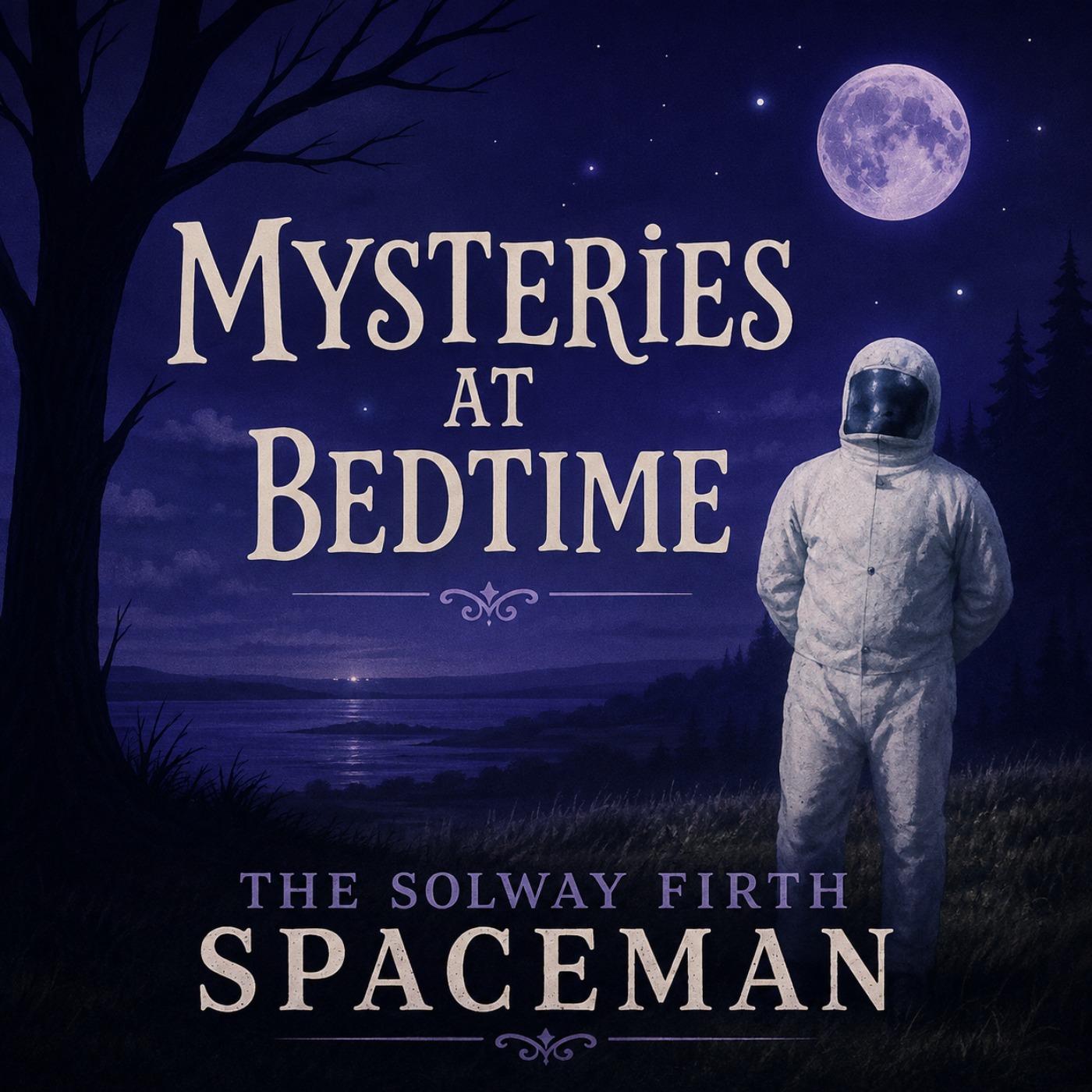
The Solway Firth Spaceman: The 1964 Photograph No One Can Explain
About this episode
The Solway Firth Spaceman is one of the most famous unexplained photographs in British history, and after more than sixty years, people are still arguing about what it shows. On the afternoon of the 23rd of May 1964, a Carlisle firefighter named Jim Templeton took three photographs of his five-year-old daughter Elizabeth on Burgh Marsh, overlooking the Solway Firth in Cumberland, England. It was an ordinary family day out on an ordinary spring afternoon. But when the film came back from Kodak, the middle photograph showed something that should not have been there: a tall figure in what looked like a white spacesuit, standing silently in the empty marsh behind the little girl. Templeton swore no one had been there when he took the picture. The police examined it and found nothing suspicious. Kodak confirmed the negative had not been faked or tampered with. Within days, the photograph was in newspapers around the world. Then two strange men in dark suits arrived at Templeton's fire station, refused to give their names, and demanded he take them to the marsh. And on the far side of the world, at a rocket testing range in Australia, a launch was said to have been aborted after two similar figures were seen on the firing range. In this episode of Mysteries at Bedtime, we tell the full story of the Solway Firth Spaceman: the photograph, the family, the Men in Black, the Blue Streak missile connection, and the surprisingly
Become a Patreon or Apple + subscriber now for ealry and ad free access from as little as $1.69 a week. All the details here
Subscribe to Crime at Bedtimes Youtube channel HERE
Hosted on Acast. See acast.com/privacy for more information.
Get every episode summarized
Each time Crime at Bedtime publishes, we email you a written briefing from the transcript — the topics, who appeared, and any specific claims, with the ad reads skipped.
Email me new episodesFree for 3 shows. No card needed.
Hosts & guests
Transcript ready
387 searchable segments. Every word is indexed and playable.
Full transcript
Crime at Bedtime — The Solway Firth Spaceman: The 1964 Photograph No One Can Explain. Machine-transcribed; use the interactive transcript above to jump the player to any line.
Before we get into tonight's episode, I just want to let you know about an exciting addition coming to your feed. Crime at Bedtime's sister show, Mystery's at Bedtime will now be accessible right here in the same place. No need to jump between shows. All the content in one easy location. For lovers of true crime, Crime at Bedtime continues at the same time twice a week as normal, with an additional episode of Mystery's at Bedtime dropping every Wednesday. More Bedtime content, same great format. Just more of it. On the afternoon of Saturday, the 23rd of May, 1964, a firefighter from the English city of Carlyle took his wife and five-year-old daughter for a day out on the marshes overlooking the sole way of birth. His name was Jim Templeton. He was 44 years of age and worked for the Cumberland Fibregade.
He was in his spare time a keen amateur photographer and a lover of the local history of his corner of northwest England. On that particular Saturday, he brought his camera. He wanted to take some photos of his daughter Elizabeth who was wearing a new dress. The place he took her to was Brough Marsh, a wide flat expanse of tidal grassland on the southern shore of Sohe Firth. He poxed me eight miles west of Carlyle. It was a quiet and beautiful place. On a clear day, you can see across the Firth to the hills of Scotland. It is the kind of place where a family might spend a pleasant spring afternoon and where a father with a camera might take some photographs of his little girl among the wildflowers. Jim found a good spot. He sat on Elizabeth's down on the grass, gave her a small pose of flowers that she had picked to hold. And he took three photographs of her. It more or less the same pose, one after the other. It was by every account he ever gave an entirely ordinary afternoon.
There was, he said, only one thing that had struck him is slightly odd. The cattle and sheep that normally grazed across the whole of Brough Marsh were that afternoon all bunched together at the far end of it. They were huddled, he said, as though something had frightened them. He also recalled though he struggled to put it into words a certain feeling in the air. But it was a warm sunny day. There were other people anywhere near them where a couple of elderly women sitting in a car parked at the far edge of the marsh several hundred yards away. Jim thought no more about it. He finished his pictures and the family went home. He would send the role of film off to be developed, as everyone did in 1964, and he waited for the prince to come back. When they did, the first photograph of the Elizabeth was normal, as was the third. The middle photograph was not. My name is Jack Lawrence. Welcome to mysteries of bedtime, a show where we explore the strange and explained a mysterious. At tonight we look at the case of the sole way first space man.
An image that was captured in the middle photograph of what Jim had received back. The air standing directly behind Elizabeth, slightly above and to the right of her, was a figure. The figure appeared to be a man, appeared to be wearing a white suit of some kind, closely resembling to everyone who has ever looked at the photograph in the six-second since, the pressurized suit of an astronaut or a space man. He appeared to be facing away from the camera so that only the back and side of the helmet and the upper body were visible. He also appeared to be standing in the empty air above the marsh grass, and a distance behind Elizabeth that would have placed him squarely in the open field. There had been, Jim Templeton insisted for the rest of his life, no one standing there when he took the photograph.
Before we go any further into the story of the sole way first space man, it's time to take a minute, time to relax and focus on our breathing. As always we'll utilize the four-six-eight method, breathing in slow and deep through the nose for four seconds, holding the breath for six, before breathing out slow and controlled. For eight, here we go, breathing in for four, hold, and slowly and controlled, back out. Again slowly breathing in deep, filling the lungs for four, holding, and slowly and controlled back out again.
One more time, breathing in deep, slow, through the nose, filling the lungs for four seconds holding for six, and slowly and controlled back out again. Now as you breathe normally let's head back to the UK and the bizarre story of the sole way first space man. Jim Templeton was by every account of the people who knew him and the journalist who would interview him over the following decades an entirely ordinary and entirely credible man.
He was born in 1920 and spent his working life as a firefighter with a cumble and fire brigade based in Carlisle. The county town of what was then cumble and is now part of Cumbria, in the far northwest of England close to the border with Scotland. He was married to his wife Annie and they had a daughter Elizabeth. He was his hobby and he was a reasonably serious amateur. He owned a good quality single lens reflex camera. He understood the basics of exposure and composition. He developed an eye for a good picture and he had in Elizabeth a photogenic and much love subject. There is a particular quality to Jim Templeton that everyone who has written about this case whether they believe his accounts or doubt it have agreed upon. He's not a fantasist. He was not a self-promoter. He was not in the assessment of the investigators who interviewed him across nearly five decades a man who sought attention or who profited from the fame that the photograph brought him.
He was simply a firefighter from Carlisle who had taken a photograph of his daughter and who spent the rest of his life being asked about it. And who never once in all that time changed a single detail of what he said had happened. That consistency is in the end one of the central facts of the entire case. Brough Marsh where Jim Templeton took his daughter that Saturday afternoon sits on the southern edge of the Solway Firth. The wide sea inlet separates northwest England from southwest Scotland. It is an ancient and atmospheric landscape. It was on Brough Marsh in the year 1307 that the English king Edward I would die while campaigning against the Scots. A monument to him stands on the marsh to this day. The marsh is a place of wide skies titled channels and grazing livestock. The tide comes in fast across the flat ground. The light on a clear day has the particular quality that coastal light has in an north of Britain.
Bright, clean and prone to sudden change. On the 23rd of May 1964 the light was good. The weather was warm and sunny. Jim walked out onto the marsh with Annie and Elizabeth, found an attractive spot and prepared to photograph his daughter in her new dress. The only detail he ever reported as being out of the ordinary apart from the figure itself was the behaviour of the animals. The cattle and sheep that would ordinary have been scattered across the whole of Brough Marsh were that afternoon gathered together at the far end of it, huddled in a way that Templeton found unusual. He mentioned this detail in almost every interview he ever gave. He never claimed to know what it meant. He simply reported it as one of the two things about that afternoon he couldn't fully account for. The other, of course, was the figure. Jim Templeton took three photographs of Elizabeth that afternoon in quick succession. In more or less the same pose. She sat on the grass and held her pose of flowers.
She looked in all three like exactly what she was, a happy five-year-old and a family day out. When the developed prince came back from Kodak some days later, Templeton looked through them. The first and the third photographs of Elizabeth were unremarkable. But it was the middle one that stopped him. Behind his daughter and slightly above her, rising out of the empty marsh, was the figure in white. His immediate assumption by his own account was that he had somehow failed to notice a person standing in the field behind his daughter when he took the picture. But this did not make sense to him. When he had been looking through the viewfinder, he would have seen someone standing that close. And in any case, there had been no one there. The only other people on the entire marsh had been two elderly women in a car several hundred yards away in the opposite direction. The figure was more overdressed in a way that no one on a cumble and marsh in 1964 would have ever been dressed.
It appeared to be wearing a white pressurized suit. Of the kind that in 1964 the general public associated almost exclusively with astronauts and test pilots. The early man's space programs of the United States and the Soviet Union were in the spring of 1964, front page news around the world. The image of a man in a white space suit was in that specific cultural moment one of the most recognizable images on earth. And here was one. Apparently, standing on rough marsh behind a five-year-old girl in a photograph that Jim Templeton was certain he had taken of an empty field. They decided to take it to the police. Jim took the photograph to the police in Carlisle. The officers who examined it were by his account initially skeptical and then genuinely puzzled. They could find no evidence that the photograph had been faked. They could find no evidence that it had been tampered with, double exposed or manipulated in any way that trick photography of that era could be manipulated. The Carlisle police sent the photograph onto the experts at Kodak, the company that
had manufactured the film and developed the prints. Kodak's own technicians examined the negative. They confirmed that it was a single genuine untampered with exposure. There was no evidence of a double exposure. There was no evidence that the image had been altered. The figure, whatever it was, had been present in the light that entered Jim Templeton's camera at the moment he pressed the shutter on the middle of his three photographs. Kodak was sufficiently intrigued that according to the accounts that circulated in the following months, the company offered a prize to anyone who could provide a satisfactory explanation for the figure. No one at the time claimed it. The photograph was published in the local newspaper, the Kumbler News. Within hours it had been picked up by the National British Press and within days by newspapers around the world. Jim Templeton, a firefighter from Kala, found himself and his photograph at the centre of a global sensation. The image itself has reproduced everywhere, but acquired the name by which it has been
known ever since. The sole way, first, space man. And then according to Jim Templeton, things became stranger still. Sometime after the photograph was published, two men would arrive at the fire station in Kala where Jim Templeton worked. They were dressed by his account in dark suits. They arrived in a dark, chakuakar, identifying themselves as officials of the British government, though they produced no identification to prove it, and they referred to each other throughout their visit not by names but by numbers. One was nine, the other was eleven. The two men questioned Templeton about the photograph, but they then asked him to drive them out to Brough Marsh to the exact spot where the picture had been taken. He agreed, and the three men drove out to the Marsh together. During the entire journey, according to Templeton, the two men didn't speak to him at all. At the Marsh, the men questioned him further. They asked him about the weather that day.
Asked him about the behaviour of the birds and animals, and in particular, whether he was certain that he had not seen a figure standing in the field at the time he took the photograph. He hasn't told them truthfully that he had not seen anyone. At this, according to his account, the two men became annoyed. They appeared to have wanted him to say that he had seen the figure. When he would not, they abruptly ended the conversation, got into the dark, chakuakar and drove away, leaving him standing on Brough Marsh to make his own way home. This episode has become, over the following six decades, one of the most frequently cited early-preach examples of the phenomena that would later be given the name, Men in Black. The mysterious, badly identified officials who, in the folklore of unexplained phenomena, arrive after a sighting to question, intimidate, and silence witnesses. It should be said, however, that Jim Templeton himself did not take the two men, especially seriously. In September of 1964, only a few months after the visit, he dismissed them in plain terms.
It all looks like a leg-pull to me, he said. I'm sure the men were not security agents. He appears to have regarded them at the time as pranksters or hoaxsters, rather than as genuine government agents. It was only in the retelling over the following decades that the two men grew in the wider culture into something more sinister than Templeton himself had ever believed them to be. The strangest threat of the entire case and the one that did the most to elevate it from a local curiosity into international mystery arrived on the other side of the world. Approximately a month after the photograph was published, Jim Templeton received word by his account of an incident that had occurred at the Womera Test Range in South Australia. Womera was in 1964 one of the most important rocket and missile testing facilities in the world. It was the site at which Britain, in partnership with Australia, tested its Blue Strict missile, central component of the early British Space and Defence Program.
The Blue Strict was a genuine and significant piece of Cold War military and aerospace engineering. According to the account that reached Jim Templeton, a Blue Strict launch at Womera had been aborted because two large figures had been observed on the firing range where no one should be. A subsequent search of the range found no trace of them. And then according to the account, a technician at Womera had seen Jim Templeton's photograph reproduced in an Australian newspaper and had been struck by the resemblance between the figure on rough marsh and the figures that had been seen on the firing range. The detail that made this connection genuinely interesting was a matter of geography. The Blue Strict missile was designed, built and initially tested not in Australia but in England. Specifically, it was tested at RAF Spatum, a Royal Air Force facility in Cumberland, and a few miles from rough marsh. The suggestion in the folklore that grew up around the case was that there was some connection between the British rocket program, the figures at Womera, and the figure that had appeared
behind Elizabeth Templeton on the marsh. But the spaceman, whatever they were, had some interest in the Blue Strict and had been present at both the English site where it was built and the Australian site where it was launched. It is an extraordinary and evocative story. The most thorough investigation of the sole way for the spaceman photograph was conducted over a period of many years by a British journalist and academic named Dr. David Clark. Clark is a lecturer at Sheffield University. He served for a number of years as a consultant to the British National Archives on the release of the Ministry of Defense's UFO files. He is in the specific field of the investigation of British unexplained phenomena cases, one of the most rigorous and most respected researchers alive. Clark would meet with Templeton in person in 2001 and 2002. He interviewed him at length. He came away by his own account and entirely convinced of one thing. The Jim Templeton was telling the truth as he understood it.
He then genuinely believed that he had photographed an empty field. He wasn't lying. He wasn't perpetrating a hoax. He was a sincere and honest man who was as bewildered by the photograph as anyone else. Clark was, however, considerably less convinced by the more dramatic elements of the story that had accumulated around the photograph over the decades. He investigated the womber connections directly and found no photographic evidence that any figures had ever been seen on the Blue Strict firing range. He obtained and personally viewed the footage of the aborted Blue Strict launch that was supposed to be connected to the case and said he saw nothing unusual. There was, he concluded, no verifiable evidence that the womber incident, as it had been described in the focal of the case, had ever actually happened. It appeared to be a story that had grown over the years in the retelling until it had attached itself firmly to the Templeton photograph despite having any solid foundation. The British Ministry of Defence for its part was entirely uninterested in the photograph.
When UFOologists formally asked the M.O.D. whether the Templeton photograph was of any concern to the British government, an official responded simply that it was not. And on the central question, the question of the figure itself, David Clark arrived at his own explanation. His explanation, which he set out most fully in a 2014 interview with the BBC, is this. He says he believes the figure in the photograph is Jim Templeton's wife, Annie. Annie Templeton was on the march that afternoon. She was by the evidence of the photographs themselves wearing a light blue dress. And in one of the other two photographs that Jim Templeton took of Elizabeth that day, Annie can be seen partially at the edge of the frame wearing that light blue dress. The film was also a bit of a shock. At the moment, Jim Templeton took the middle of these three photographs, Annie was standing behind and slightly to the side of Elizabeth with her back to the camera.
She was not at that moment visible to Jim through his viewfinder for a specific and technical reason. The single lens reflex camera that Templeton was using had a viewfinder that did not show the entire area that the lens actually captured. It showed only approximately 70% of the final frame. The remaining portion around the edges was captured on the film, but not seen by the photographer at the moment of exposure. Annie standing at the top edge of the frame would have been outside the portion of the image that Jim could see through the viewfinder. He genuinely would not have seen her when he pressed the shutter. And then there's the matter of the exposure. It was a bright sunny day. Annie's light blue dress in the strong, comrian sunlight was overexposed by the film. Over exposure washes out. Color and detail. Turning a light blue into a bright, featureless white. A dark hair seen from behind formed the shape that resembled a helmet. Her pale overexposed body formed the shape that resembled a white, pressurized suit. And because she was standing at a distance behind Elizabeth and was captured only partially,
the ordinary human proportions of her body were distorted into something that looked to the eye that was primed by 1964 to see spacemen everywhere like a figure floating in a space suit. It is on the evidence of genuinely persuasive explanation. It accounts for the figure. It accounts for the white suit. It accounts for the helmet. And Jim Templeton's sincere insistence that he had seen no one. Because through his viewfinder, he generally had not. And it is supported by the physical evidence of the second photograph in which Annie in her blue dress is partially visible. Most serious investigators of the case now accept some version of this explanation. The figure on the wash was in a probability of mothering a blue dress standing behind a daughter, transformed by overexposure by the limitations of a 1964 camera viewfinder into one of the most famous unexplained photographs in British history. And yet, the explanation persuasive as it is does not entirely close the case.
And the reasons it does not are worth sitting with. The first is Jim Templeton himself. If the figure was Annie, then Jim Templeton spent 47 years from 1964 until his death in 2011, insisting that no one had been standing behind his daughter when, in fact, his own wife had been. It is possible, of course, that he simply never realized. The viewfinder explanation accounts for why he didn't see her at the moment of exposure. But over 47 years of looking at the photograph of being asked about it thousands of times of it being examined by police and Kodak journalists, neither Jim nor Annie Templeton ever appears to have looked at the figure and thought, that's Annie. That is a strange thing. A husband and wife looking at a photograph of a figure for nearly half a century and neither of them recognizing the figure as the wife who had been standing on the marsh that day. The second is the question of why. If it was such a simple thing, it fooled the experts of Kodak in 1964.
Kodak's technicians examined the negative. They confirmed it was genuine and untampered with. They did not, however, identify the figure as an overexposed person standing at the edge of the frame. It took nearly 50 years and the specific insights of David Clark for that explanation to be assembled. It is possible that Kodak technicians in 1964 simply did not think to consider it. But it also reminded that the explanation, obviously it now seems, was not obvious at the time. And third is the simple stubborn power of the photograph itself. Whatever the explanation, the image remains genuinely arresting. A little girl in the dress sitting on a marsh holding a posse of flowers with a figure and what appears to be a white spacesuit standing silently behind her. It is regardless of what caused it one of the most haunting photographs ever taken by an amateur with a family camera. Jim's daughter Elizabeth, the little girl in the photograph grew up, married and became Elizabeth Dobson.
In a 1996 interview as an adult, she reflected on the strange fame that had attached itself to her family since she was five. We got a lot of hassle from people, she said. With the figure itself, she said simply, I think it was somebody from another planet. Jim continued throughout his life to be asked about the photograph and he continued throughout his life to give the same answer. He had taken three photographs of his daughter and breath marsh. The middle one had come back with a figure in it. He had not seen anyone there when he took it. He didn't know what it was and he was as puzzled as everyone else. He never sold the photograph for profit. He never wrote a sensationalised book about it. He never embellished the story or added new dramatic details of the years went on. He remained to the end of his life exactly what he'd been at the beginning. A firefighter from Carlisle who had taken a photograph he couldn't explain. Jim died on the 27th of November 2011 at the age of 91. He lived for 47 years with a figure on the marsh.
He'd never, in all that time, changed his account. He'd never claimed to understand it. So what in the end was the sole way for a spaceman. The most likely answer on the balance of the evidence is the one that David Clark assembled. It was simply Annie Templeton, a light blue dress standing behind a daughter. That explanation is probably correct. Most careful investigators believe it. It fits the physical evidence and Jim Templeton's sincerity. There requires no aliens, no government cover-ups and no visitors from Warmerer. For the case in Geors, six decades on, for a reason it has nothing to do with whether it has been solved, it in Geors because of the photograph, because of a firefighter's ordinary love for his daughter. Captured on an ordinary spring afternoon with an extraordinary and inexplicable figure standing silent in the background. Because a good and honest man looked at the figure for 47 years and never once claimed to know what it was.
And because even when you have heard the explanation and even when you find it convincing, some part of he looks again with a little girl on the marsh and at the tall white figure behind her and feels the same small chill made newspapers around the world in the summer of 1964 stop to print the picture. The photograph is still there. It hangs in reproductions, in books and documentaries and on walls of the pubs around Sourway Firth. Rough marshes of course still there wide and quiet, with the tide coming in fast across the flat grass and the monument to a dead English king standing among the graze in cattle. And a five-year-old girl in a new dress holding a pose of flowers still sits on the grass in the sunshine on the 23rd of May 1964, smiling at a father's camera, with a figure that most people believe was her mother, and that some people will always believe was something else standing silently behind her.
Mysteries at bedtime is a mashed pumpkin production, hosted, written, produced and created by Jack Lawrence. Audio and Sound Design by Jack Lawrence of Mash Pumpkin Productions and Dom Evans and James Costa of USA.
More episodes
More from Crime at Bedtime
The Carnegie Secret: The Great Con of Cassie Chadwick
Crime at Bedtime

Ninety Flashes in the Dark: The Disappearance of Kris Kremers and Lisanne Froon
Crime at Bedtime

The Man Who Would Not Die: The Murder of Brett Bowyer
Crime at Bedtime
The Acid Bath Murders: The Crimes of John George Haigh
Crime at Bedtime