Loading...
newspoliticssociety
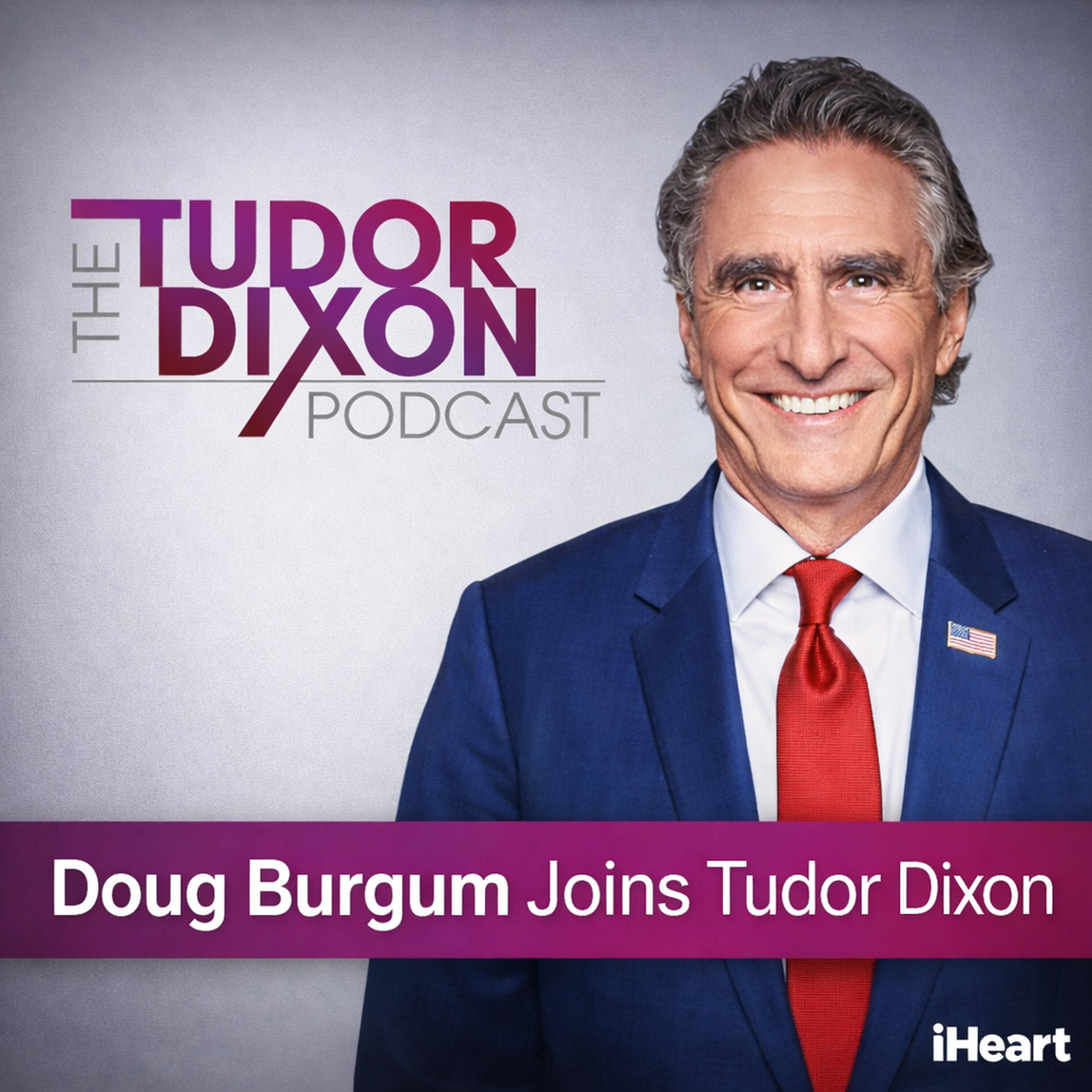
The Tudor Dixon Podcast: Doug Burgum on the Future of Venezuela and the Lies about Data Centers
About this Episode
On this episode of The Tudor Dixon Podcast, Tudor Dixon sits down with U.S. Secretary of the Interior Doug Burgum, former North Dakota governor and chairman of the National Energy Dominance Council, just hours after his return from Venezuela.
Secretary Burgum explains the Trump administration’s dramatic shift in relations with Venezuela and how a new oil partnership could reshape global energy markets, lower prices in the United States, and weaken China’s grip on critical resources. The conversation explores how Venezuela’s vast oil reserves—larger than Saudi Arabia’s—could once again flow to American refineries and help rebuild the country’s economy after decades of socialist mismanagement.
Tudor and Burgum also dive into the strategic battle over critical minerals, why China currently dominates the global supply chain, and what the U.S. is doing to secure resources needed for everything from smartphones to cars and national defense.
Finally, Burgum breaks down the AI and data center race with China, why these “intelligence manufacturing centers” are vital for economic growth and national security, and how communities across America could benefit from hosting them.
See omnystudio.com/listener for privacy information.
Hosts & Guests


Transcript
This is an iHeart podcast.
Guaranteed Human.
It's happening across America.
Men are being allowed to compete in women's sports,
robbing girls of scholarships, medals, titles, and safety.
For the first time in history, the U.S. Supreme Court
heard two cases that could decide
the future of women's sports nationwide.
Alliance-defending freedom needs your voice today.
Visit joinadf.com slash Dixon or text Dixon
to 83848 to add your name and side with truth and fairness.
That's joinadf.com slash Dixon, paid for by Alliance-defending freedom.
Support for the show comes from public,
the investing platform for those who take it seriously.
On public, you can build a multi-asset portfolio of stock,
bonds, options, crypto, and now generated assets
which allow you to turn any idea into an investable index with AI.
It all starts with your prompt,
from renewable energy companies with high free cash flow
to semiconductor suppliers, growing revenue over 20% year over year.
You can literally type any prompt and put the AI to work.
It screens thousands of stocks, builds a one-of-a-kind index,
and lets you backtest it against the S&P 500.
Then, you can invest in a few clicks.
Generated assets are like ETFs with infinite possibilities,
completely customizable and based on your thesis, not someone else's.
Go to public.com slash podcast,
and earn an uncapped 1% bonus when you transfer your portfolio.
That's public.com slash podcast,
paid for by Public Investing,
brokerage services by Open to the Public Investing Inc,
member Finra and SIPC,
advisory services by Public Advisors LLC,
SEC Registered Advisor.
Generated assets is an interactive analysis tool,
output is for informational purposes only,
and is not an investment recommendation or advice,
complete disclosures available at public.com slash disclosures.
Imagine if your Wi-Fi was a little hot,
smarter, and way more reliable.
Picture it.
Your TV, phone, laptop, even your fancy fridge,
working together to make life easier.
Well, Exfinity makes that dream a reality.
Devices so in sync you'd think they're telepathic.
Wi-Fi that knows when your device needs a boost,
the best equipment to stream,
or games at once with multi-view,
or stream your favorite podcast on iHeartRadio.
That's the magic of Exfinity.
It's seamlessly in tune with you.
Exfinity.
Imagine that.
Restrictions apply.
I think when you're diagnosed with cancer,
you crave a semblance of normalcy,
in control, and so work allowed me to be me.
So I think it's really important that companies stay flexible.
Cancer in a diagnosis can be all-consuming,
but it doesn't have to be.
Research shows there is a significant connection
between the ability to continue to work
and cancer recovery.
We can make work a better place for healing.
Learn more and sign the pledge at workingwithcancerpledge.com.
Welcome to the Tutor Dixon Podcast today.
I am excited because we have the secretary of the interior with us.
Doug Burgham, you also know him as the former North Dakota governor,
but now he is the US secretary of the interior
and the chairman of the National Energy Dominance Council.
And a guy who just got back from Venezuela,
which is very interesting.
Welcome to the podcast.
Well, Tutor, great to be with you.
And yes, just got back from Venezuela late last night.
That is so that's why so we're getting you fresh back from Venezuela,
which I think is very exciting because I hear a lot of people
that are concerned what's actually happening over there,
what is going on with oil, what's going on with gas prices here.
And there has been this kind of remarkable deal made with Venezuela
on the oil side.
Tell us a little bit about that.
Well, first of all, I just want to say to President Trump,
I mean, without his courageous, decisive leadership on January 3rd,
that we wouldn't even be having this conversation.
And I wouldn't have been in Venezuela.
I mean, two months ago,
Venezuela was a sanctioned adversary.
And now they're one becoming one of our most important strategic
allies in the Western Hemisphere.
I mean, this is a country that has the only country in the world
that has larger oil reserves than Saudi Arabia is Venezuela.
And it had been going out at a discount to people like China.
When it used to flow in five days
to the Gulf of America refineries along the coast of Texas and Louisiana,
and which was great for keeping prices down in America.
It was great for American jobs.
It was great for handling their heavier crude
because we built these refineries to do it.
And they went down a path on socialism under a corrupt leadership.
And thank President Trump, I guess with his action, our military.
It's basically a new dawn for the people of Venezuela.
People in Venezuela, I'm telling you,
they will outside of this building,
there's the interior building in Washington, DC.
There's a statue to Simon Boulevard,
the guy that liberated Venezuela and Bolivia back centuries ago.
There will likely be a statue of President Trump and streets
renamed after him in Caracas because this is a guy that his action
has created this new dawn of opportunity for people in Venezuela.
And only they remember what it was like just over 20 years ago,
when they had a market.
Their economy has shrunk by a factor of four.
I mean, their GDP today is one fourth of what it was
back when their industry was really going.
And that affects everybody in the country.
They're just a much poorer country than they were before.
So quite exciting to go down there and be working on
getting that oil and gas flowing back to America again,
to benefit Americans.
I think it's kind of a critical message as we go into the midterm.
What Venezuela became and how the United States is coming to the rescue
to rebuild it because we are hearing these messages of socialism.
In fact, we had an Argentinian politician recently in Germany
sitting next to AOC.
And AOC is talking about a wealth tax and she's talking about socialism.
And this woman, it was so gracious, but she said,
what President Trump did for Venezuela is,
I've seen the people cheering.
They've come to my country to get away from Venezuela.
This is such a critical moment for people to understand.
The infrastructure, the oil infrastructure there was destroyed by socialism.
And the opportunity here is to come together as partners to rebuild that, correct?
Yeah, absolutely.
Well, part of our delegation that we went down on this trip,
we had dozens of American companies across oil and gas and mining because
they're rich, a country rich in critical minerals.
That matters to every American because if you use a cell phone, drive a car,
have a refrigerator in your house, you're using critical minerals.
I mean, some of these, like I have some of the phones that they might have
42 of the 60 critical minerals that China controls all the processing
is in your phone, aka the supercomputer in your pocket.
So we just can't, we can't be a country and have our independence,
have our sovereignty.
If it's another nation controls the supply chain for things that we need
to support our economy, to support daily life.
So across all this, but these companies that we brought down there,
some of them had been kicked out of the country 20 years ago
when their companies were nationalized, aka their assets were stolen.
Well, you know what happened?
The people that were the Venezuelans working for American companies,
they didn't stay.
They left.
They left.
I mean, in where did they go?
They went to places like Houston.
I mean, there's one of the companies that said we have 600 Venezuelans that are now
Venezuelan Americans working as engineers, technicians, or leaders in our company in Houston.
They are chomping to go back down their increased production,
get it shipping back to the US.
And again, like I said, it's the one of the things that's going to help
bring that energy, the center of the energy world out of the Middle East,
which would be important right now.
Get it back to the Western Hemisphere between the US and Venezuela.
We've got everything we need right here.
You know how fantastic will that be?
That's been an interesting message that I've heard from both people in the United States
that want to go back to Iran and Venezuela.
It's people who were driven away by these radical policies.
And you said leaders, leaders, the wealth, all driven away from these countries.
But you also talked about the rare earth minerals.
And I want to clarify something there because I think that people in America have always
felt like we can only rely on China for these.
Do we have another option now?
Can we take that control back?
Absolutely.
Because across the US, we've got vast resources of minerals.
We got ourselves completely out of the mining game.
And that was a team effort.
I mean, that's been going on for 30 years.
You know, started back under Clinton.
Obama accelerated it.
Biden really took it to the max.
You know, but it was basically like, we're not going to permit mines.
We're going to fight these things any way we possibly can.
And we're going to save the planet by not doing it in America.
Well, you know, we saved nothing because in the US,
we did a cleaner, smarter, safer than anywhere else.
And then we outsourced the China.
China goes to the Congo in the middle of Africa.
They go to Indonesia.
They have no reclamation.
They have no child labor laws.
They have no EPA, if you will.
And so some of the biggest ecological disasters are occurring
where China is doing mining.
And then they mine it and they don't care about that place.
It's not China.
They just tear it up.
Bring it back to China.
Control the processing in China.
And then they basically have got the whole world hostage.
When they control 90 to 100% of some of these minerals
that's the only place you can get a refined product.
It's from China.
You know, that's why we had a ministerial, as they say,
it's a new word I'm learning here from the State Department.
But it was like you get all the energy ministers
and all the mining ministers from all the world.
We had 51 countries come to DC a couple of weeks ago.
They all want to cut a deal with the US
to be part of this club of nations
where we will all trade amongst each other.
We'll have price floors so that China can't do a legal dumping.
And we'll have a solution that will take the rest of democracy,
the democratic western countries.
We'll all be able to have a secure supply of critical minerals
without being reliant on China.
So again, moving at Trump's speed
to solve some of these important national security issues.
But Venezuela, human rights issues.
Yeah, that's right.
Yes, human rights issues.
But Venezuela can also be a key part of that as well.
And now just last night,
we normalized relations with Venezuela.
I mean, they're recognizing our ambassador.
They're recognizing theirs.
We're going to open up our embassy in Caracas again.
They'll have an embassy here.
Relationships for businesses to start in capital,
start flowing.
And goods from Venezuela keep flowing to the US.
I mean, it's just incredible.
I mean, all the doubters about President Trump
on the day that he did this rage,
he'll go back and watch the tape.
Because here, two months later,
like again, we're building
incredible positive momentum.
And we've got US companies that know that they can do great things for America
by working in Venezuela again.
Because that's where any of these companies were 20 years ago.
The Naysayers will criticize this and they'll say,
this is the United States stepping in.
And Donald Trump just wants to take their oil.
But I want you to explain how this changes the GDP
and the opportunity for growth and prosperity
on the ground in Venezuela.
Because it is not.
Venezuela was really under the control of China,
I believe, when it came to their oil supply.
And under the control,
really a very nefarious players.
And it's critical for the United States
to free them from that.
Yes, well, I'll give you one example.
It's pretty simple because they were,
their oil industry under socialism had gone
from almost four million barrels a day down to
less than 800,000 barrels a day.
I mean, North Dakota, for example,
produces 1.2 million barrels right now.
So North Dakota was producing more than Venezuela.
I mean, that's just a, I mean, it's kind of amazing
how socialism can wreck an economy.
But that was just one industry.
But that was their big source of revenue.
Well, then normally, if you're Venezuelan,
you have a, they have a state controlled oil company
like many countries do.
I'm going to sell it.
I'm going to sell it for $60 a barrel.
Well, if I'm, you know, producing a million barrels a day,
I'm going to $60 million in.
If you sell one barrel, you get $60.
China was saying, oh, no, we loans you money.
You owe us some money.
Oh, and by the way, you know, you guys are sanctioned.
And so we're not going to pay full price.
So they take a $60 barrel.
They'd get a $30 discount.
And then they would take it.
So then it says Venezuela was getting $30 instead of $60.
But then China would go, but you owe us money.
So we're going to take 15% and apply that against your debt.
Or I mean, or another $15.
So then in some cases,
as recently as two months ago,
Venezuela on a $60 barrel of oil,
$15 million, you know, or one-fourth of it,
of it's $15 out of every barrel we're coming to,
to Venezuela.
So it means like literally China was taking three quarters
and they were taking one quarter.
So for them to be back and be able to sell oil
on the world market at the full price
and then work to split those proceeds with the US,
you know, just overnight we were doubling the revenue
that they were getting on the same production.
But now we bring in US equipment,
US technology, US team players,
Chevron, who was one of the companies down there
on Wednesday hit record production in two months.
I mean, everything is scaling up for Venezuela.
The people there have a sense of optimism about their future.
And of course, capital is in human talents
ready to flow back in that country,
which will have a huge benefit for the United States.
And what is the leadership feeling like there?
I know there was some concern having the vice president
kind of step into that role.
And was that also going to be a problem
that they would be loyal to Maduro.
But it seems like President Trump is pleased
with what's going on in leadership there.
Well, he's very pleased.
And President Trump even tweeted about it yesterday.
Well, I was in the meeting with the acting president,
Kelsey Rodriguez.
So, you know, a Trump truth comes out talking about
how he thinks she's doing a fantastic job.
So, that was very fun.
That happened.
And then of course, we met the next day.
And then last night, Marco Rubio and President Trump,
you know, tweeted in truth out that we were, you know,
formalizing and recognizing the country.
So, very fun, very fun time to be there.
And of course, one of the other things we talked about,
they've got enormous gold reserves.
And so, they'll be news coming on that
because just like oil and critical minerals,
the US can be a buyer of those products.
And that's going to also be helpful
on the precious metal side for America as well.
Let's take a quick commercial break.
We'll continue next on the Tutor Dixon podcast.
Hey, it's Ben Ferguson.
And I want to be honest with you for a second
about how an act of compassion really feels.
A couple of years ago, I made the choice to partner
with an amazing organization called Compassion International.
Why?
Because I wanted to sponsor a child in need.
It was a nice idea, sure.
But I had no idea just how much that simple act
would change my life as well.
I sponsored Nadia and got to watch her life
change right in front of my eyes,
going from starving literally alone on the streets
to getting the healthcare and education she needs to reach her.
God given full potential.
I got to be a part of that change.
And the light of that compassion not only illuminates in her,
it illuminates now in me.
That is the power of compassion.
The light of Christ shines on all of us.
Feel it for yourself and change literally a child's life.
Change the world.
And you also change yourself.
You can sponsor a child today.
Visit compassion.com.
That's compassion.com.
It's happening across America.
Men are being allowed to compete in women's sports,
robbing girls of scholarships, medals, titles, and safety.
For the first time in history,
the U.S. Supreme Court heard two cases
that could decide the future of women's sports nationwide.
Alliance defending freedom needs your voice today.
Visit joinadf.com slash Dixon
or text Dixon to 83848 to add your name
and side with truth and fairness.
That's joinadf.com slash Dixon.
Paid for by Alliance defending freedom.
Support for the show comes from public,
the investing platform for those who take it seriously.
On public, you can build a multi-asset portfolio of stock,
bonds, options, crypto, and now generated assets
which allow you to turn any idea into an investable index with AI.
It all starts with your prompt.
From renewable energy companies with high free cash flow
to semiconductor suppliers growing revenue over 20% year over year,
you can literally type any prompt and put the AI to work.
It screens thousands of stocks,
builds a one-of-a-kind index,
and lets you backtest it against the S&P 500.
Then you can invest in a few clicks.
Generated assets are like ETFs with infinite possibilities,
completely customizable and based on your thesis,
not someone else's.
Go to public.com slash podcast
and earn an uncapped 1% bonus when you transfer your portfolio.
That's public.com slash podcast.
Paid for by public investing,
brokerage services by open to the public investing ink,
member Finra and SIPC.
Advisory services by public advisors LLC,
SEC registered advisor.
Generated assets is an interactive analysis tool.
Output is for informational purposes only
and is not an investment recommendation or advice.
Complete disclosures available at public.com slash disclosures.
Imagine if your Wi-Fi was a lot smarter and way more reliable.
Picture it.
Your TV, phone, laptop, even your fancy fridge
working together to make life easier.
Well, Exfinity makes that dream a reality.
Devices so in sync you'd think they're telepathic.
Wi-Fi that knows when your device needs a boost,
the best equipment to stream or games at once with multi-view
or stream your favorite podcast on iHeartRadio.
That's the magic of Exfinity.
It's seamlessly in tune with you.
Exfinity.
Imagine that.
Restrictions apply.
I need to be healthy every day to survive it and go through
the next chemo round and the next chemo round.
So it's important that work was part of that.
To keep my mind busy for eight, nine hours
and then I had to go back and face the reality.
I had a goal and the goal was to survive.
Research shows there is a significant connection between the ability
to continue to work and cancer recovery.
We can make work a better place for healing.
Learn more and sign the pledge at workingwithcancerpledge.com.
Do you think that the future of Venezuela will continue to rise up
or do you think there will be an undercurrent of the
Maduro folks that could come back?
I think that somewhere between eight out of ten
or nine out of ten people in Venezuela are
celebrating the fact that that Maduro's gone
and they see President Trump as their liberator.
I mean, this is a country that respects the U.S.
They love following the NBA.
They love following Major League Baseball.
They're tied, you know, they're in the same hemisphere.
They're, you know, they're only time zone wise
that are one hour ahead of East Coast time zones.
So they're aligned that way in terms of, you know,
our news cycles or their cycles.
So I just sensed a lot of optimism and positiveness on there.
You know, and back when you're questioned about what can we do on
on minerals.
The other thing is like President Trump says drill baby drill.
We've got a mind baby mind.
Also, we've got to get back in the mining business,
even for things like copper, you know,
those are things that we need for our power grid.
We need them for electronics and there's industries
where we've got enormous,
New United States has got enormous resources.
We just have to have the will to develop them.
But when we do, we know we'll do it cleaner,
smarter, safer than anywhere in the world.
So that's that's also great.
That's also great for our heavy resource states.
You are speaking my language now,
because I come from a manufacturing background.
And we used to do a lot.
We used to make a lot of steel castings for mining companies
and those mining companies.
We're not doing much mining in the United States.
And those are big big pieces of equipment to build and ship
and move.
And I know that even in the state of Michigan,
we have had the availability to mine in the UP.
And there were so many jobs lost under Obama and Biden.
And all of these, these Democrats that want to shut down
any type of mining, but that was the,
that was what we always said about not just mining,
but also the foundry industry.
You think that this is to, in your mind,
this is a dirty job, the United States does it better
than any other country would do it cleaner.
This is where you want to have these things done.
And you've been, you've been sold a book of lies
to get all of this shut down.
One other area I want to ask you about,
because we're not familiar with this,
this new data center area.
You, this is kind of like, this is your bread and butter.
This is where you grew up in the data area.
So it's a big controversy right now in our state.
I know across the country, people are going,
I want local control.
I don't want this in my backyard.
They're getting a really bad rap on being huge pieces
or huge buildings taking up massive amounts of land,
not a lot of jobs, lots of noise,
energy costs are increasing,
but they are also the future.
So how do we marry that together
and get people to understand
that we can't demonize data centers,
but we also have to have local control?
Well, my first, my first comment on this
is for everybody locally is just a curious.
I mean, and don't believe everything you say,
because you talked about China early.
China doesn't want us to build any of these.
They're not data centers per se.
They call them that, but this is where we manufacture intelligence.
I mean, electricity has been a miracle.
I mean, we were able to,
you know, with going back to Thomas Edison,
produce a light out of electricity.
I mean, the light bulb invention
and then using electricity for heat,
capturing that, harnessing that,
that was, that changed the world.
But now electricity can be converted into intelligence.
And so being against a manufacturing plant
that manufactures intelligence
and people have all these complaints,
well, first of all, technology is going to solve some of it.
The noise issue relates to fans.
They're building that these AI manufacturing sites
right now are AI data centers.
They're, you know, they're building them
where they're liquid cooled.
And so instead of a bunch of fans using a bunch of power,
you're recycling and cooling liquid over them.
So that's one piece.
There are big advances that are happening
on nuclear and geothermal that are just around the corner.
They're going to help power these.
And then yesterday at the White House,
we had the rate payer protection event
where the five big companies in America,
the five big tech companies that are building most of these
and have the big capital budgets.
They all agreed that they're going to,
I call it a BYOP, bring your own power.
They're going to be building power.
And so when they build it,
they'll build enough to run their data center
or they'll build extra to be able to dump some back on the grid.
In North Dakota, when I was governor still just 15 months ago,
we could, we were finishing up a project there
where we were able to get the actual electric rates down
for everybody in that rural area
where the thing was going not up.
Because the company agreed to help buy down everybody's rates.
I mean, electricity's worth more than it has been before.
So versus instead of like getting out the pitchforks
and the torches at hating on these proposals,
I just would encourage local policy makers
and state officials to go talk to these data center folks
and say, what do you need?
And then say, what do we need?
I mean, we need lower electric rates.
We need it to be quiet.
Oh, and by the way, if you're going to build here,
we would like to have you take some of your AI capacity
and create a personalized tutor
for every school kid in the whole state.
And they will probably go, yes,
or they'd say, oh, we want you to partner
with this hospital chain to go cure cancer.
Because so we need some percentage
of the AI you're generating.
It has to go here to solve a problem in our state.
I mean, it's like having 100,000 geniuses
is moving to your backyard, but they're not going to,
they're not going to compete on housing.
I mean, they're not going to compete for,
you don't need to build more roads for them.
You don't need to build more subdivisions to me or whatever.
But all of a sudden, you got all this brain power
and it shows up and start negotiating
with these companies to get what you need
to make it work for you.
But to put a ban and say, we don't want that stuff,
they're just going to go to the places
and the places that end up with these
are going to see quality life improvements,
educational improvements, health improvements,
and there's all these benefits
because being close to an, again, when I say intelligence,
you know, I've interviewed thousands of people
in my tech career.
I've never met anybody who speaks 27 languages fluently.
It is in the top 1% of the software
developed for coders in America.
Even the generic AI today can do those two things.
I mean, translate to more languages
than you could ever imagine and concode.
I mean, so there will be software companies
that get started tapping into this power.
And so, you know, this is an asset
and we need it strategically to compete against China.
Absolutely, we need that.
And any of the, any of the locals or states
that say that they think they're winning,
you know, by banning, banning this stuff,
they're buying it, they're buying into basically
a narrative that China's pushing
because China is building enormous amounts of electricity
right now, enormous amounts of AI data centers.
They'll do anything, including have misinformation
campaigns online to get us to not do that.
So I think this is actually so critical right now
because that's what we're hearing in campaigns.
Like I said, we're going into the midterms.
This is a big discussion in our state and many states.
People are very scared.
But I don't think that there's,
we don't understand it like you do.
When you talk about intelligence,
people on the ground don't understand
what the opportunities are
or what the consequences are of not having
these intelligence manufacturing centers
because we could get so far behind
and why China would want us behind.
So I will just say that perhaps the tour
of Secretary Bergam and Tutor Dixon should continue
because we did that great chat up in Traverse City.
But I mean, in reality, I do think that
if we could get people to kind of explain this in more detail.
So I will say, I would love to have you back sometime
so that we can talk about what exactly
that intelligence is and people can understand
a little bit deeper why it's important.
And from a military standpoint,
a national security standpoint,
all of these things is so new to us
who aren't in it every day, we don't get it.
But I thank you so much for the time
that you did spend here today.
Secretary Doug Bergam, thank you so much.
Thanks for explaining this.
And thank you for what you're doing at home and overseas.
Well, you're welcome to it,
and if you want some bonus, a bonus minute,
if I could, I'll just say one other thing.
I mean, the war that's that are happening right now,
I mean, if Iran is launching,
like they did last year, 500 projectiles at Israel
in one day, and Israel shoots down 495 of them,
that was last year during that 12-day war.
And then in a home here in America,
we go, oh, what was the score of the ball game?
I mean, it's like, no,
artificial intelligence is at work right now
protecting all of our allies in the Middle East.
I mean, you don't shoot down, you know,
95 or 98% of the incoming things,
if it's just a bunch of guys with a good aim.
No, it's like, you've got to be sophisticated
on the targeting because in that particular example,
400 of those were low-flying drones
that took six hours to get there.
Another almost 100, we're gonna get there in two hours,
throwing some ballistic ones that go out of the atmosphere
and come down and gonna land on Israel in 12 minutes.
They're all time to arrive at the same time.
Well, if I got 20 rockets and they all shoot at one incoming,
then 19 get through.
You know, so the complexity to be able to do
that missile defense work absolutely requires AI.
We cannot lose the AI arms race.
I mean, that is a, that, you know, they're in their tide.
I mean, Iran having a nuclear weapon, existential threat.
Losing the AI arms race, existential threat.
If we want prosperity in the world and peace at home,
we got to do both those things.
And the last thing for those citizens of Michigan,
I don't know if you think your property taxes are,
but the other thing you can do it.
In North Dakota, this is a $1.2 billion data center
in a town of 800 people.
You know, I mean, a mile and a half out of town
on some farmland, that thing is gonna pay more property taxes
than the whole town combined.
So it's kind of like, what do you guys want?
New school, new gym, new uniforms, new park.
Oh, you wanna eliminate your property taxes?
Great, just shift the whole burden over to this,
you know, this multi-billion dollar data center.
So I mean, people, I say, stay curious, ask questions.
There's big opportunities for those communities
that are interested in those that just say not here.
You know, they might miss out some states
and some communities will be curious enough
to end up with a really great opportunity
to benefit them for generations to come.
I'm just gonna say, I've said this before,
but President Trump has the absolute best
and most intelligent cabinet on the planet
and history in the history of the United States.
Thank you.
I mean, honestly, I'm so impressed every time I talk
to anybody who is working in this administration,
but everybody has this great knowledge base
and you're so willing to share.
And I will just say behind the scenes,
everybody says to us that they love working with you.
You are very, you've always been so kind and special to us.
So thank you so much for coming on the podcast
and sharing this.
It's meaningful to me, but to all the people out there
that are trying to figure this out,
it's so meaningful that you spend time with us.
Well, likewise, Tudor, thank you for all you do
and thanks for using your voice and your talent,
your skills to reach people and help people understand
what the truth is and make sure that they can help
make informed decisions because that's what we need
to keep democracy going.
Yes, absolutely, thank you.
Thank you so much.
And thank you all for listening to the Tudor Dixon podcast.
Make sure you check out the next episode
at TudorDixonPodcast.com and have a blessed day.
It's happening across America.
Men are being allowed to compete in women's sports,
robbing girls of scholarships, medals, titles, and safety.
For the first time in history,
the US Supreme Court heard two cases
that could decide the future of women's sports nationwide.
Alliance-defending freedom needs your voice today.
Visit joinadf.com slash Dixon or text Dixon
to 83848 to add your name and side with truth and fairness
that's joinadf.com slash Dixon,
paid for by Alliance-defending freedom.
Imagine if your Wi-Fi was a lot smarter
and way more reliable.
Picture it.
Your TV, phone, laptop, even your fancy fridge
working together to make life easier.
Well, Xfinity makes that dream a reality.
Devices so insane you think they're telepathic.
Wi-Fi that knows when your device needs a boost,
the best equipment to stream,
or games at once with multi-view
or stream your favorite podcast on iHeartRadio.
That's the magic of Xfinity.
It's seamlessly in tune with you.
Xfinity, imagine that, restrictions apply.
When I was diagnosed, all I wanted to do was get back to work.
I wanted to get back to that trajectory
that I was on prior to the cancer.
I always felt like I had value.
I had a place on the team to just be treated with dignity.
It means I'll be thin.
Research shows there is a significant connection
between the ability to continue to work
and cancer recovery.
We can make work a better place for healing.
Learn more and sign the pledge at workingwithcancerpledge.com.


