Loading...
About this Episode
The United States and Israel on Saturday launched an attack against Iran, killing the nation’s supreme leader, Ayatollah Ali Khamenei, and, according to Iranian state media, several people in the country’s leadership structure.
The New York Times journalists Mark Mazzetti and David E. Sanger explain what is next for Iran, and what these strikes threaten to unleash.
Guest:
- Mark Mazzetti, an investigative reporter for The New York Times based in Washington, D.C.
- David E. Sanger, the White House and National Security Correspondent for The New York Times.
Background reading:
- Here’s what to know about the U.S. attacks on Iran.
- Fact-checking President Trump’s justifications for attacking Iran.
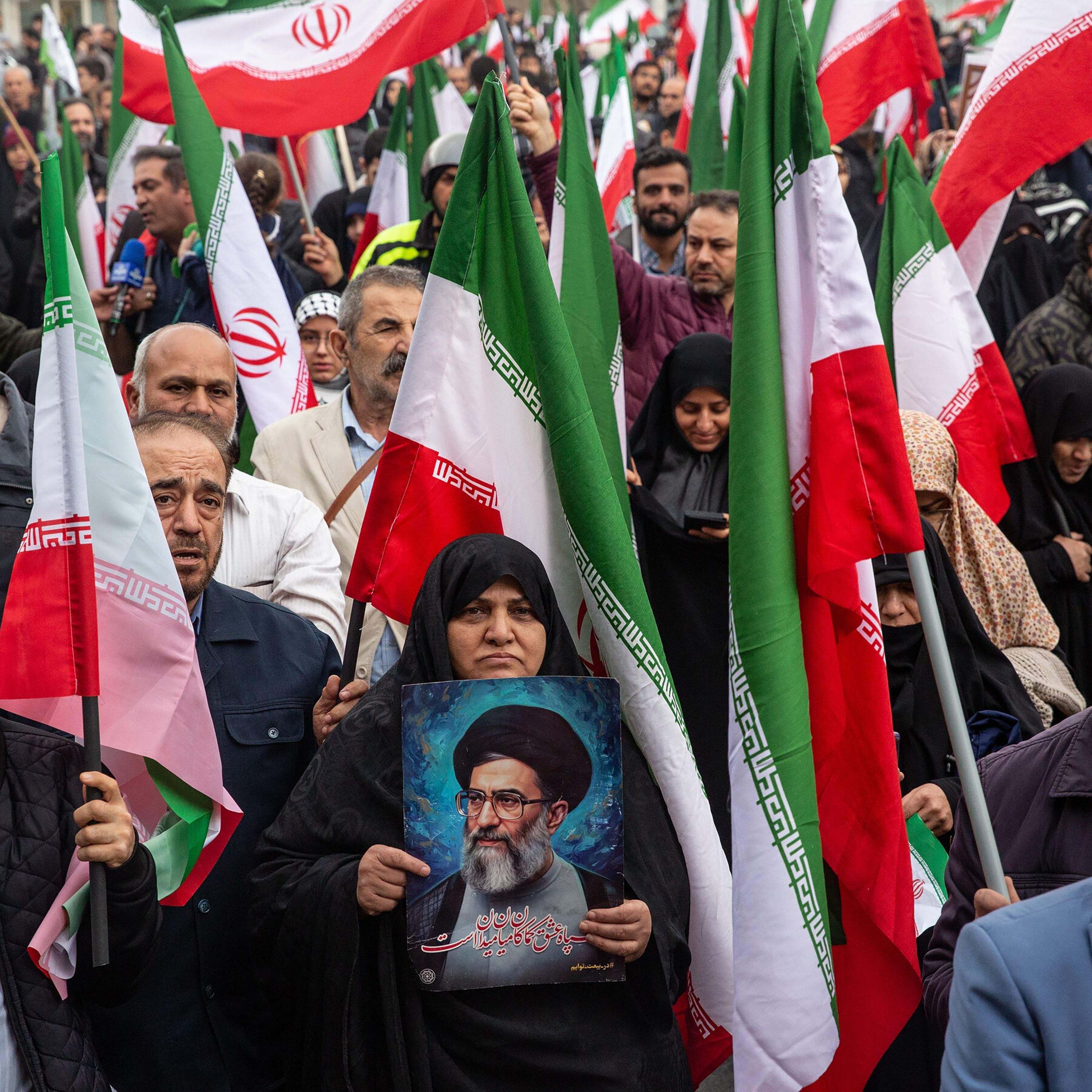
Photo: Arash Khamooshi for The New York Times
For more information on today’s episode, visit nytimes.com/thedaily. Transcripts of each episode will be made available by the next workday.
Subscribe today at nytimes.com/podcasts or on Apple Podcasts and Spotify. You can also subscribe via your favorite podcast app here https://www.nytimes.com/activate-access/audio?source=podcatcher. For more podcasts and narrated articles, download The New York Times app at nytimes.com/app.
Hosted by Simplecast, an AdsWizz company. See pcm.adswizz.com for information about our collection and use of personal data for advertising.
Hosts & Guests

Transcript
From the New York Times, I'm Rachel Abrams, and this is a special episode of The Daily.
We have breaking news that we're following from overnight.
The U.S. and Israel have launched a wide-scale assault on Iran.
Breaking news this hour, smoke can be seen coming from buildings in Tehran and people have
reportedly been running away in panic there.
This weekend, the United States and Israel have launched a massive attack against Iran,
killing the Supreme Leader, and, according to Iranian state media, several people in the
country's leadership structure.
This is very big news.
These strikes are now officially decapitation strikes.
The strikes were the most aggressive military action that the U.S. has taken against Iran
in generations.
Aimed a toppling regime that President after President has deemed an enemy of the United
States.
The attack has already prompted retaliation across the region, as well as fears about a wider
conflict that could reshape the Middle East.
You can hear the sirens are going off right now, and this is indicating essentially that
there is a barrage of missiles coming towards Israel.
U.S. embassies across the region are now telling Americans to shelter and place and just
in the State Department is now urging all U.S. citizens in Lebanon to get out while
commercial options are still available.
Today, my colleagues Mark Mazzetti and David Sanger explain what's next for Iran and what
these strikes threaten to unleash.
It's Sunday, March 1st.
David, Mark, welcome to the show.
Thank you.
Good to be back, Rachel.
So in my lifetime, there have been many false alarms about a full-fledged U.S. war with
Iran, where it seemed like we were close, but obviously it did not happen.
This moment feels very different, though, and I think that that's in large part because
these strikes have killed Iran's supreme leader, as well as a number of top officials in
the regime.
And just the scale of that alone, as well as the scale of the retaliation we've seen
in the region just in the last, basically less than 24 hours, it far surpasses any kind
of military operation we have seen in Iran since the Iranian Revolution in 1979.
So I think that a basic question on a lot of people's minds right now is, are we at war
with Iran?
And David, let's start with you.
It certainly feels like that, Rachel.
After all, the United States, for the first time, hit at the core of Tehran, the leadership
compounds, and the Iranians have responded by missile attacks on many of the U.S. allies
and on U.S. bases.
If that doesn't define a war, even one that may only last a few days, I don't know what
does.
That's right, David.
This is a full-blown war by the United States and Israel against Iran.
Last summer, when the Israelis began a conflict, there were clear lines that they didn't want
to cross, they didn't want to kill the supreme leader, or topple the regime.
The ambitions in this conflict are extraordinary.
One Trump said he is trying to basically knock off the leadership of the country and let
the country of Iran figure out what goes on from there.
This has never happened before.
Okay, so clearly we are at an unprecedented moment.
Talk about how we ended up here.
Well, this phase of it started with the protests last January, and you remember that there were
hundreds of thousands, if not millions, of Iranians who were on the streets.
Right.
And thousands, if not tens of thousands, who were killed.
And at that time, the president declared that he was going to come aid the protesters.
And that began the huge military buildup all around Iran that we've discussed before.
Two aircraft carriers, hundreds of bombers, fighter jets, refuelers, just a huge buildup.
And not only that, there's another important element here.
And that's after last summer's conflict with Iran, Benjamin Netanyahu, the Israeli
Prime Minister, starts making the case that there needs to be another round of strikes.
That last summer's war didn't finish the job.
So last December, he goes to Mar-a-Lago to meet with President Trump.
And during that meeting, we believe that Netanyahu basically asks Trump's permission for
Israel to strike sometime in 2026, particularly ballistic missile sites.
Because this is of urgent concern to Israel, Iran's missile program, as we've seen, is
quite capable of hitting Israel.
And so even as Trump is talking about the protesters, Netanyahu is also making his own case for
a joint U.S.-Israeli conflict to be far more ambitious than what happened last year.
But even as the buildup began, the President decided to go ahead with a diplomatic conversation
with Iran, one that was limited almost entirely to the future of the nuclear program.
We can't tell yet whether that was a serious effort or just for show.
But three administration officials who briefed us on this effort on Saturday made the case
that in two or three separate meetings in Geneva, they were pressing the Iranians on whether
they would be willing to give up all of their enrichment capability, the ability to produce
nuclear fuel.
At one point, U.S. officials told us they even offered to supply uranium for free to the
Iranians forever so that the U.S. stayed in control of how it was enriched and to make
sure that it couldn't be used for a weapon.
And they maintained that the Iranians turned that down.
And that when they reported that back to President Trump, that was sort of the breaking point.
And the question, of course, as all of these diplomatic talks are happening, is if they
fail, we're building up this huge military presence in the Middle East around Iran,
what kind of attack will the United States be willing to do?
Would it be limited?
Would it be large?
And what would the goal of any such attack be from the United States perspective?
That was the biggest question over the last several weeks as this military buildup in
the Middle East was happening, the largest military buildup since the Iraq War of 2003.
The military is planning for a very large scale conflict, but what would the President
decide and why and why now?
And how is the Trump administration justifying this conflict?
What is the reason for war?
What is the evidence of the threat?
And what you saw this week was President Trump and some of his senior advisors making a
case for war on many different fronts, and that case didn't hold up very well under scrutiny.
So you heard the President in the State of the Union address on Tuesday night saying
that Iran has ballistic missiles that will soon be capable of hitting the United States.
That is not true.
The Iranians have a ballistic missile program.
They have been interested in long-range missiles that could hit the United States, but the
Defense Intelligence Agency last year concluded that it could be a decade before they have
an arsenal of long-range ballistic missiles, and they haven't even necessarily committed
to the technology.
Separately you heard various advisors talking about Iran restarting its nuclear program.
Steve Whitkopf even said, or it could be a week away from a nuclear weapon.
And what we reported is that that is also not the case.
The strikes last June did a enough damage to Iran's nuclear program that it would take
far longer for Iran to really be able to restart it in a way that would constitute
a real threat and certainly wouldn't be able to do it within a week as Whitkopf said.
So they were kind of road testing these different justifications for war right up to the
eve of the attack.
Right, obviously the stated rationales have been dubious, but the attack of course happened
anyway.
Take us through the attack and how it unfolded.
So just after one in the morning Eastern time, the United States and Israeli militaries
launched a coordinated assault on Iran against the nuclear sites, missile sites, government
buildings, senior leaders.
There was a sort of division of labor here, Israel was going after the senior leaders of
Iran.
So it would be the supreme leader, senior IRGC commanders, upper echelon of the political
leadership.
The United States was more focused on military targets, ballistic missile targets, nuclear
sites around the country.
Can you tell us, Mark, what do we know about what exactly was hit?
We're recording late afternoon on Saturday and we want to be careful about what we can
confirm and what we can't.
Now nationwide strikes have been reported by Iranian media.
Smoke can be seen rising from capital in Tehran.
Other targets in the initial wave, the defense ministry, the parliament, the national supreme
council.
We certainly know there has been damage to government facilities and various other military
facilities in Iran.
Plumes of smoke were seen near the offices of Iran's supreme leader.
There is satellite footage of the supreme leader's compound, which appears to be flattened.
And there's no question from the targets that the goal was to change the leadership in
Iran.
Casual is now being reported after Iranian officials say an Israeli missile struck a
girl's elementary school killing 51 children and injuring another 60 people.
There are also reports of a school being hit in Iran with dozens of civilian casualties.
We will know much more in the coming days about this first wave of strikes and the damage
that was done.
And we are certainly also anticipating further waves of strikes in the coming days.
David, talk about the response from Iran so far.
Well, the Iranians were clearly ready to retaliate.
And it was only a few hours before we began hearing reports of missile attacks and drone
attacks aimed at the U.S. base in Bahrain, we've been hit, we've been hit.
Aimed at Dubai, we saw the streaks of an explosion above us aimed at U.S. allies, mostly
Arab states in the region.
And then, of course, there were attacks on Israel itself, just as we had expected.
Yeah, the aeratons had just started again in Jerusalem, we've been getting a series.
But I also thought it was interesting that the response was not an overwhelming one.
And that suggested to me that it's possible the Iranians think that they were being baited
into dumping all of their missiles and drones early on, leaving them defenseless if there
are second or third wave strikes by the U.S. and Israel.
So they responded right away, but they certainly kept a fair bit in reserve.
So at least for now, we're not seeing a serious number of casualties in the response.
So basically all of this is happening overnight, at least East Coast time where we are.
And Trump releases a video that a lot of folks in the U.S. wake up to on Saturday morning
that explains that this is the U.S. military action that we have all been waiting for.
For sure, time ago, the United States military began major combat operations in Iran.
And in this video, he talks about why he ordered it and what the goal is.
Our objective is to defend the American people by eliminating imminent threats from the Iranian
regime.
David, tell us what stood out to you from this video.
Well, there are two things that jumped out of me, Rachel.
The first part of the video was about the long list of grievances that the U.S. had against
Iran.
And he went back 47 years.
Along the regime's very first acts was to back a violent takeover of the U.S. embassy in
Tehran.
To the taking of the American hostages in the embassy for 444 days to the bombing of an
American barracks in Beirut and on to accusing Iran of knowing about, if not participating
in the attack on the USS Cole in the late 1990s.
Finally, to the great proud people of Iran, I say tonight that the hour of your freedom
is at hand.
But then he turned in a different direction.
When we are finished take over your government, it will be yours to take.
This will be probably your only chance for generations.
And for the first time, he basically urged the Iranian people to use this opportunity
to rise up against their government.
Now is the time to seize control of your destiny and to unleash the prosperous and glorious
future that is close within your reach.
This is the moment for action.
Do not let it pass.
And that was pretty remarkable because we have been wondering what was the plan to get
from attacking the leadership compounds to actually changing the regime?
Right.
Certainly saying in this video, we are going to take out the heads of the regime, and
now the people of Iran should rise up and basically finish the job of asking their government.
That's exactly right.
And we've really never seen anything like that before.
May God bless the United States of America.
May God bless you all.
Thank you.
And then later in the day, we start hearing reports that Supreme Leader Kamini is dead.
The reports first come out of Israel, and then late afternoon President Trump puts out
a post on social media announcing that he has been killed.
It's enormous.
The Supreme Leader of Iran is the identity of a theocratic government that has existed
for 47 years.
He is not only the spiritual head, but he provides all direction for the lower levels of Iran's
government.
And not only that, he is one of the most brutal autocrats, not only in the region, but
in the world.
And has a long history of fomenting chaos and violence around the Middle East.
And as the president said, attacking American troops.
So this is a historic moment.
And you know, politically and tactically for President Trump, this is also huge.
It was only two months ago, not even two months ago, that he sent a Delta Force in to pull
Nicholas Maduro from his bed in Caracas and send him off to a prison in New York.
And now he ends up killing the Supreme Leader of Iran.
We don't know where this is going to go, but it is certainly one of the most significant
turning points in the American encounters in the Middle East in decades.
We'll be right back.
So President Trump is explicitly saying that he wants the regime gone and that the people
of Iran should capitalize on this moment.
They should rise up and overthrow the government.
David, how likely do we think that actually is?
And is that a strategy that could even work for a regime that has proven itself over
and over again to be extremely resilient?
Well, the truth, Rachel, is we don't know because there has not been a regime change
in Iran since the Shah was thrown out in the late 1970s.
And the world is a very different place.
The population is very young.
But there's also this huge well-armed military establishment that is wildly invested in the
status quo and that is invested in the nuclear program as well.
So we're going to have to look for indicators.
There's lots of reason for enthusiasm right now.
There are people on the streets in Tehran and elsewhere celebrating the reports that
how many is dead.
But we also saw people celebrating in the streets in Iraq right after the liberation of Iraq
by U.S. forces and you know what happened there.
So it's important not to overread what you're going to be seeing in the next 24 or 48
hours as the country comes to terms with the fact that there is a transition of some
kind in the offing.
Right.
And David, when you and I spoke a few days ago, you told us that there was a succession
plan in place in the event of the Iatola's death.
And of course, he was also in his 80s.
So I think that a natural question is whether the regime can and may survive despite his
death.
Rachel, I think there's every possibility that it could.
The rumors we were hearing at that time was that the Iatola had planned down four levels
depending on who was killed, right?
So we're about to discover how brittle this regime is and whether it's got the resilience
to bounce back from what was clearly a huge blow and one they probably should have prepared
for better.
But it sounds like what you're saying is that the regime is not going to fall easily,
right?
So do we think that it has the capacity to fight back?
The reporting that the times has been doing and what we've talked about on the show
is that the Iranian regime is extremely weak in this moment.
Its military is extremely weak.
So Mark, what are Iran's actual capabilities to fight this war right now?
So first and foremost, it's a question of can it survive internally?
Recall that this is a security service that has been able to brutally put down internal
protests just in recent weeks.
So they are quite capable of keeping order in the country.
Of course there's this external pressure from the US and from Israel that presumably will
continue these attacks for days and that's then the question of can the regime survive
this external pressure?
What do we know about their capabilities?
We know that the regime has 2,000 or so ballistic missiles and they only used a small
part of the arsenal responding to the attacks on Saturday.
Are they waiting?
Are they trying to parse them out over time?
Or were their capabilities hit so hard in the first wave of attacks that they're having
trouble responding?
So that's another question that will only be answered in the days to come.
Let's just assume though that the United States and Israel will defend themselves against
those 2,000 missiles.
I think a lot of people might be listening to this and thinking to themselves, this really
sounds like another protracted endless war in the Middle East.
You know President Trump in talking about this is not discussing a very protracted operation.
He said on Saturday when some reporters put the question to him that he thinks he might
just pause after a couple of days, particularly now that harmony is dead.
But the key to this for President Trump is that the U.S. is not sending in ground troops
and therefore he tells his MAGA base, this isn't going to be a forever war or at least
not one in which the U.S. is taking casualties.
But of course, without boots on the ground, you don't have very much control over what
happens.
You know, in modern history, I can't think of an example in which we've brought about
regime change and certainly one in which we've managed to control it with simply air
power.
And I would add that as the experience in Iraq showed, even if you have the boots on
the ground, you don't necessarily have all the control about what happens either.
If regime change is not happening or not happening easily without U.S. boots on the ground,
do you think that there's any circumstance under which we would actually put troops on
the ground if the goal is regime change?
Do we think, for instance, that the U.S. is considering putting together some kind of
coalition of allied troops like we did after 9-11?
It is very, very hard to envision the Trump administration authorizing large-scale American
military presence in Iran with an indefinite future.
It is against what Trump has said he believes in, which is quick use of American military
power that sends a message and then you move on.
And that was why the Venezuelan operation was the sort of platonic ideal of a Trump military
operation.
And anything involving long, costly, messy regime change, boots on the ground operations
with indefinite outcomes is not really what President Trump's all about.
But if the regime doesn't fall, and if it seems like it wouldn't fall without troops
on the ground and Trump is not willing to do that, then you're saying what the Trump
just stops and pulls out?
You know, at the core of your question, Rachel, is one of the great unknowns, which is
can Iran learn anything from Venezuela?
And is the Venezuela example one that would even apply in a country of 92 million people?
You know, in Venezuela, they took out the leader but left the structure.
You know, Iran is really hard for me to understand how you would get away with doing that.
Because the Islamic Revolutionary Guard Corps, the besiege militia that puts down the protests
in the streets, they are the core of the Iranian power structure.
And it's almost impossible to imagine right now living with them still in power and
just removing the very top.
Okay, but that's kind of my question, though, like let's say that through some kind of
combination of a campaign of attacks by the US, Israel, plus whatever kind of uprising
we might see from Iranians, let's say the regime falls.
What do we think would happen next?
I assume that you do not think that there would be some kind of peaceful transfer of power
to a democratic form of government.
Well, that's possible, but there are so many other possibilities that you can't live in
the thought that it's even likely.
We've got a regime here that is in control of the guns.
We've got exiles who want to come back and take power.
You have the people on the street who envision a different Iran, but may not envision the
same kind of Iran.
That's all the formula for the possibility of civil war.
That also sounds like the recipe for the kind of power vacuum that leads to chaos after
US intervention, right?
And we've seen this before.
We have seen this in Iraq.
We've seen this in Afghanistan.
And obviously this is something that a lot of Americans do not want.
Yeah, and from the sound of it, President Trump wants to wash his hands of whatever comes next.
He said on Saturday morning, the United States has gotten rid of your bad leaders.
It's now up to you to do what you want with your country.
You have the opportunities, he said, for the first time, and maybe the only time in generations.
But what exactly does that mean?
And so it's what, as you said, could be the recipe for a protracted, violent civil war.
That doesn't necessarily have any outside guidance on what the outcome would be.
And that's what's so dangerous about this.
That kind of instability obviously could affect not just Iran, not just the entire region,
but I'm sure a lot of people are wondering or worried that it could affect Americans here
in the continental United States.
What are the risks to the US like the homeland or our allies in the West in this moment?
Well, they could be many.
So even if Iran is no longer capable of firing missiles at American bases or at Israel,
and we know that they can't fire a missile at the United States, there would still be
the possibility of Iran responding in sort of asymmetric ways with terror attacks, either
in Europe or in the United States.
They could draw this out over a very long time, long after President Trump has stopped
thinking about the Iran operation of 2026.
So if some remnants of the regime stay in place, and if there is still a Iranian government
that is adversarial to the United States and Israel and to Europe, there is a lot of
reasons to think that there is danger in the future.
It's also cyber risk out here.
They're quite skilled cyber actors.
They're not up at Chinese levels or necessarily the Russians, but they're in the next rank.
And if you don't have missiles that can reach the United States, you certainly do have
electrons that can, and they've proven in the past that they know how to use them.
Both have talked about the risks as a result of instability in Iran, around the world,
to the U.S. and our allies, and that last part does make me wonder, how have our allies
responded so far?
The American allies in the Middle East have responded with support for the operation, especially
after they themselves were attacked by Iran on Saturday.
And I'm thinking of Saudi Arabia and the United Arab Emirates and other countries.
They have at least said that symbolically we support the operation if not joining militarily.
Allies in Europe are far more cautious in expressing concern about the operation.
There is not a great deal on Saturday, at least, of cheering in Western European capitals
about the operation.
However, the British would not let the U.S. use the bomber base that the United States
frequently makes use of in Great Britain to run this attack directly, because they fundamentally
didn't believe the United States had just caused to do the attack, didn't want to be part
of it.
And I think one of the big concerns coming out of this is, does he emerge from the
Venezuela and Iran experiences emboldened to use the American military as his number
one tool of coercion?
And if so, how does that change the way the world views the United States and the way
other leaders may copy what the President views is his own expansive power?
This sort of makes me wonder whether the antagonist extends that Trump has taken toward
Europe.
Is a factor here at all?
Well, certainly at the Munich Security Conference two weeks ago, you heard a lot of skepticism
about the military build up from European officials who thought it was just an extension
of the kind of threats they had seen around Venezuela.
And even the President's vaguer threats about taking Greenland.
Stepping back here for a second, if we see the regime toppled as a result of this attack,
President Trump said in his speech that he was giving the Iranian people something that
no other President was willing to give them and that they have always wanted.
If this actually works, do you think we will look back at past Presidents and ask ourselves
why we didn't do this long ago?
Mark, what do you think?
So think back about where we were on October 7, 2023, so two and a half years ago.
There had been this sort of static position where Iran was strong.
It had its most powerful proxy force, Hezbollah, in Lebanon, that it was basically using
to deter any attacks.
After October 7 and after the Gaza war, Israel started striking all over the place in
the Middle East, including in Lebanon to take down Hezbollah.
And once that happened, it sort of set off this kind of chain reaction where the bar got
lowered for military action in the Middle East and specifically in Iran.
So I think it's important to really think about just how extraordinary the last two and
a half years that have been in the Middle East to sort of bring about the dynamic that
we are actually seeing with a regime change war led by the United States.
And you know, for everybody who wonders if we're seeing the collapse of the post-World
War II order, this is going to be another piece of the evidence because usually we have
thought about Middle East peace by constant negotiations, locking all of the neighbors
into agreements that would ultimately result in the Arabs recognizing Israel, in Israel
coming up with a two-state solution and so forth.
President Trump has tried a very different experiment.
This one in which he shows that by the use of American force and Israeli force, he can
shape the future of other nations.
And the question right now is, is he shaping their future or is he opening them up to
more chaos?
And in this dramatic moment, we simply can't yet tell.
Mark Mazzetti, David Sanger, thank you both so much for your time.
Thank you.
Thank you.
We'll be right back.
Today's episode was produced by Rochelle Bonja, Alexandra Lee Young, Shannon Lynn, and
Lindsey Garrison, with help from Eric Kruppi, who was edited by Paige Cowatt and MJ Davis
Lynn.
It contains music by Diane Wong, Sophia Landman, Marion Luzano, and Pat McCusker.
Our theme song is by Wonderly, and our episode was engineered by Chris Wood.
That's it for the daily, I'm Rachel Abrams, see you tomorrow.


