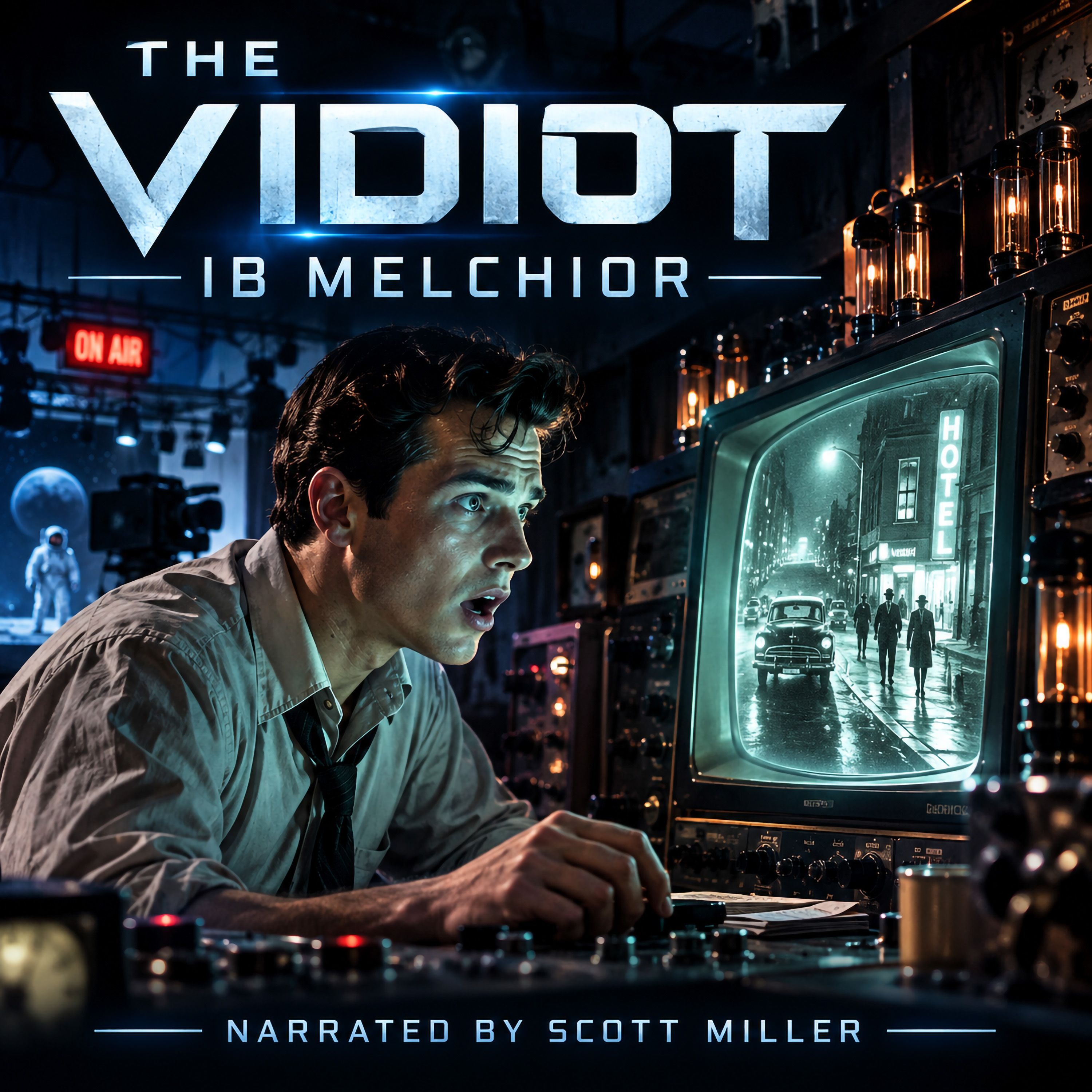
The Vidiot by Ib Melchior
About this episode
Don Hartley has stumbled upon an invention that could make him fabulously wealthy—and give anyone who controls it the power to watch anyone, anywhere. Before he cashes in, he must decide whether some discoveries are simply too dangerous to share. The Vidiot by Ib Melchior. That’s next on The Lost Sci-Fi Podcast.
Another day, another author making his debut on the podcast. Ib Melchior was born in Copenhagen, Denmark, in 1917. His father was a celebrated opera singer who performed throughout Europe and the Americas from the 1920s through the 1940s, including appearances with the Chicago Opera, San Francisco Opera and the Metropolitan Opera in New York. Near the end of his career, he also appeared in character roles in MGM musicals.
Ib spoke six languages, and his fascination with movies began when he was only 11 years old. He saw the 1928 silent film The Man Who Laughs, featuring Conrad Veidt as Gwynplaine, whose striking appearance later helped inspire the visual creation of the Joker. Melchior walked away from the movie knowing exactly what he wanted to do—direct films.
In the late 1950s, Melchior met producer Sidney W. Pink, who told him he could direct a movie if he wrote the screenplay. There was just one problem: Melchior had never written a screenplay. But he wanted to direct, so he wrote one, and the result was The Angry Red Planet. That launched a career in science fiction movies that would last for years.
Melchior went on to write and direct science fiction films including Reptilicus, Robinson Crusoe on Mars, and The Time Travelers. He also wrote for television, including an episode of The Outer Limits.
Before his movie career took off, Melchior wrote three science fiction short stories. Later, he added two science fiction novels to a remarkably varied career that began with an 11-year-old boy sitting in a movie theater, already dreaming about getting behind the camera.
His first short story appeared in Fantastic Universe in March 1956 on page 51, The Vidiot by Ib Melchior…
Next on The Lost Sci-Fi Podcast, The people of Kana refuse to abandon their forgotten world, and Kenyon is determined to discover what could make them choose isolation over the stars. Deep beneath the strange islands, something ancient has already decided who belongs on Kana—and who will never leave. Blood Lands by Alfred Coppel
Lost Sci-Fi Premium - https://lostscifi.supercast.com/
Buy Me a Coffee - https://lostscifi.com/coffee
Newsletter - https://lostscifi.com/free/
Facebook - https://lostscifi.com/facebook
YouTube - https://lostscifi.com/youtube
Instagram - https://www.instagram.com/lostscifiguy
Merchandise - https://lostscifi.creator-spring.com/
Thanks to Our Listeners Who Bought Us a Coffee
$200 Someone
$100 Tony from the Future
$75 James Van Maanenberg
$50 James Van Maanenberg, MizzBassie, Anonymous Listener
$25 Fintan Quigley, Curious Jon, David Bell, Steve, Miriam, Someone, Someone, Eaten by a Grue, Jeff Lussenden, Fred Sieber, Anne, Craig Hamilton, Dave Wiseman, Bromite Thrip, Marwin de Haan, Future Space Engineer, Fressie, Kevin Eckert, Stephen Kagan, James Van Maanenberg, Irma Stolfo, Josh Jennings, Leber8tr, Conrad Chaffee, Anonymous Listener
$15 Every Month Someone
$15 Steve, Someone, SueTheLibrarian, Joannie West, Amy Özkan, Someone, Carolyn Guthleben, Patrick McLendon, Curious Jon, Buz C., Fressie, Anonymous Listener
$10 David, Anonymous Listener
$5 Every Month Eaten by a Grue
$5 Tammy, Owen, Bruce, Someone, TLD, David, Denis Kalinin, Timothy Buckley, Andre'a, Martin Brown, Ron McFarlan, Tif Love, Chrystene, Richard Hoffman, Anonymous Listener
Listen without commercials and enjoy exclusive bonus episodes every month with Lost Sci-Fi Premium—start your free 7-day trial today. https://lostscifi.supercast.com/
Hosted by Simplecast, an AdsWizz company. See pcm.adswizz.com for information about our collection and use of personal data for advertising.
Get every episode summarized
Each time The Lost Sci-Fi Podcast - Vintage Sci-Fi Short Stories publishes, we email you a written briefing from the transcript — the topics, who appeared, and any specific claims, with the ad reads skipped.
Email me new episodesFree for 3 shows. No card needed.
Hosts & guests
Transcript ready
397 searchable segments. Every word is indexed and playable.
Full transcript
The Lost Sci-Fi Podcast - Vintage Sci-Fi Short Stories — The Vidiot by Ib Melchior. Machine-transcribed; use the interactive transcript above to jump the player to any line.
This is Belie, one network, every topic, everywhere. Don Hartley has stumbled upon an invention that could make him fabulously wealthy and give anyone who controls it the power to watch anyone anywhere. Before he cashes in, he must decide whether some discoveries are simply too dangerous to share. The Vidient by Ibb Melchior. That's next on the Lost Sci-Fi Podcast. Another day, another author making his debut on the podcast. Ibb Melchior was born in Copenhagen, Denmark in 1917. His father was a celebrated opera singer who performed throughout Europe and the Americas from the 1920s through the 1940s, including appearances with the Chicago Opera, San Francisco Opera, and the Metropolitan Opera in New York.
Near the end of his career, he also appeared in character roles in MGM musicals. Ibb spoke six languages, and his fascination with movies began when he was only 11 years old. He saw the 1928 silent film The Man Who Laughs featuring Conrad Vait as Gwynplane, whose striking appearance later helped inspire the visual creation of the Joker. Melchior walked away from the movie knowing exactly what he wanted to do, direct films. In the late 1950s, Melchior met Sydney W. Pink, who told him he could direct a movie if he wrote the screenplay. There was just one problem. Melchior had never written a screenplay, but he wanted to direct. So he wrote one, and the result was the Angry Red Planet. That launched a career in science fiction movies that would last for years.
Melchior went on to write and direct science fiction films, including Reptilicus, Robinson Crusoe on Mars, and the Time Travelers. He also wrote for television, including an episode of The Outer Lemons. Before his movie career took off, Melchior wrote three science fiction short stories. Later, he added two science fiction novels to a remarkably varied career that began with an 11-year-old boy, sitting in a movie theater, already dreaming about getting behind the camera. His first short story appeared in Fantastic Universe in March 1956 on Page 51, The Vidiate by Ibb Melchior. Don Hartley, the little blonde secretary's eyes open wide with curiosity as she repeated his name.
She knows then, about Don. Just a minute, she said. She picked up the phone and pressed the Inter-Office button. Mr. Don Hartley to see you, sir, she announced, then after a pause. Yes, sir. She replaced the receiver and turned back to Don. Won't you please have a seat, Mr. Hartley? He'll see you in a moment. Don sat uncomfortably on the edge of one of the heavy leather-apolstered chairs. He looked around the beautifully-appointed Ant-Office. The little secretary was trying and vain to be inconspicuous in her curiosity about him. He shifted self-consciously on the chair. Was he in the right place? Had he really made the right decision? It was a damn difficult thing to figure out. For the umpteenth time he let his mind wander back 24 hours.
Amazely 24 hours when George Kenmore flipped the talk back key. Okay, everybody, wrap it up. That's it for now. Be back here ready to go from the top in exactly one hour and a half. He turned to the technical director, a large, comfortable man who sat worrying of dead cigar on his left. And Steve, he warned, don't kill the cameras. Just capped them up so we don't burn in. You and the boys be back here in one hour. I've got a little problem I want to fool around with. That duplicator effect on Gennemyad. He leaned across the control desk toward the row of monitors in front of him on the lower level of the video control room, addressing himself to the top of a crew-cut. And Don, he added, be sure we have horizontal reverse scanning on camera one. And I want to use the wipe. And also, I want you to switch the matting amplifier into the circuit.
The video technician looked up over his shoulder. Okay, George, you know me, a director's wish is my command. But they sure handed you a tough one this time. What do you expect? After all, we're doing a space opera on live TV. They're bound to be technical difficulties. As long as they don't ask me for a close-up with a feed-in, they'll lick any problem they can dream up. Right? Right. Echo Don brightly. Anything the movie boys can do with process shooting and laboratory tricks. We can do right here in the studio. And better. I'm with you. George picked up his earphones from the desk and spoke into the tiny mic. Bill, Bill Sanders, are you still on cans? Out on the studio floor, one of the men waved his arm. George saw him through the double glass pane and continued. Good. Tell the boys to let in the big black and two in front of the spaceship set. And get the fog machine set.
I'm going to use a half hour of fax rehearsal time when we get back for some experimenting. As the dry ice arrived yet, on the floor, Bill waved yes. Okay. Tell me, George, the TD asked. What exactly is the effect you want in that Ganymed scene? George picked up a paperclip and an absent mindedly began twisting it around his pencil and the tight spiral. It was silly habit of his, but an innocuous one. It's like this, he began to explain. We're on Ganymede. That's one of Jupiter's moons. The planet here is landed and is walking around on the satellite in his spacesuit. We'll play the whole thing in front of the black drop and put in electronic stars. He leaned over the desk. Can do, Don? Can do? Fine. Now, the floor will be covered with dry ice fog. It's supposed to be a monue of apers or some such guck. So far so good.
He rolled his little paperclip spiral off his pencil and started on another one. The planet here is all alone, see? But suddenly another space-suitant figure joins him. It turns out to be he himself and duplicated. And if that's not enough, a third copy joins him. All three of them, he himself. He's supposed to look at himself, talk to himself, and walk in front of himself. We can't use doubles because of those transparent space helmets. And what's more, the three triplicated planeteers are supposed to make the exact same movements at the exact same time. The whole thing's supposed to be some sort of hallucination. And he stood up. And speaking about hallucinations. I'm so hungry I'm gonna get them if I don't get something to eat. Come and Steve? Fine, said the TD. The director leaned across the desk again. And how about our vidiat? You wanna join us, Don?
He asked. Don cringed mentally at the nickname. Even though he knew it was only a good-natured rib at the video technicians, he always winced at the term vidiat. But he managed to sound unconcerned when he answered, yes, not, George. I'm not hungry. Besides, I got a heavy date after the show. Well, just take around here. See you later then. The director said as he and his TD left the control room. On the studio floor, Bill, the floor manager, led a last look of inspection sweep the stage. Then he too walked out. Studio 52 was deserted, except for Don Hartley. Fine, that would give him a chance. He was pretty sure he knew what the director had in mind and how he would solve his problem of triplication. If he could have everything set up when George returned, the director was bound to send a note of commendation to Barnes, the big brass in the front office.
Don was ambitious. He had his eye on the TD chair, even on that of the director himself. And who could know everything was possible? Now, he'd use three cameras. Take the first picture of the planeteer on camera 3, normal scanning. Then he'd split the screen vertically on the white amplifier, putting the image from camera 3 on the right half of the screen. Then on camera 1, he'd take another picture of the planeteer and reverse the scanning horizontally, so that right became left and vice versa. Then he'd put the image from camera 1 on the left half of the screen, and he'd have two identical planeteers looking at each other. That would work out alright. Now, on camera 2, he'd take yet another picture of the planeteer and using the matting amplifier with primary picture on camera 2,
he could put the third planeteer in front of the two others. It would work. He'd have to try it out. Don walked out on the stage. From the prop room he got a spacesuit and a light blue color and propped it up on the test pattern stand in front of the black backdrop. That would be the planeteer. Next, he lined up his two pedestal cameras and swung in the huge boom camera so that all three had a full figure shot of the spacesuit. He returned to the control room and completed his intricate hookup. It worked. One spacesuit planeteer had become three. He reached up behind him to punch up his montage picture on the studio monitor so he could watch it out on the floor while he moved around in front of the cameras. As he swept his arm across the desk to the master switchboard, there was a tiny scratching sound. This became the sound of an object rolling and then falling off the desk.
There was a sharp crack and an accurate puff of smoke. As one of George's little paperclips spirals fell down into the exposed mass of tubes and wires of the matting amplifier. For a split second, Don's world stood still. His first reaction was a quick glance at the line monitor. The picture was still there. Something had happened to it. The matting amplifier worked by punching a hole in the image taken by one camera. The exact shape of the image taken by a second camera and putting this second image into the hole. The hole was there, alright. It was the exact shape of the propped up spacesuit. But it was a hole without an image. It was a hole of utter jet black. Don knew he ought to kill his B-plus before any more damage was done. But there was something about the total blackness of that hole in the picture on the monitor too.
Which fascinated him. It simply wasn't possible to get such a perfect black, even if you dug for it. He began cautiously to turn the brightness control. Slowly the blackness became lighter. All of a sudden an image appeared in the hole. Don worked the contrast control. The picture came swiftly into focus. It was not the image of the spacesuit as it should have been. Through the whole shape like the spacesuit, Don was looking into the interior of a spaceship. At once Don's mind supplied an answer. Something had happened to his hookup when that metal spiral had fallen into the matting amplifier and fused certain connections. Now he was actually able to pick up images from an extraterrestrial spaceship.
He must be excused, however. He had worked a long time on that TV space opera. And it wasn't long before he realized that what he was actually seeing in the hole was merely the spaceship set built for the planeteers. He was about to kill his power when it struck him like a 1,000 volt camera shock. How could he see the spaceship set? It was behind the big black backdrop. He studied the image on the monitor intently. That was it, alright. No mistake about it. He was looking right through the heavy black duveting backdrop with camera too. Or he suddenly had a thought. Don ran out into the studio. Bill usually kept a piece of chalk for floor markings near his cans. There, he went over to camera one. Carefully, he drew on the floor a straight line at a 90 degree angle to the lens from the camera
over to the black drop. Then he went to camera two and did the same. The lines did not converge in front of the drop. He ran behind the black, lifted up the bottom to orient himself, and continued the lines on the other side. They crossed each other right smack in the middle of the spaceship set. There could only be one answer. But Don had to be sure. He went back to camera two and carefully swung it a little to the right. Now the two imaginary lines would cross about a hundred feet further out. He ran back to the control room. And there, in the space suit shaped hole in the monitor image, he watched the traffic on the street outside the studio roar silently by. He was seeing through the backdrop, through the scenery stored at the rear of the studio, through the wall itself and into the street.
Wherever the lines from the two cameras would cross, he saw. He estimated the focal depth of the picture to be about ten feet on either side of the actual crossing point of the vitally important imaginary lines. He sat back. He was trembling a little. His hands felt clammy, but he soon got a hold of himself. He looked at the control room clock, 133. The guys would be back in about twenty minutes. He had to hurry. He killed the power, switched on his work lamp, and peered into the innards of the fused, mutilated, matting amplifier. From the storing case, he hauled out the complete circuit blueprint and set to work. The next fifteen minutes were spent in sketching in new connections and bridges and crossing out old ones on the drawings. Then Don carefully fished out the paperclips spiral
and deliberately dropped the heavy work light into the amplifier. There was the sharp noise of splintering tubes, stuffing the corrected circuit blueprints in his pocket. Don hurriedly left the studio minutes before the crew returned to continue their rehearsal for the planeteers. Don walked quickly through the midday crowd towards the park. Barnes would have his hide. First, were wrecking the matting amplifier, and secondly, for walking out on the rehearsal. But he desperately needed time to think. So what if he was fired? It was a big thing he'd come across. He had immediately recognized the tremendous possibilities of his accidental discovery. It had been simple for him to analyze the circuit changes produced by the paperclips spiral. And to realize that it would literally be child's play to construct a single camera, which could be focused on any given area and pick up an image,
regardless of whatever obstacles might lay between. Unknown to anyone in the area, with this camera, he could reach in anywhere with an invisible, all-seeing eye. And he was the only one who had this secret. Reflexively, he touched the pocket which held his notes. He definitely did not want to give this discovery to the network. He still remembered and resented that objectionable clause in his employment contract. I will assign to you irrevocably any and all rights I may have or get to all inventions made by me alone or with others, whether during or outside of my regular working hours. Like hell he would! This was one thing that number one boy wasn't giving away. There was a mint to be made, and Donnie Boy was going to make it.
It was a warm sunny day. Don hunted up a quiet corner in the park and relaxed on the grass. He had some tall thinking to do. Let's face it, he had a pure uranium mine on his hands. Just imagine what could be done with it. Entertainment could be plucked right out of the theaters, sports arenas, ball parks. Anywhere. News events could be covered immediately, and wherever they might occur by a spin of a dial. Even person to person wouldn't need all that cumbersome equipment. The military could watch war games, attacks, any development in safety. Why almost anyone could explore, maybe even discover rich mineral deposits with his new penetrating TV camera. You could observe the bottom of an ocean and the heart of a mountain. Yes, sir, he would revolutionize TV pickup and transmission, maybe even the secrets of space itself.
He felt dizzy. There was no end to the possibilities, and he was setting on top of the gizmo that would do it, the Hartley Penatella cam. Or, simpler still, the Hartley cam. He let someone like General Electric Hanelet, possibly RCA, and the right would be his. He'd be a creases. Rich is Rothchild, another Rockefeller. He'd buy up part of this park and put up Hartley Center, and he'd have his office on the entire Pantouse floor, the inventor and controller of the Hartley cam. It would be a closely guarded secret, like the government's Norden bombsite, or the H-bomb. The Norden bombsite, the H-bomb, the Hartley cam, the Hartley cam. Mr. Hartley, the president will see you now, a big man, round, outlish eyes behind thin steel frame spectacles.
Did he wear it to pay? Sir, when I sign contracts with your corporation to develop and exploit the Hartley cam... Say no more, my boy, I'm with you. But it is beyond my control. It has been ever since. Certain government factors have taken over, you know. There is nothing either of us can do. It was too big, too big. Of course, the president didn't wear it to pay. He was bald. It showed when he bowed, but not to don. He was not there. He bowed to the Hartley cam. The Hartley cam. Mr. Hartley, the president will see you now, a pompous man, a man accustomed to giving orders and having them obeyed. But not recently. Sir, as publisher and president of the leading Metropolitan newspaper...
Oh, man, I know who you are. Don't let too many others find out. Why did you let your spy camera get into the wrong hands? Don't you know it is the unscrupulous, the ruthless who grab power whenever they can? What happens when that power is unconquerable? But you gave them the power to penetrate into all places. No more privacy. No more privacy. No more successful opposition to ruthless power. Your paper. Can't you the freedom of the press? It is dead, like all other freedoms. Completely dead. You must conform or else. They burst in, unannounced. They were grim and tall and strong. They had black uniforms with a large silver H on the chest. H? I have been expecting you, said the pompous publisher resigningly.
I am ready. And him? Well, one of them tossing his head it done. He is only Hartley. They shrugged and left. The city was not the city. The people were not the people. There were no smiles, no joy. There were only flesh and blood robots with firties eyes and haunted looks. And it was everywhere. Watching. He could feel it. Not the deepest dungeon or the farthest corner was safe. It was all over him. Like a sticky hot, unbearable beam. Stabbing at his closed eyes. Burning is weary brain. Don sat up with the start. The glaring sun stood overhead. What a fool he had been to doze off in the sun like that. He had probably gotten himself a nice burn. No wonder he had had a nightmare. He gathered himself up and began walking through the park.
He felt sweaty and tired. And disturbed. And he still had to make up his mind. Where to go? The network? Industrial exploitation? The government? And that had been 24 hours earlier. A buzzer sounded on the little secretary's desk. She was kind of queued at that. For all of her curiosity. You may go in now, Mr. Hartley. She announced pleasantly. He walked towards the door. There was a black sign with white letters. V.P. General Engineering W. Barnes. He entered. Hello, Don. Said Barnes seriously. Sit down. Don leaned back in his chair and lit a cigarette. No, what's it all about? He had to say it fast, or he might not say it at all. I guess I lost my head. He nearly tripped over the words. I was hooking up the matting amplifier for Mr. Ken Moore on the Planetir show.
And I dropped the work light into it. I thought the whole thing had blown up. I got scared, and I just ran out of there. I don't know what came over me. I have no excuse. He stopped. It was done. There could be no turning back. Barnes looked at him for a moment. Then his stern face softened. Look, Don. He said kindly. We all have accidents. But we can't afford to panic after everyone. Still, it took courage to come here and face up to your mistake like this. I'm going to give you another chance. You got up and put his hand on Don's shoulder. Just don't lose your head again, he smiled. And Don, we'll take you off the Planetir's for a while. I guess they can get along with another video. He slapped Don on the back good naturally. In the boy's inside coat pocket, a bunch of papers crackled softly.
A bunch of papers which held the answer to an electronic device, the boy had decided was too big. The world was not ready for the Harley cam. Not yet. Not white yet. Next on the Lost Sci-Fi podcast, the people of Kanna refused to abandon there, forgotten world. And Kenyan is determined to discover what could make them choose isolation over the stars. Deep beneath the strange island, something ancient has already decided who belongs on Kanna. And who will never leave. Bloodlands by Alfred Couple. Thank you for listening.
More episodes
More from The Lost Sci-Fi Podcast - Vintage Sci-Fi Short Stories

Coffin For Two by Winston Marks
The Lost Sci-Fi Podcast - Vintage Sci-Fi Short Stories

Blood Lands by Alfred Coppel
The Lost Sci-Fi Podcast - Vintage Sci-Fi Short Stories

The Watchers by George H. Smith
The Lost Sci-Fi Podcast - Vintage Sci-Fi Short Stories

Killer by James E. Gunn
The Lost Sci-Fi Podcast - Vintage Sci-Fi Short Stories