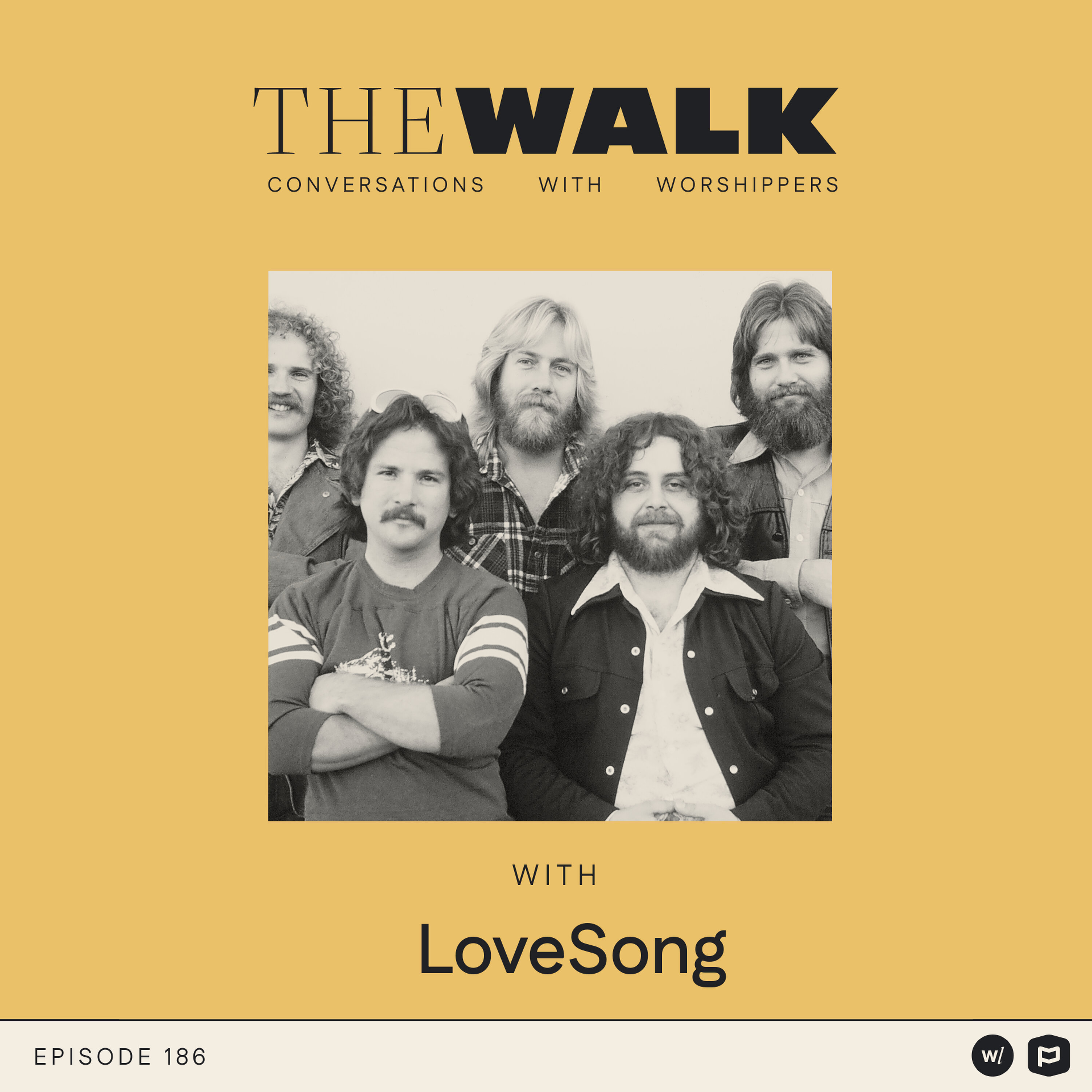
The Walk: A Devotional Podcast from Worship Leader... - Love Song: 60% of Your Church Is Not Singing
About this episode
LifeAudio is made possible by:
Tommy Coomes and Jay Truax were there. Not adjacent to the Jesus Movement, not students of it, but in it, on the beach, in the room. They're two of the founding members of Love Song, and this conversation is the long version of how a handful of California musicians accidentally became the front end of an entire industry.
Jay starts at the beginning. He was an inland surfer who helped build the first skateboards out of plywood and cut-up roller skates on his dad's bandsaw. He talked his father into a guitar instead of a trumpet, got a 1957 Strat from a pawn shop for ninety dollars, and traded it in 1963 for a brand new Fender Jazz bass. Two weeks later his band opened for the Beach Boys in a skating rink, and Brian Wilson asked to borrow the bass. Jay was fifteen. Then came the surfing, the LSD, a string of bands, and two years in Salt Lake City playing alongside the Grateful Dead and Creedence.
Tommy played trumpet for fourteen years, formed a band, and within six months all three of them were drafted at the height of Vietnam. Fred Field went to Vietnam. Chuck Butler went to South Korea. Tommy went to Germany, where he got deep into drugs mostly out of loneliness. He spent his leave in London and was standing on Carnaby Street the day Apple released its first four singles, with "Hey Jude" blasting out of every doorway. He came home in early 1969 planning to quit music and get a real job. Then friends dragged him to see a band called Love Song at a bar in Costa Mesa, and somewhere in a song he decided he couldn't quit after all.
The heart of it is what happened next, and how little of it was planned. Tommy invokes the opening of 1 John, this is what we saw, this is what we heard, and calls himself and Jay living witnesses, noting that the generation who can say that is thinning out. Jay's account of the Holy Spirit is the plainest thing in the episode: it comes about when you pull the plug on everything and stop getting in the way. They woke up with no idea what the day held and played three times a day, in jails, convalescent homes, high schools, two services at the Orange County jail. Jay compares it to being firemen. The phone rang and they went.
They tell it without polishing it. There's the Seventh Day Adventist church where they had no idea the congregation was vegetarian until Fred gave his testimony about being delivered from vegetarianism. There's Madison Square Garden one week and a flatbed truck on the Rio Grande in El Paso the next, which is where Tommy lands one of the best lines in the episode about being the same person in front of sixteen people or fifty thousand. There's Calvary Chapel going from a room the fire marshal capped around 220 to 2,500 people in a matter of months, with local pastors turning up in white belts to see what was going on.
Then Maranatha! Music, which is the part worship leaders will want. Chuck Smith sent them to a four-track studio in Huntington Beach. The compilation cost four thousand dollars, sold 160,000 copies with no distribution, and the records lived in a Sunday school room. Michael W. Smith found a copy in a used clothing store in West Virginia, took it home, and walked the aisle of his Baptist church six weeks later. Twenty years on, Tommy asked Chuck Smith why he'd started the label. The answer: because the band had no gas money and he figured an album to sell would get them home.
Kurtis asks about Chuck Fromm, who founded Worship Leader, and the two of them light up. Chuck Smith's nephew, called down from a city administration job in Yuba City to run Maranatha!, a man who used his Rolodex as a thinking tool and would talk an idea through with someone for an hour just to hear it out loud. Tommy tells the story of Chuck buying property and building a real studio without telling his uncle first. It opened in 1978 with fifty of the best tube mics in the world, and they recorded in it nonstop.
The last stretch is a challenge. To
Get every episode summarized
Each time LifeAudio publishes, we email you a written briefing from the transcript — the topics, who appeared, and any specific claims, with the ad reads skipped.
Email me new episodesFree for 3 shows. No card needed.
Transcript ready
1,425 searchable segments. Every word is indexed and playable.
Full transcript
LifeAudio — The Walk: A Devotional Podcast from Worship Leader... - Love Song: 60% of Your Church Is Not Singing. Machine-transcribed; use the interactive transcript above to jump the player to any line.
Hey, you're listening to The Walk, a podcast that dives into our journey with Jesus. One story, one step at a time. This episode is brought to you by our friends at Planning Center. I love Planning Center. We use them at my home church, destination church. Hey, whether you're organizing Sunday services or scheduling volunteers, Planning Center gives you the tools to build a healthy connected worship ministry. From check-ins to giving, music prep to communication, it's one platform designed for every step of your church. So start building your team and streamlining your Sundays at Planning Center. Planning Center, where ministry flows better together. Well, second Corinthians 5.7 says we walk by faith and not by sight. That is the Christian life. It's not just talking the talk, but it's walking. The walk, my name's Curtis Parks. And I'm your host this season. Well, listen, worship leader magazine has been around since the early 90s and we often talk about legacy. And today we've got the chance to talk to a group that has quite the legacy.
They were in the thrill of the Jesus movement. They've been called pioneers of our modern worship sound and their songs inspired probably most of the worship artists you've ever listened to. They have an incredible documentary that's out now on Amazon Prime. Today, we are taking a walk with love songs. They what's up, guys? Hey, what's up? Let's take that walk. This is going to be so much fun. We've got Tommy Coombs and J True Acts who are original founding members of the band, Love Song. I was telling you guys earlier, I watched episode one on Prime last night with my 12-year-old son, Moses, and he's asking me, when can we watch episode two? And so there's just, there's something about that era of music. My father-in-law was in a grateful, dead cover band. And he shows me all these pictures. It just looked like a cool time to be alive. What was it like in that culture, in that era of music? Not everything was perfect.
I love what you guys said on the documentary, where it was like, there's a lot of mistrust and political turmoil and things weren't great with war stuff. So there's obviously, I think sometimes we look back on nostalgic periods way better than they really were. Like, we're like, oh, it was perfect back then, but it wasn't. Like, talk about that era and what you guys still remember from just the general culture of that time, guys. Well, I think for me, everywhere in the world, the subculture of youth was looking for something better. And they kind of found us together. That common search for something better. Now, unfortunately, there were other binders like LSD and Reefer. And by the way, that is still going on two days. Right. Yeah. Abby, right? Now, everybody's walking around with a medical marijuana license, thinking this is the answer. But everybody's got some pain. They're trying to kill.
Just gotta be careful how you do it. But that was a worldwide phenomenon. Dress, culture, carnivist street, beetles, stalls, great for dead, do be brothers. Music had a big art. Chef, your art set in the movie Music led the way. Wow. That's so cool. Jay, what do you remember from that era? And just talked to us a little bit about what it actually felt like to experience the Jesus movement firsthand? Well, I have to back up a tad. I mean, I was a surfer. Actually, in high school, I started surfing. Actually, we invented skateboard. So you can believe that. That's awesome. Before I skateboard, we bought skates at a skating rink for a cheap that were used for like three bucks or something. We take them apart and my dad had a bandsaw and we cut out surfboards on plywood. Size of a skateboard today. And we would mount the wheels and then we would customize the wheels so they could turn
because roller skates were really firm, really stiff. So we would make them so you could go. And then we inset them so you could do kick turns. And so we were doing all these tricks and after school skateboarding because we were inland surfers. Okay. So we couldn't go to the beach every day. But we went quite often. But anyway, I was in a, got into high school, I begged my dad instead of playing trumpet to get me a guitar. And he did. He went to a pawn shop and bought me a 57 strat, which I wish I really still had. Oh, man. Right. For 90 bucks. And so automatically was in a band. And I think I had a old, I don't even know what the amp was, but it was funky. And we started playing little deals and then kind of got better people in the band. And I ended up going from league guitar to down to rhythm guitar down to bass guitar.
And so eventually I actually traded that in and got a bass guitar. So I traded my 57 strat in in 1963. They gave me $50 for it at the music store. And I bought a brand new Fender Jazz bass for three in a bucks. You know, what's the $50? So it was $350 minus the 50. And two weeks later we opened for the Beach Boys in a skating rink by band. What? Oh my goodness. On the 15th, 1963, Ryan Wilson forgets his bass. And that's the bar of my brand new Fender Jazz bass. I didn't want to love music because it was like, you know, it's like having a Ferrari without it. I didn't have a car. And so anyway, I did love music. Okay. Okay. That was a good call. I was a surfer when the Beatles came out and all that. I was living at the beach. And actually the Beatles came out in high school. When they're like revolver album and everybody started getting into the drug deal.
And we first time I took LSD was surfing. And with a lot of really famous surfers actually. But kind of got out of music and then my parents took my car away because I wasn't going to school. So I ended up going back to school. Loaned a band. Someone who guys in the band, a bunch of my instruments, my bass guitar and my amp. He got drafted. The band goes, well, come on. And we got your stuff. Come on play in our band. So anyway, I got in a band. Went down to Fender to kind of re get my guitar. We adjusted and ran into the sky. Virgil Beckham. And he was in a band at a club in Garden Grove called the Surries. The club was called Gold Street. And I told him we had a band. And we were called the hustlers and he goes, hey, we have a Sunday night jam night. Come down, sit in. So we did. That's cool. That band ended up going to Vegas for two weeks. And the owner called us and said, hey, would you like to come in and take the place of
the Surries for two weeks? Wow. So we go cool. So anyway, we kind of like we're kind of going through a change. So we got a couple of new guys and changed the name to the park bench. The park bench. The park bench. Met John Maylor. John, our drummer got drafted also. So John came in as a recommendation and that's how I met John Maylor. Anyway, we're there. After the two weeks, the band comes back from Vegas. While they were in Vegas, they meet Chuck T. Rarks band. Playing at this club in Vegas. So they invite Chuck to come down and sit in. And so I was there one night. Chuck shows up and we all met and that's kind of where I became a Christian. Danny, one of the guys had become a Christian and grabbed me and just said, you got to know Jesus. And which I had never even thought about. I was having some some problems and he goes, God, you know, forgive all your sins, wipe your sins away. And I'm going, and I need that. Yeah. So, uh, and I'm having a group of guys that were all kind of into the Bible and we were
all musicians and we were doing Bible studies at the nightclub on, uh, on and off night. And Chuck was there. Chuck came, uh, Ernie, the drummer. So we ended up forming a band and it was Danny Carell on the love songs. And it was, this is like 1967. Wow. And Danny and Chuck wrote a song called Changes. Mm hmm. And we would sing that, you know, I try so hard. You know, you know, and anyway, it was, uh, we played it in bars and clubs and anywhere we had it, anyway, to find a gig. But we were kind of a God band back in those days talking about Jesus. Yeah. And we were reading the Bible. And it was, that's kind of how that whole thing started me. And then through a lot of situations, I ended up in Hawaii and came back and got into a band with John again, John, uh, Mailler and a guitar player and we ended up calling ourselves
screwed to creation. Mm hmm. And we went on to Canada and on the way through to Canada, we stopped in Salt Lake City and we went to the back door of a concert deal, whether we were setting up one day and I was can't he. And the band, one of the bands didn't show up and, uh, I told the promoter that we were from California and we were the best band that he never heard. Nice. Somehow another, he let us open for can't he? Wow. And we blew everybody away. Wow. And they said, you got to come back and open for Hendrix and blah, blah, blah. Oh my goodness. So we went on our way to Canada. We spent a couple months up there, came back and we had been in two years in Salt Lake City as the down band and we played with the dead, we played with credence, uh, you know, all the bands and those, this is, this is spirit of creation. Correct. Correct. Wow. Wow. Wow. Wow. I mean, club polyole, go ahead, tell me. No, I think, go ahead. Nope. You don't need help. Uh, anyway, it's a band that never did a recording.
So it's. It's kind of like in your, in your memories, but we did a lot of improv. I mean, we would walk out there not knowing what we were going to do and just make up stuff. Wow. Because I was trying to kind of create a music form that would be, allow people to get out of the format of their life and experience some type of a spiritual, uh, like get high with music, rather than drugs, basically. Yeah. Yeah. And that was the goal. And whether we did that or not, I'm not sure I think that we were more like, for example, any type of a spiritual enlightenment. Wow. But we ended up, uh, joining forces with Chuck and Danny, they put together another band called Love Song down in Orange County and they ended up coming to Salt Lake and we got them some gigs and John and I left our band and joined Love Song. And that band was, you know, what did some, they're a great band.
We had a couple of eyes from the vibrance that they were the Long Beach. Tommy knows them really good. Long Beach band. Sent them a sender. Sent them a sender. Wow. And all the guys were good. Bobby Gooddottie, he played with the box tops. We had two drummers. Blah, blah, blah. And, uh, now was Tommy in the band at this time when you guys joined up. Okay. Tommy was a guy that, uh, I had met. Yeah, I had met Fred and, uh, this is a funny story. I met Fred and Chuck Butler, Fred Field and Chuck Butler at a nightclub where Danny and Chuck were playing in Costa Mesa. We all came, John and I came down from Salt Lake, drove all the way like 12 hours. Wow. And ended up getting at the club like at one o'clock in the morning and we sat in the last set. Wow. I stayed there a few days and I met Chuck and, uh, Fred and back in those days, I was kind of in close with one of the guys from Fender. And he had given me a free base amp and a bunch of stuff and they had just made this prototype
violin, uh, like a hard body Fender violin. And Fred was a violinist. He was a great violin player and we had a gig with the grateful dead about four days back in Salt Lake. Wow. So I grabbed him and we went down and got him a violin from Fender. They just gave it to us and, uh, got Chuck Butler and we jumped, they took, we took off and went to Salt Lake and, uh, no rehearsal and they came out and played with us with the grateful dead and, uh, Fred would have his wawa on and all this stuff I have with his violin and, uh, it was crazy. Wow. And, uh, that's all I met Fred and then Tommy because of what year was that, Jay? 1969. This was Fred, Fred Woodstock. This was April Woodstock was in August. Wow. Anyway, Tommy was friends with all these guys. So he ended up coming up to Salt Lake and that's how I met Tommy. Okay. Um, Tommy would kind of jam with us and play and blah, blah, blah.
And then anyway, everybody migrated back down to Orange County eventually. Yeah. And then he was hanging with all those guys and we're doing it. And, uh, that's kind of how we kind of met. Okay. Tommy, tell him the story, how you ended up playing with love song. It's, well, I met, you know, like in Southern California culture in the mid 60s, everybody was in a band. Everybody wanted to be in a band. That's why you could be playing a, a debut root beer or a frat party or whatever. Everybody had a band. I was a trumpet player. I played for 14 years and we used to go this club called the Cinnamon Sender in Long Beach and it was for the best bands around called the vibrant. Jay mentioned two of those guys were later playing with him. And I met Chuck Butler there, a good singer in front of field who played guitar player there. And, you know, you're hanging out, you're watching other musicians. So we formed a band. We're together about six months and all three of us got drafted in the US Army at the
height of the adults. Wow. I was in 1967 within six weeks. Fred goes to NUM, Chuck Butler goes to South Korea and I go to Germany. Wow. Wow, but when I'm in Germany, I buy lots of records. And I used my 21 days of leave. I went to London. I saw Jimmy Hendrix in Germany. I saw a small face, it was a broadsteward. I saw a Rory Gallagher. I saw the doors. I saw at least people in good. And then came along. And it was just like a little beach. Thousands of people on the street and big concert venues and music was a big deal. So I'm on car to be street. Car to be street was the place to London where all the record stores were in all the hip clothing stores. When you see rolling stones, those really close, that's where they got them all. Yeah. I'm in a record store. And I'm not kidding you've every blues American blues album that you had never even heard
of. That's almost all that was there because Ronnie Whit from the Stones, Clap and Jeff Beck, that's all. What if everything you love about your faith got deeper? Richard Moore rooted more alive. L. Chennai Ministries exists to take Torah to the nations, restoring the biblical and historical foundations of the connection between Christians and the Jewish roots of Scripture. Pastor Mark Biltz has taught in 25 nations on five continents and now he's teaching you. Listen free at oneplace.com. Just search L. Chennai Ministries at oneplace.com. Oh, the real estate too, right? So on car to be street, the day that Apple releases their first four singles, A. Jude is blasting everywhere. Crazy. I'm just so excited but I got too involved in drugs. I was just very lonely in the army and the truth of the matter was everybody was either getting
stolen on weed or hash or something, right? Tell the money right out because they were just so lonely and didn't want to be there. So I get home from the army. March I think maybe of 69. And the very first and then Chuck Butler and Fred Field who got dropped the cent on me, they had just gotten home. They went to see this band called Love Song at a bar on the happening in Costa Mesa. And they call me up, first down home saying, you gotta go see this band. I just got home. So I go to see this band with a, and I see my two favorite guitar players in Dini Carell and a guy I never heard of called Chuck's Rourke. And I was at a point in my life where I thought, I've gotten too involved in drugs. I just got home from the army. I need to get a job, need to get my life together. I got to quit music because this is taking me places that might not be too healthy. Yeah. So Love Song plays and I think it was a song called Feel the Love and I was backed by the
board. And it was my moment. And I went, I can't quit. I can't quit music. I don't know what this is. And I got, I found a real bond with all these guys that were on a similar path of finding God and doing music and playing good music and being creative. And you know, pretty similar all living together and playing in different bands together. And, but the one thing we had in common besides music and what you did good music was the spiritual search. And we were in that deep together like brothers going to war. Wow. And so it's so interesting, you know, you're talking about getting drafted and a lot of your friends getting drafted. And I think it's just such a foreign concept for people that are in 2026 America. And you know, who knows if that would happen again. But the fact that like, you know, your friends could be here, you could be here one day and then you're getting shipped off, you know, the very next month, like just like that.
And the generation of Vietnam vets, you know, first off, just thank you for serving, you know, like I'm from a military family and, you know, I think that was one generation that never really got their due and their gratitude from a country, you know, just from what I've seen on documentaries and movies. I love things from that era. And, but it's just so wild because you do have this generation that's kind of back their home. It's the mid 60s going into the early 70s looking for what they don't realize is God in all the wrong places. And this thing, this thing called the Jesus movement. I mean, many of us have seen the Jesus revolution movie that came out a few years ago. It's incredible. And it's basically like, I'm talking to the guys that were there like on the beach, like in the midst of all that happening, just kind of seeing this revival happen where people are finally putting two and two together that like, we're on this search and it's Jesus. Jesus is the answer.
Like, and talk to us a little bit about living in that environment where there was no, you couldn't just flip on the radio and listen to worship music like we have today. You couldn't just open your iPhone and look at, you know, the latest devotional on you version. I mean, there wasn't all these resources back then. It was literally people were on a journey, a very visceral journey trying to figure out this life. And then this thing called the Jesus movement happens where you guys are and Lonnie Frisbee, they're preaching, it's a very simple gospel. You know, we're talking about this on the other podcast I do. And it's a very simple gospel. What was it that drove you guys in? Because as we were talking before, the sex drugs and rock and roll, they all came to dead ends and it was like they made a promise they couldn't fulfill. They made a promise they couldn't fulfill. And it was only fulfilled when you finally figured out, oh, it's this Jesus that we've been looking. What was that environment like?
The hunger for blind people. Let me be, let me be preface it. Let me preface this by saying the last time I read the letters of John, I think it's first John probably in the first six verses. He basically says, hey, I'm going to tell you these stories. This is what we saw. This was we heard, we had lunch with them. We touched them. We lived with them. I'm going to tell you these stories. At this point in my life and Jay's life and Karen's life and John Maylard who now lives in Sweden, we, in a use the term living witnesses, we were alive. We saw it. And that, that, that era is coming to an end. You know, we've lost Keith Green, Larry Norman and some others. You know, we're all getting up there, but we actually saw it. We felt it. And you write it was simple. It was exciting. It wasn't strategy. It was authentic. And finally, after searching all these dead ends, there was no plan.
No. Finally, after all these dead ends, we knew this is the real deal. And you couldn't find a weirder situation or a cooler situation. We come to hear a hippie preacher and here's this bald guy about 40 who has the whole Bible memorized and all these different people that are loving on each other and excited to read the Bible and pray. And you know, it was a healthy community. Wow. Jay, speak to that because you know, there was no strategy. Like, that's what's kind of so mind blowing for somebody who, who, you know, I've been in ministry for, you know, full time ministry for 17 years. And you know, we have a vision retreat every single year, you know, and obviously our strategy is the gospel. I mean, when you, when you put it down to it, it's just like, we're just here trying to figure out how to, you know, bring Jesus to the world and more and more people and make heaven crowded, right? But it's like, I think when you look at a movement that has such a, the breadth of God on
it and such as excess that the Jesus movement seemed to have, like, talk to us Jay about like the fact that there was no strategy. It was like, you're building this airplane in the air. Yeah. It was, it was the, it was the Holy Spirit. Wow. Wow. The Holy Spirit to me is like, it comes about when you basically pull the plug on all your, everything. It's just like, it's, it's God, it's God guiding you without you trying to give him the way. And we kind of like just pretty much gave ourself to that. I mean, we woke up in the morning not thinking about what we were going to do or we were just ready to do anything. Wow. Sometimes like, you know, that we would play three times a day. We'd go with Chuck. We'd play at high schools. We did, we did convalescent homes. We did jail. We did a Sunday mornings. We did two services at Orange County, jail.
We did the Catholic and the Protestant service. And then we came back and played three times a church in the morning. And then we probably did something in the evening too. Wow. That's just kind of what we did. We were like always, it was, we were like farming, foam with ring and we'd go. I love it. I love it. I love it. We didn't, we didn't think about it. We did, it's kind of like you're in the army in a way because God's army because you were, someone always directed you what to do. It wasn't like I was directing my own life. I was basically God was telling us where to go. And it's hard to explain. But it was really a cool time because you didn't really, you weren't, you knew you were in the right spot. Like I told you before that this is, you knew that this is exactly where I'm supposed to be. No other place. No doubt about it. That's amazing. That's amazing. What's so cool, what you just talked about is like I remember here in a preacher, this
is probably 10 years ago, you know, he said, what if we just woke up every day and said, Jesus, what is it you're doing in it and can I come with you? Can I come do it with you? And it's what we did. Man. It's got a chance to do that. That's all I got. Okay. Now I'm, I was married. I had kids and jobs and work and this. And now I'm kind of like winding down from all that and I play golf. That's kind of my, my new deal. But it's like that was so cool that we got, we got to do stuff for the Lord every day and we really didn't know what it was going to be. I mean, we got, you know, I think that we've told some funny stories that we got asked to go to play the seven, seven day Adventist Church one time by one of the kids that was coming to Calvary and they got us in there and we show up and people don't really know who we are and the meat starts to sing and Fred shared a testimony about how you got delivered from vegetarianism. That doesn't all fricked up too because we had no idea that they were, they didn't need
meat, you know, we just, we were really nice. We were normal church. We were really naive about there's how many different ways there are to do church, right? One of my fun stories I, there was a guy in El Paso, Texas and he kept begging Chuck, please on your way back from New York or from wire someplace, please stop. We got this movement going on and we get there. You know, this is the humble part. Okay, you play some big thing like Madison Square Garden in New York. Next thing you know, you want a flatbed truck on the Rio Grande River in El Paso, Texas. Whatever situation it is, you know, time to bring it, you know, let's go. And it's where, you know, and the truth of matter is if there's 16 people in front of you or 16,000 or 50,000, you got to be the same guy. You got to be that instrument just used as a Holy Spirit. What am I supposed to do?
What am I supposed to say? How do I, I remember one time walking off Calvary Chapel stage. It had been a real busy day and I was just, you thought hit me. It's like, oh, I didn't have to change to go do that. I'm the same guy over here as the guy who's just on the stage. And I was like, I was early on and I went, oh, that's the way to do it, you know. But it's interesting. Jay's right, we played three times a day all the time. We just said yes. And every kind of situation, I mean, we wound up in Manila and the Philippines with another one record. Wow. And it was chapter in one, I second or third episode called Beatles for a Week. And that story was well told there. But I mean, God really literally gave us the country. The media, everything and thousands of kids came to Christ. It was, and, but I'll tell you what, I wouldn't want to be that famous on a regular basis. Yeah. Because you got to have security guards around, you know, all kind of stuff.
But even in Manila, people were really hungry for God. And they loved that. The harmonies of love song as well. That was the kind of speaking, their kind of language. But so for flatbed trucks, two stadiums, we, in prisons, we did it all. I love that. You guys were just willing to do whatever was on the docket for that day. Like, and so let's talk a little bit about this. So, you know, 1970 is kind of, the love song is getting together with you guys. And of course, you know, Calvary, the Jesus movement, it's blowing up. 19, was it 72 when X-Blo was? Yeah. Okay. 72. Give us a snapshot of that because, you know, we've seen pictures in black and white. We've seen video clips like just so many people. What was it? Almost a quarter million people gathered that. That was on that. I think that was, was it the Sunbe? Yeah. It was the last thing on that part. And one thing, one thing that was the cotton bowl, the next day was out on the parkway.
Crazy. Where they had the big, you know, they had about 110 or 20,000 in the cotton bowl. Wow. And then on the parkway, there was like 200 and something thousand. Incredible. Yeah, it was like 1970. We all, the ones that came to Calvary, there was a bunch of us. There were musicians. The ones that kind of quit doing smoking pot and all that and kind of said, okay, we're gonna, this is, you know, this is for real. So, yeah. That's kind of what it did. At that point in time, we didn't have a drummer even. John was still up in Utah or Salt Lake City. Wow. So it was just four of us with no drums. And we played all acoustic. We never thought about playing electric at all because, wow. Figured just the way we looked was bad enough. Let's not rock the boat too much. Exactly. So it was a gradual, you know, deal to break out anything electric.
Wow. We played at the troubidore even and actually, me back, take finally what the heck happened. We got John to come down. And when we were all at the Gilbert's teachers that adopted us, that turned a garage into our room. Wow. They had a camper shell next to their, they had a big piece of property, a bunch of apartment units and they were in the back with the big house and the pool. And this is in California. And they had a camper shell there. So John, you know, he just had a little baby. So him and his wife, Mary, come down from Utah and they live in the camper shell. Wow. That's their place. So now we have a drummer. And so John just basically, even though he was like buddy rich, drummer, he's playing bongos. Crazy. So one of our gigs we had, we were playing in front of Ahmed Erdogan from Atlantic Records in Clive Davis, their group Columbia at the troubidore.
John was playing bongos. I didn't even play bass. I just slapped my leg because of the rest of the acoustic bass in those days. Wow. And then everybody was playing acoustic. We didn't even have anything electric. And we played at the troubidore and pretty much blew. It was really good. And a lot of kids from church came. I think at, anyway, one of the guys brought a bunch of kids, a whole, probably a busload of kids. And it was just a great night. We had Ahmed Erdogan there and his girlfriend was in tears. And it was the Holy Spirits. Once again, just basically hit this deal. And it was amazing. Anyway, we're back at the house. And one day the phone rings. It's Chuck Smith. And he goes, hey, is John there? And so we get a whole lot of mailer. You have to go out and get him out of the camper or whatever. He comes in and he goes, yeah, oh, really?
Okay. Wow. Okay. And we're going, what the heck is he talking about? Anyway, we go, John, what do you say? He goes, well, Chuck wants me to bring my drum set in and play a drum solo at church. Oh, wow. We're freaking out. We're going, you got to be kidding me. So anyway, he does. And so that was kind of the beginning of us trying to break out of our kind of a low key deal and become more, I got to start playing bass for, you know, playing guitar. A full sounding band, yeah. Yeah, exactly. Yeah. That's so cool. It was, it was, and then we, you know, we would play it some stuff just acoustic and people thought we were from the devil. Just because of our music. Wow. Wow. And we went through a lot of that. We went through all kinds of weird stuff. I mean, we hear stories these days about like what you're talking about, like, you know, you should have seen when we first introduced electric guitar and church, you wouldn't have believed or drums. And it's like, you guys lived that.
Like you guys literally like kind of transitioned from, you know, it was like soft. I mean, what was it like as far as like congregational singing within a context of a church service? What was it like in that era? Was it like more hymns or was it like more acapella? We did not do sing-alongs. Okay. Yeah. Per se. The church had songs like happy, happy, you know, people right. They had a bunch of songs like that. Yeah. But our stuff was not sing along. Okay. In fact, people very rarely even applauded at me pretty much. There was no applause after you played. Wow. Hopefully not because we wanted people to be just in the process of it. Yeah. Exactly. Wow. So go ahead, Tony. Well, one thing that a couple things come to mind, listen to Jay Talk. It's like, I think a love song maybe had the very best blend I could think of singing around one vocal microphone. It's sort of like you know, when the bluegrass guys do it, somebody's gonna sing like
they step forward. There was something about the ability to hear each other naturally that the vocals were just so good. Second chapter acts across these social national problems like that too. But we did so much like that around one microphone and there's some really cool early black white pictures of that. Wow. One of the things we, one of the things we, the first two songs on our first album, a love song and two hands. Yeah. We sang around one mic. That's right. In the studio. Yeah, I forgot about that. But one of the things we've learned is, I mean, we had a van full of equipment that had come from Jay's band called Spirit of Creation. Some martial stacks, some things, and not double bass drums enough to be loud with a cream. But we learned pretty much, we learned to go in and look at the venue and the people we were playing for and make a decision about what we would bring in.
And I call that communication. Yeah. If we want to build a bridge, our job is not to blow these little conservative people away, but to rule them over with some acoustic music. I think that was one of the things that really helped us a lot. The guide at our whole ministry was not just doing the same thing to everybody, but if we're with a bunch of teenage kids and then the University of Austin, man, bring out the rig. Let's go. Let's make some noise. Stanford, we played at the amphitheater up there for that sweet Jesus roll away the stone festival. Wow. Yeah, we got to rock. But we could do it either way. We could we did adaptable kind of cool thing. We did some radio shows before there was a Christian radio scene at all or TV. Remember the guy in Dallas, that Dylan guy? Yeah, he was the most famous FM DJ in Dallas.
Yeah, we would do his radio show. And then eventually he had a TV show, kind of like an American bandstand or something like that. Wow. And we were on with Bob Seeger one day. Wow. He first started. That was fun. And, you know, I never even heard of him. My dad loves Bob Seeger. You didn't hear him. He didn't hear of us either, I'm sure. Yeah. You know, it's funny. We had Phil Kaye in our band for a while. Wow. In the very beginning, people would tape us at church. Yeah. And on their recorders, their little recorders. And they'd make tapes, cassette tapes. And they would send them out. People would, our cassette tapes before we ever recorded anything on a record. Wow. We're going out all over the country. I mean, Phil heard us somewhere. That's why. Like a bootleg concert, kind of saying. Yeah. So that was it.
Well, let's talk about that a little bit because, you know, I didn't want to get into like Maranatha music. And like, like, why was that created in the first place? Was it just like a record label out of Calvary Chapel? And what was the kind of process like in those early days working with Maranatha music? And for those who don't know, of course, Chuck From, who founded Worship Leader magazine, was a part of Maranatha. So talk to us a little bit about like, what was it like kind of going from not having any recordings and people recording you live and sending out cassettes to like making your record and doing this thing with Maranatha? Well, you see, what people may or may not know is that Chuck Smith just had a nose for making money and doing the right thing and not spending money wrongly. If he started something, he wanted to be self-sustaining. So I got a call one day from Chuck Gerard saying, hey, Chuck Smith call, we're all going to this Ford track recording studio in Huntington Beach and making an album.
So love songs, did a couple of songs, children of the days, say, love. Kind of like a compilation thing. It was a compilation. Yeah. And everything that was about community then too. And really Chuck had made a lot of records so he wouldn't have produced it. It cost $4,000. So it was $160,000 copies, no distribution. And they just named it Maranatha music and it was a nonprofit that records were kept in a Sunday school room. $160,000 copies. Wow. Okay, so one of the things that happened, I think they were $4.95, kids would buy five of them and give them to their non-Christian friends and then we get saved. Michael W. Smith found that and he used clothing store in his little town in West Virginia. And this is in the movie. He inducted it into the gospel music hall of fame. He tells the stories that I found. Yes. I saw this big red dove and I flipped it over and all these kids got along and hearing
them at this school. He went home and listened to the album and he says, God's honest truth. It was about six weeks later. I walked the aisle of my home Baptist church and said, this is what I want to do for the rest of my life. Now that to me, we would have never known anything about it had Michael not told us. Crazy. One of the things I love about music, you can go a lot of places that you will never be physically and you can touch people in South Africa or Singapore and not know anything about it till we get to heaven. Wow. So Michael, and a lot of others that I've met that are kind of the next generation of Christian artists talk about. That was the first album they heard. They went, oh man, finally something for us for our generation. We started like Cross Wises National, you know, who were our contemporaries, the Beach Boys, the band and the Beatles. Good songs, good harmonies, good compositions by people that were reasonably professional. So that, that Mayor Nothin' One was kind of a, you know, a little clunky album but it
still had the spirit. I love songs. Tell them how he made it. Oh yeah, that's just the 20 years later. 20 years later I'm talking to Chuck Smith and he says, well you know I started Mayor Nothin' Music, don't you? And I had my own idea. He said, it's no, because you guys had no gas money. Oh my. I figured if you had an album to sell, you could have enough gas money to get back home. That's all right. Anyway, there was no strategy. He wasn't trying to create some room, the Holy Spirit. The Holy Spirit was already doing something and that allowed it to be codified or codified and a lot of people got saved as a result of it. And that- What if everything you love about your faith got deeper? Richard, more rooted, more alive. L. Shani Ministries exists to take Torah to the nations, restoring the biblical and historical foundations of the connection between Christians and the Jewish roots of Scripture. Pastor Mark Biltz has taught in 25 nations on five continents and now he's teaching you.
Listen free at 1place.com. Just search L. Shani Ministries at 1place.com. It's not church money, that was his private family money. Wow. From a little church. From a little time of church. That's wow. It was recorded on the Fort Track. Oh, that's awesome. Yeah, I love that. You had a ping pong. You probably don't even know what that is at this day and age. Well, I remember when I was in high school, our bass player in my band had a Fort Track recorder and we recorded some stuff on that and I don't remember much about it but I just remember whatever we came out with did not sound good. So you don't answer. Well, the Sergeant Peppers was recorded on a Fort Track. That's wild. That is wild. You had a ping pong. You had to mix stuff and do it. Then you had to siphon it back in and you were locked in. Yeah. So once you did that, you couldn't really. You have to have a solid foundation with that kind of recording.
You got to make a commitment. But I found the rest Stevens from children of the day was just here in Nashville. We had lunch last week. He claims that they did the very first album and recorded it and Chuck Smith asked them not to release it until after Maranatha won. I never heard that story. But over the day, the way was the 7th album, the first praise album was number 8. We had care of my effort in there. And they were just, I don't know how many bands, like 12 or 15 bands or so, just came out of the Calvary Chapel within a year. And were they all a part of the Maranatha family? Yeah. Eventually, yeah. Wow. When we first started going there, there was another group called the Joy Band. And there was four guys. They didn't have a drummer. And then there was some solo people that would come up and sing. And that was pretty much it. And so when we started playing there, there was, you know, there wasn't a lot.
Well, children of the day were also there. So there was, yeah. Showing the day, the Joy Band and loved some. Wow. Then that kind of started to grow. But when we first went there, there was like 300 people. Wow. Oh, less, probably 220 max. The church, the church, the official fire marshal thing is under 300 for the CD. Wow. Yeah. So anyway, that was it. And then by, in what, two, three months later, it's like 2,500 people. That's why. Outside, the windows are open. And that's when they started thinking about doing something bigger. Yeah. Because of all that stuff going on, and because the hippies, a lot of you could see a lot of the local pastors showing up just to check it out. Yeah. I mean, you could spot them a mile away. And they had their white belts on and kind of styled the air. Oh, man. They just, they didn't look, they didn't really fit in. But they thought we were. Something was going on.
Well, something was going on. I know, but it was like, it was really spirit. That's it, man. Yeah. That's so cool. Well, I mean, we talk about it even in this day and age of like, you know, whenever we go into the studio as a worship team or, you know, I've done several live records with churches and it's kind of like, you know, you just pray that somehow you're able to capture what the Holy Spirit is doing in the room, what the Holy Spirit is doing in the songs. And clearly those early recordings, you know, even though they may have been a little clunky, they were able to capture that spirit. And it just went everywhere. Like, what do you guys remember? I have to ask this because, you know, I work with Lexi and, you know, her dad, obviously the founder of Worshable Leader Magazine, like, what do you guys remember about Chuck Fromm and what he brought to to Mary and Arthur music and any stories that you guys have working with him back in the day? Well, you know what that Chuck Smith is, his uncle, right? Okay, I do now. There's a lot of Chuck's in this story.
So, you know, I was thinking about that. Like, man, the name Chuck, we need to bring it back. So there have been several part time leaders of Mary and Arthur music. I mean, it was just out of business, you know, and Chuck Smith called his nephew Chuck Fromm who was in city administration in U of city, California and said, I want you to come down here, stop what you're doing to take over Mary and Arthur music. I'm not sure when that was. But, you know, he had been instrumental with another guy named Ted Blamire. They were roommates there about bringing the Mary and Arthur bands on the road and doing tourers for Central California. And Mike Macintosh felt the same way. His money came in and he should send these bands out to do more ice colds instead. So Chuck, anybody a new Chuck Fromm, know that he could start a whole different company the next day. He's just, his mind was always with new things, right? Well, part of my job was he would have, he used his phone in his Rolex for ideas.
If he had an idea, he would call somebody and talk to him for an hour straight about the idea just to see what they thought. So he was always bouncing ideas all before worship with your magazine. And yeah, he actually took a big risk without, if I can remember, just to reiterate, we wanted a better recording studio and we had enough money and Mary and Arthur was a nonprofit. He went down the street, bought a piece of property and built a studio without telling his uncle. That's a risk taker right there. Oh, man, he knew it was a real suit. But it worked out great that that studio opened in 1978. Really, a great studio with 50 of the best two mics in the world and a hand-built one. And we just were recording non-stop. That's amazing. It was a great era with a lot of great artists and, you know, it was sweet comfort, terrible,
and terrible. You've been most done at that Ford Track Home recording studio. And guess, Chuck Butler, the guy who wrote two hands and I mentioned earlier, his son is Chad and Switchfoot. Oh, are you serious? Yeah. There's so much legacy crossover with so many different things. I didn't want to hit something though. You said earlier, you know, just about this idea that like your music can take you places where you're not physically able to go. I once heard somebody say that our songs are missionaries, like our songs are missionaries. And the fact that, I mean, you know, Michael W. Smith, and obviously he's on the documentary sharing here. Jeremy Camp is talking. There's so many different artists. I mean, the list goes on and on and on where it's like, you always look back to who influenced you. And then there's some people where it's like, and they got influenced by it. It's like grandfathering influences still going on. And there's just generational pull of music that I think generations to come will still look back and look at that Jesus music era. It's like not just a starting catalyst, but really something that just opened up a whole
damn of music to just flow like a river from that place, man. Well, I want to, one of the things we want to do very specifically with this film, a band called Love Song on Amazon Prime, is to make it a real documentary with fact-checked deluxe. It took seven months just to get the permissions for photos and any audio set where it works. Oh, right. Literally an eight-year project, but it's not a dramatic recreation. You know, when you say, you see, films goes based on true story. Well, they're trying to achieve five different things and they're like drama and the girlfriend and the happy ending and all that stuff. This is not that. This is a real documentary. And our hope is that it's really in a historic document. Yeah. One 18-year-old girl said, which she saw the preview, she said, I've always heard a little bit about Vietnam and the Berkeley riots and Kent State and the Jesus movement. Now I feel like I've actually seen it.
Wow. I thought that was really powerful. So the other thing that was part of our week we prayer every week, I mean, I traveled with Franklin Graham all over the world and he said, man, just keep the gospel right in the middle. Wow. And so every week we would pray, holy spirit, just be in the middle of this guide art thinking, let this be filled with the holy spirit and bring people to Christ. That was the genuine prayer for us every week and I was going to cry to God. He said, you know, when you make a film, you get blocked and you stop and you wonder what's going on, but God was in it all. Wow. That's incredible. Talk to us a little bit about like, you know, as you look at worship today, what do you think we need to recover from the Jesus movement? What would be that one thing where you know, as a worship leader who's listening to this, what if we lost that we need to get back? And I'd love to hear that from both of you guys.
Well, there's so many good people doing it now for really good reasons. You know, Phil Wickenman, Shirley Gill and Jeremy K. App and lots of others. They're doing it really well. But if you go back and ask them how they started, they become interesting because it probably started in the humble way too. Like Shirley Gill, her parents are pastors, right? And her heart is to really write fresh new songs and put in words in their mouth that are full of accurate biblical theology for the church to really sing their heart out. Oh, man. You know, Frank and Graham founder by just, he was in Dallas in their Houston and heard a song on the phone and he said, I got to find this one. This song, this song is amazing. You know, the blood. And he said that as a preacher, he's going, nobody sings like that. So she's involved in his things right now. And you know, we've had a lot of people from Kirk Franklin, Mary Mary and even switched
for the early days. But you know, it's one thing if you're doing a big event, you want something to fulfill the seats that help you fill the seats, right? Yeah. Well, what they do when they're there, better connect, right? So I think there's a lot of great players and musicians and there's a very small number of great communicators. There's a difference. You don't have to be a great center to be a great communicator. You just have to have that connection with people. Cliff Barrows who let all the music and radio programs for a billion a year, he never called it worship. He always called it community singing. Huh. And the first time I heard that, that's really interesting. He could take a group of 50,000 people and make it feel like you're just in your living room and you were all friends. Wow. I would say you know, if you're worship, you know, you find your craft as a writer, as
somebody can play their instrument with proficiency, decent singer, boy, be a communicator. You do not take that off the top of the list of be a communicator, connect with the audience. You know, that means you need to read an audience if it's hard to degrees outside. Everybody's uncomfortable. You better make an adjustment, right? Wow. We were with Barry McGuire on the time. We were with Barry McGuire and it was in a snow storm in Minneapolis and he comes out and goes, is a happy day. And I praise God for the weather. People just start cracking up, man. I like the one we were in Houston at the Memorial Auditorium and a fire broke out in the mechanical. There was smoke coming out of the vents in the auditorium. So we had to clear the auditorium and we're out on the loading dock in the back. Here he comes out there, he comes out there with his guitar and he goes, holy smoke.
Quite literally. Pretty much. Oh man. What about you, man? What do you think that we're missing today that you guys had back then? Well, I was going to say one of the connection things that we did were simple songs and I was on stage at Greg Laurie's church a couple years ago. They kind of did a, this is kind of back when the Jesus Revolution movie was coming out. Okay. And they had a, I was there. I was the only guy from Love Song that built Bastone was there. There were some other people that they had kids on the floor on stage and was kind of like trying to create the old days at Calvary because everybody sat on the floor because there was a lot of seats. And they did a couple of love song songs. And Greg said, let's just do some old time stuff that we did at Calvary and we did like these songs in a round. You picked like three different groups of people and you go, you know, happy, happy, and
then you would do like an around, around. So you have the whole place kind of involved in something. And those were kind of like the days where it was, you know, it wasn't reading the hymn notes. It was, you know, and people knew these songs. They were real simple. Yeah. And it was complicated and you didn't have to read anything and it was anyway. Wow. I think it's not really a worship guy. I'm not really a lead singer. I'm a band guy. Yeah. I've always been in a band. I'm a band, you know, I'm not the, that's kind of why I'm doing what I do rather than being in a ministry. I just. Yeah, but James got one of the better high voices. Chuck, your overseas got one of the better high voices of the Beach Boys or whatever. The other thing, you know, back on Cliff Feroz in his community singing, no, everybody used to sing. And literally we have an opportunity to make church for the last places we, for people
sing. Now given that, you'll see some of these young musicians that are really gifted. I can't think of the kids name. The English kid who's such a genius. Um, who gets a whole audience singing? Oh, Ed Sheeran. Raise the pitch. What's that? You're talking about Ed Sheeran? No, no, no, no, the British kid who's half Asian. Great keyboard. I can't think of his name. Well, he's he's made you some of every, I'm sorry, I can't think of his name right now. But people sing in his concert. It's it. Yeah. And here we are in church. I'm telling you the truth. I'm a producer. I can walk into a room in the back and I wish I could go tell the pastor. Do you realize 60% of the people sitting in the puse are not singing at all? They're just waiting for your sermon. Why do you think that would be? Hmm. You have not given them an opportunity. They can't hear themselves. The band is so loud. So loud. And drums are so loud, you couldn't hear the person next to you.
Well, that's not creating community singing. That's well, I don't want to tell what I really think. But it's like, I would say this. One pastor in Philadelphia, Joe Post, got me in the back room. He said, I've had it with all this worship entertainment. I went out on a sweep and with old, our congregation, I'm not going to bring out a guy with an acoustic guitar. And if you don't sing, nothing's going to happen. Wow. And I thought, wow, he's really slowly pedaling away this way and probably spring back. And I mean, this is where skill comes into the equation. And you wish that every pastor worship leader would have somebody go sit in your audience halfway back and you'll change a lot of stuff like tomorrow. So this is having an opportunity for the community of God to sing their prayers.
That's basically what we're trying to do to sing our prayers. So God, we love them. And all we hear is the kick drum. And it sounds great. But I didn't come to church to hear the coolest music in the world. I came to worship and to study. Yeah. And I get, I mean, I get I'm a band guy. So I love all that stuff too. But if you're trying to build community and have people sing, you really think about that and make it a priority. And at least experiment a little bit. No, we played loud music. I mean, we had staccato. We had marshals. We had everything. And when we came to Calvary, we had nothing. Like I said, I didn't even play bass. I just slapped my legs and sing. Yeah. So we had, you know, that's kind of where it's at for me too. I mean, yeah. I need to get you guys out to Richmond. You guys got to come to my church destination church because we sing the congregation sings us out. Like it's, it's pretty wild. And I do think, I do think you're onto something though because you're singing, you're seeing
it, you're seeing this, this true hunger for encounter over experience. If I can put it that way. Oh, wait, that's that's a good one. That's a good one. You know, where it's kind of like, I think people are so hungry for the presence of God and the, the, the concert era is you're, you are starting to see people move away from that. Like, I mean, my kids, you know, they've grown up with, you know, the light show and the LED and all that stuff. So it's, it's like, okay, there's got to be more, right? So if it's not a genuine encounter with the Lord, these kids aren't wanting it. And we talked about this on, on my other podcast where, you know, you're seeing Gen Z with this huge hunger to experience something real because they've grown up with screens and AI and all the fake and it's like, they, they can spot the inauthenticity a mile away. But there is this thing where I really do believe that God is awakening His church to, to the encounter thing over the experience. And it's, it's amazing, man. It's, it's, it's asking. So you know, I, I have a saying, God's not an either or God.
It's not like, oh, you know, play music from your heart, but your, your skill is terrible or your skill is great, but you have no heart. Maybe it's the same way too. It's like, what I watch some of these younger musicians who they've got 20 musicians on stage and every kid in the artist got their hands on their sink. They know those songs. Right. They're not sitting there. So I need to put that in there to balance it out because if you can do that and make a lot of noise and everybody knows the song or not the art, I'm, I'm in for that. Yeah. But it's got to have that communal aspect to it. It has to be all of us, you know, engaging. And I think some of the stuff that you guys have shared is, is a really good challenge. It's also an encouragement that like, hey, it's not, it's not up to, like if, if it was up to my skill to see people's life change, we'd all be in a lot of trouble. But you know, the Holy Spirit doesn't turn down an invitation and, and the gospel is just as true as it was in the 70s, just as true as it was when Paul was walking the earth.
I mean, that's the thing where it's like we're leaning on a gospel that has always been true. It's always been the answer. And you know, when we look to where we are today, you know, we stand on the shoulders of giants. You know, I would say this, like, you know, I don't know where our time is gone because it's so fun talking to you guys. But what I would love to just kind of close out today is something that you guys talk about in that documentary, which by the way, we're going to have a link in our show notes so you can make sure you watch it. It's incredible. But the question is, do you believe God could do something like that? And could he move in a way that just completely changes the world, changes the world as we know it? My answer, but yes, but, and by that, I mean, I think it's going to happen again.
There are signs. People have to be really want to know what the truth is. And sometimes when the ship is sinking, that's when people get serious about, like, I got to fight a raft. Wow. You know, that might be kind of what's going on everywhere in the world. I mean, you know, Jesus talked about wars and rumors of wars and that's still not the time I might show up and all that kind of thing. There's a lot of terrible things going on, a lot of disappointment. And I got to show everybody's disappointed with most of everything, you know. I would also say God has a way of picking the least and the likely. You know, when Sam, we want to pick the king after God said, okay, go let him pick a king. He goes through all those brothers. I think there's seven or nine of them. And you get going. Charlie, and the very first one, he said, oh, this is going to be the one. He said, oh, no, well, do you have any others? No, they had to go get him from tending the sheep, right?
Yep. Yeah. So God will pick who he wants. You may not, you may feel like I'm not a very big guitar player, but you may be the next Paul Balosh. Wow. You know, Paul's a great musician and a great writer and one of my favorite worship leaders. And I've got some videos. Some time we should talk about you loaning you some of these videos because my idea was like, I want to interview Paul and I want to ask him how he thinks about what he does and how he learned to do it and what's important. And I've got that with my phone, Paul Balosh and a bunch of people. And I've got down until like three minutes segments and four minutes segments. But, you know, God, God chooses unlikely people like me and Jay and Chuck Gerard and he plexus out and says, here, this is what I wanted to do. And it could be something. Remember where you were when you got a call to come and play with love song at a police
event in the one time, any fairgrounds? Oh, yeah. Yeah. We got pulled over one night coming back from the gig when we were in that garage apartment above in Fountain Valley. And we were in our van. It was like probably one something in the morning, maybe two. And as we pulled up to the curb, cops were going by and they see us a bunch of long-haired bearded guys. So they kind of make a U-turn and come in to check us out. And so we're getting out of the van and they're kind of going to the show. What's going on here? And we just said, we're coming back from a gig where we're a Christian band and, you know, blah, blah, blah. And they were just kind of going right, you know. And so anyway, we ended taking out our guitars and playing for them. That's awesome. Singing songs, you know, pretty much blew them away. And they were having some drug deal at Orange County Fairgrounds and they invited us to
come and play. So we kind of got involved and we did. And so we ended another guitar player and Tommy was like working at some, I don't know where you were. You were back working again. Yeah, I was working at a factory. So I got the call to call Tommy to see if I could get him to come and play with us. So God basically grabbed Tommy out of a factory gig, which I don't believe he ever went back to. Wow. No, no. It was just, it was my last night. I was my last night working there. I was living with my mom and dad. I was playing off the court fire. And there's a note by the phone. I was going to forget to mention that everybody was talking about the rafts sinking and all that stuff. Not me, not me. Not you. But it's not funny. So I had already given, yeah, I was going to go work for my father's construction company. Like when he worked for on a Monday, there's a note by the phone. It says, hey, you supposed to call Jay about some anti drug rally tomorrow.
It's like called Jay. No, remember, Danny Correll says to Jay, hey, you need to come to Christ. Well, Jay's doing this to me on the phone. He's going to like, dude, what are you doing with your life? It's like we're down here and that and you know, a pianist got 88 keys on it and and God's trying to play it and your keys not making any noise. Something like that. Oh, man. So I think my mom maybe drove me down to the, yeah, to the blue top where Lonnie and Connie lived. It was raining like crazy. And I had to see the guys for a few weeks and they're telling me stories about what's been happening. And I think there were four or six songs already created by that time. Marranoff of being one of them. And we went up and Lonnie Frisbee's apartment and learned four or six songs. And we did three services for the police department. Now, these are the same people that busted me illegal search and seizure. And I'm just going to say it in front. What they did was illegal because they didn't want to walk here doing this.
I went through a year of court and all that kind of stuff and I'm doing what? I'm playing for the police department. What? And so this anti-drug rally we're playing and man on the third service, the Holy Holy Spirit hippie like both a lightning. And I was on the floor crying like a baby. I finally understood it. What a man. I wasn't trying to read more or I was reading the Bible, reading goodness from modern man and trying really hard to do all the right things. I loved all the stories about Jesus. I'd never heard any of that. But I didn't, nobody had ever explained to me that he wanted to live inside me and control my life. Right? And pretty much almost what I heard the Lord said is you've been trying to do all the right things but that's not what I want. I want your whole heart. Time the only one that can make your life everything is supposed to be.
And I was probably on the floor crying for 45 minutes. And that was, that's why I say there's no turning back. That was just the most real thing that has ever happened to me ever. And that, that all of a sudden love song was for guys and no drummer and what do we do to do next? You know? And yeah, the movie's so great because it's got 22 chapters and they're all telling these beautiful stories in detail. And yeah, by the way, it's called A band called Love Song. And if you don't get the A in there, you'll get a funny response. And for the east, one of the things you really want people to do is see it, hear it. The best kind of marketing we could have is you to watch it, show it to other people and tell everybody about it. That's that's kind of what they call pull marketing. Well, word of mouth is always the best, yeah. We're not once again, we're not in this for the money. Yeah.
You know, it's just like the Philippines where we played, filled a baseball stadium five nights and had the number one record. We made zero money on that whole trip. Nothing we didn't get paid anything. So the last day we were there, the guy who was like the godfather of the entertainment business and the Philippines, he controls all the labels. He takes it to a fancy lunch. It's quite a so great. You hear, we sold a lot of records, but sorry, you can't take one dime out of the country. We got martial arts against the law. Whoa. They didn't have any copyright laws. So they didn't have to. Because we were on United, we were distributed by United artists and they put our record out all over the world. But for some reason, it hit in the Philippines. One of the guys heard it in an elevator, one of our songs. That's wild. That's wild. He started asking around and people, yeah, that's love song. Yeah. So by the time, just like the Beatles, when they came to America, when their song was
like number six or something, by the time they got to America, it was number one. Crazy thing. When we got to the Philippines, our song was number one and we were basically like the Beatles for a week. That's wild. But didn't make anybody see up. I'm not married anymore. And that's there's a lot of probably that's one of the, you know, I'm just kidding. You know, but my friends and I have been talking about how you can, you can be wronged like that. And God's got the most wonderful way of making up for it in some way. You would never saw coming. You know? Yeah. Yeah. Yeah. The Bible's full of that. And if somebody really messes with you, that's something though. Don't take vengeance. Just look at the story of Joseph. Just look at the story of Joseph and you can see, you know, amazing, right? Save the whole nation. He did the right thing. He did the right thing in 13 years in prison. But as you said, like all things work together, right? I mean, Romans, in 28 and it all comes together. And I think your story is incredible.
Definitely encourage everyone listening, go and check it out. It's an incredible documentary. A band called Love Song on Amazon Prime. Thank you guys for just sharing your lives with us and pulling back the curtain a little bit on the story and how God used you during the Jesus movement and beyond. And man, this has been so much fun. Appreciate you guys taking a walk with us today, Tommy and Jay. See you next. See you. Bye, bye. Hey, you've been listening to the walk, a podcast that dives into our journey with Jesus one story, one step at a time. This episode has been brought to you by Planning Center, whether you're organizing Sunday services or scheduling volunteers, Planning Center gives you the tools to build a healthy, connected worship ministry. Make sure you go and check them out at Planning Center dot com, Planning Center, where ministry flows better together.
Hi, I'm Dr. Michelle Bankson, a board certified clinical neuropsychologist and host of your Hope Build perspective podcast. After 30 years in the mental health field, I am passionate about helping you regain hope and transform your life. Join me and my amazing guests as we tackle real life struggles with compassion, vulnerability and biblically based insights. If you're ready to renew your mind and find practical solutions to life's most common concerns, subscribe now on your favorite podcast platform.
More episodes
More from LifeAudio

The Greg Laurie Show - Charlie Kirk Tribute: A Life Worth Remembering
LifeAudio

Your Hope-Filled Perspective with Dr. Michelle Ben... - How Disappointment Affec...
LifeAudio

Timeless Wisdom with Dennis Prager - Remembering Charlie Kirk: Conversations wit...
LifeAudio

Thinking Christian: Clear Theology for a Confusing... - Liberalism Isn't Crucifo...
LifeAudio