About this episode
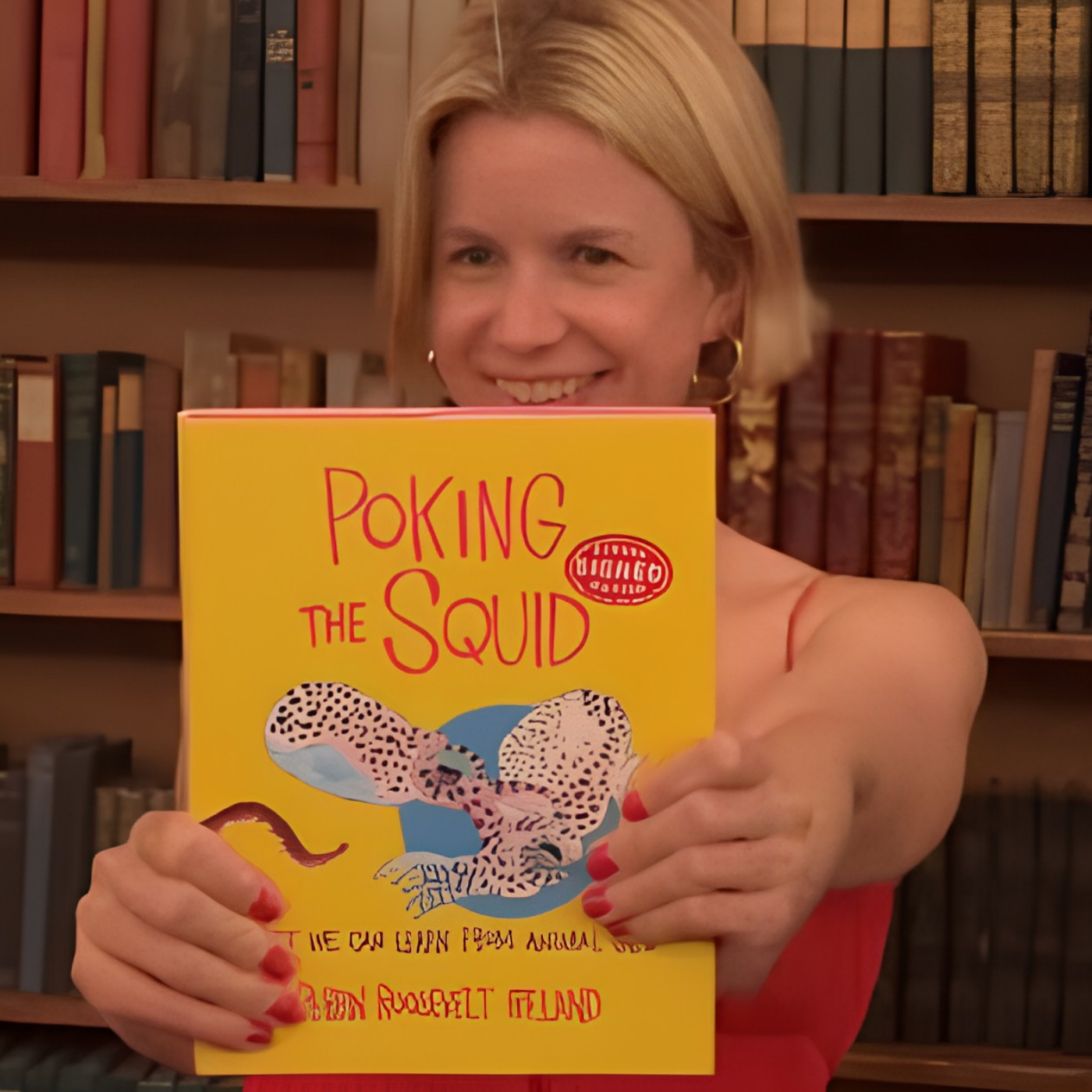
Same-sex coupledom is surprisingly frequent in the animal kingdom – scientists have found 1500 species and counting that pair up in this way. Perrin Roosevelt Ireland is an artist and environmentalist who serves on the board of the Roosevelt Institute, was an inaugural artist in residence at the New York Aquarium and is a Banff Graphic Novel Resident. She joins host Krys Boyd to discuss interesting facts about animal sex – from gender fluidity to procreation to co-parenting – and offer a glimpse into why so many species are worth saving from extinction. Her book is “Poking the Squid: What We Can Learn from Animal Sex.”
Learn about your ad choices: dovetail.prx.org/ad-choicesGet every episode summarized
Each time Think from KERA publishes, we email you a written briefing from the transcript — the topics, who appeared, and any specific claims, with the ad reads skipped.
Email me new episodesFree for 3 shows. No card needed.
Hosts & guests
Transcript ready
623 searchable segments. Every word is indexed and playable.
Full transcript
Think from KERA — The wild sex lives of animals. Machine-transcribed; use the interactive transcript above to jump the player to any line.
Adults used to talk about the birds and the bees as a kind of on-ramp to explaining human sexuality to adolescents. But let's be honest, most of us adults have only third-hand knowledge at best of how sex works for birds or bees or beluga whales. And for a long time, biologists who did observe animal sexuality tried to map it directly onto the cisgender heteronormative, culturally influenced binary they assumed was just natural. From KERA in Dallas, this is Think. I'm Chris Boyd. Turns out we missed a lot hiding in plain sight for a very long time. Like animals that engage in sexual behaviors, even if they're unlikely to produce offspring, including because the object of their affection is the same sex. We missed lots of gender, stereotype, defying caretaking behavior, especially among birds
and fish. We even overlook the fact that some animals can and do change their sex. My guest finds all this illuminating, and she happens to be both an environmentalist and an artist. So she's created an illustrated book to give us a glimpse into the newly acknowledged, but certainly age-old truths about sex in the wild. Perrin Roosevelt, Ireland, serves on the board of the Roosevelt Institute, was an inaugural artist in residence at the New York Aquarium and is a BANF graphic novel resident. Her book is called Poking the Squid, what we can learn from animal sex. Perrin, welcome to Think. Thank you so much for having me. I'm delighted to be here. This is a book and it will be a conversation about animal sex and we'll be learning fun facts for trivia night. But what might be most surprising is how and why humans missed and overlooked so much in the past? How did you get interested in that subject? Well, the main reason that I felt the need to go into more depth into what we may have
overlooked in the past and the way cultural norms shaped how we talk about animal sex is that I've been talking to people for over a decade about animal behaviors. And when I tell stories about animal behaviors and explain new results from journal papers, I find humans are titillated by conversations about animal sex. And they have very human understandable responses. So for instance, if I share a story about new research that sexual friendships between male dolphins are the most important relationships in their adult lives, they have sex with each other 2.38 times an hour while they rove the ocean and they're all male packs of dolphins. But I use the term sexual friendship. I find people on the internet push back and let me know, do not burden any of these relationships. Don't put these dolphins back in the closet. These are sexual relationships. And my natural response was, you know what you're right. And queer and feminist thinkers have been pushing back on the way science tells stories about
these kinds of relationships for decades. And so what I wanted to bring to light in this book was, evolutionary biology is trying to map animal behaviors to evolutionary theory, which gives animals the primary agency over reproducing. But animals are doing a lot more surprising things than that that we need to make room for in scientific discussions of animal behaviors. And so there are social thinkers, social scientists, anthropologists, and queer and feminist theorists that can help us poke a little bit at the way science tells these stories to understand better what animals are really up to. You note here that sexual diversity is a form of biodiversity. Explain why it's helpful for the survival of many complex organisms that there are so many different ways for bodies to work to produce offspring. I just love it so much and it delights me, it inspires me, and I think spending time thinking about sexual diversity is a way to be reinvigorated about the creativity about
how life's itself on planet earth. So the idea of biodiversity, it can take the shape of genetic diversity in a population, it can take the shape of how many different organisms are living in one ecosystem. And in my opinion, it also takes the shape of the different ways that animals have sex. So you might have a rotifer that lives in septic tanks, the deloid rotifer specifically of which no male has ever been observed, which is believed to have been asexually reproducing for 45 million years, they're sometimes referred to as the ancient asexuals. And then at the end of the spectrum, you have bonobos who are living in these highly progressive communities where they are having sex with each other, you know, up to eight times a day. And that range and why different animals have made different sexual choices in their habitats, in their communities, in their bodies, and in their lifestyles to keep producing themselves is such a source of genius to me that I love to revel in.
You've mentioned now bonobos and dolphins kind of getting it on multiple times a day if they're hanging out together. Is there any evidence that the what's been described as a kind of sex drought in the human population has made its way to animals? Ooh, I love this question. This is a new one for me. What I would say is that we are observing that habitat destruction and climate change are changing the ways that animals reproduce. So I don't know if I would say there's a sort of sex drought along the lines of what we're witnessing in the sort of chronic singlehood or, you know, not participating in sex among certain groups of humans right now, but I do think that human behavior is changing animal sexual behavior. So we are forcing changes in their relationships based on warming oceans in the example of Blackbrowed Obatross. When we cut down forests, we know that chimpanzees lose their culture and some of their language and ways of communicating with each other. And this will manifest itself in their sexual habits over time.
So I think it's more a little bit honestly with animals. Some of the things that humans are doing that might be contributing to changes in their sexual behaviors. Set us up here. How were early scientific observers influenced by what they thought they knew for certain about human gender and genitalia and sex and sexual orientation? Well, when we think about our dear Charles Darwin developing the theory of sexual selection, he needs to be contextualized as in certain ways a kind of radical dude, in Victorian England. And so there were prevailing ideas at the time about female coinness, female resistance to sex and only really sort of surrendering to the most persistent, least terrible male that was available and male lustfulness and male desire to propagate and just so their wild oats. And this plays itself out in the way that he was looking and writing about animals. And we do observe animals where this is the case, right?
The often taught elephant seal where the males maintain heroms of beaches and they're fighting each other for access to females. But Darwin also spent 10 years studying barnacles and he proclaimed that truly the wonders and schemes of nature are limitable in describing sexual fluidity in barnacles in the ways that he would observe barnacles changing sex across a lifetime, changing sexual strategies depending on where they settled on rocks or the backs of turtles, changing their genitalia depending on the conditions they were in. And so even if we look at, you know, our sort of founding father of evolutionary theory and all the scientists that came after him, I think it's really important to hold the cultural context they were in. If you're a scientist observing same-sex sexual behavior and saw me, right, is a capital crime, you might not feel comfortable reporting on same-sex sexual behavior in animals. But also noting that they were documenting these behaviors even if we have to find it
buried inside the literature or in the case of some scientist, written in Greek because they were afraid of the consequences if it was written in English. But when we re-examine it today, we do find they were reporting these things. I just think we need to contextualize it in the time and place. You open the book by telling us about hyenas, which at first glance appear to contradict the usual rules for mammals. Why is that? I love hyenas so much and I defer to K-hole camp who has maintained the longest running field study of hyenas ever. So what she says is when you study an animal that breaks all the rules, it helps you to re-examine what the rules actually are. So hyenas scientists have difficulty sexing them in the field because females have what used to be called a pseudo-penis and now many of the feminist biologists I talked to argue this is an externalized clitoris. They have genitalia, the female hyenas, that we aren't really accustomed to for an animal
that is giving birth. They give birth through these externalized clitoris, it's very painful. They often lose their first baby. They have sex through the externalized clitoris, they need to retract it into their body in order to have sex. And so there's elaborate courtship rituals and hyenas are the matriarchs that really run these tightly controlled societies. And so as I think sometimes cisgender humans in the field wanting to identify animal scientists do tend to look to genitalia. And what hyenas show us is, wait a minute, you can't actually determine our sex based on genitalia. And hyenas also say to us, we'll raise one. Female hyenas, alpha females, bathe their babies in utero in androgens because a female hyena cub needs to come out fighting, especially if she's the baby of the alpha female. She needs to come out prepared to defend her rank. But what scientists have found what they long assumed is that that androgen bath would contribute to the development of this externalized clitoris.
And recent evidence indicates it's actually not the direct cause. So not only are hyenas manifesting external genitalia that we can't quite pin down, they're also showing us that internally the way that sex manifests in bodies might be a different concert in different organisms. And so we need to stay specific to our study species when we are naming what sex is or isn't. How does a female hyena social ranking within her matriarchal pack affect the way she produces sex hormone? Well, so exactly. So the alpha female, I mean, when K-hole camp and some of her lead researchers talked to me about this long term study on the mass amara, I imagine it like these sort of dynastic maps, like we study the tutor dynasty. So the alpha female, her daughter, the way that the hierarchy works is, let's say she has three babies. The last female born to her will immediately outrank them all upon birth.
And the highest ranking male in a hyena clan is lower than the lowest ranking female. Now a female hyena cub that is born to the alpha male mother also inherits her mother's social alliances. So she inherits this social capital. But while this alpha female is bathing her babies in utero, she, the highest ranking alpha female gives her babies the strongest bath of Androgens so that they are prepared to come out fighting. The reproductive endocrinologist Christine Dreia told me no one comes out of the womb swinging quite like a hyena cub. They come out fighting. They come out ready to defend their rank. And so the hormone bath is directly corresponded to their ranking that they will receive. Okay, I'm going to say this is if I knew it before I read the book, but albatrosses are famously monogamous over time. How do albatross and human, if you want to call them divorce rates, compare?
So the last I checked the heterosexual divorce rate in the United States and Europe is hovering at around 39% for the last decade or so. Albatross divorce rates are at around 1 to 3%. However, that jumps to 7 to 8% when the ocean surface temperature is warmer. And I hate to break it to fans of March of the penguins, but the ember of penguin divorce rate is about 86%. So why would their divorce rates change as the oceans get warmer? The hypothesis that Francesco Ventura, who's the lead author of this study that I focus on in that section of the book from the Woods Hole Oceanographic Institute, this 20 to 30 years study, they looked at 20 years of data of a breeding colony of black, brown albatross in the Falkland Islands. And they found that in years when the ocean surface temperature is warmer, a female member of a reproductively successful pair returns to her island after scientists think flying
further afield to find less food when the ocean is hotter. And due to a partner blaming hypothesis that these scientists have come up with, she takes one look at her mate and she's like, I'm out of here, dude. I'm tired. I'm lonely. I'm hungry. I'm stressed. And you are everything wrong with my life at this moment. So she shacks up with the neighbor male instead. Goes on to lead scientists have found a pretty successful reproductive life. And Francesco Ventura let me know that he observes that for multiple years after, often that male that has been left will not remade. They think that it's because she is increasingly stressed out because it's harder to fish successfully when the ocean is hotter. I do have to ask you, Karen, as an illustrator, were there particular animals, particular things that you found it really, a particular joy to draw, were there some that you found really challenging and it sort of changed the way you approached the book? Yes, I loved drawing seahorses.
They're so adorable. They're surprisingly challenging, but drawing this sort of growing, brewed pouch on a pregnant seahorse dad and watching video after video of thousands of seahorse babies emerge and then figuring out how to draw them was a really fun problem to tackle. I have to say that when I was looking at some of the studies on pleasure in animals that have predominantly happened in laboratory settings and that many of the papers I'm referencing were from, you know, there's one anthropological study from the 1970s where what's fun about drawing recent research is I get to collaborate with scientists on, you know, they have all of this video they'll send me, imagery they'll send me, imagery that's now part of the study that's posted online as supplemental materials. When you're working from a paper from the 1970s and earlier, there's often no imagery to reference and sometimes those scientists are no longer reachable. And so working back from those studies proved to be more challenging.
I worked with Diane Kelly as my fact checker and she not only fact checked the text of the book, she fact checked all the images and we really partnered to figure out how I was going to convey these pleasure studies on these monkeys that were happening in the lab. I found it emotionally challenging and undesirable to draw the restraints that were in place during these experiments. And I got extra support from my fact checker who's also a scientist herself on figuring out how we were going to represent the experimental methodology and equipment based on the written descriptions and looking up references online. All right, I want to go back to this because you mentioned it sort of quickly. In recent years there has been a move towards sometimes referring to pregnant people because of course there are some folks who identify as men but retain the biological capacity to bear a child. The idea of a pregnant father really upsets some folks but as you mentioned this to exist in nature, how does it happen that some seahorse dads give birth to their own young?
In fact, all seahorse dads get birth to their own young but so I will start by saying part of why I was so committed to including seahorses in the book is that there is as you reference this fabulous hashtag on the internet called seahorse dad where trans dads are documenting their pregnancy journeys and identifying with this animal that does a similar thing. So in the seahorse which is actually one of the most genetically monogamous animals on planet earth, if you look at the genetic evidence, seahorses really are choosing a mate and mating with that one mate for their reproductive life. This has come together in an elaborate courtship ritual at dusk in seagrass and there are multiple meetings where the seahorse sort of the male will sort of come show the female. Here's my brood pouch, it's open, it's empty for you, I'm available to you, I'm interested in you, I will not be raising or incubating other eggs right now and after she's had a chance to really sus him out. The female deposits with what's called an ovipositor, her eggs inside the male's brood
pouch, he quickly inseminates them, covers them up and incubates them in his body and he goes through a lot of the same changes that other pregnant animals go through across the animal, Queendom. But what Camilla Witton who's a researcher based in Australia studying the evolution of pregnancy has taught me is that all of the different animals that are using the same basic genetic toolkit to go through the process of pregnancy draw on those genes in different ways and have their own unique processes that their bodies go through. So the seahorse dad is going through his own process, he's incubating his babies, his bodies going through these changes. As the pregnancy progresses he's bringing more and more seawater into that brood pouch to prepare his babies to have less of a rude awakening when they emerge into the seawater itself and then he gives birth through skeletal muscle, which every person I've told is ever given birth, shutters at because humans give birth with smooth muscle, which is involuntary
contractions. Skeletal muscle requires voluntary contractions, which takes the labor process up a notch. He expels thousands of seahorse babies and then the female pops right back up and almost immediately after he's done giving birth to the last of that brood, he becomes impregnated again and starts the process all over. In paternal care, so in fish, the predominant modes of parental care are either no parental care at all. Off you go eggs, hope that you meet up with the sperm that's in the water column from the male fishes, an absolute best of luck or paternal care, which is variations of male brooding sometimes in their mouths. There's another type of frog that sort of seems to vomit up their young the fathers, but either no parental care or paternal care is the predominant form of parental care in fishes. And so when groups are organizing, like moms for liberty, to have completely innocuous
children's first grade level books about seahorses, that some science writers argue are actually really payans to the heterosexual lifestyle removed from curriculums. My question is, is the goal to have no fish in the curriculum? Because if we're not talking about paternal care in fishes, we get pretty limited, pretty quick about exactly how many fishes we're going to get to learn about. What was this remarkable thing that happened when students in a lab set up two tanks of seahorses, one male and one female? So, this is the, in the lab of Karen Bales, and this is sort of, you know, scientists are so careful about, well, I've done this study. I think the results are replicable, and so I've published it, and it's the results versus this is an anecdote. And so Karen Bales told me, this is a story that happened in my lab. We haven't tested it yet. However, she was starting to breed lined seahorses to study parabons, which is Karen Bales' area of research. And they had females in a tank, and they had males in a tank.
And what started to happen was the sum of these females in this tank were developing brood pouches. So, her grad students called her one day, and they were like, hey, we came into lab for the feeding, and some of these seahorses have actually developed brood pouches in this tank. And they were completely stymied by it. There was not previous evidence that seahorses are able to undergo a transition like that, but it seemed like in this contained space, some of them had, you know, moved tissues around in order to be able to breed with the other seahorses in the tank. She did a little bit of sort of anecdotal looking at preference for partnerships, and has found that thus far, the females prefer what she called the sort of transitioned male, but it's not clear whether that was due to familiarity or actual partner preference at that stage, but she is interested in expanding the study and really looking at that capacity to transition
in seahorses. But I mean, seahorses would kind of, I guess, just underline this idea that there is no absolute binary that dictates which individuals bring gametes to one another for fertilization, right? Like, we assume, you know, if an animal has an egg, that is the animal that will bear or nurture the young. That's not, seahorses prove that's not true. That's right, there is a lot of prevailing thought in evolutionary theory that stems from Darwin and that, you know, is increasingly being tested, but I would argue this is a real area for future research. Is it actually more energetically intensive to produce an egg versus millions of sperm in a given animal? Because the prevailing assumption is that an animal that produces the egg, which is thought to be more energy intensive to make, will be more invested in choosing who their partner is and being the chooseier sex and in raising that offspring and investing in its survival.
And so many, I would argue, a sort of gender-based stereotype, cascades from that fundamental foundational thought in science that I agree with you, seahorses can sort of help us upend. And it totally, I was having a conversation in a bar after a book reading last night where someone was reminding me about the slipper shell, which is a type of shell that sort of grows itself in these stacks. And it changes sex depending on where it is in the stack. And it's just such a key example to me of, I think that one of the things animals show us is that animals are changing which gamut they produce in some animal communities, depending on the needs of their community. It's a sort of community-based decision. And that's a really different way than I think humans sometimes think about sex change. Yeah, I mean, it was why they reported a few years ago that people discovered frogs changing their sex. And the concern was that this must have been some kind of consequence of them living in
incredibly contaminated waters. What might the other plausible explanations be? Yes, so this is one of the authors that was helping sort of generate that thought about frog genitalia being altered by toxic chemicals is a researcher named Max Lambert. And one of my favorite examples in the book of, you know, scientists sort of thinking critically about how they contribute to the ways we think about gender and sex is that almost a decade later, Max Lambert and Melina Packer revisited his 2015 study. And they wanted to go back and look at, okay, so our frogs in suburban ponds, having their genitalia changed by toxic chemicals from fertilizers and other industrial chemicals leaking into those ponds. And if their genitalia are being changed, is it actually catastrophic for frog populations? Because what happens when we see these potential ramifications of toxicology, you know, the
feminization of animals is this panic that they won't be able to reproduce and perpetuate. And then we might be contributing to the extinction of those animals. But where it gets tricky is with our own concerns about sex change and about, you know, our fixation on genitalia and what it means for what a person is doing or not doing and reproducing sort of mapping itself on to what we're able to see or not see about animal life. And what Max Lambert and Melina Packer found is frog genitalia is diverse and there's a lot of variation in it that is not necessarily linked to toxicology and that is not necessarily having adverse impacts on reproductive potential. And so it is important for toxicology to focus on toxic chemicals. But probably more for the cancer causing components of them than what they might be doing or not doing to frog genitalia. So in other words, clean water is of course essential for healthy animals, but the sex
change could be just a natural adaptation. Yes. Okay. Many people have heard many times that among nonhuman animals, the only scientific reason sex would ever happen is procreation. We've learned a lot to challenge that belief. Yes. And I understand that as an evolutionary biologist, encountering same sex-exual behavior in the field. If you are trying to map the behavior you see onto evolutionary theory, which gives animals as their primary agency as they move through the world, their reproductive fitness, right? Their capacity to produce the next generation. But encountering the myriad examples of same sex-exual behavior might be hard to map onto that theory. But we spend a lot of time with the work of someone named Bruce Bagamel in poking the squid. And in the year 2000, Bruce Bagamel produced a book called Biological Exuberance, which I have seen cited in every single study.
And there are many documenting evidence of same sex-exual behavior in the animal kingdom sense that is a door-stopper catalog of over 1,500 species that have been observed, engaging in same sex-exual behavior. And what I find evolutionary biologists to be observing today is that it's actually not the case that it is breaking rules for animals to engage in same sex-exual behavior. It seems to be that it is a normal course of animal behavior. This also challenges the idea that animals don't necessarily take any particular pleasure from sexual encounters. What do we know about that? Yeah, the study of pleasure from what I have seen in animal sex is a tricky line to walk. The genital morphologist that I spend a lot of time talking to in part two of the book, Patricia Brennan, said to me at one point, look, we, in marine mammal strandings that
her team would get called into where they would dissect dolphin genitalia. They kept finding dolphin clitoris, says, that looks a lot like the human clitoris, which is to say, you know, over 10,000 nerve endings more densely packed than in the penis. A lot of nerve endings write undercladural hood, corpuscles of pleasure, which are cells whose only known function is pleasure. A lot of evidence that this organ is likely contributing to pleasure, but what Patricia Brennan will say is, you can't ask a dolphin, you know, are you having an orgasm? And so what scientists right now, you know, the genital morphologist I talked to, tend to map against what they are finding in the body. And if what they're finding in the body indicates that these organs have a significant function in mating, it is likely that they contribute to pleasure in mating. There are other studies that have been done, a study that I referenced earlier, looking
at whether monkeys might go through the stages of orgasm, you know, five stages of orgasm that were laid out in the 1970s. And you know, all we can do is look to, okay, we see that these tissues are engorged. We see that there are these vocalizations that are happening. We see that the skin color is changing and we think that these are likely contributing to pleasure, but that's a little bit where our understanding of it rests today. I mean, it's an interesting, you know, question of the idea of anthropomorphization and when it's appropriate and when it's not. Yeah, I mean, I think, you know, it's so humbling to encounter all of these things, right, to think about, wow, I see these dolphins swimming in this pod when I'm out on the ocean or when I'm watching the nature documentary and to imagine that they might have as complex a sensory experience as me. They might even have access to levels of pleasure.
I don't even have access to, given that they are touching each other so constantly that they are, you know, engaging in so much sexual behavior that is non-reproductive. And I think to stay in that place of humility of we're learning all of these additional things that make us think they might have far more capacity than we attributed to them historically. It's likely that we are not so alone in our experience of pleasure, pain, connection, parabons and other of these behaviors. Pairn, how many of these revelations are being made public now because of the fact that different kinds of people have the job now of biologists? This is something I love so much. And it was something that I really learned in talking to so many scientists, feminist and queer theorists, historians of science, across the book, I interviewed, you know, more than 65 people. And what I found over and over and over again is that if we have folks of different gender
identities, sexual orientations, race and class backgrounds from different parts of the world. And I'm asking questions of animals from the position and the perspective that they come from. We're going to get many more interesting answers. And so I do think that if you have a trans-intersex evolutionary biologists wanting to understand how many genders fungi have, you might get a really different answer than a landed gentry gentleman in the 1800s from the UK asking those questions, no shade on that guy. You know, I think that it really expands when we have a huge range of people undertaking this research, what it is that we're going to find. So, you know, and we can trace that back to when women first started entering primatology in the 1960s, the famous Leakees Angels in the West. There are studies in the 70s, 80s and 90s where you really see that who it is that was making the science change, which animals in which animal communities were being observed.
All the way up to today where, you know, a diverse group of some queer identified, some not queer identified scientists asking the question of what if instead of asking why same sexual behavior evolved over and over again, we assumed that indiscriminate sexual behavior might instead be the ancestral state. It really expands what we can learn from animals, in my opinion. Another longstanding assumption about animal behavior was that females broadly have two options, right, to be sort of deliberately hesitant, I think the word you use in the book is coy about sexual mating or subject to something like non-consensual attacks by males of the species. If we hold those old scripts about choice a little more loosely, what are some other possibilities that have come to light? Well, I spend a lot of time in the book with Patricia Brennan looking at how we can track back to their behavior, the increasing understanding of the complexity of female genitalia and the
way that it forces us to rewrite sexual selection theory. So a lot of her work has shown that complex genitalia in female ducks contributes to their agency over whether or not they will conceive from non-consensual sex. So if you look at the example of mallard ducks, around 40% of mallard duck sex is forced populations. And mallard duck penises are corkscrews that they explosively avert in order to bypass what Patricia Brennan has found are actually quite a lot of gatekeeping devices in female duck genitalia. There are blind end pouches where the penis might get lost and not actually find the uterus. The duck vagina is a corkscrew that is spinning in a counterclockwise direction in the opposite spin direction to the duck penis. So if the copulation is forced, she's able to spin her vagina to refuse entry.
There are all of these devices in place where even if she can't control the copulation itself, she can control whether or not she conceives from that copulation. I talked to many other scientists as well where there's a huge range of behaviors that animals are getting up to. Jessica wears work on dragonflies. She found in several species, I believe, of damselflies. There's a certain, there's so much harassment that happens in damselflies and dragonfly and damselfly male genitalia that is designed to be coercive and to be able to remove sperm from past matings. But there's a certain amount of the population that hovers below a certain threshold of once they have engaged in the matings that they want, female damselflies posing as kind of a third sex that does not appear females so that they will evade courtship and harassment by males and sort of live out the remainder of their lives in peace.
So it's a complicated thing for humans to question and experience what looks like force copulation or coercive sex to us. And I think it's important to honor our human reaction to that and to have a very different conversation about what that looks like in humanity. But the scientist Mercedes Burns kept emphasizing with me the thing to do is focus on it from a biodiversity perspective. What is this reproductive strategy? How often does it arise? Why has it arise in this particular population? And to try to view it from a biodiversity perspective and take a step back and understand that there are tons of strategies that female animals have in place to reclaim some agency over their reproductive lives. So there's that question of how often does this reproductive strategy arise? I'll just now think pregnancy has evolved independently at least 140 times across vertebrate
groups. This is true. So we see it in yeah, it's really it's really incredible. We see it in sharks. We see it in lizards. We see it in seahorse and again, it might be that they're working from the same genetic toolbox, but different animals are employing different strategies to best meet their own needs in their ecosystems, their communities, and their bodies. So we know of course that humans can engage in sexual intercourse, but there are lots of other very sexual or we might call them romantic behaviors we engage in that stop short of that. What do we know about other species that like cuddle or just somehow otherwise physically let their beloved know they care? Yeah, there's a spread page in my book where I reference scientific terms for cuddling because it's a little bit funny to me to move through the journal papers and they'll say things like alopreening, you know, when an albatross couple that's if they live 60
to 70 years, right, they've been together 40 years and they're meeting up after a year apart and they're just alopreening, right? We don't quite want to call it cuddling and canutling in the scientific literature. Looming, huddling is the term that we give it in prayer, evil mates when they're sort of snuggled up together. There's all these different ways that animals are in constant touch with each other, you know, or because moving through this vast ocean are always, always touching each other in their family groups with their partners as they move through that vast dark ocean, they are in constant physical touch. So it's clear we are not alone in our need for touch. Is it inappropriate to imagine that these animals might be, I mean, they're physically bonded, their pairs, might they feel an emotion akin to fondness like we feel for our partners? This question is part of what makes me an avid fan of the long term field study because
I find that a scientist that has been in the field, some scientists for 40 years, some for multiple seasons, watching these animals, you know, especially Francesca Ventura naming to me when he would watch Albatross couples reunite after a year apart at sea. He, you know, they dance around this idea of love, you know, or I would be asking a hyena researcher about a hyena mother's commitment to her cubs. They might not say it, but I really find that people that have spent time in the field watching the same animals year upon year, they seem to witness something that I think sure sounds a lot like an intense bond or affection or connection between animals. I don't think they come up in the book. I'm almost sure they don't, but there are some animals like eels whose reproduction has like almost never been witnessed or never been witnessed. How many animal species are there that are still very mysterious to scientists in terms
of how they reproduce? In a performance series that I have on on social media, I have talked a little bit about eelsex and how it's this great mystery. And so then all these people were sending me this latest eel study. And I went to find it and it was like, still no. And what I love about it is that, you know, eels, they're going to this really famous, right, the Sargasa Sea, they're in this famous place. We've studied them, especially eels, for over a hundred years that we still can't pin it down. The other animal that I always think of that we've actually never observed having sex as blue whales, which is the largest animal that's ever lived on the planet. And for me, I think spending time with that mystery inspires such awe and wonder and makes me want to stick around and find out if we'll ever learn. How did the scientists you interviewed feel about the value of data they can get, you know, studying animals in controlled lab settings versus being out in the wild? I would imagine there are some, you know, it's just not entirely practical to always do everything as a field study.
I think that's true. And I think the field study is, you know, it's hard to fund. It's pretty labor intensive. It's a good question. I think there's a huge range. So, you know, the Prairie Vole is the laboratory model for understanding what the kind of hormonal and chemical breakdown is of love. So bringing these Prairie Vole pairs initially into the lab and then practicing with partnering them inside the lab, when the idea is to sort of narrow down love to oxytocin and to try to understand it's role in the parabond, then it might be the case that a laboratory setting for that particular set of studies makes the most sense. Certainly, if you're wanting to control who is meeting with whom and watching that offspring over time, like in those seahorse studies we talked about, it seems like it might be advantageous to be studying those seahorses in the lab. One of the things I found interesting about Prairie Voles is, you know, there are these,
I mean, there's thousands and thousands of papers. So I would argue that I've only barely scratched the surface. But in trying to understand their role in parabonds, the difference in what might be happening in the field with some studies that I reference that are in sort of field simulation settings where they're in sort of like controlled plots and there are multiple prairie Voles able to be near each other in burrows. What they find about the nature of monogamy versus polyamory versus multiple meetings changes pretty quickly. So I would argue that I think that field studies are really important for an ongoing understanding of, okay, in its natural environment though, how do some of these things ultimately play out? Some species, this is remarkable, seem to respond with new behaviors to changes in like the supply of fertile breeding partners. What's the story of a campaign to sterilize some blackbirds in places where those birds were like eating too many of farmer's crops? This is one of my favorites. I believe it's an all in-braise study.
So yes, blackbirds can be a pest to farmers, right? So they're nibbling on their crops. And so the idea was, and a lot of these early studies understanding actually female promiscuity stem from agricultural research and a desire to control pests. So in the case of these redwing blackbirds, they sterilize the males in a given breeding area. And at the time, redwing blackbirds were under, redwing blackbirds were understood to one male maintain a harem of females in the surrounding area. But it was really confusing because they had sterilized these male blackbirds in this given area and the females kept producing fertile eggs. And so the only way that they could explain it is to understand, oh, I guess female promiscuity must be at play here. These female redwing blackbirds are engaging in multiple matings, maybe not just with this sort of quote unquote, harem leader. And this sort of opens up this understanding that has really grown since the 70s, 80s,
early 90s among birds that male birds are often helping co-rays nests with multiple paternity. It really is amazing that anyone, any animal, any human that we're here, if you think about all the complicated things that can go wrong, I wonder if just undertaking this study just helped you appreciate just the miracle of reproduction. Oh, absolutely. And also, I think, frankly, as humans, when we talk about sex, we have a little blush and we have a little giggle, right? And for me, there are so many examples of animal sex and in doing the research for this book where the ways not only that sex manifests itself, but also the ways that some of these studies have unfolded that I find nature to be the merious prankster of them all. You know, I just, it feels like, it makes me love being an earthling that it feels like
planet earth almost has a sense of humor about all of this. Heron Roosevelt, Ireland is an artist and environmentalist who serves on the board of the Roosevelt Institute was an inaugural artist in residence at the New York Aquarium and is a BANF graphic novel resident. Her book is called Poking the Squid. We can learn from animal sex. Heron, thank you so much for making time to talk. It's been an absolute delight. It's my favorite topic. Thanks for having me. Think is distributed by PRX, the public radio exchange. Find us on Facebook, Instagram, anywhere you get podcasts and at think.ca.org. Again, I'm Chris Boyd. Thanks for listening. Have a great day.
More episodes
More from Think from KERA

Why we haven't fixed the racial wealth gap
Think from KERA

How the government wastes your time
Think from KERA

How masculinity falls apart
Think from KERA

A former Black professor quit because of DEI
Think from KERA