Loading...
news
This ‘fairyland’ bog is a beacon for winter birders – and a sponge for the climate
About this Episode
Even when it's freezing and covered in snow, Minnesota's Sax Zim Bog attracts birders from around the world. They flock there hoping to spot owls, hawks and rare songbirds that spend most of their time in northern Canada. Many of those birds are feeling the pressure of the warming climate, however, so local scientists and wildlife enthusiasts are working to conserve their habitat, which also happens to be a peatland adept at storing carbon. Here & Now's Chris Bentley reports. Then, volunteer naturalist Rich Hoeg recently installed listening devices across northern Minnesota to record elusive species of birds. Some of his recordings are informing scientific studies of owls, and surprising even lifelong birders.
See pcm.adswizz.com for information about our collection and use of personal data for sponsorship and to manage your podcast sponsorship preferences.
NPR Privacy Policy
See pcm.adswizz.com for information about our collection and use of personal data for sponsorship and to manage your podcast sponsorship preferences.
NPR Privacy Policy
Hosts & Guests

Transcript
This message comes from Intuit TurboTax.
With TurboTax expert full service,
match with a dedicated expert who will do your taxes for you
from start to finish getting you every dollar you deserve.
It's that easy.
Visit TurboTax.com to match with an expert today.
WVUR Podcasts. Boston.
When there's a lot going on in your life or in the world,
it can be good to get outside, if you can.
Even some unassuming places are full of wonder.
Most people think of this as a useless swamp.
4,000 species.
Magical useless.
This is here and now anytime from NPR and WVUR.
I'm Chris Bentley.
We've got a special bonus episode for you today.
Off the news, as we say it is.
But some things are timeless.
For instance, who hasn't had the experience of saying a word out loud
that you've only read and been met with a gallery of blank stairs?
And then realizing we're more likely being told,
than saying it wrong in your head the whole time.
There's no shame in mispronouncing a word, even Stephen King does it.
I used to think those animals that run around out west were coyotes.
I used to think that the parts of a story were dentals.
They are actually the details.
Coming up at about 10 minutes, Robin Young shares one of her most embarrassing moments on air.
But first, I was up in northern Minnesota in February, crunching through snow,
wrapped up like a mummy in my ski clothes, looking for moose.
That was for another story we had on here and now anytime.
If you missed it, look back in the feed to February's installment
of our environmental series Reverse Course.
And while I was there, I went about a place famous among birders,
chasing owls, hawks, and rare songbirds from Canada.
It's called Sax Zimbog.
I guess I'm becoming a bit of a birder myself as I get older,
which is a reflection for another day, maybe.
But I wasn't ideeing birds on my own.
I visited with a team of expert guides from Minnesota.
Crazy, crazy, right there.
Nothing stops a chat between birders,
faster than a flash of feathers in the sky.
That's kind of the day, that's one of the birds that nest here.
That's Sparky Stensors,
Pishing, or calling the bird.
He founded Friends of Sax Zimbog for moments just like this.
Stensors is one of my guides on a February walk
through this unique habitat about an hour north of Duluth,
which draws wildlife enthusiasts from all around the world this time of year.
People like Peter Burke from Colorado.
I'm owner of Rocky Mountain Birding,
and I bring a group here every February.
So you got a lot of birds in Colorado, why couldn't it in a soda?
For the owls.
I come here for the owls,
and we'll be looking out for the short-year owls,
long-year owls,
saw what owls,
and if we're really lucky, a boreal owl.
What's it like to see an owl?
Humbling.
Yeah, I mean, these are just little feather balls
that can survive minus 30 up here,
like it was nothing.
Owls are awesome.
And they look right back at you in the eye.
We human visitors to Sax Zimbog have to bundle up,
but it's a ball me getaway for birds coming from Canada.
It's the Arctic Riviera.
The Arctic Riviera.
The resorts in this Arctic Riviera
include a patch of wizard-evergreens
that lurch out of a squishy earth.
Like some of these 30-foot tall trees may be a hundred years old.
This is an old-growth forest right here.
It kind of blows people's minds when you say
this is an old-growth forest,
because it just looks like a stunted,
scraggly part of the taiga in Northern Canada or something.
What seems like an unassuming landscape in winter
is teeming with activity for birders who know where to look.
But even eagle-eyed birders can't spot everything.
So the friends of Sax Zimbog recently installed
homemade listening devices to capture bird calls around the clock
and analyze the sound with the help of AI.
It's helped them study elusive visitors like Connecticut warblers
and Northern saw wet owls.
These boreal birds are so chill.
They don't care too much about humans.
It doesn't boreal mean chill and wetting.
I think that is correct, yeah.
Boreal birds may seem chill,
Stenso says,
but their lifestyle is threatened by the warming climate.
Take that Canada J,
who's flyby stopped us in our tracks earlier.
They're very vulnerable to climate change
because what they do is they cache food in the winter
and preparation for the breeding season
where they need more energy.
Alexis Grindy of the University of Minnesota
is another one of my guides on today's Nature Walk.
But as the winter is warm up,
some of those things that they cache,
like chunks of meat from a deer on the road,
for example, those will rot
and so they don't have as much food stores.
Basically as they go into the breeding season,
so we're seeing declines in overall productivity
and declines in population,
especially at this other edge of the range.
Grindy says it's just the start of a northward shift
in bird communities that will likely continue for decades,
which is why conservationists are fighting to protect
refugees like Sac Zimbog.
We've recorded over 4,000 species of plants and animals
in the Sac Zimbog.
And most people think of this as a useless swamp, right?
4,000 species.
Magical useless ones.
Deeper into the woods,
we step onto a boardwalk
to carry us over a landscape
that's rippled with three-foot hummocks.
It looks like the whole bog has goose bumps.
In summer, this is a lush grove of orchids, carnivorous plants,
and thick mats of sphagnum moss.
Which is amazing, and it's sort of like,
you know, Lord of the Ring situation,
where you feel like you're in a very land world.
It's so thick and it's cushy and you can lay on it,
and then you go down and it's just wet.
So there's just this amazing sort of deep layer of it.
If this wetland is a fantasy world, as Grindy says,
its sorcery is scrubbing climate pollution.
Stensus, called sphagnum moss,
the unsung hero of carbon sequestration.
But back in the frontier days,
white settlers initially saw it as unformable wasteland.
So they dug ditches to drain the bog.
Everything sort of starts decaying,
I guess, at a faster rate and releasing that carbon.
The trees that are adapted for those environments
can't grow there anymore.
So we plug the ditches, the water comes back,
and now it's sort of the game of,
how do we restore the entire ecosystem function?
A study by the Nature Conservancy found
re-wedding peatlands in Minnesota would soak up so much carbon
it'd be like taking almost one and a half million cars off the road.
It says the Nature Conservancy's Jim Manolis.
It's just one of our greatest opportunities for carbon storage.
They cover about 3% of the earth's surface,
but store about 30% of the world's carbon on the land.
On our way out of the woods,
we spot hairy and downy woodpeckers,
red-breasted nut hatches,
wild turkeys,
an evening graze beak with black and white wings
and a golden swish over its eyes
like it's furrowing a breached unibrow.
And...
Nice pine growth beak.
Oh, pine growth beak.
Oh, that red, really beautiful male.
They're a fun winter visitor
that everybody loves to see.
Sparky Stensus hopes all those birds will keep visiting
for generations to come.
But he says as the climate changes,
the cast of characters taking wing at Sac Zimbog
is going to change too.
For me, it's been an existential crisis, you know,
buying up all this beautiful bog,
lands, peatlands, you know, what...
What is this going to be like in 100 years,
or 200 years, or whatever?
And I don't know,
but we're purchasing and protecting habitat.
Whatever it is,
it's going to be habitat.
It makes you feel a little better
thinking that it's going to be home to something,
maybe not the same species that it is today.
Absolutely.
For now, at least,
it's home to 4,000 species,
including rare birds,
and countless people
walking to northern Minnesota to see them.
I was curious about those listening devices
installed at Sac Zimbog.
So when I got home,
I called up Rich Hogue.
He's a naturalist in Duluth
and volunteer with Sparky Stensus' group,
Friends of Sac Zimbog.
And he's the one who built some of those devices
by sticking together a microphone
and the tiny computer board,
called Raspberry Pi.
It connects to BirdNet,
the AI-powered database of bird songs
run by the Cornell Lab of Winathology,
that powers the app Merlin,
which you might have used
if you've ever wanted to shazam a bird call.
If not, check it out sometime.
Merlin is free and pretty cool to use.
Hogue put all that stuff
into a rugged box
with a data storage card
and voila!
You've got what he calls BirdNet Pi.
I'm a retired techie
and I had always been intrigued with birds
here in northern Minnesota.
I had pet birds.
I was the person that had to fill
the bird feeders we had at our house.
And when I was a kid,
even when I was like seven or eight years old,
I was allowed to go traps
and around the forest by myself
and be home by summertime.
In his retirement,
Hogue is still exploring the woods.
He's got several of those listening devices
planted all over the arrowhead region
of northern Minnesota
that stretches along the shore of Lake Superior,
including one in his own backyard.
He says bioacoustics
have revealed a hidden world around him.
Like when his home device told him he had
sandhill cranes in town.
And I got no way.
This thing is totally messed up
because I live in the boreal forest
and there's just no way
a sandhill crane would be there.
But I went and listened
and I realized the device actually heard
sandhill cranes migrating overhead that night
and I've had the same thing happen
with golden-eyed ducks,
common loons.
And so I actually get identifications
for birds that are flying overhead
if it's relatively quiet out, you know,
if it's windy, then not.
But still, I've been really surprised.
Recording's from Sachs Zimbog
are also informing scientific studies
at the Owl Research Institute in Montana
and the Natural Resources Research Institute
at the University of Minnesota,
where Alexis Grindy,
from the Nature Walk earlier,
says listening devices can
log birds that are hard to see,
like nocturnal owls.
With multiple units,
recording in different locations,
Grindy says they can even pinpoint
which trees birds are using,
how their migrations might be shifting,
and how their fledgling young are doing,
when they're too small to leave the nest.
We can answer all those questions
just by listening to birds,
which is pretty cool.
So it's just like a microphone you put out in the box.
Essentially, it's like an old-school
boom box, and you strap it up.
It's really durable.
The batteries last a pretty long time,
and then the complicated part comes
when you take it back to the lab,
and you have to run it through all these different models
to look for finders,
and say, is that a road?
Is that an owl?
What exactly is the noise that's coming through?
They're saying different things, right?
Some calls me one thing,
other calls me another thing,
so you can understand what the sort of conversations
that the birds are having throughout the breeding season
and make some inference that way.
Birds are having conversations?
Yeah, definitely.
They're always having conversations.
You got some of that video.
They communicate with each other.
They give warning systems to each other.
So the bird community itself,
we sometimes just think about males
singing to attract females,
but they actually are communicating with each other
all the time.
Here's where the food is.
Let's go together.
There's a predator over here.
There's one predator eats, one bird.
That might be good,
but also it's more likely that the neighbors
are going to get eaten too,
so there's a lot of value
and sort of cooperating in a neighborhood.
If you're a bird probably.
I had that conversation with Grindy
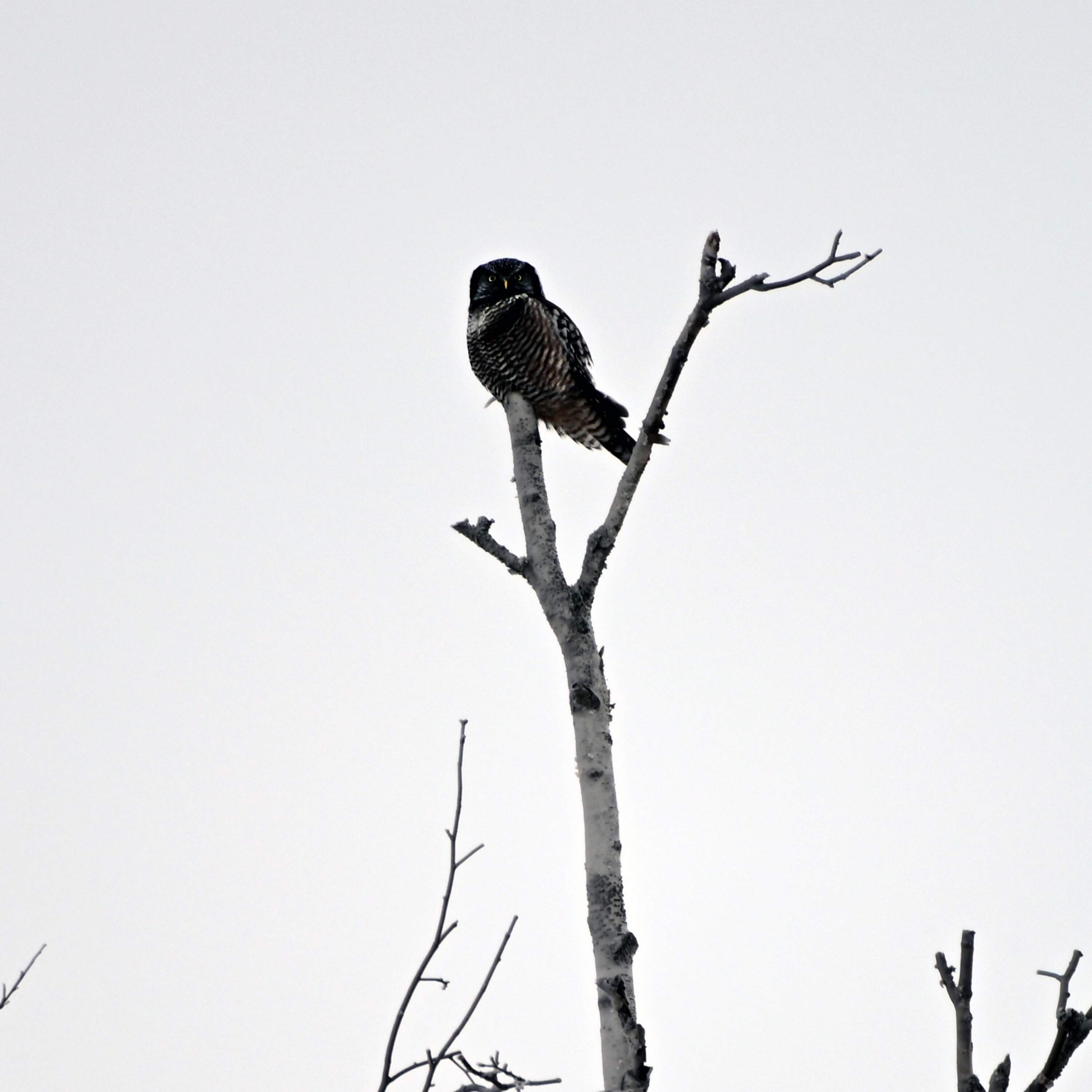
while we were trying to spot a Northern Hawk Owl.
We didn't find one then,
but I did see one another time
in a wilderness area nearby
that I later learned was one of Rich Hogue's sites
for monitoring as well.
He often records Northern Hawk Owls there,
he says,
and imagines them scanning the frozen forest
with their yellow eyes.
Speaking a language meant for non-human ears.
We'll be right back.
We're coming in from the cold
for this last story on today's show.
I'm going to hand it over to Robin Young
for a few minutes.
We've spoken with author Stephen King
many times over the years.
He's a favorite guest.
Most recently he spoke of his children's book,
Hansel and Gretel,
a reimagining of the classic tale.
But he also became reflective
about getting older
and having more to write.
Bruce Springsteen said something
that struck me as a very
a propo to my situation.
Say what?
Stephen King went on to speak eloquently
about Bruce Springsteen,
who said, by the way,
that basically life is short,
we finished the taped interview.
It was lovely.
And then this.
Okay, I'm going to ask you one thing.
I once said on the air,
I felt missled.
And of course it's misled.
So it is in that spirit.
It's in that spirit.
I think you meant to say apropos.
Apropos.
And what did I say?
Apropos.
Apropos.
Which is now one of our favorites.
When I was a kid,
I used to think that those animals
that run around west were coyotes.
Yeah.
I used to think that the parts
of a story were the dentals.
They are actually the details.
Hey, we have a segment here.
Can we ever use that if we,
you know, for our next recurring segment?
Absolutely.
Oh, yeah.
It's someone that helps people, you know.
Use coyotes.
Don't worry.
We gave Stephen a chance to correct himself.
And here we are.
Our semi-regular segment on mispronounce words.
Reminder that Stephen and I and all of you out there
are not alone.
We asked around our home station,
WVR in Boston for some confessions,
beginning with morning edition host Tiziana Diering
and her mispronounce word.
Hamash, which I thought was Hommage.
And I found out I was wrong the first time I heard somebody say Hamash.
And I was like, what is that?
And they tried to explain it to me.
And I said, that's Hommage.
And they said, oh, honey.
Vigilant.
I am convinced that it should be said, villageant.
Demand.
But in my head, I read it as Demand.
So like if there was a book called The Demon Hunter,
my brain would say The Demon Hunter.
There was a band called Behemoth,
which I read somewhere and said,
I wonder what this band BAM off is all about.
Last year, I was recording something
and I said that something would be my Denise.
What I do know is that my co-worker
will never let me rip this down.
It will probably be my demise.
Bedrackled, I think, is close enough.
I said it and probably still say it in my mind.
Bedrackled.
Bedrackled.
Wake up in bed.
You're looking a little raggedy.
Bedrackled.
Detritus is detritus.
But I was ready to do a newscast
when an NPR newscaster said to Tritus,
I was seconds away from sending a little correction
when I thought that maybe I should include
the correct pronunciation and I looked it up
and touched my tail between my legs.
Who amongst us hasn't mispronounced a word?
My moment of shame was when I was pretty young,
asked to read aloud from a book in class
and said,
Determined, instead of determined,
I still remember the laughs even from the teacher.
But hey, there's no shame.
Even Stephen King does it.
There's lots more to that conversation.
Robin even brings in two expert pedants of pronunciation
who wrote the book on it literally.
You can find that conversation
about mispronounced words at here and now.org.
But that'll do it for us today.
Here and now,
anytime comes from NPR and W.B. We're Boston.
Today's stories were produced by Karen Miller-Metson
and me, Chris Bentley.
Today's editors were Todd Mont, Michael Scatto,
Kishiko Thierry.
Technical direction from Kayla Green
and James Trow.
I wrote the theme music with Max Liebman
and a veritable Beth Hemoff
of audio engineering and musicianship,
Mike Mosquetto.
Our digital producers are Allison Hagen
and Grace Griffin.
And here and now's executive producer is Alan Price.
Thanks for listening.
We'll be back with you soon.
This message comes from Wise,
the app for international people
using money around the globe.
You can send, spend, and receive
an up to 40 currencies with only a few simple taps.
Be smart.
Get Wise.
Download the Wise app today or visit Wise.com.
T's and C's apply.
This message comes from Duck.AI.
Looking for AI that protects your data?
Go to Duck.AI slash NPR
to chat privately with popular AIs.
It's free. No account required.
Buy Duck.Go,
where AI is always optional.
This message comes from Mint Mobile.
If you're tired of spending hundreds on big wireless bills,
bogus fees and free perks,
Mint Mobile might be right for you
with plans starting from $15 a month.
Shop plans today at MintMobile.com slash switch.
Up front payment of $45 for three month five gigabyte plan required.
New customer offer for first three months only.
Then full price plan options available.
Taxes and fees extra. See Mint Mobile for details.


